
UNITED STATES
SECURITIES AND EXCHANGE COMMISSION
Washington, D.C. 20549
FORM 10-K
ACT OF 1934
For the Fiscal Year Ended September 30 , 2025
EXCHANGE ACT OF 1934
For the transition period from to
Commission File Number 000-23554
(Exact name of registrant as specified in its charter)
| (State or other jurisdiction of incorporation or organization) | (I.R.S. Employer Identification No.) | |||||||
(Address of principal executive offices) (Zip Code)
(212 ) 485-3500
(Registrant’s telephone number, including area code)
Securities registered under Section 12(b) of the Act:
| Title of Each Class | Trading Symbol | Name of each exchange on which registered | ||||||||||||
Securities registered under Section 12(g) of the Act: None
Indicate by check mark if the registrant is a well-known seasoned issuer, as defined in Rule 405 of the Securities Act. Yes ☐ No ☒
Indicate by check mark if the registrant is not required to file reports pursuant to Section 13 or Section 15(d) of the Act. Yes ☐ No ☒
Indicate by check mark whether the registrant (1) has filed all reports required to be filed by Section 13 or 15(d) of the Securities Exchange Act of 1934 during the preceding 12 months (or for such shorter period that the registrant was required to file such reports), and (2) has been subject to such filing requirements for the past 90 days. Yes ☒ No ☐
Indicate by check mark whether the registrant has submitted electronically, every Interactive Data File required to be submitted pursuant to Rule 405 of Regulation S-T (§ 232.405 of this chapter) during the preceding 12 months (or for such shorter period that the registrant was required to submit such files). Yes ☒ No ☐
Indicate by check mark whether the registrant is a large accelerated filer, an accelerated filer, a non-accelerated filer, a smaller reporting company, or an emerging growth company. See the definitions of “large accelerated filer”, “accelerated filer”, “smaller reporting company” and “emerging growth company” in Rule 12b-2 of the Exchange Act.
| ☒ | Accelerated filer | ☐ | Non-accelerated filer | ☐ | Smaller reporting company | Emerging growth company | |||||||||||||||||||||||
Indicate by check mark whether the registrant has filed a report on and attestation to its management's assessment of the effectiveness of its internal control over financial reporting under Section 404(b) of the Sarbanes-Oxley Act (15 U.S.C. 7262(b)) by the registered public accounting firm that prepared or issued its audit report. ☒
If an emerging growth company, indicate by check mark if the registrant has elected not to use the extended transition period for complying with any new or revised financial accounting standards provided pursuant to Section 13(a) of the Exchange Act. ☐
If securities are registered pursuant to Section 12(b) of the Act, indicate by check mark whether the financial statements of the registrant included in the filing reflect the correction of an error to previously issued financial statements. ☐
Indicate by check mark whether any of those error corrections are restatements that required a recovery analysis of incentive-based compensation received by any of the registrant’s executive officers during the relevant recovery period pursuant to §240.10D-1(b). ☐
Indicate by check mark whether the registrant is a shell company (as defined in Rule 12b-2 of the Exchange Act). Yes ☐ No ☒
As of March 31, 2025, the aggregate market value of the registrant’s common stock held by non-affiliates of the registrant was approximately $2,838.7 million.
As of November 21, 2025, there were 52,243,891 shares of the registrant’s common stock outstanding.
Document Incorporated by Reference
Certain portions of the definitive Proxy Statement for the Registrant’s Annual Meeting of Stockholders to be held on March 10, 2026 are incorporated by reference into Part III of this Annual Report on Form 10-K.
StoneX Group Inc.
Annual Report on Form 10-K for the Fiscal Year Ended September 30, 2025
Table of Contents
| Page | ||||||||
| PART I | ||||||||
| Item 1. | ||||||||
| Item 1A. | ||||||||
| Item 1B. | ||||||||
| Item 1C. | ||||||||
| Item 2. | ||||||||
| Item 3. | ||||||||
| Item 4. | ||||||||
| PART II | ||||||||
| Item 5. | ||||||||
| Item 6. | ||||||||
| Item 7. | ||||||||
| Item 7A. | ||||||||
| Item 8. | ||||||||
| Item 9. | ||||||||
| Item 9A. | ||||||||
| Item 9B. | ||||||||
| Item 9C. | ||||||||
| PART III | ||||||||
| Item 10. | ||||||||
| Item 11. | ||||||||
| Item 12. | ||||||||
| Item 13. | ||||||||
| Item 14. | ||||||||
| PART IV | ||||||||
| Item 15. | ||||||||
| Item 16. | ||||||||
Throughout this document, unless the context otherwise requires, the terms “Company”, “we”, “us” and “our” refer to StoneX Group Inc. and its consolidated subsidiaries.
Cautionary Statement about Forward-Looking Statements
Certain statements in this report, other than purely historical information, including estimates, projections, statements relating to our business plans, objectives and expected operating results, and the assumptions upon which those statements are based, are “forward-looking statements” within the meaning of the Private Securities Litigation Reform Act of 1995, Section 27A of the Securities Act of 1933, as amended, and Section 21E of the Securities Exchange Act of 1934, as amended. Forward-looking statements are based on current expectations and assumptions that are subject to risks and uncertainties which may cause actual results to differ materially from the forward-looking statements. A detailed discussion of these and other risks and uncertainties that could cause actual results and events to differ materially from such forward-looking statements is included in the section entitled “Risk Factors” (refer to Part I, Item 1A). We undertake no obligation to update or revise publicly any forward-looking statements, whether as a result of new information, future events or otherwise.
PART I
Item 1. Business
Overview of Business and Strategy
We operate a global financial services network that connects companies, organizations, traders and investors to the global market ecosystem through a unique blend of digital platforms, end-to-end clearing and execution services, high touch service and deep expertise. We strive to be the one trusted partner to our clients, providing our network, products and services to allow them to pursue trading opportunities, manage their market risks, make investments and improve their business performance. Our businesses are supported by our global infrastructure of regulated operating subsidiaries, advanced technology platforms and team of more than 5,400 employees as of September 30, 2025. We believe our client-first approach differentiates us from large banking institutions, engenders trust and has enabled us to establish market leading positions in a number of complex fields in financial markets around the world.
We offer a vertically integrated product suite, beginning with high-touch and electronic access to nearly all major financial markets worldwide, as well as numerous liquidity venues. We deliver this access through the entire lifecycle of a trade, from deep market expertise and on-the-ground intelligence to best execution and post-trade clearing, custody and settlement services. We believe this is a unique product offering outside of bulge bracket banks, which creates long-term relationships with our clients. Our business model has created a revenue stream diversified by asset class, client type and geography, earning commissions and spreads as clients execute transactions across our global network, monetizing non-trading client activity including interest and fee earnings on client balances as well as earning consulting fees for our market intelligence and risk management services.
We currently serve more than 80,000 commercial, institutional, and payments clients, and over 400,000 self-directed/retail accounts located in more than 180 countries. Our clients include commercial entities, regional, national and introducing broker-dealers, asset managers, insurance companies, brokers, institutional and individual investors, professional traders, commercial and investment banks as well as government and non-governmental organizations (“NGOs”). We believe our clients value us for our attention to their needs, expertise and flexibility, global reach, ability to provide access to liquidity in hard-to-reach markets and opportunities, and status as a well-capitalized and regulatory-compliant organization.
We engage in direct sales efforts to seek new clients, with a strategy of extending our services to potential clients that are similar in size and operations to our existing client base. In executing this strategy, we intend to both target new geographic locations and expand services offered in geographic locations in which we currently operate in an effort to increase our market share or where there is an unmet demand for our services. Through our mobile platforms and intranet websites, including StoneX.com, FOREX.com, and StoneXBullion.com we seek to attract and onboard new clients generated from digital marketing and brand advertising initiatives. We also pursue new clients through indirect channels, including our StoneX Marketing Partners affiliate program, StoneX.com/marketing partnerships; our relationships with introducing brokers, who solicit clients on our behalf; and white label partners, who offer our services to their clients under their own brand. In addition, we selectively pursue small- to medium-sized acquisitions, focusing primarily on targets that satisfy specified criteria, including client-centric organizations that enable us to increase market share in existing products, or which help us expand into new asset classes, client segments and geographies where we currently have a small or limited market presence.
We believe we are well positioned to capitalize on key trends impacting the financial services sector. Among others, these trends include the impact of increased regulation on banking institutions and other financial services providers; increased consolidation, especially of smaller sub-scale financial services providers and independent securities clearing firms; the growing importance and complexity of conducting secure cross-border transactions; and the demand among financial institutions to transact with well-capitalized counterparties.
3
We focus on mitigating exposure to market risk, ensuring adequate liquidity to maintain our daily operations and making non-interest expenses variable, to the greatest extent possible. Our strategy is to utilize a centralized and disciplined process for capital allocation, risk management and cost control, while delegating the execution of strategic objectives and day-to-day management to experienced individuals. This requires high quality managers, a clear communication of performance objectives and strong financial, operational and compliance controls. We believe this strategy enables us to build a more scalable and significantly larger organization that embraces an entrepreneurial approach to business, supported by strong centralized financial and compliance controls.
Available Information
Our internet address is www.stonex.com. Our annual reports on Form 10-K, quarterly reports on Form 10-Q, current reports on Form 8-K, statements of changes in beneficial ownership and press releases are available free of charge in the Investor Relations section of this website. Our website also includes information regarding our corporate governance, including our Code of Ethics, which governs our directors, officers and employees. The content of our website is not incorporated by reference into this report or any other filings with the Securities and Exchange Commission (“SEC”).
Capabilities
We connect our clients to global financial and physical markets and liquidity sources to enable them with efficient access to a broad array of financial and physical products through a combination of high-touch service and digital platforms in pursuit of their business objectives. Our financial network connects our clients to over 40 derivatives exchanges, approximately 185 foreign exchange markets, most global securities exchanges and over 18,000 over-the-counter markets.
Execution
We provide trade execution services to our clients via both high-touch service and electronically through a wide variety of technology platforms that connect them to markets across the globe. Asset and product types include listed futures and options on futures, equities, mutual funds, ETFs, equity options, foreign currencies, corporate, government and municipal bonds and unit investment trusts.
Clearing
We provide competitive and efficient clearing on all major futures exchanges globally. We operate two of the largest non-bank futures commission merchants (“FCM”) in the United States (“U.S.”) as measured by their required client segregated and foreign secured assets of $7.4 billion and $6.3 billion, respectively, as of September 30, 2025. Our United Kingdom (“U.K.”) subsidiary is one of only eight Category One ring dealing members of the London Metals Exchange (the “LME”). In addition, we act as an independent full-service provider of clearing, custody, research and security-based lending products in the global securities markets. We provide multi-asset prime brokerage, outsourced trading and custody, as well as self-clearing and introduced clearing services for hedge funds, mutual funds and family offices. We provide prime brokerage services in major foreign currency pairs and swap transactions to institutional clients. Additionally, we provide clearing of foreign exchange transactions, as well as clearing of a wide range of over-the-counter (“OTC”) products.
OTC / Market-Making
We offer clients access to the OTC markets for a broad range of traded commodities, global securities, foreign currencies, contracts for difference (“CFD”) and interest rate products. For clients with commodity price and financial risk, our customized and tailored OTC structures help mitigate those risks by integrating the processes of product design, execution of the underlying components of the structured risk product, transaction reporting and valuation.
We provide market-making and execution in a variety of financial products including commodity derivatives, unlisted American Depository Receipts (“ADRs”) and Global Depository Receipts (“GDRs”), foreign ordinary shares, and foreign currencies. In addition, we are an institutional dealer in fixed income securities including U.S. Treasury, U.S. government agency, agency mortgage-backed, asset-backed, corporate, emerging market, convertible and high-yield securities.
Payments
We have built a scalable platform to provide end-to-end global payment solutions to banks and commercial businesses, as well as charities, non-governmental organizations (“NGOs”) and government organizations. We offer payments services in more than 140 currencies. In this business, we primarily act as a principal in buying and selling foreign currencies on a spot basis deriving revenue from the difference between the purchase and sale prices. Through our comprehensive platform and our commitment to client service, we provide simple and fast execution, delivering funds in any of these countries quickly through our global network of approximately 375 correspondent banking relationships.
4
Advisory Services
We provide value-added advisory services and high-touch trade execution across a variety of financial markets, including commodities, foreign currencies, interest rates, institutional asset management and independent wealth management. For commercial clients with exposure to commodities, foreign currencies and interest rates, we work through our proprietary Integrated Risk Management Program (“IRMP®”) to systematically identify and quantify their risks and then develop strategic plans to effectively manage these risks with a view to protecting their margins and ultimately improving their bottom lines.
We operate a comprehensive investment banking platform which provides both investment banking services and equity research. This includes participating in the underwriting and trading of equity securities, agency mortgage-backed, commercial mortgage-backed, asset-backed and municipal securities as well as structured credit in domestic and international markets. Through our asset management activities, we leverage our specialist expertise in niche markets to provide institutional investors with tailored investment products. Through our independent wealth management business, we provide advisory services to the growing retail investor market.
Market Intelligence
Our Market Intelligence platform provides our clients with access to deep data and incisive commentary from our expert traders and analysts from across our global network. This platform focuses on providing local, actionable insights and detailed intelligence from every market we trade, through the lens of our professionals, who leverage first-hand knowledge and personal connections to deliver a unique advantage for our clients.
Physical Trading
We act as a principal to support the needs of our clients in a variety of physical commodities, primarily precious metals, as well as across the commodity complex, including energy and renewable fuels, grains, oil seeds, cotton, coffee, cocoa, edible oils, feed products and meats. Through these activities, we have the ability to offer a simplified risk management approach to our commercial clients by embedding more complex hedging structures as part of each physical contract to provide clients with enhanced price risk mitigation. We also offer clients efficient off-take or supply services, as well as logistics management.
Operating Segments
Our business activities are managed through four operating segments, including Commercial, Institutional, Self-Directed/Retail, and Payments, as follows:
Commercial
The Commercial segment comprises the activities associated with the identification, management, hedging and monitoring of various commodity and financial risks faced by commercial entities in their business cycles, including risks related to interest rates, foreign exchange, agricultural commodities, energy and renewable fuels, industrial metals, precious metals, and other physical commodities.
We offer our commercial clients a comprehensive array of products and services, including risk management and hedging services, execution and clearing of exchange-traded and OTC products, voice brokerage, market intelligence and physical trading as well as commodity financing and logistics services. We believe our ability to provide these high-value-added products and services, differentiates us from our competitors and maximizes the opportunity to retain our clients.
Our risk management consulting services are designed to quantify and monitor commercial entities’ exposure to commodity and financial risk. Upon assessing this exposure, we develop a plan to control and hedge these risks with post-trade reporting against specific client objectives. Our clients are assisted in the execution of their hedging strategies through a wide range of products from listed exchange-traded futures and options to basic OTC instruments that offer greater flexibility, to structured OTC products designed for customized solutions and physical contracts.
Our execution and clearing services span virtually all traded commodity markets, with the largest concentrations in agricultural and energy commodities (consisting primarily of grains, energy and renewable fuels, coffee, sugar, cotton, and food service), as well as precious and base metals products. We also provide execution of foreign currency forwards and options and interest rate swaps as well as a wide range of structured product solutions to our commercial clients who are seeking cost-effective hedging strategies. Generally, our clients direct their own trading activity, and our risk management consultants do not have discretionary authority to transact trades on behalf of our clients.
We provide a full range of physical trading capabilities in precious metals markets providing our clients the ability to purchase physical gold and other precious metals, in multiple forms, and in denominations of their choice. In our precious metals activities, we act as a principal, committing our own capital to buy and sell precious metals on a spot and forward basis.
In addition, we act as a principal to facilitate physical commodity trading and provide marketing, procurement, logistics and price management services to clients across the commodity complex, including renewable fuels, grains, oil seeds, cotton,
5
coffee, cocoa, sugar, edible oils, feed products and meats. We selectively provide financing to commercial companies against physical inventories.
We generally mitigate the price risk associated with commodities held in inventory through the use of derivatives. We do not elect hedge accounting under accounting principles generally accepted in the United States of America (“U.S. GAAP”) in accounting for this price risk mitigation.
Within this segment we organize our marketing efforts into client industry product lines including agricultural, energy and renewable fuels, metals and various other commodities, servicing commercial producers, end users and intermediaries around the world.
Competitive Environment - Commercial Segment
Industry participants include producers/end-users, wholesalers and merchants, corporations, introducing brokers, grain elevators, merchandisers, importer/exporter and market intermediaries such as FCMs and swap dealers, liquidity venues such as commodity exchanges, financial exchanges and OTC markets. Commercial entities face a variety of risks, including risks related to commodity input pricing, supply chain management and inventory financing, interest rate changes, foreign exchange rate changes, and price and quantity volatility in their outputs. Market intermediaries facilitate the identification, management and hedging of commodity and financial risks on behalf of commercial entities by designing and executing hedging programs using various hedging instruments, including futures and options traded on exchanges or plain vanilla and more complex structured products traded bi-laterally on the OTC markets. Commercial entities occasionally prefer to manage exposure to physical commodities through direct purchase and sale agreements for which they may utilize the services of physical commodity merchants.
The need for, and volume of, client hedging activity is driven by commodity supply and demand dynamics, quantity and quality of commodity production and consumption, both locally and globally, trading of various commodities, and economic and geopolitical factors. In addition, the price levels and price volatility of various commodities generally increase the need of commercial clients to hedge. FCMs, swap dealers, physical commodity merchants and other intermediaries and service providers create value for commercial clients by managing risks across the clients’ operations, allowing them to focus on their core expertise. In addition, commercial clients often face financial risks such as interest rate and foreign exchange rate volatility, which these intermediaries help to mitigate. Physical commodity merchants serve clients by providing trading, hedging, inventory financing and logistics services.
Competitors in the Commercial segment include independent (non-bank) FCMs, FCMs affiliated with large commodity producers, global banks and independent and bank-owned swap dealers. Although global banks represent the vast majority of client segregated assets, they tend to focus on larger clients. Independent, non-bank FCMs tend to focus on serving small- to mid-sized commercial clients where they face less competition from the global banks. Over the last 15 years since the financial crisis, global banks have increased the minimum size of clients they are willing to serve, in part due to decreasing profit margins often driven by regulation, such as the Dodd-Frank Wall Street Reform and Consumer Protection Act (the “Dodd-Frank Act”) in the United States and the revised Markets in Financial Instruments Directive (“MiFID II”) and accompanying regulation, Markets in Financial Instruments Regulation (“MiFIR”) in Europe. This has presented an opportunity for non-bank participants in this industry, such as us, to acquire small and mid-sized clients and increase market share.
We strive to increase market share and attract new clients that are underserved by global banks, capitalizing on our position as one of few publicly listed mid-sized financial services companies offering our clients access to global futures and options products through our well-capitalized independent FCMs, structured OTC products through our swap dealer as well as our physical commodity offerings. We have also taken advantage of opportunities to consolidate sub-scale competitors into our Commercial businesses.
Institutional
We provide institutional clients with a complete suite of equity trading services to help them find liquidity with best execution, consistent liquidity across a robust array of fixed income products, competitive and efficient clearing and execution in all major futures and securities exchanges globally, as well as prime brokerage in equities and major foreign currency pairs and swap transactions. Additionally, we operate a comprehensive investment banking platform which provides both investment banking services and equity research.
6
Securities
We provide value-added solutions that facilitate cross-border trading in equity securities and believe our clients value our ability to manage complex transactions, including foreign exchange, utilizing our local understanding of market convention, liquidity and settlement protocols around the world. Our clients include U.S.-based regional and national broker-dealers and institutions investing or executing client transactions in international markets and foreign institutions seeking access to the U.S. securities markets. We make markets in more than 16,000 equities on the NYSE, NASDAQ, and various OTC markets, including ETFs and over 7,000 ADRs, GDRs and foreign securities making us one of the leading market makers in foreign securities. In addition, we make prices in more than 10,000 foreign equities listed on foreign exchanges. We are also a broker-dealer in Argentina, Brazil and in the U.K., where we are active in providing institutional executions in the local capital markets.
We act as an institutional dealer in fixed income securities, including U.S. Treasury, U.S. government agency, agency mortgage-backed and asset-backed securities, as well as investment grade, high yield, convertible and emerging market debt to a client base including asset managers, commercial bank trust and investment departments, broker-dealers and insurance companies.
We are an independent full-service provider to introducing broker-dealers (“IBD’s”) of clearing, custody, research, syndicated and security-based lending products and services, including a proprietary technology platform which offers efficient connectivity to ensure a positive client experience through the clearing and settlement process. We believe we are one of the leading mid-market clearers in the securities industry, with approximately 100 correspondent clearing relationships with over $37 billion in assets under management or administration as of September 30, 2025.
We operate an asset management business in which we earn fees, commissions and other revenues for management of third party assets and investment gains or losses on our investments in funds and proprietary accounts managed either by our investment managers or by independent investment managers.
Listed Derivatives
We provide competitive and efficient clearing and execution in all major futures exchanges globally. Through our platforms, client orders are accepted and directed to the appropriate exchange for execution. We then facilitate the clearing of clients’ transactions. Clearing involves the matching of clients’ trades with the exchange, the collection and management of client margin deposits to support the transactions, and the accounting and reporting of the transactions to clients.
As of September 30, 2025, our two U.S. FCMs held $7.4 billion and $6.3 billion in required client segregated and foreign secured assets, which combined makes us the largest non-bank FCM in the U.S., as measured by required client segregated and foreign secured assets. We seek to leverage our capabilities and capacity in clearing to financial institutions, institutional trading firms, professional traders and introducing brokers as well as offering facilities management or outsourcing solutions to other FCMs.
Foreign Exchange
We provide prime brokerage foreign exchange (“FX”) services to financial institutions and professional traders. We provide our clients with the full range of OTC products, including 24-hour a day execution of spot, forwards and options, as well as non-deliverable forwards in both liquid and exotic currencies.
Competitive Environment - Institutional Segment
The industry in which we provide services within our Institutional segment comprises activities associated with the trading of, and investment in, various financial assets, including equity and debt securities, commodities, foreign currencies, interest rates, and derivatives, both exchange-traded and OTC. This industry also includes various services provided to participants in the financial markets, which allow participants access to liquidity and execution venues, as well as clearing and settlement of transactions. Industry participants include institutional and retail investors, banks, insurance companies, fund managers, hedge funds, investment advisers, proprietary trading firms, commodity trading advisors and commodity pool operators, and foreign institutions and investors seeking access to U.S. markets, as well as various market intermediaries such as market makers, regional and national broker-dealers, independent broker-dealers, FCMs, and investment banks and liquidity venues, such as securities and derivatives exchanges and OTC marketplaces.
Trading and investing activity across asset classes is driven by growth in wealth and savings, investors’ asset allocation and diversification needs, including across geographies, and return objectives, risk management needs and the availability of speculative arbitrage opportunities. Volatility in asset prices generally drives increased trading activity and increased demand for execution and clearing services.
Broker-dealers, FCMs, investment banks and other intermediaries create value for institutional clients by facilitating client access to various financial markets, including securities and derivatives exchanges, proprietary sources of liquidity, OTC
7
markets, other institutions and international markets. Market intermediaries can act as market-makers or principal traders that facilitate client trading activity by matching orders internally. Market intermediaries can also act as agents that accept orders, direct them to the appropriate market and facilitate the clearing of client transactions, which involves matching client trades with the exchange, collecting and managing client margin deposits to support the transactions, and accounting and reporting these transactions to clients.
Certain market intermediaries, predominantly investment banks, also provide advisory services, securities underwriting, loan syndications, security-based lending products and services, custodial services, investment research products, asset management services and technology platforms for client connectivity.
Competitors in the securities and clearing and execution businesses include global banks, institutional broker-dealers, correspondent clearers, independent broker-dealers, clearing FCMs and market-makers. We compete to secure clients based on quality of execution and client service, global access and local market expertise, and the breadth of our product offerings.
Regulatory burdens for FCMs and broker-dealers have increased since the financial crisis, which has led to increased complexity and capital requirements that have disproportionately affected smaller firms, driving consolidation. We have benefited from these trends and expect them to continue, and we seek opportunities to participate in further industry consolidation.
Self-Directed/Retail
We provide our self-directed/retail clients around the world access to over 18,000 global financial markets, including spot foreign exchange and CFDs, which are investment products with returns linked to the performance of underlying assets, and both financial trading and physical investment in precious metals. In addition, our independent wealth management business offers a comprehensive product suite to retail investors in the United States and Latin America.
Forex and CFDs
We are a provider of trading services and solutions in the global financial markets, including spot foreign exchange (“forex”) and CFDs. We offer CFDs on currencies, commodities, indices, individual equities, cryptocurrencies, bonds, options and interest rate products.
We seek to attract and support our clients through direct and indirect channels. Our primary direct channels for our retail forex and CFD business are our mobile platforms and internet websites, FOREX.com and Cityindex.com, which are available in multiple languages, including English, Chinese, Japanese, Spanish and Arabic. Our indirect channels include our relationships with introducing brokers, who solicit clients on our behalf, and white label partners, who offer our trading services to their clients under their own brand.
Our proprietary trading technology provides our clients with an enhanced client experience and multiple ways to trade and manage their accounts, tailored to their level of experience and preferred mode of access. In addition, we selectively offer third party trading tools that we believe complement our proprietary offerings. We believe that our proprietary trading technology is a significant competitive advantage because we have the ability to adapt quickly to our clients’ changing needs.
We have longstanding relationships with a large number of institutional liquidity providers, as well as access to multiple liquidity venues. They allow us to offer our clients superior liquidity and more competitive pricing with tighter bid/offer spreads than many of our competitors. In addition, we have developed a proprietary pricing engine that aggregates quotes from our liquidity sources to ensure that our prices accurately reflect current market price levels and allow us to provide our clients with fast, accurate trade execution.
We have proprietary technology to handle numerous aspects of account onboarding and client service, including the account opening and client verification process, fast online account funding and withdrawals with a wide variety of automated payment methods, and on-demand delivery of client information, such as account statements and other account-related reporting. We also offer account opening and funding functions on our mobile trading applications in order to provide a superior experience to the large number of clients who trade primarily through their mobile devices. Given the highly regulated and global nature of our business, these processes are customized to each regulatory jurisdiction in which we operate, and are further tailored to client needs and preferences in specific countries in order to make it easier for clients in these countries to open accounts with us and then to fund and trade in those accounts.
In connection with our self-directed/retail business, we look to acquire new clients as cost-efficiently as possible, primarily through online marketing efforts such as advertising on third-party websites, search engine marketing and affiliate marketing. Our experienced in-house marketing team creates highly targeted online campaigns tailored to experienced traders, as well as marketing programs and materials designed to support and educate newer traders. We use sophisticated tracking and measurement techniques to monitor the results of individual campaigns and continually work to optimize our overall marketing results.
8
We also work with introducing brokers in order to expand our client base. We work with a variety of different types of introducing brokers, ranging from small, specialized firms that specifically identify and solicit clients interested in forex and CFD trading, to larger, more established financial services firms.
Independent Wealth Management
Our independent broker/dealer, StoneX Securities Inc., member FINRA/SIPC, together with its affiliated SEC-registered investment advisor, StoneX Advisors Inc., provides an integrated platform of technology, comprehensive wealth management and investment services to registered representatives, investment advisor representatives and registered investment advisors nationwide. The firm supports more than 375 independent professionals with best-in-class service and products.
Self-Directed/Retail Precious Metals
Our physical self-directed/retail precious metals business is principally conducted within StoneX Bullion GmbH. Through our website Stonexbullion.com, we offer clients the ability to purchase physical gold and other precious metals, in multiple forms, including coins and bars, in denominations of their choice, to add to their investment portfolios.
Competitive Environment - Self-Directed/Retail
The market for our self-directed/retail services is rapidly evolving and highly competitive. Our competitors vary by region in terms of regulatory status, breadth of product offering, size and geographic scope of operations. In the self-directed/retail forex and CFD industry, we compete with both regulated firms focused on forex and CFDs, as well as with global multi-asset trading firms. In wealth management, our competitors vary from large integrated banks and on-line brokerage firms to smaller regional registered investment advisory firms, where competition is driven by reduced commission rates, continued development of online trading platforms and applications and client service.
Payments
We provide customized payment, technology and treasury services to banks and commercial businesses as well as charities, NGOs and government organizations. We provide transparent pricing and offer local currency payments services in more than 180 countries and 140 currencies, which we believe is more than any other payments solutions provider.
Our proprietary platforms allow our clients to connect to us digitally and seamlessly with customized solutions for each of our client groups that fit their specific needs.
We utilize the Society for Worldwide Interbank Financial Telecommunication (“SWIFT”) network as well as direct application programming interfaces (“APIs”) to service almost 100 financial institutions globally and connect them to our approximately 375 correspondent banks around the world enabling them to make local currency payments in a cost effective and secure manner.
Through our platforms and our commitment to client service, we believe we are able to provide simple and fast execution, ensuring delivery of funds in local currency to any of the countries we service quickly through our global network of correspondent banks. We primarily act as a principal in buying and selling foreign currencies on a spot basis and derive revenue from the difference between the purchase and sale prices.
We believe our clients value our ability to provide exchange rates that are significantly more competitive than those offered by large international banks, a competitive advantage that stems from our years of foreign exchange expertise focused on smaller, less liquid currencies.
Competitive Environment - Payments
Increasing globalization and growth of international trade, as well as the need of corporations, institutions and individuals to move money across borders efficiently, have driven growing activity in the payments industry. As the world becomes increasingly interconnected, corporations require the ability to cost-effectively exchange foreign currencies and to send and receive payments from clients and suppliers. NGOs also demand cross-border payment services as they attempt to bring funding, goods and services to their target geographies and recipients at the lowest possible cost. Even banks require lower cost implementation of foreign exchange transactions, as they are otherwise dependent on correspondent banks, which may subject such transactions to expensive and opaque pricing.
Volume growth in the payments market has been steady, driving revenue growth for cross-border payments providers. Increasingly, this volume growth comes from transactions to emerging economies, benefiting those few providers such as us who have a strong competitive position in those emerging economies and an extensive correspondent bank network that would be difficult to replicate. However, as reported in the Boston Consulting Group 2024 Global Payments Report, in recent years these rates of growth have slowed, with market participants shifting focus to unit economics, technological advances and addressing heightened regulatory scrutiny. While growth rates have slowed, the highest rates of growth through 2028 are
9
expected to be in Latin America, the Middle East and Africa, which we believe has the potential to directly benefit our payments business.
The payments market has historically been dominated by large Organization for Economic Co-operation and Development (“OECD”) banks that provide G20 to non-G20 foreign exchange rates to clients. Such banks, however, are reliant on their correspondent banking network for foreign exchange rates, which often results in uncompetitive rates and a lack of transparency. These issues are further exacerbated by a lack of uniform regulation in the business-to-business (“B2B”) payments sector, with no coordinated regulatory framework, even among significant OECD countries.
We believe that the general lack of transparency in bank offerings in the payments market with regard to fees and exchange rates, the banks’ often more expensive services, as well as the lack of systematic regulation, have opened opportunities for competitors in this market. As a result, the fast-growing space has attracted significant investor interest. Independent providers have entered the market, leveraging technology to lower client acquisition costs and providing an enhanced client experience through online platforms. In the payments market, we believe we are one of those independent providers and disruptors offering significant value to our bank, corporate and NGO/charities clients, providing competitive and transparent payments solutions.
Subsequent Acquisitions
Plantureux
On November 3, 2025, one of the Company’s subsidiaries, StoneX Financial Europe GmbH, acquired all outstanding shares of Plantureux et Associés, a Paris-based brokerage firm specializing in agricultural commodities across both the physical and derivatives markets.
Intercam Securities, Inc. and Intercam Advisors, Inc.
On October 17, 2025, we acquired all the outstanding shares of Intercam Securities, Inc. and Intercam Advisors, Inc., both U.S.-based firms providing brokerage and investment advisory services to Latin America clients. Subsequent to the acquisitions, the companies have been renamed as StoneX International Securities Inc. and StoneX International Advisors, Inc.
Acquisitions during Fiscal Year 2025
Right Corporation
On September 3, 2025, the Company acquired Right Corporation, a Montana corporation. Right Corporation provides trading and logistics services for independent meat packing operations, distributors, and end-users. Subsequent to the acquisition, the company has been renamed as Right Company LLC.
R.J. O’Brien
On July 31, 2025, the Company acquired RTS Investor Corp., a Delaware corporation, which was the parent company for the R.J. O’Brien global business (“RJO”), including R.J. O’Brien & Associates, LLC, the oldest futures brokerage in the U.S. The acquisition has made StoneX the largest non-bank FCM in the U.S. and is expected to enhance its role as an essential part of the global financial market structure, offering institutional grade execution, clearing, custody, and prime brokerage across all asset classes. The acquisition is expected to expand the Company’s client float and add many introducing brokers to its network, while RJO’s clients benefit from the Company’s extensive range of markets, products, and services.
In connection with the acquisition of RJO, on July 8, 2025, the Company issued $625.0 million in aggregate principal amount of the Notes due 2032, which are fully and unconditionally guaranteed, jointly and severally, on a senior secured second lien basis, by certain existing and future subsidiaries that guarantee indebtedness under the Company’s senior secured revolving credit facility and certain other senior indebtedness. The Notes due 2032 will mature on July 15, 2032. Interest on the Notes due 2032 accrues at a rate of 6.875% per annum and is payable semiannually in arrears on January 15 and July 15 of each year, commencing on January 15, 2026. On July 31, 2025, the net proceeds from the issuance of the Notes due 2032 were used to fund the cash portion of the purchase price and to pay related fees and expenses.
10
Benchmark
On July 31, 2025, the Company acquired The Benchmark Company, LLC (“Benchmark”). Benchmark is a full-service investment banking firm offering a robust sales and trading platform, award-winning equity research, and a highly experienced investment banking team. Headquartered in New York City and operating nationwide, Benchmark has been delivering exceptional client service, market access, and deep market and industry expertise for over 35 years. This acquisition will strengthen the Company’s offerings in equity and debt capital markets, with significant enhancements in equity research and investment banking.
Bamboo
On March 13, 2025, the Company purchased a 20% interest in Bamboo Payment Holding LLC (“Bamboo”) as part of a strategic partnership to expand cross-border payment offerings and coverage for global merchants. Bamboo is a cross-border payments company that allows global merchants to accept and make payments in Latin America.
Octo Finances SA
On January 31, 2025, the Company acquired all outstanding shares of Octo Finances SA (“Octo”), a fixed income broker based in Paris, France. Octo, which specializes in bond and convertible sales, debt capital markets, and credit research, expands the Company’s offering in fixed income and strengthens its capabilities in Europe.
Assets of JBR Recovery Limited
On October 1, 2024, the Company’s subsidiary, StoneX Metals Limited, acquired the recycling and refining business, along with certain assets, including licenses, silver inventory and refining/recycling equipment, from JBR Recovery Limited (“JBR”), a recycling and refining business incorporated in England and Wales. JBR is one of only two UK companies accredited for the supply of “Good Delivery” silver to the London Bullion Market. This acquisition extends our metals offering into sourcing and refining.
Acquisitions during Fiscal Year 2024
Trust Advisory Group, Ltd.
In September 2024, our subsidiary StoneX Advisors Inc. acquired all of the outstanding shares of Trust Advisory Group, Ltd. (“TAG”), a Massachusetts corporation. TAG is a FINRA and SIPC registered investment advisor offering a range of investing models to its customer base of mainly retail investors. The TAG acquisition reinforces the Company’s commitment to high-quality financial solutions and enhances its service reach into the Northeast.
Acquisitions during Fiscal Year 2023
Incomm S.A.S.
In February 2023, one of the Company’s subsidiaries, StoneX Commodity Solutions LLC acquired all of the outstanding shares of Incomm S.A.S. (“Incomm”), which is based in Colombia. Incomm specializes in supporting the import of grain and feed products for Colombian clients and is a proven resource in management of customs clearing, inventory management at destination ports and providing non-recourse trade finance for destination buyers via local Colombian banks.
Cotton Distributors Inc.
In October 2022, our wholly owned subsidiary, StoneX (Netherlands) B.V., acquired CDI-Societe Cotonniere De Distribution S.A (“CDI”), based in Switzerland. CDI operates a global cotton merchant business with a strong network of producers in Brazil and West Africa as well as buyers throughout Asia.
Regulation
Overview
Our business and the industries in which we operate are highly regulated. Our operating subsidiaries are regulated in a number of jurisdictions including the U.S., the U.K, Luxembourg, Germany, Cyprus, Argentina, Brazil, Dubai, Nigeria, Hong Kong, Singapore, Japan, Australia, Canada and the Cayman Islands. Government regulators and self-regulatory organizations oversee the conduct of our business in many ways, and a number perform regular examinations to monitor our compliance with applicable statutes, regulations and rules. These statutes, regulations and rules cover all aspects of our business, including:
•maintaining specified minimum amounts of capital and limiting withdrawals of funds from our regulated operating subsidiaries;
•the treatment of client assets, including custody, control, safekeeping and, in certain countries, segregation of our client funds and securities;
11
•the methods by which clients can fund accounts with us;
•sales and marketing activities, including our interaction with, and solicitation of, clients;
•disclosures to clients, including those related to product risks, self-dealing and material conflicts of interest;
•the collection, use, transfer and protection of client personal information;
•anti-money laundering practices;
•recordkeeping and reporting requirements; and
•continuing education and licensing requirements for our employees, and supervision of the conduct of directors, officers and employees.
In some jurisdictions in which we offer our products and services, we are not subject to regulation because there is no established regulatory regime that covers our products and services or due to the manner in which we offer our products and services. We consult with legal counsel in jurisdictions in which we operate on a regular basis, or where we have a material concentration of clients, as to whether we have the required authorizations, licenses or approvals or whether we may conduct our business cross-border with residents in that jurisdiction without obtaining local regulatory authorization, approval or consent. To the extent that we wish to serve clients in a jurisdiction in which we determine licensing or registration is required, we may also elect to direct such clients to a licensed white label or other partner, rather than pursuing licensing or registration ourselves.
Though we conduct our business in a manner which we believe complies with applicable local law, regulators may assert authority over activities that they deem to take place within the jurisdiction they regulate, and new laws, rules or regulations may be enacted that change the regulatory landscape and result in new, or clarify preexisting, registration or licensing requirements.
The primary responsibility for ensuring that we maintain compliance with all applicable regulatory requirements is vested in our legal and compliance departments. In addition, our legal and compliance departments are responsible for our ongoing training and education programs, supervision of our personnel required to be licensed by one or more of our regulators, review of sales, marketing and other communications and other related functions. Also where appropriate, our sales employees are licensed pursuant to applicable regulation.
Failure to comply with our regulatory requirements could result in a variety of sanctions, including, but not limited to, revocation of applicable licenses and registrations, restrictions or limitations on our ability to carry on our business, suspensions of individual employees and significant fines.
U.S. Regulation
The commodities industry in the U.S. is subject to extensive regulations under federal law. We are required to comply with a wide range of requirements imposed by the Commodity Futures Trading Commission (the “CFTC”) and the National Futures Association (the “NFA”). Similarly, the securities industry in the United States is subject to extensive regulation under federal and state securities laws. We must comply with a wide range of requirements imposed by the SEC, state securities commissions, the Municipal Securities Rulemaking Board (“MSRB”) and the Financial Industry Regulatory Authority (“FINRA”). These regulatory bodies safeguard the integrity of the financial markets and protect the interests of investors in these markets. They also impose minimum capital requirements on regulated entities.
Our subsidiaries, StoneX Advisors Inc. and OASIS Investment Strategies, LLC, are registered with, and subject to oversight by, the SEC as investment advisers. As such, in their relations with their advisory clients, StoneX Advisers Inc. and OASIS Investment Strategies, LLC are subject to the fiduciary and other obligations imposed on investment advisers under the Investment Advisers Act of 1940 and the rules and regulations promulgated thereunder, as well as various state securities laws. These laws and regulations include obligations relating to, among other things, custody and management of client assets, marketing activities, self-dealing and full disclosure of material conflicts of interest, and generally grant the SEC and other supervisory bodies administrative powers to address non-compliance.
The CFTC and NFA also regulate our forex, futures and swaps trading activities. Historically, the principal legislation covering our U.S. forex business was the Commodity Exchange Act, which provides for federal regulation of all commodities and futures trading activities. In recent years, as is the case of other companies in the financial services industry, our forex business has been subject to increasing regulatory oversight. The CFTC Reauthorization Act of 2019, which grants the CFTC express authority to regulate the retail forex industry, includes a series of additional rules which regulate various aspects of our business, including additional risk disclosures to retail forex clients, further limitations on sales and marketing materials and additional rules and interpretive notices regarding NFA mandated Information Systems Security Programs, including training and notification requirements for cybersecurity incidents.
12
In connection with our foreign-currency exchange risk management and payment solutions services business, one of our subsidiaries, StoneX Payment Services LTD., is registered as a money services business with the Financial Crimes Enforcement Network (“FinCEN”) and has 41 state money transmitter licenses and 8 license exemptions in the United States. Additionally, StoneX Payment Services LTD. is registered with the Financial Transactions and Reports Analysis Centre of Canada (“FINTRAC”) and holds a money transmitter license in Canada.
Net Capital Requirements
Many of our subsidiaries are regulated and subject to minimum and/or net capital requirements. All of our subsidiaries are in compliance with their capital regulatory requirements as of September 30, 2025. Additional information on our subsidiaries subject to significant net capital and minimum net capital requirements can be found in Note 21 to the Consolidated Financial Statements.
Segregated Client Assets
We maintain client segregated deposits from our clients relating to their trading of futures and options on futures on U.S. commodities exchanges, making us subject to CFTC regulation 1.20, which specifies that such funds must be held in segregation and not commingled with the firm’s own assets. We maintain acknowledgment letters from each depository at which we maintain client segregated deposits in which the depository acknowledges the nature of funds on deposit in the account. In addition, CFTC regulations require filing of a daily segregation calculation which compares the assets held in clients segregated depositories (“segregated assets”) to the firm’s total segregated assets held on deposit from clients (“segregated liabilities”). The amount of client segregated assets must be in excess of the segregated liabilities owed to clients and any shortfall in such assets must be immediately communicated to the CFTC.
In addition, we are subject to CFTC regulation 1.25, which governs the acceptable investment of client segregated assets. This regulation allows for the investment of client segregated assets in readily marketable instruments including U.S. Treasury securities, municipal securities, government sponsored enterprise securities, certificates of deposit, commercial paper and corporate notes or bonds which are guaranteed by the U.S. under the Temporary Liquidity Guarantee Program, interest in money market mutual funds, and repurchase transactions with unaffiliated entities in otherwise allowable securities. We predominantly invest our client segregated assets in U.S. Treasury securities and interest-bearing bank deposits.
In addition, in our capacity as a securities clearing broker-dealer, we clear transactions for clients and certain proprietary accounts of broker-dealers (“PABs”). In accordance with Rule 15c3-3 of the Securities Exchange Act of 1934 (“Rule 15c3-3”), we maintain special reserve bank accounts (“SRBAs”) for the exclusive benefit of securities clients and PABs.
Secured Client Assets
We maintain client secured deposits from our clients relating to their trading of futures and options on futures traded on, or subject to the rules of, a foreign board of trade, making us subject to CFTC Regulation 30.7, which requires that such funds must be carried in separate accounts in an amount sufficient to satisfy all of our current obligations to clients trading foreign futures and foreign options on foreign commodity exchanges or boards of trade, which are designated as secured clients’ accounts.
Self-Directed/Retail Forex Client Assets
As a retail foreign exchange dealer (“RFED”) registered with the CFTC and member of NFA, we maintain deposits from clients relating to their trading of OTC foreign exchange contracts whereby we act as counterparty to client trading activity making us subject to CFTC regulation 5.8, which specifies that such funds must be held in designated accounts at qualifying institutions in the United States or money center countries as defined by CFTC regulation 1.49. In addition, CFTC regulations require filing of a daily retail forex obligation calculation which compares the assets held for clients with qualifying institutions (“retail forex assets”) to the firm’s total obligation to retail forex clients, also known as net liquidating value (“retail forex liabilities”). The amount of retail forex assets must be in excess of the retail forex liabilities owed to clients and any shortfall in such assets must be immediately communicated to the CFTC.
Dodd-Frank
Like other companies in the financial services industry, the Dodd-Frank Act provides for a number of significant provisions affecting our business. Notably, the Dodd-Frank Act requires the registration of swap dealers with the CFTC and provides framework for:
•swap data reporting and record keeping on counterparties and data repositories;
•centralized clearing for swaps, with limited exceptions for end-users;
•the requirement to execute swaps on regulated swap execution facilities;
•the imposition on swap dealers to exchange margin on uncleared swaps with counterparties; and
13
•the requirement to comply with capital rules.
We are a CFTC registered swap dealer, whose business is overseen by the NFA. The CFTC imposes rules over net capital requirements, as well as the exchange of initial margin between registered swap dealers and certain counterparties.
With respect to our retail OTC business, the Dodd-Frank Act includes:
•rules that require us to ensure that our clients residing in the United States have accounts open only with our U.S. registered NFA-member operating entity; and
•rules that essentially require all retail transactions in any commodity product other than a retail foreign currency transaction that is traded on a leveraged basis to be executed on an exchange, rather than OTC.
OFAC
The U.S. maintains various economic sanctions programs administered by the U.S. Treasury Department’s Office of Foreign Assets Control (“OFAC”). The OFAC administered sanctions take many forms, but generally prohibit or restrict trade and investment in and with sanctions targets, and in some cases require blocking of the target’s assets. Violations of any of the OFAC-administered sanctions are punishable by civil fines, criminal fines, and imprisonment. We believe that we have implemented, and that we maintain, appropriate internal practices, procedures and controls to enable us to comply with applicable OFAC requirements.
U.S. Patriot Act
We are subject to a variety of statutory and regulatory requirements concerning our relationships with clients and the review and monitoring of their transactions. Specifically, we are subject to the Uniting and Strengthening America by Providing Appropriate Tools Required to Intercept and Obstruct Terrorism Act of 2001 (the “USA PATRIOT Act”), which requires that we maintain a comprehensive anti-money laundering (“AML”) program, a customer identification program (“CIP”), designate an AML compliance officer, provide specified employee training and conduct an annual independent audit of our AML program. The USA PATRIOT Act seeks to promote cooperation among financial institutions, regulators and law enforcement entities in identifying parties that may be involved in terrorism or money laundering. Anti-money laundering laws outside of the U.S. contain similar provisions. We believe that we have implemented, and that we maintain, appropriate internal practices, procedures and controls to enable us to comply with the provisions of the USA PATRIOT Act and other anti-money laundering laws.
FINCEN CDD Final Rule
Additionally, our US legal entities qualifying as covered financial institutions are subject to the Customer Due Diligence Rule (“the CDD Rule”), which clarifies and strengthens customer due diligence requirements. This applies to our U.S. broker dealer(s) in securities, FCMs, and introducing brokers in commodities. The CDD Rule requires these covered financial institutions to identify and verify the identity of the natural persons (known as beneficial owners) of legal entity customers who own, control, and profit from companies when those companies open accounts.
The CDD Rule has four core requirements. It requires covered financial institutions to establish and maintain written policies and procedures that are reasonably designed to:
•identify and verify the identity of customer;
•identify and verify the identity of the beneficial owners of companies opening accounts;
•understand the nature and purpose of customer relationships to develop customer risk profiles; and
•conduct ongoing monitoring to identify and report suspicious transactions and, on a risk basis, to maintain and update customer information.
With respect to the requirement to obtain beneficial ownership information, financial institutions will have to identify and verify the identity of any individual who owns 25 percent or more of a legal entity, and an individual who controls the legal entity. A Beneficial Ownership Form or an acceptable equivalent is also required. These requirements are applied to customers which meet the CDD Rule Criteria.
European and United Kingdom Regulation
The Financial Conduct Authority (“FCA”), the regulator of investment firms in the U.K., regulates our U.K. subsidiary as a Markets in Financial Instruments Directive (“MiFID”) investment firm under U.K. law. In Europe, our regulated subsidiaries are subject to E.U. regulation. Across the U.K. and E.U., the respective transpositions of the Market Abuse Regulation, and the General Data Protection Regulation, also apply.
Applicable regulations also impose regulatory capital, as well as conduct of business, governance, and other requirements on these entities. The client assets (“CASS”) rules in the FCA regulations include those that govern the handling of client money and other assets which, under certain circumstances must be segregated from the firm’s own assets.
14
CFDs referencing cryptocurrencies
The FCA adopted rules to ban the sale of CFDs referencing cryptocurrencies to retail consumers in January 2021.
Client Money Rules
We are subject to the FCA’s Client Money rules, under which we are required to:
•maintain adequate segregation of client funds;
•maintain adequate records in order to identify appropriate client details;
•have adequate organizational arrangements in place to minimize the risk that client money may be paid for by the account of a client whose money has not yet been received by us;
•undertake daily internal and external client money reconciliations within an appropriate risk and control framework; and
•appoint an individual who is responsible for CASS oversight.
Anti-Money Laundering and Sanctions
As in the U.S., our U.K. and European entities are subject to statutory and regulatory requirements concerning relationships with customers and the review and monitoring of their transactions. Regulated firms in both the U.K. and in the European Union (“E.U.”) must have robust governance, effective risk procedures and adequate internal control mechanisms to manage the exposure to financial crime risk. The measures require the U.K. and E.U. entities to verify customer identity and understand the nature and purpose of the proposed relationship on the basis of documents, data or information obtained from a reliable and independent source; and review and monitor their customer’s transactions and activities to identify anything suspicious.
Our U.K. and E.U. entities take a risk-based approach and senior management is responsible for addressing these risks. There is a requirement to regularly identify and assess the exposure to financial crime risk and report to the governing body on the same. This enables the targeting of financial crime resources on the areas of greatest risk. Procedures in the U.K. and E.U. are based on guidance and requirements issued both at a national and supranational level.
The FCA and the financial supervisory authorities in the E.U. require our entities to have systems and controls in place to enable them to identify, assess, monitor and manage financial crime risk. Accordingly, we have implemented appropriate systems and controls which are proportionate to the nature, scale and complexity of our activities. We provide relevant training to our employees in relation to financial crime. As required, our Europe, Middle East and Africa (“EMEA”) Money Laundering Reporting Officer as well as the Money Laundering Reporting Officer appointed in respect of each of the entities in the E.U. provide regular reports on the operation and effectiveness of these systems and controls, including details of our regular assessments of the adequacy of these systems and controls to ensure their compliance with the local regulatory requirements.
Our financial crime systems and controls also include routine screening to identify where customers and others with whom we transact may be subject to financial sanctions, including measures initiated or adopted by inter alia the U.K. Treasury, E.U. or OFAC (as required in the U.S.).
EMIR
The E.U. European Market Infrastructure Regulation (Regulation (EU) 648/2012) (“EMIR”) imposes requirements on entities that enter into any form of derivative contract and applies directly to firms in the E.U. that trade derivatives and indirectly to non-E.U. firms that trade derivatives with E.U. firms. Accordingly, under these rules, we are required to:
•report all derivative contracts and their lifecycle events (concluded, modified and terminated) to which we are a party to a trade repository either by ourselves or through a third party;
•keep all records relating to the conclusion of derivative contracts and any subsequent modification for 5 years;
•comply with the risk management requirements for OTC bilateral derivatives, including portfolio reconciliation, portfolio compression, record keeping, dispute resolution and margining; and
•clear through central counterparties all OTC derivatives which will be subject to the mandatory clearing obligation.
MiFID
Where firms offer “execution only” services for certain financial instruments which are deemed “complex”, E.U. Markets in Financial Instruments Directive II (Directive 2014/65/EU) (“MiFID II”) requires firms to assess the appropriateness of those investments for retail clients. For this assessment, we are required to collect information about our existing and potential clients’ knowledge and experience with regard to specific products and services, including:
•the types of services, transactions and financial instruments with which the retail client is familiar;
15
•the nature, volume, and frequency of the retail client’s transactions in financial instruments and the period over which they have been carried out; and
•the level of education and profession, or relevant former profession, of the retail client or potential retail client.
We are required to offer to a retail client or transact for them only those products that are deemed appropriate for their knowledge, experience and other circumstances. If the retail client demands a product that has been assessed as inappropriate for the retail client’s circumstances by us, we may either refuse to offer the product to the client or allow them access to the product but we are required to give the retail client a warning that the product may be inappropriate to its circumstances. We are not required to undertake this analysis for professional clients as we are entitled to assume that a professional client has the necessary knowledge and experience in order to understand the risks involved in relation to the particular products or services for which they have been classified as a professional client.
In addition to the requirements described above, MiFID II requires that:
•firms carry out an appropriateness assessment before providing an execution only service to retail clients;
•transparency is given to derivatives traded on regulated markets, multi-lateral trading facilities (“MTFs”), and organized trading facilities (“OTFs”);
•transactions are reported for those financial instruments traded on MTFs, OTFs, and those financial instruments where the underlying instrument is traded on a Trading Venue; and
•E.U. Member State regulators ban or restrict the marketing, distribution or sale of a financial instrument or types of financial practice where there is a threat to investor protection, the orderly functioning and integrity of markets or to financial stability. The European Banking Authority and the European Securities and Markets Authority have similar powers to impose a ban on an E.U.-wide basis or in relation to a particular E.U. Member State.
Packaged Retail and Insurance-based Investment Products
Our U.K. entities are required to comply with the PRIIPs Regulation in relation to packaged retail and insurance-based investment products (“PRIIPs”) that they manufacture, advise on or sell to retail clients. The FCA regards derivatives (including options, futures, and contracts for difference) as falling within the definition of a PRIIP. The regime requires us to provide retail clients with a standardized key information document (“KID”) in good time before any transaction in derivatives is concluded or for transactions concluded by distance communications, after the transaction has taken place, but only if it is not possible to provide the KID in advance and the client consents.
Payments Services Regulations 2017
The Payments Services Regulations 2017 (“PSRs”) implemented the second Payments Services Directive (“PSD II”) in the U.K., which contained the requirement for payment services firms to introduce strong customer authentication (“SCA”) on the payment platforms.
StoneX Financial Ltd put in place a comprehensive Brexit contingency plan to mitigate the risks associated with Brexit. This included the transfer of assets, services and clients to StoneX Financial Ltd’s subsidiary (StoneX Financial GmbH) and sister company (StoneX Financial Europe S.A.).
Similarly, the group has executed a plan to mitigate the risks associated with Brexit for retail clients including the establishment of a licensed entity in Cyprus, StoneX Europe Ltd.
U.K. Investment Firm Prudential Regime
StoneX Financial Ltd is subject to the rules under the U.K. Investment Firm Prudential Regime (“IFPR”) established for investment firms.
E.U. Conflict Minerals Regulation
We are subject to the E.U. Conflict Minerals Regulation (“CMR”), and in the U.K, the FCA has recognized the Global Precious Metals Code in the U.K. The CMR requires importers to conduct due diligence on their gold, tantalum, tin, and tungsten supply chains to identify minerals that may have originated from conflict zones. The new requirements are largely based on existing guidance issued by the Organisation for Cooperation and Development (“OECD”) which StoneX Financial Ltd already applies, as part of its policies and procedures. StoneX Financial Ltd is a full member of the London Bullion Market Association which sets out and oversees adherence to the principles to promote the integrity and effective functioning of the global precious metals market.
Irish Virtual Asset Service Provider (“VASP”) Regime and Forthcoming Markets in Crypto Assets Regulation
The European Union’s Fifth Anti-Money Laundering Directive (“5AMLD”) extended Anti-Money Laundering and Countering the Financing of Terrorism (“AML/CFT”) obligations to entities that provide certain services relating to virtual assets. This was transposed into Irish law by way of amendments to the Criminal Justice (Money Laundering and Terrorist Financing) Acts 2010
16
to 2021. This legislation requires all entities providing certain services in relation to virtual assets to undertake the process of registration as a VASP with the Central Bank of Ireland (“CBI”).
The E.U. Markets in Crypto Assets Regulation (“MiCA”) was effective for Crypto-Asset Service Providers (“CASPs”) from the end of December 2024. Entities registered by the CBI and operating as VASPs by that date can take advantage of a 12-month transition period within which they can continue operating while applying for authorization as a CASP. StoneX Digital International Limited, the Group’s Ireland-based digital assets entity, is registered with the CBI as a VASP with the CBI, and intends to apply for authorization as a CASP in Ireland under MiCA. The VASP application comprised a comprehensive CBI review of the Firm’s financial crime systems and controls.
Other International Regulation
Our operating subsidiaries in jurisdictions outside of the U.S., U.K., and E.U. are registered with, or obtained a license from, local regulatory bodies that seek to protect clients by imposing requirements relating to capital adequacy and other matters.
Several of our foreign subsidiaries are subject to certain business rules, including those that govern the treatment of client money and other assets which under certain circumstances for certain classes of clients must be segregated from the firm’s own assets.
Asia Pacific
In the Asia Pacific region, our subsidiaries operate under licenses and/or authority from various regulators. In Singapore, StoneX Financial Pte. Ltd. is regulated by the Monetary Authority of Singapore and is a Capital Markets Service Licensee (for dealing in capital market products), an Exempt Financial Adviser (for advising on investment products and issuing or promulgating analyses/ reports on investment products) and a Major Payments Institution (for cross-border and domestic money transfer services). In addition, in Singapore, StoneX APAC Pte. Ltd. is regulated as a Dealer under the Precious Stones and Precious Metals (Prevention of Money Laundering and Terrorism Financing) Act 2019 for purposes of anti-money laundering and countering the financing of terrorism, and is authorized to act as a Spot Commodity Broker under the Commodity Trading Act 1992.
In Hong Kong, StoneX Financial (HK) Limited is regulated by the Hong Kong Securities and Futures Commission for Dealing in Securities and Dealing in Futures Contracts. In Australia, StoneX Financial Pty Ltd is regulated by the Australian Securities and Investments Commission and holds an Australian Financial Service License to provide general financial product advice to retail and wholesale clients in derivatives and foreign exchange contracts, to provide general financial product advice to wholesale clients in securities, to deal and make a market for retail and wholesale clients in derivatives and foreign exchange contracts, and to deal and make a market for wholesale clients in securities. In Japan, StoneX Securities Co. Ltd. is regulated by the Financial Services Agency as a Type-I Financial Instruments Business and Securities-Related Business (Kanto Local Finance Bureau (FIBO) No.291).
The Monetary Authority of Singapore, Hong Kong Securities and Futures Commission, Australian Securities and Investments Commission, and Japan Financial Services Agency are members of the International Organization of Securities Commissions which promotes adherence to internationally recognized standards for securities regulation encompassing the key objectives of protecting investors, ensuring that markets are fair, efficient, and transparent, and reducing systematic risk.
Privacy and Data Protection
Our business is subject to rules and regulations adopted by state, federal and foreign governments, and regulatory organizations governing data privacy, including for example the California Consumer Privacy Act (“CCPA”) and the European General Data Protection Regulation (“GDPR”). Additional states, as well as foreign jurisdictions, have enacted or are proposing similar data protection regimes, resulting in a rapidly evolving landscape governing how we collect, use, transfer and protect personal data.
Exchange Memberships
Through our various operating subsidiaries, we are members of a number of exchanges, including the Chicago Mercantile Exchange, the Chicago Board of Trade, the New York Mercantile Exchange, COMEX, InterContinental Exchange, Inc., the MIAX Futures Exchange, the London Metal Exchange, ICE Europe Ltd, Eurex Exchange, Dubai Mercantile Exchange, Euronext Amsterdam, Euronext Paris, European Energy Exchange, B3 S.A., Norexco ASA, the Rosario Futures Exchange, ICE Futures Abu Dhabi, India International Bullion Exchange, Australian Securities Exchange, the Montreal Exchange, Nodal Exchange, CBOE Futures Exchange, ICE Endex Energy Exchange and the Singapore Exchange. These exchanges impose their own requirements on a variety of matters, in some cases addressing capital adequacy, protection of client assets, record-keeping and reporting.
Failure to comply with our exchange membership requirements could result in a variety of consequences, including, but not limited to fines and revocation of memberships, which would limit our ability to carry on our business with these exchanges.
17
Human Capital Management
We believe that our long-term success depends in large part on the quality and dedication of our people, as well as on empowering our employees to serve and engage our clients worldwide. At the direction of our Executive Committee and in furtherance of our business strategies as a whole, our global human resources leaders are responsible for developing and implementing our overall talent strategy. This includes the attraction, acquisition, development and engagement of talent to deliver on our strategy and the design of employee compensation, incentive, wellbeing and benefits programs. We focus on the following factors in order to implement and develop our talent strategy:
•Employee Compensation and Incentives
•Evaluation of Employee Performance, Training and Talent Development
•Employee Health, Safety and Wellness
•Diversity
Employee Compensation and Incentives
Ensuring that our employees are well-compensated and have the appropriate incentives in place to meet and exceed their potential is a central part of our talent strategy. Our entrepreneurial culture aligns pay with performance through various programs, including incentive-based compensation and performance-driven rewards. We grant options and restricted stock to our employees and also encourage our employees to acquire an ownership stake in our business by sponsoring restricted stock plans for directors, officers and employees. Furthermore, our Nominating & Governance Committee requires that directors and executive officers hold vested Company stock, promoting a strong sense of ownership and alignment with shareholder interests.
Evaluation of Employee Performance, Training and Talent Development
We commit to our employees by encouraging their growth and professional development through performance management, training and talent development, including:
•Performance evaluations. Employee performance is evaluated annually through written self-assessments which are reviewed in discussions with supervisors and managers. Mid-year check-ins are also conducted to provide feedback, assess progress toward goals, and ensure continued alignment with business priorities. Employee performance is assessed based on a variety of key performance indicators, including achievement of objectives specific to the employee’s department or role, an assessment of company core competencies, feedback from peers and subordinate employees and managers in other departments and an assessment conducted by the employee’s direct manager.
•Business Unit Training. Business units provide hands-on training to their employees to equip them for success in their roles and provide increased opportunities to develop their careers.
•Learning and Development Platforms. We provide employees with access to LinkedIn Learning, the firm’s primary platform for professional skills development. This platform offers employees self-directed learning opportunities in areas such as leadership, communication, collaboration, and other critical soft skills that support career advancement and alignment with the company’s core competencies.
•Manager Training. Management training is provided to certain senior leaders and mid-level managers. This training covers, among other topics, talent review, development of underperforming employees, handling employee misconduct and coaching and success workshops.
•Know-Your-Business Programs. We make available to employees a monthly “Know-Your-Business” program led by senior managers, including our CEO, to provide our employees with the opportunity to learn about our diverse product and service offerings, as well as familiarize themselves with the various operational and administrative support areas.
•Virtual Networking and Mentoring Programs. We have established networking and mentoring programs to provide an additional means for employees to connect with each other, learn about different parts of our business and to help each other further develop their careers.
Employee Health, Safety and Wellness
We believe that doing our part to maintain the health and welfare of our employees is a critical element for achieving commercial success. As such, we have established a comprehensive wellness program to support the “whole” person.
We offer a holistic and supportive workplace environment, as well as programming to empower and inspire employees to thrive financially, personally, and professionally. We’re passionate about creating and maintaining an environment where the ripple effects of wellness extend throughout the company.
To empower employees to lead healthier, more balanced lives, and to foster a supportive and inclusive work environment, we offer:
• A discount on employee medical premiums for the completion of wellness initiatives.
• Employee assistance programs that include confidential financial, mental, and physical assistance.
18
• Financial education webinars on saving for retirement and other life milestones.
• A program where employees give back to their communities and/or charities through a “Collective Giving” program with a company match for charitable contributions and volunteer hours.
• A global personal day off for participating in community service or related personal causes that prioritize employee wellbeing.
• Newly enhanced family-friendly benefits, which include eight (8) weeks of paid leave for our parental bonding, adoption, and birth-related leaves, as well as fertility benefits.
• Employee Resource Groups (“ERGs”) where employees interact over areas of common interest across all segments and geographies.
We believe that the effects of our daily choices ripple through our communities, workplaces, and homes. By embracing a “whole” person with well-being in mind, we can make life more sustainable for all, now and in the future.
We promote a culture of hard work and achievement that also values an appropriate work-life balance for our employees. We conduct employee surveys from time-to-time to collect feedback on our employees’ experience so that we understand and build upon the positive aspects of work life StoneX while improving our processes and policies.
Foreign Operations
We operate in a number of foreign jurisdictions, including Canada, Ireland, the U.K., Cyprus, Luxembourg, Germany, Argentina, Brazil, Colombia, Uruguay, Paraguay, Mexico, Nigeria, Dubai, China, India, Hong Kong, Australia, Singapore, Switzerland, Japan, Cayman Islands, Bermuda and Poland. We established wholly owned subsidiaries in the Netherlands, Cayman Islands and Bermuda but do not have offices or employees in those countries.
Intellectual Property
We rely on a combination of trademark, copyright, trade secret and unfair competition laws in the United States and other jurisdictions to protect our proprietary technology, intellectual property rights and our brands. We also enter into confidentiality and invention assignment agreements with our employees and consultants, and confidentiality agreements with other third parties. We rigorously control access to our proprietary technology. Currently, we do not have any pending or issued patents.
We use a variety of service marks that have been registered with the U.S. Patent and Trademark Office (“USPTO”), including: StoneX, StoneX One, StoneHedge, StoneX Bullion, IRMP, FC Stone, CommodityNetwork, CoffeeNetwork, Gain Capital, FOREX.com, It’s Your World. Trade It., Gain Capital Futures, Gain Futures, Hrvyst, RJO Connect, Service is Our Trade, and RJ Oasis Strategic Investment Solutions. We also have registered trademarks covering our City Index brand name and logo in a variety of jurisdictions, including Australia, the U.K., the E.U., Singapore and China. We also have pursued trademark protection through the Madrid Protocol covering our StoneX brand name in a variety of jurisdictions. To date, we have received grants of registration in Australia, Brazil, Benelux, Columbia, the U.K., Japan, South Korea, Mexico, Singapore and are awaiting examination resolutions in other jurisdictions.
Business Risks
We seek to mitigate the market and credit risks arising from our financial trading activities through an active risk management program. The principal objective of this program is to limit trading risk to an acceptable level while maximizing the return generated on the risk assumed.
We have a defined risk policy administered by our risk management committee, which reports to the Risk Committee of our Board of Directors. We established specific exposure limits for inventory positions in every business, as well as specific issuer limits and counterparty limits. We designed these limits to ensure that in a situation of unexpectedly large or rapid movements or disruptions in one or more markets, systemic financial distress, and the failure of a counterparty or the default of an issuer, the potential estimated loss will remain within acceptable levels. The Risk Committee of our Board of Directors reviews the performance of the risk management committee on a quarterly basis to monitor compliance with the established risk policy.
Item 1A. Risk Factors
We face a variety of risks that could adversely impact our financial condition and results of operations, set forth below.
Macroeconomic Risks
Our ability to achieve consistent profitability is subject to uncertainty due to the nature of our businesses and the markets in which we operate. Our revenues and operating results may fluctuate significantly because of the following factors:
•market conditions, such as price levels and volatility in the commodities, securities and foreign exchange markets in which we operate;
•changes in the volume of our market-making and trading activities;
19
•changes in the value of our financial instruments, currency and commodities positions and our ability to manage related risks; and
•the level and volatility of interest rates.
There have been significant declines in trading volumes in the financial markets generally in the past and there may be similar declines in trading volumes generally or across our platforms in particular in the future. Any one or more of the above factors may contribute to reduced trading volumes. Our revenues and profitability are likely to decline significantly during periods of stagnant economic conditions or decreased trading volume in the U.S. and global financial markets.
Although we continue our efforts to diversify the sources of our revenues, it is likely that our revenues and operating results will continue to fluctuate substantially in the future and such fluctuations could result in losses. These losses could have a material adverse effect on our business, financial condition and operating results.
Our net operating revenues may decrease due to changes in client trading volumes which are dependent in large part on commodity prices and commodity price volatility. Our clients’ trading volumes are largely driven by the degree of volatility—the magnitude and frequency of fluctuations—in prices of commodities. Higher volatility increases the need to hedge contractual price risk and creates opportunities for arbitrage trading. Energy and agricultural commodities markets periodically experience significant price volatility. In addition to price volatility, increases in commodity prices generally lead to increased trading volume. As prices of commodities rise, especially energy prices, new participants enter the markets to address their growing risk-management needs or to take advantage of greater trading opportunities. Sustained periods of stability in the prices of commodities or generally lower prices could result in lower trading volumes and, potentially, lower revenues. In addition, lower volatility and lower volumes could lead to lower client balances held on deposit, which in turn may reduce the amount of interest revenue and account fees we collect based on these deposits.
Factors that are particularly likely to affect price volatility and price levels of commodities include supply and demand of commodities, weather conditions affecting certain commodities, national and international economic and geopolitical conditions, including the war in Ukraine, the Israel-Hamas war and rising tensions in the Middle East, the perceived stability of commodities and financial markets, the level and volatility of interest rates and inflation and the financial strength of market participants.
Low short-term interest rates negatively impact our profitability. We earn interest and fee income on client balances left on deposit with us. We have generated significant interest-related revenue in both the current and prior periods and a decline in short-term interest rates or a decline in the amount of client funds on deposit may have a material adverse effect on our profitability in the future.
Short-term interest rates are highly sensitive to factors that are beyond our control and we can provide no assurance as to whether short-term interest rates will decline in the future.
Our financial position and results of operations may be adversely affected by unfavorable economic and financial market conditions as well as catastrophic events and crises such as pandemics, armed conflicts, wars and geopolitical tensions.
Economic and financial market conditions, including conditions impacted by public health emergencies, such as the COVID-19 pandemic, and geopolitical events such as terrorism and related sanctions imposed by the U.S. Department of Treasury and other governing bodies in countries in which we conduct business, have created significant market volatility, uncertainty and economic disruption. While increased volatility is typically a driver of increased client activity and growth in our operating revenues, longer periods of extreme volatility and dislocation in global securities, foreign exchange and commodity markets may affect our ability to establish effective offsetting positions in our principal trading and market-making activities which may expose us to trading losses. In addition, in the event that a global recession or slowdown occurs, this could lead to extended periods of low short-term interest rates and decreased volatility which could adversely affect our profitability. We also may be exposed to increased counterparty default, liquidity and credit risks with respect to our client accounts, which means if our clients experience losses in excess of the funds they have deposited with us, we may not be able to recover the negative client equity from our clients. In these circumstances, we may nonetheless be required to fund positions with counterparties using our own funds, which in turn would reduce our liquidity buffers. If any of these risks materialize, our operating results or ability to conduct our business may be materially adversely affected.
In addition, the COVID-19 pandemic led to increased operational and cybersecurity risks and the pandemic, or other public health emergencies, may again do so in the future. These risks have included, among others, increased demand on our information technology resources and systems and the increased risk of phishing and other cybersecurity attacks. In the event of a significant COVID-19 resurgence or other public health emergency, any failure to effectively manage these increased operational and cybersecurity demands and risks may materially adversely affect our results of operations and the ability to conduct our business. For a further discussion of cybersecurity risks, see Technology and Cybersecurity Risks below.
20
To the extent that our business, financial condition, liquidity or results of operations are adversely affected by catastrophic events and crises, including public health emergencies and armed conflicts, these events may also have the effect of heightening many of the other risks described herein and in any future filings we make with the SEC.
Business Risks
We face risks associated with our market-making and trading activities. A significant portion of our operating revenues are generated through our market making and trading activities. The success of our market-making and trading activities principally depends on:
•the price volatility of specific financial instruments, currencies and commodities;
•our ability to attract order flow and our competitiveness;
•the skill of our personnel, including the efficiency of our order execution, quality of our client service and the sophistication of our trading technology;
•the availability of sufficient capital, in order to provide enhanced liquidity to our clients; and
•general market conditions.
We conduct our market-making and trading activities predominantly as a principal and therefore hold positions that bear the risk of significant price fluctuations, rapid changes in the liquidity of markets, deterioration in the creditworthiness of our counterparties and other risks that may cause the value of our positions to decline, which would lead to lower operating revenues.
In addition, as a market maker, while we seek to hedge our exposure to market risk relating to the positions we hold, at any given moment, our unhedged exposure subjects us to market risk, including the risk of significant losses. Principal gains and losses resulting from our positions could have a disproportionate effect, positive or negative, on our financial condition and results of operations for any particular reporting period. These risks are increased when we have concentrated positions in securities of a single issuer or issuers in specific countries and markets, which is the case from time-to-time.
Declines in the volume of securities, commodities and derivative transactions and in market liquidity generally may result in lower revenues from market-making and trading activities. Changes in price levels of securities and commodities and other assets, and in interest and foreign exchange rates also may result in reduced trading activity and reduce our revenues from market-making transactions. Changes in price levels also may result in losses in the fair value of securities, commodities and other assets held in inventory. Sudden sharp changes in the fair value of securities, commodities and other assets can result in a number of adverse consequences for our business, including illiquid markets, fair value losses arising from positions held by us, and the failure of buyers and sellers of securities, commodities and other assets to fulfill their settlement obligations. Any change in market volume, price, liquidity or any other of these factors could have a material adverse effect on our business, financial condition and operating results.
We operate as a principal in the OTC derivatives markets which involves significant risks associated with commodity derivative instruments in which we transact. We offer OTC derivatives to our clients in which we act as a principal counterparty. We endeavor to simultaneously offset the underlying risk of the instruments, such as commodity price risk, by establishing corresponding offsetting positions with commodity counterparties, or alternatively we may offset those transactions with similar but not identical positions on an exchange. To the extent that we are unable to simultaneously offset an open OTC derivative position or the offsetting transaction is not effective to fully eliminate the derivative risk, we have market risk exposure on these unmatched transactions. Our exposure varies based on the size of our overall positions, the terms and liquidity of the instruments we offer to our clients and the amount of time the positions remain open.
While we mitigate market risk on OTC derivative positions with strict risk limits, limited holding periods and active risk management, adverse movements in the referenced assets or rates underlying these positions or a downturn or disruption in the markets for these positions could result in a substantial loss. In addition, any principal gains and losses resulting from these positions could have a disproportionate effect, positive or negative, on our financial condition and results of operations for any particular reporting period.
Transactions involving OTC derivative contracts may be adversely affected by fluctuations in the level, volatility, correlation or relationship between market prices, rates, indices and/or other factors. These types of instruments may also suffer from illiquidity in the market or in a related market.
OTC derivative transactions are subject to unique risks. OTC derivative transactions are subject to the risk that, as a result of mismatches or delays in the timing of cash flows due from or to counterparties in OTC derivative transactions or related hedging, trading, collateral or other transactions, we or our counterparty may not have adequate cash available to fund our or its current obligations.
21
We could incur material losses pursuant to OTC derivative transactions because of inadequacies in or failures of our internal systems and controls for monitoring and quantifying the risk and contractual obligations associated with OTC derivative transactions and related transactions or for detecting human error, systems failure or management failure.
OTC derivative transactions may generally be modified or terminated only by mutual consent of the parties to any such transaction (other than in certain limited default and other specified situations (e.g., market disruption events)) and subject to agreement on individually negotiated terms. Accordingly, it may not be possible to modify, terminate or offset obligations or exposure to the risk associated with a transaction prior to its scheduled termination date.
In addition, we note that as a result of rules adopted by U.S. and foreign regulators concerning certain financial contracts, including OTC derivatives, entered into with our counterparties that have been designated as global systemically important banking organizations, we may be restricted in our ability to terminate such contracts following the occurrence of certain insolvency-related default events. Transactions with these counterparties, therefore, carry heightened risk in the event that the counterparty defaults on its obligations to us.
We are subject to margin funding requirements on short notice. Our business involves establishment and carrying of substantial open positions for clients on futures exchanges and in the OTC derivatives markets. We are required to post and maintain margin or credit support for these positions. Although we collect margin or other deposits from our clients for these positions, significant adverse price movements can occur which will require us to post margin or other deposits on short notice, regardless of whether we are able to collect additional margin or credit support from our clients. We maintain borrowing facilities for the purpose of funding margin and credit support and have in place procedures for collecting margin and other deposits from clients on a same-day basis; however, there can be no assurance that these facilities and procedures will provide us with sufficient funds to satisfy funds to satisfy any additional margin or credit support we may be required to post in the event of severe adverse price movements affecting the open positions of our clients. Generally, if a client is unable to meet its margin call, we promptly liquidate the client’s account. However, there can be no assurance that in each case the liquidation of the account will not result in a loss to us or that liquidation will be feasible, given market conditions, size of the account and tenor of the positions.
We are exposed to counterparty credit risk whereby the failure by persons with whom we do business to meet their financial obligations could adversely affect our business, financial condition and results of operations. We are exposed to the risk that our counterparties fail to meet their obligations to us or to other parties, resulting in significant financial loss to us. These risks include:
•failure by our clients and counterparties to fulfill contractual obligations and honor commitments to us;
•failure by clients to deposit additional collateral for their margin loans during periods of significant price declines;
•failure by our clients to meet their margin obligations;
•failure by our hedge counterparties to meet their obligations to us;
•failure by our clearing brokers and banks to adequately discharge their obligations on a timely basis or remain solvent; and
•default by clearing members in the clearing houses in the U.S. and abroad of which we are members which could cause us to absorb shortfalls pro rata with other clearing members.
These and similar events could materially affect our business, financial condition and results of operations. While we have policies, procedures and automated controls in place to identify and manage our credit risk, there can be no assurance that they will effectively mitigate our credit risk exposure. If our policies, procedures and automated controls fail, our business, financial condition and results of operations may be adversely affected.
We are subject to risk of default by financial institutions that hold our funds and our clients’ funds. We have significant deposits of our own funds and our clients' funds with banks and other financial institutions, including liquidity providers. Although we did not have any material deposits with any of the banks affected by the banking crisis (such as the closure of Silicon Valley Bank, receiverships of First Republic Bank and Signature Bank, and acquisition of Credit Suisse Group AG), we could experience losses on our holdings of cash and investments due to failures of other financial institutions and other parties. If other banks and financial institutions enter receivership or become insolvent in the future in response to financial conditions affecting the banking system and financial markets, we might not be able to fully recover the assets we have deposited, or deposited on our customers’ behalf, since in certain cases, we will be among the institution’s unsecured creditors. As a result, our business, financial condition and results of operations could be materially adversely affected by the loss of these funds.
We rely on relationships with introducing brokers for obtaining some of our clients and our business or reputation could be harmed by such introducing broker misconduct or errors. We have relationships with introducing brokers, both domestic and international, who solicit clients for their execution and/or advisory services. Those introducing brokers work to establish execution and/or clearing accounts with our entities for those new client relationships but generally serve as the primary
22
relationship and customer service point for those clients. Many of our relationships with introducing brokers are non-exclusive or may be canceled on relatively short notice. In addition, our introducing brokers have no obligation to provide new client relationships or minimum levels of transaction volume. To the extent any of our competitors offers more attractive compensation terms to one or more of our introducing brokers, we could lose the brokers’ services or be required to increase the compensation we pay to retain the brokers. Further, we may agree to set the compensation for one or more introducing brokers at a level where, based on the transaction volume generated by clients directed to us by such brokers, it would have been more economically attractive to seek to acquire the clients directly rather than through the introducing broker. Our failure to maintain our relationships with these introducing brokers or the failure of these introducing brokers to establish and maintain client relationships could result in a loss of revenues, which would adversely affect our business.
We may be held responsible by regulators or third-party plaintiffs for any improper conduct by our introducing brokers, even though we do not control their activities. This may be the case even when the introducing brokers are separately regulated. Many of our introducing brokers operate websites, which they use to advertise our services or direct clients to us and there may be statements on such websites in relation to our services that may not be accurate and may not comply with applicable rules and regulations. Any disciplinary action taken against us relating to the activities of our introducing brokers, or directly against any of our introducing brokers could have a material adverse effect on our reputation, damage our brand name and adversely affect our business, financial condition and operating results.
Products linked to cryptocurrencies could expose us to technology, regulatory and financial risks. We offer derivative products linked to Bitcoin and other cryptocurrencies in certain jurisdictions, and may expand the types of these products offered, the associated types of cryptocurrencies and the jurisdictions in which the products are offered. The distributed ledger technology underlying cryptocurrencies and other similar financial assets is evolving at a rapid pace and may be vulnerable to cyberattacks or have other inherent weaknesses that are not yet apparent. We may be, or may become, exposed to risks related to cryptocurrencies or other financial products that rely on distributed ledger technology through our facilitation of clients’ activities involving such financial products linked to distributed ledger technology.
There is currently no broadly accepted regulatory framework for Bitcoin or other cryptocurrencies, and the regulation of cryptocurrencies is developing and changing rapidly in the U.S. and other countries around the world. For example, in the U.S., it is unclear whether many cryptocurrencies are “securities” under federal securities laws, and the implications for us if any of our products linked to cryptocurrencies are determined to be securities could be significant and adverse. In addition, some market observers have asserted that historical material price fluctuations in many cryptocurrency markets, such as that for Bitcoin, may indicate the propensity for cryptocurrency markets to “bubble,” and if markets for any cryptocurrencies linked to our products suffer severe fluctuations, our clients could experience significant losses and we could lose their business.
The manner in which we account for certain of our precious metals and energy commodities inventory may increase the volatility of our reported earnings. Our net income is subject to volatility due to the manner in which we report our precious metals and energy commodities inventory held by subsidiaries that are not broker-dealers. Our precious metals and energy inventory held in subsidiaries which are not broker-dealers is stated at the lower of cost or net realizable value. We generally mitigate the price risk associated with our commodities inventory through the use of derivatives. We do not elect hedge accounting under U.S. GAAP for this price risk mitigation. In such situations, any unrealized gains in our precious metals and energy inventory in our non-broker-dealer subsidiaries are not recognized under U.S. GAAP, but unrealized gains and losses in related derivative positions are recognized under U.S. GAAP. As a result, our reported earnings from these business segments are subject to greater volatility than the earnings from our other business segments.
Our risk management policies and procedures may leave us exposed to unidentified or unanticipated risk, which could harm our business. Our risk management policies and procedures may not be fully effective in mitigating our risk exposure in all market environments or against all types of risk, including risks that are unidentified or unanticipated. Our risk management policies and procedures require, among other things, that we record and monitor thousands of transactions each day and we face the significant risk that we are not able to appropriately manage the risk associated with the large volume of transactions.
Our risk management policies and procedures rely on a combination of technology and human controls and supervision that are subject to error and failure. Some of our methods for managing risk are discretionary by nature and are based on internally developed controls and observed historical market behavior, and also involve reliance on standard industry practices. These methods may not adequately prevent losses, particularly as they relate to extreme market movements, which may be significantly greater than historical fluctuations in the market. In addition, our risk management policies and procedures also may not adequately prevent losses due to technical errors if our testing and quality control practices are not effective in preventing software or hardware failures. To the extent that we elect to adjust our risk management policies and procedures to allow for an increase in risk tolerance, we will be exposed to the risk of greater losses. Even if our risk management procedures are effective in mitigating known risks, new unanticipated risks may arise and we may not be protected against significant financial loss stemming from these unanticipated risks. These new risks may emerge if, among other reasons, regulators adopt new interpretations of existing laws, new laws are adopted or third-parties initiate litigation against us based on new, novel or
23
unanticipated legal theories. Our risk management policies and procedures may not prevent us from experiencing a material adverse effect on our financial condition and results of operations and cash flows.
Technology and Cybersecurity Risks
Our revenues, operational costs, regulatory compliance and client satisfaction could be adversely affected by the failure of a vendor or other third party to continue providing services to us. We rely on vendors and other third-parties to provide us with services that are essential to our ability to provide clients with our products and services. These services range from core infrastructure, such as utilities, communications and web hosting services, to systems that allow us to execute and process transactions entered into by our clients.
If these vendors or other third-parties suffer operations issues, including as a result of cyber attacks, and they are unable to continue to provide these services to us, we may be exposed to a variety of risks, including loss of revenue if our clients cannot trade with us, increased costs if we are required to employ alternative solutions and reputational harm.
In addition, some of our vendors hold sensitive information on our behalf, including personally identifiable information relating to our clients. If this data were to be compromised, either as a result of a cyber attack or otherwise, we could be in breach of our obligations to our clients, as well as applicable data protections laws, which could materially adversely affect our results of operations and reputation.
Cyber attacks directed at our vendors may also make us more vulnerable to being targeted for cyber attacks ourselves if the bad actors are able to obtain information relating to our company and / or systems.
If one of our vendors experiences a cyberbreach of its own systems or has data that it holds misappropriated, we could be exposed to a number of additional risks, including:
•heightened risk that we will not be able to comply with applicable regulatory requirements;
•increased risk that external parties will be able to execute fraudulent transactions using our systems;
•losses from fraudulent transactions, as well as potential liability for losses suffered by our clients;
•increased operational costs to remediate the consequences of the external party’s security breach; and
•reputational harm arising from the perception that our systems may not be secure.
In some cases, operational issues or security breaches affecting our vendors may require us to take steps to protect the integrity of our own operational systems or to safeguard confidential information that we hold, including restricting the ability of our clients to trade or have access to their accounts. These actions could potentially diminish customer satisfaction and confidence in us, materially adversely affecting our results of operations.
Furthermore, the widespread and expanding interconnectivity among financial institutions, clearing banks, CCPs, payment processors, financial technology companies, securities exchanges, clearing houses and other financial market infrastructures increases the risk that the disruption of an operational system involving one institution or entity, including those due to a cyber attack, may cause industry-wide operational disruptions that could materially affect our ability to conduct business.
Internal or third-party computer and communications systems failures, capacity constraints and breaches of security could increase our operating costs and/or credit losses, decrease net operating revenues and cause us to lose clients. We are heavily dependent on the capacity and reliability of the computer and communications systems supporting our operations, whether owned and operated internally or by vendors or third parties, including those used for execution and clearance of our clients’ trades and our market-making activities. We receive and process a large portion of our trade orders through electronic means, such as through public and private communications networks. These computer and communications systems and networks are subject to performance degradation or failure due to any number of reasons, including loss of power, acts of war or terrorism, human error, natural disasters, fire, sabotage, hardware or software malfunctions or defects, computer viruses, cyber attacks, intentional acts of vandalism, client error or misuse, lack of proper maintenance or monitoring and similar events. While we currently maintain business continuity and disaster recovery plans (the “BCPs”), which are intended to minimize service interruptions and secure data integrity, our BCPs may not be sufficient or work effectively during an emergency.
Similarly, although some contracts with our third-party providers, such as our hosting facility providers, require adequate disaster recovery or business continuity capabilities, we cannot be certain that these will be adequate or implemented properly. Our disaster recovery and business continuity plans are heavily reliant on the availability of the internet and mobile phone technology, so any disruption of those systems would likely affect our ability to recover promptly from a crisis situation. If we are unable to execute our disaster recovery and business continuity plans, or if our plans prove insufficient for a particular situation or take longer than expected to implement in a crisis situation, our business, financial condition and results of
24
operations could be materially adversely affected, and our business interruption insurance may not adequately compensate us for losses that may occur.
Our inability to avoid or adequately address the failure of our key computer and communication systems exposes us to significant risks, including:
•unanticipated disruptions in service to our clients;
•slower response times, delays in trade execution and failed settlement of trades;
•incomplete, untimely or inaccurate accounting, recording, reporting or processing of trades;
•financial losses; and
•litigation or other client claims and regulatory sanctions.
We hold a large amount of personally identifiable information relating to our clients and other counterparties, which exposes us to significant regulatory and financial risks if such information is not properly safeguarded. In connection with our business, we collect and retain personally identifiable information of our clients. The continued occurrence of high-profile data breaches provides evidence of the serious threats to information security in general and as it relates to our business. Our clients expect that we will adequately protect their personal information, and the regulatory environment surrounding information security and privacy is rapidly evolving and increasingly demanding. Protecting against security breaches, including cyber-security attacks, is an increasing challenge, and penetrated or compromised data systems or the intentional or inadvertent release or disclosure of data has in the past, and may in the future, result in theft, loss or fraudulent or unlawful use of client or company data. It is possible that our security controls over personally identifiable information, our training of employees on data security and other practices we follow may not prevent the improper disclosure of personally identifiable information that we collect, store and manage.
We are exposed to significant risks relating to cybersecurity attacks against our trading platforms, internal databases and other technology systems. Cybersecurity attacks across industries, including ours, are increasing in sophistication and frequency and may range from uncoordinated individual attempts to measures targeted specifically at us. These attacks include but are not limited to, malicious software or viruses, attempts to gain unauthorized access to, or otherwise disrupt, our information systems, attempts to gain unauthorized access to proprietary information, and other electronic security breaches that could lead to disruptions in critical systems, unauthorized release of confidential or otherwise protected information and corruption of data. Cybersecurity failures may be caused by employee error or malfeasance, system errors or vulnerabilities, including vulnerabilities of our vendors, suppliers, and their products. We have been subject to cybersecurity attacks in the past, including breaches of our information technology systems, and may experience them in the future, potentially with more frequency or sophistication. Although we maintain cyber risk insurance, this insurance may not be sufficient to cover all of our losses from any future breaches of our systems.
System failures, inadvertent disclosure of client personal information and/or cybersecurity breaches expose us to financial losses, regulatory fines or sanctions and third-party litigation. The degradation or failure of the communications and computer systems on which we rely, due to internal system issues, vendor or other third party issues, cybersecurity attacks or for other reasons, or the significant theft, loss or fraudulent use of client information under any circumstances, may lead to financial losses, litigation or arbitration claims filed by or on behalf of our clients, and regulatory investigations and sanctions against us. These events could also have a negative effect on our reputation, which in turn could cause us to lose existing clients to our competitors or make it more difficult for us to attract new clients in the future.
Rapid market or technological changes may render our technology obsolete or decrease the attractiveness of our products and services to our clients. We must continue to enhance and improve our electronic trading platforms. The financial services industry is characterized by significant structural changes, increasingly complex systems and infrastructures, changes in clients’ needs and preferences and new business models. If new industry standards and practices emerge and our competitors release new technology before us, our existing technology, systems and electronic trading platforms may become obsolete or our existing business may be harmed. Our future success will depend on our ability to:
•enhance our existing products and services;
•develop and/or license new products and technologies that address the increasingly sophisticated and varied needs of our clients and prospective clients;
•continue to attract highly-skilled technology personnel; and
•respond to technological advances and emerging industry standards and practices on a cost-effective and timely basis.
Developing our electronic trading platforms and other technology entails significant technical and business risks. We may use new technologies ineffectively or we may fail to adapt our electronic trading platforms, information databases and network infrastructure to client requirements or emerging industry standards. If we face material delays in introducing new services, products and enhancements, our clients may forego the use of our platforms and use those of our competitors.
25
Further, the adoption of new internet, networking, cloud, telecommunications or blockchain technologies may require us to devote substantial resources to modify and adapt our services. We cannot assure that we will be able to successfully implement new technologies or adapt our proprietary technology and transaction-processing systems to client requirements or emerging industry standards. We cannot assure that we will be able to respond in a timely manner to changing market conditions or client requirements.
Debt Financing and Indebtedness Risks
The success of our business depends on us having access to significant liquidity. Our business requires substantial cash to support our operating activities, including establishing and carrying substantial open positions for clients on futures exchanges and in the OTC derivatives markets by posting and maintaining margin or credit support for these positions. Although we collect margin or other deposits from our clients for these positions, significant adverse price movements can occur which will require us to post margin or other deposits on short notice, whether or not we are able to collect additional margin or credit support from our clients. We have systems in place to collect margin and other deposits from clients on a same-day basis, however, there can be no assurance that these facilities and systems will be enable us to obtain additional cash on a timely basis. As such, the Company is highly dependent on its lines of credit and other financing facilities in order to fund margin calls and other operating activities and the loss of access to these sources of financing could materially adversely affect our results of operations, financial condition and cash flows.
In addition, tightening of the credit markets could limit our ability to obtain external financing to fund our operations and capital expenditures, if and when needed. For example, Signature Bank was a lender under certain of our facilities, and although we did not experience any adverse impact upon the receivership of Signature Bank, we could experience reduced access to liquidity due to failures of other financial institutions and other parties. If other banks and financial institutions enter receivership or become insolvent in the future in response to financial conditions affecting the banking system and financial markets, our ability to access our existing cash, cash equivalents and investments may be threatened and could substantially and negatively impact our financial condition and ability to do business.
Our significant level of indebtedness could adversely affect our business, financial condition and results of operations. As of September 30, 2025, our total consolidated indebtedness was $1,941.0 million, and we may increase our indebtedness in the future as we continue to expand our business. The level of our indebtedness could have material adverse effects on our business, financial condition and results of operations, including:
•requiring that an increasing portion of our cash flow from operations be used for the payment of interest on our indebtedness, thereby reducing our ability to use our cash flow to fund working capital, capital expenditures, acquisitions, investments and general corporate requirements;
•limiting our ability to obtain additional financing to fund future working capital, capital expenditures, acquisitions, investments and general corporate requirements:
•limiting our flexibility in planning for, or reacting to, changes in the economy, the markets, regulatory requirements, our operations or business;
•increasing the risk of a future downgrade of our credit ratings, which could increase future debt costs; and restricting our ability to borrow additional funds or refinance existing debt as needed or take advantage of business opportunities as they arise.
We may incur additional indebtedness in the future, including secured indebtedness. If new indebtedness is added to our current indebtedness levels, the related risks that we now face could increase materially.
As of September 30, 2025, $782.0 million of our borrowings are subject to variable interest rates and as such, in periods of rising interest rates, our cost of funds will increase, which could reduce our net income.
Committed credit facilities currently available to us might not be renewed. As of the date of this report, we have various committed credit facilities under which we could borrow up to $1,705.0 million, consisting of:
•a $650.0 million facility for general working capital requirements, committed until June 3, 2028;
•a $325.0 million facility for short-term funding of margin to commodity exchanges, committed until October 27, 2026;
•a $325.0 million committed facility for financing commodity financing arrangements and commodity repurchase agreements, committed until July 29, 2026;
•a $180.0 million committed subordinated credit facility that complies with the applicable regulatory requirements, and the borrowings are available for computing net capital under the CFTC’s net capital rule for R.J. O’Brien & Associates, LLC, committed until April 30, 2027;
•a $175.0 million facility for short-term funding of margin to commodity exchanges, committed until October 6, 2026; and
26
•a $20.0 million facility for general working capital requirements, committed until January 23, 2026;
•a $15.0 million facility for general working capital requirements, committed until September 4, 2026;
•a $15.0 million facility for general working capital requirements, committed until October 1, 2026;
It is possible that these facilities might not be renewed at the end of their commitment periods and that we will be unable to replace them with other facilities on terms favorable to us or at all. If our credit facilities are unavailable or are insufficient to support future levels of business activity, our business, financial condition and results of operations may be materially adversely affected. In addition, in such circumstances, we may need to raise additional debt or equity financing on terms that are unattractive or dilutive to our current shareholders. Moreover, if we cannot raise additional funds on acceptable terms, we may not be able to develop or enhance our business, take advantage of future opportunities or respond to competitive pressure or unanticipated requirements, leading to reduced profitability.
The agreements governing our notes and other debt contain financial covenants that impose restrictions on our business. The indentures governing our 7.875% Senior Secured Notes due 2031, 6.875% Senior Secured Notes due 2032 and the agreements governing our above-mentioned committed credit facilities impose significant operating and financial restrictions and limit our ability and that of our restricted subsidiaries to incur and guarantee additional indebtedness, pay dividends or make other distributions in respect of, or repurchase or redeem, capital stock and prepay, redeem or repurchase certain debt, among other restrictions.
Our failure to comply with these restrictive covenants, as well as others contained in any future debt instruments entered into from time to time, could result in an event of default, which, if not cured or waived, could have a material adverse effect on our business, financial condition and results of operations and result in our being required to repay these borrowings before their maturity. Our inability to generate sufficient cash flow to satisfy our debt obligations, to obtain additional debt or to refinance our obligations on commercially reasonable terms would have a material adverse effect on our business, financial condition and results of operations.
Global Regulatory Risks
The scope and complexity of the regulation to which we are subject creates significant risks for us. The securities and derivatives industries are subject to extensive regulation under federal, state and foreign laws. In addition, the SEC, the CFTC, FINRA, the MSRB, the FCA, the Financial Services Authority, the Cyprus Securities and Exchange Commission, the Investment Industry Regulatory Organization of Canada, the U.S. Office of Special Counsel, the Monetary Authority of Singapore, the Australian Securities and Investments Commission, the Cayman Islands Monetary Authority, the NFA, the CME Group, Inc. and other self-regulatory organizations (commonly referred to as SROs), state securities commissions, and foreign securities regulators require compliance with their respective rules and regulations.
These regulations govern a broad and diverse range of our activities, including, without limitation, risk management, disclosures to clients, reporting requirements, client identification and anti-money laundering requirements, safeguarding client assets and personal information and the conduct of our directors, officers and employees.
Failure to comply with any of these laws, rules or regulations could result in material adverse effects on or business, results of operations and financial condition, including as a result of regulatory investigations and enforcement proceedings, civil litigation, fines and/or other settlement payments. In addition, changes in existing rules or regulations, including the interpretation thereof, or the adoption of new rules or regulations, could subject us to increased cost and risk of regulatory investigation or civil litigation, one or more of which could have a material adverse effect on our business, financial condition and results of operations.
The cost of complying with our regulatory requirements is significant and could increase materially in the future.
We have incurred and expect to continue to incur significant costs to comply with our regulatory requirements, including with respect to the development, operation and continued enhancement of our trading platforms and technology solutions relating to trade execution, trade reporting, trade surveillance and transaction monitoring, record keeping and data reporting. New regulations, including amendments of existing rules, could result in material increases in operating costs in order to comply with additional regulatory requirements.
We are exposed to significant risk from civil litigation and regulatory enforcement actions against us. As a result of the broad scope of our highly regulated business activities and our large and diverse client population, we are subject to various proceedings, lawsuits, disputes and claims arising in the ordinary course of our business, including governmental and regulatory investigations and proceedings, which can be costly and time consuming to defend or address and expose us to risk of loss and fines and penalties. Actions that have been filed against us, and that may be filed against us in the future, include tort claims, contractual disputes, employment matters and workers’ compensation claims. The timing and final resolutions to these types of matters is often uncertain. Additionally, the possible outcomes or resolutions to these matters could include adverse judgments or settlements, either of which could require substantial payments, adversely affecting our liquidity. Moreover, the amounts
27
involved in the trades we execute, together with the potential for rapid price movements in the products we offer, can result in potentially large damage claims in any litigation that arises in connection with such trades.
In addition, the volume of claims and the amount of damages and fines claimed in litigation and regulatory proceedings against financial services firms has been increasing and may continue to increase. The risks relating to litigation and regulatory investigations and enforcement actions will also increase as our business expands.
For a further discussion of litigation risks, see Item 3—Legal Proceedings below and Note 13 - Commitments and Contingencies in the Consolidated Financial Statements.
Certain of our subsidiaries are required to maintain significant levels of net capital and if our subsidiaries fail to meet these requirements, we face suspension, expulsion or limitation on our product lines. Our regulated subsidiaries are subject to a number of requirements to maintain specific levels of net capital. Failure to maintain the required net capital may subject our subsidiaries to suspension or revocation of their license or registration or expulsion from regulatory bodies. Any of these developments could have a material adverse effect on our business, results of operations and financial condition.
In addition to these net capital requirements, certain of our subsidiaries are subject to the deposit and/or collateral requirements of the clearing houses and exchanges in which such subsidiaries participate. These requirements may fluctuate significantly from time to time based upon the nature and size of client trading activity. Failure to meet such requirements could result in our inability to continue to participate in such clearinghouses and exchanges, which could have a material adverse effect on our business, financial condition and results of operation.
Changes in existing net capital rules or the issuance of new rules could restrict our operations or limit our ability to issue dividends or repay debt. Our business depends on the use of capital, most of which is generated and held by our operating subsidiaries. If there are changes to existing net capital rules, or new rules are issued, that require us to hold additional capital at our operating subsidiaries, we may be unable to issue dividends from our subsidiaries to fund our operations or repay our debt, which could have a material adverse effect on our business, financial condition and results of operation.
Rapidly evolving regulations regarding data privacy could increase our costs and adversely affect our business. Our business is subject to rules and regulations adopted by state, federal and foreign governments, and regulatory organizations governing data privacy, including, but not limited to for example, the California Consumer Privacy Act (“CCPA”) and the European General Data Protection Regulation (“GDPR”). Additional states, as well as foreign jurisdictions, have enacted or are proposing similar data protection regimes, resulting in a rapidly evolving landscape governing how we collect, use, transfer and protect personal data.
These laws and regulations are inconsistent across jurisdictions and are subject to evolving interpretations. Government officials, regulators, privacy advocates and class action attorneys are increasingly scrutinizing how companies collect, process, use, store, share, transmit and destroy personal data. We must continually monitor the development and adoption of, and commit substantial time and resources to comply with, new and emerging laws and regulations and/ or expanded interpretations of existing laws. These regulations, as well as changes to existing rules, could result in material increases in operating costs and impact the manner in which our products and services can be offered to our clients. Any inability, or perceived inability, to adequately address privacy and data protection concerns, even if unfounded, and any failure to comply with the CCPA, GDPR or other applicable data protection regulations, policies, industry standards, contractual obligations, or other legal obligations, could subject us to risk of regulatory investigation, penalties, business disruption, civil litigation and reputational harm, and could have a material adverse effect on our business, financial condition and results of operations.
International Operations Risks
Our international operations involve special challenges that we may not be able to meet, which could adversely affect our business, financial condition and results of operations. We engage in a significant amount of business with clients in markets outside the United States. We face certain additional risks that are inherent in doing business in international markets, particularly in the regulated industries in which we participate. These risks include an inability to manage and coordinate the various regulatory requirements of multiple jurisdictions that are constantly evolving and are also subject to unexpected change, difficulties of debt collection and enforcement of contractual rights in foreign jurisdictions and reduced protection for intellectual property rights.
Fluctuations in currency exchange rates could negatively impact our earnings. A significant portion of our international business is conducted in currencies other than the U.S. dollar, and changes in foreign exchange rates relative to the U.S. dollar can therefore affect the value of our non‑U.S. dollar net assets, revenues and expenses. Although we closely monitor potential exposures as a result of these fluctuations in currencies and adopt strategies designed to reduce the impact of these fluctuations on our financial results, there can be no assurance that we will be successful in managing our foreign exchange risk and potential movements in the U.S. dollar against other currencies could adversely affect our results of operations. Our exposure to
28
currency exchange rate fluctuations will grow if the relative contribution of our operations outside the U.S. increases. Any material fluctuations in currencies could have a material effect on our financial condition, results of operations and cash flows.
Our international operations are subject to the political, legal and economic risks associated with politically unstable and less developed regions of the world, including the risk of war and other international conflicts and actions by governmental authorities, insurgent groups, terrorists and others. Our international operations are subject to specific risks that are more likely to arise in politically unstable and less developed regions of the world. We may conduct business in countries that are the subject of actual or threatened war, terrorist activity, outbreaks of pandemic or contagious diseases, such as COVID-19, political instability, civil strife and other geopolitical uncertainty, economic and financial instability, highly inflationary environment, unexpected changes in regulatory requirements, tariffs and other trade barriers, exchange rate fluctuations, applicable currency controls, the imposition of restrictions on currency conversion or the transfer of funds and difficulties in staffing and managing foreign operations, including reliance on local experts. As a result of these and other factors, the currencies of these countries may be unstable. Future instability in such currencies or the imposition of governmental or regulatory restrictions on such currencies or on business in such countries could impede our foreign business.
As we operate or otherwise extend our services in certain jurisdictions without local registration, licensing or authorization, we may be subject to possible enforcement actions and sanctions for our operations in such jurisdictions if our operations are determined to have violated regulations in those jurisdictions. Further, we may be required to cease operations in one or more of the countries in which we operate without registration, licensing or authorization, or our growth may be limited by newly imposed regulatory or other restrictions. A portion of our trading volume is attributable to clients in jurisdictions in which we or our white label partners are not currently licensed or authorized by the local government or applicable self-regulatory organization. This includes jurisdictions, such as China, from which we derive revenue and profit, and in which the local government has not adopted specific regulations governing the trading of foreign exchange and CFD products of the types we offer to clients, and jurisdictions in which we operate or otherwise extend our services in reliance on exemptions from the regulatory regime. We determine the nature and extent of services we can offer and the manner in which we conduct our business in the various jurisdictions in which we serve clients based on a variety of factors, including legal advice received from local counsel, our review of applicable U.S. and local laws and regulations and, in some cases, our discussions with local regulators. In cases in which we operate in jurisdictions based on local legal advice and/or cross border in a manner that we believe does not require us to be regulated in a particular jurisdiction, we are exposed to the risk that our legal, regulatory and other analysis is subsequently determined by a local regulatory agency or other authority to be incorrect and that we have not been in compliance with local laws or regulations, including local licensing or authorization requirements, and to the risk that the regulatory environment in a jurisdiction may change, including in a circumstance where laws or regulations or licensing or authorization requirements that previously were not enforced become subject to enforcement.
In such jurisdictions in which we are not licensed or authorized, we may be subject to a variety of restrictions regarding the manner in which we conduct our business or serve clients, including restrictions on:
•our sales and marketing activities;
•the use of a website specifically targeted to potential clients in a particular country;
•our ability to have a physical presence in a particular country; or
•the types of services we may offer clients physically present in each country.
These restrictions may have a material adverse effect on our results of operations and financial condition and/or may limit our ability to grow or continue to operate our business in any such jurisdiction or may result in increased overhead costs or degradation in our services in that jurisdiction. Consequently, we cannot assure you that our operations in jurisdictions where we are not licensed or authorized will continue uninterrupted or that our international expansion plans will be achieved.
We may be subject to possible enforcement action and penalties if we are determined to have previously offered, or currently offer, our services in violation of applicable laws and regulations in any of the markets in which we serve clients. In any such case, we may be required to cease the conduct of our business with clients in one or more jurisdictions. We may also determine that compliance with the laws or licensing, authorization or other regulatory requirements for continuing the business in one or more jurisdictions are too onerous to justify making the necessary changes. In addition, any such event could negatively impact our relationship with the regulators or self-regulatory organizations in the jurisdictions where we are subject to regulation.
Our operations are required to comply with specific anti-corruption and record-keeping laws and regulations applicable to companies conducting business internationally, and if we violate these laws and regulations, it could adversely affect our business and subject us to broader liability. Our international business operations are subject to various anti-corruption laws and regulations, including restrictions imposed by the Foreign Corrupt Practices Act (the “FCPA”) and trade sanctions administered by OFAC. The FCPA is intended to prohibit bribery of foreign officials and requires companies whose securities are listed in the U.S. to keep books and records that accurately and fairly reflect those companies’ transactions and to devise and maintain an adequate system of internal accounting controls. OFAC administers and enforces economic and trade sanctions based on U.S. foreign policy and national security goals against designated foreign states, organizations and individuals.
29
Though we have policies in place designed to comply with applicable OFAC sanctions, rules and regulations as well as the FCPA and equivalent laws and rules of other jurisdictions, including the UK Bribery Act 2010, there can be no assurance that, in the future, our business operations will not violate these laws and regulations, and we could be exposed to claims for damages, financial penalties, reputational harm, incarceration of employees and restrictions on our operations and cash flows.
The imposition of new tariffs or changes to existing tariffs could adversely affect our business, financial condition and results of operations. A number of significant structural, political, and monetary issues continue to confront the global economy, and instability could continue, resulting in changes to the level of inflation, market volatility, potential recession, supply chain constraints and costs, diminished trading volumes, uncertainty, increased operating expenses, and increased costs due to potential new tariffs or changes to existing tariffs. The impact of these events and other factors on our financial position and results of operations is difficult to predict, could affect the comparability of our results of operations from period to period, and may have an adverse effect on our financial results.
Competition Risk
We are subject to intense competition. We derive a significant portion of our revenues from market-making and trading activities involving securities, commodities and foreign exchange. The market for these services, particularly market-making services through electronic platforms, is rapidly evolving and intensely competitive. We expect competition to continue and increase in the future. We compete primarily with wholesale, national and regional broker-dealers and FCMs, as well as electronic communications networks and retail brokers. We compete primarily on the basis of our expertise and quality of service.
We also derive a significant portion of our revenues from commodities risk management services. The commodity risk management industry is very competitive and we expect competition to continue to intensify in the future. Our primary competitors in this industry include both large, diversified financial institutions and commodity-oriented businesses, smaller firms that focus on specific products or regional markets and independent FCMs.
A number of our competitors have significantly greater financial, technical, marketing and other resources than we have. Some of them:
•offer alternative forms of financial intermediation as a result of superior technology and greater availability of information;
•offer a wider range of services and products than we offer;
•are larger and better capitalized;
•have greater name recognition; and
•have more extensive client bases.
These competitors may be able to respond more quickly to new or evolving opportunities and client requirements. They may also be able to undertake more extensive promotional activities and offer more attractive terms to clients.
Alternatively, some of our competitors are smaller, subject to lower capital requirements, and may be able to adopt and implement emerging technologies more quickly.
Recent advances in computing and communications technology are substantially changing the means by which market-making and brokerage services are delivered, including more direct access on-line to a wide variety of services and information. This has created demand for more sophisticated levels of client service. Providing these services may entail considerable cost without an offsetting increase in revenues. In addition, current and potential competitors have established or may establish cooperative relationships or may consolidate to enhance their services and products. New competitors or alliances among competitors may emerge and they may acquire significant market share.
We cannot assure you that we will be able to compete effectively with current or future competitors or that the competitive pressures we face will not have a material adverse effect on our business, results of operation and financial condition.
Organizational Risks
Our growth has depended significantly on acquisitions. A large proportion of our historical growth has been achieved through acquisitions of complementary businesses, technologies or services. Our operating revenues grew from $1,673.1 million in fiscal 2021 to $4,126.9 million in fiscal 2025 partially as a result of several acquisitions. We cannot provide any assurances that we will be able to engage in additional suitable acquisitions on attractive terms or at all, or that we would be able to obtain financing for future transactions. If we are not able to enter into additional transactions, our growth may be adversely affected.
There are numerous significant risks associated with acquisitions and our failure to adequately manage these risks could lead to financial loss and a failure to realize the benefits of the transactions. There are a number of significant challenges that need to be overcome in order to realize the benefits of acquisitions, including:
30
•integrating the management teams, strategies, cultures, technologies and operations of the acquired companies;
•retaining and assimilating the key personnel of acquired companies;
•retaining existing clients of the acquired companies;
•creating uniform standards, controls, procedures, policies and information systems; and
•achieving revenue growth.
If these risks are not appropriately managed, we may fail to realize the anticipated benefits of such acquisitions or incur unanticipated liabilities, any of which could materially affect our business, financial condition and operating results. In addition, in connection with our acquisitions, we may be required to issue common stock, which would dilute our existing shareholders, or incur additional debt, which would increase our operating costs and potentially strain our liquidity. Moreover, acquisitions could lead to increases in amortization expenses, impairments of goodwill and purchased long-lived assets or restructuring charges, any of which could materially harm our financial condition or results.
Lapses in disclosure controls and procedures or internal control over financial reporting could materially and adversely affect our operations, profitability or reputation. We are committed to maintaining high standards of internal control over financial reporting and disclosure controls and procedures. Nevertheless, lapses or deficiencies in disclosure controls and procedures or in our internal control over financial reporting may occur from time to time. Management identified a material weakness in our internal control over financial reporting as we have determined that our control was not operating effectively to assess the proper presentation of “securities purchased under agreements to resell” and “securities sold under agreements to repurchase” for financial reporting purposes, as it related to netting by counterparty, within the presentation of our consolidated balance sheet and consolidated statement of cash flows as of and for the year ended September 30, 2025 prior to filing. As a result of the material weakness, management concluded that our disclosure controls and procedures were not effective at September 30, 2025. Management is taking steps to remediate the internal control deficiency through additional employee training on the proper review procedures in their respective internal control areas as well as reinforcement of the importance of a strong control environment and clearly communicating expectations to emphasize responsibilities and the technical requirements for internal control.
There can be no assurance that our disclosure controls and procedures will be effective in the future or that a material weakness in internal control over financial reporting will not again exist. Any such lapses or deficiencies may materially and adversely affect our business and results of operations or financial condition, require us to expend significant resources to correct the lapses or deficiencies, expose us to regulatory or legal proceedings, subject us to fines, penalties, judgments or losses not covered by insurance, harm our reputation, or otherwise cause a decline in investor confidence.
Acquisitions give rise to unforeseen issues. Acquisitions involve considerable risk, including the potential disruption of each company’s ongoing business and the distraction of their respective management teams, unanticipated expenses and unforeseen liabilities. Our failure to address these risks or other problems encountered in connection with acquisitions could cause us to fail to realize the anticipated benefits of such acquisitions or incur unanticipated liabilities, any of which could adversely affect our business, financial condition and operating results.
From time to time, we may enter into negotiations for acquisitions or investments that are not ultimately consummated. Such negotiations could result in significant diversion of management time, as well as out-of-pocket costs.
The consideration paid in connection with an investment or acquisition also affects our financial results. If we were to proceed with one or more significant acquisitions in which the consideration included cash, we could be required to use a substantial portion of our available cash to consummate any acquisition. To the extent we issue shares of capital stock or other rights to purchase capital stock, including options or other rights, existing stockholders may be diluted and earnings per share may decrease. In addition, acquisitions may result in the incurrence of debt, large non-recurring write-offs, such as of acquired in-process research and development costs, and restructuring charges.
We depend on our ability to attract and retain key personnel. Competition for key personnel and other highly qualified management, sales, trading, compliance and technical personnel is significant. It is possible that we will be unable to retain our key personnel and to attract, assimilate or retain other highly qualified personnel in the future. The loss of the services of any of our key personnel or the inability to identify, hire, train and retain other qualified personnel in the future could have a material adverse effect on our business, financial condition and operating results.
From time to time, other companies in the financial sector have experienced losses of sales and trading professionals. The level of competition to attract these professionals is intense. It is possible that we will lose professionals due to increased competition or other factors in the future. The loss of a sales and trading professional, particularly a senior professional with broad industry expertise, could have a material adverse effect on our business, financial condition and operating results.
Certain provisions of Delaware law and our charter may adversely affect the rights of holders of our common stock and make a takeover of us more difficult. We are organized under the laws of the State of Delaware. Certain provisions of
31
Delaware law may have the effect of delaying or preventing a change in control. In addition, certain provisions of our certificate of incorporation may have anti-takeover effects and may delay, defer or prevent a takeover attempt that a stockholder might consider in its best interest. Our certificate of incorporation authorizes the board to determine the terms of our unissued series of preferred stock and to fix the number of shares of any series of preferred stock without any vote or action by our stockholders. As a result, the board can authorize and issue shares of preferred stock with voting or conversion rights that could adversely affect the voting or other rights of holders of our common stock. In addition, the issuance of preferred stock may have the effect of delaying or preventing a change of control, because the rights given to the holders of a series of preferred stock may prohibit a merger, reorganization, sale, liquidation or other extraordinary corporate transaction.
Item 1B. Unresolved Staff Comments
We have received no written comments regarding our periodic or current reports from the staff of the SEC that were issued 180 days or more preceding the end of our fiscal year 2025 that remain unresolved.
Item 1C. Cybersecurity
Risk Management and Strategy
We recognize that cyber incidents, including but not limited to data breaches, ransomware attacks, and system outages, pose a material risk to our operations. We have processes in place for assessing, identifying and managing material risks from cybersecurity threats. These processes are embodied in our Information Risk Management Policy, which is supported by a set of standards and procedures, to provide a structured methodology for identifying, assessing, and managing risks to critical assets, including applications and systems. The Information Risk Management Policy is designed to provide a consistent risk management approach across the organization to safeguard against existing and emerging threats and to align with the National Institute of Standards and Technology (“NIST”) Cybersecurity Framework. The processes for cybersecurity risk management that we follow are integrated into our enterprise risk management (“ERM”) program.
Our risk management processes include identifying and documenting key risks, assessing the potential business impact and likelihood of the identified risks, and developing mitigation plans for any risks that are deemed to be critical and or material. The Company uses various techniques to identify risks, up to and including input from our threat intelligence teams, which includes monitoring adversarial tactics and techniques, as well as annual penetration testing using third-party vendors. Once identified, these risks are assessed to evaluate potential impacts to us from compromised confidentiality, integrity, or availability of information systems, considering financial, operational, legal, and reputational risks. Risk ratings are determined by evaluating the threats, any vulnerabilities, and potential business impacts, and this information is documented in our risk register. The management of material risks from cybersecurity threats is assigned to appropriate personnel, with mitigation or remediation plans approved by executive management and reviewed regularly.
The ongoing management of material risks from cybersecurity threats includes promoting security awareness throughout the Company, such as quarterly employee training, ongoing monitoring for cybersecurity threats and vulnerabilities, incident response planning, and data backup and retention and recovery readiness in accordance with our global business resilience planning policy and program. We have in place a comprehensive Security Incident Response Plan that outlines the policies and procedures to be followed in the event of an incident, including escalation and communication procedures.
We also have processes in place to oversee and identify material risks from cybersecurity threats associated with our use of third-party service providers. These processes include a review of vendors against cybersecurity-focused criteria through our vendor due diligence process, as well as a policy which mandates the inclusion of certain security-related clauses and provisions in our contracts with vendors and suppliers. We also conduct ongoing monitoring and assurance processes, including assessments, to ensure compliance with applicable security-related contractual provisions and other requirements.
Governance
Our management is responsible for identifying, assessing, and managing our exposure to risk. The Board of Directors plays an active role in overseeing management’s activities regarding risk management in part through its various committees based on
32
Item 2. Properties
We have offices, operations and data centers located around the world. Our corporate headquarters is located at 230 Park Avenue, New York, New York. We have significant operations located in London, Chicago, Birmingham and Kansas City, along with many other locations globally. We believe that our facilities are adequate to meet our anticipated requirements for current lines of business. Most of our offices support multiple or all of our segments. All our offices and other principal business properties are leased, except for a portion of our space in Buenos Aires, which we own.
Item 3. Legal Proceedings
For information regarding certain legal proceedings to which we are currently a party, see Note 13, “Commitments and Contingencies - Legal and Regulatory Proceedings” in the notes to our Consolidated Financial Statements included in this Annual Report on Form 10-K.
Item 4. Mine Safety Disclosures
Not applicable.
PART II
Item 5. Market for Registrant’s Common Equity, Related Stockholder Matters and Issuer Purchases of Equity Securities
Market Information
Our common stock is listed on The NASDAQ Stock Market LLC (“NASDAQ”) under the symbol ‘SNEX’. Our common stock trades on the NASDAQ Global Select Market.
Holders of Record
As of September 30, 2025, there were 632 registered holders of record of our common stock. This figure excludes the beneficial holders whose shares may be held of record by brokerage firms and clearing agencies.
Dividends
We have never declared any cash dividends on our common stock, and do not currently have any plans to pay dividends on our common stock. The payment of cash dividends in the future is subject to the discretion of our Board of Directors and will depend on our earnings, financial condition, capital requirements, contractual restrictions and other relevant factors. Our credit agreements currently prohibit the payment of cash dividends by us.
Recent Sales of Unregistered Securities
We did not have any sales of unregistered equity securities for the fiscal years ended September 30, 2025, 2024 and 2023.
Issuer Purchases of Equity Securities
On August 13, 2025, our Board of Directors authorized the repurchase of up to 2.25 million shares of our outstanding common stock from time to time in open market purchases and private transactions, commencing on October 1, 2025 and ending on September 30, 2026. This authorization replaced the previous authorization to purchase up to 2.25 million shares during fiscal 2025, which expired on September 30, 2025. The repurchases are subject to the discretion of the senior management team to implement our stock repurchase plan, and subject to market conditions and as permitted by securities laws and other legal, regulatory and contractual requirements and covenants.
Our common stock repurchase program activity for the three months ended September 30, 2025 was as follows:
| Period | Total Number of Shares Purchased (1) | Average Price Paid per Share | Total Number of Shares Purchased as Part of Publicly Announced Program | Maximum Number of Shares Remaining to be Purchased Under the Program | |||||||||||||||||||
| July 1, 2025 to July 31, 2025 | 187 | $ | 96.97 | — | 2,250,000 | ||||||||||||||||||
| August 1, 2025 to August 31, 2025 | 18 | 78.60 | — | 2,250,000 | |||||||||||||||||||
| September 1, 2025 to September 30, 2025 | — | — | — | 2,250,000 | |||||||||||||||||||
| Total | 205 | $ | 95.36 | — | |||||||||||||||||||
| (1) The 2022 Omnibus Incentive Compensation Plan allows for “withhold to cover” as a tax payment method for vesting of restricted stock awards. Pursuant to the “withhold to cover” method, we withheld from certain employees shares noted in the table above to cover tax withholding related to the vesting of their awards. | |||||||||||||||||||||||
Securities Authorized for Issuance under Equity Compensation Plans
Information relating to compensation plans under which our equity securities are authorized for issuance is set forth in Part III, Item 12 of this Annual Report on Form 10-K.
34
Stock Performance Graph
The following graph compares the cumulative total return on the Company’s common stock for the most recent five years with the cumulative return on the S&P 500 Index and the NYSE/Arca Securities Broker/Dealer Index, assuming an initial investment of $100 on September 30, 2020, with all dividends reinvested. The stock price performance is not intended to forecast or be indicative of future performance.
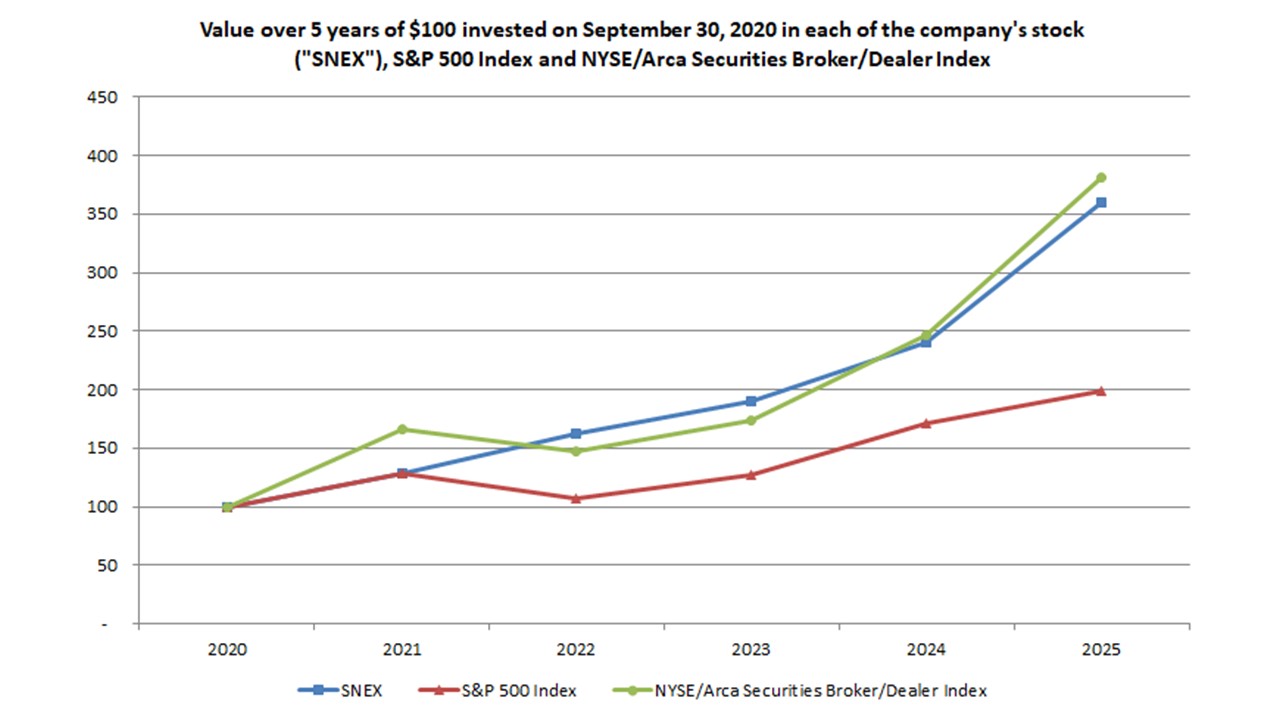
Item 6. Reserved
Item 7. Management’s Discussion and Analysis of Financial Condition and Results of Operations
Throughout this discussion, unless the context otherwise requires, the terms “Company”, “we”, “us” and “our” refer to StoneX Group Inc. and its consolidated subsidiaries.
The following discussion and analysis should be read in conjunction with the consolidated financial statements and notes thereto appearing elsewhere in this report. This Annual Report on Form 10-K contains “forward-looking statements” within the meaning of the safe harbor provisions of the Private Securities Litigation Reform Act of 1995. The words “believe,” “may,” “will,” “estimate,” “continue,” “anticipate,” “intend,” “expect,” and similar expressions are intended to identify forward-looking statements. These forward-looking statements involve known and unknown risks and uncertainties, many of which are beyond the control of the Company, including statements about the benefits of our acquisition of RJO, expected synergies and future financial and operating results, the plans, objectives, expectations and intentions of StoneX after the acquisition, adverse changes in economic, political and market conditions, including losses from our market-making and trading activities arising from counterparty failures, global trade policies and tariffs, the loss of key personnel, the impact of increasing competition, the impact of changes in government regulation, uncertainty concerning fiscal or monetary policies established by central banks and financial regulators, the possibility of liabilities arising from violations of foreign, United States (“U.S.”) federal and U.S. state securities laws, the impact of changes in technology in the securities and commodities trading industries, and other risks discussed in our filings with the SEC, including Part I, Item A of this Annual Report on Form 10-K for the year ended September 30, 2025. Although we believe that our forward-looking statements are based upon reasonable assumptions regarding our business and future market conditions, there can be no assurances that our actual results will not differ materially from any results expressed or implied by our forward-looking statements. We undertake no obligation to publicly update or revise any forward-looking statements, whether as a result of new information, future events or otherwise, except as required by law. We caution readers that any forward-looking statements are not guarantees of future performance.
35
Overview
We operate a global financial services network that connects companies, organizations, traders and investors to the global market ecosystem through a unique blend of digital platforms, end-to-end clearing and execution services, high touch service and deep expertise. We strive to be the one trusted partner to our clients, providing our network, products and services to allow them to pursue trading opportunities, manage their market risks, make investments and improve their business performance. Our businesses are supported by our global infrastructure of regulated operating subsidiaries, our advanced technology platforms and our team of more than 5,400 employees as of September 30, 2025. We believe our client-first approach differentiates us from large banking institutions, engenders trust and enables us to establish leading positions in a number of complex fields in financial markets around the world. For additional information, see Overview of Business and Strategy within Item 1. Business section of this Annual Report on Form 10-K.
We report our operating segments based primarily on the nature of the clients we serve (commercial, institutional, and self-directed/retail), and a fourth operating segment, our payments business. This structure allows us to efficiently serve clients in more than 180 countries and manage our large global footprint. See Segment Information for a listing of business activities performed within our reportable segments.
StoneX Group Inc. and its trade name "StoneX" carry forward the foundation established by Saul Stone in 1924 to today's modern financial services firm. Today, we provide an institutional-grade financial services ecosystem, connecting our clients to over 40 derivatives exchanges, 180 foreign exchange markets, most global securities exchanges and over 18,000 over-the-counter (“OTC”) markets via our networks of highly integrated digital platforms and experienced professionals. Our platform delivers support throughout the entire lifecycle of a transaction, from consulting and boots-on-the-ground intelligence, to efficient execution, to post-trade clearing, custody and settlement.
Recent Events
Closing of the Acquisition of R.J. O’Brien
On July 31, 2025, we completed our acquisition RTS Investor Corp., which was the parent company for the R.J. O’Brien global business (“RJO”), including R.J. O’Brien & Associates, LLC, the oldest futures brokerage in the U.S., and selected affiliates. The purchase price consideration was paid in a combination of cash of approximately $651.9 million and the issuance of 3,085,554 shares of the Company’s common stock, which were reissued from treasury stock. At closing, we assumed approximately $125.7 million of RJO debt related to a RJO subordinated debt facility. We believe the acquisition significantly strengthens our position as a leading FCM and enhances our role as an essential part of the global financial market structure, offering institutional grade execution, clearing, custody, and prime brokerage across all asset classes. The acquisition expanded our client float and added many introducing brokers to our network, while RJO’s clients benefit from our extensive range of markets, products, and services.
In connection with the acquisition of RJO, on July 8, 2025, we issued $625.0 million in aggregate principal amount of Senior Secured Notes due 2032 (the “Notes due 2032”), which are fully and unconditionally guaranteed, jointly and severally, on a senior secured second lien basis, by certain existing and future subsidiaries that guarantees indebtedness under the Company’s senior secured revolving credit facility and certain other senior indebtedness. The Notes due 2032 will mature on July 15, 2032. Interest on the Notes due 2032 accrues at a rate of 6.875% per annum and is payable semiannually in arrears on January 15 and July 15 of each year, commencing on January 15, 2026. On July 31, 2025, the net proceeds from the issuance of the Notes due 2032 were used to fund the cash portion of the purchase price and to pay related fees and expenses, as described above.
Closing of the Acquisition of Benchmark
On July 31, 2025, we completed our acquisition of The Benchmark Company, LLC (“Benchmark”). Benchmark is a full-service investment banking firm offering a robust sales and trading platform, award-winning equity research, and a highly experienced investment banking team. We believe this acquisition will strengthen our offerings in equity and debt capital markets, with significant enhancements in equity research and investment banking. The purchase price consideration includes cash of approximately $57.1 million and four annual contingent payments, each capped at $7.0 million, plus a final contingent payment for any excess above the annual caps over the four year period following the close, valued together at $25.3 million.
36
Potential Impacts of New Tariffs or Changes to Existing Tariffs
A number of significant structural, political, and monetary issues, and global conflicts continue to confront the global economy, and instability could continue, resulting in changes to the level of inflation, market volatility, potential recession, supply chain constraints and costs, diminished trading volumes, uncertainty, increased operating expenses, and increased costs due to potential new tariffs or changes to existing tariffs. The impact of these events and other factors on our financial position and results of operations is difficult to predict, could affect the comparability of our results of operations from period to period, and may have an adverse effect on our financial results.
Common Stock Split
On March 21, 2025, we completed a three-for-two split of our common stock, effected as a stock dividend entitling each shareholder of record to receive one additional share of common stock for every two shares owned. Additional shares issued as a result of the stock dividend were distributed after close of trading on March 21, 2025, to stockholders of record at the close of business on March 11, 2025. Cash was distributed in lieu of fractional shares based on the opening price of a share of common stock on March 12, 2025. All share and per share amounts contained herein have been retroactively adjusted for this stock split.
Executive Summary
We achieved record net operating revenues, up 16%, and net income, up 17%, in fiscal 2025, despite experiencing generally diminished commodity volatility, declining short-term interest rates, heightened interest expense and logistical charges in our precious metals activities related to tariff related disruptions. We experienced growth in segment income across all of our operating segments, led by a 45% increase in the segment income of our Institutional segment, driven by strong performances in equity trading and prime brokerage as well as in listed derivatives.
We experienced an increase in transaction volumes across all of our product offerings, as well as growth in average client equity and average money market/FDIC sweep client balances as compared to the prior year.
In terms of revenue capture on our transactional volumes as compared to the prior fiscal year, we experienced:
•Rate per contract (“RPC”) on listed derivatives increased 8%, due to client mix as well as the acquisition of RJO.
•OTC derivatives RPC declined 3%, with diminished commodity volatility leading to lower spreads captured.
•9% growth in securities rate per million (“RPM”), primarily due to improved performance in global equity markets.
•a 7% decline in FX/CFD RPM, due to product mix and diminished FX volatility
•an 11% decline in payments RPM due to generally lower FX spreads in certain markets, most notably in Africa.
Interest and fee income earned on client balances increased $45.7 million, principally driven by the acquisition of RJO which contributed $50.0 million. This increase was partially offset by the decline in short term interest rates. Average client equity and average money-market/FDIC sweep client balances increased 25% and 21%, respectively.
Interest expense on corporate funding increased $10.0 million, primarily as a result of $7.8 million in bridge loan interest expense and the incremental interest expense associated with the senior secured notes issued related to the acquisition of RJO.
On the expense side, we continued to focus on maintaining our variable cost model and limiting the growth of our non-variable expenses. Variable expenses were 54% of total expenses in the fiscal year ended September 30, 2025 as compared to 52% in the fiscal year ended September 30, 2024. Non-variable expenses, excluding bad debts, increased $124.5 million, including $32.4 million in the acquired RJO and Benchmark businesses as well as $10.4 million in investment banking and M&A related professional fees related to the RJO acquisition.
Net income increased $45.1 million to $305.9 million in the fiscal year ended September 30, 2025. Diluted earnings per share was $5.89 for the fiscal year ended September 30, 2025 compared to $5.31 in the fiscal year ended September 30, 2024.
37
Selected Summary Financial Information
Results of Operations
Our total revenues, as reported, combine gross revenues for the physical commodities business and net revenues for all other businesses. Management believes that operating revenues, which deduct the cost of sales of physical commodities from total revenues, is a more useful financial measure with which to assess our results of operations. The table below sets forth our operating revenues, as well as other key financial measures, for the periods indicated.
Financial Overview
| Fiscal Year Ended September 30, | |||||||||||||||||||||||||||||
| (in millions) | 2025 | % Change | 2024 | % Change | 2023 | ||||||||||||||||||||||||
| Revenues: | |||||||||||||||||||||||||||||
| Sales of physical commodities | $ | 128,462.6 | 33% | $ | 96,586.2 | 66% | $ | 58,131.2 | |||||||||||||||||||||
| Principal gains, net | 1,247.2 | 5% | 1,189.6 | 10% | 1,079.9 | ||||||||||||||||||||||||
| Commission and clearing fees | 728.2 | 33% | 548.0 | 10% | 498.4 | ||||||||||||||||||||||||
| Consulting, management, and account fees | 205.9 | 23% | 167.2 | 5% | 159.0 | ||||||||||||||||||||||||
| Interest income | 1,734.3 | 24% | 1,396.8 | 41% | 987.6 | ||||||||||||||||||||||||
| Total revenues | 132,378.2 | 33% | 99,887.8 | 64% | 60,856.1 | ||||||||||||||||||||||||
| Cost of sales of physical commodities | 128,251.3 | 33% | 96,451.6 | 66% | 57,942.0 | ||||||||||||||||||||||||
| Operating revenues | 4,126.9 | 20% | 3,436.2 | 18% | 2,914.1 | ||||||||||||||||||||||||
| Transaction-based clearing expenses | 382.2 | 20% | 319.3 | 17% | 271.8 | ||||||||||||||||||||||||
| Introducing broker commissions | 211.4 | 27% | 166.2 | 3% | 161.6 | ||||||||||||||||||||||||
| Interest expense | 1,402.7 | 26% | 1,115.7 | 39% | 802.2 | ||||||||||||||||||||||||
| Interest expense on corporate funding | 77.8 | 15% | 67.8 | 18% | 57.5 | ||||||||||||||||||||||||
| Net operating revenues | 2,052.8 | 16% | 1,767.2 | 9% | 1,621.0 | ||||||||||||||||||||||||
| Variable compensation and benefits | 607.1 | 20% | 506.5 | 5% | 483.2 | ||||||||||||||||||||||||
| Net contribution | 1,445.7 | 15% | 1,260.7 | 11% | 1,137.8 | ||||||||||||||||||||||||
| Fixed compensation and benefits | 500.6 | 15% | 435.9 | 13% | 385.4 | ||||||||||||||||||||||||
| Trading systems and market information | 83.1 | 5% | 79.1 | 7% | 74.0 | ||||||||||||||||||||||||
| Professional fees | 86.3 | 24% | 69.7 | 29% | 54.0 | ||||||||||||||||||||||||
| Non-trading technology and support | 87.3 | 19% | 73.4 | 82% | 40.4 | ||||||||||||||||||||||||
| Occupancy and equipment rental | 55.7 | 14% | 49.0 | (14)% | 57.0 | ||||||||||||||||||||||||
| Selling and marketing | 50.5 | (4)% | 52.6 | 112% | 24.8 | ||||||||||||||||||||||||
| Travel and business development | 33.0 | 16% | 28.4 | (54)% | 61.6 | ||||||||||||||||||||||||
| Communications | 9.3 | 9% | 8.5 | (83)% | 51.0 | ||||||||||||||||||||||||
| Depreciation and amortization | 67.5 | 27% | 53.1 | 484% | 9.1 | ||||||||||||||||||||||||
| Bad debts, net of recoveries | 3.1 | 417% | 0.6 | (96)% | 16.5 | ||||||||||||||||||||||||
| Other expenses | 66.0 | 1% | 65.1 | (2)% | 66.4 | ||||||||||||||||||||||||
| Total fixed compensation and other expenses | 1,042.4 | 14% | 915.4 | 9% | 840.2 | ||||||||||||||||||||||||
| Gain on acquisition and other gains, net | 5.5 | (38)% | 8.8 | (65)% | 25.4 | ||||||||||||||||||||||||
| Income before tax | 408.8 | 15% | 354.1 | 10% | 323.0 | ||||||||||||||||||||||||
| Income tax expense | 102.9 | 10% | 93.3 | 10% | 84.5 | ||||||||||||||||||||||||
| Net income | $ | 305.9 | 17% | $ | 260.8 | 9% | $ | 238.5 | |||||||||||||||||||||
Return on equity (“ROE”)(1) | 15.6% | 16.9% | 19.5% | ||||||||||||||||||||||||||
(1)The Company calculates ROE on stated book value based on net income divided by the average stockholders’ equity, calculated based on average monthly equity amounts. | |||||||||||||||||||||||||||||
38
The tables below present operating revenues disaggregated across the key products we provide to our clients and select operating data and metrics used by management in evaluating our performance, for the periods indicated.
| Fiscal Year Ended September 30, | |||||||||||||||||||||||||||||
| 2025 | % Change | 2024 | % Change | 2023 | |||||||||||||||||||||||||
| Operating Revenues (in millions): | |||||||||||||||||||||||||||||
| Listed derivatives | $ | 574.2 | 22% | $ | 469.6 | 13% | $ | 416.5 | |||||||||||||||||||||
| OTC derivatives | 214.4 | 2% | 209.9 | (10)% | 232.2 | ||||||||||||||||||||||||
| Securities | 1,833.6 | 27% | 1,442.7 | 36% | 1,064.0 | ||||||||||||||||||||||||
| FX/CFD contracts | 312.5 | (1)% | 316.1 | 21% | 261.9 | ||||||||||||||||||||||||
| Payments | 209.2 | 2% | 205.1 | (2)% | 208.3 | ||||||||||||||||||||||||
| Physical contracts | 287.0 | 32% | 217.9 | (11)% | 244.9 | ||||||||||||||||||||||||
| Interest/fees earned on client balances | 477.8 | 11% | 432.1 | 12% | 384.7 | ||||||||||||||||||||||||
| Other | 215.0 | 48% | 145.2 | 33% | 109.4 | ||||||||||||||||||||||||
| Corporate | 64.4 | 37% | 46.9 | 48% | 31.7 | ||||||||||||||||||||||||
| Eliminations | (61.2) | 24% | (49.3) | 25% | (39.5) | ||||||||||||||||||||||||
| $ | 4,126.9 | 20% | $ | 3,436.2 | 18% | $ | 2,914.1 | ||||||||||||||||||||||
| Fiscal Year Ended September 30, | |||||||||||||||||||||||||||||
| 2025 | % Change | 2024 | % Change | 2023 | |||||||||||||||||||||||||
| Volumes and Other Select Data: | |||||||||||||||||||||||||||||
Listed derivatives (contracts, 000’s)(1) | 237,423 | 11% | 214,811 | 34% | 160,292 | ||||||||||||||||||||||||
Listed derivatives, average RPC(2) | $ | 2.26 | 8% | $ | 2.09 | (14)% | $ | 2.44 | |||||||||||||||||||||
Average client equity - listed derivatives (millions)(1) | $ | 7,785 | 25% | $ | 6,206 | (13)% | $ | 7,137 | |||||||||||||||||||||
| OTC derivatives (contracts, 000’s) | 3,759 | 6% | 3,538 | —% | 3,553 | ||||||||||||||||||||||||
| OTC derivatives, average RPC | $ | 57.65 | (3)% | $ | 59.62 | (9)% | $ | 65.78 | |||||||||||||||||||||
| Securities average daily volume (“ADV”) (millions) | $ | 9,085 | 27% | $ | 7,156 | 36% | $ | 5,257 | |||||||||||||||||||||
Securities RPM(3) | $ | 278 | 9% | $ | 256 | (15)% | $ | 301 | |||||||||||||||||||||
| Average MM/FDIC sweep client balances (millions) | $ | 1,233 | 21% | $ | 1,017 | (24)% | $ | 1,338 | |||||||||||||||||||||
| FX/CFD contracts ADV (millions) | $ | 11,403 | 5% | $ | 10,813 | (9)% | $ | 11,943 | |||||||||||||||||||||
| FX/CFD contracts RPM | $ | 107 | (7)% | $ | 115 | 32% | $ | 87 | |||||||||||||||||||||
| Payments ADV (millions) | $ | 80 | 16% | $ | 69 | 3% | $ | 67 | |||||||||||||||||||||
| Payments RPM | $ | 10,444 | (11)% | $ | 11,693 | (5)% | $ | 12,367 | |||||||||||||||||||||
Adjusted EBITDA(4) | $ | 597.6 | 19% | $ | 503.4 | 16% | $ | 434.1 | |||||||||||||||||||||
(1) | The acquisition of RJO, effective July 31, 2025, contributed 20.0 million listed derivative contracts in the fiscal year ended September 30, 2025. Also, for the fiscal year ended September 30, 2025, the average client equity includes the effect of an incremental $5.6 billion per month from RJO for the two months post-acquisition. | |||||||||||||
(2) | Give up fee revenues, related to contract execution for clients of other FCMs, as well as cash and voice brokerage revenues are excluded from the calculation of listed derivatives, average rate per contract. | |||||||||||||
(3) | Interest expense associated with our fixed income activities is deducted from operating revenues in the calculation of Securities RPM, while interest income related to securities lending is excluded. | |||||||||||||
(4) | Adjusted EBITDA is a non-GAAP measure. See Liquidity, Financial Condition and Capital Resources - Non-GAAP Financial Information for further information. | |||||||||||||
Operating Revenues
Year Ended September 30, 2025 Compared to Year Ended September 30, 2024
Operating revenues increased $690.7 million, or 20%, to $4,126.9 million in the fiscal year ended September 30, 2025 compared to $3,436.2 million in the fiscal year ended September 30, 2024. The acquisition of RJO contributed $141.0 million in operating revenues.
Operating revenues from listed derivatives increased $104.6 million, principally driven by the acquisition of RJO which contributed $89.5 million. Our Commercial and Institutional segments were up $53.8 million and $50.8 million, respectively.
Operating revenues in OTC derivatives increased $4.5 million, principally driven by a 6% increase in OTC contract volumes, which was partially offset by a 3% decline in the average rate per contract.
39
Operating revenue from securities transactions increased $390.9 million, principally due to a 27% increase in securities ADV as well as a 9% increase in securities RPM. Carried interest on fixed income securities is a component of operating revenues, however, interest expense associated with financing these positions is not. In the calculation of securities RPM in the table above, we deduct interest expense associated with our fixed income activities from operating revenues, as well as exclude interest income related to securities lending, in order to provide a more useful measure of the financial performance of our securities business. Net operating revenues derived from securities transactions increased $126.1 million, principally driven by the increase in ADV and RPM noted above.
Operating revenues from FX/CFD contracts decreased $3.6 million, with a $3.8 million decline in our Institutional segment, partially offset by a $0.2 million increase in our Self-Directed/Retail segment.
Operating revenues from payments increased by $4.1 million, principally driven by a 16% increase in the ADV, which was partially offset by an 11% decline in payments RPM.
Operating revenues from physical contracts increased $69.1 million, driven by increases of $41.2 million and $27.9 million in our physical agricultural and energy and precious metals businesses, respectively. Precious metals related operating revenues were unfavorably impacted by $5.2 million and $6.8 million in the fiscal year ended September 30, 2025 and 2024, respectively, by unrealized losses on derivative positions related to physical inventories carried at the lower of cost or net realizable value.
Interest and fee income earned on client balances, which is associated with our listed and OTC derivative businesses, as well as our Correspondent Clearing and Independent Wealth Management businesses, increased $45.7 million, principally driven by the acquisition of RJO which contributed $50.0 million. This increase was partially offset by the decline in short term interest rates. Average client equity and average money-market/FDIC sweep client balances increased 25% and 21%, respectively. For the fiscal year ended September 30, 2025, the average client equity includes the effect of an incremental $5.6 billion per month from RJO for the two months post-acquisition.
Year Ended September 30, 2024 Compared to Year Ended September 30, 2023
For a discussion of changes for the year ended September 30, 2024 compared to the year ended September 30, 2023 refer to the Annual Report on Form 10-K filed with the SEC on November 29, 2024.
Interest and Transactional Expenses
Year Ended September 30, 2025 Compared to Year Ended September 30, 2024
Transaction-based clearing expenses
| Fiscal Year Ended September 30, | |||||||||||||||||||||||
| 2025 | 2024 | $ Change | % Change | ||||||||||||||||||||
| Transaction-based clearing expenses | $ | 382.2 | $ | 319.3 | $ | 62.9 | 20 | % | |||||||||||||||
| Percentage of operating revenues | 9 | % | 9 | % | |||||||||||||||||||
The business activities of RJO added $24.5 million of increased expenses. Additionally, expenses were higher in the Equity and Debt Capital Markets businesses, principally related to the increased ADV, along with an increase in ADR conversion fees. Additionally, excluding RJO, expenses were higher in our Financial Ag and Energy business, principally related to the increase in contracts traded, and within our Correspondent Clearing business.
Introducing broker commissions
| Fiscal Year Ended September 30, | |||||||||||||||||||||||
| 2025 | 2024 | $ Change | % Change | ||||||||||||||||||||
| Introducing broker commissions | $ | 211.4 | $ | 166.2 | $ | 45.2 | 27 | % | |||||||||||||||
| Percentage of operating revenues | 5 | % | 5 | % | |||||||||||||||||||
The business activities of RJO added $27.4 million of increased expenses. Expenses were higher in our Independent Wealth Management and Self-Directed/Retail Forex businesses, principally due to increased revenues and higher payouts, as well as in our Financial Ag and Energy and LME businesses, principally due to increased volume and client mix traded. These increases were partially offset by lower introducing broker commissions in our Exchange-Traded Futures & Options business, excluding RJO.
40
Interest expense
| Fiscal Year Ended September 30, | |||||||||||||||||||||||
| 2025 | 2024 | $ Change | % Change | ||||||||||||||||||||
| Interest expense attributable to: | |||||||||||||||||||||||
| Trading activities: | |||||||||||||||||||||||
| Institutional dealer in fixed income securities | $ | 1,063.6 | $ | 852.4 | $ | 211.2 | 25 | % | |||||||||||||||
| Securities borrowing | 99.3 | 64.3 | 35.0 | 54 | % | ||||||||||||||||||
| Client balances on deposit | 154.0 | 132.9 | 21.1 | 16 | % | ||||||||||||||||||
| Short-term financing facilities of subsidiaries and other direct interest of operating segments | 85.8 | 66.1 | 19.7 | 30 | % | ||||||||||||||||||
| 1,402.7 | 1,115.7 | 287.0 | 26 | % | |||||||||||||||||||
| Corporate funding | 77.8 | 67.8 | 10.0 | 15 | % | ||||||||||||||||||
| Total interest expense | $ | 1,480.5 | $ | 1,183.5 | $ | 297.0 | 25 | % | |||||||||||||||
The increase in interest expense attributable to fixed income securities and securities borrowing was principally due to the growth in the size of the security repo and securities lending businesses. The business activities of RJO added an incremental $17.6 million of interest expense attributable to client balances. The increase in other direct interest expense attributable to operating segments principally resulted from an increase in our physical precious metals business activities and our equity securities trading activities.
During the year ended September 30, 2025, interest expense attributable to corporate funding included $3.1 million of bridge loan financing fees related to the amendment of our revolving credit facility. In addition, the period included interest expense attributable to corporate funding of $4.7 million, related to bridge loan financing fees for the issuance of $625 million in aggregate principal amount of the Notes due 2032, which closed on July 8, 2025.
During the year ended September 30, 2024, interest expense attributable to corporate funding included incremental interest from our March 1, 2024 issuance of $550 million in aggregate principal amount of the Notes due 2031, the proceeds of which were used to redeem the Notes due 2025. This redemption did not occur until June 17, 2024, in order to redeem those notes at par, and therefore there was a temporary period in which both the Notes due 2025 and Notes due 2031 were outstanding. In addition, upon completion of the redemption of the Notes due 2025, we recognized a $3.7 million loss on the extinguishment of debt related to the write-off of unamortized original issue discount and deferred financing costs, which we classified as a component of Interest expense on corporate funding on the Consolidated Income Statements.
Year Ended September 30, 2024 Compared to Year Ended September 30, 2023
For a discussion of changes for the year ended September 30, 2024 compared to the year ended September 30, 2023 refer to the Annual Report on Form 10-K filed with the SEC on November 29, 2024.
Net Operating Revenues
Net operating revenues is one of the key measures used by management to assess the performance of our operating segments. Net operating revenue is calculated as operating revenue less transaction-based clearing expenses, introducing broker commissions and interest expense. Transaction-based clearing expenses represent variable expenses paid to executing brokers, exchanges, clearing organizations and banks in relation to our transactional volumes. Introducing broker commissions include payments to non-employee third parties that have introduced clients to us. Net operating revenues represent revenues available to pay variable compensation to risk management consultants and traders and direct non-variable expenses, as well as variable and non-variable expenses of operational and administrative employees, including our executive management team.
41
The table below presents net operating revenues disaggregated across the key products we provide to our clients used by management in evaluating our performance, for the periods indicated.
| Fiscal Year Ended September 30, | |||||||||||||||||||||||||||||
| 2025 | % Change | 2024 | % Change | 2023 | |||||||||||||||||||||||||
| Net Operating Revenues (in millions): | |||||||||||||||||||||||||||||
| Listed derivatives | $ | 262.3 | 21% | $ | 216.0 | 10% | $ | 195.5 | |||||||||||||||||||||
| OTC derivatives | 214.3 | 2% | 209.8 | (10)% | 232.1 | ||||||||||||||||||||||||
| Securities | 496.2 | 34% | 370.1 | 14% | 325.5 | ||||||||||||||||||||||||
| FX/CFD contracts | 277.1 | (2)% | 282.2 | 26% | 224.2 | ||||||||||||||||||||||||
| Payments | 197.6 | 1% | 195.1 | (2)% | 199.2 | ||||||||||||||||||||||||
| Physical contracts | 208.7 | 20% | 174.0 | (14)% | 202.7 | ||||||||||||||||||||||||
| Interest, net / fees earned on client balances | 338.0 | 10% | 306.8 | 29% | 237.0 | ||||||||||||||||||||||||
| Other | 115.2 | 48% | 77.9 | 15% | 67.7 | ||||||||||||||||||||||||
| Corporate | (56.6) | (13)% | (64.7) | 3% | (62.9) | ||||||||||||||||||||||||
| $ | 2,052.8 | 16% | $ | 1,767.2 | 9% | $ | 1,621.0 | ||||||||||||||||||||||
Compensation and Other Expenses
The following table presents a summary of expenses, other than interest and transactional expenses.
| Fiscal Year Ended September 30, | |||||||||||||||||||||||||||||
| (in millions) | 2025 | % Change | 2024 | % Change | 2023 | ||||||||||||||||||||||||
| Compensation and benefits: | |||||||||||||||||||||||||||||
| Variable compensation and benefits | $ | 607.1 | 20% | $ | 506.5 | 5% | $ | 483.2 | |||||||||||||||||||||
| Fixed compensation and benefits | 500.6 | 15% | 435.9 | 13% | 385.4 | ||||||||||||||||||||||||
| 1,107.7 | 18% | 942.4 | 8% | 868.6 | |||||||||||||||||||||||||
| Other expenses: | |||||||||||||||||||||||||||||
| Trading systems and market information | 83.1 | 5% | 79.1 | 7% | 74.0 | ||||||||||||||||||||||||
| Professional fees | 86.3 | 24% | 69.7 | 22% | 57.0 | ||||||||||||||||||||||||
| Non-trading technology and support | 87.3 | 19% | 73.4 | 19% | 61.6 | ||||||||||||||||||||||||
| Occupancy and equipment rental | 55.7 | 14% | 49.0 | 21% | 40.4 | ||||||||||||||||||||||||
| Selling and marketing | 50.5 | (4)% | 52.6 | (3)% | 54.0 | ||||||||||||||||||||||||
| Travel and business development | 33.0 | 16% | 28.4 | 15% | 24.8 | ||||||||||||||||||||||||
| Communications | 9.3 | 9% | 8.5 | (7)% | 9.1 | ||||||||||||||||||||||||
| Depreciation and amortization | 67.5 | 27% | 53.1 | 4% | 51.0 | ||||||||||||||||||||||||
| Bad debts, net of recoveries | 3.1 | 417% | 0.6 | (96)% | 16.5 | ||||||||||||||||||||||||
| Other | 66.0 | 1% | 65.1 | (2)% | 66.4 | ||||||||||||||||||||||||
| 541.8 | 13% | 479.5 | 5% | 454.8 | |||||||||||||||||||||||||
| Total compensation and other expenses | $ | 1,649.5 | 16% | $ | 1,421.9 | 7% | $ | 1,323.4 | |||||||||||||||||||||
Year Ended September 30, 2025 Compared to Year Ended September 30, 2024
Compensation and Other Expenses: Compensation and other expenses increased $227.6 million, or 16%, to $1,649.5 million in the fiscal year ended September 30, 2025 compared to $1,421.9 million in the fiscal year ended September 30, 2024.
42
Compensation and Benefits:
| Fiscal Year Ended September 30, | |||||||||||||||||||||||
| (in millions) | 2025 | 2024 | $ Change | % Change | |||||||||||||||||||
| Compensation and benefits: | |||||||||||||||||||||||
| Variable compensation and benefits | |||||||||||||||||||||||
| Front office | $ | 521.1 | $ | 426.5 | $ | 94.6 | 22 | % | |||||||||||||||
| Administrative, executive, and centralized and local operations | 86.0 | 80.0 | 6.0 | 8 | % | ||||||||||||||||||
| Total variable compensation and benefits | 607.1 | 506.5 | 100.6 | 20 | % | ||||||||||||||||||
| Variable compensation and benefits as a percentage of net operating revenues | 30 | % | 29 | % | |||||||||||||||||||
| Fixed compensation and benefits: | |||||||||||||||||||||||
| Non-variable salaries | 343.4 | 305.6 | 37.8 | 12 | % | ||||||||||||||||||
| Employee benefits and other compensation | 97.3 | 85.1 | 12.2 | 14 | % | ||||||||||||||||||
| Share-based compensation | 49.0 | 37.2 | 11.8 | 32 | % | ||||||||||||||||||
| Severance | 10.9 | 8.0 | 2.9 | 36 | % | ||||||||||||||||||
| Total fixed compensation and benefits | 500.6 | 435.9 | 64.7 | 15 | % | ||||||||||||||||||
| Total compensation and benefits | $ | 1,107.7 | $ | 942.4 | $ | 165.3 | 18 | % | |||||||||||||||
| Total compensation and benefits as a percentage of operating revenues | 27 | % | 27 | % | |||||||||||||||||||
| Number of employees, end of period | 5,430 | 4,556 | 874 | 19 | % | ||||||||||||||||||
Incremental cost from acquisitions completed during the fiscal year ended September 30, 2025 added $14.4 million of non-variable salary expense. The additional increase of $23.4 million is principally due to expansion in our Commercial and Institutional business segments, as well as within our overhead departments, principally due to the increase in headcount, as well as the impact of annual merit increases.
Employee benefits and other compensation increased principally due to higher payroll taxes, retirement costs, and healthcare benefits principally related to the increase in headcount. The fiscal year ended September 30, 2025 and 2024 included $0.9 million in accelerated long-term incentive due to the departures of executive officers.
Share-based compensation, which contains stock option and restricted stock expense, increased principally due to the issuance of additional stock option awards during 2024 and 2025 and additional restricted stock grants, as well as from increased restricted stock amortization related to employee-elected and statutorily-required deferred incentive, which results in cash exchanged for restricted stock that is amortized over a thirty-six month period following the grant date. The fiscal year ended September 30, 2025 and 2024 also included $1.1 million and $0.9 million, respectively, in accelerated share-based compensation due to the departure of executive officers.
During the fiscal year ended September 30, 2025 and 2024, severance costs included amounts related to the departure of executive officers.
Other Expenses: Other non-compensation expenses increased $62.3 million, or 13%, to $541.8 million in the fiscal year ended September 30, 2025 compared to $479.5 million in the fiscal year ended September 30, 2024.
Professional fees increased $16.6 million, principally due to investment banking fees related to the closing of the RJO acquisition, as well as higher legal fees related to our defense in various legal matters, net of recoveries, and increased merger and acquisition activity during the fiscal year ended September 30, 2025. Incremental cost from acquired entities completed during the fiscal year ended September 30, 2025 added $4.2 million of expense.
Non-trading technology and support costs increased $13.9 million, principally due to an increase in headcount driven technology costs and compliance costs. Incremental cost from acquisitions completed during the fiscal year ended September 30, 2025 added $2.3 million of expense.
Occupancy and equipment rental costs increased $6.7 million, principally due to the year ended September 30, 2024 including a partial refund of property rates covering prior years in London, and an increase in costs of utilities. Incremental cost from acquired entities completed during the fiscal year ended September 30, 2025 added $3.8 million of expense.
Travel and business development increased $4.6 million, principally due to an increase in higher transportation and lodging costs across our Commercial and Institutional segments and support departments. Incremental cost from acquired entities completed during the fiscal year ended September 30, 2025 added $0.8 million of expense.
Depreciation and amortization increased $14.4 million, principally due to $10.5 million of incremental depreciation expense from internally developed software placed into service, and incremental amortization of acquired intangibles from the acquisitions completed in fiscal 2025, partially offset by decreased amortization of certain intangibles recognized as part of
43
previous acquisitions which became fully amortized during fiscal 2024. Amortization of acquired intangibles related to the RJO and Benchmark acquisitions was $3.6 million during the fiscal year ended September 30, 2025.
During the fiscal year ended September 30, 2025, we recorded bad debts, net of recoveries of $3.1 million, principally related to bad debt expense from client trading deficits in our Self-Directed/Retail segment and Financial Ag & Energy business of our Commercial segment of $1.5 million and $1.7 million, respectively, which were partially offset by $0.1 million of recoveries within the LME business of our Commercial segment. During the fiscal year ended September 30, 2024, we recorded net recoveries of bad debts of $0.6 million, principally related to recoveries within our Institutional segment of $1.3 million, which were partially offset by bad debt expense of $1.2 million of client receivables in the Payments segment, $0.5 million within the Self-Directed/Retail segment, and $0.2 million within the Commercial segment.
Other Gains, net: The results of the fiscal year ended September 30, 2025 include gains of $8.1 million, resulting from proceeds received from class action settlements, partially offset by a $2.3 million loss on the disposal of certain capitalized hardware expenditures and a $0.3 million loss on equity investment. The results of the fiscal year ended September 30, 2024 included gains of $8.8 million resulting from proceeds received from class action settlements.
Provision for Taxes: Our effective income tax rate was 25% and 26% for fiscal year ended September 30, 2025 and 2024, respectively. The effective income tax rate was higher than the U.S. federal statutory rate of 21% due to U.S. state and local taxes, changes in valuation allowances, GloBe minimum tax, BEAT, GILTI, and the amount of foreign earnings taxed at lower tax rates.
Year Ended September 30, 2024 Compared to Year Ended September 30, 2023
For a discussion of changes for the year ended September 30, 2024 compared to the year ended September 30, 2023 refer to the Annual Report on Form 10-K filed with the SEC on November 29, 2024.
Variable vs. Fixed Expenses
The table below presents our variable expenses and non-variable expenses as a percentage of total non-interest expenses for the periods indicated.
| Fiscal Year Ended September 30, | |||||||||||||||||||||||||||||||||||
| (in millions) | 2025 | % of Total | 2024 | % of Total | 2023 | % of Total | |||||||||||||||||||||||||||||
| Variable compensation and benefits | $ | 607.1 | 27% | $ | 506.5 | 26% | $ | 483.2 | 28% | ||||||||||||||||||||||||||
| Transaction-based clearing expenses | 382.2 | 17% | 319.3 | 17% | 271.8 | 15% | |||||||||||||||||||||||||||||
| Introducing broker commissions | 211.4 | 10% | 166.2 | 9% | 161.6 | 9% | |||||||||||||||||||||||||||||
| Total variable expenses | 1,200.7 | 54% | 992.0 | 52% | 916.6 | 52% | |||||||||||||||||||||||||||||
| Fixed compensation and benefits | 500.6 | 22% | 435.9 | 23% | 385.4 | 22% | |||||||||||||||||||||||||||||
| Other fixed expenses | 538.7 | 24% | 478.9 | 25% | 438.3 | 25% | |||||||||||||||||||||||||||||
| Bad debts, net of recoveries | 3.1 | —% | 0.6 | —% | 16.5 | 1% | |||||||||||||||||||||||||||||
| Total non-variable expenses | 1,042.4 | 46% | 915.4 | 48% | 840.2 | 48% | |||||||||||||||||||||||||||||
| Total non-interest expenses | $ | 2,243.1 | 100% | $ | 1,907.4 | 100% | $ | 1,756.8 | 100% | ||||||||||||||||||||||||||
Our variable expenses include variable compensation paid to traders and risk management consultants, bonuses paid to operational, administrative, and executive employees, transaction-based clearing expenses and introducing broker commissions. We seek to make our non-interest expenses variable to the greatest extent possible, and to keep our fixed costs as low as possible.
During the fiscal year ended September 30, 2025, non-variable expenses, excluding bad debts, net of recoveries, increased $124.5 million, or 14%, compared to the fiscal year ended September 30, 2024.
During the fiscal year ended September 30, 2024, non-variable expenses, excluding bad debts, net of recoveries, increased $91.1 million, or 11%, compared to the fiscal year ended September 30, 2023.
Segment Information
Our operating segments are based principally on the nature of the clients we serve (commercial, institutional, and self-directed/retail), and a fourth operating segment, our payments business. We manage our business in this manner due to our large global footprint, in which we have more than 5,400 employees allowing us to serve clients in more than 180 countries.
44
During the three months ended September 30, 2025, our acquisition of RJO triggered a reassessment of the financial information reviewed by management. We determined the acquired business activities of RJO were similar to our existing businesses, and the reassessment confirmed the current composition of the Company’s operating segments, except for one change resulting in the combination of all physical trading capabilities in precious metals being reported within the Commercial segment. Previously, the Self-Directed/Retail segment contained a portion of our precious metals activities. All segment information has been revised to reflect all precious metals business within the Commercial segment retroactive to October 1, 2022.
Our business activities are managed as operating segments, which are our reportable segments for financial reporting purposes, as shown below.
| StoneX Group Inc. | ||||||||||||||||||||||||||||||||
| Commercial | Institutional | Self-Directed/Retail | Payments | |||||||||||||||||||||||||||||
| Primary Activities: | Primary Activities: | Primary Activities: | Primary Activities: | |||||||||||||||||||||||||||||
| Financial Ag & Energy | Equity Capital Markets | Forex/CFD | Payments | |||||||||||||||||||||||||||||
| LME Metals | Debt Capital Markets | Independent Wealth Management | Payment Technology Services | |||||||||||||||||||||||||||||
| Physical Ag & Energy | FX Prime Brokerage | |||||||||||||||||||||||||||||||
| Precious Metals | Exchange-Traded Futures & Options | |||||||||||||||||||||||||||||||
| Correspondent Clearing | ||||||||||||||||||||||||||||||||
Total revenues, operating revenues and net operating revenues shown as “Corporate” primarily consist of interest income from our centralized corporate treasury function. Corporate also includes net costs not allocated to operating segments, including costs and expenses of certain shared services such as information technology, accounting and treasury, credit and risk, legal and compliance, and human resources and other activities. For additional information regarding Corporate, see Note 22 to the Consolidated Financial Statements.
Operating revenues, net operating revenues, net contribution and segment income are some of the key measures used by management to assess the performance of each segment and for decisions regarding the allocation of our resources. Operating revenues are calculated as total revenues less cost of sales of physical commodities.
Net operating revenue is calculated as operating revenue less transaction-based clearing expenses, introducing broker commissions and interest expense.
Net contribution is calculated as net operating revenues less variable compensation. Variable compensation paid to risk management consultants and traders generally represents a fixed percentage that can vary by revenue type. This fixed percentage is applied to revenues generated, and in some cases, revenues generated less transaction-based clearing expenses, base salaries and other expenses/allocations.
Segment income is calculated as net contribution less non-variable direct segment costs. These non-variable direct expenses include trader base compensation and benefits, operational charges, trading systems and market information, professional fees, travel and business development, communications, bad debts, trade errors and direct marketing expenses.
Segment income is used by our chief operating decision maker (“CODM”) as the primary measure of segment profit or loss in the evaluation for each of our operating segments. During the year ended September 30, 2024, we revised our method of allocating certain overhead costs to our operating segments, and, beginning in the year ended September 30, 2024, the CODM also uses ‘Segment income, less allocation of overhead costs’ as an additional segment measure of our segments’ financial performance. The allocation of overhead costs to operating segments includes costs associated with compliance, technology, and credit and risk costs. The share of allocated costs is based on resources consumed by the relevant businesses. In addition, the allocation of human resources and occupancy costs is principally based on employee costs within the relevant businesses. The measure of segment profit or loss most consistent with the corresponding amounts in the consolidated financial statements is segment income.
45
In the accompanying segment tables, ‘Allocation of overhead costs’ has been added beneath ‘Segment income’, which reconciles the segment income measure to the segment income, less allocation of overhead costs measure beginning with the year ended September 30, 2024.
Total Segment Results
The following table presents summary information concerning all of our business segments on a combined basis, excluding Corporate, for the periods indicated.
| Fiscal Year Ended September 30, | |||||||||||||||||||||||||||||||||||
| (in millions) | 2025 | % of Operating Revenues | 2024 | % of Operating Revenues | 2023 | % of Operating Revenues | |||||||||||||||||||||||||||||
| Sales of physical commodities | $ | 128,462.6 | $ | 96,586.2 | $ | 58,131.2 | |||||||||||||||||||||||||||||
| Principal gains, net | 1,229.9 | 1,186.3 | 1,077.4 | ||||||||||||||||||||||||||||||||
| Commission and clearing fees | 730.6 | 550.3 | 500.3 | ||||||||||||||||||||||||||||||||
| Consulting, management, and account fees | 201.8 | 165.2 | 155.6 | ||||||||||||||||||||||||||||||||
| Interest income | 1,750.1 | 1,402.2 | 999.4 | ||||||||||||||||||||||||||||||||
| Total revenues | 132,375.0 | 99,890.2 | 60,863.9 | ||||||||||||||||||||||||||||||||
| Cost of sales of physical commodities | 128,251.3 | 96,451.6 | 57,942.0 | ||||||||||||||||||||||||||||||||
| Operating revenues | 4,123.7 | 100% | 3,438.6 | 100% | 2,921.9 | 100% | |||||||||||||||||||||||||||||
| Transaction-based clearing expenses | 379.6 | 9% | 318.9 | 9% | 271.6 | 9% | |||||||||||||||||||||||||||||
| Introducing broker commissions | 211.4 | 5% | 166.2 | 5% | 161.6 | 6% | |||||||||||||||||||||||||||||
| Interest expense | 1,423.3 | 35% | 1,121.6 | 33% | 804.8 | 28% | |||||||||||||||||||||||||||||
| Net operating revenues | 2,109.4 | 1,831.9 | 1,683.9 | ||||||||||||||||||||||||||||||||
| Variable compensation and benefits | 524.0 | 13% | 430.3 | 13% | 410.3 | 14% | |||||||||||||||||||||||||||||
| Net contribution | 1,585.4 | 1,401.6 | 1,273.6 | ||||||||||||||||||||||||||||||||
| Fixed compensation and benefits | 224.5 | 218.8 | 204.9 | ||||||||||||||||||||||||||||||||
| Trading systems and market information | 66.1 | 59.8 | 55.9 | ||||||||||||||||||||||||||||||||
| Professional fees | 38.4 | 37.8 | 30.6 | ||||||||||||||||||||||||||||||||
| Non-trading technology and support | 16.3 | 16.7 | 17.8 | ||||||||||||||||||||||||||||||||
| Selling and marketing | 43.1 | 44.7 | 49.6 | ||||||||||||||||||||||||||||||||
| Travel and business development | 20.9 | 19.4 | 18.8 | ||||||||||||||||||||||||||||||||
| Depreciation and amortization | 38.0 | 28.9 | 28.3 | ||||||||||||||||||||||||||||||||
| Bad debts, net of recoveries | 3.1 | 0.6 | 16.5 | ||||||||||||||||||||||||||||||||
| Shared services | 66.8 | 58.0 | 52.2 | ||||||||||||||||||||||||||||||||
| Other fixed expenses | 46.0 | 40.1 | 37.6 | ||||||||||||||||||||||||||||||||
| Total non-variable direct expenses | 563.2 | 14% | 524.8 | 15% | 512.2 | 18% | |||||||||||||||||||||||||||||
| Other gains | 5.5 | 8.8 | 2.1 | ||||||||||||||||||||||||||||||||
| Segment income | 1,027.7 | 885.6 | 763.5 | ||||||||||||||||||||||||||||||||
| Allocation of overhead costs (1) | 172.1 | 156.0 | — | ||||||||||||||||||||||||||||||||
| Segment income, less allocation of overhead costs | $ | 855.6 | $ | 729.6 | $ | 763.5 | |||||||||||||||||||||||||||||
(1) Includes an allocation of certain overhead costs to our operating segments as noted above for the fiscal years ended September 30, 2025 and 2024. These allocations will be provided on an ongoing basis but have not been calculated for fiscal year ended September 30, 2023.
Commercial
We offer our commercial clients a comprehensive array of products and services, including risk management and hedging services, execution and clearing of exchange-traded and OTC products, voice brokerage, market intelligence and physical trading, as well as commodity marketing, procurement, logistics and price management services. We believe providing these high-value-added products and services differentiates us from our competitors and maximizes our ability to retain our clients.
46
As noted in the beginning of this Segment Information section, the portion of our precious metals activities previously reported in our Self-Directed/Retail segment have been moved into and combined with our precious metals activities within this segment. All segment information has been revised to reflect all precious metals business within this segment retroactive to October 1, 2022.
The tables below present the financial performance, a disaggregation of operating revenues, and select operating data and metrics used by management in evaluating the performance of the Commercial segment, for the periods indicated.
(1) Includes an allocation of certain overhead costs to our operating segments as noted above for the years ended September 30, 2025 and 2024. These allocations will be provided on an ongoing basis but have not been calculated for the year ended September 30, 2023.
| Year Ended September 30, | |||||||||||||||||||||||||||||
| (in millions) | 2025 | % Change | 2024 | % Change | 2023 | ||||||||||||||||||||||||
| Revenues: | |||||||||||||||||||||||||||||
| Sales of physical commodities | $ | 128,462.6 | 33% | $ | 96,586.2 | 66% | $ | 58,131.2 | |||||||||||||||||||||
| Principal gains, net | 310.8 | (8)% | 338.2 | 4% | 324.4 | ||||||||||||||||||||||||
| Commission and clearing fees | 243.3 | 26% | 192.6 | 8% | 178.0 | ||||||||||||||||||||||||
| Consulting, management and account fees | 31.7 | 6% | 29.8 | 4% | 28.6 | ||||||||||||||||||||||||
| Interest income | 208.8 | 15% | 182.1 | 18% | 154.5 | ||||||||||||||||||||||||
| Total revenues | 129,257.2 | 33% | 97,328.9 | 65% | 58,816.7 | ||||||||||||||||||||||||
| Cost of sales of physical commodities | 128,251.3 | 33% | 96,451.6 | 66% | 57,942.0 | ||||||||||||||||||||||||
| Operating revenues | 1,005.9 | 15% | 877.3 | —% | 874.7 | ||||||||||||||||||||||||
| Transaction-based clearing expenses | 83.2 | 18% | 70.3 | 16% | 60.7 | ||||||||||||||||||||||||
| Introducing broker commissions | 70.6 | 59% | 44.3 | 10% | 40.2 | ||||||||||||||||||||||||
| Interest expense | 83.4 | 100% | 41.8 | 2% | 41.0 | ||||||||||||||||||||||||
| Net operating revenues | 768.7 | 7% | 720.9 | (2)% | 732.8 | ||||||||||||||||||||||||
| Variable compensation and benefits | 192.9 | 11% | 174.5 | (2)% | 177.2 | ||||||||||||||||||||||||
| Net contribution | 575.8 | 5% | 546.4 | (2)% | 555.6 | ||||||||||||||||||||||||
| Fixed compensation and benefits | 77.6 | 13% | 68.9 | 12% | 61.4 | ||||||||||||||||||||||||
| Trading systems and market information | 17.3 | 10% | 15.7 | 13% | 13.9 | ||||||||||||||||||||||||
| Professional fees | 8.0 | 5% | 7.6 | 23% | 6.2 | ||||||||||||||||||||||||
| Non-trading technology and support | 2.0 | 11% | 1.8 | (42)% | 3.1 | ||||||||||||||||||||||||
| Selling and marketing | 5.0 | (9)% | 5.5 | 12% | 4.9 | ||||||||||||||||||||||||
| Travel and business development | 9.2 | 11% | 8.3 | 17% | 7.1 | ||||||||||||||||||||||||
| Depreciation and amortization | 10.3 | 66% | 6.2 | 44% | 4.3 | ||||||||||||||||||||||||
| Bad debts, net of recoveries | 1.6 | 700% | 0.2 | (99)% | 15.7 | ||||||||||||||||||||||||
| Shared services | 32.2 | 12% | 28.7 | 20% | 24.0 | ||||||||||||||||||||||||
| Other fixed expenses | 18.1 | (6)% | 19.2 | 30% | 14.8 | ||||||||||||||||||||||||
| Non-variable direct expenses | 181.3 | 12% | 162.1 | 4% | 155.4 | ||||||||||||||||||||||||
| Other gains | 1.0 | (86)% | 6.9 | n/m | — | ||||||||||||||||||||||||
| Segment income | 395.5 | 1% | 391.2 | (2)% | 400.2 | ||||||||||||||||||||||||
Allocation of overhead costs (1) | 39.2 | 10% | 35.6 | n/m | — | ||||||||||||||||||||||||
| Segment income, less allocation of overhead costs | $ | 356.3 | —% | $ | 355.6 | (11)% | $ | 400.2 | |||||||||||||||||||||
47
| Fiscal Year Ended September 30, | |||||||||||||||||||||||||||||
| 2025 | % Change | 2024 | % Change | 2023 | |||||||||||||||||||||||||
| Operating Revenues (in millions): | |||||||||||||||||||||||||||||
| Listed derivatives | $ | 316.1 | 21% | $ | 262.3 | 14% | $ | 230.5 | |||||||||||||||||||||
| OTC derivatives | 214.4 | 2% | 209.9 | (10)% | 232.2 | ||||||||||||||||||||||||
| Physical contracts | 287.0 | 32% | 217.9 | (11)% | 244.9 | ||||||||||||||||||||||||
| Interest / fees earned on client balances | 161.6 | 1% | 160.2 | 13% | 142.2 | ||||||||||||||||||||||||
| Other | 26.8 | (1)% | 27.0 | 8% | 24.9 | ||||||||||||||||||||||||
| $ | 1,005.9 | 15% | $ | 877.3 | —% | $ | 874.7 | ||||||||||||||||||||||
| Select data (all $ amounts are U.S. dollar equivalent): | |||||||||||||||||||||||||||||
Listed derivatives (contracts, 000’s) (1) | 51,402 | 29% | 39,906 | 16% | 34,430 | ||||||||||||||||||||||||
Listed derivatives, average rate per contract (2) | $ | 5.91 | (7)% | $ | 6.33 | (1)% | $ | 6.37 | |||||||||||||||||||||
Average client equity - listed derivatives (millions) (1) | $ | 2,114 | 23% | $ | 1,715 | (11)% | $ | 1,927 | |||||||||||||||||||||
| Over-the-counter (“OTC”) derivatives (contracts, 000’s) | 3,759 | 6% | 3,538 | —% | 3,553 | ||||||||||||||||||||||||
| OTC derivatives, average rate per contract | $ | 57.65 | (3)% | $ | 59.62 | (9)% | $ | 65.78 | |||||||||||||||||||||
(1) The acquisition of RJO, effective July 31, 2025, contributed 4.1 million listed derivative contracts in the fiscal year ended September 30, 2025. Also, for the fiscal year ended September 30, 2025, the average client equity includes the effect of an incremental $2.3 billion per month from RJO for the two months post-acquisition. | |||||||||||||||||||||||||||||
(2) Give up fees, related to contract execution for clients of other FCMs, as well as cash and voice brokerage are excluded from the calculation of listed derivatives, average rate per contract. | |||||||||||||||||||||||||||||
For information about the assets of this segment, see Note 22 to the Consolidated Financial Statements.
Year Ended September 30, 2025 Compared to Year Ended September 30, 2024
Operating revenues increased $128.6 million, or 15%, to $1,005.9 million in the fiscal year ended September 30, 2025 compared to $877.3 million in the fiscal year ended September 30, 2024. Net operating revenues increased $47.8 million, or 7%, to $768.7 million in the fiscal year ended September 30, 2025 compared to $720.9 million in the fiscal year ended September 30, 2024.
Operating revenues derived from listed derivatives increased $53.8 million, principally driven by a 29% increase in listed derivative contract volumes, partially offset by a 7% decrease in the average rate per contract. The decline in the average rate per contract was primarily related to activity in LME base metals markets as compared to the prior year, as the prior year benefited from a widening of spreads related to U.S. and U.K. imposed sanctions on Russian base metals exports. The acquired RJO business contributed $35.3 million in operating revenues derived from listed derivatives.
Operating revenues derived from OTC transactions increased $4.5 million, principally resulting from a 6% increase in OTC derivative contract volumes, which was partially offset by a 3% decline in the average rate per contract.
Operating revenues derived from physical transactions increased $69.1 million, principally driven by $41.2 million and $27.9 million increases in operating revenues in our physical agricultural and energy and precious metals businesses, respectively. The increase in physical agricultural and energy operating revenues were primarily driven by strong performance in global cocoa and coffee markets. Precious metals related operating revenues were unfavorably impacted by $5.2 million and $6.8 million in the fiscal year ended September 30, 2025 and 2024, respectively, by unrealized losses on derivative positions related to physical inventories carried at the lower of cost or net realizable value.
Interest and fee income earned on client balances increased $1.4 million, primarily as a result of the acquisition of RJO, which contributed $16.7 million in interest and fee income earned on client balances and helped drive a 23% increase in average client equity. This increase was partially offset by the decline in short term interest rates.
Interest expense increased $41.6 million, primarily related to heightened interest expense in our precious metals business related to carrying costs on inventory which was held in the U.S. to mitigate against possible U.S. government tariffs on imported precious metals.
Variable expenses, excluding interest, expressed as a percentage of operating revenues, were 34% and 33% for the fiscal year ended September 30, 2025 and 2024, respectively.
Segment income increased $4.3 million, primarily related to the increase in operating revenues noted above, which were partially offset by a $26.3 million increase in introducing broker commissions and a $12.9 million increase in transaction-based clearing expenses, each of which was principally driven by the acquisition of RJO. In addition, the operating revenue growth was also partially offset by the increase in interest expense noted above, an $18.4 million increase in variable compensation and an $19.2 million increase in non-variable direct expenses, of which $4.1 million was attributable to the RJO business. Segment income for the fiscal year ended September 30, 2025 and 2024 include gains of $1.0 million and $6.9 million, respectively, related to proceeds received from class action settlements.
48
For the fiscal year ended September 30, 2025, we calculated an allocation for overhead costs of $39.2 million for the Commercial segment compared to a $35.6 million allocation in the fiscal year ended September 30, 2024.
Year Ended September 30, 2024 Compared to Year Ended September 30, 2023
Operating revenues increased $2.6 million to $877.3 million in the fiscal year ended September 30, 2024 compared to $874.7 million in the fiscal year ended September 30, 2023. Net operating revenues decreased $11.9 million, or 2%, to $720.9 million in the fiscal year ended September 30, 2024 compared to $732.8 million in the fiscal year ended September 30, 2023.
Operating revenues derived from listed derivatives increased $31.8 million, principally driven by a 16% increase in listed derivative contract volumes, primarily in agricultural and LME base metal commodity markets. This was partially offset by a 1% decline in the average rate per contract.
Operating revenues derived from OTC transactions declined $22.3 million, principally driven by a 9% decline in the average rate per contract as a result of a decline in commodity volatility.
Operating revenues derived from physical transactions declined $27.0 million, principally driven by a $31.0 million decline in operating revenues in our physical agricultural and energy business which was partially offset by a $4.0 million increase in operating revenues in our precious metals businesses.
Interest and fee income earned on client balances increased $18.0 million, as a result of an increase in the short-term interest rates realized, which was partially offset by an 11% decrease in average client equity.
Variable expenses, excluding interest, expressed as a percentage of operating revenues, were 33% in the fiscal year ended September 30, 2024 compared to 32% in the fiscal year ended September 30, 2023.
Segment income decreased $9.0 million, partially due to the decline in net operating revenues, as well as a $22.2 million increase in non-variable direct expenses, excluding bad debts, net of recoveries. The increase in non-variable direct expenses was primarily due to a $7.5 million increase in fixed compensation and benefits, a $1.4 million increase in professional fees, a $1.9 million increase in depreciation and amortization and a $1.2 million increase in travel and business development. The increase in non-variable direct expenses were partially offset by a $15.5 million decline in bad debts, net of recoveries. Also, the decline in segment income was partially offset by a nonrecurring gain of $6.9 million related to proceeds from a settlement in a commodity exchange gold futures and options trading matter.
Beginning with the fiscal year ended September 30, 2024, we calculated an allocation for overhead costs of $35.6 million for the Commercial segment as described in the introduction to Total Segment Results above. An allocation of overhead costs was not calculated for historical comparable information.
Institutional
We provide institutional clients with a suite of equity trading services to help them find liquidity with best execution, consistent liquidity across a robust array of fixed income products, competitive and efficient clearing and execution in all major futures and securities exchanges globally as well as prime brokerage in equities and major foreign currency pairs and swap transactions. Additionally, we operate a comprehensive investment banking platform which provides both investment banking services and equity research.
49
The tables below present the financial performance, a disaggregation of operating revenues, and select operating data and metrics used by management in evaluating the performance of the Institutional segment, for the periods indicated.
| Fiscal Year Ended September 30, | |||||||||||||||||||||||||||||
| (in millions) | 2025 | % Change | 2024 | % Change | 2023 | ||||||||||||||||||||||||
| Revenues: | |||||||||||||||||||||||||||||
| Sales of physical commodities | $ | — | —% | $ | — | —% | $ | — | |||||||||||||||||||||
| Principal gains, net | 464.4 | 15% | 404.1 | 13% | 359.2 | ||||||||||||||||||||||||
| Commission and clearing fees | 426.9 | 41% | 301.9 | 12% | 268.8 | ||||||||||||||||||||||||
| Consulting, management, and account fees | 99.8 | 31% | 76.1 | 4% | 72.9 | ||||||||||||||||||||||||
| Interest income | 1,507.4 | 28% | 1,180.0 | 45% | 812.7 | ||||||||||||||||||||||||
| Total revenues | 2,498.5 | 27% | 1,962.1 | 30% | 1,513.6 | ||||||||||||||||||||||||
| Cost of sales of physical commodities | — | —% | — | —% | — | ||||||||||||||||||||||||
| Operating revenues | 2,498.5 | 27% | 1,962.1 | 30% | 1,513.6 | ||||||||||||||||||||||||
| Transaction-based clearing expenses | 275.7 | 21% | 228.0 | 21% | 187.9 | ||||||||||||||||||||||||
| Introducing broker commissions | 33.6 | 8% | 31.2 | (12)% | 35.4 | ||||||||||||||||||||||||
| Interest expense | 1,332.3 | 24% | 1,072.5 | 41% | 758.3 | ||||||||||||||||||||||||
| Net operating revenues | 856.9 | 36% | 630.4 | 18% | 532.0 | ||||||||||||||||||||||||
| Variable compensation and benefits | 281.5 | 41% | 200.1 | 11% | 180.5 | ||||||||||||||||||||||||
| Net contribution | 575.4 | 34% | 430.3 | 22% | 351.5 | ||||||||||||||||||||||||
| Fixed compensation and benefits | 87.5 | 13% | 77.1 | 29% | 59.7 | ||||||||||||||||||||||||
| Trading systems and market information | 34.6 | 15% | 30.0 | 8% | 27.7 | ||||||||||||||||||||||||
| Professional fees | 15.7 | (22)% | 20.1 | 51% | 13.3 | ||||||||||||||||||||||||
| Non-trading technology and support | 3.9 | 18% | 3.3 | (35)% | 5.1 | ||||||||||||||||||||||||
| Selling and marketing | 3.4 | (3)% | 3.5 | 52% | 2.3 | ||||||||||||||||||||||||
| Travel and business development | 8.7 | 16% | 7.5 | 15% | 6.5 | ||||||||||||||||||||||||
| Depreciation and amortization | 7.2 | 85% | 3.9 | 11% | 3.5 | ||||||||||||||||||||||||
| Bad debts, net of recoveries | — | (100)% | (1.3) | (13)% | (1.5) | ||||||||||||||||||||||||
| Shared services | 16.1 | 18% | 13.6 | 30% | 10.5 | ||||||||||||||||||||||||
| Other fixed expenses | 11.8 | 79% | 6.6 | (23)% | 8.6 | ||||||||||||||||||||||||
| Total non-variable direct expenses | 188.9 | 15% | 164.3 | 21% | 135.7 | ||||||||||||||||||||||||
| Other (loss) gain, net | (0.7) | n/m | — | (100)% | 2.1 | ||||||||||||||||||||||||
| Segment income | $ | 385.8 | 45% | $ | 266.0 | 22% | $ | 217.9 | |||||||||||||||||||||
Allocation of overhead costs (1) | 59.8 | 14% | 52.4 | — | — | ||||||||||||||||||||||||
| Segment income, less allocation of overhead costs | $ | 326.0 | 53% | $ | 213.6 | n/m | $ | 217.9 | |||||||||||||||||||||
(1) Includes an allocation of certain overhead costs to our operating segments as noted above for the years ended September 30, 2025 and 2024. These allocations will be provided on an ongoing basis but have not been calculated for the year ended September 30, 2023.
| Fiscal Year Ended September 30, | |||||||||||||||||||||||||||||
| 2025 | % Change | 2024 | % Change | 2023 | |||||||||||||||||||||||||
| Operating Revenues (in millions): | |||||||||||||||||||||||||||||
| Listed derivatives | $ | 258.1 | 25% | $ | 207.3 | 11% | $ | 186.0 | |||||||||||||||||||||
| Securities | 1,718.0 | 28% | 1,342.1 | 38% | 973.6 | ||||||||||||||||||||||||
| FX contracts | 30.8 | (11)% | 34.6 | (12)% | 39.4 | ||||||||||||||||||||||||
| Interest / fees earned on client balances | 313.8 | 17% | 269.2 | 12% | 239.5 | ||||||||||||||||||||||||
| Other | 177.8 | 63% | 108.9 | 45% | 75.1 | ||||||||||||||||||||||||
| $ | 2,498.5 | 27% | $ | 1,962.1 | 30% | $ | 1,513.6 | ||||||||||||||||||||||
| Volumes and Other Select Data (all $ amounts are U.S. dollar equivalents): | |||||||||||||||||||||||||||||
Listed derivatives (contracts, 000’s)(1) | 186,021 | 6% | 174,905 | 39% | 125,862 | ||||||||||||||||||||||||
Listed derivatives, average rate per contract(2) | $ | 1.25 | 12% | $ | 1.12 | (18)% | $ | 1.36 | |||||||||||||||||||||
Average client equity - listed derivatives (millions)(1) | $ | 5,671 | 26% | $ | 4,491 | (14)% | $ | 5,210 | |||||||||||||||||||||
| Securities ADV ( millions) | $ | 9,085 | 27% | $ | 7,156 | 36% | $ | 5,257 | |||||||||||||||||||||
Securities RPM(3) | $ | 278 | 9% | $ | 256 | (15)% | $ | 301 | |||||||||||||||||||||
| Average MM/FDIC sweep client balances (millions) | $ | 1,233 | 21% | $ | 1,017 | (24)% | $ | 1,338 | |||||||||||||||||||||
| FX contracts ADV ( millions) | $ | 3,194 | (17)% | $ | 3,827 | (11)% | $ | 4,321 | |||||||||||||||||||||
| FX contracts RPM | $ | 37 | (8)% | $ | 40 | 8% | $ | 37 | |||||||||||||||||||||
| n/m = not meaningful to present as a percentage | |||||||||||||||||||||||||||||
(1) The acquisition of RJO, effective July 31, 2025, contributed 15.9 million listed derivative contracts in the fiscal year ended September 30, 2025. Also, for the fiscal year ended September 30, 2025, the average client equity includes the effect of an incremental $3.3 billion per month from RJO for the two months post-acquisition. | |||||||||||||||||||||||||||||
(2) Give up fees, related to contract execution for clients of other FCMs, are excluded from the calculation of listed derivative, average rate per contract. | |||||||||||||||||||||||||||||
(3) Interest expense associated with our fixed income activities is deducted from operating revenues in the calculation of Securities RPM, while interest income related to securities lending is excluded. | |||||||||||||||||||||||||||||
50
For information about the assets of this segment, see Note 22 to the Consolidated Financial Statements.
Year Ended September 30, 2025 Compared to Year Ended September 30, 2024
Operating revenues increased $536.4 million, or 27%, to $2,498.5 million in the fiscal year ended September 30, 2025 compared to $1,962.1 million in the fiscal year ended September 30, 2024. Net operating revenues increased $226.5 million, or 36%, to $856.9 million in the fiscal year ended September 30, 2025 compared to $630.4 million in the fiscal year ended September 30, 2024.
Operating revenues derived from listed derivatives increased $50.8 million, principally driven by a 6% increase contract volumes, primarily as a result of the acquisition of RJO, as well as 12% increase in the average rate per contract. The acquired RJO business contributed $54.2 million in operating revenues derived from listed derivatives.
Operating revenues derived from securities transactions increased $375.9 million, principally driven by a 27% increase in the ADV of securities traded, primarily as a result of increased client activity in both equity and fixed income markets, as well as an 9% increase in securities RPM.
Operating revenues derived from FX contracts declined $3.8 million, principally driven by a 17% decline in the ADV of FX contracts traded as well as an 8% decline in the average rate per contract.
Finally, interest and fee income earned on client balances, which is associated with our listed derivative business, as well as our correspondent clearing businesses, increased $44.6 million, principally driven by increases of 26% and 21% in average client equity and average money market / FDIC sweep client balances, respectively, which was partially offset by a decline in short term interest rates. The increase in average client equity was partially driven by the acquisition of RJO, which added $3.3 billion in average client equity in each of the two months post-acquisition. The acquired RJO business contributed $33.3 million in interest and fee income earned on client balances.
Primarily as a result of the increase in Securities ADV, interest expense increased $259.8 million, with interest expense directly associated with serving as an institutional dealer in fixed income securities increasing $211.2 million, to $1,063.6 million and interest expense directly attributable to securities lending activities increasing $35.0 million to $99.3 million. Additionally, interest paid to clients increased $4.7 million to $116.3 million, as the acquired RJO business added $13.5 million, partially offset by a decrease in our Exchange-Traded Futures & Options business, excluding RJO.
Variable expenses, excluding interest, expressed as a percentage of operating revenues increased to 24% in the fiscal year ended September 30, 2025 compared to 23% in the fiscal year ended September 30, 2024.
Segment income increased $119.8 million, principally driven by the increase in net operating revenues noted above, which was partially offset by a $24.6 million increase in non-variable direct expenses, with $10.2 million of this increase attributable to the acquisition of RJO. Segment income in the fiscal year ended September 30, 2025 included a $2.3 million loss on the disposal of certain capitalized hardware expenditures, partially offset by a gain of $1.6 million related to proceeds received from class action settlements.
For the fiscal year ended September 30, 2025, we calculated an allocation for overhead costs of $59.8 million for the Institutional segment compared to a $52.4 million allocation in the fiscal year ended September 30, 2024.
Year Ended September 30, 2024 Compared to Year Ended September 30, 2023
Operating revenues increased $448.5 million, or 30%, to $1,962.1 million in the fiscal year ended September 30, 2024 compared to $1,513.6 million in the fiscal year ended September 30, 2023. Net operating revenues increased $98.4 million, or 18%, to $630.4 million in the fiscal year ended September 30, 2024 compared to $532.0 million in the fiscal year ended September 30, 2023.
Operating revenues derived from listed derivatives increased $21.3 million, principally driven by a 39% increase in listed derivative contract volumes, which was partially offset by an 18% decline in the average rate per contract.
Operating revenues derived from securities transactions increased $368.5 million, principally driven by a 36% increase in the ADV of securities traded, primarily as a result of increased client activity in both equity and fixed income markets. The securities RPM decreased 15%, principally due to a tightening of spreads and a change in product mix.
51
Operating revenues derived from FX contracts declined $4.8 million, principally driven by an 11% decline in the ADV of FX contracts traded, which was partially offset by an 8% increase in the average rate per contract.
Finally, interest and fee income earned on client balances, which is associated with our listed derivative business, as well as our correspondent clearing businesses, increased $29.7 million, principally driven by an increase in the short-term interest rates realized, which was partially offset by declines of 14% and 24% in average client equity and average MM/FDIC sweep client balances, respectively.
As a result of the increase in short-term interest rates and the increase in the ADV, interest expense increased $314.2 million, with interest expense directly associated with serving as an institutional dealer in fixed income securities increasing $295.7 million and interest expense directly attributable to securities lending activities increasing $24.9 million. Partially offsetting these increases, interest paid to clients decreased $20.8 million.
Variable expenses, excluding interest, expressed as a percentage of operating revenues declined to 23% in the fiscal year ended September 30, 2024 compared to 27% in the fiscal year ended September 30, 2023, principally as the result of the increase in interest/fees earned on client balances, which is generally not a component of variable compensation.
Segment income increased $48.1 million, principally driven by the increase in net operating revenues noted above, which was partially offset by a $28.6 million increase in non-variable direct expenses. The increase in non-variable direct expenses was primarily related to a $17.4 million increase in fixed compensation and benefits, a $2.3 million increase in trade systems and market information, a $6.8 million increase in professional fees and a $1.0 million increase in travel and business development. These increases were partially offset by a $1.8 million decline in non-trading technology and support as compared to the fiscal year ended September 30, 2023. Segment income in the fiscal year ended September 30, 2023, was favorably impacted by a nonrecurring gain related to proceeds received of $2.1 million resulting from an institutional-based foreign exchange antitrust class action settlement.
Beginning with the fiscal year ended September 30, 2024, we calculated an allocation for overhead costs of $52.4 million for the Institutional segment as described in the introduction to Total Segment Results above. An allocation of overhead costs was not calculated for historical comparable information.
Self-Directed/Retail
We provide our self-directed/retail clients around the world access to over 18,000 global financial markets, including spot foreign exchange ("forex"), as well as contracts for difference (“CFDs”), which are investment products with returns linked to the performance of underlying assets. In addition, our independent wealth management business offers a comprehensive product suite to retail investors in the U.S.
As noted in the beginning of this Segment Information section, the portion of our precious metals activities previously reported in this segment have been moved into and combined with our precious metals activities within our Commercial segment. All segment information has been revised to reflect all precious metals business within the Commercial segment retroactive to October 1, 2022.
52
The tables below present the financial performance, a disaggregation of operating revenues, and select operating data and metrics used by management in evaluating the performance of the Self-Directed/Retail segment, for the periods indicated.
| Fiscal Year Ended September 30, | |||||||||||||||||||||||||||||
| (in millions) | 2025 | % Change | 2024 | % Change | 2023 | ||||||||||||||||||||||||
| Revenues: | |||||||||||||||||||||||||||||
| Sales of physical commodities | $ | — | —% | $ | — | —% | $ | — | |||||||||||||||||||||
| Principal gains, net | 251.9 | 2% | 246.0 | 27% | 193.5 | ||||||||||||||||||||||||
| Commission and clearing fees | 53.2 | 7% | 49.9 | 8% | 46.3 | ||||||||||||||||||||||||
| Consulting, management, and account fees | 68.1 | 22% | 55.9 | 10% | 50.7 | ||||||||||||||||||||||||
| Interest income | 32.3 | (15)% | 37.8 | 24% | 30.5 | ||||||||||||||||||||||||
| Total revenues | 405.5 | 4% | 389.6 | 21% | 321.0 | ||||||||||||||||||||||||
| Cost of physical commodities sold | — | —% | — | —% | — | ||||||||||||||||||||||||
| Operating revenues | 405.5 | 4% | 389.6 | 21% | 321.0 | ||||||||||||||||||||||||
| Transaction-based clearing expenses | 13.3 | (2)% | 13.6 | (16)% | 16.2 | ||||||||||||||||||||||||
| Introducing broker commissions | 103.0 | 17% | 87.8 | 5% | 83.7 | ||||||||||||||||||||||||
| Interest expense | 7.6 | 7% | 7.1 | 34% | 5.3 | ||||||||||||||||||||||||
| Net operating revenues | 281.6 | —% | 281.1 | 30% | 215.8 | ||||||||||||||||||||||||
| Variable compensation and benefits | 15.1 | (19)% | 18.7 | 36% | 13.8 | ||||||||||||||||||||||||
| Net contribution | 266.5 | 2% | 262.4 | 30% | 202.0 | ||||||||||||||||||||||||
| Fixed compensation and benefits | 33.5 | (24)% | 44.2 | (6)% | 47.2 | ||||||||||||||||||||||||
| Trading systems and market information | 13.1 | 3% | 12.7 | (2)% | 13.0 | ||||||||||||||||||||||||
| Professional fees | 11.5 | 26% | 9.1 | (8)% | 9.9 | ||||||||||||||||||||||||
| Non-trading technology and support | 8.6 | (12)% | 9.8 | 24% | 7.9 | ||||||||||||||||||||||||
| Selling and marketing | 34.2 | (3)% | 35.2 | (15)% | 41.3 | ||||||||||||||||||||||||
| Travel and business development | 1.9 | (24)% | 2.5 | (26)% | 3.4 | ||||||||||||||||||||||||
| Depreciation and amortization | 15.8 | 2% | 15.5 | (21)% | 19.7 | ||||||||||||||||||||||||
| Bad debts, net of recoveries | 1.5 | 200% | 0.5 | (78)% | 2.3 | ||||||||||||||||||||||||
| Shared services | 9.7 | 23% | 7.9 | (25)% | 10.6 | ||||||||||||||||||||||||
| Other fixed expenses | 12.6 | 14% | 11.1 | 7% | 10.4 | ||||||||||||||||||||||||
| Total non-variable direct expenses | 142.4 | (4)% | 148.5 | (10)% | 165.7 | ||||||||||||||||||||||||
| Other gain | 5.5 | 189% | 1.9 | n/m | — | ||||||||||||||||||||||||
| Segment income | 129.6 | 12% | 115.8 | 219% | 36.3 | ||||||||||||||||||||||||
Allocation of overhead costs (1) | 50.5 | 7% | 47.1 | n/m | — | ||||||||||||||||||||||||
| Segment income, less allocation of overhead costs | $ | 79.1 | 15% | $ | 68.7 | 89% | $ | 36.3 | |||||||||||||||||||||
(1) Includes an allocation of certain overhead costs to our operating segments as noted above for the years ended September 30, 2025 and 2024. These allocations will be provided on an ongoing basis but have not been calculated for the fiscal year ended September 30, 2023.
The tables below reflect a disaggregation of operating revenues and select operating data and metrics used by management in evaluating performance of our Self-Directed/Retail segment for the periods indicated.
| Fiscal Year Ended September 30, | |||||||||||||||||||||||||||||
| 2025 | % Change | 2024 | % Change | 2023 | |||||||||||||||||||||||||
| Operating Revenues (in millions): | |||||||||||||||||||||||||||||
| Securities | $ | 115.6 | 15% | $ | 100.6 | 11% | $ | 90.4 | |||||||||||||||||||||
| FX/CFD contracts | 281.7 | —% | 281.5 | 27% | 222.5 | ||||||||||||||||||||||||
| Interest / fees earned on client balances | 2.4 | (11)% | 2.7 | (10)% | 3.0 | ||||||||||||||||||||||||
| Other | 5.8 | 21% | 4.8 | (6)% | 5.1 | ||||||||||||||||||||||||
| $ | 405.5 | 4% | $ | 389.6 | 21% | $ | 321.0 | ||||||||||||||||||||||
| Select data (all $ amounts are U.S. dollar equivalents): | |||||||||||||||||||||||||||||
| FX/CFD contracts ADV (millions) | $ | 8,209 | 18% | $ | 6,986 | (8)% | $ | 7,622 | |||||||||||||||||||||
| FX/CFD contracts RPM | $ | 134 | (15)% | $ | 157 | 37% | $ | 115 | |||||||||||||||||||||
For information about the assets of this segment, see Note 22 to the Consolidated Financial Statements.
53
Year Ended September 30, 2025 Compared to Year Ended September 30, 2024
Operating revenues increased $15.9 million, or 4%, to $405.5 million in the fiscal year ended September 30, 2025 compared to $389.6 million in the fiscal year ended September 30, 2024. Net operating revenues increased $0.5 million to $281.6 million in the fiscal year ended September 30, 2025 compared to $281.1 million in the fiscal year ended September 30, 2024.
Operating revenues derived from FX/CFD contracts increased $0.2 million, principally due to an 18% increase in FX/CFD contracts ADV, which was mostly offset by an 15% decline in FX/CFD contracts RPM.
Operating revenues derived from securities transactions, which are related to our independent wealth management activities, increased $15.0 million, principally due to increased management fees.
Interest and fee income earned on client balances decreased $0.3 million versus the prior year, primarily due to a decline in short term interest rates.
Variable expenses, excluding interest, expressed as a percentage of operating revenues increased to 32% in the fiscal year ended September 30, 2025 compared to 31% in the fiscal year ended September 30, 2024.
Segment income increased $13.8 million, principally due to a $3.6 million decline in variable direct compensation and benefits and a $6.1 million decline in non-variable direct expenses. The decline in non-variable direct expenses was primarily driven by a $10.7 million decline in fixed compensation and benefits, which was partially driven by the move of certain development and marketing teams to a centralized shared services model within overheads. Subsequently, a portion of these costs have been directly allocated to this segment through a shared service fee, which increased $1.8 million as compared to the prior year. Segment income was favorably impacted by a class action settlements received of $5.5 million and $1.9 million in the fiscal year ended September 30, 2025 and 2024, respectively.
For the fiscal year ended September 30, 2025, we calculated an allocation for overhead costs of $50.5 million for the Self-Directed/Retail segment compared to a $47.1 million allocation in the fiscal year ended September 30, 2024.
Year Ended September 30, 2024 Compared to Year Ended September 30, 2023
Operating revenues increased $68.6 million, or 21%, to $389.6 million in the fiscal year ended September 30, 2024 compared to $321.0 million in the fiscal year ended September 30, 2023. Net operating revenues increased $65.3 million, or 30%, to $281.1 million in the fiscal year ended September 30, 2024 compared to $215.8 million in the fiscal year ended September 30, 2023.
Operating revenues derived from FX/CFD contracts increased $59.0 million, principally due to a 37% increase in FX/CFD contracts RPM, which was primarily driven by increased client activity in gold, oil and index contracts, which typically have a higher RPM than FX contracts. This increase was partially offset by an 8% decline in FX/CFD contracts ADV, primarily related to a decline in client activity in FX markets.
Operating revenues derived from securities transactions, which are related to our independent wealth management activities, increased $10.2 million.
Interest and fee income earned on client balances was $2.7 million in the fiscal year ended September 30, 2024 as compared to $3.0 million in the fiscal year ended September 30, 2023.
Variable expenses, excluding interest, as a percentage of operating revenues were 31% in the fiscal year ended September 30, 2024 compared to 35% in the fiscal year ended September 30, 2023, principally due to the increase in operating revenues derived from FX/CFD contracts which typically incur a lower relative percentage of variable expenses than do our other revenue streams within this segment.
Segment income increased $79.5 million, principally due to the increase in net operating revenues noted above as well as a $17.2 million, or 10%, decline in non-variable direct expenses. The decline in non-variable direct expenses was partially driven by a $4.2 million decline in depreciation and amortization, as certain intangibles, recognized as part the acquisition of Gain Capital Holdings, Inc. in fiscal 2020, became fully amortized during fiscal 2023, partially offset by an increase in amortization of capitalized software development for post-acquisition software placed into service. In addition, the decline in non-variable expenses was driven by a $6.1 million decline in direct selling and marketing costs, a $3.0 million decline in fixed compensation and benefits and a $1.8 million decrease in bad debts.
Beginning with the fiscal year ended September 30, 2024, we calculated an allocation for overhead costs of $47.1 million for the Self-Directed/Retail segment as described in the introduction to Total Segment Results above. An allocation of overhead costs was not calculated for historical comparable information.
54
Payments
We provide customized foreign exchange and treasury services to banks and commercial businesses, charities, non-governmental organizations, as well as governmental organizations. We provide transparent pricing and offer payments services in more than 180 countries and 140 currencies, which we believe is more than any other payments solutions provider.
The tables below present the financial performance, a disaggregation of operating revenues, and select operating data and metrics used by management in evaluating the performance of the Payments segment for the periods indicated.
| Fiscal Year Ended September 30, | |||||||||||||||||||||||||||||
| (in millions) | 2025 | % Change | 2024 | % Change | 2023 | ||||||||||||||||||||||||
| Revenues: | |||||||||||||||||||||||||||||
| Sales of physical commodities | $ | — | —% | $ | — | —% | $ | — | |||||||||||||||||||||
| Principal gains, net | 202.8 | 2% | 198.0 | (1)% | 200.3 | ||||||||||||||||||||||||
| Commission and clearing fees | 7.2 | 22% | 5.9 | (18)% | 7.2 | ||||||||||||||||||||||||
| Consulting, management, account fees | 2.2 | (35)% | 3.4 | —% | 3.4 | ||||||||||||||||||||||||
| Interest income | 1.6 | (30)% | 2.3 | 35% | 1.7 | ||||||||||||||||||||||||
| Total revenues | 213.8 | 2% | 209.6 | (1)% | 212.6 | ||||||||||||||||||||||||
| Cost of sales of physical commodities | — | —% | — | —% | — | ||||||||||||||||||||||||
| Operating revenues | 213.8 | 2% | 209.6 | (1)% | 212.6 | ||||||||||||||||||||||||
| Transaction-based clearing expenses | 7.4 | 6% | 7.0 | 3% | 6.8 | ||||||||||||||||||||||||
| Introducing broker commissions | 4.2 | 45% | 2.9 | 26% | 2.3 | ||||||||||||||||||||||||
| Interest expense | — | (100)% | 0.2 | —% | 0.2 | ||||||||||||||||||||||||
| Net operating revenues | 202.2 | 1% | 199.5 | (2)% | 203.3 | ||||||||||||||||||||||||
| Variable compensation and benefits | 34.5 | (7)% | 37.0 | (5)% | 38.8 | ||||||||||||||||||||||||
| Net contribution | 167.7 | 3% | 162.5 | (1)% | 164.5 | ||||||||||||||||||||||||
| Fixed compensation and benefits | 25.9 | (9)% | 28.6 | (22)% | 36.6 | ||||||||||||||||||||||||
| Trading systems and market information | 1.1 | (21)% | 1.4 | 8% | 1.3 | ||||||||||||||||||||||||
| Professional fees | 3.2 | 220% | 1.0 | (17)% | 1.2 | ||||||||||||||||||||||||
| Non-trading technology and support | 1.8 | —% | 1.8 | 6% | 1.7 | ||||||||||||||||||||||||
| Selling and marketing | 0.5 | —% | 0.5 | (55)% | 1.1 | ||||||||||||||||||||||||
| Travel and business development | 1.1 | —% | 1.1 | (39)% | 1.8 | ||||||||||||||||||||||||
| Depreciation and amortization | 4.7 | 42% | 3.3 | 313% | 0.8 | ||||||||||||||||||||||||
| Bad debts, net of recoveries | — | (100)% | 1.2 | n/m | — | ||||||||||||||||||||||||
| Shared services | 8.8 | 13% | 7.8 | 10% | 7.1 | ||||||||||||||||||||||||
| Other fixed expenses | 3.5 | 9% | 3.2 | (16)% | 3.8 | ||||||||||||||||||||||||
| Total non-variable direct expenses | 50.6 | 1% | 49.9 | (10)% | 55.4 | ||||||||||||||||||||||||
| Other gain | (0.3) | n/m | — | —% | — | ||||||||||||||||||||||||
| Segment income | 116.8 | 4% | 112.6 | 3% | 109.1 | ||||||||||||||||||||||||
Allocation of overhead costs (1) | 22.6 | 8% | 20.9 | n/m | — | ||||||||||||||||||||||||
| Segment income, less allocation of overhead costs | $ | 94.2 | 3% | $ | 91.7 | (16)% | $ | 109.1 | |||||||||||||||||||||
(1) Includes an allocation of certain overhead costs to our operating segments as noted above for the years ended September 30, 2025 and 2024. These allocations will be provided on an ongoing basis but have not been calculated for the year ended September 30, 2023.
| Fiscal Year Ended September 30, | |||||||||||||||||||||||||||||
| 2025 | % Change | 2024 | % Change | 2023 | |||||||||||||||||||||||||
| Operating Revenues (in millions): | |||||||||||||||||||||||||||||
| Payments | $ | 209.2 | 2% | $ | 205.1 | (2)% | $ | 208.3 | |||||||||||||||||||||
| Other | 4.6 | 2% | 4.5 | 5% | 4.3 | ||||||||||||||||||||||||
| $ | 213.8 | 2% | $ | 209.6 | (1)% | $ | 212.6 | ||||||||||||||||||||||
| Select data (all $ amounts are U.S. dollar equivalents): | |||||||||||||||||||||||||||||
| Payments ADV (millions) | $ | 80 | 16% | $ | 69 | 3% | $ | 67 | |||||||||||||||||||||
| Payments RPM | $ | 10,444 | (11)% | $ | 11,693 | (5)% | $ | 12,367 | |||||||||||||||||||||
For information about the assets of this segment, see Note 22 to the Consolidated Financial Statements.
55
Year Ended September 30, 2025 Compared to Year Ended September 30, 2024
Operating revenues increased $4.2 million, or 2%, to $213.8 million in the fiscal year ended September 30, 2025 compared to $209.6 million in the fiscal year ended September 30, 2024. Net operating revenues increased $2.7 million, or 1%, to $202.2 million in the fiscal year ended September 30, 2025 compared to $199.5 million in the fiscal year ended September 30, 2024.
The increase in operating revenues was principally driven by a 16% increase in the ADV, which was partially offset by an 11% decline in RPM traded.
Variable expenses, excluding interest, expressed as a percentage of operating revenues were 22% in both the fiscal year ended September 30, 2025 and 2024.
Segment income increased $4.2 million, primarily as a result of the increase in operating revenues noted above.
For the fiscal year ended September 30, 2025, we calculated an allocation for overhead costs of $22.6 million for the Payments segment compared to a $20.9 million allocation in the fiscal year ended September 30, 2024.
Year Ended September 30, 2024 Compared to Year Ended September 30, 2023
Operating revenues decreased $3.0 million, or 1%, to $209.6 million in the fiscal year ended September 30, 2024 compared to $212.6 million in the fiscal year ended September 30, 2023. Net operating revenues decreased $3.8 million, or 2%, to $199.5 million in the fiscal year ended September 30, 2024 compared to $203.3 million in the fiscal year ended September 30, 2023.
The decline in operating revenues was principally driven by a 5% decline in RPM traded, which was partially offset by a 3% increase in the ADV.
Variable expenses, excluding interest, expressed as a percentage of operating revenues were 22% in the fiscal year ended September 30, 2024 as compared to 23% in the fiscal year ended September 30, 2023.
Segment income increased $3.5 million, principally driven by a $5.5 million decline in non-variable direct expenses, which was partially offset by the decline in net operating revenues noted above. The decline in non-variable direct expenses was primarily driven by an $8.0 million decrease in fixed compensation and benefits as severance declined $10.6 million, partially offset by higher salaries related to increased headcount. The fiscal year ended September 30, 2023 included $10.0 million in severance related to a reorganization of the business.
Beginning with the fiscal year ended September 30, 2024, we calculated an allocation for overhead costs of $20.9 million for the Payments segment as described in the introduction to Total Segment Results above. An allocation of overhead costs was not calculated for historical comparable information.
Overhead Costs
We incur overhead and global operational costs and expenses, including certain shared services such as information technology, accounting and treasury, credit and risk, legal and compliance, human resources, certain global operations and other activities.
The following table provides information regarding our overhead costs and expenses. The information in the table below has been reclassified to reflect certain global operations costs on a gross basis, as well as the amount of shared services reimbursement through charges to business segments, retroactive to October 1, 2022. This reclassification has not resulted in any changes to the total compensation and other expenses amounts previously reported.
56
In addition, for the year ended September 30, 2025 and 2024, the table provides information regarding the allocation of a portion of these costs to the aforementioned operating segments. The allocation of overhead costs to operating segments includes costs associated with compliance, technology, and credit and risk costs. The share of allocated costs is based on resources consumed by the relevant businesses. In addition, the allocation of human resources and occupancy costs is principally based on employee costs within the relevant businesses.
| Fiscal Year Ended September 30, | |||||||||||||||||||||||||||||
| (in millions) | 2025 | % Change | 2024 | % Change | 2023 | ||||||||||||||||||||||||
| Compensation and benefits: | |||||||||||||||||||||||||||||
| Variable compensation and benefits | $ | 83.1 | 9% | $ | 76.2 | 5% | $ | 72.9 | |||||||||||||||||||||
| Fixed compensation and benefits | 276.1 | 27% | 217.1 | 20% | 180.5 | ||||||||||||||||||||||||
| 359.2 | 22% | 293.3 | 16% | 253.4 | |||||||||||||||||||||||||
| Other expenses: | |||||||||||||||||||||||||||||
| Occupancy and equipment rental | 50.3 | 7% | 46.9 | 19% | 39.4 | ||||||||||||||||||||||||
| Non-trading technology and support | 71.0 | 25% | 56.7 | 29% | 43.8 | ||||||||||||||||||||||||
| Professional fees | 47.9 | 50% | 31.9 | 21% | 26.4 | ||||||||||||||||||||||||
| Depreciation and amortization | 29.5 | 22% | 24.2 | 7% | 22.7 | ||||||||||||||||||||||||
| Communications | 6.4 | 7% | 6.0 | (10)% | 6.7 | ||||||||||||||||||||||||
| Selling and marketing | 7.4 | (6)% | 7.9 | 80% | 4.4 | ||||||||||||||||||||||||
| Trading systems and market information | 17.0 | (12)% | 19.3 | 7% | 18.1 | ||||||||||||||||||||||||
| Travel and business development | 12.1 | 34% | 9.0 | 50% | 6.0 | ||||||||||||||||||||||||
| Other | 28.3 | (4)% | 29.6 | (8)% | 32.2 | ||||||||||||||||||||||||
| 269.9 | 17% | 231.5 | 16% | 199.7 | |||||||||||||||||||||||||
| Overhead costs, before shared services | 629.1 | 20% | 524.8 | 16% | 453.1 | ||||||||||||||||||||||||
| Shared services | (66.8) | 15% | (58.0) | 11% | (52.2) | ||||||||||||||||||||||||
| Overhead costs, net of shared services | 562.3 | 20% | 466.8 | 16% | 400.9 | ||||||||||||||||||||||||
Allocation of overhead costs (1) | (172.1) | 10% | (156.0) | — | — | ||||||||||||||||||||||||
| Overhead costs, net of shared services, net of allocation to operating segments | $ | 390.2 | 26% | $ | 310.8 | n/m | $ | 400.9 | |||||||||||||||||||||
(1) Includes an allocation of certain overhead costs to our operating segments as noted above for the years ended September 30, 2025 and 2024. An allocation was not calculated for the year ended September 30, 2023.
Year Ended September 30, 2025 Compared to Year Ended September 30, 2024
The increase in non-variable compensation was partially related to a reorganization of our IT and centralized marketing personnel, including the move of certain development and marketing teams out of discrete business lines and into centralized shared services, resulting in increased compensation expense in overhead, and lower compensation expense in the discrete business lines, which were partially offset with non-variable charges to the business lines based on use of IT and marketing resources. Additionally, the increase in non-variable compensation was impacted by an increase in headcount, as well as the impact of annual merit increases. Share-based compensation expense increased principally due to the issuance of additional stock option awards during December 2024. Incremental cost from acquisitions completed during the fiscal year ended September 30, 2025 added $10.6 million of non-variable compensation expense.
Fixed compensation and benefits for the year ended September 30, 2025 and 2024 included, in aggregate, $6.6 million and $4.5 million, respectively, related to severance, accelerated long-term incentive and accelerated share-based compensation due to the departure of two executive officers.
Non-trading technology and support increased $14.3 million, principally due to higher non-trading software maintenance and support costs related to various IT systems technologies, driven by increased headcount. Non-trading technology and support costs related to the activities of RJO added an incremental $1.9 million of increased expenses.
Professional fees increased $16.0 million, principally due to investment banking fees related to the closing of the RJO acquisition, as well as higher legal fees related to our defense in various legal matters, net of recoveries, and increased merger and acquisition activity during the fiscal year ended September 30, 2025. Incremental cost from acquired entities completed during the fiscal year ended September 30, 2025 added $0.8 million of expense.
Travel and business development increased $3.1 million, principally due to higher transportation and lodging costs. This increase is also partially related to the reorganization of certain IT personnel discussed above.
Year Ended September 30, 2024 Compared to Year Ended September 30, 2023
For a discussion of changes for the year ended September 30, 2024 compared to the Year Ended September 30, 2023 refer to the Annual Report on Form 10-K filed with the SEC on November 29, 2024.
57
Liquidity, Financial Condition and Capital Resources
Overview
Liquidity is our ability to generate sufficient funding to meet all of our cash needs. Liquidity is of critical importance to us and imperative to maintaining our operations on a daily basis. Senior management establishes liquidity and capital policies, which we monitor and review for funding from both internal and external sources. We evaluate how effectively our policies support our operations, issuing debt and equity securities, and accessing committed credit facilities. Liquidity and capital matters are reported regularly to our Board of Directors.
Regulatory
StoneX Financial Inc. and R.J. O’Brien and Associates LLC are both registered as an futures commission merchant with the CFTC and NFA, and members of various commodities and futures exchanges in the U.S. and abroad. StoneX Financial Inc. and R.J. O’Brien and Associates LLC have responsibilities to meet margin calls at all exchanges on a daily basis, and even on an intra-day basis, if deemed necessary by relevant regulators or exchanges. We require our clients to make margin deposits the next business day, and we require our largest clients to make intra-day margin payments during periods of significant price movement. Margin required to be posted to the exchanges is a function of our clients’ net open positions and required margin per contract. StoneX Financial Inc. and R.J. O’Brien and Associates LLC are subject to minimum capital requirements under Section 4(f)(b) of the Commodity Exchange Act, Part 1.17 of the rules and regulations of the CFTC. In addition, StoneX Financial Inc. is registered as a broker-dealer with the SEC and is a member of both FINRA and MSRB. StoneX Financial Inc. is also subject to the SEC Uniform Net Capital Rule 15c3-1 under the Securities Exchange Act of 1934, as amended (“the Exchange Act”) and Rule 15c3-3 of the Exchange Act (“Customer Protection Rule”).
Gain Capital Group, LLC is registered as both a futures commission merchant and registered foreign exchange dealer, subject to minimum capital requirements under Section 4(f)(b) of the Commodity Exchange Act, Part 1.17 of the rules and regulations of the CFTC and NFA Financial Requirements, Sections 1 and 11.
StoneX Markets LLC is a CFTC registered swap dealer, whose business is overseen by the NFA. The CFTC imposes rules over net capital requirements, as well as the exchange of initial margin between registered swap dealers and certain counterparties.
These rules specify the minimum amount of capital that must be available to support our clients’ account balances and open trading positions, including the amount of assets that StoneX Financial Inc., R.J. O’Brien and Associates, LLC, Gain Capital Group, LLC and StoneX Markets LLC must maintain in relatively liquid form. Further, the rules are designed to maintain general financial integrity and liquidity.
The Benchmark Company LLC is a registered as a broker-dealer with the SEC and is a member of FINRA.
StoneX Financial Ltd is regulated by the FCA, the regulator of investment and payment firms in the U.K. as a MiFID investment firm under U.K. law, and is subject to regulations which impose regulatory capital requirements. In Europe, our regulated subsidiaries are subject to E.U. regulation. Across the U.K. and E.U., the respective transpositions of the Market Abuse Regulation, and the General Data Protection Regulation, also apply. StoneX Financial Ltd is a member of various commodities, futures, and securities exchanges in the U.K. and Europe and has the responsibility to meet margin calls at all exchanges on a daily basis and intra-day basis, as necessary. StoneX Financial Ltd is required to be compliant with the U.K.’s regulation for capital liquidity, and CASS regulation for client money and safeguarding. To comply with these liquidity regulations, we have implemented daily liquidity procedures, conduct periodic reviews of liquidity by stressed scenarios, and are required to maintain enough liquidity for the firm to survive for one year under the appropriate stressed conditions.
R.J. O’Brien Limited is regulated by the FCA. The regulations impose regulatory capital, as well as conduct of business, governance, and other requirements. The conduct of business rules include those that govern the treatment of client money and other assets which, under certain circumstances, for certain classes of client, must be segregated from the firm’s own assets.
R.J. O’Brien (MENA) Capital Limited is registered with the Dubai International Financial Centre (“DIFC”) and regulated by the Dubai Financial Services Authority (“DFSA”). R.J. O’Brien (MENA) Capital Limited has been granted a prudential “Category 3A” license by the DFSA, and is engaged in the business of dealing in investments as principal (limited to deals undertaken on a matched principle basis only), dealing in investments as agent, arranging custody, arranging deals in investments and advising on financial products.
StoneX Financial Pte. Ltd. is regulated by the Monetary Authority of Singapore (“MAS”) and operates as an approved holder of a Capital Market Services and a Payments Service License. StoneX Financial Pte. Ltd. is subject to the requirements of MAS pursuant to the Securities and Futures Act and the Payments Services Act 2019. The regulations include those that govern the treatment of client money and other assets which under certain circumstances must be segregated from the firm’s own assets.
The regulations discussed above limit funds available for dividends to us. As a result, we may be unable to access our operating subsidiaries’ funds when we need them.
58
In our physical commodities trading, commercial hedging OTC, securities and foreign exchange trading activities, we may be required to meet margin calls with various counterparties based upon the underlying open transactions we have in place with those counterparties.
We review our overall credit and capital needs to determine whether our capital base, both stockholders’ equity and debt, as well as available credit facilities, can appropriately support the anticipated financing needs of our operating subsidiaries.
As of September 30, 2025, we had total equity of $2,377.4 million, outstanding loans under revolving credit facilities and other payables to lenders of $782.0 million and $1,159.0 million outstanding on our senior secured notes, net of deferred financing costs.
A substantial portion of our assets are liquid. As of September 30, 2025, approximately 97% of our assets consisted of cash and cash equivalents; securities purchased under agreements to resell; securities borrowed; deposits with and receivables from broker-dealers, clearing organizations and counterparties; receivables from clients; financial instruments owned, at fair value; and physical commodities inventory. All assets that are not client and counterparty deposit financed are financed by our equity capital, bank loans, short-term borrowings from financial instruments sold, not yet purchased and under repurchase agreements, securities loaned and other payables.
Client and Counterparty Credit and Liquidity Risk
Our operations expose us to credit risk of default of our clients and counterparties. The risk includes liquidity risk to the extent our clients or counterparties are unable to make timely payment of margin or other credit support. We are indirectly exposed to the financing and liquidity risks of our clients and counterparties, including the risks that our clients and counterparties may not be able to finance their operations.
As a clearing broker, we act on behalf of our clients for all trades consummated on exchanges. We must pay initial and variation margin to the exchanges, on a net basis, before we receive the required payments from our clients. Accordingly, we are responsible for our clients’ obligations with respect to these transactions, which exposes us to significant credit risk. Our clients are required to make any margin deposits the next business day, and we require our largest clients to make intra-day margin payments during periods of significant price movement. Our clients are obligated to maintain initial margin requirements at the level set by the respective exchanges, but we have the ability to increase margin requirements for clients based on their open positions, trading activity, or market conditions.
As it relates to OTC derivative transactions, we act as a principal, which exposes us to the credit risk of both our clients and the counterparties with which we offset our client positions. As with exchange-traded transactions, our OTC transactions require that we meet initial and variation margin payments on behalf of our clients before we receive related required payments from our clients. OTC clients are required to post sufficient collateral to meet margin requirements based on value-at-risk models, as well as variation margin requirements based on the price movement of the commodity or security in which they transact. Our clients are required to make any margin deposits the next business day, and we may require our largest clients to make intra-day margin payments during periods of significant price movement. In this business as well, we have the ability to increase the margin requirements for clients based on their open positions, trading activity, or market conditions. On a limited basis, we provide credit thresholds to certain clients, based on internal evaluations and monitoring of client creditworthiness.
In addition, with OTC transactions, we are at risk that a counterparty will fail to meet its obligations to us when due. We would then be exposed to the risk that the settlement of a transaction which is due from a client will not be collected from the respective counterparty with which the transaction was offset. We monitor the credit quality of our respective counterparties and mark our positions held with each counterparty to market on a daily basis.
We enter into securities purchased under agreements to resell, securities sold under agreements to repurchase, securities borrowed and securities loaned transactions to, among other things, finance financial instruments, acquire securities to cover short positions, acquire securities for settlement, and to accommodate counterparties’ needs. In connection with these agreements and transactions, it is our policy to receive or pledge cash or securities to adequately collateralize such agreements and transactions in accordance with general industry guidelines and practices. The collateral is valued daily and we may require counterparties to deposit additional collateral or return collateral pledged, when appropriate.
Primary Sources and Uses of Cash
Our cash and cash equivalents and client cash and securities held for clients are held at banks, deposits at liquidity providers, investments in money market funds that invest in highly liquid investment grade securities including U.S. treasury bills, as well as investments in U.S treasury bills. In general, we believe all of our investments and deposits are of high credit quality and we have more than adequate liquidity to conduct our businesses.
Our assets and liabilities may vary significantly from period to period due to changing client requirements, economic and market conditions and our growth. Our total assets as of September 30, 2025 and 2024, were $45,268.0 million and $27,466.3
59
million, respectively. Our operating activities generate or utilize cash as a result of net income or loss earned or incurred during each period and fluctuations in our assets and liabilities. The most significant fluctuations arise from changes in the level of client activity, commodities prices, and changes in the balances of financial instruments and commodities inventory. StoneX Financial Inc., R.J. O’Brien and Associates LLC, and StoneX Financial Ltd occasionally utilize their margin line credit facilities, on a short-term basis, to meet intraday settlements with the commodity exchanges prior to collecting margin funds from their clients.
The majority of the assets of StoneX Financial Inc., StoneX Financial Ltd, StoneX Financial Pte. Ltd, StoneX Markets LLC, Gain Capital Group, LLC, R.J. O’Brien & Associates, LLC, and R.J. O’Brien Limited are restricted from being transferred to us or other affiliates due to specific regulatory requirements. This restriction has no current impact on our ability to meet our cash obligations, and no such impact is expected in the future.
We have liquidity and funding policies and processes in place that are intended to maintain sufficient flexibility to address both company-specific and industry liquidity needs. The majority of our excess funds are held with high-quality institutions, under highly-liquid reverse repurchase agreements, U.S. government obligations, interest earning cash deposits and AA-rated money market investments.
We do not intend to distribute earnings of our foreign subsidiaries in a taxable manner, and therefore intend to limit distributions to earnings previously taxed in the U.S., or earnings that would qualify for the 100 percent dividends received deduction, and earnings that would not result in any significant foreign taxes. We repatriated $73.5 million and $100.0 million for the fiscal year ended September 30, 2025 and 2024, respectively, of earnings previously taxed in the U.S. resulting in no significant incremental taxes. Therefore, the Company has not recognized a deferred tax liability on its investment in foreign subsidiaries.
Senior Secured Notes
On March 1, 2024, we issued $550.0 million in aggregate principal amount of the Notes due 2031, which are fully and unconditionally guaranteed, jointly and severally, on a senior secured second lien basis, by certain subsidiaries of the Company that guarantee the Company’s senior committed credit facility and certain of its domestic subsidiaries.
The Notes due 2031 will mature on March 1, 2031. Interest on the Notes due 2031 accrues at a rate of 7.875% per annum and is payable semiannually in arrears on September 1 and March 1 of each year. We incurred debt issuance costs of $7.6 million in connection with the issuance of the Notes due 2031, which are being amortized over the term of the notes.
On July 8, 2025, we issued $625.0 million in aggregate principal amount of the Notes due 2032, which are fully and unconditionally guaranteed, jointly and severally, on a senior secured second lien basis, by certain subsidiaries of the Company that guarantee the Company’s senior committed credit facility and certain of its domestic subsidiaries. The Notes due 2032 will mature on July 15, 2032. Interest on the Notes due 2032 accrues at a rate of 6.875% per annum and is payable semiannually in arrears on January 15 and July 15 of each year, commencing on January 15, 2026. On July 31, 2025, the net proceeds from the issuance of the Notes due 2032 were used to fund the cash portion of the purchase price of the RJO acquisition and to pay related fees and expenses.
The Indentures governing our senior secured notes contain covenants that limit, among other things, our ability to (1) transfer and sell assets; (2) pay dividends or distributions on our capital stock, repurchase our capital stock, make payments on subordinated indebtedness and make certain investments; (3) incur additional debt; (4) create or incur liens on our assets; (5) create any restriction on the ability of any of our restricted subsidiaries to pay dividends, make loans to us or any of our restricted subsidiaries or sell assets to us or any of our restricted subsidiaries; (6) merge, amalgamate or consolidate with another company; and (7) enter into transactions with affiliates. These covenants are subject to a number of important limitations, qualifications and exceptions. In addition, the Indentures provide for customary events of default (subject in certain cases to customary grace and cure periods), which include nonpayment; failure to comply with redemption and repurchase provisions; failure to comply with the agreements in any of the indentures, notes and related guarantees and security agreements; payment defaults or acceleration of other material indebtedness; failure to pay certain judgments; unenforceability, repudiation, denial or disaffirmation of obligations of certain subsidiaries; and certain events of bankruptcy and insolvency. In addition, upon the occurrence of a Change of Control (as defined in the indentures), each holder of the notes will have the right to require us to make an offer to repurchase all or a portion of the notes in cash at a price equal to 101% of the aggregate principal amount of the Notes to be repurchased, plus accrued and unpaid interest, if any, thereon to the date of repurchase.
Committed Credit Facilities
As of the date of this report, we had various committed bank credit facilities, totaling $1,705.0 million, of which $621.8 million was outstanding as of September 30, 2025. Additional information regarding the committed bank credit facilities can be found in Note 11 of the Consolidated Financial Statements. The credit facilities include:
60
•A first-lien senior secured syndicated loan facility committed until June 3, 2028 under which $650.0 million is available to us for general working capital requirements and capital expenditures.
•An unsecured line of credit committed until October 27, 2026, under which $325.0 million is available to our wholly owned subsidiary, StoneX Financial Inc. to provide short term funding.
•A syndicated borrowing facility committed until July 29, 2026, under which $325.0 million is available to our wholly owned subsidiary, StoneX Commodity Solutions LLC (“StoneX Commodity Solutions”) to facilitate physical commodity trade and provide marketing, procurement, logistics and price management services to clients across the commodity complex.
•A subordinated credit facility which allows our subsidiary, R.J. O’Brien & Associates, LLC, to borrow up to $180.0 million. As of September 30, 2025, the outstanding tranches of borrowings mature at various dates through July 14, 2026. The facility matures in April 2027, at which point no further draws can be made. The subordinated credit facility complies with the applicable regulatory requirements, and the borrowings are available for computing net capital under the CFTC’s net capital rule for R.J. O’Brien & Associates, LLC.
•An unsecured syndicated loan facility committed until October 6, 2026, under which our subsidiary, StoneX Financial Ltd is entitled to borrow up to $175.0 million, subject to certain terms and conditions of the credit agreement. This facility is intended to provide short-term funding.
•An unsecured revolving credit facility committed until September 4, 2026, under which $15.0 million is available to our wholly owned subsidiary, StoneX Financial Pte. Ltd. for general working capital requirements.
In October 2025, we added a secured loan facility committed until October 1, 2026, under which our subsidiary, Right Company LLC is entitled to borrow up to $15.0 million, subject to certain terms and conditions of the credit agreement to facilitate physical commodity trade.
Our facility agreements contain certain financial covenants relating to financial measures on a consolidated basis, as well as on a stand-alone basis for certain subsidiaries, including minimum tangible net worth, minimum regulatory capital, minimum net unencumbered liquid assets, maximum net loss, minimum fixed charge coverage ratio and maximum funded debt to net worth ratio. Failure to comply with any such covenants could result in the debt becoming payable on demand. As of September 30, 2025, we and our subsidiaries were in compliance with all of our financial covenants under the outstanding facilities.
In accordance with required disclosure as part of our first-lien senior secured syndicated loan facility, during the trailing twelve months ended September 30, 2025, interest expense directly attributable to trading activities includes $1,063.6 million in connection with trading activities conducted as an institutional dealer in fixed income securities, and $99.3 million in connection with securities lending activities.
As reflected above, certain of our committed credit facilities are scheduled to expire during the next twelve months following the year ended September 30, 2025. We intend to renew or replace all of our facilities as they expire, and based on our liquidity position and capital structure, we believe we will be able to do so.
Uncommitted Credit Facilities
We have access to certain uncommitted financing agreements that support our ordinary course securities and commodities inventories. The agreements are subject to certain borrowing terms and conditions. As of September 30, 2025 and September 30, 2024, the Company had $153.9 million and $104.9 million total borrowings outstanding under these uncommitted credit facilities, respectively.
Other Capital Considerations
Our activities are subject to various significant governmental regulations and capital adequacy requirements, both in the U.S. and in the international jurisdictions in which we operate. Our subsidiaries are in compliance with all of their capital regulatory requirements as of September 30, 2025. Additional information on our subsidiaries subject to significant net capital and minimum net capital requirements can be found in Note 21 of the Consolidated Financial Statements.
61
Cash Flows
We include client cash and securities that meet the short-term requirement for cash classification to be segregated for regulatory purposes in our Consolidated Statements of Cash Flows. We hold a significant amount of U.S. Treasury obligations and U.S. government agency obligations, which represent investments of client funds or client-owned investments pledged in lieu of cash margin. U.S. Treasury or securities or government agency obligations held with third-party banks or pledged with exchange-clearing organizations representing investments of client funds or which are held for particular clients in lieu of cash margin are included in the beginning and ending cash balances reconciled on our Consolidated Statements of Cash Flows to the extent that they have an original or acquired maturity of 90 days or less and, therefore, meet the definition of a segregated cash equivalent. Purchases and sales of securities representing investment of clients’ funds and securities pledged or redeemed by particular clients in lieu of cash margin are presented as operating uses and sources of cash, respectively, within the operating section of the Consolidated Statements of Cash Flows if they have an original or acquired maturity of greater than 90 days. Typically, there is an offsetting use or source of cash related to the change in the payables to clients. However, we will report a use of cash in periods where segregated securities that meet the aforementioned definition of a segregated cash equivalent mature and are replaced with securities that have acquired maturities that are greater than 90 days.
Our cash, segregated cash, cash equivalents, and segregated cash equivalents increased by $4,847.6 million from $6,672.6 million as of September 30, 2024 to $11,520.2 million as of September 30, 2025. Net cash of $4,388.3 million was provided by operating activities, including movements typical of our operations, with large changes coming from payables to clients, securities sold under agreements to repurchase, financial instruments owned, securities purchased under agreements to resell, securities borrowed and loaned, as well as securities purchased and securities sold.
Net cash provided by financing activities during the fiscal year ended September 30, 2025 included significant inflows related to the Notes due 2032, which resulted in an inflow of $625.0 million, and inflows primarily related to our revolving credit facility, of $317.4 million. We did not repurchase any of our outstanding common stock during the years ended September 30, 2025 and September 30, 2024.
In the broker-dealer and related trading industries, companies report trading activities in the operating section of the statement of cash flows. Due to the daily price volatility in the commodities market, as well as changes in margin requirements, fluctuations in the balances of deposits held at various exchanges, marketable securities and client commodity accounts may occur from day-to-day. A use of cash, as calculated on the consolidated statement of cash flows, includes unrestricted cash transferred and pledged to the exchanges or guaranty funds. These funds are held in interest-bearing deposit accounts at the exchanges, and based on daily exchange requirements, may be withdrawn and returned to unrestricted cash. Additionally, within our unregulated OTC and foreign exchange operations, cash deposits received from clients are reflected as cash provided from operations. Subsequent transfer of these cash deposits to counterparties or exchanges to margin their open positions will be reflected as an operating use of cash to the extent the transfer occurs in a different period than the cash deposit was received.
Unrealized gains and losses on open positions revalued at prevailing foreign currency exchange rates are included in trading revenue but have no direct impact on cash flow from operations. Similarly, gains and losses become realized when client transactions are liquidated, although they do not affect cash flow. To some extent, the amount of net deposits made by our clients in any given period is influenced by the impact of gains and losses on our client balances, such that clients may be required to post additional funds to maintain open positions or may choose to withdraw excess funds on open positions.
We evaluate opportunities to expand our business. Investing activities included $65.4 million in capital expenditures for property and equipment and the capitalization of internally developed software during the fiscal year ended September 30, 2025 compared to $65.2 million during the fiscal year ended September 30, 2024 and $46.9 million during the fiscal year ended September 30, 2023. Capital expenditures over the past three years have primarily included software development, core information technology hardware acquisitions, and leasehold improvements on office space.
Investing activities include $392.1 million in cash payments for the acquisition of assets and businesses during the fiscal year ended September 30, 2025 compared to $2.3 million during the fiscal year ended September 30, 2024 and $6.1 million during the fiscal year ended September 30, 2023. Further information about business acquisitions is contained in Note 20 to the Consolidated Financial Statements.
See Item 5. Market for Registrant’s Common Equity, Related Stockholder Matters and Issuer Purchases of Equity for information related to the authorization provided by our Board of Directors to repurchase our outstanding common stock.
Apart from what has been disclosed above, there are no known trends, events or uncertainties that have had or are likely to have a material impact on our liquidity, financial condition and capital resources.
62
Contractual Obligations
The following table summarizes our cash payment obligations as of September 30, 2025:
| Payments Due by Period | |||||||||||||||||||||||||||||
| (in millions) | Total | Less than 1 year | 1 - 3 Years | 3 - 5 Years | After 5 Years | ||||||||||||||||||||||||
| Operating lease obligations | $ | 258.8 | $ | 34.5 | $ | 71.8 | $ | 56.7 | $ | 95.8 | |||||||||||||||||||
Purchase obligations(1) | 149,968.9 | 149,968.9 | — | — | — | ||||||||||||||||||||||||
| Payable to lenders under loans | 782.0 | 264.3 | 517.7 | — | — | ||||||||||||||||||||||||
| Senior secured borrowings | 1,159.0 | — | — | — | 1,159 | ||||||||||||||||||||||||
| Deferred acquisition consideration | 59.8 | 17.6 | 16.1 | 26.1 | — | ||||||||||||||||||||||||
| Other | 115.2 | 24.2 | 45.4 | 19.5 | 26.1 | ||||||||||||||||||||||||
| $ | 152,343.7 | $ | 150,309.5 | $ | 651.0 | $ | 102.3 | $ | 1,280.9 | ||||||||||||||||||||
(1) Represents an estimate of contractual purchase commitments in the ordinary course of business primarily for the purchase of precious metals and agricultural and energy commodities. Unpriced contract commitments have been estimated using September 30, 2025 market values. The purchase commitments for less than one year will be partially offset by corresponding sales commitments of $147,941.2 million.
Total contractual obligations exclude defined benefit pension obligations. We comply with the minimum funding requirements, and accordingly contributed $0.1 million to our defined benefit pension plans during the year ended September 30, 2025. During the year ending September 30, 2025, we anticipate making future benefit payments of $2.0 million related to the defined benefit plans. Additional information on the funded status of these plans can be found in Note 17 of the Consolidated Financial Statements.
Based on our current operations, we believe that cash flow from operations, available cash and available borrowings under our credit facilities will be adequate to meet our future liquidity needs.
Off Balance Sheet Arrangements
We are party to certain financial instruments with off-balance sheet risk in the normal course of business as a registered securities broker-dealer, futures commission merchant, U.K. based investment firm, provisionally registered swap dealer and from our market-making and proprietary trading in the foreign exchange and commodities and debt securities markets. These financial instruments include futures, forward and foreign exchange contracts, exchange-traded and OTC options, To Be Announced (“TBA”) securities and interest rate swaps. Derivative financial instruments involve varying degrees of off-balance sheet market risk whereby changes in the fair values of underlying financial instruments may result in changes in the fair value of the financial instruments in excess of the amounts reflected in the Consolidated Balance Sheets. Exposure to market risk is influenced by a number of factors, including the relationships between the financial instruments and our positions, as well as the volatility and liquidity in the markets in which the financial instruments are traded. The principal risk components of financial instruments include, among other things, interest rate volatility, the duration of the underlying instruments and changes in commodity pricing and foreign exchange rates. We attempt to manage our exposure to market risk through various techniques. Aggregate market limits have been established and market risk measures are routinely monitored against these limits. Derivative contracts are traded along with cash transactions because of the integrated nature of the markets for such products. We manage the risks associated with derivatives on an aggregate basis along with the risks associated with our proprietary trading and market-making activities in cash instruments as part of our firm-wide risk management policies.
A significant portion of these instruments are primarily the execution of orders for commodity futures and options on futures contracts on behalf of our clients, substantially all of which are transacted on a margin basis. Such transactions may expose us to significant credit risk in the event margin requirements are not sufficient to fully cover losses which clients may incur. We control the risks associated with these transactions by requiring clients to maintain margin deposits in compliance with both clearing organization requirements and internal guidelines. We monitor required margin levels daily and, therefore, may require clients to deposit additional collateral or reduce positions when necessary. We also establish contract limits for clients, which are monitored daily. We evaluate each client’s creditworthiness on a case-by-case basis. Clearing, financing, and settlement activities may require us to maintain funds with or pledge securities as collateral with other financial institutions. Generally, these exposures to exchanges are subject to netting of open positions and collateral, while exposures to clients are subject to netting, per the terms of the client agreements, which reduce the exposure to us by permitting receivables and payables with such clients to be offset in the event of a client default. Management believes that the margin deposits held as of September 30, 2025 are adequate to minimize the risk of material loss that could be created by positions held at that time. Additionally, we monitor collateral fair value on a daily basis and adjust collateral levels in the event of excess market exposure. Generally, these exposures to both counterparties and clients are subject to master netting agreements and the terms of the client agreements, which reduce our exposure.
63
As a broker-dealer in U.S. Treasury obligations, U.S. government agency obligations, agency mortgage-backed obligations, and asset-backed obligations, we are engaged in various securities trading, borrowing and lending activities serving solely institutional counterparties. Our exposure to credit risk associated with the non-performance of counterparties in fulfilling their contractual obligations pursuant to these securities transactions and market risk associated with the sale of securities not yet purchased can be directly impacted by volatile trading markets which may impair the counterparties’ ability to satisfy outstanding obligations to us. In the event of non-performance and unfavorable market price movements, we may be required to purchase or sell financial instruments, which may result in a loss to us.
We transact OTC and foreign exchange contracts with our clients, and our OTC and foreign exchange trade desks will generally offset the client’s transaction simultaneously with one of our trading counterparties or will offset that transaction with a similar, but not identical, position on the exchange. These unmatched transactions are intended to be short-term in nature and are conducted to facilitate the most effective transaction for our client.
Additionally, we hold futures and options on futures contracts resulting from market-making and proprietary trading activities in these product lines. We assist clients in our commodities trading business to protect the value of their future production (precious or base metals) by selling them put options on an OTC basis. We also provide our physical commodities trading business clients with sophisticated option products, including combinations of buying and selling puts and calls. We mitigate our risk by effecting offsetting options with market counterparties or through the purchase or sale of exchange-traded commodities futures. The risk mitigation of offsetting options is not within the documented hedging designation requirements of the Derivatives and Hedging Topic of the ASC.
As part of the activities discussed above, we carry short positions. We sell financial instruments that we do not own, borrow the financial instruments to make good delivery, and therefore are obliged to purchase such financial instruments at a future date in order to return the borrowed financial instruments. We record these obligations in the consolidated financial statements as of September 30, 2025 and 2024, at fair value of the related financial instruments, totaling $2,919.8 million and $2,853.3 million, respectively. These positions are held to offset the risks related to financial assets owned, and reported in our Consolidated Balance Sheets in Financial instruments owned, at fair value, and Physical commodities inventory, net. We will incur losses if the fair value of the Financial instruments sold, not yet purchased, increases subsequent to September 30, 2025, which might be partially or wholly offset by gains in the value of assets held as of September 30, 2025. The totals of $2,919.8 million and $2,853.3 million include a net liability of $298.3 million and $265.0 million for derivatives contracts, including those designated as hedges, based on their fair value as of September 30, 2025 and 2024, respectively.
We do not anticipate non-performance by counterparties in the situations described above. We have a policy of reviewing the credit standing of each counterparty with which we conduct business. We have credit guidelines that limit our current and potential credit exposure to any one counterparty. We administer limits, monitor credit exposure, and periodically review the financial soundness of counterparties. We manage the credit exposure relating to our trading activities in various ways, including entering into collateral arrangements and limiting the duration of exposure. Risk is mitigated in certain cases by closing out transactions and entering into risk reducing transactions.
We are a member of various exchanges that trade and clear futures and option contracts. We are also a member of and provide guarantees to securities clearinghouses and exchanges in connection with client trading activities. Associated with our memberships, we may be required to pay a proportionate share of the financial obligations of another member who may default on its obligations to the exchanges. While the rules governing different exchange memberships vary, in general our guaranty obligations would arise only if the exchange had previously exhausted its resources. In addition, any such guaranty obligation would be apportioned among the other non-defaulting members of the exchange. Our liability under these arrangements is not quantifiable and could exceed the cash and securities we have posted as collateral at the exchanges. However, management believes that the potential for us to be required to make payments under these arrangements is remote. Accordingly, no contingent liability for these arrangements has been recorded in the Consolidated Balance Sheets as of September 30, 2025 and 2024.
Effects of Inflation
Increases in our expenses, such as compensation and benefits, transaction-based clearing expenses, as well as occupancy and equipment rental, may result from inflation and may not be readily recoverable by increasing the prices of our services. While heightened interest rates are generally favorable for us, to the extent that changes in interest rates arise from inflationary pressures, and such inflationary pressures have other adverse effects on the financial markets and on the value of the financial instruments held in inventory, it may adversely affect our financial position and results of operations.
Critical Accounting Policies
Preparing consolidated financial statements in conformity with U.S. GAAP requires that management make estimates and assumptions affecting reported amounts of assets and liabilities, disclosure of contingent liabilities at the date of the financial statements, as well as the recorded amounts of revenue and expenses during the reported period. The accounting policies
64
discussed in this section are those that we consider the most critical to the financial statements. Therefore, understanding these policies is important to understanding our reported and potential future results of operations and financial position.
Valuation of Financial Instruments and Foreign Currencies
Description
Substantially all financial instruments are reflected in the consolidated financial statements at fair value, or amounts that approximate fair value due to their short-term nature or level of collateralization. These financial instruments include: cash and cash equivalents; cash, securities and other assets segregated under federal and other regulations; securities purchased under agreements to resell; securities borrowed; deposits with and receivables from broker-dealers, clearing organizations, and counterparties; financial instruments owned; securities sold under agreements to repurchase; securities loaned; and financial instruments sold, but not yet purchased. Unrealized gains and losses related to these financial instruments, when we are principal to the transaction, are reflected in earnings.
Foreign currency translation is an estimate critical to consolidating in our reporting currency. The value of certain assets and liabilities denominated in foreign currencies, including foreign currencies sold, not yet purchased, are converted into their U.S. dollar equivalents at the foreign exchange rates in effect at the close of business at the end of the accounting period. For foreign currency transactions completed during each reporting period, the relevant exchange rate at the time is used before translation into U.S. dollar equivalent for consolidated reporting.
Judgment and Uncertainties
At each period end, using professional judgment and industry expertise, we select fair values for financial instruments. Where available, we price from independent sources such as listed market prices, third-party pricing services, or broker dealer price quotations. We use fair values derived from pricing models that consider current market and contractual prices for the underlying financial instruments or commodities, as well as time value and yield curve or volatility factors underlying the positions. In some cases, even though the value of a security is derived from an independent market price, or broker or dealer quote, we may need to make certain assumptions to determine the fair value.
Effect if Actual Results Differ From Assumptions
Our valuation assumptions may be incorrect, and the actual value realized upon closing any position could be different from estimated carrying value, because of changes in prices, assumptions, or the overall business environment. We believe that the likelihood of such an outcome is low and, if it should be the case, it is likely to not be significant. This view is supported by a few key factors:
•Valuations for substantially all of the financial instruments, most of which are in highly liquid markets, are available from independent, well-known publishers of market information.
•We have robust controls and procedures surrounding pricing and our various technologies involved in it.
•The relevant positions are generally short-term in nature.
•The Company holds positions in a wide range of products, such that an error in a limited number of prices is unlikely to cause a significant change to the overall result and pricing issues in a wide array of products is very unlikely.
Revenue Recognition
Description
A significant portion of our revenues are derived principally, from realized and unrealized trading income in securities, derivative instruments, commodities and foreign currencies purchased or sold for our account. We record realized and unrealized trading income on a trade date basis. We state financial instruments owned and financial instruments sold, not yet purchased and foreign currencies sold, not yet purchased, at fair value with related changes in unrealized appreciation or depreciation reflected in Principal gains, net in the Consolidated Income Statements. We record fee and interest income on the accrual basis and dividend income is recognized on the ex-dividend date.
A substantial amount of our revenues relate to Commission and clearing fees. These revenue types involve less complexity than Principal gains, net would, as, generally, we are an agent in the underlying transactions. We recognize revenues on a trade date basis for the transactions, as, typically, our obligation is met at that point and there are no future obligations to consider.
We recognize revenue on commodities that are purchased for physical delivery to clients when we meet our obligations to our clients and in an amount equal to the consideration we expect to receive at that point in time.
Judgment and Uncertainties
Judgments, outside of the valuation considerations previously discussed, relate to the timing and appropriateness of revenue recognition and whether we have fulfilled our performance obligations.
65
Effect if Actual Results Differ From Assumptions
If we misapply the relevant guidance or incorrectly recognize revenue that we have not earned, earnings may be misstated. We do not believe that such a possibility is reasonably likely, because we have developed systems and controls for each of our businesses to capture all known transactions in the appropriate reporting period. In addition, the overwhelming majority of our revenue is recognized upon trade consummation, as we satisfy our performance obligations, and we do not need to estimate when that may have occurred.
Income Taxes
Description
We are subject to income taxes in the U.S. and numerous foreign jurisdictions.
Judgment and Uncertainties
Judgment is required in determining the consolidated income taxes and in evaluating tax positions, including evaluating income tax uncertainties. As a result, the company recognizes tax liabilities based on estimates of whether additional taxes and interest will be due. We currently have an immaterial amount of unrecognized tax benefits.
Income taxes are accounted for under the asset and liability method, recognizing the estimated future tax consequences attributable to differences between the financial statement carrying amounts of existing assets and liabilities and their respective tax bases. Deferred tax assets and liabilities are measured using enacted tax rates in effect for the year in which those temporary differences are expected to be recovered or settled, with any change in tax rates recognized in income in the period that includes the enactment date. Management considers all relevant evidence for each jurisdiction to determine valuation allowances. If we change our determination as to the amount of deferred tax assets we expect to realize, we adjust our valuation allowance with a corresponding impact to income tax expense in the period in which such determination is made.
Effect if Actual Results Differ From Assumptions
We believe that our accruals for tax liabilities are adequate for all open audit years. This assessment relies on estimates and assumptions and may involve a series of judgments about future events. To the extent circumstances arise requiring us to change our judgment regarding the adequacy of existing tax accounts, we do not believe such a change is likely to be material to our financial statements. The tax accounts in total are relatively immaterial to the balance sheet, which, when combined with their likelihood of being misstated, particularly our valuation allowances given our positive earnings trend in recent years, results in a generally insignificant risk to us.
Valuation of and Accounting for Business Combinations
Description
We made a number of acquisitions of businesses and assets in the periods presented and prior. Certain of these acquisitions, particularly the RJO acquisition, is significant in its size and effect on our financial results. Acquisition accounting involves assumptions and estimates which may be significant.
We account for business combinations using the acquisition method of accounting, which requires that once control is obtained, all the assets acquired and liabilities assumed are recorded at fair value, or a reasonable approximation thereof, as of acquisition date. For the valuation of intangible assets acquired in a business combination, we typically use an income approach or relief from royalty method.
Specifically in the case of RJO, we used the multi-period excess earnings method to determine the estimated acquisition date fair value of the client base intangible assets. The significant assumptions used to estimate the fair value of the client base intangible assets included the expected client base attrition rate and a discount rate. Selection and evaluation of these assumptions requires specialized skills for which we engaged a valuation specialist. Further, we executed controls, including historical comparisons, industry comparisons and sensitivity analyses, surrounding these assumptions and calculations.
Although we believe our estimates of acquisition date fair values are reasonable, actual financial results could differ from those that underlie our estimates due to the inherent uncertainty involved in making such estimates. Changes in assumptions concerning future financial results or other underlying assumptions could have a significant impact on the determination of the fair value of the client base intangible assets or the goodwill acquired.
Judgment and Uncertainties
Judgment is required in selecting the valuation methods used for intangible assets and assumptions involved in each method. Judgment is further required in calculating fair value for acquired net assets and liabilities.
Effect if Actual Results Differ From Assumptions
66
If results differ from assumptions it is possible that we will be required to impair intangible assets or goodwill that have significant net book values.
Recent Events
The Organisation for Economic Co-operation and Development (“OECD”) Global Anti-Base Erosion Model Rules (“Pillar Two”) aim to ensure that multinationals with revenues in excess of EUR 750 million pay a minimum effective corporate tax rate of 15% (minimum tax) in each jurisdiction in which they operate. EU member states are required to adopt the OECD Pillar Two rules, some countries have already adopted and other non-U.S. countries are expected to follow suit. Under these rules, we are required to pay a “top-up” tax to the extent that our effective tax rate in any given country is below 15%. The United States is not expected to pass Pillar Two legislation in the near term, but the top-up tax can be collected by other countries. The Pillar Two legislation is effective for us with the fiscal year beginning October 1, 2024. This minimum tax, if any, will be recognized in the period in which it is incurred.
On July 4, 2025, the One Big Beautiful Bill Act ("OBBBA") was enacted into law. The OBBBA makes permanent key elements of the Tax Cuts and Jobs Act, including 100% bonus depreciation, domestic research cost expensing and the business interest expense limitation. The legislation has multiple effective dates, with certain provisions effective in 2025 and others implemented after. The legislation did not have a material impact on our fiscal 2025 effective tax rate or consolidated financial statements and is not expected to have a material impact in fiscal 2026. We continue to review the OBBBA tax provisions to assess impacts to the consolidated financial statements.
Accounting Standards Update
In December 2023, the FASB issued ASU No. 2023-09, Income Taxes (Topic 740): Improvements to Income Tax Disclosures (“ASU 2023-09”), which will require the Company to disclose specified additional information in its income tax rate reconciliation and provide additional information for reconciling items that meet a quantitative threshold. ASU 2023-09 will also require the Company to disaggregate its income taxes paid disclosure by federal, state and foreign taxes, with further disaggregation required for significant individual jurisdictions. ASU 2023-09 is effective for the Company’s fiscal year ending September 30, 2026. Early adoption is permitted. The guidance allows for adoption using either a prospective or retrospective transition method. We are currently evaluating the impact that adopting this guidance will have on our disclosures.
In November 2024, the FASB issued ASU 2024-03, Disaggregation of Income Statement Expenses (Subtopic 220-40) related to disclosure of disaggregated expenses. This amendment requires public business entities to provide detailed disclosures in the notes to financial statements disaggregating specific expense categories, including employee compensation, depreciation, and intangible asset amortization, as well as certain other disclosures to provide enhanced transparency into the nature and function of expenses. This new guidance is effective for annual periods beginning in our fiscal 2028 and interim periods beginning in our fiscal first quarter of 2029 with early adoption permitted, although we do not plan to early adopt. This guidance will be applied on a prospective basis with retrospective application permitted. Since this amendment only requires additional disclosures, adoption of this ASU will not have an impact on our financial condition, results of operations, or cash flows. We are currently evaluating the impact that adopting this guidance will have on our disclosures.
In September 2025, the FASB issued ASU 2025-06, Targeted Improvement to the Accounting for Internal-Use Software (Subtopic 350-40) related to capitalization of internal-use software costs. This amendment eliminates references to sequential software development stages and requires capitalization of internal-use software costs once management has authorized and committed to funding the software project and when the probability that the project will be completed and the software will be used to perform the function intended is evident. This new guidance is effective for annual and interim periods beginning in our fiscal 2029 with early adoption permitted. This guidance will be applied using a prospective transition approach, with a modified retrospective or full retrospective transition approach permitted. Since the capitalization of internal-use software costs generally will not change significantly for most types of software under the amendments in this guidance, we do not expect adoption of this ASU to have a material impact on our financial condition or results of operations. We are currently evaluating the impact that adopting this guidance will have on our disclosures.
67
Non-GAAP Financial Information
The following table reconciles net income to EBITDA and Adjusted EBITDA.
| Fiscal Year Ended September 30, | |||||||||||||||||||||||||||||
| 2025 | % Change | 2024 | % Change | 2023 | |||||||||||||||||||||||||
| (in millions) | |||||||||||||||||||||||||||||
| Net income | $ | 305.9 | 17% | $ | 260.8 | 9% | $ | 238.5 | |||||||||||||||||||||
| Interest expense | 1,480.5 | 25% | 1,183.5 | 38% | 859.7 | ||||||||||||||||||||||||
| Depreciation and amortization | 67.5 | 27% | 53.1 | 4% | 51.0 | ||||||||||||||||||||||||
| Income tax expense | 102.9 | 10% | 93.3 | 10% | 84.5 | ||||||||||||||||||||||||
| EBITDA | 1,956.8 | 23% | 1,590.7 | 29% | 1,233.7 | ||||||||||||||||||||||||
| Amortization of share-based compensation | 49.0 | 32% | 37.2 | 33% | 28.0 | ||||||||||||||||||||||||
| Interest expense attributable to trading activities | (1,402.7) | 26% | (1,115.7) | 39% | (802.2) | ||||||||||||||||||||||||
| Gain on acquisition and other gains, net | (5.5) | (38)% | (8.8) | (65)% | (25.4) | ||||||||||||||||||||||||
| Adjusted EBITDA | $ | 597.6 | 19% | $ | 503.4 | 16% | $ | 434.1 | |||||||||||||||||||||
EBITDA, a non-GAAP measure used to measure operating performance, is defined as net income plus interest expense, depreciation and amortization, and income tax expense. Adjusted EBITDA represents EBITDA plus amortization of share-based compensation and less interest expenses attributable to trading activities, including the credit facilities of our subsidiaries, gain on acquisitions, and other non-recurring gains and losses, net.
Each of the EBITDA-based measures described above is not a presentation made in accordance with GAAP and should not be considered as an alternative to net income or any other performance measures derived in accordance with GAAP as a measure of operating performance or to cash flows as a measure of liquidity. Additionally, each such measure is not intended to be a measure of free cash flows available for management’s discretionary use, as it does not consider certain cash requirements such as interest payments, tax payments and debt service requirements. Such measures have limitations as analytical tools, and you should not consider any of such measures in isolation or as substitutes for our results as reported under GAAP. Management compensates for the limitations of using non-GAAP financial measures by using them to supplement GAAP results to provide a more complete understanding of the factors and trends affecting the business than GAAP results alone. Because not all companies use identical calculations, these EBITDA-based measures may not be comparable to other similarly titled measures of other companies.
The Company believes EBITDA is helpful in highlighting the business’s trends because EBITDA excludes the results of decisions that are outside the control of management and can differ significantly from company to company depending on long-term strategic decisions regarding capital structure, the tax jurisdictions in which companies operate and capital investments. In addition, we believe EBITDA may provide more comparability between the historical operating results that reflect purchase accounting and the new capital structure.
Item 7A. Quantitative and Qualitative Disclosures about Market Risk
See also Note 4 to the Consolidated Financial Statements, ‘Financial Instruments with Off-Balance Sheet Risk and Concentrations of Credit Risk’.
Market Risk
We conduct our market-making and trading activities predominantly as a principal, which subjects our capital to significant risks. These risks include, but are not limited to, absolute and relative price movements, price volatility and changes in liquidity, over which we have virtually no control. Our exposure to market risk varies in accordance with the volume of client-driven market-making transactions, the size of the proprietary positions and the volatility of the financial instruments traded.
We seek to mitigate exposure to market risk by utilizing a variety of qualitative and quantitative techniques:
•Diversification of business activities and instruments;
•Limitations on positions;
•Allocation of capital and limits based on estimated weighted risks; and
•Daily monitoring of positions and mark-to-market profitability.
We utilize derivative products in a trading capacity as a dealer to satisfy client needs and mitigate risk. We manage risks from both derivatives and non-derivative cash instruments on a consolidated basis. The risks of derivatives should not be viewed in isolation, but in aggregate with our other trading activities.
We are exposed to market risk in connection with our self-directed/retail trading activities. Because we act as counterparty to our self-directed/retail clients’ transactions, we are exposed to risk on each trade that the value of our position will decline.
68
Accordingly, accurate and efficient management of our net exposure is a high priority, and we have developed policies addressing both our automated and manual procedures to manage our exposure. These risk-management policies and procedures are established and reviewed regularly by the Risk Committee of our Board of Directors. Our risk-management policies require quantitative analyses by instrument, as well as assessment of a range of market inputs, including trade size, dealing rate, client margin and market liquidity. Our risk-management procedures require our team of senior traders to monitor risk exposure and update senior management both informally over the course of the trading day and formally through intraday and end of day reporting. A key component of our approach to managing market risk is that we do not initiate market positions for our own account in anticipation of future movements in the relative prices of products we offer.
Management believes that the volatility of revenues is a key indicator of the effectiveness of our risk management techniques. The graph below summarizes volatility of our daily revenue, determined on a marked-to-market basis, during the year ended September 30, 2025.
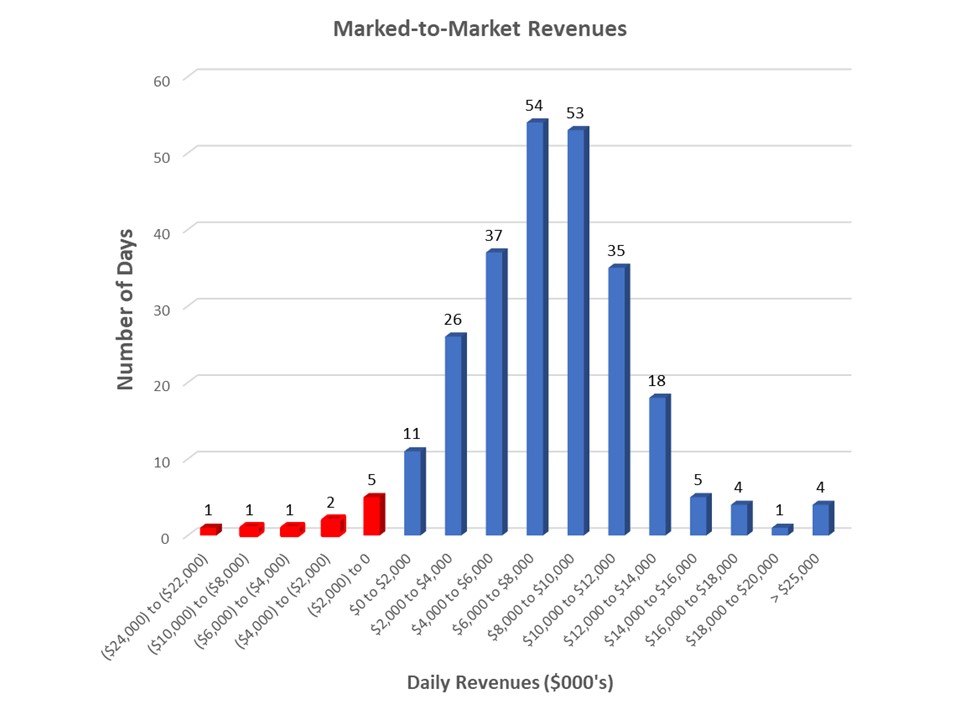
The graph above includes unrealized price movements in our precious metals inventories and related futures hedge positions during the period depicted in which we experienced temporary dislocations in published London spot market cash prices and Comex listed gold and silver futures contracts, related to potential tariffs to be imposed by the U.S. government on imported metals.
In our securities market-making and trading activities, we maintain inventories of equity and debt securities. In our Commercial segment, our positions include physical commodities inventories, precious metals on lease, forwards, futures and options on futures, and OTC derivatives. Our commodity trading activities are managed as one consolidated book for each commodity encompassing both cash positions and derivative instruments. We monitor the aggregate position for each commodity in equivalent physical ounces, metric tons, or other relevant unit.
Interest Rate Risk
In the ordinary course of our operations, we have interest rate risk from the possibility that changes in interest rates will affect the values of financial instruments and impact interest income earned. Within our domestic institutional dealer in fixed income
69
securities business, we maintain a significant amount of trading assets and liabilities which are sensitive to changes in interest rates. These trading activities primarily consist of securities trading in connection with U.S. Treasury, U.S. government agency, agency mortgage-backed and agency asset-backed obligations as well as investment grade, high-yield, convertible and emerging markets debt securities. Derivative instruments, which consist of futures, TBA securities and forward settling transactions are used to manage risk exposures in the trading inventory. We enter into TBA securities transactions for the sole purpose of managing risk associated with mortgage-backed securities.
In addition, we generate interest income from the positive spread earned on client deposits. We typically invest in U.S. Treasury bills, notes, and obligations issued by government sponsored entities, reverse repurchase agreements involving U.S. Treasury bills and government obligations or AA-rated money market funds. In some instances, we maintain interest earning cash deposits with banks, clearing organizations and counterparties. We have an investment policy which establishes acceptable standards of credit quality and limits the amount of funds that can be invested within a particular fund, institution, clearing organization or counterparty. We estimate that as of September 30, 2025, an immediate 25 basis point decrease in short-term interest rates would result in approximately $13.5 million less in annual net income.
We manage interest expense using a combination of variable and fixed rate debt. The carrying value of the debt instruments represents their principal amounts net of unamortized deferred financing costs. As of September 30, 2025, $782.0 million of outstanding principal debt was variable-rate debt. We are subject to earnings and liquidity risks for changes in the interest rate on this debt. As of September 30, 2025, $1,175.0 million of outstanding principal debt was fixed-rate long-term debt, with a fair value of $1,222.1 million.
Foreign Currency Risk
Currency risk arises from the possibility that fluctuations in foreign exchange rates will impact the value of our earnings and assets. Entities that have assets and liabilities denominated in currencies other than the primary economic environment in which the entity operates are subject to remeasurement. Principally, all sales are denominated in the currency of the subsidiary, while related operating costs are denominated in the currency of the local country and translated into USD for consolidated reporting purposes. Although the majority of the assets and liabilities of these subsidiaries are denominated in the functional currency of the subsidiary, they may also hold assets or liabilities denominated in other currencies. As a result, our results of operations and financial position are exposed to changing currency rates. We have executed hedging transactions in relation to certain currencies to mitigate our exposure to volatility in those certain foreign currency exchange rates. From time-to-time, we may consider entering into larger hedges in those certain contracts or hedging transactions in additional currencies to mitigate our exposure to more foreign currency exchange rates. These hedging transactions may not be successful.
70
ITEM 8. Financial Statements and Supplementary Data
Report of Independent Registered Public Accounting Firm
To the Stockholders and Board of Directors
StoneX Group Inc.:
Opinion on the Consolidated Financial Statements
We have audited the accompanying consolidated balance sheets of StoneX Group Inc. and subsidiaries (the Company) as of September 30, 2025 and 2024, the related consolidated income statements, consolidated statements of comprehensive income, consolidated statements of cash flows, and consolidated statements of stockholders’ equity for each of the years in the three-year period ended September 30, 2025, and the related notes and financial statement schedule (collectively, the consolidated financial statements). In our opinion, the consolidated financial statements present fairly, in all material respects, the financial position of the Company as of September 30, 2025 and 2024, and the results of its operations and its cash flows for each of the years in the three-year period ended September 30, 2025, in conformity with U.S. generally accepted accounting principles.
We also have audited, in accordance with the standards of the Public Company Accounting Oversight Board (United States) (PCAOB), the Company’s internal control over financial reporting as of September 30, 2025, based on criteria established in Internal Control – Integrated Framework (2013) issued by the Committee of Sponsoring Organizations of the Treadway Commission, and our report dated November 26, 2025 expressed an adverse opinion on the effectiveness of the Company’s internal control over financial reporting.
Basis for Opinion
These consolidated financial statements are the responsibility of the Company’s management. Our responsibility is to express an opinion on these consolidated financial statements based on our audits. We are a public accounting firm registered with the PCAOB and are required to be independent with respect to the Company in accordance with the U.S. federal securities laws and the applicable rules and regulations of the Securities and Exchange Commission and the PCAOB.
We conducted our audits in accordance with the standards of the PCAOB. Those standards require that we plan and perform the audit to obtain reasonable assurance about whether the consolidated financial statements are free of material misstatement, whether due to error or fraud. Our audits included performing procedures to assess the risks of material misstatement of the consolidated financial statements, whether due to error or fraud, and performing procedures that respond to those risks. Such procedures included examining, on a test basis, evidence regarding the amounts and disclosures in the consolidated financial statements. Our audits also included evaluating the accounting principles used and significant estimates made by management, as well as evaluating the overall presentation of the consolidated financial statements. We believe that our audits provide a reasonable basis for our opinion.
Critical Audit Matter
The critical audit matters communicated below are matters arising from the current period audit of the consolidated financial statements that were communicated or required to be communicated to the audit committee and that: (1) relate to accounts or disclosures that are material to the consolidated financial statements and (2) involved our especially challenging, subjective, or complex judgments. The communication of critical audit matters does not alter in any way our opinion on the consolidated financial statements, taken as a whole, and we are not, by communicating the critical audit matters below, providing separate opinions on the critical audit matters or on the accounts or disclosures to which they relate.
Accounting for unrealized gains and losses from certain market making activities
As discussed in Note 15 to the consolidated financial statements, the Company recorded principal gains, net from financial transactions for which the Company acted as principal, a portion of which related to unrealized gains and losses derived from over-the-counter derivatives market making activities (collectively, Unrealized Gains and Losses). Such Unrealized Gains and Losses represent the change in fair value for those financial instruments that are held by the Company as of year-end and reflected in earnings.
We identified the accounting for Unrealized Gains and Losses as a critical audit matter. A high degree of auditor subjectivity and judgment was involved in determining the sufficiency and timing of audit procedures required to evaluate the existence and accuracy of certain Unrealized Gains and Losses reflected in earnings as of September 30, 2025.
The following are the primary procedures we performed to address this critical audit matter. We evaluated the design and tested the operating effectiveness of certain internal controls related to Unrealized Gains and Losses, including controls that ensure trading subledger values were not modified within the computations. We evaluated Unrealized Gains and Losses as
71
of September 30, 2025 by comparing inputs to the Unrealized Gains and Losses computation prepared by the Company to source documents and recalculating Unrealized Gains and Losses recorded. We also assessed the sufficiency of the audit evidence obtained related to Unrealized Gains and Losses by evaluating the cumulative results of the audit procedures and potential management bias.
Acquisition date fair value of client base intangible assets
As discussed in Note 20 to the consolidated financial statements, on July 31, 2025, the Company acquired R.J. O’Brien & Associates LLC and selected affiliates. The Company accounted for the acquired business using the acquisition method of accounting by recording assets acquired and liabilities assumed at their respective fair values. As part of the transaction, the Company acquired client base intangible assets with an acquisition date fair value of $407.7 million. The Company used the multi-period excess earnings method to determine the estimated acquisition date fair value of client base intangible assets. The significant assumptions used to estimate the fair value of client base intangible assets included an expected client base attrition rate and a discount rate.
We identified the assessment of the acquisition date fair value of client base intangible assets as a critical audit matter. The acquisition date fair value involved a high degree of measurement uncertainty and subjectivity, which required specialized skills and knowledge to evaluate. Specifically, the assessment of the acquisition date fair value of client base intangible assets encompassed the evaluation of the significant assumptions of expected client base attrition rate and discount rate. Changes in these assumptions could have a material impact on the resulting acquisition date fair value of the client base intangible assets.
The following are the primary procedures we performed to address this critical audit matter. We evaluated the design and tested the operating effectiveness of certain internal controls related to the Company’s acquisition date valuation process over client base intangible assets, including controls over the development of the expected client base attrition rate and discount rate. We evaluated the expected client base attrition rate by comparing it to historical attrition rates for similar clients. We evaluated the discount rate by recalculating the components and comparing inputs to industry data. We involved valuation professionals with specialized skills and knowledge who assisted in evaluating:
•the Company’s expected client base attrition rate by comparing to historical attrition rate data
•the Company’s discount rate assumption used for the client base intangible assets by independently developing a range of discount rates based on publicly available market data for comparable entities and comparing that range to the Company’s discount rate.
/s/ KPMG LLP
We have served as the Company’s auditor since 2010.
Kansas City, Missouri
November 28, 2025
72
Report of Independent Registered Public Accounting Firm
To the Stockholders and Board of Directors
StoneX Group Inc.:
Opinion on Internal Control Over Financial Reporting
We have audited StoneX Group Inc. and subsidiaries' (the Company) internal control over financial reporting as of September 30, 2025, based on criteria established in Internal Control – Integrated Framework (2013) issued by the Committee of Sponsoring Organizations of the Treadway Commission. In our opinion, because of the effect of the material weakness, described below, on the achievement of the objectives of the control criteria, the Company has not maintained effective internal control over financial reporting as of September 30, 2025, based on criteria established in Internal Control – Integrated Framework (2013) issued by the Committee of Sponsoring Organizations of the Treadway Commission.
We also have audited, in accordance with the standards of the Public Company Accounting Oversight Board (United States) (PCAOB), the consolidated balance sheets of the Company as of September 30, 2025 and 2024, the related consolidated income statements, consolidated statements of comprehensive income, consolidated statements of cash flows, and consolidated statements of stockholders’ equity, for each of the years in the three-year period ended September 30, 2025, and the related notes and financial statement schedule (collectively, the consolidated financial statements), and our report dated November 26, 2025 expressed an unqualified opinion on those consolidated financial statements.
A material weakness is a deficiency, or a combination of deficiencies, in internal control over financial reporting, such that there is a reasonable possibility that a material misstatement of the company’s annual or interim financial statements will not be prevented or detected on a timely basis. A material weakness related to a control that did not operate effectively that was designed to assess the proper presentation of securities purchased under agreements to resell and securities sold under agreements to repurchase has been identified and included in management’s assessment. The material weakness was considered in determining the nature, timing, and extent of audit tests applied in our audit of the 2025 consolidated financial statements, and this report does not affect our report on those consolidated financial statements.
The Company acquired JBR Recovery Limited, Octo Finances SA, R.J. O’Brien & Associates LLC and selected affiliates, The Benchmark Company, LLC, and Right Corporation during 2025, and management excluded from its assessment of the effectiveness of the Company’s internal control over financial reporting as of September 30, 2025, JBR Recovery Limited, Octo Finances SA, R.J. O’Brien & Associates LLC and selected affiliates, The Benchmark Company, LLC, and Right Corporation’s internal control over financial reporting associated with total assets of $7,583.6 million and total revenues of $211.6 million included in the consolidated financial statements of the Company as of and for the year ended September 30, 2025. Our audit of internal control over financial reporting of the Company also excluded an evaluation of the internal control over financial reporting of JBR Recovery Limited, Octo Finances SA, R.J. O’Brien & Associates LLC and selected affiliates, The Benchmark Company, LLC, and Right Corporation.
Basis for Opinion
The Company’s management is responsible for maintaining effective internal control over financial reporting and for its assessment of the effectiveness of internal control over financial reporting, included in the accompanying Management's Report on Internal Control Over Financial Reporting. Our responsibility is to express an opinion on the Company’s internal control over financial reporting based on our audit. We are a public accounting firm registered with the PCAOB and are required to be independent with respect to the Company in accordance with the U.S. federal securities laws and the applicable rules and regulations of the Securities and Exchange Commission and the PCAOB.
We conducted our audit in accordance with the standards of the PCAOB. Those standards require that we plan and perform the audit to obtain reasonable assurance about whether effective internal control over financial reporting was maintained in all material respects. Our audit of internal control over financial reporting included obtaining an understanding of internal control over financial reporting, assessing the risk that a material weakness exists, and testing and evaluating the design and operating effectiveness of internal control based on the assessed risk. Our audit also included performing such other procedures as we considered necessary in the circumstances. We believe that our audit provides a reasonable basis for our opinion.
73
Definition and Limitations of Internal Control Over Financial Reporting
A company’s internal control over financial reporting is a process designed to provide reasonable assurance regarding the reliability of financial reporting and the preparation of financial statements for external purposes in accordance with generally accepted accounting principles. A company’s internal control over financial reporting includes those policies and procedures that (1) pertain to the maintenance of records that, in reasonable detail, accurately and fairly reflect the transactions and dispositions of the assets of the company; (2) provide reasonable assurance that transactions are recorded as necessary to permit preparation of financial statements in accordance with generally accepted accounting principles, and that receipts and expenditures of the company are being made only in accordance with authorizations of management and directors of the company; and (3) provide reasonable assurance regarding prevention or timely detection of unauthorized acquisition, use, or disposition of the company’s assets that could have a material effect on the financial statements.
Because of its inherent limitations, internal control over financial reporting may not prevent or detect misstatements. Also, projections of any evaluation of effectiveness to future periods are subject to the risk that controls may become inadequate because of changes in conditions, or that the degree of compliance with the policies or procedures may deteriorate.
/s/ KPMG LLP
Kansas City, Missouri
November 28, 2025
74
StoneX Group Inc.
Consolidated Balance Sheets
| (in millions, except par value and share amounts) | September 30, 2025 | September 30, 2024 | |||||||||
| ASSETS | |||||||||||
| Cash and cash equivalents | $ | $ | |||||||||
Cash, securities and other assets segregated under federal and other regulations (including $ | |||||||||||
| Collateralized transactions: | |||||||||||
| Securities purchased under agreements to resell | |||||||||||
| Securities borrowed | |||||||||||
Deposits with and receivables from broker-dealers, clearing organizations and counterparties, net (including $ | |||||||||||
Receivable from clients, net (including $ | |||||||||||
| Income taxes receivable | |||||||||||
Financial instruments owned, at fair value (includes securities pledged as collateral that can be sold or repledged of $ | |||||||||||
Physical commodities inventory, net (including $ | |||||||||||
| Deferred tax assets | |||||||||||
| Property and equipment, net | |||||||||||
| Operating right of use assets | |||||||||||
| Goodwill and intangible assets, net | |||||||||||
| Other assets | |||||||||||
| Total assets | $ | $ | |||||||||
| LIABILITIES AND EQUITY | |||||||||||
| Liabilities: | |||||||||||
Accounts payable and other accrued liabilities (including $ | $ | $ | |||||||||
| Operating lease liabilities | |||||||||||
| Payables to: | |||||||||||
Clients (including $ | |||||||||||
Broker-dealers, clearing organizations and counterparties (including $ | |||||||||||
| Lenders under loans | |||||||||||
| Senior secured borrowings, net | |||||||||||
| Income taxes payable | |||||||||||
| Deferred tax liabilities | |||||||||||
| Collateralized transactions: | |||||||||||
| Securities sold under agreements to repurchase | |||||||||||
| Securities loaned | |||||||||||
| Financial instruments sold, not yet purchased, at fair value | |||||||||||
| Total liabilities | |||||||||||
| Commitments and contingencies (Note 13) | |||||||||||
| Stockholders' equity: | |||||||||||
Preferred stock, $ | |||||||||||
Common stock, $ | |||||||||||
Common stock in treasury, at cost. | ( | ( | |||||||||
| Additional paid-in-capital | |||||||||||
| Retained earnings | |||||||||||
| Accumulated other comprehensive loss, net | ( | ( | |||||||||
| Total equity | |||||||||||
| Total liabilities and stockholders' equity | $ | $ | |||||||||
See accompanying notes to consolidated financial statements.
75
StoneX Group Inc.
Consolidated Income Statements
| Fiscal Year Ended September 30, | |||||||||||||||||
| (in millions, except share and per share amounts) | 2025 | 2024 | 2023 | ||||||||||||||
| Revenues: | |||||||||||||||||
| Sales of physical commodities | $ | $ | $ | ||||||||||||||
| Principal gains, net | |||||||||||||||||
| Commission and clearing fees | |||||||||||||||||
| Consulting, management, and account fees | |||||||||||||||||
| Interest income | |||||||||||||||||
| Total revenues | |||||||||||||||||
| Cost of sales of physical commodities | |||||||||||||||||
| Operating revenues | |||||||||||||||||
| Transaction-based clearing expenses | |||||||||||||||||
| Introducing broker commissions | |||||||||||||||||
| Interest expense | |||||||||||||||||
| Interest expense on corporate funding | |||||||||||||||||
| Net operating revenues | |||||||||||||||||
| Compensation and other expenses: | |||||||||||||||||
| Compensation and benefits | |||||||||||||||||
| Trading systems and market information | |||||||||||||||||
| Professional fees | |||||||||||||||||
| Non-trading technology and support | |||||||||||||||||
| Occupancy and equipment rental | |||||||||||||||||
| Selling and marketing | |||||||||||||||||
| Travel and business development | |||||||||||||||||
| Communications | |||||||||||||||||
| Depreciation and amortization | |||||||||||||||||
| Bad debts, net of recoveries | |||||||||||||||||
| Other | |||||||||||||||||
| Total compensation and other expenses | |||||||||||||||||
| Gain on acquisitions and other gains, net | |||||||||||||||||
| Income before tax | |||||||||||||||||
| Income tax expense | |||||||||||||||||
| Net income | $ | $ | $ | ||||||||||||||
| Earnings per share: | |||||||||||||||||
| Basic | $ | $ | $ | ||||||||||||||
| Diluted | $ | $ | $ | ||||||||||||||
| Weighted-average number of common shares outstanding: | |||||||||||||||||
| Basic | |||||||||||||||||
| Diluted | |||||||||||||||||
See accompanying notes to consolidated financial statements.
76
StoneX Group Inc.
Consolidated Statements of Comprehensive Income
| Fiscal Year Ended September 30, | |||||||||||||||||
| (in millions) | 2025 | 2024 | 2023 | ||||||||||||||
| Net income | $ | $ | $ | ||||||||||||||
| Other comprehensive income/(loss), net of tax: | |||||||||||||||||
| Foreign currency translation adjustment | ( | ||||||||||||||||
| Cash flow hedges | ( | ||||||||||||||||
| Pension liabilities adjustment | ( | ||||||||||||||||
| Other comprehensive income, net of tax | |||||||||||||||||
| Comprehensive income | $ | $ | $ | ||||||||||||||
See accompanying notes to consolidated financial statements.
77
StoneX Group Inc.
Consolidated Statements of Cash Flows
| Fiscal Year Ended September 30, | |||||||||||||||||
| (in millions) | 2025 | 2024 | 2023 | ||||||||||||||
| Cash flows from operating activities: | |||||||||||||||||
| Net income | $ | $ | $ | ||||||||||||||
| Adjustments to reconcile net income to net cash provided by/(used in) operating activities: | |||||||||||||||||
| Depreciation and amortization | |||||||||||||||||
| Amortization of operating right of use assets | |||||||||||||||||
| Provision for bad debts, net of recoveries | |||||||||||||||||
| Deferred income taxes | ( | ( | |||||||||||||||
| Loss on extinguishment of debt | |||||||||||||||||
| Amortization and extinguishment of debt issuance costs | |||||||||||||||||
| Actuarial adjustment on pension and postretirement benefits | ( | ||||||||||||||||
| Amortization of share-based compensation expense | |||||||||||||||||
| Loss on disposal of property and equipment | |||||||||||||||||
| Gain on acquisition | ( | ||||||||||||||||
| Accretion of deferred consideration | |||||||||||||||||
| Adjustment to fair value of deferred consideration | ( | ||||||||||||||||
| Loss on equity method investment | |||||||||||||||||
| Changes in operating assets and liabilities, net: | |||||||||||||||||
| Securities and other assets segregated under federal and other regulations | ( | ||||||||||||||||
| Securities purchased under agreements to resell | ( | ( | ( | ||||||||||||||
| Securities borrowed | ( | ( | |||||||||||||||
| Deposits with and receivables from broker-dealers, clearing organizations, and counterparties, net | ( | ||||||||||||||||
| Receivable from clients, net | ( | ( | ( | ||||||||||||||
| Notes receivable, net | ( | ||||||||||||||||
| Income taxes receivable | ( | ( | |||||||||||||||
| Financial instruments owned, at fair value | ( | ( | ( | ||||||||||||||
| Physical commodities inventory, net | ( | ( | ( | ||||||||||||||
| Other assets | ( | ( | ( | ||||||||||||||
| Accounts payable and other accrued liabilities | ( | ||||||||||||||||
| Operating lease liabilities | ( | ( | ( | ||||||||||||||
| Payable to clients | |||||||||||||||||
| Payable to broker-dealers, clearing organizations and counterparties | ( | ||||||||||||||||
| Income taxes payable | ( | ( | |||||||||||||||
| Securities sold under agreements to repurchase | |||||||||||||||||
| Securities loaned | ( | ||||||||||||||||
| Financial instruments sold, not yet purchased, at fair value | ( | ||||||||||||||||
| Net cash provided by/(used in) operating activities | ( | ||||||||||||||||
| Cash flows from investing activities: | |||||||||||||||||
| Collection of notes receivable | |||||||||||||||||
| Cash paid for acquisitions of businesses and assets, net of cash acquired | ( | ( | ( | ||||||||||||||
| Equity method investment | ( | ||||||||||||||||
| Purchase of exchange memberships and common stock | ( | ||||||||||||||||
| Purchase of property and equipment and internally developed software | ( | ( | ( | ||||||||||||||
| Net cash used in investing activities | ( | ( | ( | ||||||||||||||
| Cash flows from financing activities: | |||||||||||||||||
| Net change in lenders under loans with maturities 90 days or less | ( | ( | |||||||||||||||
| Proceeds from lenders under loans with maturities greater than 90 days | |||||||||||||||||
| Repayments of lenders under loans with maturities greater than 90 days | ( | ( | |||||||||||||||
| Proceeds from issuance of senior secured notes | |||||||||||||||||
| Repayment of senior secured notes | ( | ||||||||||||||||
| Deferred payments on acquisitions | ( | ( | ( | ||||||||||||||
| Debt issuance costs | ( | ( | |||||||||||||||
| Shares withheld to cover taxes on vesting of equity awards | ( | ( | |||||||||||||||
| Exercise of stock options | |||||||||||||||||
| Net cash provided by/(used in) financing activities | ( | ||||||||||||||||
| Effect of exchange rates on cash, segregated cash, cash equivalents, and segregated cash equivalents | ( | ||||||||||||||||
| Net increase/(decrease) in cash, segregated cash, cash equivalents, and segregated cash equivalents | ( | ||||||||||||||||
| Cash, segregated cash, cash equivalents, and segregated cash equivalents at beginning of period | |||||||||||||||||
| Cash, segregated cash, cash equivalents, and segregated cash equivalents at end of period | $ | $ | $ | ||||||||||||||
78
| (continued) | |||||||||||||||||
| Year Ended September 30, | |||||||||||||||||
| (in millions) | 2025 | 2024 | 2023 | ||||||||||||||
| Supplemental disclosure of cash flow information: | |||||||||||||||||
| Cash paid for interest | $ | $ | $ | ||||||||||||||
| Income taxes paid, net of cash refunds | $ | $ | $ | ||||||||||||||
| Supplemental disclosure of non-cash investing and financing activities: | |||||||||||||||||
| Identified intangible assets and goodwill on acquisitions | $ | $ | $ | ||||||||||||||
| Additional consideration payable related to acquisitions, net | $ | $ | $ | ||||||||||||||
| Acquisition consideration paid in common stock | $ | $ | $ | ||||||||||||||
| Acquisition consideration paid in silver bullion | $ | $ | $ | ||||||||||||||
| Acquisition of businesses: | |||||||||||||||||
| Assets acquired | $ | $ | $ | ||||||||||||||
| Liabilities acquired | |||||||||||||||||
| Total net assets acquired | $ | $ | $ | ||||||||||||||
The following table provides a reconciliation of cash, segregated cash, cash equivalents and segregated cash equivalents reported within the Consolidated Balance Sheets.
| September 30, | |||||||||||||||||
| (in millions) | 2025 | 2024 | 2023 | ||||||||||||||
| Cash and cash equivalents | $ | $ | $ | ||||||||||||||
Cash segregated under federal and other regulations(1) | |||||||||||||||||
Securities segregated under federal and other regulations(2) | |||||||||||||||||
Cash segregated and deposited with or pledged to exchange-clearing organizations and other futures commission merchants (“FCMs”)(3) | |||||||||||||||||
Securities segregated and pledged to exchange-clearing organizations(4) | |||||||||||||||||
| Total cash, segregated cash, cash equivalents and segregated cash equivalents shown in the consolidated statements of cash flows | $ | $ | $ | ||||||||||||||
(1) Represents segregated client cash held at third-party banks included within Cash, securities and other assets segregated under federal and other regulations on the Consolidated Balance Sheets.
(2) Represents segregated client United States (“U.S.”). Treasury obligations and U.S. government agency obligations. Excludes segregated commodity warehouse receipts, segregated U.S. Treasury obligations with acquired maturities of greater than 90 days, and other assets, combined totaling $471.1 million, $51.8 million, and $5.8 million as of September 30, 2025, 2024, and 2023, respectively, included within Cash, securities and other assets segregated under federal and other regulations on the Consolidated Balance Sheets.
(3) Represents segregated client cash on deposit with, or pledged to, exchange clearing organizations and other FCMs. Excludes non-segregated cash and other assets, combined totaling $2,629.5 million, $2,662.0 million, and $2,218.3 million as of September 30, 2025, 2024, and 2023, respectively, included within Deposits with and receivables from broker-dealers, clearing organizations, and counterparties, net on the Consolidated Balance Sheets.
(4) Represents segregated client U.S. Treasury obligations and U.S. government agency obligations on deposit with, or pledged to, exchange clearing organizations and other FCMs. Excludes segregated securities pledged to exchange-clearing organizations with acquired maturities greater than 90 days and other assets, combined totaling $5,146.7 million, $2,007.0 million, and $2,712.6 million as of September 30, 2025, 2024, and 2023, respectively, included within Deposits with and receivables from broker-dealers, clearing organizations, and counterparties, net on the Consolidated Balance Sheets.
See accompanying notes to consolidated financial statements.
79
StoneX Group Inc.
Consolidated Statements of Stockholders’ Equity
| (in millions) | Common Stock | Treasury Stock | Additional Paid-in Capital | Retained Earnings | Accumulated Other Comprehensive Loss, net | Total | |||||||||||||||||||||||||||||
| Balances as of September 30, 2022 | $ | $ | ( | $ | $ | $ | ( | $ | |||||||||||||||||||||||||||
| Net income | — | — | — | — | |||||||||||||||||||||||||||||||
| Other comprehensive income | — | — | — | — | |||||||||||||||||||||||||||||||
| Exercise of stock options | — | — | — | — | |||||||||||||||||||||||||||||||
| Share-based compensation | — | — | — | — | |||||||||||||||||||||||||||||||
| Balances as of September 30, 2023 | ( | ( | |||||||||||||||||||||||||||||||||
| Net income | — | — | — | — | |||||||||||||||||||||||||||||||
| Other comprehensive income | — | — | — | — | |||||||||||||||||||||||||||||||
| Exercise of stock options | — | — | — | — | |||||||||||||||||||||||||||||||
| Shares withheld to cover taxes on vesting of equity awards | — | — | ( | — | — | ( | |||||||||||||||||||||||||||||
| Share-based compensation | — | — | — | — | |||||||||||||||||||||||||||||||
| Balances as of September 30, 2024 | ( | ( | |||||||||||||||||||||||||||||||||
| Net income | — | — | — | — | |||||||||||||||||||||||||||||||
| Other comprehensive income | — | — | — | — | |||||||||||||||||||||||||||||||
| Exercise of stock options | — | — | — | — | |||||||||||||||||||||||||||||||
| Shares withheld to cover taxes on vesting of equity awards | — | — | ( | — | — | ( | |||||||||||||||||||||||||||||
| Share-based compensation | — | — | — | — | |||||||||||||||||||||||||||||||
| Acquisition consideration shares reissued from treasury | — | — | — | ||||||||||||||||||||||||||||||||
| Balances as of September 30, 2025 | $ | $ | ( | $ | $ | $ | ( | $ | |||||||||||||||||||||||||||
See accompanying notes to consolidated financial statements.
80
StoneX Group Inc.
Notes to Consolidated Financial Statements
Note 1 – Description of Business and Significant Accounting Policies
StoneX Group Inc., a Delaware corporation, and its consolidated subsidiaries (collectively “SNEX” or “the Company”), is a global financial services network that connects companies, organizations, traders and investors to the global market ecosystem through a unique blend of digital platforms, end-to-end clearing and execution services, high touch service, and deep expertise. The Company strives to be its clients’ sole trusted partner, providing its networks, products, and services to allow them to pursue trading opportunities, manage market risks, make investments and improve business performance. The Company offers a vertically integrated product suite, beginning with high-touch and electronic access to nearly all major financial markets worldwide, as well as numerous liquidity venues. The Company delivers access and service through the entire trade lifecycle, by delivering deep market expertise and on-the-ground intelligence, best execution, and finally post-trade clearing, custody, as well as settlement services. The Company has created revenue streams, diversified by asset class, client type and geography, that earn commissions and spreads as clients execute transactions across the Company’s financial networks, while the Company monetizes non-trading client activity including interest and fee earnings on client balances as well as earning consulting fees for market intelligence and risk management services.
The Company provides these services to a diverse group of clients in more than 180 countries. These clients include more than 80,000 commercial, institutional, and payments clients and over 400,000 self-directed/retail clients. The Company’s clients include commercial entities, asset managers, regional, national and introducing broker-dealers, insurance companies, brokers, institutional investors and professional traders, commercial and investment banks, and government and non-governmental organizations (“NGOs”).
Basis of Presentation
The accompanying consolidated financial statements include the accounts of StoneX Group Inc. and all entities in which the Company has a controlling financial interest. All material intercompany transactions and balances have been eliminated in consolidation.
In the Consolidated Income Statements, total revenues reported combine gross revenues for the physical commodities business and metals business and net revenues for all other businesses, including metals transacted by broker-dealer subsidiaries. The subtotal Operating revenues in the Consolidated Income Statements is physical commodities cost of sales deducted from total revenues. The subtotal Net operating revenues in the Consolidated Income Statements is operating revenues less transaction-based clearing expenses, introducing broker commissions, and interest expense. Transaction-based clearing expenses are variable expenses paid to executing brokers, exchanges, clearing organizations, and banks, typically related to transactional volumes. Introducing broker commissions include commission paid to non-employee third parties that have introduced clients to the Company. Net operating revenues represent revenues available to pay variable compensation to risk management consultants and traders, certain non-variable expenses, as well as variable and non-variable expenses related to both operational and administrative employees.
Use of Estimates
Preparing consolidated financial statements in conformity with accounting principles generally accepted in the United States of America (“U.S. GAAP”) requires that management make estimates and assumptions affecting the reported amounts of assets and liabilities, disclosure of contingent liabilities as of the date of the financial statements and the reported amounts of revenue and expense during the reporting period. The most significant of these estimates and assumptions in the current year relate to fair value measurements for financial instruments; revenue recognition; valuation of inventories; acquisition valuation for goodwill, intangible assets, and consideration payable; as well as income taxes. These estimates are based on management’s best knowledge of current events and actions the Company may undertake in the future. The Company reviews all significant estimates affecting the financial statements on a recurring basis and records the effect of any necessary adjustments prior to financial statement issuance. Although these and other estimates and assumptions are based on the best available information, actual results could be materially different from these estimates.
Foreign Currency Translation
The Company’s consolidated financial statements are reported in U.S. dollars. The Company’s subsidiaries maintain their records either in U.S. dollars or, as appropriate, the currencies of the countries in which they operate. The method of translating local currency financial information into U.S. dollars depends on whether the economy in which the foreign subsidiary operates has been designated as highly inflationary. Economies with a three-year cumulative inflation rate of more than 100% are considered highly inflationary.
Assets and liabilities of foreign subsidiaries in non-highly inflationary economies are translated into U.S. dollars using rates of exchange at the balance sheet date. Translation adjustments are recorded in other comprehensive income (loss). Revenues and
81
expenses are translated at rates of exchange in effect at relevant times during the year. Transaction gains and losses related to changes in currency rates are recorded in earnings.
Foreign subsidiaries that operate in highly inflationary countries use the U.S. dollar as their functional currency. Local currency monetary assets and liabilities are remeasured into U.S. dollars using rates of exchange as of each balance sheet date, with remeasurement adjustments and other transaction gains and losses recognized in earnings. Nonmonetary assets and liabilities
do not fluctuate with changes in the local currency exchange rates to the dollar as the translated amounts for nonmonetary assets and liabilities at the end of the accounting period in which the economy becomes highly inflationary becomes the accounting basis for those assets and liabilities in the period of change and subsequent periods. Revenues and expenses are translated at rates of exchange in effect at relevant times during the year.
At September 30, 2025, the Company had net monetary liabilities denominated in Argentine pesos of $0.9 million, compared to net monetary liabilities of $2.4 million at September 30, 2024. The Company held cash and cash equivalents, including amounts in segregation, denominated in Argentine pesos of $0.9 million and $3.0 million as of September 30, 2025 and 2024, respectively. At September 30, 2025 and 2024, the Company had net non-monetary assets denominated in Argentine pesos of $3.6 million and $2.7 million, respectively.
Cash and Cash Equivalents
Cash, Securities and Other Assets Segregated under Federal and other Regulations
Collateralized Transactions
The Company enters into securities purchased under agreements to resell, securities sold under agreements to repurchase, securities borrowed transactions, and securities loaned transactions primarily to fund principal debt trading, acquire securities to cover short positions, acquire securities for settlement, or meet counterparty needs under matched-booked trading strategies.
These transactions are accounted for as collateralized financing transactions and are recorded at their contractual amounts plus accrued interest. In connection with these agreements and transactions, it is the Company’s policy to receive or pledge cash or securities to collateralize such agreements and transactions in accordance with contractual arrangements. The Company monitors the fair value of its collateral on a daily basis, and the Company may require counterparties, or may be required by counterparties, to deposit additional collateral or return collateral pledged. Interest income and interest expense are recognized over the life of the arrangements and are recorded in the Consolidated Income Statements as Interest income or Interest expense, as applicable. The carrying amount of these transactions approximate fair value due to their short-term nature and the level of collateralization.
82
Certain transactions may be classified in securities purchased under agreements to resell rather than securities borrowed because the characteristics and circumstances more closely align with this presentation, although the securities’ legal form is securities borrowed.
Repurchase and Reverse repurchase agreement netting
Deposits with and Receivables from Broker-dealers, Clearing Organizations and Counterparties, and Payables to Broker-dealers, Clearing Organizations and Counterparties
Deposits with broker-dealers, clearing organizations, and counterparties pertain primarily to deposits made to satisfy margin requirements on client and proprietary open futures and options on futures positions and to satisfy the requirements set by clearing exchanges for clearing membership. The Company also deposits margin with various counterparties for over-the-counter (“OTC”) derivative contracts. These deposits are also included in deposits with broker-dealers, clearing organizations, and counterparties. The Company also deposits cash margin with various securities clearing organizations as an ongoing condition of the securities clearing relationships, and these deposits are included in deposits with and receivables from broker-dealers, clearing organizations, and counterparties. Deposits with and receivables from broker-dealers, clearing organizations, and counterparties are reported gross, except where a right of offset exists. As of September 30, 2025 and 2024, the Company had cash and cash equivalents on deposit with or pledged to broker-dealers, clearing organizations, and counterparties of approximately $5,114.5 million and $2,614.2 million, respectively.
Deposits with and receivables from broker-dealers, clearing organizations, and counterparties also includes guaranty deposits with clearing exchanges. The guaranty deposits are held by the clearing exchanges for use in potential default situations by one or more members of the clearing exchanges. The guaranty deposits may be applied to the Company’s obligations to the clearing exchange, or to the clearing exchange’s obligations to unrelated parties.
Deposits with and receivables from broker-dealers, clearing organizations, and counterparties also include securities pledged to clearing exchanges. Some of these securities are included in the cash equivalents on deposit with or pledged to broker-dealers. These securities are either pledged to the Company by its clients or represent investments of client funds. It is the Company’s practice to include client-owned securities on its Consolidated Balance Sheets, as the rights to those securities have been transferred to the Company under the terms of the relevant futures trading agreements. Securities pledged primarily include U.S. Treasury obligations, U.S. governmental agency obligations, and foreign government obligations. Securities that are not client-owned, and represent an investment of client funds, are adjusted to fair value with associated changes in unrealized gains or losses recorded in Interest income in the Consolidated Income Statements. For client-owned securities, the change in fair value is offset against the payable to clients with no impact recognized in the Consolidated Income Statements. The total fair value of such client owned and non-client owned securities included within Deposits with and receivables from broker-dealers, clearing organizations, and counterparties, net was $6,335.2 million and $2,951.5 million as of September 30, 2025 and 2024, respectively.
Management has considered guidance required by ASC 860, Transfers and Servicing as it relates to securities pledged by clients to margin their futures and options on futures trading accounts. Management believes that the transferor surrenders control over those assets because, under the guidance, the transferee relinquishes control of the assets to the Company, among other factors. Under this guidance, the Company reflects the client collateral assets and corresponding liabilities in the Company’s Consolidated Balance Sheets as of September 30, 2025 and 2024.
Deposits with and receivables from broker-dealers, clearing organizations, and counterparties also includes amounts due from clearing exchanges for unrealized gains and losses associated with clients’ options on futures contracts. See discussion in the Financial Instruments section below for additional information on the Company’s accounting policies for derivative contracts. For client-owned derivative contracts, the fair value is offset against the payable to clients with no impact recognized on the Consolidated Income Statements.
The Company maintains client omnibus and proprietary accounts with other clearing organizations. The equity balances in those accounts, along with any margin cash or securities deposited with the clearing organizations are included in deposits with and receivables from broker-dealers, clearing organizations, and counterparties.
Deposits with and receivables from broker-dealers, clearing organizations, and counterparties also include amounts due from or due to clearing exchanges for daily variation settlements on open futures and options on futures positions. The variation settlements due from or due to clearing exchanges are paid in cash on the following business day. Variation settlements equal the daily settlement of futures contracts and premiums on options on futures contracts.
83
Deposits with and receivables from broker-dealers, clearing organizations, and counterparties further include amounts receivable for securities sold but not yet delivered by the Company on settlement date (“fails-to-deliver”) and net receivables arising from unsettled proprietary trades.
Payables to broker-dealers, clearing organizations, and counterparties primarily include amounts payable for securities purchased but not yet received by the Company on settlement date (“fails-to-receive”) and net payables arising from unsettled proprietary trades.
Deposits with and receivables from broker-dealers, clearing organizations and counterparties, and payables to broker-dealers, clearing organizations and counterparties also include amounts related to the value of registered broker-dealer clients cross-currency payment transactions related to the Payments segment. These amounts arise due to a clearing period before funds are received and payments are made, which usually is one to two business days.
Receivable from and Payables to Clients
Receivable from clients, net includes the total of net deficits in individual exchange-traded futures and OTC derivative trading accounts carried by the Company. Client deficits arise from realized and unrealized trading losses on client OTC, futures, options on futures, swaps and forwards and amounts due on cash and margin transactions. Client deficit accounts are reported gross of client accounts that contain net credit or positive balances, except where a right of offset exists. Net deficits in individual futures exchange-traded and OTC derivative trading accounts include both secured and unsecured deficit balances due from clients as of the balance sheet date. Secured deficit amounts are backed by U.S. Treasury obligations and commodity warehouse receipts. These U.S Treasury obligations and commodity warehouse receipts are netted against the secured deficit amounts when conditions necessary for the right to offset exist.
Receivable from clients, net also includes the net amounts receivable from securities clients in connection with the settlement of regular-way cash securities, margin loans to clients, and client cash debits. It is the Company’s policy to report margin loans and payables that arise due to positive cash flows in the same client’s accounts on a net basis when the conditions for netting as specified in U.S. GAAP are met. Clients’ securities transactions cleared by the Company are recorded on a settlement date basis, but the Company makes accruals necessary to adjust any uncompleted transactions to a trade date basis for consolidated reporting, under U.S. GAAP. Securities cleared by the Company and pledged to the Company as a condition of custodial clearing arrangements are owned by the clients, including those that collateralize margin or other similar transactions, and are not reflected on the Consolidated Balance Sheets as the Company does not have title to, or beneficial interests, in those assets. The carrying value of the receivables and payables approximates fair value due to their short-term nature.
Receivable from clients, net also include amounts receivable from non-broker-dealer clients for securities sold but not yet delivered by the Company on settlement date (“fails-to-deliver”) and net receivables arising from unsettled proprietary trades.
Payables to clients represent the total of client accounts with credit or positive balances. Client accounts are used primarily in connection with exchange-traded and OTC commodity, foreign exchange, precious metals, and securities transactions and include gains and losses on open trades as well as securities and cash margin deposits made as required by the Company, the exchange-clearing organizations or other clearing organizations. Client accounts with credit or positive balances are reported gross of client deficit accounts, except where a right of offset exists.
Payables to broker-dealers and counterparties also includes amounts payable to non-broker-dealer clients for securities purchased but not yet received by the Company on settlement date (“fails-to-receive”) and net payables arising from unsettled proprietary trades.
Receivable from and payables to clients also include amounts related to the value of non-registered broker-dealer clients’ cross-currency payment transactions related to the Payments segment. These amounts arise due to a clearing period before the funds are received and payments are made, which usually is one to two business days.
The future collectability of receivable from clients can be impacted by the Company’s collection efforts, client financial stability, and the general economic climate. In determining collectability, the Company considers a number of factors including, but not limited to, historical collection experience, current and forecasted economic and business conditions, internal and external credit risk ratings, collateral terms, payment terms, client financial strength, and aging of the financial asset. The Company adheres to the Current Expected Credit Loss model and, in addition, may use specific-identification in certain circumstances to further inform estimates. The Company may unilaterally close client trading positions in certain circumstances. In addition, to evaluate client margining and collateral requirements, client positions are stress tested regularly and monitored for excessive concentration levels relative to the overall market size. Furthermore, in certain instances, the Company is indemnified and able to charge back introducing broker-dealers for bad debts incurred by their clients.
The Company generally writes off an outstanding receivable balance when all economic means of recovery have been exhausted. That determination considers information such as the occurrence of significant changes in the client’s financial
84
position such that the client can no longer pay the obligation, or that the proceeds from collateral will not be sufficient to pay the balance.
Physical Commodities Inventory
Inventories of certain agricultural commodities are carried at net realizable value, which approximates fair value less disposal costs. Agricultural commodities inventories have reliable, readily determinable and realizable market prices, relatively predictable and insignificant costs of disposal, and are available for immediate delivery. Changes in the fair values of these agricultural commodities inventories are included as a component of Cost of sales of physical commodities in the Consolidated Income Statements.
Inventories of precious metals held by subsidiaries that are not broker-dealers are valued at the lower of cost or net realizable value, using the weighted-average price and first-in first-out costing method. Changes in the values of these inventories are included as a component of Cost of sales of physical commodities in the Consolidated Income Statements.
The JBR Recovery Limited (“JBR”) assets and business acquisition, discussed and defined in Note 20, introduced stages of refining, such as raw materials, work in process, and completed goods. These are reported as components of Physical commodities inventory, net on the Condensed Consolidated Balance Sheets. The Company’s valuation policy includes estimating the cost to complete refining the various stages into finished product, the type of materials being refined, along with the market prices of the finished product to arrive at the lower of cost or net realizable value.
Property and Equipment
Property and equipment is stated at cost, net of accumulated depreciation and amortization and depreciated using the straight-line method over the estimated useful life. Leasehold improvements are amortized on a straight-line basis over the estimated useful life of the improvement or the term of the lease, whichever is shorter. Expenditures that increase the value or productive capacity of assets are capitalized. When an asset is retired, sold, or otherwise disposed of, the carrying amount and related accumulated depreciation are removed from the accounts and any gain or loss is included in earnings. The Company had no assets held for sale at September 30, 2025 and 2024.
The Company accounts for costs incurred to develop its trading platforms and related software in accordance with ASC 350-40, Internal-Use Software, which requires that such technology be capitalized in the application development stage. Costs related to planning, training, administration, and non-value added maintenance are charged to expense as incurred. Capitalized software development costs are amortized over the useful life of the software, which the Company generally estimates at three years .
Goodwill and Identifiable Intangible Assets
Goodwill is the cost of acquired companies in excess of the fair value of identifiable net assets at acquisition date. Goodwill is not subject to amortization, but rather is evaluated for impairment at least annually. The Company evaluates its goodwill for impairment during the fourth quarter of its fiscal year or more frequently if indicators of potential impairment exist, in accordance with ASC 350, Intangibles - Goodwill and Other. Goodwill impairment is determined by comparing the estimated fair value of a reporting unit (generally defined as the businesses for which financial information is available and reviewed regularly by management) with its respective carrying value. If the estimated fair value exceeds the carrying value, goodwill at the reporting unit level is not deemed to be impaired. However, if the estimated fair value is below carrying value, further analysis is required to determine the amount of the impairment.
85
In the course of evaluating the potential impairment of goodwill, the Company may perform either a qualitative or a quantitative assessment. The Company’s qualitative assessment of potential impairment may result in the determination that a quantitative impairment analysis is not necessary. Under this elective process, the Company assesses qualitative factors to determine whether the existence of events or circumstances leads the Company to determine that it is more likely than not that the fair value of a reporting unit is less than its carrying amount. If after assessing the totality of events and circumstances, the Company determines it is more likely than not that the fair value of a reporting unit is greater than its carrying amount, then performing a quantitative analysis is not required. However, if the Company concludes otherwise, then the Company performs a quantitative impairment analysis.
If the Company either chooses not to perform a qualitative assessment, or the Company chooses to perform a qualitative assessment but is unable to qualitatively conclude that no impairment has occurred, then the Company performs a quantitative evaluation. In the case of a quantitative assessment, the Company estimates the fair value of the reporting unit with which the goodwill that is subject to the quantitative analysis is associated and compares it to the carrying value. If the estimated fair value of a reporting unit is less than its carrying value, the Company estimates the fair value of all assets and liabilities of the reporting unit, including goodwill. If the carrying value of the reporting unit’s goodwill is greater than the estimated fair value, an impairment charge is recognized for the excess. The fair value of the Company’s reporting units exceeded their respective carrying values under the qualitative assessment approach. No
Identifiable intangible assets subject to amortization are amortized using the straight-line method over their estimated period of benefit, ranging from to twenty years . Both definite and indefinite lived identifiable intangible assets are tested for impairment whenever events or changes in circumstances suggest that an asset’s or asset group’s carrying value may not be fully recoverable. Residual value is presumed to be zero for all identifiable intangible assets. No
Financial Instruments Owned and Sold, Not Yet Purchased
Financial instruments owned and sold, not yet purchased, at fair value consist of financial instruments carried at fair value, measured on a recurring basis, or amounts that approximate fair value. Related realized and unrealized gains and losses are recognized in current period earnings within Principal gains, net, Interest income, Interest expense, and Cost of sales of physical commodities in the Consolidated Income Statements. The fair value of a financial instrument is the amount at which the instrument could be exchanged in a current transaction between willing parties.
The Company has entered into certain mortgages and other loans that will eventually be securitized. The Company has elected the fair value option, under ASC 825, because this election aligns mark to market recognition of these assets with the rest of the Company’s portfolio of similar assets. Changes to the value of these assets are recorded to Principal gains, net in the Consolidated Income Statements.
Financial instruments owned and sold, not yet purchased comprise primarily the financial instruments held by the Company’s broker-dealer subsidiaries and the Company’s OTC derivative swap dealer. Financial instruments owned and financial instruments sold, not yet purchased, includes trading securities that the Company holds as a principal. The Company has not classified any financial instruments owned or sold, not yet purchased, as available-for-sale or held-to-maturity.
Financial instruments owned and sold, not yet purchased includes derivative instruments that the Company holds as a principal which are primarily transacted on an OTC basis. As a derivatives dealer, the Company utilizes these instruments to manage exposures to foreign currency, commodity price and interest rate risks for the Company and its clients. The Company’s objectives for holding derivatives include reducing, eliminating, and efficiently managing the economic impact of these exposures as effectively as possible. The Company’s derivative instruments also include forward purchase and sale commitments for the physical delivery of agricultural and energy related commodities in a future period. Contracts for the sale of agricultural and energy commodities generally do not extend beyond one year, while contracts to purchase agricultural and energy commodities generally relate to the current or future crop year.
Derivative instruments are measured at fair value on a recurring basis. For derivatives for which the Company does not elect hedge accounting, realized and unrealized gains and losses from the changes in fair value of derivative instruments are recognized immediately in current period earnings. Realized and unrealized gains and losses from the derivative instruments in which the Company acts as a dealer are included within Principal gains, net on the Consolidated Income Statements. Realized and unrealized gains and losses on firm purchase and sale commitments are included within Cost of sales of physical commodities on the Consolidated Income Statements.
To reduce credit exposure on the derivative instruments for which the Company acts as a dealer, the Company may enter into a master netting arrangement that allows for settlement of all derivative transactions with each counterparty. In addition, the credit support annex that accompanies master netting arrangements allows parties to the master netting agreement to mitigate their credit risk by requiring the party which is out of the money to post collateral. The Company accepts collateral in the form
86
of cash or other marketable securities. Where permitted, the Company elects to net-by-counterparty certain derivative instruments entered into under a legally enforceable master netting agreement and, therefore, the fair value of those derivative instruments are netted by counterparty in the Consolidated Balance Sheets. As the Company elects to net-by-counterparty the fair value of such derivative instruments, the Company also nets-by-counterparty cash collateral exchanged as part of those derivative instruments.
The Company also brokers foreign exchange forwards, options and cash, or spot, transactions between clients and external counterparties. A portion of the contracts are arranged on an offsetting basis, limiting the Company’s risk to performance of the two offsetting parties. The offsetting nature of the contracts eliminates the effects of market fluctuations on the Company’s operating results. Due to the Company’s role as a principal participating in both sides of these contracts, the amounts are presented gross on the Consolidated Balance Sheets at their respective fair values, net of offsetting assets and liabilities.
The Company holds proprietary positions in its foreign exchange line of business. On a limited basis, the Company’s foreign exchange trade desk will accept a client transaction and will offset that transaction with a similar but not identical position with a counterparty. These unmatched transactions are intended to be short-term in nature and are often conducted to facilitate the most effective transaction for the Company’s client. These spot and forward contracts are accounted for as free-standing derivatives and reported in the Consolidated Balance Sheets at their fair values.
For further information regarding the types of financial instruments owned and sold, not yet purchased, as well as the related valuation techniques refer to Note 3.
Derivative instruments and hedging activities
Exchange and Clearing Organization Memberships
The Company or its affiliates are required to hold certain exchange and clearing organization memberships and pledges them for clearing purposes, in order to provide the right to process trades directly with the respective venues. Exchange memberships include seats on the Chicago Board of Trade (“CBOT”), the New York Mercantile Exchange (“NYMEX”), the Commodity Exchange, Inc. (“COMEX”) Division of the New York Mercantile Exchange, Mercado de Valores de Buenos Aires S.A. (“MERVAL”), the Chicago Mercantile Exchange (“CME”) Growth and Emerging Markets, InterContinental Exchange, Inc. (“ICE”) Futures US, and the London Metal Exchange (“LME”). Exchange firm and clearing organization common stock include shares of CME Group, Inc., ICE, MIAX Futures Exchange, LME Holdings Limited, and the Depository Trust & Clearing Corporation (“DTCC”).
Exchange and clearing organization memberships required in order to conduct business through the respective venues are recorded at cost and are included in Other assets on the Consolidated Balance Sheets. Equity investments in exchange firm common stock not required in order to conduct business on the exchanges are classified as trading securities included within Financial instruments owned, at fair value on the Consolidated Balance Sheets and recorded at fair value, with unrealized gains and losses recorded as a component of Principal gains, net on the Consolidated Income Statements. The fair value of exchange firm common stock not required in order to conduct business on the exchanges is determined from quoted market prices.
Exchange memberships that represent both (a) an ownership interest and the right to conduct business in the respective venues and are held for operating purposes, or (b) an ownership interest, which must be held by the Company to conduct business in the respective venues are accounted for as an ownership interest at cost with appropriate consideration for other-than-temporary impairment.
87
Alternatively, exchange memberships, or seats, that only represent the right to conduct business on an exchange, but not an ownership interest in the exchange, are accounted for as intangible assets at cost with potential impairment determined under Accounting Standards Codification 350-30, Intangibles - Goodwill and Other. As of and during the year ended September 30, 2025, there were no indicators of impairment that would suggest that the carrying value of exchange memberships that don’t represent an ownership interest are impaired, primarily based upon projections of future cash flows and earnings attributable to access these respective venues.
Commodity Financing
The Company also participates in commodity repurchase transactions that are accounted for as commodity inventory and purchases and sales of physical commodities as opposed to secured borrowings. The repurchase price under these arrangements is not fixed at the time of execution and, therefore, does not meet all the criteria to be accounted for as product financing arrangements.
Lenders Under Loans
Senior Secured Borrowings
Contingent Consideration
For acquisitions which include contingent consideration as a component of the purchase price, the Company estimates and records the fair value of the contingent consideration at the acquisition date. Additionally, each reporting period, the Company estimates changes in the fair value of contingent consideration, and any change in fair value is recognized in the Consolidated Income Statements. Estimating contingent consideration fair value incorporates assumptions regarding future operating results, discount rates, and probabilities assigned to various potential operating results scenarios.
Revenue Recognition
The Company accounts for revenue earned from contracts with clients for services such as the execution, clearing, brokering, and custody of futures and options on futures contracts, OTC derivatives, and securities, investment management, and underwriting services under FASB ASC 606, Revenue from Contracts with Customers (“Topic 606”). Revenues for these services are recognized when the performance obligations related to the underlying transaction are completed.
Only when goods or services are transferred to clients are revenues recognized and the amount reflects the consideration that the Company expects to be entitled to in exchange for those goods or services. Revenues are analyzed to determine whether the Company is the principal (i.e. reports revenue on a gross basis) or agent (i.e., reports revenues on a net basis) in the contract. Principal or agent designations depend primarily on the control an entity has over the good or service before control is transferred to a client. The indicators of which party exercises control include primary responsibility over performance obligations, inventory risk before the good or service is transferred, and discretion in establishing the price.
Refer to Note 15 for further discussion of the Company’s significant accounting policies related to revenue recognition.
Cost of Sales of Physical Commodities
Cost of sales of physical commodities includes finished commodity or raw material and processing costs along with operating costs relating to the receipt, storage and delivery of physical commodities. Cost of sales of physical commodities also includes changes in the fair value of agricultural commodity inventories held for sale and adjustments for related forward purchase and sale commitments and exchange-traded futures and options contracts. Cost of sales of physical commodities further includes lower of cost or net realizable value for energy commodities and certain precious metals.
The Company’s cost of sales of physical commodities and the related impact on inventory are valued using various methods, including average costing and specific identification, in different geographies and for different business lines.
88
Interest Expense
Interest expense is recognized on an accrual basis. Interest expense is incurred on outstanding balances on the Company’s credit facilities. Interest expense is also incurred on fixed income securities sold, not yet purchased, that the Company holds in its market-marking businesses. Interest expense is also incurred from collateralized transactions, including securities loaned and securities sold under agreements to repurchase.
Transaction-Based Clearing Expenses
Clearing fees and related expenses include primarily variable expenses for clearing and settlement services, including fees the Company pays to executing brokers, exchanges, clearing organizations and banks. These fees are based on transaction volume and recorded as expense on trade date. Clearing fees are passed on to clients and are presented gross in the consolidated statements of income as the Company acts as a principal for these transactions.
Introducing Broker Commissions
Introducing broker commissions are amounts paid to non-employee individuals or organizations that maintain relationships with clients and introduce them to the Company. Introducing brokers accept exchange-based futures and options orders from those clients, while the Company directly provides all account, transaction and margining services, including accepting money, securities and property from the clients. Introducing brokers bring clients to the Company’s OTC, physical commodity and payment businesses as well. Introducing broker commissions are determined monthly and settled regularly.
Compensation and Benefits
Compensation and benefits consists primarily of salaries, incentive compensation, share-based compensation, variable compensation, including commissions, related payroll taxes and employee benefits. The Company classifies employees as either front office, operational or administrative personnel, which includes executive officers. Variable compensation paid to front office personnel generally represents a fixed percentage of revenues generated, and in some cases, revenues produced less direct costs and an overhead allocation. The Company accrues commission expense on a trade-date basis.
Share-Based Compensation
The Company grants long-term equity awards under its stock-based compensation plans to certain employees of the Company. These awards include stock options, restricted stock, and performance share units. The Company accounts for share-based compensation resulting from these awards in accordance with the guidance in ASC 718-10, Compensation - Stock Compensation. The fair value of stock option awards is estimated using a Black-Scholes-Merton option-pricing model.
The fair value of restricted stock and performance share units is the closing market price per share of the Company’s common stock on the grant date less the present value of the expected dividends, if any, not received during the vesting period. The Company estimates the fair value of performance share units using the closing market price of Company common stock on the date of grant, based on the performance condition that was most probable at that time. The Company amortizes the calculated fair value over the requisite service period for each vesting tranche of the award. The Company reassesses the probability at each reporting period and recognize the cumulative effect of the change in estimate in the period of change.
In the reporting period it becomes probable that the minimum performance threshold specified in the performance share unit award will be achieved, the Company recognizes compensation expense for the proportionate share of the total fair value of the performance share units related to the vesting period that has already lapsed for the performance share units expected to vest. The remaining fair value of the performance share units expected to vest is expensed on a straight-line basis over the remainder of the vesting period. In the event the Company determines it is no longer probable that the minimum performance threshold specified in the award will be achieved, the Company reverses all of the previously recognized compensation expense in the reporting period such a determination is made.
Share-based employee awards that require future service are amortized over the relevant service period. For awards granted, compensation cost is recognized on a straight-line basis over the vesting period for the entire award. Forfeitures are accounted for as they occur in determining share-based employee compensation expense. See Note 16 for further information on the Company’s share-based compensation.
Selling and Marketing
The Company generally expenses Selling and marketing costs as incurred. The Company’s policy includes expensing commercial media development costs as incurred, rather than deferring them until the related commercial airs. The Company expenses air time, such as television air-time, as used.
89
Income Taxes
Additional Paid-In Capital
The Company’s additional paid-in capital (“APIC”) consists of stockholder contributions that are in excess of par value of common stock, also including amounts related to stock options exercises and share-based compensation.
Comprehensive Income
Comprehensive income consists of net income and other gains and losses affecting stockholders’ equity that, under U.S. GAAP, are excluded from net income. Other comprehensive income (loss) includes net actuarial gains and losses from defined benefit pension plans, the unrealized gains and losses from the Company’s cash flow hedges, as well as gains and losses on foreign currency translations.
Preferred Stock
The Company is authorized to issue one million shares of preferred stock, par value of $0.01 per share, in one or more classes or series to be established by the Company’s Board of Directors. As of September 30, 2025 and 2024, no
Common stock in treasury, at cost
As of September 30, 2025, the Company had 2,780,923 shares at historical cost of $32.8 million held in treasury. During the year ended September 30, 2025, the Company reissued 3,085,554 shares with a historical average cost of $11.82 per share, for a total cost of $36.5 million. These shares were reissued in connection with the Company’s acquisition of RTS Investor Corp., which was the parent company for the R.J. O’Brien global business (“RJO”) for a total fair value $300.1 million or $97.24 per share. The difference between the cost and reissued fair value was booked within Additional paid-in-capital.
Acquisitions
90
Common Stock Split
On March 21, 2025, the Company completed a 3-for-2 split of its common stock, effected as a stock dividend entitling each shareholder of record to receive one additional share of common stock for every two shares owned. Additional shares issued as a result of the stock dividend were distributed after close of trading on March 21, 2025, to stockholders of record at the close of business on March 11, 2025. Cash was distributed in lieu of fractional shares based on the opening price of a share of common stock on March 12, 2025. All share and per share amounts contained herein have been retroactively adjusted for this stock split.
Accounting Standards Adopted
In November 2023, the Financial Accounting Standards Board (“FASB”) issued Accounting Standards Update (“ASU”) No. 2023-07, Improvements to Reportable Segment Disclosures, which requires entities to enhance disclosures regarding segments, including significant segment expenses. The Company adopted ASU No. 2023-07 for its annual reporting for fiscal 2025 and updated its disclosures to conform to the new segment disclosure requirement, and applied the updated disclosure requirements retrospectively to all periods presented. See Note 22 for more information.
Note 2 – Earnings per Share
The following is a reconciliation of the numerator and denominator of the diluted net income per share computations for the periods presented below.
| Fiscal Year Ended September 30, | |||||||||||||||||
| (in millions, except share amounts) | 2025 | 2024 | 2023 | ||||||||||||||
| Numerator: | |||||||||||||||||
| Net income | $ | $ | $ | ||||||||||||||
| Less: Allocation to participating securities | ( | ( | ( | ||||||||||||||
| Net income allocated to common stockholders | $ | $ | $ | ||||||||||||||
| Denominator: | |||||||||||||||||
| Weighted average number of: | |||||||||||||||||
| Common shares outstanding | |||||||||||||||||
| Dilutive potential common shares outstanding: | |||||||||||||||||
| Share-based awards | |||||||||||||||||
| Diluted shares outstanding | |||||||||||||||||
| Earnings per share - basic | $ | $ | $ | ||||||||||||||
| Earnings per share - diluted | $ | $ | $ | ||||||||||||||
The dilutive effect of share-based awards is reflected in diluted net income per share by application of the treasury stock method, which includes consideration of unamortized share-based compensation expense.
Options to purchase 712,280 , 2,348,682 and 557,485 shares of common stock for the years ended September 30, 2025, 2024, and 2023, respectively, were excluded from the calculation of diluted earnings per share because they would have been anti-dilutive.
Note 3 – Assets and Liabilities, at Fair Value
Fair value is defined by U.S. GAAP as the exchange price that would be received for an asset or paid to transfer a liability (an exit price) in the principal or most advantageous market for the asset or liability in an orderly transaction between willing market participants on the measurement date.
Fair value is a market-based measure considered from the perspective of a market participant rather than an entity-specific measure. Even when market assumptions are not readily available, the Company is required to develop a set of assumptions that reflect those that market participants would use in pricing an asset or liability at the measurement date. The Company uses prices and inputs that are current as of the measurement date, including periods of market dislocation. In periods of market
91
dislocation, the observability of prices and inputs may be reduced for many securities. This condition could cause a security to be reclassified to a lower level within the fair value hierarchy.
The Company has designed independent price verification controls to mitigate risks related to the reasonableness of such prices.
Financial and nonfinancial assets and liabilities are classified in their entirety based on the lowest level of input that is significant to the fair value measurement. The hierarchy gives the highest priority to unadjusted quoted prices in active markets for identical assets or liabilities (Level 1 measurements) and the lowest priority to unobservable inputs (Level 3 measurements). A market is active if there are sufficient transactions on an ongoing basis to provide current pricing information for the asset or liability, pricing information is released publicly, and price quotations do not vary substantially either over time or among market participants. Observable inputs reflect the assumptions market participants would use in pricing the asset or liability developed based on market data obtained from sources independent of the reporting entity.
Relevant guidance requires the Company to consider counterparty credit risk of all parties to outstanding derivative instruments that would be considered by a market participant in the transfer or settlement of such contracts (exit price). The Company’s exposure to credit risk on derivative financial instruments relates to the portfolio of OTC derivative contracts as all exchange-traded contracts held can be settled on an active market with a credit guarantee from the respective exchange. The Company requires each counterparty to deposit margin collateral for all OTC instruments and is also required to deposit margin collateral with counterparties. The Company has assessed the nature of these deposits and used its discretion to adjust each based on the underlying credit considerations for the counterparty and determined that the collateral deposits minimize the exposure to counterparty credit risk in the evaluation of the fair value of OTC instruments as determined by a market participant.
In accordance with ASC 820, Fair Value Measurement, the Company groups its assets and liabilities measured at fair value in three levels based on the markets in which the assets and liabilities are traded and the reliability of the assumptions used to determine fair value. These levels are:
Level 1 - Valuation is based upon unadjusted quoted prices in active markets that are accessible at the measurement date for identical, unrestricted assets or liabilities. Level 1 consists of financial assets and liabilities whose fair values are estimated using quoted market prices.
Level 2 - Valuation is based upon quoted prices for identical or similar assets or liabilities in markets that are less active, that is, markets in which there are few transactions for the asset or liability that are observable for substantially the full term. Included in Level 2 are those financial assets and liabilities for which fair values are estimated using models or other valuation methodologies. These models are primarily industry-standard models that consider various observable inputs, including time value, yield curve, volatility factors, observable current market and contractual prices for the underlying financial instruments, as well as other relevant economic measures.
Level 3 - Valuation is based on prices or valuation techniques that require inputs that are both significant to the fair value measurement and unobservable (i.e., supported by little or no market activity). Level 3 comprises financial assets and liabilities whose fair value is estimated based on internally developed models or methodologies utilizing significant inputs that are not readily observable from objective sources. Level 3 includes contingent liabilities that have been valued using an income approach based upon management developed discounted cash flow projections, which are an unobservable input.
Fair value of financial and nonfinancial assets and liabilities that are carried on the Consolidated Balance Sheets at fair value on a recurring basis
Cash and cash equivalents reported at fair value on a recurring basis includes certificates of deposit and money market mutual funds, which are stated at cost plus accrued interest, which approximates fair value.
Cash, securities and other assets segregated under federal and other regulations reported at fair value on a recurring basis include the value of pledged investments, primarily U.S. Treasury obligations and commodities warehouse receipts.
Deposits with and receivables from broker-dealers, clearing organizations and counterparties and payable to clients and broker-dealers, clearing organizations and counterparties includes the fair value of pledged investments, primarily U.S. Treasury obligations and foreign government obligations. These balances also include the fair value of exchange-traded options on futures and OTC forwards, swaps, and options.
Financial instruments owned and sold, not yet purchased include the fair value of equity securities, which includes common, preferred, and foreign ordinary shares, American Depository Receipts (“ADRs”), Global Depository Receipts (“GDRs”), and exchange-traded funds (“ETFs”), corporate and municipal bonds, U.S. Treasury obligations, U.S. government agency obligations, foreign government obligations, agency mortgage-backed obligations, asset-backed obligations, derivative financial instruments, commodities warehouse receipts, exchange firm common stock, and investments in managed funds. The fair value of exchange firm common stock is determined by quoted market prices.
92
Cash equivalents, debt and equity securities, commodities warehouse receipts, physical commodities inventory, derivative financial instruments and contingent liabilities are carried at fair value, on a recurring basis, and are classified and disclosed into three levels in the fair value hierarchy.
The following section describes the valuation methodologies used by the Company to measure classes of financial instruments at fair value and specifies the level within the fair value hierarchy where various financial instruments are classified.
The Company uses quoted prices in active markets, where available, and classifies instruments with such quotes within Level 1 of the fair value hierarchy. Examples include U.S. Treasury obligations, foreign government obligations, commodities warehouse receipts, certain equity securities traded in active markets, physical precious metals inventory held by a regulated broker-dealer subsidiary, exchange firm common stock, investments in managed funds, as well as options on futures contracts traded on national exchanges. The fair value of exchange firm common stock is determined by recent sale transactions and is included within Level 1.
When instruments are traded in secondary markets and observable prices are not available for substantially the full term, the Company generally relies on internal valuation techniques based upon observable inputs for comparable financial instruments, or prices obtained from third-party pricing services or brokers or a combination thereof, and accordingly, classified these instruments as Level 2. Examples include corporate and municipal bonds, U.S. government agency obligations, agency-mortgage backed obligations, asset-backed obligations, certain equity securities traded in less active markets, and OTC derivative contracts, which include purchase and sale commitments related to the Company’s foreign exchange, agricultural, and energy commodities.
Certain derivatives without a quoted price in an active market and derivatives executed OTC are valued using internal valuation techniques, including pricing models which utilize significant inputs observable to market participants. The valuation techniques and inputs depend on the type of derivative and the nature of the underlying instrument. The key inputs depend upon the type of derivative and the nature of the underlying instrument and include interest yield curves, foreign exchange rates, commodity prices, volatilities and correlation. These derivative instruments are included within Level 2 of the fair value hierarchy.
Physical commodities inventory includes precious metals that are a part of the trading activities of a regulated broker-dealer subsidiary and is recorded at fair value using exchange-quoted prices. Physical commodities inventory also includes agricultural commodities that are a part of the trading activities of a non-broker dealer subsidiary and are recorded at net realizable value using exchange-quoted prices. The fair value of precious metals physical commodities inventory is based upon unadjusted exchange-quoted prices and is, therefore, classified within Level 1 of the fair value hierarchy. The fair value of agricultural physical commodities inventory and the related OTC firm sale and purchase commitments are generally based upon exchange-quoted prices, adjusted for basis or differences in local markets, broker or dealer quotations or market transactions in either listed or OTC markets. Exchange-quoted prices are adjusted for location and quality because the exchange-quoted prices for agricultural and energy related products represent contracts that have standardized terms for commodity, quantity, future delivery period, delivery location, and commodity quality or grade. The basis or local market adjustments are observable inputs or have an insignificant impact on the measurement of fair value and, therefore, the agricultural physical commodities inventory as well as the related OTC forward firm sale and purchase commitments have been included within Level 2 of the fair value hierarchy.
With the exception of certain derivative instruments where the valuation approach is disclosed above, financial instruments owned and sold are primarily valued using third-party pricing sources. Third-party pricing vendors compile prices from various sources and often apply matrix pricing for similar securities when market-observable transactions for the instruments are not observable for substantially the full term. The Company reviews the pricing methodologies used by third-party pricing vendors in order to evaluate the fair value hierarchy classification of vendor-priced financial instruments and the accuracy of vendor pricing, which typically involves comparing of primary vendor prices to internal trader prices or secondary vendor prices. When evaluating the propriety of vendor-priced financial instruments using secondary prices, considerations include the range and quality of vendor prices, level of observable transactions for identical and similar instruments, and judgments based upon knowledge of a particular market and asset class. If the primary vendor price does not represent fair value, justification for using a secondary price, including source data used to make the determination, is subject to review and approval by authorized personnel prior to using a secondary price. Financial instruments owned and sold that are valued using third party pricing sources are included within either Level 1 or Level 2 of the fair value hierarchy based upon the observability of the inputs used and the level of activity in the market.
The fair value estimates presented herein are based on pertinent information available to management as of September 30, 2025 and 2024. Although management is not aware of any factors that would significantly affect the estimated fair value amounts, such amounts have not been comprehensively revalued for purposes of these consolidated financial statements since that date and current estimates of fair value may differ significantly from the amounts presented herein.
93
The following tables set forth the Company’s financial and nonfinancial assets and liabilities accounted for at fair value, on a recurring basis, as of September 30, 2025 and 2024 by level in the fair value hierarchy. All fair value measurements were performed on a recurring basis as of September 30, 2025 and 2024.
| September 30, 2025 | |||||||||||||||||||||||||||||
| (in millions) | Level 1 | Level 2 | Level 3 | Netting (1) | Total | ||||||||||||||||||||||||
| Assets: | |||||||||||||||||||||||||||||
| Certificates of deposit | $ | $ | $ | $ | $ | ||||||||||||||||||||||||
| Money market mutual funds and other | |||||||||||||||||||||||||||||
| Cash and cash equivalents | |||||||||||||||||||||||||||||
| Commodities warehouse receipts | |||||||||||||||||||||||||||||
| U.S. government agency obligations | |||||||||||||||||||||||||||||
| U.S. Treasury obligations | |||||||||||||||||||||||||||||
| Securities and other assets segregated under federal and other regulations | |||||||||||||||||||||||||||||
| U.S. Treasury obligations | |||||||||||||||||||||||||||||
| U.S. government agency obligations | |||||||||||||||||||||||||||||
| To be announced ("TBA") and forward settling securities | ( | ||||||||||||||||||||||||||||
| Foreign government obligations | |||||||||||||||||||||||||||||
| Derivatives | ( | ||||||||||||||||||||||||||||
| Deposits with and receivables from broker-dealers, clearing organizations and counterparties, net | ( | ||||||||||||||||||||||||||||
| Receivable from clients, net - Derivatives | ( | ||||||||||||||||||||||||||||
| Equity securities | |||||||||||||||||||||||||||||
| Corporate and municipal bonds | |||||||||||||||||||||||||||||
| U.S. Treasury obligations | |||||||||||||||||||||||||||||
| U.S. government agency obligations | |||||||||||||||||||||||||||||
| Foreign government obligations | |||||||||||||||||||||||||||||
| Agency mortgage-backed obligations | |||||||||||||||||||||||||||||
| Asset-backed obligations | |||||||||||||||||||||||||||||
| Derivatives | ( | ||||||||||||||||||||||||||||
| Commodities warehouse receipts | |||||||||||||||||||||||||||||
| Exchange firm common stock | |||||||||||||||||||||||||||||
| Cash flow hedges | |||||||||||||||||||||||||||||
| Mutual funds and other | |||||||||||||||||||||||||||||
| Financial instruments owned | ( | ||||||||||||||||||||||||||||
| Physical commodities inventory | |||||||||||||||||||||||||||||
| Total assets at fair value | $ | $ | $ | $ | ( | $ | |||||||||||||||||||||||
| Liabilities: | |||||||||||||||||||||||||||||
| Accounts payable and other accrued liabilities - contingent liabilities | $ | $ | $ | $ | $ | ||||||||||||||||||||||||
| Payables to clients - Derivatives | ( | ||||||||||||||||||||||||||||
| To be announced and forward settling securities | ( | ||||||||||||||||||||||||||||
| Derivatives | ( | ( | |||||||||||||||||||||||||||
| Payable to broker-dealers, clearing organizations and counterparties | ( | ||||||||||||||||||||||||||||
| Equity securities | |||||||||||||||||||||||||||||
| Corporate and municipal bonds | |||||||||||||||||||||||||||||
| U.S. Treasury obligations | |||||||||||||||||||||||||||||
| U.S. government agency obligations | |||||||||||||||||||||||||||||
| Agency mortgage-backed obligations | |||||||||||||||||||||||||||||
| Derivatives | ( | ||||||||||||||||||||||||||||
| Cash flow hedges | |||||||||||||||||||||||||||||
| Other | |||||||||||||||||||||||||||||
| Financial instruments sold, not yet purchased | ( | ||||||||||||||||||||||||||||
| Total liabilities at fair value | $ | $ | $ | $ | ( | $ | |||||||||||||||||||||||
(1)Represents cash collateral and the impact of netting across the levels of the fair value hierarchy. Netting among positions classified within the same level are included in that level.
94
| September 30, 2024 | |||||||||||||||||||||||||||||
| (in millions) | Level 1 | Level 2 | Level 3 | Netting (1) | Total | ||||||||||||||||||||||||
| Assets: | |||||||||||||||||||||||||||||
| Certificates of deposit | $ | $ | $ | $ | $ | ||||||||||||||||||||||||
| Money market mutual funds | |||||||||||||||||||||||||||||
| Cash and cash equivalents | |||||||||||||||||||||||||||||
| Commodities warehouse receipts | |||||||||||||||||||||||||||||
| Securities and other assets segregated under federal and other regulations | |||||||||||||||||||||||||||||
| U.S. Treasury obligations | |||||||||||||||||||||||||||||
| To be announced and forward settling securities | ( | ||||||||||||||||||||||||||||
| Foreign government obligations | |||||||||||||||||||||||||||||
| Derivatives | ( | ||||||||||||||||||||||||||||
| Deposits with and receivables from broker-dealers, clearing organizations and counterparties, net | ( | ||||||||||||||||||||||||||||
| Receivable from clients, net - Derivatives | ( | ( | |||||||||||||||||||||||||||
| Equity securities | |||||||||||||||||||||||||||||
| Corporate and municipal bonds | |||||||||||||||||||||||||||||
| U.S. Treasury obligations | |||||||||||||||||||||||||||||
| U.S. government agency obligations | |||||||||||||||||||||||||||||
| Foreign government obligations | |||||||||||||||||||||||||||||
| Agency mortgage-backed obligations | |||||||||||||||||||||||||||||
| Asset-backed obligations | |||||||||||||||||||||||||||||
| Derivatives | ( | ||||||||||||||||||||||||||||
| Commodities warehouse receipts | |||||||||||||||||||||||||||||
| Exchange firm common stock | |||||||||||||||||||||||||||||
| Cash flow hedges | |||||||||||||||||||||||||||||
| Mutual funds and other | |||||||||||||||||||||||||||||
| Financial instruments owned | ( | ||||||||||||||||||||||||||||
| Physical commodities inventory | |||||||||||||||||||||||||||||
| Total assets at fair value | $ | $ | $ | $ | ( | $ | |||||||||||||||||||||||
| Liabilities: | |||||||||||||||||||||||||||||
| Accounts payable and other accrued liabilities - contingent liabilities | $ | $ | $ | $ | $ | ||||||||||||||||||||||||
| Payables to clients - Derivatives | ( | ||||||||||||||||||||||||||||
| TBA and forward settling securities | ( | ||||||||||||||||||||||||||||
| Derivatives | ( | ( | |||||||||||||||||||||||||||
| Payable to broker-dealers, clearing organizations and counterparties | ( | ( | |||||||||||||||||||||||||||
| Equity securities | |||||||||||||||||||||||||||||
| Foreign government obligations | |||||||||||||||||||||||||||||
| Corporate and municipal bonds | |||||||||||||||||||||||||||||
| U.S. Treasury obligations | |||||||||||||||||||||||||||||
| U.S. government agency obligations | |||||||||||||||||||||||||||||
| Agency mortgage-backed obligations | |||||||||||||||||||||||||||||
| Asset-backed obligations | |||||||||||||||||||||||||||||
| Derivatives | ( | ||||||||||||||||||||||||||||
| Cash flow hedges | |||||||||||||||||||||||||||||
| Other | |||||||||||||||||||||||||||||
| Financial instruments sold, not yet purchased | ( | ||||||||||||||||||||||||||||
| Total liabilities at fair value | $ | $ | $ | $ | ( | $ | |||||||||||||||||||||||
(1)Represents cash collateral and the impact of netting across the levels of the fair value hierarchy. Netting among positions classified within the same level are included in that level.
Realized and unrealized gains and losses are included in Principal gains, net, Interest income, and Cost of sales of physical commodities in the Consolidated Income Statements.
The fair value of an exchange-traded options on futures contract is equal to the unrealized gain or loss on the contract determined by marking the contract to the current settlement price for a like contract on the valuation date of the contract. A
95
settlement price may not be used if the market makes a limit move with respect to a particular options on futures contract or if the contract’s underlying experiences significant price fluctuations after the determination of the settlement price. When a settlement price cannot be used, options on futures contracts will be valued at their fair value as determined in good faith pursuant to procedures adopted by management of the Company.
Information on Level 3 Financial Liabilities
The acquisition of The Benchmark Company, LLC (“Benchmark”), as further discussed in Note 20, included a contingent earn-out. Pursuant to the consideration agreement, the Company is required to make additional future cash payments. The balance of the earn-out was $26.5 million at September 30, 2025 and is included in Accounts payable and other accrued liabilities in the Consolidated Balance Sheets.
The acquisition of Right Corporation (“Right”), as further discussed in Note 20, included a contingent earn-out. Pursuant to the consideration agreement, the Company is required to make additional future cash payments based on a percentage of pre-tax earnings. The balance of the earn-out was $2.6 million at September 30, 2025 and is included in Accounts payable and other accrued liabilities in the Consolidated Balance Sheets.
The acquisition of JBR Recovery Limited (“JBR”) as further discussed in Note 20, included a contingent earn-out. Pursuant to the consideration agreement, the Company is required to make additional future cash payments. The balance of the earn-out was $1.5 million at September 30, 2025 and is included in Accounts payable and other accrued liabilities in the Consolidated Balance Sheets.
The acquisition of CDI-Societe Cotonniere De Distribution S.A, as further discussed in Note 20, included a put and call option feature that will be settled in a future period. The future value of these options, which are an asset and liability respectively, is dependent upon certain financial metrics. The preceding table contains the current values in Level 3, at $2.3 million and $0.1 million, within Financial instruments owned and Financial instruments sold, not yet purchased, respectively.
The acquisition of Trust Advisory Group, Ltd., as further discussed in Note 20, included a contingent earn-out. Pursuant to the consideration agreement, the Company is required to make an additional future cash payment based on a ratio of the business line’s net revenue. The balance of the earn-out was $1.7 million at September 30, 2025 and is included in Accounts payable and other accrued liabilities in the Consolidated Balance Sheets.
Additional Disclosures about the Fair Value of Financial Instruments that are not carried on the Consolidated Balance Sheets at Fair Value
Many, but not all, of the financial instruments that the Company holds are recorded at fair value in the Consolidated Balance Sheets. The following represents financial instruments for which the ending balance at September 30, 2025 and 2024 were not carried at fair value on our Consolidated Balance Sheets in accordance with U.S. GAAP:
Short-term financial instruments: The carrying value of short-term financial instruments, including cash and cash equivalents, cash segregated under federal and other regulations, securities purchased under agreements to re-sell and securities sold under agreements to re-purchase, and securities borrowed and loaned are recorded at amounts that approximate the fair value of these instruments due to their short-term nature and level of collateralization. These financial instruments generally expose the Company to limited credit risk and have no stated maturities or have short-term maturities and carry interest rates that approximate market rates. Under the fair value hierarchy, cash and cash equivalents and cash segregated under federal and other regulations are classified as Level 1. Securities purchased under agreements to re-sell and securities sold under agreements to re-purchase, and securities borrowed and loaned are classified as Level 2 under the fair value hierarchy as they are generally overnight, or short-term in nature, and are collateralized by common stock, U.S. Treasury obligations, U.S. government agency obligations, agency mortgage-backed obligations, and asset-backed obligations.
Receivables and other assets: Receivables from broker-dealers, clearing organizations, and counterparties, receivables from clients, net, notes receivables and certain other assets are recorded at amounts that approximate fair value due to their short-term nature and are classified as Level 2 under the fair value hierarchy.
Payables: Payables to clients and payables to brokers-dealers, clearing organizations, and counterparties are recorded at amounts that approximate fair value due to their short-term nature. They are classified as Level 2 under the fair value hierarchy.
Lenders under loans: Payables to lenders under loans carry variable rates of interest and thus approximate fair value and are classified as Level 2 under the fair value hierarchy.
Senior secured borrowings, net: Senior secured borrowings, net includes the Company's 7.875 % Senior Secured Notes due 2031 (the “Notes due 2031”) and the Company’s 6.875 % Senior Secured Notes due 2032 (the “Notes due 2032”), as further described in Note 11 with carrying values of $544.1 million and $614.9 million, respectively, as of September 30, 2025. The carrying value of the Notes due 2031 and Notes due 2032 represent their principal amounts net of unamortized deferred
96
financing costs. As of September 30, 2025, the Notes due 2031 and Notes due 2032 had a fair value of $578.5 million and $643.6 million, respectively. They were classified as Level 2 under the fair value hierarchy.
Note 4 – Financial Instruments with Off-Balance Sheet Risk and Concentrations of Credit Risk
The Company is party to certain financial instruments with off-balance sheet risk in the normal course of its business. The Company has sold financial instruments that it does not currently own and will therefore be obliged to purchase such financial instruments at a future date. The Company has recorded these obligations in the consolidated financial statements as of September 30, 2025 at the fair values of the related financial instruments. The Company will incur losses if the fair value of the underlying financial instruments increases subsequent to September 30, 2025. The total Financial instruments sold, not yet purchased, at fair value of $2,919.8 million as of September 30, 2025 includes $297.3 million for derivative contracts not designated as hedges, which represented a liability to the Company based on their fair values as of September 30, 2025.
Derivatives
The Company utilizes derivative products in its trading capacity as a dealer in order to satisfy client needs and mitigate risk. The Company manages risks from both derivatives and non-derivative cash instruments on a consolidated basis. The risks of derivatives should not be viewed in isolation, but in aggregate with the Company’s other trading activities. The Company’s derivative positions are included in the Consolidated Balance Sheets in Deposits with and receivables from broker-dealers, clearing organizations, and counterparties, Receivables from clients, net; Financial instruments owned, and sold, not yet purchased, at fair value, Payable to clients, and Payables to broker-dealers, clearing organizations and counterparties.
Listed below are the fair values of the Company’s derivative assets and liabilities as of September 30, 2025 and 2024. Assets represent net unrealized gains and liabilities represent net unrealized losses.
| September 30, 2025 | September 30, 2024 | ||||||||||||||||||||||
| (in millions) | Assets (1) | Liabilities (1) | Assets (1) | Liabilities (1) | |||||||||||||||||||
| Derivative contracts not accounted for as hedges: | |||||||||||||||||||||||
| Exchange-traded commodity derivatives | $ | $ | $ | $ | |||||||||||||||||||
| OTC commodity derivatives | |||||||||||||||||||||||
| Exchange-traded foreign exchange derivatives | |||||||||||||||||||||||
| OTC foreign exchange derivatives | |||||||||||||||||||||||
| Exchange-traded interest rate derivatives | |||||||||||||||||||||||
| OTC interest rate derivatives | |||||||||||||||||||||||
| Exchange-traded equity index derivatives | |||||||||||||||||||||||
| OTC equity and indices derivatives | |||||||||||||||||||||||
| TBA and forward settling securities | |||||||||||||||||||||||
| Total derivative contracts not accounted for as hedges | |||||||||||||||||||||||
| Derivative contracts designated as hedging instruments: | |||||||||||||||||||||||
| Interest rate swaps | |||||||||||||||||||||||
| Foreign currency forwards | |||||||||||||||||||||||
| Total derivative contracts designated as hedging instruments | |||||||||||||||||||||||
| Gross fair value of derivative contracts | $ | $ | $ | $ | |||||||||||||||||||
| Impact of netting and collateral | ( | ( | ( | ( | |||||||||||||||||||
Total fair value included in Deposits with and receivables from broker-dealers, clearing organizations, and counterparties, net | $ | $ | |||||||||||||||||||||
Total fair value included in Receivable from clients, net | $ | $ | ( | ||||||||||||||||||||
Total fair value included in Financial instruments owned, at fair value | $ | $ | |||||||||||||||||||||
Total fair value included in Payables to clients | $ | $ | |||||||||||||||||||||
Total fair value included in Payables to broker-dealers, clearing organizations and counterparties | $ | $ | ( | ||||||||||||||||||||
Fair value included in Financial instruments sold, not yet purchased, at fair value | $ | $ | |||||||||||||||||||||
(1)As of September 30, 2025 and 2024, the Company’s derivative contract volume for open positions was approximately 19.2 million and 12.2 million contracts, respectively.
97
The Company’s derivative contracts are principally held in its Institutional, Commercial, and Self-Directed/Retail segments. The Company provides its Institutional segment clients access to exchanges at which they can carry out their trading strategies. The Company assists its Commercial segment clients in protecting the value of their future production by entering into option or forward agreements with them on an OTC basis. The Company also provides its Commercial segment clients with exchange products, including combinations of buying and selling puts and calls. In its Self-Directed/Retail segment, the Company provides its retail clients with access to spot foreign exchange, precious metals trading, as well as contracts for difference (“CFD”) and spread bets, where permitted. The Company mitigates its risk by generally offsetting the client’s transaction simultaneously with one of the Company’s trading counterparties or will offset that transaction with a similar but not identical position on the exchange. The risk mitigation of these offsetting trades is not within the documented hedging designation requirements of the Derivatives and Hedging Topic of the ASC. These derivative contracts are traded along with cash transactions because of the integrated nature of the markets for these products. The Company manages the risks associated with derivatives on an aggregate basis along with the risks associated with its proprietary trading and market-making activities in cash instruments as part of its firm-wide risk management policies. In particular, the risks related to derivative positions may be partially offset by inventory, other derivatives, or cash collateral paid or received.
Hedging Activities
The Company also uses foreign currency derivatives, in the form of forward contracts, to hedge risk related to the variability in exchange rates relative to certain of the Company’s non-USD expenditures. These hedges are designated cash flow hedges, through which the Company mitigates variability in exchange rates by exchanging foreign currency for USD at fixed exchange rates at a pre-determined future date, or several cash flows at several pre-determined future dates. While the forward contracts mitigate exchange rate variability risk, they do introduce credit risk, which is the possibility that the Company’s trading counterparty fails to meet its obligation. The Company minimizes this risk by entering into its forward contracts with highly-rated, multi-national institutions. These hedges will all mature within 2 years from the end of the current period.
The Company used interest rate derivatives, in the form of swaps, to hedge risk related to variability in overnight rates. These hedges were designated cash flow hedges, through which the Company mitigated uncertainty in its interest income by converting floating-rate interest income to fixed-rate interest income. The swaps introduced credit risk, which the Company minimized by entering into its swaps with highly-rated, multi-national institutions. In addition to credit risk, there was limited market risk associated with the swap position, because any amounts the Company paid from having exchanged variable interest was funded by the variable interest the Company received on its deposits. During the period ended September 30, 2025, the Company’s interest rate hedges all matured.
The fair values of derivative instruments designated for hedging held as of September 30, 2025 and 2024 are as follow:
| September 30, 2025 | September 30, 2024 | ||||||||||||||||
| (in millions) | Balance Sheet Location | Fair Value | Fair Value | ||||||||||||||
| Asset Derivatives | |||||||||||||||||
| Derivatives designated as hedging instruments: | |||||||||||||||||
| Foreign currency forward contracts | Financial instruments owned, net | $ | $ | ||||||||||||||
| Total derivatives designated as hedging instruments | $ | $ | |||||||||||||||
Derivative assets, net expected to be released from Other comprehensive income into earnings within the next 12 months: | |||||||||||||||||
| Foreign currency forward contracts | $ | $ | |||||||||||||||
Total expected to be released from Other comprehensive income into earnings | $ | $ | |||||||||||||||
| Liability Derivatives | |||||||||||||||||
| Derivatives designated as hedging instruments: | |||||||||||||||||
| Interest rate contracts | Financial instruments sold, not yet purchased | $ | $ | ||||||||||||||
| Foreign currency forward contracts | Financial instruments sold, not yet purchased | ||||||||||||||||
| Total derivatives designated as hedging instruments | $ | $ | |||||||||||||||
Derivative liabilities, net expected to be released from Other comprehensive income into earnings within the next 12 months: | |||||||||||||||||
| Interest rate contracts | $ | $ | |||||||||||||||
Total expected to be released from Other comprehensive income into earnings | $ | $ | |||||||||||||||
The notional values of derivative instruments designated for hedging held as of September 30, 2025 and 2024 are as follows:
98
| September 30, 2025 | September 30, 2024 | |||||||||||||
| (in millions) | Notional Value | Notional Value | ||||||||||||
| Derivatives designated as hedging instruments: | ||||||||||||||
| Interest rate contracts | $ | $ | ||||||||||||
| Foreign currency forward contracts: | ||||||||||||||
| Foreign currency forward contracts to purchase Polish Zloty: | ||||||||||||||
| Local currency | zł | zł | ||||||||||||
| USD | $ | $ | ||||||||||||
| Foreign currency forward contracts to purchase British Pound Sterling: | ||||||||||||||
| Local currency | £ | £ | ||||||||||||
| USD | $ | $ | ||||||||||||
The Consolidated Income Statement effects of derivative instruments designated for hedging held for the fiscal years ended September 30, 2025 and 2024 are as follows:
| (in millions) | Income Statement Location | Fiscal Year Ended September 30, 2025 | Fiscal Year Ended September 30, 2024 | ||||||||||||||
| Total gain/(loss) reclassified from Accumulated Other Comprehensive Loss, net into Income: | |||||||||||||||||
| Interest rate contracts | Interest income | $ | ( | $ | ( | ||||||||||||
| Foreign currency forward contracts | Compensation and benefits | ||||||||||||||||
| Total derivatives designated as hedging instruments | $ | $ | ( | ||||||||||||||
| Amount of gain reclassified from accumulated other comprehensive loss, net into income as a result of a forecasted transaction that is no longer probable of occurring | $ | $ | |||||||||||||||
The accumulated other comprehensive income effects of derivative instruments designated for hedging held for the years ended September 30, 2025 and 2024 are as follows:
| Amount of Gain/(Loss) Recognized in Other Comprehensive Income on Derivatives, net of tax | |||||||||||
| (in millions) | Fiscal Year Ended September 30, 2025 | Fiscal Year Ended September 30, 2024 | |||||||||
| Derivatives in Cash Flow Hedging Relationships: | |||||||||||
| Interest rate contracts | $ | $ | |||||||||
| Foreign currency forward contracts | ( | ||||||||||
| Total | $ | ( | $ | ||||||||
The following table sets forth the Company’s net gains/(losses) related to derivative financial instruments for the periods indicated, in accordance with the Derivatives and Hedging Topic of the ASC. The net gains/(losses) set forth below are included in in the Consolidated Income Statements.
| Year Ended September 30, | |||||||||||||||||
| (in millions) | 2025 | 2024 | 2023 | ||||||||||||||
| Commodities | $ | $ | $ | ||||||||||||||
| Foreign exchange | |||||||||||||||||
| Interest rate, equities, and indices | |||||||||||||||||
| TBA and forward settling securities | ( | ||||||||||||||||
| Net gains from derivative contracts | $ | $ | $ | ||||||||||||||
Credit Risk
In the normal course of business, the Company purchases and sells financial instruments, commodities and foreign currencies as either a principal or agent on behalf of its clients. If either the client or counterparty fails to perform, the Company may be required to discharge the obligations of the nonperforming party. In such circumstances, the Company may sustain a loss if the fair value of the financial instrument, commodity, or foreign currency is different from the contract value of the transaction.
The majority of the Company’s transactions and, consequently, the concentration of its credit exposure are with commodity exchanges, clients, broker-dealers and other financial institutions. These activities primarily involve collateralized and uncollateralized arrangements and may result in credit exposure in the event that a counterparty fails to meet its contractual obligations. The Company’s exposure to credit risk can be directly impacted by volatile financial markets, which may impair
99
counterparties’ ability to satisfy contractual obligations. The Company seeks to control its credit risk through a variety of reporting and control procedures, including establishing credit and/or position limits based upon a review of the counterparties’ financial condition and credit ratings. The Company monitors collateral levels on a daily basis for compliance with regulatory and internal guidelines and requests changes in collateral levels as appropriate.
The Company is a party to financial instruments in the normal course of its business through client and proprietary trading accounts in exchange-traded and OTC derivative instruments. These instruments are primarily the result of the execution of orders for commodity futures, options on futures, OTC swaps and options and spot and forward foreign currency contracts on behalf of its clients, substantially all of which are transacted on a margin basis. Such transactions may expose the Company to significant credit risk in the event that margin requirements are not sufficient to fully cover losses which clients may incur. The Company controls the risks associated with these transactions by requiring clients to maintain margin deposits in compliance with individual exchange regulations and internal guidelines. The Company monitors required margin levels daily and, therefore, may require clients to deposit additional collateral or reduce positions when necessary. The Company also establishes credit limits for clients, which are monitored daily. The Company evaluates each client’s creditworthiness on a case by case basis. Clearing, financing, and settlement activities may require the Company to maintain funds with or pledge securities as collateral with other financial institutions. Generally, these exposures to both clients and exchanges are subject to master netting, or client agreements, which reduce the exposure to the Company by permitting receivables and payables with such clients to be offset in the event of a client default. Management believes that the margin deposits held as of September 30, 2025 and 2024 were adequate to minimize the risk of material loss that could be created by positions held at that time. Additionally, the Company monitors collateral fair value on a daily basis and adjusts collateral levels in the event of excess market exposure.
Derivative financial instruments involve varying degrees of off-balance sheet market risk whereby changes in the fair values of underlying financial instruments may result in changes in the fair value of the financial instruments in excess of the amounts reflected in the Consolidated Balance Sheets. Exposure to market risk is influenced by a number of factors, including the relationships between the financial instruments and the Company’s positions, as well as the volatility and liquidity in the markets in which the financial instruments are traded. The principal risk components of financial instruments include, among other things, interest rate volatility, the duration of the underlying instruments and changes in commodity pricing and foreign exchange rates. The Company attempts to manage its exposure to market risk through various techniques. Aggregate market limits have been established and market risk measures are routinely monitored against these limits.
Note 5 – Allowance for Doubtful Accounts
Deposits with and receivables from broker-dealers, clearing organizations, and counterparties, net; receivable from clients, net; and notes receivable, net include allowances for doubtful accounts, which reflect the Company’s best estimates of probable losses inherent in the accounts. In determining expected credit losses and establishing its allowance for doubtful accounts, the Company considers a number of factors including, but not limited to, historical collection experience, current and forecasted economic and business conditions, internal and external credit risk ratings, collateral terms, payment terms and aging of the financial asset, as well as specific-identification in certain circumstances. The Company continually reviews its allowance for doubtful accounts.
The Company had no allowance for doubtful accounts related to deposits with and receivables from broker-dealers, clearing organizations, and counterparties and no allowance for doubtful accounts related to notes receivable as of September 30, 2025 and 2024. The allowance for doubtful accounts related to receivables from clients was $53.9 million and $51.9 million as of September 30, 2025 and 2024, respectively.
Activity in the allowance for doubtful accounts for the years ended September 30, 2025, 2024, and 2023 was as follows:
| (in millions) | 2025 | 2024 | 2023 | ||||||||||||||
| Balance, beginning of year | $ | $ | $ | ||||||||||||||
Provision (recovery) for bad debts(1) | ( | ||||||||||||||||
| Allowance charge-offs | ( | ( | ( | ||||||||||||||
| Other | |||||||||||||||||
| Balance, end of year | $ | $ | $ | ||||||||||||||
(1) An additional $ | |||||||||||||||||
100
Note 6 – Physical Commodities Inventory
The Company’s inventories consist of finished physical commodities as shown below.
| September 30, | |||||||||||
| (in millions) | 2025 | 2024 | |||||||||
| Physical Ag & Energy | $ | $ | |||||||||
| Precious metals - held by broker-dealer subsidiary | |||||||||||
Precious metals - held by non-broker-dealer subsidiaries(1) | |||||||||||
| Physical commodities inventory, net | $ | $ | |||||||||
(1)Includes raw materials of $ | |||||||||||
Physical Ag & Energy consists of agricultural commodity inventories, including corn, soybeans, wheat, dried distillers grain, canola, sorghum, coffee, cocoa, cotton, and various energy commodity inventories. Agricultural inventories have reliable, readily determinable and realizable market prices, have relatively insignificant costs of disposal and are available for immediate delivery. The Company records changes to these values in Cost of sales of physical commodities on the Consolidated Income Statements.
Note 7 – Property and Equipment, net
Property and equipment is stated at cost, and reported net of accumulated depreciation and amortization on the Consolidated Balance Sheets. Depreciation on property and equipment is generally calculated using the straight-line method over the relevant asset’s estimated useful life. The estimated useful lives of property and equipment range from 3 to 10 years. During the years ended September 30, 2025, 2024, and 2023, depreciation and amortization related to property and equipment was $58.0 million, $45.6 million, and $36.3 million respectively.
The Company capitalized $38.3 million and $36.1 million of software development costs during the years ended September 30, 2025 and September 30, 2024.
During the fiscal year ended September 30, 2025, the Company disposed of $6.7 million of property and equipment with a net book value of $2.3 million, which became impaired during the year. The Company recognized this amount as a loss on disposal in Gain on acquisitions and other gains, net in the Consolidated Income Statements. In addition, the Company accelerated the amortization of certain software, which had a cost of $4.0 million and $1.2 million of net book value that was accelerated and recognized as amortization expense in Depreciation and amortization in the Consolidated Income Statements during the year.
During the fiscal year ended September 30, 2024, the Company disposed of $4.8 million of fully depreciated property and equipment assets.
A summary of property and equipment, at cost less accumulated depreciation and amortization as of September 30, 2025 and 2024 is as follows:
| September 30, | |||||||||||
| (in millions) | 2025 | 2024 | |||||||||
| Property and equipment: | |||||||||||
| Furniture and fixtures | $ | $ | |||||||||
| Software | |||||||||||
| Equipment | |||||||||||
| Leasehold improvements | |||||||||||
| Capitalized software development | |||||||||||
| Total property and equipment | |||||||||||
| Less: accumulated depreciation and amortization | ( | ( | |||||||||
| Property and equipment, net | $ | $ | |||||||||
101
Note 8 – Goodwill
Goodwill allocated to the Company’s operating segments as of September 30, 2025 and 2024 is as follows:
| September 30, | |||||||||||
| (in millions) | 2025 | 2024 | |||||||||
| Commercial | $ | $ | |||||||||
| Institutional | |||||||||||
| Self-Directed/Retail | |||||||||||
| Payments | |||||||||||
| Total Goodwill | $ | $ | |||||||||
During the three months ended September 30, 2025, the Company’s acquisition of RJO triggered a reassessment of the financial information reviewed by management. The Company determined the acquired business activities of RJO were similar to its existing businesses, and the reassessment confirmed the current composition of the Company’s operating segments, except for one change resulting in the combination of all physical trading capabilities in precious metals being reported within the Commercial segment. Previously, the Self-Directed/Retail segment contained a portion of our precious metals activities. This business included $2.2 million of goodwill that moved to the Commercial segment. All segment information has been revised to reflect all precious metals business within the Commercial segment retroactive to October 1, 2022.
The Company recorded $0.7 million and $0.3 million in foreign exchange translation decline related to Goodwill for the years ended September 30, 2025 and 2024, respectively.
The Company recorded additional goodwill during the year ended September 30, 2025 related to the purchase price allocation for the following acquisitions, as further discussed in Note 20 (in millions):
| Acquisition | Reportable Segment | Goodwill | ||||||
| JBR | Commercial | $ | ||||||
| Octo | Institutional | |||||||
| RJO | Commercial | |||||||
| RJO | Institutional | |||||||
| Benchmark | Institutional | |||||||
| Right | Commercial | |||||||
| Total Goodwill Recorded | $ | |||||||
The Company recorded additional goodwill of $2.0 million during the year ended September 30, 2024 within the Self-Directed/Retail reportable segment related to the initial purchase price allocation for the acquisition of TAG, as further discussed in Note 20.
Note 9 – Intangible Assets
The Company recorded approximately $420.9 million of client base assets and $6.5 million of trade/domain name and other license assets related to various acquisitions during the fiscal year ended September 30, 2025, further discussed in Note 20. The Company wrote off $16.2 million of fully amortized intangible assets during the fiscal year ended September 30, 2025.
The Company recorded $3.6 million of client base assets and wrote off $27.8 million of fully amortized intangible assets during the fiscal year ended September 30, 2024.
102
The gross and net carrying values of intangible assets as of the balance sheet dates, by major intangible asset class are as follows (in millions):
| September 30, 2025 | September 30, 2024 | ||||||||||||||||||||||||||||||||||
| Gross Amount | Accumulated Amortization | Net Amount | Gross Amount | Accumulated Amortization | Net Amount | ||||||||||||||||||||||||||||||
| Intangible assets subject to amortization: | |||||||||||||||||||||||||||||||||||
| Trade/domain names and other licenses | $ | $ | ( | $ | $ | $ | ( | $ | |||||||||||||||||||||||||||
| Software programs/platforms | ( | ( | |||||||||||||||||||||||||||||||||
| Client base | ( | ( | |||||||||||||||||||||||||||||||||
| Total intangible assets subject to amortization | ( | ( | |||||||||||||||||||||||||||||||||
| Intangible assets not subject to amortization | |||||||||||||||||||||||||||||||||||
| Website domains | — | — | |||||||||||||||||||||||||||||||||
| Business licenses | — | — | |||||||||||||||||||||||||||||||||
| Total intangible assets not subject to amortization | — | — | |||||||||||||||||||||||||||||||||
| Total intangible assets | $ | $ | ( | $ | $ | $ | ( | $ | |||||||||||||||||||||||||||
Amortization expense related to intangible assets was $9.5 million, $7.5 million, and $14.7 million for the years ended September 30, 2025, 2024, and 2023, respectively.
As of September 30, 2025, estimated future amortization expense was as follows:
| (in millions) | |||||
| Fiscal 2026 | $ | ||||
| Fiscal 2027 | |||||
| Fiscal 2028 | |||||
| Fiscal 2029 | |||||
| Fiscal 2030 and thereafter | |||||
| $ | |||||
Note 10 - Leases
The Company leases office space under non-cancelable operating leases with third parties as of September 30, 2025. Leases with an initial term of twelve months or less are not recorded on the Consolidated Balance Sheets and the Company recognizes lease expense for these leases on a straight-line basis over the lease term. Certain office space leases include one or more options to renew, with renewal terms that can extend the lease term from to ten years , and some of which include the Company’s option to terminate the leases within two years of the balance sheet date. In determining the term of certain office space leases, the Company has not considered any renewal options in the lease terms of its office space leases as the Company does not believe it is reasonably certain that any of the rights will be exercised. Further, the Company has not included periods after termination date, if the Company holds a termination option and believes it is reasonably certain to exercise.
As the office space leases do not provide an implicit rate, the Company applies a collateralized incremental borrowing rate based on information available at lease commencement date in determining the present value of lease payments. For office space leases executed by subsidiaries, including foreign subsidiaries, the Company has applied its incremental borrowing rate. The Company believes this is a reasonable approach as its subsidiaries either do not have their own treasury functions or the credit facilities available to its subsidiaries do not permit financing of right-of-use assets. Additionally, in certain instances, the parent company provides a guaranty of the lease payments to the lessor under office space leases executed by its subsidiaries. The Company believes that pricing subsidiary leases is more significantly influenced by the credit standing of the parent company than that of its subsidiaries.
Certain office space leases contain variable lease payments related to fair market rent adjustments and local inflation index measures. The Company estimates variable lease payments based upon information available at lease commencement date in determining the present value of lease payments.
The Company has elected to not separate lease components from nonlease components for all office space leases. The Company does not have any financing leases as of September 30, 2025. Operating lease expense is recognized on a straight-line basis over the lease term and is reported within Occupancy and equipment rental on the Consolidated Income Statements.
As of September 30, 2025 and 2024, the Company recorded operating lease right-of-use assets of $161.9 million and $157.0 million, respectively, and operating lease liabilities of $211.7 million and $195.9 million, respectively.
103
The following table presents operating lease costs and other related information as of and for the fiscal year ended September 30, 2025 and 2024 (in millions, except as stated):
| Fiscal Year Ended September 30, | ||||||||
| 2025 | 2024 | |||||||
Operating lease costs (1)(2) | $ | $ | ||||||
| Supplemental cash flow information and non-cash activity: | ||||||||
| Cash paid for amounts included in the measurement of operating lease liabilities | $ | $ | ||||||
| Right-of-use assets obtained in exchange for operating lease liabilities | $ | $ | ||||||
| Lease term and discount rate information: | ||||||||
| Weighted average remaining lease term (years) | ||||||||
| Weighted average discount rate | % | % | ||||||
(1) Includes short-term leases and variable lease costs, which are immaterial.
(2) Elements of operating lease costs are included as components of Cost of sales of physical commodities and Occupancy and equipment rental in the Consolidated Income Statements.
(2) Elements of operating lease costs are included as components of Cost of sales of physical commodities and Occupancy and equipment rental in the Consolidated Income Statements.
The maturities of the lease liabilities are as follows as of September 30, 2025 (in millions):
| 2026 | $ | ||||
| 2027 | |||||
| 2028 | |||||
| 2029 | |||||
| 2030 | |||||
| After 2030 | |||||
Total lease payments | |||||
| Less: interest | |||||
| Present value of lease liabilities | $ | ||||
Note 11 – Credit Facilities
Committed Credit Facilities
The Company and its subsidiaries have committed credit facilities under which they may borrow up to $1,705.0 million, subject to the terms and conditions for these facilities. The amounts outstanding under these credit facilities carry variable rates of interest, thus approximating fair value. The committed credit facilities have covenant requirements that generally relate to various leverage, debt to net worth, fixed charge, tangible net worth, excess net capital, or profitability measures, as agreed for each. The Company and its subsidiaries were in compliance with all relevant covenants as of September 30, 2025.
Uncommitted Credit Facilities
The Company has access to certain uncommitted financing agreements that support its ordinary course securities and commodities business activities. The agreements are subject to certain borrowing terms and conditions.
Subordinated Credit Facility
The Company’s subsidiary, R.J. O’Brien & Associates, LLC, has a subordinated credit facility which allows it to borrow up to $180.0 million. As of September 30, 2025, the outstanding tranches of borrowings mature at various dates through July 14, 2026. The facility matures in April 2027, at which point no further draws can be made. The subordinated credit facility complies with the applicable regulatory requirements, and the borrowings are available for computing net capital under the CFTC’s net capital rule for R.J. O’Brien & Associates, LLC.
Notes Payable to Bank
The Company has a note payable to bank related to financing certain equipment which secures the note.
104
Senior Secured Notes
On March 1, 2024, the Company issued $550 million in aggregate principal amount of its 7.875 % Notes due 2031 at the offering price of 100 % of the aggregate principal amount. The Notes due 2031 are fully and unconditionally guaranteed, jointly and severally, on a senior secured second lien basis by each of the Company’s existing and future subsidiaries that guarantee indebtedness under the Company’s senior secured revolving credit facility and certain other senior indebtedness. Interest related to these notes is payable twice annually, in arrears. The Company incurred debt issuance costs of $7.6 million, which are being amortized over the term of the Notes due 2031 under the effective interest method.
On June 17, 2024, the Company used part of the proceeds from its Notes due 2031 to extinguish its 8.625 % Senior Secured Notes due 2025 (the “Notes due 2025”) when $363.0 million that the Company had previously deposited into an irrevocable trust as part of an in-substance defeasance was remitted to the note holders to redeem the notes and pay interest due up to that date.
In accordance with ASC 470-50 “Debt - Modifications and Extinguishments”, the transactions noted above were determined to be an extinguishment of the Notes due 2025 and an issuance of new debt. As a result, the Company recorded a loss on the extinguishment of debt in the amount of $3.7 million included in Interest expense on corporate funding on the Consolidated Income Statements for the year ended September 30, 2024, of which $2.4 million represented the write off of deferred financing costs and $1.3 million represented the write off of original issue discount.
On July 8, 2025, the Company issued $625 million in aggregate principal amount of its 6.875 % Notes due 2032, in connection with the acquisition of R.J. O’Brien, at the offering price of 100 % of the aggregate principal amount. The Notes due 2032 are fully and unconditionally guaranteed, jointly and severally, on a senior secured second lien basis by each of the Company’s existing and future subsidiaries that guarantee indebtedness under the Company’s senior secured revolving credit facility and certain other senior indebtedness. Interest related to these notes is payable twice annually, in arrears. The Company incurred debt issuance costs of $10.5 million, which are being amortized over the term of the Notes due 2032 under the effective interest method.
The following table sets forth a listing of credit facilities, the current committed amounts as of the report date on the facilities, and outstanding (in millions, except for percentages):
| Amounts Outstanding | |||||||||||||||||||||||||||||||||||
| Borrower | Security | Renewal or Expiration Date | Interest Rate at September 30, 2025 | Total Commitment | September 30, 2025 | September 30, 2024 | |||||||||||||||||||||||||||||
| Committed Credit Facilities | |||||||||||||||||||||||||||||||||||
| Senior StoneX Group Inc. Committed Credit Facility | (1) | June 3, 2028 | Base rate - SOFR - | (5) | |||||||||||||||||||||||||||||||
| StoneX Financial Inc. | None | October 27, 2026 | % | (9) | (5) | ||||||||||||||||||||||||||||||
| R.J. O’Brien & Associates, LLC subordinated | None | April 30, 2027 | % | (5) | |||||||||||||||||||||||||||||||
| R.J. O’Brien Limited | None | January 23, 2026 | % | (5) | |||||||||||||||||||||||||||||||
| StoneX Commodity Solutions LLC | Certain assets | July 29, 2026 | Base rate - SOFR - | (5) | |||||||||||||||||||||||||||||||
| Right Company LLC | Certain assets | October 1, 2026 | % | (8) | (5) | ||||||||||||||||||||||||||||||
| StoneX Financial Ltd | None | October 6, 2026 | % | (7) | (5) | ||||||||||||||||||||||||||||||
| StoneX Financial Pte. Ltd. | None | September 4, 2026 | % | (6) | (5) | ||||||||||||||||||||||||||||||
| $ | $ | $ | |||||||||||||||||||||||||||||||||
| Uncommitted Credit Facilities | Various | Various | Various | (5) | |||||||||||||||||||||||||||||||
| Notes payable to bank | Certain equipment | December 1, 2025 | Index rate plus | (5) | |||||||||||||||||||||||||||||||
| Senior Secured Notes due 2031 | (2) | March 1, 2031 | % | (3) | |||||||||||||||||||||||||||||||
| Senior Secured Notes due 2032 | (2) | July 15, 2032 | % | (4) | |||||||||||||||||||||||||||||||
| Total outstanding borrowings | $ | $ | |||||||||||||||||||||||||||||||||
(1) The StoneX Group Inc. senior committed credit facility is a revolving facility secured by substantially all of the assets of StoneX Group Inc. and certain subsidiaries identified in the credit facility agreement as obligors, and pledged equity of certain subsidiaries identified in the credit facility as limited guarantors.
(2) The Notes and the related guarantees are secured by liens on substantially all of the Company’s and the guarantors’ assets, subject to certain customary and other exceptions and permitted liens. The liens on the assets that secure the Notes and the related guarantees are contractually subordinated to the liens on the assets that secure the Company’s and the guarantors’ existing and future first lien secured indebtedness, including indebtedness under the Company’s senior committed credit facility.
105
(3) Included in Senior secured borrowings, net on the Consolidated Balance Sheets. Amounts outstanding under the Notes due 2031 are reported net of unamortized deferred financing costs of $5.9 million.
(4) Included in Senior secured borrowings, net on the Consolidated Balance Sheets. Amounts outstanding under the Notes due 2032 are reported net of unamortized deferred financing costs of $10.1 million.
(5) Included in Lenders under loans on the Consolidated Balance Sheets.
(6) The facility was amended on October 2, 2025 to extend the maturity date to September 4, 2026.
(7) The facility was amended on October 6, 2025 to extend the maturity date to October 6, 2026, and to increase the amount available from $115.0 million to $175.0 million.
(8) The facility was entered into on October 10, 2025, establishing a $15.0 million commitment with a maturity date of October 1, 2026.
(9) The facility was amended on October 28, 2025 to extend the maturity date to October 27, 2026, and to increase the amount available from $250.0 million to $325.0 million.
As reflected above, certain of the Company’s committed credit facilities are scheduled to expire during the upcoming fiscal year. The Company intends to renew or replace all of its facilities as they expire over time, and based on the Company’s liquidity position and capital structure, the Company believes it will be able to do so.
Note 12 – Securities and Commodity Financing Transactions
The Company’s repurchase agreements and securities borrowing and lending arrangements are generally recorded at cost in the Consolidated Balance Sheets, which is a reasonable approximation of their fair values due to their short-term nature. Secured borrowing and lending arrangements are entered into to obtain collateral necessary to effect settlement, finance inventory positions, meet customer needs or re-lend as part of our dealer operations. The fair value of securities loaned and borrowed is monitored daily compared with the related payable or receivable, and additional collateral or returning excess collateral is requested, as appropriate. These arrangements may serve to limit credit risk resulting from our transactions with our counterparties. Financial instruments are pledged as collateral under repurchase agreements, securities lending agreements and other secured arrangements, including clearing arrangements. Agreements with counterparties generally contain contractual provisions allowing counterparties the right to sell or repledge collateral. Either the Company or its counterparties may require additional collateral. All collateral is held by the Company or a custodian.
The following tables set forth the carrying value of repurchase agreements, and securities lending agreements by remaining contractual maturity (in millions):
| September 30, 2025 | |||||||||||||||||
| Overnight and Open | Less than 30 Days | 30-90 Days | Over 90 Days | Total | |||||||||||||
| Securities sold under agreements to repurchase | $ | $ | $ | $ | $ | ||||||||||||
| Securities loaned | |||||||||||||||||
| Gross amount of secured financing | $ | $ | $ | $ | $ | ||||||||||||
| September 30, 2024 | |||||||||||||||||
| Overnight and Open | Less than 30 Days | 30-90 Days | Over 90 Days | Total | |||||||||||||
| Securities sold under agreements to repurchase | $ | $ | $ | $ | $ | ||||||||||||
| Securities loaned | |||||||||||||||||
| Gross amount of secured financing | $ | $ | $ | $ | $ | ||||||||||||
106
Offsetting of Collateralized Transactions
The following table sets forth the carrying value of repurchase agreements and securities lending agreements by class of collateral pledged (in millions):
| September 30, | |||||||||||
| Securities sold under agreements to repurchase | 2025 | 2024 | |||||||||
| U.S. Treasury obligations | $ | $ | |||||||||
| U.S. government agency obligations and municipal bonds | |||||||||||
| Asset-backed obligations | |||||||||||
| Agency mortgage-backed obligations | |||||||||||
| Foreign government obligations | |||||||||||
| Corporate bonds | |||||||||||
| Total securities sold under agreement to repurchase | $ | $ | |||||||||
| Securities loaned | |||||||||||
| Equity securities | $ | $ | |||||||||
| Total securities loaned | |||||||||||
| Gross amount of secured financing | $ | $ | |||||||||
The following tables provide the netting of securities purchased under agreements to resell, securities sold under agreements to repurchase, securities borrowed and securities loaned as of the periods indicated (in millions):
| September 30, 2025 | |||||||||||
| Offsetting of collateralized transactions: | Gross Amounts Recognized | Amounts Offset in the Consolidated Balance Sheet | Net Amounts Presented in the Consolidated Balance Sheet | ||||||||
| Securities purchased under agreements to resell | $ | $ | ( | $ | |||||||
| Securities borrowed | $ | $ | — | $ | |||||||
| Securities sold under agreements to repurchase | $ | $ | ( | $ | |||||||
| Securities loaned | $ | $ | — | $ | |||||||
| September 30, 2024 | |||||||||||
| Offsetting of collateralized transactions: | Gross Amounts Recognized | Amounts Offset in the Consolidated Balance Sheet | Net Amounts Presented in the Consolidated Balance Sheet | ||||||||
| Securities purchased under agreements to resell | $ | $ | ( | $ | |||||||
| Securities borrowed | $ | $ | — | $ | |||||||
| Securities sold under agreements to repurchase | $ | $ | ( | $ | |||||||
| Securities loaned | $ | $ | — | $ | |||||||
The Company pledges securities owned as collateral in both tri-party and bilateral arrangements. Pledged securities under tri-party arrangements may not be repledged or sold by the Company’s counterparties, whereas bilaterally pledged securities may be. The approximate fair value of pledged securities that can be sold or repledged by the Company’s counterparties has been parenthetically disclosed on the Consolidated Balance Sheets.
The Company receives securities as collateral under reverse repurchase agreements, securities borrowed agreements, and margin securities held on behalf of counterparties. This collateral is used by the Company to cover financial instruments sold, not yet purchased; to obtain financing in the form of repurchase agreements; and to meet counterparties’ needs under lending arrangement and matched-booked trading strategies. Additional securities collateral is obtained as necessary to ensure such transactions are adequately collateralized. In many instances, the Company is permitted by contract to repledge the securities received as collateral, which may include pledges to cover collateral requirements for tri-party repurchase agreements.
107
The following table sets forth the fair value, which approximates carrying value because of the short term nature, of collateral pledged, received and repledged (in millions):
| September 30, 2025 | September 30, 2024 | ||||||||||
| Securities pledged or repledged to cover collateral requirements for tri-party arrangements | $ | $ | |||||||||
| Securities received as collateral that may be repledged | $ | $ | |||||||||
| Securities received as collateral that are subject to segregation rules | $ | $ | |||||||||
| Securities received as collateral that may be repledged covering securities sold short | $ | $ | |||||||||
| Repledged securities borrowed and client securities held under custodial clearing arrangements to collateralize securities loaned agreements | $ | $ | |||||||||
Note 13 – Commitments and Contingencies
Certain conditions may exist as of the date the financial statements are issued, which may result in a loss to the Company but which will only be resolved when one or more future events occur or fail to occur. The Company assesses such contingent liabilities, and such assessment inherently involves an exercise of judgment. In assessing loss contingencies related to legal and regulatory proceedings that are pending against the Company or unasserted claims that may result in such proceedings, the Company’s legal counsel evaluates the perceived merits of any legal or regulatory proceedings or unasserted claims as well as the perceived merits of the amount of relief sought or expected to be sought therein.
If the assessment of a contingency indicates that it is probable that a material loss has been incurred at the date of the financial statements and the amount of the liability can be estimated, then the estimated liability would be accrued in the Company’s financial statements. If the assessment indicates that a potentially material loss contingency is not probable, but is reasonably possible, or is probable but cannot be estimated, then the nature of the contingent liability, together with an estimate of the range of possible loss if determinable and material, would be disclosed. Neither accrual nor disclosure is required for loss contingencies that are deemed remote. The Company accrues legal fees related to contingent liabilities as they are incurred.
Legal Proceedings
From time to time and in the ordinary course of business, the Company is involved in various legal actions and proceedings, including tort claims, contractual disputes, employment matters and workers’ compensation claims. The Company carries insurance that provides protection against certain types of claims, up to the limits of the respective policy. Additionally, the Company is subject to extensive regulation and supervision by U.S. federal and international governmental agencies and various self-regulatory organizations. The Company and its advisors periodically engage with such regulatory agencies and organizations, in the context of examinations or otherwise, to respond to inquiries, informational requests, and investigations. From time to time, such engagements result in regulatory complaints or other matters, the resolution of which can include fines and other remediation.
In November 2023, BTIG filed a civil complaint (the “BTIG complaint”) against the Company and StoneX Financial Inc. in San Francisco Superior Court (CGC-23-610525) seeking monetary damages and injunctive relief for, among other things, alleged theft of purported trade secrets by former BTIG employees later employed at StoneX. The proceedings have moved to FINRA Arbitration and the court action is stayed. The Company intends to vigorously defend itself. The Company received from the U.S. Department of Justice (the “DOJ”) and the SEC subpoenas that the Company believes are related to conduct alleged in the BTIG complaint, and the Company is cooperating with these agencies. The ultimate outcomes of the BTIG complaint and the DOJ and SEC subpoenas cannot presently be determined.
As of September 30, 2025 and 2024, the Consolidated Balance Sheets include loss contingency accruals, recorded during and prior to these years then ended, which are not material, individually or in the aggregate, to the Company’s financial position or liquidity. Management does not currently believe exposure from loss contingencies in excess of the amounts accrued, and in addition to the possible losses discussed below, to be material to the Company’s earnings, financial position or liquidity.
Contingencies
The Company had receivables, net of collections and other allowable deductions, of $9.2 million as of September 30, 2025, due from account holders in connection with the liquidation of their accounts in accordance with StoneX Financial Inc.’s client agreements and obligations under market regulation standards after the balances in the accounts fell below required maintenance margin levels and into deficit balances. The allowance against these uncollected balances was $3.3 million as of September 30, 2025. The Company is pursuing collection of the outstanding balances through arbitration proceedings against the account holders. The Company will consider developments in these proceedings, and any other relevant matters, in determining whether any changes in the allowance against the uncollected balances are required.
In these and other arbitration proceedings, clients are seeking damages from StoneX Financial Inc. relating to the trading losses in their accounts.
108
During the fiscal year ended September 30, 2025, the Company favorably resolved several of these arbitration claims through arbitration decisions and privately negotiated settlements. All of the arbitration panels that issued decisions during the year awarded StoneX Financial Inc. the full amount of the uncollected balances. As noted, several of the arbitrations were resolved through privately negotiated settlement, pursuant to which the account holders agreed to pay some or all of their outstanding deficit balances. The Company intends to continue vigorously pursuing claims through arbitration and settling cases in what the Company determines to be appropriate circumstances. The ultimate outcome of remaining arbitrations cannot presently be determined.
Depending on future collections and the outcomes of arbitration proceedings, any provisions for bad debts and actual losses may or may not be material to the Company’s financial results. However, the Company believes that the likelihood of a material adverse outcome is remote, and does not currently believe that any potential losses related to this matter would impact its ability to comply with its ongoing liquidity, capital, and regulatory requirements.
Contractual Commitments
Purchase Commitments
The Company determines an estimate of contractual purchase commitments in the ordinary course of business primarily for the purchase of precious metals and agricultural and energy commodities. Unpriced contract commitments have been estimated using September 30, 2025 fair values. Purchase commitments and other obligations as of September 30, 2025 for less than one year, one to three years, three to five years, and after five years were $150,309.5 million, $651.0 million, $102.3 million, and $1,280.9 million respectively. The purchase commitments for less than one year will be offset by corresponding sales commitments of $147,941.2 million.
Acquisition Consideration
As part of certain of its acquisitions, the Company has contingent liabilities or amounts already determined to be paid at a future date. These are discussed in detail in Note 20.
Exchange Member Guaranties
The Company is a member of various exchanges that trade and clear futures and option contracts. The Company is also a member of and provides guaranties to securities clearinghouses and exchanges in connection with client trading activities. Associated with its memberships, the Company may be required to pay a proportionate share of the financial obligations of another member who may default on its obligations to the exchanges. While the rules governing different exchange memberships vary, in general the Company’s guaranty obligations would arise only if the exchange had previously exhausted its resources. In addition, any such guaranty obligation would be apportioned among the other non-defaulting members of the exchange. Any potential contingent liability under these arrangements is not quantifiable and could exceed the cash and securities posted to the clearinghouse as collateral.
The Company has not recorded any contingent liability in the consolidated financial statements for these agreements and believes that any potential requirement to make payments under these agreements is remote.
Self-Insurance
The Company self-insures its medical and dental claims costs up to a stop loss amount, for eligible participating employees and retirees, and for qualified dependents, subject to deductibles and limitations. Liabilities are recognized based on claims filed and an estimate of claims incurred but not reported. The Company has purchased stop-loss coverage to limit its exposure on a per claim basis and in aggregate in the event that aggregated actual claims would exceed 120 % of the actuarial estimate. The Company is insured for covered costs in excess of these limits. Although the ultimate outcome of these matters may exceed the amounts recorded and additional losses may be incurred, the Company does not believe that any additional potential exposure for such liabilities will have a material adverse effect on the Company’s consolidated financial position or results of operations. As of September 30, 2025 and 2024, the Company had $2.0 million and $2.2 million, respectively, accrued for self-insured medical and dental claims included in Accounts payable and other liabilities in the Consolidated Balance Sheets.
109
Note 14 – Accumulated Other Comprehensive Loss, Net
Accumulated other comprehensive loss, net includes net actuarial losses from defined benefit pension plans, foreign currency translation adjustments, and cash flow hedge gains or losses.
The following table summarizes the changes in accumulated other comprehensive loss for the years ended September 30, 2025, 2024, and 2023.
| (in millions) | Foreign Currency Translation Adjustment | Pension Benefits Adjustment | Cash Flow Hedge | Accumulated Other Comprehensive Loss, net | ||||||||||||||||||||||
| Balances as of September 30, 2022 | $ | ( | $ | ( | $ | ( | $ | ( | ||||||||||||||||||
| Other comprehensive income, net of tax | ||||||||||||||||||||||||||
| Balances as of September 30, 2023 | $ | ( | $ | ( | $ | ( | $ | ( | ||||||||||||||||||
| Other comprehensive income/(loss), net of tax | ( | |||||||||||||||||||||||||
| Balances as of September 30, 2024 | $ | ( | $ | ( | $ | $ | ( | |||||||||||||||||||
| Other comprehensive income/(loss), net of tax | ( | ( | ||||||||||||||||||||||||
| Balances as of September 30, 2025 | $ | ( | $ | ( | $ | $ | ( | |||||||||||||||||||
Note 15 – Revenue from Contracts with Clients
The Company’s revenues from contracts with clients subject to FASB ASC 606, Revenue from Contracts with Customers (“Topic 606”) represent approximately 2.3 %, 2.2 %, and 5.7 % of the Company’s total revenues for the years ended September 30, 2025, 2024, and 2023, respectively.
Revenues within the scope of Topic 606 are presented within Commission and clearing fees, Consulting, management, and account fees, and Sales of physical commodities, on the Consolidated Income Statements. Revenues that are not within the scope of Topic 606 are presented within Sales of physical commodities, Principal gains, net, and Interest income on the Consolidated Income Statements.
110
The following table represents a disaggregation of the Company’s total revenues separated between revenues from contracts with clients and other sources of revenue for the periods indicated (in millions):
| Fiscal Year Ended September 30, | |||||||||||||||||
| 2025 | 2024 | 2023 | |||||||||||||||
| Revenues from contracts with clients: | |||||||||||||||||
| Commission and clearing fees: | |||||||||||||||||
| Sales-based: | |||||||||||||||||
| Exchange-traded futures and options | $ | $ | $ | ||||||||||||||
| OTC derivative brokerage | |||||||||||||||||
| Equities and fixed income | |||||||||||||||||
| Mutual funds | |||||||||||||||||
| Insurance and annuity products | |||||||||||||||||
| Other | |||||||||||||||||
| Total sales-based commission | |||||||||||||||||
| Trailing: | |||||||||||||||||
| Mutual funds | |||||||||||||||||
| Insurance and annuity products | |||||||||||||||||
| Total trailing commission | |||||||||||||||||
| Clearing fees | |||||||||||||||||
| Trade conversion fees | |||||||||||||||||
| Other | |||||||||||||||||
| Total commission and clearing fees | |||||||||||||||||
| Consulting, management, and account fees: | |||||||||||||||||
| Underwriting fees | |||||||||||||||||
| Asset management fees | |||||||||||||||||
| Advisory and consulting fees | |||||||||||||||||
| Sweep program fees | |||||||||||||||||
| Client account fees | |||||||||||||||||
| Other | |||||||||||||||||
| Total consulting, management, and account fees | |||||||||||||||||
| Sales of physical commodities: | |||||||||||||||||
| Precious metals sales under ASC Topic 606 | |||||||||||||||||
| Total revenues from contracts with clients | $ | $ | $ | ||||||||||||||
| Method of revenue recognition: | |||||||||||||||||
| Point-in-time | $ | $ | $ | ||||||||||||||
| Time elapsed | |||||||||||||||||
| Total revenues from contracts with clients | |||||||||||||||||
| Other sources of revenues | |||||||||||||||||
| Physical precious metals under ASC Topic 815 | |||||||||||||||||
| Physical agricultural and energy products | |||||||||||||||||
| Principal gains, net | |||||||||||||||||
| Interest income | |||||||||||||||||
| Total revenues | $ | $ | $ | ||||||||||||||
The substantial majority of the Company’s performance obligations for revenues from contracts with clients are satisfied at a point in time and are typically collected from clients by debiting client trading accounts with the Company.
Commission and clearing fee revenue and consulting, management, and account fees revenue are primarily related to the Commercial, Institutional and Self-Directed/Retail reportable segments. Principal gains, net are contributed by all of the Company’s reportable segments. Interest income is primarily related to the Commercial and Institutional reportable segments. Precious metals trading and agricultural and energy product trading revenues are primarily related to the Commercial reportable segment. Precious metals retail sales revenues are primarily related to the Self-Directed/Retail reportable segment.
111
Commission and Clearing Fees
Commission revenue represents sales and brokerage commissions generated by internal brokers, introducing broker-dealers, or registered investment advisors of introducing-broker dealers for their clients’ trading activity in futures, options on futures, OTC derivatives, fixed income securities, equity securities, mutual funds, and annuities. The Company views the selling, distribution, and marketing, or any combination thereof, of mutual funds and insurance and annuity products to clients on the Company’s registered investment advisor (“RIA”) platform as a single performance obligation to the product sponsors.
The Company is the principal for commission revenue, as it is responsible for executing client purchases and sales, and maintaining relationships with product sponsors for trailing commissions. Introducing broker dealers and registered investment advisors assist the Company in performing its obligations. Accordingly, total commission revenues are reported on a gross basis.
The Company primarily generates commission revenue on exchange-traded derivatives, OTC derivatives, and securities. Exchange-traded and OTC derivative commissions are recognized at a point in time on the trade date when the client, either directly or through the use of an internal broker or introducing broker, requests the clearance and execution of a trade. Securities commissions are either sale-based commissions that are recognized at a point in time on the trade date or trailing commission that are recognized over time as earned. Sales-based securities commissions are typically a flat fee per security transaction and in certain instances are based on a percentage of the trade date transaction value.
Trailing commission revenue is generally based on a percentage of the periodic fair value of clients’ investment holdings in trail-eligible assets, and is recognized over the period during which services, such as on-going support, are performed. As trailing commission revenue is based on the fair value of clients’ investment holdings in trail-eligible assets. This variable consideration is constrained until the fair value of trail-eligible assets is determinable.
Clearing fees generally represent transaction based fees charged by the various exchanges and clearing organizations at which the Company or one of its clearing brokers is a member for the privilege of executing and clearing trades through them. Clearing fees are generally passed through to the clients’ accounts and are reported gross as the Company maintains control over the clearing and execution services provided, maintains relationships with the exchanges or clearing brokers, and has ultimate discretion in whether the fees are passed through to the clients and the rates at which they are passed through. As clearing fees are transactional based revenues they are recognized at a point in time on the trade date along with the related commission revenue when the client requests the clearance and execution of a trade.
Trade Conversion Fees
Trade conversion fees include revenue earned from converting foreign ordinary equities into an American Depository Receipt (“ADR”) or Global Depository Receipt (“GDR”) and fees earned from converting an ADR or GDR into foreign ordinary equities on behalf of clients. Trade conversion revenue is recognized at a point in time on the trade date.
Underwriting Fees
Revenues from investment banking consists of revenues earned from underwriting fixed income securities, primarily municipal and asset-backed securities, and are recognized in revenues upon completion of the underlying transaction, which is generally the trade date, based upon the terms of the assignment as the performance obligation is to successfully broker a specific transaction.
Asset Management Fees
The Company earns asset management fees on Company sponsored and managed mutual funds and on the advisory accounts of independent registered investment advisors on the Company’s platform. The Company provides ongoing investment advice and acts as a custodian, providing brokerage and execution services on transactions, and performs administrative services for these accounts. This series of performance obligations transfers control of the services to the client over time as the services are performed. This revenue is recognized ratably over time to match the continued delivery of the performance obligations to the client over the life of the contract. The asset management revenue generated is based on a percentage of the market value of the eligible assets in the clients’ accounts. As such, the consideration for this revenue is variable and this variable consideration is constrained until the market value of eligible assets in the clients’ accounts is determinable.
112
Advisory and Consulting Fees
Advisory and consulting fees are primarily related to risk management consulting fees which are billed and recognized as revenue on a monthly basis when risk management services are provided. Risk management consulting contracts are generally for a minimum term of six months and then continue from month to month, but may be terminated at any time after the original six months by either party upon providing written notice. Advisory and consulting fees are not variable based on client trading activities. This revenue is generally recognized ratably over time to match the continued delivery of the performance obligation to the client over the life of the contract.
Sweep Program Fees
The Company earns fees generated in lieu of interest income from a multi-bank sweep program with unaffiliated banks and money market funds. Pursuant to contractual arrangements with clients and their introducing-brokers, available cash balances in client accounts are swept into either Federal Deposit Insurance Corporation (“FDIC”) insured cash accounts at unaffiliated banks or unaffiliated money market funds for which the Company earns a portion of the income generated by the client balances for administration and recordkeeping. The fees generated by the Company’s multi-bank sweep program are reported net of the balances remitted to the introducing-brokers and the clients of introducing-brokers. These fees are paid and recognized over time to match the continued delivery of the administration and recordkeeping performance obligations to the life of the contract. The fees earned under this program are generally based upon the type of sweep account, prevailing interest rates, and the amount of client balances invested.
Client Account Fees
Client account fees represent fees earned for custodial, recordkeeping, and administrative functions performed for client accounts. These functions include statement delivery fees, account transfer fees, safekeeping fees, errors and omission insurance fees, platform fees, and other fees. Client account fees that are transactional based, such as account transfer fees, are recognized at a point in time when the related performance obligation is satisfied. Client account fees that are related to ongoing services, such as statement delivery fees and errors and omission insurance fees, are recognized over time. Client account fees that relate to ongoing services are typically billed to clients’ accounts on a monthly or quarterly basis.
Precious Metals Sales Under ASC Topic 606
The Company principally generates revenue from sale of bullion coins and small bars of precious metal via its websites. Revenues from the sale of physical precious metals are recognized when control of the inventory is transferred within the meaning of Topic 606. This revenue source primarily executes its contracts on a spot basis at agreed upon rates and amounts, which further aligns with Topic 606.
Physical Precious Metals Under ASC 815
The Company principally generates revenue from trading physical precious metals on an OTC basis. Revenues from the sale of physical precious metals are recorded on a trade date basis and generally settle on an unallocated basis. Substantially all of the Company’s sales of precious metals are conducted using sales contracts that meet the definition of derivative instruments in accordance with ASC 815, Derivatives and Hedging (“Topic 815”). The contracts underlying the Company’s commitment to deliver precious metals are referred to as fixed price forward commodity contracts because the price of the commodity is fixed at the time the order is placed. Although the contracts typically are executed on a spot basis and settle on unallocated account, the client has the option to request delivery of the precious metals, the option to net settle out of the position by executing an offsetting trade, or the option to roll the transaction to a subsequent maturity date. Thus, the sales contracts contain embedded option derivatives that would be subject to the guidance in Topic 815. As the contracts are subject to the guidance in Topic 815, the fixed price derivative sales contracts are outside the scope of Topic 606. The Company recognizes revenue when control of the inventory is transferred within the meaning of Topic 606.
Physical precious metals trading revenue generated by registered broker-dealer subsidiaries is presented on a net basis and included as a component of Principal gains, net in the Consolidated Income Statements, in accordance with U.S GAAP for broker-dealers. Revenues from the sale of physical precious metals originating from non-broker-dealer subsidiaries is reported gross in the Consolidated Income Statements.
Physical Agricultural and Energy Products
The Company principally generates revenue from merchandising and originating physical agricultural and energy commodities from forward firm sales commitments accounted for in accordance with Topic 815. The fixed and provisionally-priced derivative sales contracts that result in physical delivery are outside the scope of Topic 606. The Company recognizes revenue when control of the inventory is transferred within the meaning of Topic 606.
Principal Gains, Net
Principal gains, net includes revenues on financial transactions or contracts for which the Company acts as principal. This
113
revenue is reported on a net basis and is primarily outside the scope of ASC 606. Principal gains, net includes margins generated from OTC derivative trades, equities, fixed income, precious metals with derivative characteristics, and foreign exchange executed with clients and other counterparties and are recognized on a trade-date basis. Principal gains, net, also includes realized and unrealized gains and losses derived principally from market making activities in OTC derivatives, equities, fixed income, and foreign exchange. Net dealer inventory and investment gains are recognized on a trade-date basis and include realized gains or losses and changes in unrealized gains or losses on investments at fair value. Principal gains, net also includes dividend income on long equity positions and dividend expense on short equity positions, which are recognized on the ex-dividend date. The following table indicates the relevant income and expense:
| Year Ended September 30, | |||||||||||||||||
| (in millions) | 2025 | 2024 | 2023 | ||||||||||||||
| Dividend income on long equity positions | $ | $ | $ | ||||||||||||||
| Dividend expense on short equity positions | |||||||||||||||||
Dividend (loss)/income net of dividend expense reported within Principal Gains, net | $ | ( | $ | $ | ( | ||||||||||||
Interest Income
Interest income is generated from client funds deposited with the Company to satisfy margin required by third-party banks, exchange-clearing organizations, or other FCMs. Interest income is also generated from investing client funds in allowable securities, primarily U.S. Treasury obligations and from trading fixed income securities that the Company holds in its market-making businesses. Interest income also includes interest generated from collateralized transactions, including securities borrowed and securities purchased under agreements to resell, and from extending margin loans to clients. Interest income is recognized on an accrual basis and is not within the scope of Topic 606.
Remaining Performance Obligations
Remaining performance obligations are services that the firm has committed to perform in the future in connection with its contracts with clients. The Company’s remaining performance obligations are generally related to its risk management consulting and asset management contracts with clients. Revenues associated with remaining performance obligations related to these contracts with clients are not material to the overall consolidated results of the Company. Similar to the above, risk management consulting contracts are generally for a minimum term of six months and then continue from month to month, but may be terminated at any time after the original six months by either party upon providing written notice. Asset management contracts may be terminated by the client at any time. For the Company’s asset management activities, where fees are calculated based on a percentage of the market value of eligible assets in client’s accounts, future revenue associated with remaining performance obligations cannot be determined as such fees are subject to fluctuations in the market value of eligible assets in clients’ accounts.
Practical Expedients
The Company has applied Topic 606’s practical expedient that permits for the non-disclosure of the value of performance obligations for (i) contracts with an original expected length or one year or less and (ii) contracts for which the Company recognizes revenue at the amount to which it has the right to invoice for services performed.
Note 16 – Share-Based Compensation
The 2022 Omnibus Incentive Compensation Plan (the “Omnibus Plan”), authorizes the Company to issue up to 5.4 million shares in connection with the grants of stock options, restricted stock, and performance share units, and 4.4 million shares are available for issuance as of September 30, 2025. Share-based compensation expense is included in Compensation and benefits in the Consolidated Income Statements and totaled $49.0 million, $37.2 million and $28.0 million for the years ended September 30, 2025, 2024, and 2023, respectively.
Stock Options
The Company sponsors the Omnibus Plan for its directors, officers, employees and consultants. Shares underlying awards that expire or are canceled generally become available for issuance again under the Omnibus Plan. The Company settles stock option exercises with newly issued shares of common stock.
114
Fair value is estimated at the grant date based on a Black-Scholes-Merton option-pricing model using the following weighted-average assumptions:
| Fiscal Year Ended September 30, | |||||||||||||||||
| 2025 | 2024 | 2023 | |||||||||||||||
| Expected stock price volatility | % | % | % | ||||||||||||||
| Expected dividend yield | % | % | % | ||||||||||||||
| Risk free interest rate | % | % | % | ||||||||||||||
| Average expected life (in years) | |||||||||||||||||
Expected stock price volatility rates are primarily based on historical volatility. The Company has not paid dividends in the past and does not currently expect to do so in the future. Risk free interest rates are based on the U.S. Treasury yield curve in effect at the time of grant for periods corresponding with the expected life of the option or award. The average expected life represents the estimated period of time that options or awards granted are expected to be outstanding, based on the Company’s historical share option exercise experience for similar option grants. The weighted average fair value of options issued during the years ended September 30, 2025, 2024, and 2023 was $27.93 , $26.77 , and $22.14 , respectively.
The following is a summary of stock option activity for the year ended September 30, 2025:
| Number of Options Outstanding | Weighted Average Exercise Price | Weighted Average Grant Date Fair Value | Weighted Average Remaining Term (in years) | Aggregate Intrinsic Value ($ millions) | |||||||||||||||||||||||||
| Balances as of September 30, 2024 | $ | $ | $ | ||||||||||||||||||||||||||
| Granted | $ | $ | |||||||||||||||||||||||||||
| Exercised | ( | $ | $ | ||||||||||||||||||||||||||
| Forfeited | ( | $ | $ | ||||||||||||||||||||||||||
| Expired | ( | $ | $ | ||||||||||||||||||||||||||
| Balances as of September 30, 2025 | $ | $ | $ | ||||||||||||||||||||||||||
| Exercisable at September 30, 2025 | $ | $ | $ | ||||||||||||||||||||||||||
The total compensation cost not yet recognized for non-vested awards of $45.9 million as of September 30, 2025 has a weighted-average period of 2.60 years over which the compensation expense is expected to be recognized. The total intrinsic value of options exercised during the years ended September 30, 2025, 2024, and 2023 was $22.4 million, $9.8 million and $4.2 million, respectively.
The options outstanding as of September 30, 2025 broken down by exercise price are as follows:
| Exercise Price | Number of Options Outstanding | Weighted Average Exercise Price | Weighted Average Remaining Term (in Years) | |||||||||||||||||||||||
| $ | - | $ | $ | |||||||||||||||||||||||
| $ | - | $ | $ | |||||||||||||||||||||||
| $ | - | $ | $ | |||||||||||||||||||||||
| $ | - | $ | $ | |||||||||||||||||||||||
| $ | - | $ | $ | |||||||||||||||||||||||
| $ | ||||||||||||||||||||||||||
115
Restricted Stock
The Company grants restricted stock under the Omnibus Plan to its directors, officers, and employees. Restricted stock awards that expire or are canceled generally become available for issuance again under the Omnibus Plan. The Company utilizes newly issued shares of common stock to make restricted stock grants.
Restricted Stock Units
The following is a summary of restricted stock activity through September 30, 2025:
| Number of Shares Outstanding | Weighted Average Grant Date Fair Value | Weighted Average Remaining Term (in years) | Aggregate Intrinsic Value ($ millions) | ||||||||||||||||||||
| Balances as of September 30, 2024 | $ | $ | |||||||||||||||||||||
| Granted | $ | ||||||||||||||||||||||
| Vested | ( | $ | |||||||||||||||||||||
| Forfeited | ( | $ | |||||||||||||||||||||
| Balances as of September 30, 2025 | $ | $ | |||||||||||||||||||||
The total compensation cost not yet recognized of $63.7 million as of September 30, 2025 has a weighted-average period of 1.24 years over which the compensation expense is expected to be recognized. Compensation expense is amortized on a straight-line basis over the vesting period. Restricted stock grants are included in the Company’s total issued and outstanding common shares.
Performance Share Units
During the year ended September 30, 2025, the Company granted performance shares units (“PSU”), which are earned on the basis of pre-established performance goals approved by the Compensation Committee of the Company’s Board of Directors for a specified performance period. The performance shares are subject to a cliff vesting on the fourth anniversary of the grant date. The target amount of the award is 225,000 shares of Company common stock.The range of payout is zero to 337,500 shares, based on the outcome of the performance condition.
The following is a summary of performance share activity through September 30, 2025:
| Number of Shares Outstanding | Weighted Average Grant Date Fair Value | Weighted Average Remaining Term (in years) | Aggregate Intrinsic Value ($ millions) | ||||||||||||||||||||
| Balances as of September 30, 2024 | n/a | n/a | n/a | ||||||||||||||||||||
| Granted | $ | ||||||||||||||||||||||
| Balances as of September 30, 2025 | $ | $ | |||||||||||||||||||||
The total compensation cost not yet recognized for PSUs is $15.0 million as of September 30, 2025. This amount will be amortized on a straight-line basis over the vesting period.
Note 17 – Retirement Plans
Defined Benefit Retirement Plans
The Company has a frozen qualified defined benefit pension plan (the “Qualified Plan”) and a nonqualified defined benefit pension plan (the “Nonqualified Plan”), and recognizes their funded status, measured as the difference between the fair value of the plan assets and the projected benefit obligation, in Other assets or Accounts payable and other accrued liabilities in the Consolidated Balance Sheets, depending on the funded status of each plan.
The Qualified Plan assets, which are managed in a third-party trust, primarily consist of a diversified blend of approximately 90 % debt securities and 10 % equity investments and had a total fair value of $31.2 million and $32.3 million as of September 30, 2025 and 2024, respectively. All Qualified Plan assets fall within Level 2 of the fair value hierarchy. The benefit obligation associated with the Qualified Plan will vary over time only as a result of changes in market interest rates, the life expectancy of the plan participants, and benefit payments, since the accrual of benefits was suspended when the Qualified Plan was frozen in 2006. The benefit obligation was $24.5 million and $25.9 million and the discount rate assumption used in the measurement of this obligation was 5.25 % and 4.90 % as of September 30, 2025 and 2024, respectively. Related to the Qualified Plan, the Company’s net pension obligation was in a funded status of $6.7 million and $6.4 million as of September 30, 2025 and 2024, respectively.
116
The Nonqualified Plan assets had a total fair value of less than $0.1 no active participants in the Nonqualified plan. The benefit obligation was $1.1 million and $1.1 million as of September 30, 2025 and 2024, respectively. Related to the Nonqualified Plan, the Company’s unfunded pension obligation was $1.1 million and $1.1 million as of September 30, 2025 and 2024, respectively.
The Company recognized a net periodic benefit of $0.4 million for the year ended September 30, 2025, and a net periodic cost of $0.1 million and $0.3 million for the years ended September 30, 2024 and 2023. The expected long-term return on plan assets assumption for the Qualified Plan was 5.50 % for 2025. The Company made contributions of $0.1 2.0 million in 2026, $2.0 million in 2027, $2.1 million in 2028, $2.2 million in 2029, $2.1 million in 2030, and $8.9 million in 2031 through 2035.
Defined Contribution Retirement Plans
The Company offers participation in the StoneX Group Inc. 401(k) Plan (“401(k) Plan”), a defined contribution plan providing retirement benefits to all domestic full-time non-temporary employees who have reached 21 years of age. Employees may contribute from 1 % to 80 % of their annual compensation to the 401(k) Plan, limited to a maximum annual amount as set periodically by the Internal Revenue Service. For each participant’s eligible elective deferral contribution to the 401(k) Plan, the Company makes matching contributions to the 401(k) Plan in amounts equal to 100 % on the first 3 % of employee contributions and 50 % on the next 4 % of employee contributions, up to 7 % of employee compensation. Employees are fully vested in both employee and matching employer contributions immediately.
U.K. based employees of StoneX Group are eligible to participate in a defined contribution pension plan. The Company contributes double the employee’s contribution up to 10 % of total base salary for this plan. For this plan, employees are 100 % vested in both the employee and employer contributions at all times.
For fiscal years ended September 30, 2025, 2024, and 2023, the Company’s contributions to these defined contribution plans were $27.1 million, $23.3 million and $19.2 million, respectively.
Note 18 – Other Expenses
Other expenses consisted of the following, for the periods indicated.
| Fiscal Year Ended September 30, | |||||||||||||||||
| (in millions) | 2025 | 2024 | 2023 | ||||||||||||||
| Non-income taxes | $ | $ | $ | ||||||||||||||
| Insurance | |||||||||||||||||
| Employee related expenses | |||||||||||||||||
| Other direct business expenses | |||||||||||||||||
| Membership fees | |||||||||||||||||
| Director and public company expenses | |||||||||||||||||
| Office expenses | |||||||||||||||||
| Other expenses | |||||||||||||||||
| Total other expenses | $ | $ | $ | ||||||||||||||
Note 19 – Income Taxes
Inflation Reduction Act
In August 2022, the Inflation Reduction Act of 2022 (“Act”) was signed into U.S. law. Under the Act, there is a new 15% corporate minimum tax and a new 1% excise tax on stock repurchases that are effective after December 31, 2022. Further, the Act includes provisions related to climate change, energy, and health care. These provisions are not expected to have a material impact on the Company’s consolidated financial statements.
The Organisation for Economic Co-operation and Development (“OECD”) Global Anti-Base Erosion Model Rules (“Pillar Two”) aim to ensure that multinationals with revenues in excess of EUR 750 million pay a minimum effective corporate tax rate of 15% (minimum tax) in each jurisdiction in which they operate. EU member states are required to adopt the OECD Pillar rules, some countries have already adopted and other non-U.S. countries are expected to follow suit. Under these rules, the Company is required to pay a “top-up” tax to the extent that the effective tax rate in any given country is below 15%. The United States is not expected to pass Pillar Two legislation in the near term, but the top-up tax can be collected by other
117
countries. The Pillar Two legislation is effective for the Company with the fiscal year beginning October 1, 2024. This minimum tax, if any, will be recognized in the period in which it is incurred.
On July 4, 2025, the One Big Beautiful Bill Act ("OBBBA") was enacted into law. The OBBBA makes permanent key elements of the Tax Cuts and Jobs Act, including 100% bonus depreciation, domestic research cost expensing and the business interest expense limitation. The legislation has multiple effective dates, with certain provisions effective in 2025 and others implemented after. The legislation did not have a material impact on the Company’s fiscal 2025 effective tax rate or consolidated financial statements and is not expected to have a material impact in fiscal 2026. The Company continues to review the OBBBA tax provisions to assess impacts to the consolidated financial statements.
Income tax expense/(benefit) for the years ended September 30, 2025, 2024, and 2023 was allocated as follows:
| Fiscal Year Ended September 30, | |||||||||||||||||
| (in millions) | 2025 | 2024 | 2023 | ||||||||||||||
| Income tax expense attributable to income from operations | $ | $ | $ | ||||||||||||||
| Taxes allocated to stockholders’ equity, related to pension liabilities | |||||||||||||||||
| Taxes allocated to stockholders’ equity, related to hedge accounting | |||||||||||||||||
| Total income tax expense | $ | $ | $ | ||||||||||||||
The components of income tax expense/(benefit) attributable to income from operations were as follows:
| Fiscal Year Ended September 30, | |||||||||||||||||
| (in millions) | 2025 | 2024 | 2023 | ||||||||||||||
| Current taxes: | |||||||||||||||||
| U.S. federal | $ | $ | $ | ||||||||||||||
| U.S. state and local | |||||||||||||||||
| Brazil | |||||||||||||||||
| Germany | |||||||||||||||||
| Singapore | |||||||||||||||||
| United Kingdom | |||||||||||||||||
| Other international | |||||||||||||||||
| Total current taxes | |||||||||||||||||
| Deferred taxes: | |||||||||||||||||
| U.S. federal | ( | ( | |||||||||||||||
| U.S. state and local | ( | ||||||||||||||||
| Brazil | ( | ||||||||||||||||
| Germany | ( | ||||||||||||||||
| United Kingdom | ( | ( | |||||||||||||||
| Other international | ( | ( | |||||||||||||||
| Total deferred taxes | ( | ( | |||||||||||||||
| Income tax expense | $ | $ | $ | ||||||||||||||
U.S. and international components of income from operations, before tax, were as follows:
| Fiscal Year Ended September 30, | |||||||||||||||||
| (in millions) | 2025 | 2024 | 2023 | ||||||||||||||
| U.S. | $ | $ | $ | ||||||||||||||
| Brazil | |||||||||||||||||
| Germany | |||||||||||||||||
| Singapore | |||||||||||||||||
| United Kingdom | |||||||||||||||||
| Other international | |||||||||||||||||
| Income from operations, before tax | $ | $ | $ | ||||||||||||||
118
Items accounting for the difference between income taxes computed at the federal statutory rate and income tax expense were as follows:
| Fiscal Year Ended September 30, | |||||||||||||||||
| 2025 | 2024 | 2023 | |||||||||||||||
| Federal statutory rate effect of: | % | % | % | ||||||||||||||
| U.S. State and local income taxes | % | % | % | ||||||||||||||
| Foreign earnings and losses taxed at different rates | % | % | % | ||||||||||||||
| Stock compensation | ( | % | ( | % | ( | % | |||||||||||
| BEAT | % | % | % | ||||||||||||||
| Pillar 2 minimum tax | % | % | % | ||||||||||||||
| Non-deductible compensation | % | % | % | ||||||||||||||
| Permanent items | % | ( | % | % | |||||||||||||
| U.S. bargain purchase gain | % | % | ( | % | |||||||||||||
| GILTI | % | % | % | ||||||||||||||
| R&D Credit | ( | % | ( | % | ( | % | |||||||||||
| Effective rate | % | % | % | ||||||||||||||
The components of deferred income tax assets and liabilities were as follows:
| (in millions) | September 30, 2025 | September 30, 2024 | |||||||||
| Deferred tax assets: | |||||||||||
| Share-based compensation | $ | $ | |||||||||
| Deferred compensation | |||||||||||
| Net operating loss carryforwards | |||||||||||
| Capitalized interest | |||||||||||
| Bad debt reserve | |||||||||||
| Foreign tax credit carryforwards | |||||||||||
| Other compensation | |||||||||||
| Pension | |||||||||||
| Right of use assets | |||||||||||
| Property and equipment | |||||||||||
| Other | |||||||||||
| Total gross deferred tax assets | |||||||||||
| Less valuation allowance | ( | ( | |||||||||
| Deferred tax assets | |||||||||||
| Deferred income tax liabilities: | |||||||||||
| Unrealized gain on securities | |||||||||||
| Prepaid expenses | |||||||||||
| Intangibles | |||||||||||
| Right of use liabilities | |||||||||||
| Mark to market on inventory | |||||||||||
| Other deferred liabilities | |||||||||||
| Deferred compensation | |||||||||||
| Hedging | |||||||||||
| Deferred income tax liabilities | |||||||||||
| Deferred income taxes, net | $ | ( | $ | ||||||||
Deferred income tax balances reflect the effects of temporary differences between the carrying amounts of assets and liabilities and their tax bases and are stated at enacted tax rates expected to be in effect when taxes are actually paid or recovered.
As of September 30, 2025 and 2024, the Company has net operating loss carryforwards for U.S. federal, state, local, and foreign income tax purposes of $13.0 million and $5.3 million, net of valuation allowances, respectively, which are available to offset future taxable income in these jurisdictions. The state and local net operating loss carryforwards of $12.1 million, net of valuation allowance, begin to expire after September 2025.
The Company also has $0.6 million, net of valuation allowances, of federal net operating loss carryforwards, which consist of a portion that will expire in tax years ending 2031 through 2036, and are limited by Internal Revenue Code (“IRC”) Section 382.
119
The remaining portion of the federal net operating loss carryforwards do not expire, but cannot be utilized until after 2037 and are also limited by IRC Section 382. As of September 30, 2025, the Company has $0.3 million, net of valuation allowance, of foreign net operating loss carryforwards primarily in Brazil, Columbia, Germany, Netherlands and United Kingdom, which have various carryforward periods.
The valuation allowance for deferred tax assets as of September 30, 2025 was $18.5 million. The net change in the total valuation allowance for the year ended September 30, 2025 was an increase of $3.0 million. The increase was related to the increase in foreign net operating loss carryforwards and increases related to foreign tax credits. The valuation allowances as of September 30, 2025 and 2024 were primarily related to U.S. state and local and foreign net operating loss carryforwards that, in the judgment of management, are not more likely than not to be realized.
The Company does not intend to distribute earnings of its foreign subsidiaries in a taxable manner, and therefore intends to limit distributions to earnings previously taxed in the U.S., or earnings that would qualify for the 100 percent dividends received deduction, and earnings that would not result in any significant foreign taxes. The Company repatriated $73.5 million and $100.0 million during the years ended September 30, 2025 and 2024, respectively, of earnings previously taxed in the U.S. resulting in no significant incremental taxes. Therefore, the Company has not recognized a deferred tax liability on its investment in foreign subsidiaries.
The Company recognizes the tax benefit from an uncertain tax position only if it is more likely than not that the tax position will be sustained on examination by the taxing authority, based upon the technical merits of the position. The tax benefit recognized in the consolidated financial statements from such a position is measured based on the largest benefit that has a greater than 50% likelihood of being realized upon ultimate settlement.
A reconciliation of the beginning and ending amount of unrecognized tax benefits is as follows:
| Year Ended September 30, | |||||||||||||||||
| (in millions) | 2025 | 2024 | 2023 | ||||||||||||||
| Balance, beginning of year | $ | $ | $ | ||||||||||||||
| Gross increases for tax positions related to current year | |||||||||||||||||
| Gross increases for tax positions related to prior years | |||||||||||||||||
| Gross decreases for tax positions of prior years | |||||||||||||||||
| Settlements | |||||||||||||||||
| Lapse of statute of limitations | ( | ||||||||||||||||
| Balance, end of year | $ | $ | $ | ||||||||||||||
The Company had $0.5 million of unrecognized tax benefits as of September 30, 2025 that, if recognized, would affect the effective tax rate. The Company had a de minimis balance of unrecognized tax benefits as of September 30, 2024 and 2023 that, if recognized, would affect the effective tax rate.
Accrued interest and penalties are included in the related tax liability line in the Consolidated Balance Sheets. The Company had $0.1 million and $0.1 million of accrued interest and penalties included in the Consolidated Balance Sheets as of September 30, 2025 and 2024, respectively.
The Company recognizes accrued interest and penalties related to income taxes as a component of income tax expense. The Company had $0.0 million of interest, net of federal benefit, and penalties recognized as a component of income tax expense during the year ended September 30, 2025, $0.1 million of interest, net of federal benefit, and penalties recognized as a component of income tax expense during the year ended September 30, 2024 and a de minimis amount during the year ended September 30, 2023.
The Company and its subsidiaries file income tax returns with the U.S. federal jurisdiction and various U.S. state and local and foreign jurisdictions. The Company has open tax years ranging from September 30, 2018 through September 30, 2025 with U.S. federal and state and local taxing authorities, however the Company has acquired net operating losses from tax year 2010 that may allow the IRS to make adjustments to positions in returns as early as 2010. In the U.K., the Company has open tax years ending September 30, 2023 to September 30, 2025. In Brazil, the Company has open tax years ranging from December 31, 2020 through December 31, 2024. In Singapore, the Company has open tax years ranging from September 30, 2021 to September 30, 2025.
Note 20 – Acquisitions
The Company’s consolidated financial statements include the operating results and cash flows of the acquired businesses from the dates of acquisition.
120
Acquisitions in Fiscal 2025
Assets of JBR Recovery Limited
On October 1, 2024, the Company’s subsidiary, StoneX Metals Limited, executed a sale and purchase agreement to acquire the recycling and refining business, along with certain assets, including licenses, silver inventory, and refining and recycling equipment, from JBR, a company incorporated in England and Wales. This transaction was effective on the closing date of October 1, 2024. The asset purchase was accounted for as a business acquisition in accordance with ASC 805. JBR was, at the acquisition date, one of only two UK companies accredited for the supply of “Good Delivery” silver to the London Bullion Market and is expected to enhance the Company’s supply chain integration.
The purchase price consists of $8.0 million of cash consideration paid at closing, approximately $12.6 million in silver bullion paid at closing, approximately $0.7 million of silver bullion payable upon determination of final silver inventory valuation, and deferred consideration totaling $2.4 million due in two equal annual payments beginning on October 1, 2025. The business activities of JBR have been assigned to the Company’s Commercial reportable segment. The acquisition generated $4.8 million of Goodwill and $2.5 million of intangible assets.
Octo Finances SA
On January 31, 2025, the Company executed a share purchase agreement to acquire all of the outstanding shares of Octo Finances SA (“Octo”), a fixed income broker based in Paris, France. Octo, which specializes in bond and convertible sales, debt capital markets, and credit research, expands the Company’s offering in fixed income and strengthens its capabilities in Europe. This transaction was effective on the closing date of January 31, 2025.
The purchase price consists of $7.5 million of cash consideration paid at closing, an additional $0.9 million paid within 45 days post closing, and a non-contingent earn-out valued at approximately $0.1 million split between the first two anniversaries of the closing date. The business activities of Octo have been assigned to the Company’s Institutional reportable segment. The acquisition generated $2.1 million of Goodwill and $1.9 million of intangible assets.
R.J. O’Brien
On April 14, 2025, the Company announced that it had entered into a definitive agreement with RTS Merger Sub Inc., RTS Investor Corp., and Westmoor Trail Partners LLC to acquire 100 % ownership of RTS Investor Corp., which was the parent company for the R.J. O’Brien global business (“RJO”), including R.J. O’Brien & Associates, LLC, the oldest futures brokerage in the U.S, and selected affiliates. This transaction was effective on the closing date of July 31, 2025, subsequent to approval by regulators and completing customary closing conditions. The purchase price consideration was paid in a combination of cash and the issuance of 3,085,554 shares of the Company’s common stock, which were reissued from treasury stock. The number of shares issued was determined using a pre-close target value of $275.0 million, as per the merger agreement. The issued shares are subject to certain lock-up provisions that restrict share transfer per the terms of the relevant agreements. At closing, the Company assumed approximately $125.7 million related to a RJO subordinated debt facility.
The acquisition is expected to significantly strengthen the Company’s position as a leading FCM and enhance its role as an essential part of the global financial market structure, offering institutional grade execution, clearing, custody, and prime brokerage across all asset classes. The acquisition is expected to expand the Company’s client float and add many introducing brokers to its network, while RJO’s clients benefit from the Company’s extensive range of markets, products, and services. As of September 30, 2025 the Company’s fair value and purchase price accounting are preliminary.
On July 31, 2025, the net proceeds from the issuance of the Notes due 2032 were used to fund the cash portion of the purchase price and to pay related fees and expenses, as described above. See Note 11 for further discussion surrounding the Notes due 2032.
Purchase Price
The aggregate merger consideration was (in millions):
| Cash consideration | $ | ||||
| Common stock | |||||
| Amounts receivable from sellers | ( | ||||
| Total merger consideration | $ | ||||
121
The following table summarizes the preliminary purchase price allocation as of the RJO acquisition date (in millions):
| Preliminary Purchase Price Allocation | |||||
| Cash and cash equivalents | $ | ||||
| Cash, securities and other assets segregated under federal and other regulations | |||||
| Securities purchased under agreements to resell | |||||
| Deposits with and receivables from broker-dealers, clearing organizations and counterparties, net | |||||
| Receivable from clients, net | |||||
| Financial instruments owned, at fair value | |||||
| Deferred tax asset | ( | ||||
| Property and equipment, net | |||||
| Operating right of use assets | |||||
| Other assets | |||||
| Total fair value of assets acquired | |||||
| Accounts payable and other accrued liabilities | |||||
| Operating lease liabilities | |||||
| Payable to clients | |||||
| Payables to lenders under loans | |||||
| Income taxes payable | |||||
| Deferred tax liabilities | |||||
| Total fair value of liabilities assumed | |||||
| Fair value of tangible net assets acquired | |||||
| Identifiable intangible assets acquired | |||||
| Client base | |||||
| Trade name | |||||
| Total fair value of intangible assets acquired | |||||
| Fair value of identifiable net assets acquired | |||||
| Total merger consideration | |||||
| Goodwill | $ | ||||
RJO’s assets and liabilities in the above table were reported at fair value or values that approximate fair value, as determined by using certain estimates and assumptions that are not observable in the market. The Company used the multi-period excess earnings method to determine the estimated acquisition date fair value of client base intangible assets. The significant assumptions used to estimate the fair value of client base intangibles included expected client base attrition rate and a discount rate. Other assets and liabilities were generally valued using observable inputs.
Post-Acquisition Results and Unaudited Pro Forma Information
RJO’s results of operations and cash flows have been included in the Company’s consolidated financial statements for the period subsequent to July 31, 2025. For the year ended September 30, 2025, the Company’s results include total operating revenues and net income from RJO of $141.0 million and $14.7 million, respectively.
The following unaudited pro forma financial information (in millions, except per share amounts) has been adjusted to give effect to the RJO merger as if it had been consummated on October 1, 2023.
| Fiscal Year Ended September 30 | ||||||||
| 2025 | 2024 | |||||||
| Total revenues | $ | $ | ||||||
| Operating revenues | $ | $ | ||||||
| Net income | $ | $ | ||||||
| Basic earnings per share | $ | $ | ||||||
| Diluted earnings per share | $ | $ | ||||||
122
The Company incurred costs related to the merger of $10.1 million for the year ended September 30, 2025, that are included within on the consolidated income statement.
Benchmark
On March 11, 2025, the Company announced that it had signed an agreement to acquire Benchmark. Benchmark is a full-service investment banking firm offering a robust sales and trading platform, award-winning equity research, and a highly experienced investment banking team. The purchase price consideration includes cash of $57.1 million and four annual contingent payments, each capped at $7.0 million, plus a final contingent payment for any excess above the annual caps over the four year period following the close, valued together at $25.3 million. This transaction was effective on the closing date of July 31, 2025. The business activities of Benchmark have been assigned to the Company’s Institutional reportable segment. The acquisition generated $55.7 million of Goodwill and $10.2 million of intangible assets. As of September 30, 2025, the Company’s fair value and purchase price accounting are preliminary.
Benchmark’s results of operations and cash flows have been included in the Company’s consolidated financial statements for the period subsequent to July 31, 2025. For the year ended September 30, 2025, the Company’s results include total operating revenues and net income from Benchmark of $11.4 million and $1.6 million, respectively.
Headquartered in New York City and operating nationwide, Benchmark has been delivering exceptional client service, market access, and deep market and industry expertise for over 35 years. This acquisition will strengthen the Company’s offerings in equity and debt capital markets, with significant enhancements in equity research and investment banking.
Right Corporation
On September 3, 2025, the Company entered into, and closed, an agreement to acquire Right, a Montana corporation. Right Corporation provides trading and logistics services for independent meat packing operations, distributors, and end-users. The purchase price consideration includes cash of approximately $9.2 million, $2.5 million of hold-back payable within 6 months based on successful collection of customer receivables, an earn-out valued at approximately $2.6 million payable over a 4 year period following the close, and $5.0 million in extinguishment of Right’s outstanding debt on the close date. The business activities of Right have been assigned to the Company’s Commercial reportable segment. The acquisition generated $1.0 million of Goodwill and $1.9 million of intangible assets.
Bamboo
On March 13, 2025, the Company entered into an agreement to purchase a 20 % interest in Bamboo Payment Holding LLC (“Bamboo”) for $8.0 million cash, which was funded as of July 1, 2025. Under the terms of the agreement, the Company is entitled to designate no less than 25 % of the members comprising Bamboo’s board. As a result, this investment was accounted for under the equity method in accordance with relevant accounting guidance. For the year ended September 30, 2025, the Company recognized a loss of $0.3 million for the Company’s share of Bamboo’s loss. This loss is recorded in Gain on acquisitions and other gains, net on the Consolidated Income Statements.
Acquisitions in Fiscal 2024
Trust Advisory Group, Ltd.
On September 20, 2024, the Company’s subsidiary StoneX Advisors Inc. executed a sale and purchase agreement to acquire all of the outstanding shares of Trust Advisory Group, Ltd. (“TAG”), a Massachusetts corporation. This transaction was effective on the closing date of September 20, 2024.
The purchase price consists of $1.5 million of cash consideration paid at closing, plus an estimated $1.0 million hold-back due to be paid on or before February 15, 2025 and a contingent earn-out valued at approximately $1.7 million due within 90 days after March 31, 2026. The business activities of TAG have been assigned to the Company’s Self-Directed/Retail reportable segment. The acquisition generated $2.0 million of Goodwill and $2.1 million of intangible assets.
Acquisitions in Fiscal 2023
Cotton Distributors Inc.
On October 31, 2022, the Company’s wholly owned subsidiary, StoneX Netherlands B.V., acquired CDI-Societe Cotonniere De Distribution S.A (“CDI”), based in Switzerland. CDI operates a global cotton merchant business with clients and producers in Brazil and West Africa as well as buyers throughout Asia. The purchase price is approximately $42.7 million, which is based on CDI’s estimated acquisition date tangible book value as defined by the terms of the purchase agreement and based on Swiss accounting practices, and an earn-out payment due to the seller. The earn-out value was determined by CDI’s performance with respect to certain contracts entered into before the acquisition date and settling after the closing date.
123
During the year ended September 30, 2023, CDI contributed $36.9 million of Net operating revenue and $18.6 million of Net income.
The gain on acquisition was principally due to the fair value of commodity forward purchases and sales contracts and fair value of identified intangible assets acquired exceeding the consideration paid for these assets.
| (in millions) | Fair Value | ||||
| Cash and cash equivalents | $ | ||||
| Deposits with and receivables from broker-dealers, clearing organizations, and counterparties | |||||
| Receivable from clients, net | |||||
| Financial instruments owned, at fair value | |||||
| Deferred income taxes, net | ( | ||||
| Property and equipment, net | |||||
| Physical commodities inventory, net | |||||
| Other assets | |||||
| Total fair value of tangible assets acquired | |||||
| Accounts payable and other accrued liabilities | |||||
| Financial instruments sold, not yet purchased, at fair value | |||||
| Payables to lenders under loans | |||||
| Payables to broker-dealers, clearing organizations, and counterparties | |||||
| Payables to clients | |||||
| Income taxes payable | |||||
| Total fair value of liabilities assumed | |||||
| Fair value of tangible net assets acquired | $ | ||||
| Identifiable intangible assets acquired | |||||
| Client relationships | $ | ||||
| Supplier relationships | |||||
| Trade name | |||||
| Non-compete | |||||
| Total fair value of intangible assets acquired | |||||
| Fair value of identifiable net assets acquired | |||||
| Total merger consideration | |||||
| Gain on acquisition | $ | ||||
Incomm S.A.S.
On February 3, 2023, the Company’s subsidiary StoneX Commodity Solutions LLC executed a sale and purchase agreement to acquire all of the outstanding shares of Incomm S.A.S. (“Incomm”), a company duly incorporated and in existence according with the laws of Colombia. This transaction was effective on the closing date of February 3, 2023. Incomm was established to support the import of grain and feed products for Colombian clients, and is a proven resource in management of customs clearing, inventory management at destination ports and providing non-recourse trade finance for destination buyers via local Colombian banks.
The purchase price consists of $0.2 million of cash consideration and also includes a contingent earn-out valued at approximately $1.3 million with annual payments over the four years following the acquisition. The contingent earn-out payments are variable in nature, as they equal a percentage of the acquired business line’s pre-tax profits, as defined in the purchase agreement. The business activities of Incomm will be assigned to the Company’s Commercial reportable segment. The acquisition generated $1.3 million of Goodwill.
Note 21 – Regulatory Requirements and Subsidiary Dividend Restrictions
The Company’s subsidiary StoneX Financial Inc. is registered as a broker dealer and member of the Financial Industry Regulatory Authority (“FINRA”) subject to the SEC Uniform Net Capital Rule 15c3-1, which requires the maintenance of minimum net capital. StoneX Financial Inc. is also a futures commission merchant registered with the CFTC and subject to the net capital requirements of the CFTC Regulation 1.17. Under the more restrictive of these rules, StoneX Financial Inc. is required to maintain “adjusted net capital”, equivalent to the greater of $1.5 million or 8 % of client and non-client risk maintenance margin requirements on all positions, as defined in such rules, regulations, and requirements. Adjusted net capital and the related net capital requirement may fluctuate on a daily basis. StoneX Financial Inc., along with certain regulated affiliates, including GAIN Capital Group, LLC and others, has a restriction on dividends. For StoneX Financial Inc. and R.J.
124
O’brien and Associates LLC, withdrawn excess capital cannot reduce excess capital, after haircuts and charges, to an amount less than 120 % of the greatest minimum requirement.
The Company’s subsidiary, GAIN Capital Group, LLC, is subject to regulation by the CFTC and NFA and is required to maintain specific levels of regulatory capital. As a futures commission merchant and retail foreign exchange dealer, GAIN Capital Group, LLC is required to maintain adjusted net capital of the greater of $1.0 million or 8 % of customer and non-customer risk maintenance margin, or $20.0 million plus 5.0 % of the amount of retail customer liabilities over $10.0 million, plus 10 % of all liabilities owed to eligible contract participant counterparties acting as a dealer that are not an affiliate.
The Company’s subsidiary R.J. O’Brien and Associates LLC, is subject to regulation by the CFTC and NFA and is required to maintain specific levels of regulatory capital. R.J. O’Brien and Associates LLC is required to maintain adjusted net capital of the greater of $20 million or the sum of 8 % of customer and 8 % of non-customer risk maintenance margin requirement on all positions.
Pursuant to the requirements of the Commodity Exchange Act, funds deposited by clients of R.J. O’Brien and Associates LLC supporting trading of futures and options on futures on a U.S. commodities exchange must be carried in separate accounts which are designated as segregated client accounts. Pursuant to the requirements of the CFTC, funds deposited by clients of R.J. O’Brien and Associates LLC related to trading futures and options on futures traded on, or subject to the rules of a foreign board of trade, must be carried in separate accounts, which are designated as secured clients’ accounts.
Swap dealers are subject to a comprehensive regulatory regime with new obligations for the swaps activities for which they are registered, including adherence to risk management policies, supervisory procedures, trade record and real time reporting requirements, as well as rules for minimum capital requirements which became effective October 6, 2021. Our subsidiary, StoneX Markets LLC, is a CFTC registered swap dealer, and under these capital rules, StoneX Markets LLC is subject to a minimum regulatory capital requirement of $20.0 million.
StoneX Financial Inc. as a registered securities carrying broker dealer is also subject to Rule 15c3-3 of the Securities Exchange Act of 1934 (“Rule 15c3-3”), which requires the Company to maintain separate accounts for the benefit of securities clients and proprietary accounts of broker dealers (“PABs”). These client protection rules require the Company to maintain special reserve bank accounts (“SRBAs”) for the exclusive benefit of securities clients and PABs. As of September 30, 2025, StoneX Financial Inc. prepared reserve computations for the client accounts and PAB accounts in accordance with the customer reserve computation guidelines set forth in Rule 15c3-3. Based upon these computations, excess of total credits over debits was $149.0 million as of September 30, 2025. The Company held $147.5 million in customer SRBAs as of September 30, 2025, and made additional deposits of $17.2 million on October 2, 2025. The total PAB credits over total PAB debits was $8.9 million as of September 30, 2025 and the PAB reserve requirement was $8.9 million as of September 30, 2025. The Company held $14.5 million in the PAB SRBA as of September 30, 2025, and withdrew $0.6 million on October 2, 2025.
Pursuant to the requirements of the Commodity Exchange Act, funds deposited by clients of StoneX Financial Inc. supporting trading of futures and options on futures on a U.S. commodities exchange must be carried in separate accounts which are designated as segregated client accounts. Pursuant to the requirements of the CFTC, funds deposited by clients of StoneX Financial Inc. related to trading futures and options on futures traded on, or subject to the rules of a foreign board of trade, must be carried in separate accounts in, which are designated as secured clients’ accounts.
The Company’s subsidiary StoneX Financial Ltd is regulated by the Financial Conduct Authority (“FCA”), the regulator of the financial services industry in the U.K. The regulations impose regulatory capital, as well as conduct of business, governance, and other requirements. The conduct of business rules include those that govern the treatment of client money and other assets which, under certain circumstances, for certain classes of client, must be segregated from the firm’s own assets.
The Company’s subsidiary R.J. O’Brien Limited is regulated by the FCA. The regulations impose regulatory capital, as well as conduct of business, governance, and other requirements. The conduct of business rules include those that govern the treatment of client money and other assets which, under certain circumstances, for certain classes of client, must be segregated from the firm’s own assets.
StoneX Financial Pte. Ltd. is regulated by the Monetary Authority of Singapore (“MAS”) and operates as an approved holder of a Capital Market Services and a Payments Service License. StoneX Financial Pte. Ltd. is subject to the requirements of MAS pursuant to the Securities and Futures Act and the Payments Services Act 2019. The regulations include those that govern the treatment of client money and other assets which under certain circumstances must be segregated from the firm’s own assets.
125
The following table details the Company’s subsidiaries with a minimum regulatory client money or segregation requirement, as well as the client segregated funds and secured funds of the subsidiary as of September 30, 2025 (in millions):
| Client Segregated Funds | Client Secured Funds | |||||||||||||||||||||||||
| Subsidiary | Regulatory Authority | Actual | Minimum Requirement | Actual | Minimum Requirement | |||||||||||||||||||||
| StoneX Financial Inc. | SEC and CFTC | $ | $ | $ | $ | |||||||||||||||||||||
| StoneX Financial Ltd | FCA | $ | $ | N/A | N/A | |||||||||||||||||||||
| StoneX Financial Pte. Ltd. | MAS | $ | $ | N/A | N/A | |||||||||||||||||||||
| R.J. O’Brien & Associates LLC | CFTC and NFA | $ | $ | $ | $ | |||||||||||||||||||||
| R.J. O’Brien Limited | FCA | $ | $ | N/A | N/A | |||||||||||||||||||||
The following table details the Company’s subsidiaries with a minimum regulatory net capital requirement in excess of $10.0 million as well as the actual regulatory capital of the subsidiary as of September 30, 2025 (in millions):
| Subsidiary | Regulatory Authority | Actual | Minimum Requirement | |||||||||||
| StoneX Financial Inc. | SEC and CFTC | $ | $ | |||||||||||
| StoneX Financial Ltd | FCA | $ | $ | |||||||||||
| GAIN Capital Group, LLC | CFTC and NFA | $ | $ | |||||||||||
| StoneX Financial Pte. Ltd. | MAS | $ | $ | |||||||||||
| StoneX Markets LLC | CFTC and NFA | $ | $ | |||||||||||
| R.J. O’Brien & Associates LLC | CFTC and NFA | $ | $ | |||||||||||
| R.J. O’Brien Limited | FCA | $ | $ | |||||||||||
Note 22 – Segment and Geographic Information
The Company's operating segments are principally based on the nature of the clients it serves (commercial, institutional, and self-directed/retail), and a fourth operating segment, its payments business. The Company manages its business in this manner due to its large global footprint, in which it has more than 5,400 employees allowing it to serve clients in more than 180 countries.
During the three months ended September 30, 2025, the Company’s acquisition of RJO triggered a reassessment of the financial information reviewed by management. The Company determined the acquired business activities of RJO were similar to its existing businesses, and the reassessment confirmed the current composition of the Company’s operating segments, except for one change resulting in the combination of all physical trading capabilities in precious metals being reported within the Commercial segment. Previously, the Self-Directed/Retail segment contained a portion of our precious metals activities. All segment information has been revised to reflect all precious metals business within the Commercial segment retroactive to October 1, 2022.
The Company’s business activities are managed as operating segments and organized into reportable segments as follows:
Commercial
The Company offers commercial clients a comprehensive array of products and services, including risk management and hedging services, execution and clearing of exchange-traded and OTC products, voice brokerage, market intelligence and physical commodity trading, marketing, procurement, logistics and price management services. The ability to provide these high-value-added products and services, differentiates the Company from its competitors and maximizes the opportunity to retain clients.
Institutional
The Company provides institutional clients with a complete suite of equity trading services to help them find liquidity with best execution, consistent liquidity across a robust array of fixed income products, competitive and efficient clearing and execution in all major futures and securities exchanges globally as well as prime brokerage in equities and major foreign currency pairs
126
and swap transactions. Additionally, the Company operates a comprehensive investment banking platform which provides both investment banking services and equity research.
Self-Directed/Retail
The Company provides self-directed/retail clients around the world access to over 18,000 global financial markets, including spot foreign exchange ("forex"), as well as CFDs, which are investment products with returns linked to the performance of underlying assets. In addition, its independent wealth management business offers a comprehensive product suite to self-directed/retail investors in the U.S.
Payments
The Company provides customized payment, technology and treasury services to banks and commercial businesses as well as charities and non-governmental organizations and government organizations. The Company provides transparent pricing and offers payments services in more than 180 countries and 140 currencies, which it believes is more than any other payments solution provider.
********
The total revenues reported combine gross revenues from physical contracts for subsidiaries that are not broker-dealers and net revenues for all other businesses. In order to reflect the way that the Company’s management views the results, the tables below reflect Operating revenues, Net operating revenues, Net contribution, and Segment income by segment, which are key measures used by management to assess the performance of each segment and for decisions regarding the allocation of the Company’s resources
Operating revenues, which is shown on the face of the Consolidated Income Statements is calculated by deducting physical commodities cost of sales from total revenues.
Net Operating revenues, which is also shown on the face of the Consolidated Income Statements is calculated by deducting transaction-based clearing expenses, introducing broker commissions, and interest expense from operating revenues.
Net contribution is calculated as net operating revenues less direct variable compensation. Variable compensation paid to risk management consultants/traders generally represents a fixed percentage of revenues generated, and in some cases, revenues generated less transaction-based clearing expenses, base salaries and an overhead allocation.
Segment data also includes segment income which is calculated as net contribution less non-variable direct expenses of the segment. These non-variable direct expenses include trader base compensation and benefits, operational employee compensation and benefits, communication and data services, business development, professional fees, bad debt expense and other direct expenses.
Inter-segment revenues, expenses, receivables and payables are eliminated upon consolidation.
Total revenues, operating revenues and net operating revenues shown in the table below as “Corporate” primarily consist of interest income from the Company’s centralized corporate treasury function. In the normal course of operations, the Company operates a centralized corporate treasury function in which it may sweep excess cash from certain subsidiaries, where permitted within regulatory limitations, in exchange for a short-term interest bearing intercompany payable, or provide excess cash to subsidiaries in exchange for a short-term interest bearing intercompany receivable in lieu of the subsidiary borrowing on external credit facilities. The intercompany receivables and payables are eliminated during consolidation.
“Overhead costs and expenses” include costs and expenses of certain shared services such as information technology, accounting and treasury, credit and risk, legal and compliance, and human resources and other activities. These amounts represent the gross overhead costs and expenses, before any allocation of overhead costs to operating segments.
The Company’s Executive Committee functions as the Company’s Chief Operating Decision Maker ("CODM"). The Executive Committee comprises its Executive Vice-Chairman, Chief Executive Officer, President, Chief Financial Officer, Chief Operating Officer, Chief Risk Officer, Chief Governance and Legal Officer, Chief Information Officer, and Chief Executive Officer - Asia Pacific.
The accounting policies of the segments are the same as those described in the summary of significant accounting policies. The CODM uses segment net operating revenues and segment income to manage business operational decisions, including the allocation of financial and employee resources, and to evaluate the performance of each segment by comparing the results of each segment with one another, as well as to internal forecasts.
127
The following tables summarize by segment certain revenues and significant expense categories that are regularly provided to the CODM.
| Fiscal Year Ended September 30, 2025 | |||||||||||||||||||||||||||||||||||||||||
| (in millions) | Commercial | Institutional | Self-Directed / Retail | Payments | Corporate | Eliminations | Total | ||||||||||||||||||||||||||||||||||
| Non-interest revenues | $ | $ | $ | $ | $ | $ | ( | $ | |||||||||||||||||||||||||||||||||
| Interest income | ( | ||||||||||||||||||||||||||||||||||||||||
| Total revenues | ( | ||||||||||||||||||||||||||||||||||||||||
| Cost of sales of physical commodities | |||||||||||||||||||||||||||||||||||||||||
| Operating revenues | ( | ||||||||||||||||||||||||||||||||||||||||
| Transaction-based clearing expenses | ( | ||||||||||||||||||||||||||||||||||||||||
| Introducing broker commissions | |||||||||||||||||||||||||||||||||||||||||
| Total interest expense | ( | ||||||||||||||||||||||||||||||||||||||||
| Net operating revenues | ( | ||||||||||||||||||||||||||||||||||||||||
| Variable compensation and benefits | |||||||||||||||||||||||||||||||||||||||||
| Net contribution | ( | ||||||||||||||||||||||||||||||||||||||||
| Fixed compensation and benefits | |||||||||||||||||||||||||||||||||||||||||
| Trading systems and market information | |||||||||||||||||||||||||||||||||||||||||
| Professional fees | |||||||||||||||||||||||||||||||||||||||||
| Non-trading technology and support | |||||||||||||||||||||||||||||||||||||||||
| Selling and marketing | |||||||||||||||||||||||||||||||||||||||||
| Travel and business development | |||||||||||||||||||||||||||||||||||||||||
| Depreciation and amortization | |||||||||||||||||||||||||||||||||||||||||
| Bad debts, net of recoveries | |||||||||||||||||||||||||||||||||||||||||
| Shared services | ( | ||||||||||||||||||||||||||||||||||||||||
| Other fixed expenses | |||||||||||||||||||||||||||||||||||||||||
| Non-variable expenses | |||||||||||||||||||||||||||||||||||||||||
| Other gains (losses), net | ( | ( | |||||||||||||||||||||||||||||||||||||||
| Segment income | $ | 2` | $ | $ | $ | $ | ( | $ | $ | ||||||||||||||||||||||||||||||||
| As of September 30, 2025 | |||||||||||||||||||||||||||||||||||||||||
| Total assets | $ | $ | $ | $ | $ | $ | $ | ||||||||||||||||||||||||||||||||||
| Fiscal Year Ended September 30, 2024 | |||||||||||||||||||||||||||||||||||||||||
| (in millions) | Commercial | Institutional | Self-Directed / Retail | Payments | Corporate | Eliminations | Total | ||||||||||||||||||||||||||||||||||
| Non-interest revenues | $ | $ | $ | $ | $ | $ | ( | $ | |||||||||||||||||||||||||||||||||
| Interest income | ( | ||||||||||||||||||||||||||||||||||||||||
| Total revenues | ( | ||||||||||||||||||||||||||||||||||||||||
| Cost of sales of physical commodities | |||||||||||||||||||||||||||||||||||||||||
| Operating revenues | ( | ||||||||||||||||||||||||||||||||||||||||
| Transaction-based clearing expenses | ( | ||||||||||||||||||||||||||||||||||||||||
| Introducing broker commissions | |||||||||||||||||||||||||||||||||||||||||
| Total interest expense | ( | ||||||||||||||||||||||||||||||||||||||||
| Net operating revenues | ( | ||||||||||||||||||||||||||||||||||||||||
| Variable compensation and benefits | |||||||||||||||||||||||||||||||||||||||||
| Net contribution | ( | ||||||||||||||||||||||||||||||||||||||||
| Fixed compensation and benefits | |||||||||||||||||||||||||||||||||||||||||
| Trading systems and market information | |||||||||||||||||||||||||||||||||||||||||
| Professional fees | |||||||||||||||||||||||||||||||||||||||||
| Non-trading technology and support | |||||||||||||||||||||||||||||||||||||||||
| Selling and marketing | |||||||||||||||||||||||||||||||||||||||||
| Travel and business development | |||||||||||||||||||||||||||||||||||||||||
| Depreciation and amortization | |||||||||||||||||||||||||||||||||||||||||
| Bad debts, net of recoveries | ( | ||||||||||||||||||||||||||||||||||||||||
| Shared services | ( | ||||||||||||||||||||||||||||||||||||||||
| Other fixed expenses | |||||||||||||||||||||||||||||||||||||||||
| Non-variable expenses | |||||||||||||||||||||||||||||||||||||||||
| Other gains, net | |||||||||||||||||||||||||||||||||||||||||
| Segment income | $ | $ | $ | $ | $ | ( | $ | $ | |||||||||||||||||||||||||||||||||
| As of September 30, 2024 | |||||||||||||||||||||||||||||||||||||||||
| Total assets | $ | $ | $ | $ | $ | $ | $ | ||||||||||||||||||||||||||||||||||
128
| Fiscal Year Ended September 30, 2023 | |||||||||||||||||||||||||||||||||||||||||
| (in millions) | Commercial | Institutional | Self-Directed / Retail | Payments | Corporate | Eliminations | Total | ||||||||||||||||||||||||||||||||||
| Non-interest revenues | $ | $ | $ | $ | $ | $ | ( | $ | |||||||||||||||||||||||||||||||||
| Interest income | ( | ||||||||||||||||||||||||||||||||||||||||
| Total revenues | ( | ||||||||||||||||||||||||||||||||||||||||
| Cost of sales of physical commodities | |||||||||||||||||||||||||||||||||||||||||
| Operating revenues | ( | ||||||||||||||||||||||||||||||||||||||||
| Transaction-based clearing expenses | ( | ||||||||||||||||||||||||||||||||||||||||
| Introducing broker commissions | |||||||||||||||||||||||||||||||||||||||||
| Total interest expense | ( | ||||||||||||||||||||||||||||||||||||||||
| Net operating revenues | ( | ||||||||||||||||||||||||||||||||||||||||
| Variable compensation and benefits | |||||||||||||||||||||||||||||||||||||||||
| Net contribution | ( | ||||||||||||||||||||||||||||||||||||||||
| Fixed compensation and benefits | |||||||||||||||||||||||||||||||||||||||||
| Trading systems and market information | |||||||||||||||||||||||||||||||||||||||||
| Professional fees | |||||||||||||||||||||||||||||||||||||||||
| Non-trading technology and support | |||||||||||||||||||||||||||||||||||||||||
| Selling and marketing | |||||||||||||||||||||||||||||||||||||||||
| Travel and business development | |||||||||||||||||||||||||||||||||||||||||
| Depreciation and amortization | |||||||||||||||||||||||||||||||||||||||||
| Bad debts, net of recoveries | ( | ||||||||||||||||||||||||||||||||||||||||
| Shared services | ( | ||||||||||||||||||||||||||||||||||||||||
| Other fixed expenses | |||||||||||||||||||||||||||||||||||||||||
| Non-variable expenses | |||||||||||||||||||||||||||||||||||||||||
| Gain on acquisition and other gains, net | |||||||||||||||||||||||||||||||||||||||||
| Segment income | $ | $ | $ | $ | $ | ( | $ | $ | |||||||||||||||||||||||||||||||||
| As of September 30, 2023 | |||||||||||||||||||||||||||||||||||||||||
| Total assets | $ | $ | $ | $ | $ | $ | $ | ||||||||||||||||||||||||||||||||||
129
Information regarding revenues and operating revenues for the fiscal years ended September 30, 2025, 2024, and 2023, and information regarding long-lived assets (defined as property, equipment, leasehold improvements and software) as of September 30, 2025, 2024, and 2023 in geographic areas were as follows:
| Fiscal Year Ended September 30, | |||||||||||||||||
| (in millions) | 2025 | 2024 | 2023 | ||||||||||||||
| Total revenues: | |||||||||||||||||
| United States | $ | $ | $ | ||||||||||||||
| Europe | |||||||||||||||||
| South America | |||||||||||||||||
| Middle East and Asia | |||||||||||||||||
| Other | |||||||||||||||||
| Total | $ | $ | $ | ||||||||||||||
| Operating revenues: | |||||||||||||||||
| United States | $ | $ | $ | ||||||||||||||
| Europe | |||||||||||||||||
| South America | |||||||||||||||||
| Middle East and Asia | |||||||||||||||||
| Other | |||||||||||||||||
| Total | $ | $ | $ | ||||||||||||||
| (in millions) | As of September 30, 2025 | As of September 30, 2024 | As of September 30, 2023 | ||||||||||||||
| Long-lived assets, as defined: | |||||||||||||||||
| United States | $ | $ | $ | ||||||||||||||
| Europe | |||||||||||||||||
| South America | |||||||||||||||||
| Middle East and Asia | |||||||||||||||||
| Other | |||||||||||||||||
| Total | $ | $ | $ | ||||||||||||||
130
Schedule I
StoneX Group Inc.
Condensed Balance Sheets
Parent Company Only
| (in millions) | September 30, 2025 | September 30, 2024 | |||||||||
| ASSETS | |||||||||||
| Cash and cash equivalents | $ | $ | |||||||||
| Receivable from subsidiaries, net | |||||||||||
| Deposits with and receivables from subsidiary broker-dealer, net | |||||||||||
| Income taxes receivable | |||||||||||
| Investment in subsidiaries | |||||||||||
| Financial instruments owned, at fair value | |||||||||||
| Deferred tax assets | |||||||||||
| Property and equipment, net | |||||||||||
| Operating right of use assets | |||||||||||
| Other assets | |||||||||||
| Total assets | $ | $ | |||||||||
| LIABILITIES AND EQUITY | |||||||||||
| Liabilities: | |||||||||||
| Accounts payable and other accrued liabilities | $ | $ | |||||||||
| Operating lease liabilities | |||||||||||
| Payable to broker-dealers, clearing organizations and counterparties | |||||||||||
| Payable to lenders under loans | |||||||||||
| Senior secured borrowings, net | |||||||||||
| Financial instruments sold, not yet purchased, at fair value | |||||||||||
| Total liabilities | |||||||||||
| Stockholders’ equity: | |||||||||||
Preferred stock, $ | |||||||||||
Common stock, $ | |||||||||||
Common stock in treasury, at cost. | ( | ( | |||||||||
| Additional paid-in capital | |||||||||||
| Retained earnings | |||||||||||
| Accumulated other comprehensive loss, net | ( | ( | |||||||||
| Total stockholders’ equity | |||||||||||
| Total liabilities and equity | $ | $ | |||||||||
(1) The periods presented follow the equity method of accounting.
131
Schedule I
StoneX Group Inc.
Condensed Statements of Operations
Parent Company Only
| Fiscal Year Ended September 30, | |||||||||||||||||
| (in millions) | 2025 | 2024 | 2023 | ||||||||||||||
| Revenues: | |||||||||||||||||
| Management fees from affiliates | $ | $ | $ | ||||||||||||||
| Principal gains, net | ( | ||||||||||||||||
| Consulting, management, and account fees | |||||||||||||||||
| Interest income | |||||||||||||||||
| Equity earnings of subsidiaries | |||||||||||||||||
| Total revenues | |||||||||||||||||
| Interest expense | |||||||||||||||||
| Net revenues | |||||||||||||||||
| Non-interest expenses: | |||||||||||||||||
| Compensation and benefits | |||||||||||||||||
| Trade systems and market information | |||||||||||||||||
| Occupancy and equipment rental | |||||||||||||||||
| Selling and marketing | |||||||||||||||||
| Professional fees | |||||||||||||||||
| Travel and business development | |||||||||||||||||
| Non-trading technology and support | |||||||||||||||||
| Depreciation and amortization | |||||||||||||||||
| Communications | |||||||||||||||||
| Management services fees to affiliates | |||||||||||||||||
| Other | |||||||||||||||||
| Total non-interest expenses | |||||||||||||||||
| Gain on acquisitions and other gains, net | |||||||||||||||||
| Income before tax | |||||||||||||||||
| Income tax benefit | |||||||||||||||||
| Net income | $ | $ | $ | ||||||||||||||
(1) The periods presented follow the equity method of accounting.
132
Schedule I
StoneX Group Inc.
Condensed Statements of Cash Flows
Parent Company Only
| Year Ended September 30, | |||||||||||||||||
| (in millions) | 2025 | 2024 | 2023 | ||||||||||||||
| Cash flows from operating activities: | |||||||||||||||||
| Net income | $ | $ | $ | ||||||||||||||
| Adjustments to reconcile net income to net cash (used in)/provided by operating activities: | |||||||||||||||||
| Equity earnings of subsidiaries | ( | ( | ( | ||||||||||||||
| Depreciation and amortization | |||||||||||||||||
| Amortization of operating right of use assets | |||||||||||||||||
| Deferred income taxes | ( | ( | ( | ||||||||||||||
| Amortization and extinguishment of debt issuance costs | |||||||||||||||||
| Loss on extinguishment of debt | |||||||||||||||||
| Amortization of share-based compensation expense | |||||||||||||||||
| Accretion of deferred consideration | |||||||||||||||||
| Loss on disposal of property and equipment | |||||||||||||||||
| Changes in operating assets and liabilities: | |||||||||||||||||
| Cash dividends from subsidiaries | |||||||||||||||||
| Receivables from subsidiaries, net | ( | ( | |||||||||||||||
| Payable to subsidiaries, net | ( | ||||||||||||||||
| Receivable from clients, net | |||||||||||||||||
| Deposits with and receivables from subsidiary broker-dealer, net | |||||||||||||||||
| Income taxes receivable | ( | ( | ( | ||||||||||||||
| Financial instruments owned, at fair value | ( | ||||||||||||||||
| Other assets | ( | ( | ( | ||||||||||||||
| Accounts payable and other accrued liabilities | ( | ||||||||||||||||
| Operating lease liabilities | ( | ( | ( | ||||||||||||||
| Payable to broker-dealers, clearing organizations and counterparties | |||||||||||||||||
| Financial instruments sold, not yet purchased, at fair value | ( | ||||||||||||||||
| Net cash (used in)/provided by operating activities | ( | ( | |||||||||||||||
| Cash flows from investing activities: | |||||||||||||||||
| Capital contribution to and investment in affiliates | ( | ( | ( | ||||||||||||||
| Collection of notes receivable | |||||||||||||||||
| Purchase of property and equipment and internally developed software | ( | ( | ( | ||||||||||||||
| Net cash used in investing activities | ( | ( | ( | ||||||||||||||
| Cash flows from financing activities: | |||||||||||||||||
| Net change in lenders under loans with maturities 90 days or less | ( | ||||||||||||||||
| Repayments of senior secured notes | ( | ||||||||||||||||
| Proceeds from issuance of senior secured notes | |||||||||||||||||
| Deferred payments on acquisitions | ( | ( | |||||||||||||||
| Debt issuance costs | ( | ( | |||||||||||||||
| Shares withheld to cover taxes on vesting of equity awards | ( | ||||||||||||||||
| Exercise of stock options | |||||||||||||||||
| Net cash provided by/(used in) financing activities | ( | ||||||||||||||||
| Net (decrease)/increase in cash and cash equivalents | ( | ( | |||||||||||||||
| Cash and cash equivalents at beginning of period | |||||||||||||||||
| Cash and cash equivalents at end of period | $ | $ | $ | ||||||||||||||
| Supplemental disclosure of cash flow information: | |||||||||||||||||
| Cash paid for interest | $ | $ | $ | ||||||||||||||
| Income taxes (received)/paid, net of cash refunds | $ | ( | $ | $ | |||||||||||||
| Non-cash dividends received from subsidiaries | $ | $ | $ | ||||||||||||||
(1) The periods presented follow the equity method of accounting.
133
Item 9. Changes in and Disagreements with Accountants on Accounting and Financial Disclosure
None.
Item 9A. Controls and Procedures
(a)Evaluation of Disclosure Controls and Procedures
In connection with the filing of this Form 10-K, our management, including our Chief Executive Officer and Chief Financial Officer, evaluated the effectiveness of the design and operation of our disclosure controls and procedures (as such term is defined in Rules 13a-15(e) and 15d-15(e) under the Securities Exchange Act of 1934, as amended (the “Exchange Act”)) as of September 30, 2025. Disclosure controls and procedures are designed to ensure that information required to be disclosed by a company in the reports that it files or submits under the Exchange Act is recorded, processed, summarized, and reported within the time periods specified in the SEC’s rules and forms. Disclosure controls and procedures include, without limitation, controls and procedures designed to ensure that information required to be disclosed by a company in the reports that it files or submits under the Exchange Act is accumulated and communicated to our management, including our Chief Executive Officer and Chief Financial Officer, as appropriate, to allow timely decisions regarding required disclosure.
Based upon that evaluation, our Chief Executive Officer and Chief Financial Officer have concluded that our disclosure controls and procedures were not effective as of September 30, 2025, based on the material weakness discussed in Management’s Report on Internal Control over Financial Reporting described below.
Notwithstanding such material weakness in our Internal Control over Financial Reporting, management, including our Chief Executive Officer and Chief Financial Officer, concluded that our consolidated financial statements in this Annual Report present fairly, in all material respects, our financial position, results of operations and cash flows for the periods presented, in conformity with U.S. generally accepted accounting principles (“U.S. GAAP”).
(b)Management’s Report on Internal Control Over Financial Reporting
Our management is responsible for establishing and maintaining adequate internal control over financial reporting, as such term is defined in Exchange Act Rule 13a-15(f) and 15d-15(f). Our internal control over financial reporting is a process designed to provide reasonable assurance regarding the reliability of financial reporting and the preparation of financial statements for external purposes in accordance with U.S. GAAP. Our internal control over financial reporting includes those policies and procedures that: (i) pertain to the maintenance of records that, in reasonable detail, accurately and fairly reflect the transactions and dispositions of the assets of the Company; (ii) provide reasonable assurance that transactions are recorded as necessary to permit preparation of financial statements in accordance with U.S. GAAP, and that receipts and expenditures of the Company are being made only in accordance with authorizations of management and directors of the Company; and (iii) provide reasonable assurance regarding prevention or timely detection of unauthorized acquisition, use, or disposition of the Company’s assets that could have a material effect on the financial statements.
Because of its inherent limitations, internal control over financial reporting may not prevent or detect misstatements. Also, projections of any evaluation of effectiveness to future periods are subject to the risk that controls may become inadequate because of changes in conditions or that the degree of compliance with the policies or procedures may deteriorate.
Management’s evaluation of the effectiveness of the Company’s internal control over financial reporting as of September 30, 2025 excluded JBR Recovery Limited, the recycling and refining business, along with certain assets, acquired with effect from October 1, 2024, Octo Finances SA, acquired with effect from January 31, 2025, R.J. O’Brien & Associates LLC and selected affiliates, acquired with effect from July 31, 2025, The Benchmark Company, LLC, acquired with effect from July 31, 2025, and Right Corporation, acquired with effect from September 3, 2025. These acquired businesses had aggregate total assets of $7,583.6 million and total revenues of $211.6 million included in the Company’s consolidated financial statements as of and for the year ended September 30, 2025.
Management, with the participation of our Chief Executive Officer and Chief Financial Officer, under the oversight of our Board of Directors, evaluated the Company’s internal control over financial reporting as of September 30, 2025, using the framework in Internal Control - Integrated Framework (2013) issued by the Committee of Sponsoring Organizations (COSO) of the Treadway Commission. Based on that evaluation, management concluded that the Company’s internal control over financial reporting was not effective as of September 30, 2025 due to the material weakness in internal control over financial reporting, described below.
Management identified a material weakness in our internal control over financial reporting as we have determined that our control was not operating effectively to assess the proper presentation of “securities purchased under agreements to resell” and “securities sold under agreements to repurchase” for financial reporting purposes, as it related to netting by counterparty, within the presentation of the Company’s consolidated balance sheet and consolidated statement of cash flows as of and for the year ended September 30, 2025. This material weakness was the result of the control operator not appropriately detecting and correcting the error, as a result of insufficient training and enforcement of internal control responsibilities in this internal control area.
134
Prior to the filing of this Annual Report on Form 10-K, the control deficiency resulted in a material error associated with the calculation of offsetting amounts of collateralized transactions with the same counterparty, whereby “securities purchased under agreements to resell” were underreported with a consistent dollar amount underreported for “securities sold under agreements to repurchase” within the Company’s consolidated balance sheet. This error was corrected in the consolidated balance sheet as of and for the fiscal year ended September 30, 2025 prior to filing. This error had no impact on the Company’s earnings, financial position or liquidity.
KPMG LLP, our independent registered public accounting firm, who audited the consolidated financial statements included in this Annual Report on Form 10-K, issued an adverse opinion on the effectiveness of our internal control over financial reporting as of September 30, 2025. KPMG LLP’s report appears in Part II, Item 8 of this Annual Report on Form 10-K.
(c)Remediation Steps to Address Material Weakness
Management intends to remediate the material weakness described above through additional employee training on the proper review procedures in their respective internal control areas as well as reinforcement of the importance of a strong control environment and clearly communicating expectations to emphasize responsibilities and the technical requirements for internal control.
In addition, the Company has redesigned the process to automate the calculation of offsetting amounts of collateralized transactions with the same counterparty, to ensure proper presentation of “securities purchased under agreements to resell” and “securities sold under agreements to repurchase” within the Company’s consolidated balance sheet.
(d)Changes in Internal Control Over Financial Reporting
Other than the material weakness discussed above, there were no changes in our internal control over financial reporting that occurred during the quarter ended September 30, 2025 that materially affected, or were reasonably likely to materially affect, our internal control over financial reporting.
Item 9B. Other Information
Insider Adoption or Termination of Trading Arrangements:
During the three months ended September 30, 2025, none of our directors or officers (as defined in Rule 16a-1(f) of the Exchange Act) adopted or terminated
| Name and Title | Type of Plan | Adoption Date | Duration or End Date | Aggregate Number of Securities to be Sold | Description of Trading Arrangement | |||||||||||||||||||||||||||
12/17/2025 to | Sales of shares | |||||||||||||||||||||||||||||||
| Sales of shares | ||||||||||||||||||||||||||||||||
Item 9C. Disclosure Regarding Foreign Jurisdictions that Prevent Inspections
Not applicable.
135
PART III
Item 10. Directors, Executive Officers and Corporate Governance
We will include a list of our executive officers and biographical and other information about them and our directors in the definitive Proxy Statement for our 2026 Annual Meeting of Stockholders to be held on March 10, 2026. We will file the proxy within 120 days of the end of our fiscal year ended September 30, 2025 (the “2026 Proxy Statement”). The 2026 Proxy Statement is incorporated herein by reference. Information about our Audit Committee may be found in the Proxy Statement. That information is incorporated herein by reference.
We adopted a code of ethics that applies to the directors, officers and employees of the Company and each of its subsidiaries. The code of ethics is publicly available on our website at https://ir.stonex.com/corporate-governance. If we make any substantive amendments to the code of ethics or grant any waiver, including any implicit waiver, from a provision of the code to our Chief Executive Officer, Chief Financial Officer, or Chief Accounting Officer, we will disclose the nature of the amendment or waiver on that website or in a report on Form 8-K.
Item 11. Executive Compensation
We will include information relating to our executive officer and director compensation and the compensation committee of our Board of Directors in the 2026 Proxy Statement and is incorporated herein by reference.
Item 12. Security Ownership of Certain Beneficial Owners and Management and Related Stockholder Matters
We will include information relating to security ownership of certain beneficial owners of our common stock and information relating to the security ownership of our management in the 2026 Proxy Statement and is incorporated herein by reference.
The following table provides information generally as of September 30, 2025, the last day of fiscal 2025, regarding securities to be issued on exercise of stock options, and securities remaining available for issuance under our equity compensation plans that were in effect during fiscal 2025.
| Plan Category | Number of securities to be issued upon exercise of outstanding options, warrants and rights | Weighted average exercise price of outstanding options, warrants and rights | Number of securities remaining available for future issuance under equity compensation plans (excluding securities reflected in column (a)) | ||||||||||||||
| (a) | |||||||||||||||||
| Equity compensation plans approved by stockholders | 4,660,751 | $ | 39.97 | 4,367,808 | |||||||||||||
| Equity compensation plans not approved by stockholders | — | — | — | ||||||||||||||
| Total | 4,660,751 | $ | 39.97 | 4,367,808 | |||||||||||||
Item 13. Certain Relationships and Related Transactions, and Director Independence
We will include information regarding certain relationships and related transactions and director independence in the 2026 Proxy Statement and is incorporated herein by reference.
Item 14. Principal Accountant Fees and Services
Our independent registered public accounting firm is KPMG LLP , Kansas City, MO , Auditor Firm ID: 185 .
Information regarding principal accountant fees and services will be included in the 2026 Proxy Statement and is incorporated herein by reference.
136
PART IV
Item 15. Exhibits and Financial Statement Schedules
(a) (1) and (2) Financial Statements and Financial Statement Schedules - All financial statement schedules are filed as part of this report under Item 8 - Financial Statements.
(3) Exhibits
| 2.1 | ||||||||
| 2.2 | ||||||||
| 3.1 | ||||||||
| 3.2 | ||||||||
| 3.3 | ||||||||
| 3.4 | ||||||||
| 4.1 | ||||||||
| 4.2 | ||||||||
| 4.3 | ||||||||
| 4.4 | ||||||||
| 4.5 | ||||||||
| 4.6 | ||||||||
| 10.1 | ||||||||
| 10.2 | ||||||||
| 10.3 | ||||||||
| 10.4 | ||||||||
| 10.5 | ||||||||
| 10.6 | ||||||||
| 10.7 | ||||||||
| 10.8 | ||||||||
| 10.9 | ||||||||
| 10.10 | ||||||||
137
138
| 10.29 | Amended and Restated First Amendment entered into as of July 11, 2025 by and among R.J. O’Brien & Associates, LLC, as Borrower, Bank of Hope, as Administrative Agent, and the lenders party thereto (the “Lenders”), to the Third Amended and Restated Senior Unsecured Loan Agreement (the “Senior Unsecured Loan Agreement”) and the related Addendum thereto (the “Addendum”), each dated as of February 28, 2025 (collectively, the “Loan Agreement”). This Amendment restated and amends in its entirety that certain First Amendment to Third Amended and Restated Senior Unsecured Loan Agreement dated as of May 7, 2025.* | |||||||
| 10.30 | ||||||||
| 10.31 | ||||||||
| 10.32 | ||||||||
| 10.33 | ||||||||
| 10.34 | ||||||||
| 10.35 | ||||||||
| 10.36 | ||||||||
| 10.37 | ||||||||
| 10.38 | ||||||||
| 10.39 | ||||||||
| 19.1 | ||||||||
| 21.1 | ||||||||
| 23.1 | ||||||||
| 31.1 | ||||||||
| 31.2 | ||||||||
| 32.1 | ||||||||
| 32.2 | ||||||||
| 97.1 | ||||||||
| 101.INS | Inline XBRL Instance Document (the instance document does not appear in the Interactive Data File because its XBRL tags are embedded within the Inline XBRL document) | |||||||
| 101.SCH | Inline XBRL Taxonomy Extension Schema Document* | |||||||
| 101.CAL | Inline XBRL Taxonomy Extension Calculation Linkbase Document* | |||||||
| 101.DEF | Inline XBRL Taxonomy Extension Definition Linkbase Document* | |||||||
| 101.LAB | Inline XBRL Taxonomy Extension Label Linkbase Document* | |||||||
| 101.PRE | Inline XBRL Taxonomy Extension Presentation Linkbase Document* | |||||||
| 104 | Cover Page Interactive Data File (formatted as inline XBRL and contained in Exhibit 101)* | |||||||
| * | Filed as part of this report. | |||||||
| ** | Furnished herewith. | |||||||
139
| + | Management contract or compensatory plan or arrangement | |||||||
Schedules and Exhibits Excluded
All schedules and exhibits not included are not applicable, not required or would contain information which is included in the Consolidated Financial Statements, Summary of Significant Accounting Policies, or the Notes to the Consolidated Financial Statements.
Item 16. Form 10-K Summary
None.
140
Signatures
Pursuant to the requirements of Section 13 or 15(d) of the Securities Exchange Act of 1934, the registrant has duly caused this report to be signed on its behalf by the undersigned, thereunto duly authorized.
| StoneX Group Inc. | ||||||||||||||
| /s/ PHILIP A. SMITH | ||||||||||||||
| Philip A. Smith | ||||||||||||||
| Chief Executive Officer | ||||||||||||||
| Dated: | November 28, 2025 | |||||||||||||
Pursuant to the requirements of the Securities Exchange Act of 1934, this report has been signed below by the following persons on behalf of the registrant and in the capacities and on the dates indicated.
| Signature | Title | Date | ||||||||||||
| /s/ JOHN RADZIWILL | Director and Chairman of the Board | November 28, 2025 | ||||||||||||
| John Radziwill | ||||||||||||||
| /s/ SEAN M. O’CONNOR | Director and Executive Chairman | November 28, 2025 | ||||||||||||
| Sean M. O’Connor | ||||||||||||||
| /s/ PHILIP A. SMITH | Chief Executive Officer | November 28, 2025 | ||||||||||||
| Philip A. Smith | (Principal Executive Officer) | |||||||||||||
| /s/ ANNABELLE G. BEXIGA | Director | November 28, 2025 | ||||||||||||
| Annabelle G. Bexiga | ||||||||||||||
| /s/ DIANE L. COOPER | Director | November 28, 2025 | ||||||||||||
| Diane L. Cooper | ||||||||||||||
| /s/ JOHN M. FOWLER | Director | November 28, 2025 | ||||||||||||
| John M. Fowler | ||||||||||||||
| /s/ STEVEN KASS | Director | November 28, 2025 | ||||||||||||
| Steven Kass | ||||||||||||||
| /s/ ERIC PARTHEMORE | Director | November 28, 2025 | ||||||||||||
| Eric Parthemore | ||||||||||||||
| /s/ DHAMU THAMODARAN | Director | November 28, 2025 | ||||||||||||
| Dhamu Thamodaran | ||||||||||||||
| /s/ WILLIAM J. DUNAWAY | Chief Financial Officer | November 28, 2025 | ||||||||||||
| William J. Dunaway | (Principal Financial and Accounting Officer) | |||||||||||||
141
Exhibit 4.1
DESCRIPTION OF REGISTRANT’S SECURITIES
As of November 28, 2025, StoneX Group Inc., a Delaware corporation (hereinafter, the “Company”), had one class of securities registered pursuant to Section 12 of the U.S. Securities Exchange Act of 1934, as amended: Common Stock, par value $0.01 per share (the “Common Stock”). The following summary includes a brief description of the Common Stock, as well as certain related additional information.
General. The Company has authority to issue 200,000,000 shares of Common Stock, and 1,000,000 shares of preferred stock, par value $0.01 per share (the “Preferred Stock”), issuable in one or more series from time to time by resolution of the Company’s Board of Directors (the “Board”).
Voting Rights. Holders of Common Stock are entitled to one vote for each share held of record and are vested with all of the voting power, except as the Board may provide in the future with respect to any class or series of Preferred Stock that it may authorize in the future. Any action to be taken at a meeting of the stockholders may be taken without a meeting by written consent.
Dividend Rights. Holders of Common Stock are entitled to receive dividends when, as, and if declared by the Board out of any funds legally available for dividends, subject to the preferences applicable to any shares of Preferred Stock outstanding at the time.
No Preemption, Conversion or Redemption Rights; No Sinking Fund Provisions. Shares of Common Stock are not redeemable and have no subscription, conversion or preemption rights. There are no sinking fund provisions.
Right to Receive Liquidation Distributions. Holders of Common Stock are entitled, upon liquidation, to share ratably in all assets remaining after payment of liabilities.
Anti-Takeover Effects of the Certificate of Incorporation and Bylaws. The provisions of the Company’s Certificate of Incorporation, as amended (the “Certificate of Incorporation”) and Amended and Restated Bylaws (the “Bylaws”) described below may have the effect of delaying, deferring or preventing a change in control of the Company:
•Board may adopt, amend or repeal bylaws without stockholder approval;
•the Bylaws specify advance notice procedures that stockholders must follow in order to bring business at an annual or special meeting of stockholders, and proxy access procedures for director nominations at annual meetings;
•the Bylaws provide that the Secretary of the Company shall call a special meeting of stockholders upon the written request of a stockholder, or group of stockholders, owning not less than 20% of the outstanding capital stock of the Company, provided that the stockholder or stockholders satisfy the procedural requirements specified in the Bylaws;
•the Bylaws otherwise limit the ability to call special meetings of stockholders to the President or a majority of the Board;
•vacancies on the Board can be filled by a majority vote of the remaining members of the Board, even where less than a quorum, or by decision of a sole remaining director, or, upon application by a stockholder or stockholders holding at least 10% of the shares currently outstanding to the Court of Chancery, by a vote of the stockholders required for the election of directors generally, if the remaining members of the Board constitute less than a majority of the Board;
•the Board is authorized to issue Preferred Stock without stockholder approval; and
•the Company is incorporated in Delaware and is thus subject to the provisions of the General Corporation Law of the State of Delaware (the “DGCL”), including Section 203 of the DGCL regarding business combinations with an interested stockholder.
The foregoing summary does not purport to be complete and is subject to, and qualified in its entirety by, the full text of the Certificate of Incorporation and Bylaws. For additional information we encourage you to read the Certificate of Incorporation and Bylaws, including amendments, all of which are exhibits to the Company’s Annual Report on Form 10‑K, and applicable provisions of the DGCL.
FOURTH AMENDMENT TO CREDIT AGREEMENT
AND JOINDER
AND JOINDER
This FOURTH AMENDMENT TO CREDIT AGREEMENT AND JOINDER (the “Amendment”) is entered into as of October 28, 2025, by and among STONEX FINANCIAL INC., a Florida corporation (the “Existing Borrower”), R.J. O’BRIEN & ASSOCIATES, LLC, a Delaware limited liability company (the “New Borrower”, and together with the Existing Borrower, each a “Borrower” and collectively, the “Borrowers”), STONEX GROUP INC., a Delaware corporation (“Guarantor”), as a Guarantor, the several financial institutions from time to time party to this Amendment, as Lenders, and BMO BANK N.A., as Administrative Agent.
PRELIMINARY STATEMENTS
1.The Existing Borrower, the Guarantor, the Administrative Agent, and the Lenders entered into that certain Credit Agreement dated as of December 12, 2022 (as amended, restated, supplemented or otherwise modified prior to the date hereof, the “Credit Agreement”). All capitalized terms used herein without definition shall have the same meanings herein as such terms have in the Credit Agreement.
2.The New Borrower has requested to become an additional Borrower under the Credit Agreement.
3.The Existing Borrower has requested that the Administrative Agent and the Lenders (i) add the New Borrower as an additional Borrower, (ii) extend the Termination Date and (iii) make certain other amendments to the Credit Agreement, and the Administrative Agent and the Lenders are willing to do so under the terms and conditions set forth in this Amendment.
4.Each of M&T Bank and The Bank of New York Mellon (each a “New Lender”) requests that it join the Credit Agreement as a new Lender, and the Guarantor, the Borrowers, the Lenders and the Administrative Agent agree to add the New Lenders as a Lender under the Credit Agreement.
NOW, THEREFORE, for good and valuable consideration, the receipt and sufficiency of which is hereby acknowledged, the parties hereto agree as follows:
SECTION 1. AMENDMENTS.
Subject to the satisfaction of the conditions precedent set forth in Section 3 below, the Credit Agreement (including the exhibits and schedules thereto) shall be and hereby is amended to delete the stricken text (indicated textually in the same manner as the following example: stricken text) and to add the underlined text (indicated textually in the same manner as the following example: underlined text) as set forth in the pages of the Credit Agreement attached as Annex I hereto.
1
Fourth Amendment October 2025 4904-0244-2094 v8.docx
4396354
4396354
2
SECTION 2. ADDITIONAL BORROWER; NEW LENDERS.
2.1. Additional Borrower. The New Borrower hereby requests that it be added as an additional Borrower under the Credit Agreement and, upon satisfaction of the conditions set forth in Section 3 of this Amendment by the New Borrower, the Existing Borrower, the Administrative Agent and each Lender agree to admit the New Borrower as an additional Borrower, and all references in the Credit Agreement to the Borrower shall include the New Borrower. The New Borrower agrees to be bound by the terms and conditions of the Credit Agreement as a Borrower thereunder as if it were an original party to the Credit Agreement, and the New Borrower hereby assumes all of the obligations of a Borrower thereunder. Further, the New Borrower hereby appoints the Existing Borrower as its Borrower Agent under the Loan Documents as set forth in Section 1.17 of the Credit Agreement.
2.2. New Lenders. Upon the Effective Date (as hereinafter defined), each New Lender (i) shall be deemed automatically to have become a party to the Credit Agreement as a Lender, and have all the rights and obligations of a “Lender” under the Credit Agreement, (ii) shall have a Commitment in the amount set forth on Schedule 1 to the Credit Agreement, and (iii) agrees to be bound by the terms and conditions of the Credit Agreement as if it were an original signatory thereto. Each New Lender hereby confirms that it has received a copy of the Credit Agreement and the other Loan Documents and the exhibits related thereto, together with copies of the documents which were required to be delivered under the Credit Agreement as a condition to the making of the Loans and other extensions of credit thereunder. Each New Lender acknowledges and agrees that it has made and will continue to make, independently and without reliance upon the Administrative Agent or any other Lender and based on such documents and information as it has deemed appropriate, its own credit analysis and decisions relating to the Credit Agreement. Each New Lender further acknowledges and agrees that the Administrative Agent has not made any representations or warranties about the credit worthiness of the Loan Parties or any other party to the Credit Agreement or any other Loan Document or with respect to the legality, validity, sufficiency or enforceability of the Credit Agreement or any other Loan Document or the value of any security therefor.
2.3. Equalization of Loans. Upon the Effective Date, the Lenders each agree to make such purchases and sales of interests in the outstanding Loans among themselves so that each Lender is then holding its relevant Percentage of outstanding Loans. Such purchases and sales shall be arranged through the Administrative Agent and each Lender hereby agrees to execute such further instruments and documents, if any, as the Agent may reasonably request in connection therewith.
SECTION 3. CONDITIONS PRECEDENT.
The effectiveness of this Amendment is subject to the satisfaction of all of the following conditions precedent (the date upon which such conditions are satisfied being referred to herein as the “Effective Date”):
3.1. The Borrowers, the Guarantor, the Administrative Agent, and the Lenders shall have executed and delivered this Amendment.
3
3.2. The Administrative Agent shall have received the following (in form and substance reasonably acceptable to the Administrative Agent):
(1)copies (executed or certified as may be appropriate) of resolutions of the Board of Directors or other governing body of the Existing Borrower and the Guarantor authorizing the execution, delivery, and performance of this Amendment and the other Loan Documents;
(2)good standing certificates for the Borrowers and the Guarantor, dated as of a date no earlier than 30 days prior to the date hereof, from the appropriate governmental offices in the state of its incorporation or organization
(3)financing statement, tax and judgment lien search results against the Property of the Borrowers and the Guarantors evidencing the absence of Liens on their Property except as permitted by Section 8.8 of the Credit Agreement;
(4)the favorable written opinion of counsel for the Existing Borrower
3.3. The Administrative Agent shall have received the fees set forth in that certain
Mandate Letter dated August 12, 2025 between the Administrative Agent and the Borrower, including the payment of an upfront fee payable to the Lenders in an amount equal to 0.15% of each Lender’s Commitment.
3.4. Each of the Lenders shall have received, sufficiently in advance of the Effective
Date, all documentation and other information requested by any such Lender required by bank regulatory authorities under applicable “know your customer” and anti-money laundering rules and regulations, including without limitation, the Patriot Act and the Administrative Agent shall have received a fully executed Internal Revenue Service Form W-9 (or its equivalent) and, to the extent applicable, the Beneficial Ownership Certification for Guarantor, the Existing Borrower and the New Borrower.
3.5. No material adverse change in the business, condition (financial or otherwise),
operations, performance, Properties or prospects of the Borrowers shall have occurred since September 30, 2024.
3.6. The Administrative Agent shall have received such other agreements, instruments, documents and certificates as the Administrative Agent may reasonably request.
3.7. Legal matters incident to the execution and delivery of this Amendment shall be satisfactory to the Administrative Agent and its counsel.
SECTION 4. CONDITIONS SUBSEQUENT.
The New Borrower shall not request a Loan nor shall any Lender have an obligation to make any Loan to the New Borrower until the Administrative Agent shall have received the following (in form and substance satisfactory to the Administrative Agent):
4
4.1 Copies (executed or certified, as may be appropriate) of all legal documents or proceedings taken in connection with the execution and delivery of this Amendment, the New Borrower’s Note and the other Loan Documents by the New Borrower together with a certified copy of resolutions of the Board of Directors (or other governing body) of the New Borrower (together with certificates of formation (or the equivalent) certified to by the Secretary of State for the state of incorporation) (or the equivalent) and the New Borrower’s Organizational Documents;
4.2. an incumbency certificate containing the name, title and genuine signatures of initial Authorized Representatives for the New Borrower;
4.3. the favorable written opinion of counsel for the New Borrower;
4.4. evidence reasonably satisfactory to it that the New Borrower has directed the return of any margin calls from the Clearing Houses by deposit into the Settlement Account; and
4.5. such other agreements, instruments, documents, certificates and opinions as the Administrative Agent may reasonably request.
SECTION 5. REPRESENTATIONS.
In order to induce the Administrative Agent to enter into this Amendment, each Borrower and the Guarantor, severally and neither jointly nor jointly and severally, solely with respect to itself (collectively, the “Loan Parties”) hereby represent and warrant to the Administrative Agent that as of the date hereof:
5.1. Authorization, Etc. The Loan Parties have the power and authority to execute, deliver and perform this Amendment and the other Loan Documents (if any) called for hereby. The Loan Parties have taken all necessary action (including, without limitation, obtaining approval of its equity holders, if necessary) to authorize their execution, delivery and performance of this Amendment and the other Loan Documents (if any) called for hereby. No consent, approval or authorization of, or declaration or filing with, any Governmental Authority, and no consent of any other Person, is required in connection with the Loan Parties’ execution, delivery and performance of this Amendment or such other Loan Documents, except for those already duly obtained. This Amendment and the other Loan Documents (if any) called for hereby have been duly executed and delivered by the Loan Parties and constitute the legal, valid and binding obligation of the Loan Parties, enforceable against them in accordance with their terms, except as enforceability may be limited by applicable bankruptcy, insolvency, or similar laws affecting the enforcement of creditor rights generally or by equitable principles relating to enforceability. The execution, delivery and performance of this Amendment and the other Loan Documents (if any) called for hereby by the Loan Parties do not (i) contravene the terms of the Loan Parties’ organizational documents (i.e., articles of incorporation or organization and by-laws or operating agreement, etc.); (ii) conflict with or constitute a violation or breach of, or constitute a default under, or result in the creation or imposition of any Lien upon the Property of the Loan Parties by reason of the terms of any material contractual obligation (including without limitation
5
contractual obligations arising from any material agreements to which the Loan Parties are a party or which is binding upon it); or (iii) violate any Legal Requirement in any material respect.
5.2. Representations and Warranties. After giving effect to this Amendment, the representations and warranties set forth in the Credit Agreement and in the other Loan Documents are and shall be and remain true and correct in all material respects (where not already qualified by materiality, otherwise in all respects), except to the extent the same expressly relate to an earlier date, in which case they shall be true and correct in all material respects (where not already qualified by materiality, otherwise in all respects) as of the date of this Amendment.
SECTION 6. REAFFIRMATION
Guarantor hereby acknowledges that it has reviewed the terms and provisions of this Amendment and consents to any modification of the Credit Agreement. Guarantor hereby confirms to the Administrative Agent and the Lenders that, after giving effect to this Amendment, the Guaranty and each other Loan Document to which Guarantor is a party continues in full force and effect and is the legal, valid and binding obligation of Guarantor, enforceable against Guarantor in accordance with their terms except as enforceability may be limited by applicable bankruptcy, insolvency, or similar laws affecting the enforcement of creditors’ rights generally or by equitable principles relating to enforceability. Guarantor acknowledges and agrees that (i) notwithstanding the conditions to effectiveness set forth in this Amendment, Guarantor is not required by the terms of the Credit Agreement to consent to the waivers or modifications to the Credit Agreement effected pursuant to this Amendment and (ii) nothing in the Credit Agreement, this Amendment or any other Loan Document shall be deemed to require the consent of Guarantor to any future waivers or modifications to the Credit Agreement.
SECTION 7. MISCELLANEOUS.
7.1. Except as specifically amended herein, the Credit Agreement shall continue in full force and effect in accordance with its original terms. Reference to this specific Amendment need not be made in the Credit Agreement, or any other instrument or document executed in connection therewith, or in any certificate, letter or communication issued or made pursuant to or with respect to the Credit Agreement, any reference in any of such items to the Credit Agreement being sufficient to refer to the Credit Agreement as amended hereby. This Amendment is not a novation nor is it to be construed as a release, waiver or modification of any of the terms, conditions, representations, warranties, covenants, rights or remedies set forth in the Credit Agreement or the other Loan Documents, except as specifically set forth herein. Without limiting the foregoing, the Borrower agrees to comply with all of the terms, conditions, and provisions of the Credit Agreement and the other Loan Documents except to the extent such compliance is irreconcilably inconsistent with the express provisions of this Amendment.
7.2. The Borrowers agree to pay on demand all reasonable out-of-pocket costs and expenses of or incurred by the Administrative Agent in connection with the negotiation,
6
preparation, execution and delivery of this Amendment and the other instruments and documents being executed and delivered in connection herewith and the transactions contemplated hereby, including the reasonable fees, charges and disbursements of counsel for the Administrative Agent.
7.3. This Amendment may be executed in any number of counterparts, and by the different parties on different counterpart signature pages, all of which taken together shall constitute one and the same agreement. Any of the parties hereto may execute this Amendment by signing any such counterpart and each of such counterparts shall for all purposes be deemed to be an original. Delivery of an executed counterpart of a signature page of this Amendment by facsimile or in electronic (e.g., “pdf' or “tif') format shall be effective as delivery of a manually executed counterpart of Amendment. This Amendment shall be governed by, and construed in accordance with, the internal laws of the State of Illinois without regard to conflicts of law principles that would require application of the laws of another jurisdiction.
[SIGNATURE PAGE TO FOLLOW]
7
This Fourth Amendment to the Credit Agreement and Joinder is entered into as of the date and year first above written.
“EXISTING BORROWER”
STONEX FINANCIAL INC.
STONEX FINANCIAL INC.
By /s/ William J. Dunaway
Name: William J. Dunaway
Title: Chief Financial Officer
By /s/ Kevin Murphy
Name: Kevin Murphy
Title: Group Treasurer of StoneX Group Inc.
“NEW BORROWER”
R.J. O’BRIEN & ASSOCIATES, LLC
By /s/ James Gabriele
Name: James Gabriele
Title: Senior Managing Director,
Chief Financial Officer Holdco
By /s/ Amy Meyer
Name: Amy Meyer
Title: Senior Director,
Deputy General Counsel
“GUARANTOR”
STONEX GROUP INC.
8
By /s/ William J. Dunaway
Name: William J. Dunaway
Title: Chief Financial Officer
By /s/ Kevin Murphy
Name: Kevin Murphy
Title: Group Treasurer
Name: Kevin Murphy
Title: Group Treasurer
[Fourth Amendment to Credit Agreement and Joinder]
Doc ID: 7336609431db01bfdb4848c4a69f41bf6695ca5c
"ADMINISTRATIVE AGENT AND THE LENDERS"
BMO BANK N.A., as Administrative Agent, the Swing Line Lender and a Lender
 By: /s/ Matthew Witt
Matthew Witt
Vice President
[Fourth Amendment to Credit Agreement and Joinder]
9
U.S. BANK NATIONAL ASSOCIATION, as a Lender
By /s/ Chris Doering
Name Chris Doering
Title SVP
10
[Fourth Amendment to Credit Agreement and Joinder]
By CUSTOMERS BANK, as a Lender
By /s/ Brandon Trotter
Name: Brandon Troster
Title: SVP, Financial Institutions
11
EAST WEST BANK
By /s/ Charles Corbisiero
Name Charles Corbisiero
Title Managing Director
Title Managing Director
12
WEBSTER BANK, N.A., as a Lender
By /s/ George G. Sims
George G. Sims
Title Managing Director
13
NORTHBROOK BANK & TRUST COMPANY, N.A., as a Lender
By /s/ Connor Huxtable
Name Connor Huxtable
Title Vice President
TRISTATE CAPITAL BANK, as a Lender
By /s/ Ellen Frank
Name Ellen Frank
Title Senior Vice President
14
CADENCE BANK, as a Lender
By /s/ Stephen Fast
Name Stephen Fast
Title Vice President
15
CIBC BANK USA, as a Lender
/s/ Morgan Donovan
Name Morgan Donavan
Title Managing Director
NEXBANK, as a Lender
By /s/ Jeff Kocher
Name Jeff Kocher
Title Vice President
M&T BANK, as a New Lender
/s/ Isaac Bailey
Name Isaac Baily
Title Vice President
16
The Bank of New York Mellon, as a New Lender
By /s/ Sonia Malhotra
Name Sonia Malhotra
Title Director
17
Annex I to Fourth Amendment | ||
Credit Agreement
Dated as of December 12, 2022
among
StoneX Financial Inc.,
R.J. O’Brien & Associates, LLC
The Guarantors from time to time parties hereto,
the Lenders from time to time parties hereto,
and
BMO Bank N.A., as Administrative Agent
BMO Capital Markets,
as Sole-Lead Arranger and Book Runner
as Sole-Lead Arranger and Book Runner
U.S. Bank, National Association,
as Documentation Agent
as Documentation Agent
18
Table of Contents
Section Heading Page
Section 1. The Credit Facilities 1
Section 1.1. Commitments 1
Section 1.2. Interest Rates 2
Section 1.3. Minimum Borrowing Amounts 2
Section 1.4. Manner of Borrowing Loans 2
Section 1.5. Swing Loans 3
Section 1.6. Maturity of Loans 4
Section 1.7. Prepayments 4
Section 1.8. Default Rate 5
Section 1.9. Evidence of Indebtedness 6
Section 1.10. Commitment Terminations 6
Section 1.11. Substitution of Lenders 7
Section 1.12. Increase in Commitments 7
Section 1.13. Defaulting Lenders 8
Section 1.14. Effect of Benchmark Transition Event 9
Section 1.15. Capital Adequacy 10
Section 1.16. Borrowers’ Obligations Several 11
Section 1.17. Appointment of StoneX as Borrower Agent. 11
Section 1.17. Removal of RJO as a Borrower. 11
Section 2. Fees 11
Section 2.1. Fees 11
Section 3. Place and Application of Payments 12
Section 3.1. Place and Application of Payments 12
Section 3.2. Account Debit 13
Section 4. Guaranties 13
Section 4.1. Guaranties 13
Section 4.2. Further Assurances 14
Section 5. Definitions; Interpretation 14
Section 5.1. Definitions 14
Section 5.2. Interpretation 33
Section 5.3. Change in Accounting Principles 34
Section 5.4. Interest Rates 34
Section 5.5. Divisions 35
Section 6. Representations and Warranties 35
Section 6.1. Organization and Qualification 35
Section 6.2. Holdings and Subsidiaries 35
Section 6.3. Authority and Validity of Obligations 36
Section 6.4. Use of Proceeds; Margin Stock 36
Section 6.5. Financial Reports 36
Section 6.6. No Material Adverse Change 37
Section 6.7. Full Disclosure 37
Section 6.8. Trademarks, Franchises, and Licenses 37
Section 6.9. Governmental Authority and Licensing 37
Section 6.10. Good Title 37
Section 6.11. Litigation and Other Controversies 38
Section 6.12. Taxes 38
Section 6.13. Approvals 38
Section 6.14. Affiliate Transactions 38
Section 6.15. Investment Company 38
Section 6.16. ERISA; Plan Assets; Prohibited Transactions 38
Section 6.17. Compliance with Laws 39
Section 6.18. Other Agreements 39
Section 6.19. Solvency 39
Section 6.20. No Broker Fees. 39
Section 6.21. No Default or Regulatory Action 40
Section 6.22. Sanctions; Anti-Money Laundering Laws and Anti-Corruption Laws 40
Section 6.23. EEA Financial Institution 40
Section 6.24. Registration; Qualifications 40
Section 7. Conditions Precedent 40
Section 7.1. All Credit Events 40
Section 7.2. Initial Credit Event 41
Section 8. Covenants 42
Section 8.1. Maintenance of Business 43
Section 8.2. Maintenance of Properties 43
Section 8.3. Taxes and Assessments 43
Section 8.4. Insurance 43
Section 8.5. Financial Reports 43
Section 8.6. Inspection 46
Section 8.7. Borrowings and Guaranties 46
Section 8.8. Liens 48
Section 8.9. Investments, Acquisitions, Loans and Advances 49
Section 8.10. Mergers, Consolidations and Sales 51
Section 8.11. Maintenance of Subsidiaries 51
Section 8.12. Dividends and Certain Other Restricted Payments 51
Section 8.13. ERISA 52
-ii-
Section 8.14. Compliance with Laws; Compliance with Anti-Corruption Laws, Anti-Money Laundering Laws and Sanctions 52
Section 8.15. Burdensome Contracts With Affiliates 53
Section 8.16. No Changes in Fiscal Year 53
Section 8.17. Formation of Subsidiaries 53
Section 8.18. Change in the Nature of Business 53
Section 8.19. Use of Proceeds 53
Section 8.20. No Restrictions 54
Section 8.21. Financial Covenants 54
Section 8.22. Settlement and Clearing Accounts 54
Section 9. Events of Default and Remedies 54
Section 9.1. Events of Default 54
Section 9.2. Non-Bankruptcy Defaults 56
Section 9.3. Bankruptcy Defaults 57
Section 9.4. Notice of Default 57
Section 10. The Administrative Agent 57
Section 10.1. Appointment and Authorization of Administrative Agent 57
Section 10.2. Rights as a Lender 57
Section 10.3. Action by Administrative Agent 58
Section 10.4. Consultation with Experts 58
Section 10.5. Liability of Administrative Agent; Credit Decision 58
Section 10.6. Indemnity 59
Section 10.7. Resignation of Administrative Agent and Successor Administrative Agent 60
Section 10.8. Swing Line Lender 61
Section 10.9. Designation of Additional Agents 61
Section 10.10. Delegation of Duties 61
Section 10.11. Administrative Agent may File Proofs of Claim 61
Section 10.12. Certain ERISA Matters 62
Section 10.13. Recovery of Erroneous Payments 63
Section 11. The Guarantees 63
Section 11.1. The Guarantees 63
Section 11.2. Guarantee Unconditional 64
Section 11.3. Discharge Only upon Payment in Full; Reinstatement in Certain Circumstances 65
Section 11.4. Subrogation 65
Section 11.5. Waivers 65
Section 11.6. Limit on Recovery 65
Section 11.7. Contribution 65
Section 11.8. Stay of Acceleration 66
Section 11.9. Benefit to Guarantors 66
Section 11.10. Guarantor Covenants 66
-iii-
Section 12. Miscellaneous 67
Section 12.1. Withholding Taxes 67
Section 12.2. No Waiver, Cumulative Remedies 70
Section 12.3. Non-Business Days 71
Section 12.4. Time is of the Essence 71
Section 12.5. Survival of Representations 71
Section 12.6. Survival of Indemnities 71
Section 12.7. Sharing of Set-Off 71
Section 12.8. Notices 71
Section 12.9. Counterparts 73
Section 12.10. Successors and Assigns 73
Section 12.11. Participants 73
Section 12.12. Assignments 74
Section 12.13. Amendments 77
Section 12.14. Headings 78
Section 12.15. Costs and Expenses; Indemnification 78
Section 12.16. Set-off 79
Section 12.17. Entire Agreement 80
Section 12.18. Governing Law 80
Section 12.19. Severability of Provisions 80
Section 12.20. Excess Interest 80
Section 12.21. Construction 81
Section 12.22. Lender’s Obligations Several 81
Section 12.23. Submission to Jurisdiction; Waiver of Venue; Service of Process; Waiver of Jury Trial 81
Section 12.24. USA Patriot Act 82
Section 12.25. Confidentiality 82
Section 12.26. Customary Advertising Material 83
Section 12.27. Acknowledgement and Consent to Bail-In of Affected Financial Institutions 83
Signature Page S-1
Exhibit A — Notice of Borrowing
Exhibit B-1 — Revolving Note
Exhibit B-2 — Swing Note
Exhibit C — Compliance Certificate
Exhibit D — Additional Guarantor Supplement
Exhibit E — Assignment and Acceptance
Exhibit F — Commitment Amount Increase Request
Schedule 1 — Commitments
Schedule 6.2 — Subsidiaries
Schedule 8.8 — Existing Liens
-iv-
Credit Agreement
This Credit Agreement is entered into as of December 12, 2022, by and among StoneX Financial Inc., a Florida corporation (the “StoneX”), R.J. O’Brien & Associates, LLC, a Delaware limited liability company (the “RJO” and together with StoneX, each and collectively, being referred herein, the “Borrower”), StoneX Group Inc., a Delaware corporation (“Holdings”), as a Guarantor, the several financial institutions from time to time party to this Agreement, as Lenders, and BMO Bank N.A., a national banking association, as Administrative Agent as provided herein. All capitalized terms used herein without definition shall have the same meanings herein as such terms are defined in Section 5.1 hereof.
Preliminary Statement
The Borrower has requested, and the Lenders have agreed to extend, certain credit facilities on the terms and conditions of this Agreement.
Now, Therefore, in consideration of the mutual agreements contained herein, and other good and valuable consideration, the receipt and sufficiency of which are hereby acknowledged, the parties hereto hereby agree as follows:
Section 1. The Credit Facilities.
Section 1.1. Commitments. (a) Subject to the terms and conditions hereof, each Lender, by its acceptance hereof, severally agrees to make a loan or loans (individually a “Revolving Loan” and collectively for all the Lenders the “Revolving Loans”) in U.S. Dollars to the Borrower from time to time on a revolving basis up to the amount of such Lender’s Commitment, subject to any reductions thereof pursuant to the terms hereof, before the Termination Date. Each Borrowing of Revolving Loans shall be made ratably by the Lenders in proportion to their respective Percentages. Revolving Loans may be repaid and the principal amount thereof reborrowed before the Termination Date, subject to the terms and conditions hereof.
(b) The foregoing notwithstanding:
(i) the sum of the aggregate principal amount of Revolving Loans and Swing Loans at any time outstanding shall not exceed the Commitments in effect at such time;
(ii) the aggregate principal amount of the Reserve Loans at any time outstanding shall not exceed the Borrowing Base (Reserve) as then determined and computed;
(iii) the Lenders shall not be obligated to make a Loan during any calendar month if such Loan would cause the number of Zero Loan Days during such calendar month to be less than five (5); and
(iv) the sum of the aggregate principal amount of Revolving Loans and Swing Loans at any time outstanding to RJO shall not exceed the RJO Sublimit in effect at such time.
Section 1.2. Interest Rates. (a) Each Revolving Loan made or maintained by a Lender shall bear interest (computed on the basis of a year of 360 days and the actual days elapsed) on the unpaid principal amount thereof from the date such Loan is advanced, until maturity (whether by acceleration or otherwise) at a rate per annum equal to the sum of the Applicable Margin plus the Base Rate from time to time in effect, payable by the Borrower on each Interest Payment Date and at maturity (whether by acceleration or otherwise).
(b) Rate Determinations. The Administrative Agent shall determine each interest rate applicable to the Loans hereunder, and its determination thereof shall be conclusive and binding except in the case of manifest error.
Section 1.3. Minimum Borrowing Amounts. Each Borrowing of Revolving Loans shall be in an amount not less than $5,000,000.
Section 1.4. Manner of Borrowing Loans.
(a) Notice to the Administrative Agent. The Borrower shall give notice to the Administrative Agent by no later than 2:00 p.m. (Chicago time) on the date the Borrower requests the Lenders to advance a Borrowing of Revolving Loans. The Borrower shall give all such notices requesting the advance of a Borrowing to the Administrative Agent by telephone, telecopy, or other telecommunication device acceptable to the Administrative Agent (which notice shall be irrevocable once given and, if by telephone, shall be promptly confirmed in writing), substantially in the form attached hereto as Exhibit A (Notice of Borrowing), or in such other form acceptable to the Administrative Agent. All such notices concerning the advance of a Borrowing shall specify the date of the requested advance of a Borrowing (which shall be a Business Day), the amount of the requested Borrowing to be advanced and whether such Borrowing is a Margin Loan or a Reserve Loan. The Borrower agrees that the Administrative Agent may rely on any such telephonic, telecopy or other telecommunication notice given by any person the Administrative Agent in good faith believes is an Authorized Representative without the necessity of independent investigation, and in the event any such notice by telephone conflicts with any written confirmation such telephonic notice shall govern if the Administrative Agent has acted in reliance thereon.
(b) Notice to the Lenders. The Administrative Agent shall give prompt telephonic, telecopy or other telecommunication notice to each Lender of any notice from the Borrower received pursuant to Section 1.4(a) above.
(c) Disbursement of Loans. Not later than 4:00 p.m. (Chicago time) on the date of any requested advance of a new Borrowing, subject to Section 7 hereof, each Lender shall make available its Revolving Loan comprising part of such Borrowing in funds immediately available at the principal office of the Administrative Agent in Chicago, Illinois (or at such other location as the Administrative Agent shall designate). The Administrative Agent shall make the proceeds
-2-
of each new Borrowing available to the Borrower at the Administrative Agent’s principal office in Chicago, Illinois (or at such other location as the Administrative Agent shall designate), by depositing or wire transferring such proceeds to the credit of the Borrower’s Designated Disbursement Account or as the Borrower and the Administrative Agent may otherwise agree.
(d) Administrative Agent Reliance on Lender Funding. Unless the Administrative Agent shall have been notified by a Lender prior to (or, in the case of a Borrowing of Revolving Loans, by 4:00 p.m. (Chicago time) on) the date on which such Lender is scheduled to make payment to the Administrative Agent of the proceeds of a Revolving Loan (which notice shall be effective upon receipt) that such Lender does not intend to make such payment, the Administrative Agent may assume that such Lender has made such payment when due and the Administrative Agent may in reliance upon such assumption (but shall not be required to) make available to the Borrower the proceeds of the Loan to be made by such Lender and, if any Lender has not in fact made such payment to the Administrative Agent, such Lender shall, on demand, pay to the Administrative Agent the amount made available to the Borrower attributable to such Lender together with interest thereon in respect of each day during the period commencing on the date such amount was made available to the Borrower and ending on (but excluding) the date such Lender pays such amount to the Administrative Agent at a rate per annum equal to: (i) from the date the related advance was made by the Administrative Agent to the date two (2) Business Days after payment by such Lender is due hereunder, the Federal Funds Rate for each such day and (ii) from the date two (2) Business Days after the date such payment is due from such Lender to the date such payment is made by such Lender, the Base Rate in effect for each such day. If such amount is not received from such Lender by the Administrative Agent immediately upon demand, the Borrower will, on demand, repay to the Administrative Agent the proceeds of the Loan attributable to such Lender with interest thereon at a rate per annum equal to the interest rate applicable to the relevant Loan.
Section 1.5. Swing Loans. (a) Generally. Subject to the terms and conditions hereof, as part of the Credit, the Swing Line Lender may, in its discretion, make loans in U.S. Dollars to the Borrower under the Swing Line (individually a “Swing Loan” and collectively the “Swing Loans”) which shall not in the aggregate at any time outstanding exceed the Swing Line Sublimit. Swing Loans may be availed of from time to time and borrowings thereunder may be repaid and used again during the period ending on the Termination Date. Each Swing Loan shall be in a minimum amount of $1,000,000.
(b) Interest on Swing Loans. Each Swing Loan shall bear interest until maturity (whether by acceleration or otherwise) at a rate per annum equal to the sum of the Applicable Margin plus the Base Rate from time to time in effect (computed on the basis of a year of 360 days for the actual number of days elapsed). Interest on each Swing Loan shall be due and payable by the Borrower on each Interest Payment Date and at maturity (whether by acceleration or otherwise).
(c) Requests for Swing Loans. The Borrower shall give the Administrative Agent prior notice (which may be written or oral) no later than 3:30 p.m. (Chicago time) (or such later time as agreed upon by the Borrower, the Administrative Agent and the Swing Line Lender) on the date upon which the Borrower requests that any Swing Loan be made, of the amount and date of
-3-
such Swing Loan. The Administrative Agent shall promptly advise the Swing Line Lender of any such notice received from the Borrower. Subject to the terms and conditions hereof, the proceeds of each Swing Loan extended to the Borrower shall be deposited or otherwise wire transferred to the Borrower’s Designated Disbursement Account or as the Borrower, the Administrative Agent, and the Swing Line Lender may otherwise agree. Anything contained in the foregoing to the contrary notwithstanding, the undertaking of the Swing Line Lender to make Swing Loans shall be subject to all of the terms and conditions of this Agreement (provided that the Swing Line Lender shall be entitled to assume that the conditions precedent to an advance of any Swing Loan have been satisfied unless notified to the contrary by the Administrative Agent or any Lenders).
(d) Refunding Loans. In its sole and absolute discretion, the Swing Line Lender may at any time, on behalf of the Borrower (which hereby irrevocably authorizes the Swing Line Lender to act on its behalf for such purpose) and with notice to the Borrower and the Administrative Agent, request each Lender to make a Revolving Loan in an amount equal to such Lender’s Percentage of the amount of the Swing Loans outstanding on the date such notice is given. Unless an Event of Default described in Section 9.1(j) or 9.1(k) exists with respect to the Borrower, regardless of the existence of any other Event of Default, each Lender shall make the proceeds of its requested Revolving Loan available to the Administrative Agent for the account of the Swing Line Lender), in immediately available funds, at the Administrative Agent’s office in Chicago, Illinois (or such other location designated by the Administrative Agent), before 12:00 Noon (Chicago time) on the Business Day following the day such notice is given. The Administrative Agent shall promptly remit the proceeds of such Borrowing to the Swing Line Lender to repay the outstanding Swing Loans.
(e) Participations. If any Lender refuses or otherwise fails to make a Revolving Loan when requested by the Swing Line Lender pursuant to Section 1.5(d) above (because an Event of Default described in Section 9.1(j) or 9.1(k) exists with respect to the Borrower or otherwise), such Lender will, by the time and in the manner such Revolving Loan was to have been funded to the Swing Line Lender, purchase from the Swing Line Lender an undivided participating interest in the outstanding Swing Loans in an amount equal to its Percentage of the aggregate principal amount of Swing Loans that were to have been repaid with such Revolving Loans. Each Lender that so purchases a participation in a Swing Loan shall thereafter be entitled to receive its Percentage of each payment of principal received on the Swing Loan and of interest received thereon accruing from the date such Lender funded to the Swing Line Lender its participation in such Loan. The several obligations of the Lenders under this Section shall be absolute, irrevocable, and unconditional under any and all circumstances whatsoever and shall not be subject to any set-off, counterclaim or defense to payment which any Lender may have or have had against the Borrower, any other Lender, or any other Person whatsoever. Without limiting the generality of the foregoing, such obligations shall not be affected by any Default or Event of Default or by any reduction or termination of the Commitments of any Lender, and each payment made by a Lender under this Section shall be made without any offset, abatement, withholding, or reduction whatsoever.
-4-
Section 1.6. Maturity of Loans. Revolving Loans and Swing Loans. Each Revolving Loan and Swing Loan, both for principal and interest not sooner paid, shall mature and be due and payable by the Borrower on the Termination Date.
Section 1.7. Prepayments. (a) Optional. The Borrower may prepay in whole or in part (but, if in part, then: (i) in an amount not less than $1,000,000, and (ii) in an amount such that the minimum amount required for a Borrowing pursuant to Section 1.3 and 1.5 hereof remains outstanding) with notice delivered by the Borrower to the Administrative Agent no later than 2:00 p.m. (Chicago time) on the date of prepayment (or, in any case, such shorter period of time then agreed to by the Administrative Agent), such prepayment to be made by the payment of the principal amount to be prepaid.
(b) Mandatory. Without limiting anything contained herein, the Borrower agrees to the following:
(i) if at any time any Loan remains outstanding for five (5) or more Business Days after such Loan was advanced by the Lenders, the Borrower shall immediately and without notice or demand pay over the amount of such Loan to the Administrative Agent for the account of the Lenders as and for a mandatory prepayment on such Obligations;
(ii) if at any time the sum of the principal amount of the Reserve Loans then outstanding shall be in excess of the Borrowing Base (Reserve) as then determined and computed, the Borrower shall immediately and without notice or demand pay over the amount of the excess to the Administrative Agent as and for a mandatory prepayment on such Obligations;
(iii) without notice or demand, prepay any Reserve Loan on the Business Day immediately following the next computation date of the Reserve Account in an amount equal to the lesser of (A) the full amount of such Reserve Loan and (B) the amount of excess cash that is permitted to be withdrawn from the Reserve Account;
(iv) the Borrower shall, on each date the Commitments are reduced pursuant to Section 1.10 hereof, prepay the Revolving Loans and Swing Loans, by the amount, if any, necessary to reduce the sum of the aggregate principal amount of Revolving Loans and Swing Loans then outstanding to the amount to which the Commitments have been so reduced; and
(v) Without limiting the Borrower’s obligation to repay the Loans pursuant to any other provision of this Section 1.7(b), on any Business Day in a calendar month (other than the last Business Day in a calendar month), if (A) the sum of (x) the number of Business Days remaining in such calendar month (not including such Business Day) plus (y) the number of Zero Loan Days occurring in such calendar month on or prior to such Business Day is less than (B) five (5), then the Borrower shall immediately and without notice or demand pay over the amount of such Loan to the Administrative Agent for the account of the Lenders as and for a mandatory prepayment on such Obligations.
-5-
(c) Any amount of Revolving Loans and Swing Loans paid or prepaid before the Termination Date may, subject to the terms and conditions of this Agreement, be borrowed, repaid and borrowed again.
Section 1.8. Default Rate. Notwithstanding anything to the contrary contained herein, while any Event of Default exists or after acceleration, the Borrower shall pay interest (after as well as before entry of judgment thereon to the extent permitted by law) on the principal amount of all Loans at a rate per annum equal to the sum of 2.0% plus the Applicable Margin plus the Base Rate from time to time in effect; provided, however, that in the absence of acceleration, any adjustments pursuant to this Section shall be made at the election of the Administrative Agent, acting at the request or with the consent of the Required Lenders, with written notice to the Borrower. While any Event of Default exists or after acceleration, interest shall be paid on demand of the Administrative Agent at the request or with the consent of the Required Lenders.
Section 1.9. Evidence of Indebtedness. (a) Each Lender shall maintain in accordance with its usual practice an account or accounts evidencing the indebtedness of the Borrower to such Lender resulting from each Loan made by such Lender from time to time, including the amounts of principal and interest payable and paid to such Lender from time to time hereunder.
(b) The Administrative Agent shall also maintain accounts in which it will record (i) the amount of each Loan made hereunder, (ii) the amount of any principal or interest due and payable or to become due and payable from the Borrower to each Lender hereunder and (iii) the amount of any sum received by the Administrative Agent hereunder from the Borrower and each Lender’s share thereof.
(c) The entries maintained in the accounts maintained pursuant to paragraphs (a) and (b) above shall be prima facie evidence of the existence and amounts of the Obligations therein recorded; provided, however, that the failure of the Administrative Agent or any Lender to maintain such accounts or any error therein shall not in any manner affect the obligation of the Borrower to repay the Obligations in accordance with their terms.
(d) Any Lender may request that its Loans be evidenced by a promissory note or notes in the forms of Exhibit B-1 (in the case of its Revolving Loans and referred to herein as a “Revolving Note”), or B-2 (in the case of its Swing Loans and referred to herein as a “Swing Note”), as applicable (the Revolving Notes, and Swing Note being hereinafter referred to collectively as the “Notes” and individually as a “Note”). In such event, the Borrower shall prepare, execute and deliver to such Lender a Note payable to such Lender or its registered assigns in the amount of the relevant Commitment, or Swing Line Sublimit, as applicable. Thereafter, the Loans evidenced by such Note or Notes and interest thereon shall at all times (including after any assignment pursuant to Section 12.12) be represented by one or more Notes payable to the order of the payee named therein or any assignee pursuant to Section 12.12, except to the extent that any such Lender or assignee subsequently returns any such Note for cancellation and requests that such Loans once again be evidenced as described in subsections (a) and (b) above.
-6-
Section 1.10. Commitment Terminations. The Borrower shall have the right at any time and from time to time, upon five (5) Business Days prior written notice to the Administrative Agent (or such shorter period of time agreed to by the Administrative Agent), to terminate the Commitments without premium or penalty and in whole or in part, any partial termination to be (i) in an amount not less than $10,000,000 or such greater amount which is an integral multiple of $1,000,000, and (ii) allocated ratably among the Lenders in proportion to their respective Percentages, provided that the Commitments may not be reduced to an amount less than the sum of the aggregate principal amount of Revolving Loans and Swing Loans then outstanding. Any termination of the Commitments below the Swing Line Sublimit then in effect shall reduce the Swing Line Sublimit by a like amount. The Administrative Agent shall give prompt notice to each Lender of any such termination of the Commitments. Any termination of the Commitments pursuant to this Section 1.10 may not be reinstated.
Section 1.11. Substitution of Lenders. In the event any Lender is then a Defaulting Lender or a Non-Consenting Lender (any such Lender being hereinafter referred to as an “Affected Lender”), the Borrower may, in addition to any other rights the Borrower may have hereunder or under applicable law, require, at its expense, any such Affected Lender to assign, at par, without recourse, all of its interest, rights, and obligations hereunder (including all of its Commitments and the Loans and other amounts at any time owing to it hereunder and the other Loan Documents) to an Eligible Assignee specified by the Borrower, provided that (i) such assignment shall not conflict with or violate any laws, (ii) the Affected Lender shall have received payment of an amount equal to the outstanding principal of its Loans, accrued interest thereon, accrued fees and all other amounts payable to it hereunder and under the other Loan Documents from the assignee (to the extent of such outstanding principal and accrued interest and fees) or the Borrower (in the case of all other amounts), (iii) the assignment is entered into in accordance with, and subject to the consents required by, Section 12.12 (provided any assignment fees and reimbursable expenses due thereunder shall be paid by the Borrower), and (iv) in the case of any assignment resulting from a Lender becoming a Non-Consenting Lender, the applicable assignee shall have consented to the applicable amendment, waiver or consent.
Section 1.12. Increase in Commitments. The Borrower may from time to time in consultation with the Administrative Agent, on any Business Day prior to the Termination Date so long as no Event of Default exists, increase the aggregate amount of the Commitments by delivering a Commitment Amount Increase Request at least 10 Business Days prior to the desired effective date of such increase (the “Commitment Amount Increase”) identifying the additional Commitments for existing Lender(s) agreeing to increase its/their Commitment(s) (or identifying one or more additional Lender(s) and the amount of its/their Commitment(s)); provided, however, that (i) the aggregate of all Commitment Amount Increases shall not exceed $25,000,000, (ii) the aggregate amount of the Commitments shall not at any time exceed $350,000,000, (iii) any increase of the aggregate amount of the Commitments shall be in an amount not less than $10,000,000 and (iv) if the Borrower invites additional Lenders to join this Agreement, such additional Lenders shall enter into such joinder agreements to give effect thereto as the Administrative Agent may reasonably request. The effective date of any Commitment Amount Increase shall be agreed upon by the Borrower and the Administrative Agent. Upon the effectiveness thereof, the new Lender(s) (or, if applicable, existing Lender(s)) shall advance Revolving Loans, or the existing Lenders shall make such assignments (which
-7-
assignments shall not be subject to the requirements set forth in Section 12.12) of the outstanding Revolving Loans to the Lenders providing the Commitment Amount Increase so that, after giving effect to such assignments, each Lender (including the Lenders providing the Commitment Amount Increase) will hold Revolving Loans equal to its Percentage of all outstanding Revolving Loans. The Borrower agrees to pay any reasonable expenses of the Administrative Agent relating to any Commitment Amount Increase. Notwithstanding anything herein to the contrary, no Lender shall have any obligation to increase its Commitment and no Lender’s Commitment shall be increased without its consent thereto, and each Lender may at its option, unconditionally and without cause, decline to increase its Commitment. The Borrower shall have no obligation to offer any Lender the opportunity to participate in any Commitment Amount Increase.
Section 1.13. Defaulting Lenders . (a) Defaulting Lender Adjustments. Notwithstanding anything to the contrary contained in this Agreement, if any Lender becomes a Defaulting Lender, then, until such time as such Lender is no longer a Defaulting Lender, to the extent permitted by applicable Law:
(i) Waivers and Amendments. Such Defaulting Lender’s right to approve or disapprove any amendment, waiver or consent with respect to this Agreement shall be restricted as set forth in the definition of Required Lenders and Section 12.13.
(ii) Defaulting Lender Waterfall. Any payment of principal, interest, fees or other amounts received by the Administrative Agent for the account of such Defaulting Lender (whether voluntary or mandatory, at maturity, pursuant to Section 9 or otherwise) or received by the Administrative Agent from a Defaulting Lender pursuant to Section 12.7 hereto shall be applied at such time or times as may be determined by the Administrative Agent as follows: first, to the payment of any amounts owing by such Defaulting Lender to the Administrative Agent hereunder; second, as the Borrower may request (so long as no Default exists), to the funding of any Loan in respect of which such Defaulting Lender has failed to fund its portion thereof as required by this Agreement, as determined by the Administrative Agent; third, if so determined by the Administrative Agent and the Borrower, to be held in a deposit account and released pro rata in order to satisfy such Defaulting Lender’s potential future funding obligations with respect to Loans under this Agreement; fourth, to the payment of any amounts owing to the Lenders as a result of any judgment of a court of competent jurisdiction obtained by any Lender against such Defaulting Lender as a result of such Defaulting Lender’s breach of its obligations under this Agreement; fifth, so long as no Default exists, to the payment of any amounts owing to the Borrower as a result of any judgment of a court of competent jurisdiction obtained by the Borrower against such Defaulting Lender as a result of such Defaulting Lender’s breach of its obligations under this Agreement; and sixth, to such Defaulting Lender or as otherwise directed by a court of competent jurisdiction; provided that if (x) such payment is a payment of the principal amount of any Loans in respect of which such Defaulting Lender has not fully funded its appropriate share, and (y) such Loans were made at a time when the conditions set forth in Section 7.1 were satisfied or waived, such payment shall be applied solely to pay the Loans of all Non-Defaulting Lenders on a pro rata basis prior to being applied to the payment of any Loans of owed
-8-
to, such Defaulting Lender until such time as all Loans are held by the Lenders pro rata in accordance with their Percentages of the Commitment. Any payments, prepayments or other amounts paid or payable to a Defaulting Lender that are applied (or held) to pay amounts owed by a Defaulting Lender shall be deemed paid to and redirected by such Defaulting Lender, and each Lender irrevocably consents hereto.
(iii) Certain Fees. No Defaulting Lender shall be entitled to receive any commitment fee for any period during which that Lender is a Defaulting Lender (and the Borrower shall not be required to pay any such fee that otherwise would have been required to have been paid to that Defaulting Lender).
(b) Defaulting Lender Cure. If the Borrower and the Administrative Agent agree in writing that a Lender is no longer a Defaulting Lender, the Administrative Agent will so notify the parties hereto, whereupon as of the effective date specified in such notice and subject to any conditions set forth therein, that Lender will, to the extent applicable, purchase at par that portion of outstanding Loans of the other Lenders or take such other actions as the Administrative Agent may determine to be necessary to cause the Loans to be held pro rata by the Lenders in accordance with their respective Percentages of the Commitments, whereupon such Lender will cease to be a Defaulting Lender; provided that no adjustments will be made retroactively with respect to fees accrued or payments made by or on behalf of the Borrower while that Lender was a Defaulting Lender; and provided, further, that except to the extent otherwise expressly agreed by the affected parties, no change hereunder from Defaulting Lender to Lender will constitute a waiver or release of any claim of any party hereunder arising from that Lender’s having been a Defaulting Lender.
(c) Reallocation of Participations to Reduce Fronting Exposure. All or any part of such Defaulting Lender’s participation in Swing Loans shall be reallocated among the Non-Defaulting Lenders in accordance with their respective Percentages (calculated without regard to such Defaulting Lender’s Commitments) but only to the extent that such reallocation does not cause the aggregate Revolving Loans and interests in Swing Loans of any Non-Defaulting Lender to exceed such Non-Defaulting Lender’s Commitment. Subject to Section 12.27, no reallocation hereunder shall constitute a waiver or release of any claim of any party hereunder against a Defaulting Lender arising from that Lender having become a Defaulting Lender, including any claim of a Non-Defaulting Lender as a result of such Non-Defaulting Lender’s increased exposure following such reallocation.
(d) Repayment of Swing Line Loans. If the reallocation described in clause (c) above cannot, or can only partially, be effected, the Borrower shall, without prejudice to any right or remedy available to it hereunder or under law, prepay Swing Line Loans on the next Business Day following notice by the Administrative Agent in an amount equal to the Swing Line Lenders’ Fronting Exposure.
(e) New Swingline Loans. So long as any Lender is a Defaulting Lender, the Swing Line Lender shall not be required to fund any Swing Line Loans unless it is satisfied that it will have no Fronting Exposure after giving effect to such Swing Line Loan.
-9-
Section 1.14. Effect of Benchmark Transition Event. Notwithstanding anything to the contrary herein or in any other Loan Document:
(a) Benchmark Replacement. Notwithstanding anything to the contrary herein or in any other Loan Document, if a Benchmark Transition Event and its related Benchmark Replacement Date have occurred prior any setting of the then-current Benchmark, then (x) if a Benchmark Replacement is determined in accordance with clause (1) of the definition of “Benchmark Replacement” for such Benchmark Replacement Date, such Benchmark Replacement will replace such Benchmark for all purposes hereunder and under any Loan Document in respect of such Benchmark setting and subsequent Benchmark settings without any amendment to, or further action or consent of any other party to, this Agreement or any other Loan Document and (y) if a Benchmark Replacement is determined in accordance with clause (2) of the definition of “Benchmark Replacement” for such Benchmark Replacement Date, such Benchmark Replacement will replace such Benchmark for all purposes hereunder and under any Loan Document in respect of any Benchmark setting at or after 5:00 p.m. (New York City time) on the fifth (5th) Business Day after the date notice of such Benchmark Replacement is provided to the Lenders without any amendment to, or further action or consent of any other party to, this Agreement or any other Loan Document so long as the Administrative Agent has not received, by such time, written notice of objection to such Benchmark Replacement from Lenders comprising the Required Lenders.
(b) Benchmark Replacement Conforming Changes. In connection with the use, administration, adoption or implementation of a Benchmark Replacement, the Administrative Agent will have the right to make Conforming Changes from time to time and, notwithstanding anything to the contrary herein or in any other Loan Document, any amendments implementing such Conforming Changes will become effective without any further action or consent of any other party to this Agreement or any other Loan Document.
(c) Notice; Standards for Decisions and Determinations. The Administrative Agent will promptly notify the Borrower and the Lenders of (i) the implementation of any Benchmark Replacement and (ii) the effectiveness of any Conforming Changes in connection with the use, administration, adoption or implementation of a Benchmark Replacement. The Administrative Agent will promptly notify the Borrower of the removal or reinstatement of the one month tenor. Any determination, decision or election that may be made by the Administrative Agent or, if applicable, any Lender (or group of Lenders) pursuant to this Section 1.14, including any determination with respect to a tenor, rate or adjustment or of the occurrence or non-occurrence of an event, circumstance or date and any decision to take or refrain from taking any action or any selection, will be conclusive and binding absent manifest error and may be made in its or their sole discretion and without consent from any other party to this Agreement or any other Loan Document, except, in each case, as expressly required pursuant to this Section 1.14.
(d) Benchmark Unavailability Period. During a Benchmark Unavailability Period, the component of Base Rate based upon the then-current Benchmark or such tenor for such Benchmark, as applicable, will not be used in any determination of Base Rate.
-10-
Section 1.15. Capital Adequacy. If any Lender determines that any Change in Law affecting such Lender or any lending office of such Lender or such Lender’s holding company, if any, regarding capital or liquidity requirements, has or would have the effect of reducing the rate of return on such Lender’s capital or on the capital of such Lender’s holding company, if any, as a consequence of this Agreement, the Commitments of such Lender or the Loans made by, or participations in Swing Loans held by, such Lender to a level below that which such Lender or such Lender’s holding company could have achieved but for such Change in Law (taking into consideration such Lender’s policies and the policies of such Lender’s holding company with respect to capital adequacy), then from time to time the Borrower will pay to such Lender such additional amount or amounts as will compensate such Lender or such Lender’s holding company for any such reduction suffered. A certificate of a Lender setting forth the amount or amounts necessary to compensate such Lender or its holding company, as the case may be, as specified herein and delivered to the Borrower, shall be conclusive absent manifest error. The Borrower shall pay such Lender the amount shown as due on any such certificate within 10 days after receipt thereof.
Section 1.16. Borrowers’ Obligations Several Notwithstanding anything in any Loan Document to the contrary, each Borrower shall be liable for the repayment of the principal of, and interest on, Loans made only to such Borrower and no other Borrower shall have any liability therefor. The obligations of each Borrower with respect to all principal, interest, indemnities, fees, costs, expenses and other amounts payable under this Agreement and the other Loan Documents shall be several and neither joint nor joint and several.
Section 1.17. Appointment of StoneX as Borrower Agent Each Borrower hereby appoints StoneX as its agent (“Borrower Agent”) under the Loan Documents, to make requests on such Borrower’s behalf for Loans, to select on such Borrower’s behalf the type of Loan and interest period to be applicable to such Loans, to take any other action contemplated under the Loan Documents, and, subject to Section 12.13 hereof, to execute and deliver on behalf of Borrower’s amendments, modifications, terminations and waivers of any provision of this Agreement or of any other Loan Document. The Administrative Agent shall be entitled to conclusively presume that any action with respect to any Borrower taken by StoneX under the Loan Documents is taken on behalf of such Borrower whether or not StoneX so indicates until the Administrative Agent is otherwise notified in writing by such Borrower.
Section 1.18. Removal of RJO as a Borrower The Borrower Agent shall provide written notice to the Administrative Agent promptly after a merger or transfer permitted pursuant to Section 8.10(d) hereof (the “Departure Notice”). Within two (2) Business Days after receipt by the Administrative Agent of the Departure Notice , (a) RJO shall no longer be deemed a Borrower hereunder or under any other Loan Documents, (b) all references to RJO herein or in any other Loan Document shall have no force or effect and (c) the Administrative Agent and the Lenders shall no longer honor any request for Revolving Loans and other extensions of credit made to RJO by the Lenders.
-11-
Section 2. Fees.
Section 2.1. Fees .
(a) Commitment Fee. The Borrower shall pay to the Administrative Agent for the ratable account of the Lenders in accordance with their Percentages a commitment fee at the rate per annum equal to the Applicable Margin (computed on the basis of a year of 360 days and the actual number of days elapsed) on the average daily Unused Commitments. Such commitment fee shall be payable quarterly in arrears on the last day of each March, June, September, and December in each year (commencing on the first such date occurring after the date hereof) and on the Termination Date, unless the Commitments are terminated in whole on an earlier date, in which event the commitment fee for the period to the date of such termination in whole shall be paid on the date of such termination.
(b) Administrative Agent Fees. The Borrower shall pay to the Administrative Agent, for its own use and benefit, the fees agreed to between the Administrative Agent and the Borrower in that certain Mandate Letter dated August 12, 2025, or as otherwise agreed to in writing between them.
Section 3. Place and Application of Payments.
Section 3.1. Place and Application of Payments. (a) All payments of principal of and interest on the Loans and of all other Obligations payable by the Borrower under this Agreement and the other Loan Documents, shall be made by the Borrower to the Administrative Agent by no later than 2:00 p.m. (Chicago time) on the due date thereof at the office of the Administrative Agent in Chicago, Illinois (or such other location as the Administrative Agent may designate to the Borrower), for the benefit of the Lender(s) entitled thereto. Any payments received after such time shall be deemed to have been received by the Administrative Agent on the next Business Day. All such payments shall be made in U.S. Dollars, in immediately available funds at the place of payment, in each case without set-off or counterclaim. The Administrative Agent will promptly thereafter cause to be distributed like funds relating to the payment of principal or interest on Loans ratably to the Lenders and like funds relating to the payment of any other amount payable to any Lender to such Lender, in each case to be applied in accordance with the terms of this Agreement. If the Administrative Agent causes amounts to be distributed to the Lenders in reliance upon the assumption that the Borrower will make a scheduled payment and such scheduled payment is not so made, each Lender shall, on demand, repay to the Administrative Agent the amount distributed to such Lender together with interest thereon in respect of each day during the period commencing on the date such amount was distributed to such Lender and ending on (but excluding) the date such Lender repays such amount to the Administrative Agent, at a rate per annum equal to: (i) from the date the related advance was made by the Administrative Agent to the date two (2) Business Days after payment by such Lender is due hereunder, the Federal Funds Rate for each such day and (ii) from the date two (2) Business Days after the date such payment is due from such Lender to the date such payment is made by such Lender, the Base Rate in effect for each such day.
-12-
(b) Anything contained herein to the contrary notwithstanding (including, without limitation, Section 1.7(b) hereof), all payments and collections received in respect of the Obligations by the Administrative Agent or any of the Lenders after acceleration or the final maturity of the Obligations or termination of the Commitments as a result of an Event of Default shall be remitted to the Administrative Agent and distributed as follows:
(i) first, to the payment of any outstanding costs and expenses incurred by the Administrative Agent in protecting, preserving or enforcing rights under the Loan Documents, and in any event including all costs and expenses of a character which the Borrower has agreed to pay the Administrative Agent under Section 12.15 hereof (such funds to be retained by the Administrative Agent for its own account unless it has previously been reimbursed for such costs and expenses by the Lenders, in which event such amounts shall be remitted to the Lenders to reimburse them for payments theretofore made to the Administrative Agent);
(ii) second, to the payment of any outstanding interest and fees due under the Loan Documents to be allocated pro rata in accordance with the aggregate unpaid amounts owing to each holder thereof;
(iii) third, to the payment of principal on the Loans, to be allocated pro rata in accordance with the aggregate unpaid amounts owing to each holder thereof;
(iv) fourth, to the payment of all other unpaid Obligations and all other indebtedness, obligations, and liabilities of Holdings, the Borrower and the Subsidiaries of the Borrower evidenced by the Loan Documents to be allocated pro rata in accordance with the aggregate unpaid amounts owing to each holder thereof; and
(v) finally, the balance, if any, after all Obligations have been indefeasibly paid in full, to the Borrower or as otherwise required by applicable law.
(c) Unless Administrative Agent shall have received notice from the Borrower prior to the date on which any payment is due to Administrative Agent for the account of the Lenders or the Swing Line Lender hereunder that the Borrower will not make such payment, the Administrative Agent may assume that the Borrower has made such payment on such date in accordance herewith and may (but shall not be required to) in reliance upon such assumption, distribute to the applicable Lenders or the Swing Line Lender, as the case may be, the amount due. With respect to any payment that Administrative Agent makes to any Lender or Swing Line Lender as to which Administrative Agent determines (in its sole and absolute discretion) that any of the following applies (such payment referred to as the “Rescindable Amount”): (1) the Borrower has not in fact made the corresponding payment to Administrative Agent; (2) the Administrative Agent has made a payment in excess of the amount(s) received by it from the Borrower either individually or in the aggregate (whether or not then owed); or (3) the Administrative Agent has for any reason otherwise erroneously made such payment; then each of the Lenders severally agrees to repay to the Administrative Agent forthwith on demand the Rescindable Amount so distributed to such Lender, in immediately available funds with interest thereon, for each day from and including the date such amount is distributed to it to but
-13-
excluding the date of payment to the Administrative Agent, at the greater of the Federal Funds Rate and a rate determined by the Administrative Agent in accordance with banking industry rules on interbank compensation.
Section 3.2. Account Debit. The Borrower hereby irrevocably authorizes the Administrative Agent to charge any of the Borrower’s deposit accounts maintained with the Administrative Agent for the amounts from time to time necessary to pay any then due Obligations; provided that the Borrower acknowledges and agrees that the Administrative Agent shall not be under an obligation to do so and the Administrative Agent shall not incur any liability to the Borrower or any other Person for the Administrative Agent’s failure to do so.
Section 4. Guaranties.
Section 4.1. Guaranties. The payment and performance of the Obligations shall at all times be guaranteed by Holdings and each direct and indirect Domestic Subsidiary of the Borrower (other than any Domestic Subsidiary that is an Immaterial Subsidiary) pursuant to Section 11 hereof or pursuant to one or more guaranty agreements in form and substance acceptable to the Administrative Agent, as the same may be amended, modified or supplemented from time to time (individually a “Guaranty” and collectively the “Guaranties” and each Holdings and such Subsidiary executing and delivering this Agreement as a Guarantor (including any Subsidiary hereafter executing and delivering an Additional Guarantor Supplement in the form called for by Section 11 hereof) or a separate Guaranty being referred to herein as a “Guarantor” and collectively the “Guarantors”).
Section 4.2. Further Assurances. In the event the Borrower or any Subsidiary of the Borrower forms or acquires any other Domestic Subsidiary after the date hereof, except as otherwise provided in Section 4.1 above, the Borrower shall promptly upon such formation or acquisition cause such newly formed or acquired Domestic Subsidiary to execute a Guaranty as the Administrative Agent may then require, and the Borrower shall also deliver to the Administrative Agent, or cause such Domestic Subsidiary to deliver to the Administrative Agent, at the Borrower’s cost and expense, such other instruments, documents, certificates, and opinions reasonably required by the Administrative Agent in connection therewith.
Section 5. Definitions; Interpretation.
Section 5.1. Definitions. The following terms when used herein shall have the following meanings:
Adequate Assurance Deposit” means an NSCC Deposit Requirement, in excess of ordinary course NSCC Deposit Requirements, pursuant to NSCC Rule 15, section 2(b).
“Administrative Agent” means BMO Bank N.A., in its capacity as Administrative Agent hereunder, and any successor in such capacity pursuant to Section 10.7 hereof.
“Administrative Questionnaire” means an Administrative Questionnaire in a form supplied by the Administrative Agent.
-14-
“Affected Financial Institution” means (a) any EEA Financial Institution or (b) any UK Financial Institution.
“Affiliate” means any Person directly or indirectly controlling or controlled by, or under direct or indirect common control with, another Person. A Person shall be deemed to control another Person for purposes of this definition if such Person possesses, directly or indirectly, the power to direct, or cause the direction of, the management and policies of the other Person, whether through the ownership of voting securities, common directors, trustees or officers, by contract or otherwise.
“Agreement” means this Credit Agreement, as the same may be amended, modified, restated or supplemented from time to time pursuant to the terms hereof.
“Anti-Corruption Laws” means all Laws of any jurisdiction applicable to Holdings, the Borrower or any of their Subsidiaries from time to time concerning or relating to bribery or corruption.
“Anti-Money Laundering Laws” means any and all Laws applicable to Holdings, the Borrower or their Subsidiaries related to terrorism financing or money laundering, including any applicable provision of the Patriot Act.
“Applicable Margin” means (i) with respect to Loans, 2.00% per annum and (ii) with respect to commitment fees set forth in Section 2.1(a) hereof, 0.50% per annum.
“Approved Fund” means any Fund that is administered or managed by (a) a Lender, (b) an Affiliate of a Lender or (c) an entity or an Affiliate of an entity that administers or manages a Lender.
“Assignment and Acceptance” means an assignment and acceptance entered into by a Lender and an Eligible Assignee (with the consent of any party whose consent is required by Section 12.12 hereof), and accepted by the Administrative Agent, in substantially the form of Exhibit E or any other form approved by the Administrative Agent.
“Authorized Representative” means those persons shown on the list of officers provided by the Borrower pursuant to Section 7.2 hereof or on any update of any such list provided by the Borrower to the Administrative Agent, or any further or different officers of the Borrower so named by any Authorized Representative of the Borrower in a written notice to the Administrative Agent.
“Bail-In Action” means the exercise of any Write-Down and Conversion Powers by the applicable Resolution Authority in respect of any liability of an Affected Financial Institution.
“Bail-In Legislation” means (a) with respect to any EEA Member Country implementing Article 55 of Directive 2014/59/EU of the European Parliament and of the Council of the European Union, the implementing law, regulation, rule or requirement for such EEA Member Country from time to time which is described in the EU Bail-In Legislation Schedule and
-15-
(b) with respect to the United Kingdom, Part I of the United Kingdom Banking Act 2009 (as amended from time to time) and any other law, regulation or rule applicable in the United Kingdom relating to the resolution of unsound or failing banks, investment firms or other financial institutions or their affiliates (other than through liquidation, administration or other insolvency proceedings).
“Base Rate” means, for any day, the rate per annum equal to the greatest of: (a) the rate of interest announced or otherwise established by the Administrative Agent from time to time as its prime commercial rate as in effect on such day, with any change in the Base Rate resulting from a change in said prime commercial rate to be effective as of the date of the relevant change in said prime commercial rate (it being acknowledged and agreed that such rate may not be the Administrative Agent’s best or lowest rate), (b) the sum of (i) the Federal Funds Rate in effect at such time, and (c) the sum of (i) Term SOFR for a one-month tenor in effect on such day plus (ii) 0.11448%. Any change in the Base Rate due to a change in the prime rate, the quoted federal funds rates or Term SOFR, as applicable, shall be effective from and including the effective date of the change in such rate. If the Base Rate is being used as an alternative rate of interest pursuant to Section 1.14, then the Base Rate shall be the greater of clauses (a) and (b) above and shall be determined without reference to clause (c) above, provided that if Base Rate as determined above shall ever be less than the Floor, then Base Rate shall be deemed to be the Floor.
“Benchmark” means, initially, the Term SOFR Reference Rate; provided that if a Benchmark Transition Event has occurred with respect to the Term SOFR Reference Rate or the then-current Benchmark, then “Benchmark” means the applicable Benchmark Replacement to the extent that such Benchmark Replacement has replaced such prior benchmark rate pursuant to Section 1.14.
“Benchmark Replacement” means, either of the following to the extent selected by Administrative Agent in its sole discretion,
(a) Daily Simple SOFR plus 0.11448% (11.448 basis points); or
(b) the sum of: (i) the alternate benchmark rate that has been selected by the Administrative Agent and the Borrower giving due consideration to (A) any selection or recommendation of a replacement benchmark rate or the mechanism for determining such a rate by the Relevant Governmental Body or (B) any evolving or then-prevailing market convention for determining a benchmark rate as a replacement to the then-current Benchmark for Dollar-denominated syndicated credit facilities and (ii) the related Benchmark Replacement Adjustment.
If the Benchmark Replacement as determined pursuant to clause (a) or (b) above would be less than the Floor, the Benchmark Replacement will be deemed to be the Floor for the purposes of this Agreement and the other Loan Documents.
“Benchmark Replacement Adjustment” means, with respect to any replacement of the then-current Benchmark with an Unadjusted Benchmark Replacement, the spread adjustment, or
-16-
method for calculating or determining such spread adjustment, (which may be a positive or negative value or zero) that has been selected by the Administrative Agent and the Borrower giving due consideration to (a) any selection or recommendation of a spread adjustment, or method for calculating or determining such spread adjustment, for the replacement of such Benchmark with the applicable Unadjusted Benchmark Replacement by the Relevant Governmental Body or (b) any evolving or then-prevailing market convention for determining a spread adjustment, or method for calculating or determining such spread adjustment, for the replacement of such Benchmark with the applicable Unadjusted Benchmark Replacement for Dollar-denominated syndicated credit facilities.
“Benchmark Replacement Date” means the earliest to occur of the following events with respect to the then-current Benchmark:
(a) in the case of clause (a) or (b) of the definition of “Benchmark Transition Event”, the later of (i) the date of the public statement or publication of information referenced therein and (ii) the date on which the administrator of such Benchmark (or the published component used in the calculation thereof) permanently or indefinitely ceases to provide such Benchmark (or such component thereof); or
(b) in the case of clause (c) of the definition of “Benchmark Transition Event”, the first date on which such Benchmark (or the published component used in the calculation thereof) has been determined and announced by or on behalf of the administrator of such Benchmark (or such component thereof) or the regulatory supervisor for the administrator of such Benchmark (or such component thereof) to be no longer representative; provided, that such non-representativeness or non-compliance will be determined by reference to the most recent statement or publication referenced in such clause (c) and even if any available tenor of such Benchmark (or such component thereof) continues to be provided on such date.
For the avoidance of doubt, the “Benchmark Replacement Date” will be deemed to have occurred in the case of clause (a) or (b) with respect to any Benchmark upon the occurrence of the applicable event or events set forth therein with respect to such Benchmark (or the published component used in the calculation thereof).
“Benchmark Transition Event” means the occurrence of one or more of the following events with respect to the then-current Benchmark:
(a) a public statement or publication of information by or on behalf of the administrator of such Benchmark (or the published component used in the calculation thereof) announcing that such administrator has ceased or will cease to provide such Benchmark (or such component thereof), permanently or indefinitely, provided that, at the time of such statement or publication, there is no successor administrator that will continue to provide such Benchmark (or such component thereof);
(b) a public statement or publication of information by the regulatory supervisor for the administrator of such Benchmark (or the published component used in
-17-
the calculation thereof), the Federal Reserve Board, the Federal Reserve Bank of New York, an insolvency official with jurisdiction over the administrator for such Benchmark (or such component), a resolution authority with jurisdiction over the administrator for such Benchmark (or such component) or a court or an entity with similar insolvency or resolution authority over the administrator for such Benchmark (or such component), which states that the administrator of such Benchmark (or such component) has ceased or will cease to provide such Benchmark (or such component thereof) permanently or indefinitely, provided that, at the time of such statement or publication, there is no successor administrator that will continue to provide such Benchmark (or such component thereof); or
(c) a public statement or publication of information by or on behalf of the administrator of such Benchmark (or the published component used in the calculation thereof) or the regulatory supervisor for the administrator of such Benchmark (or such component thereof) announcing that such Benchmark (or such component thereof) are no longer, or as of a specified future date will no longer be, representative.
For the avoidance of doubt, a “Benchmark Transition Event” will be deemed to have occurred with respect to any Benchmark if a public statement or publication of information set forth above has occurred with respect to such Benchmark (or the published component used in the calculation thereof).
“Benchmark Unavailability Period” means the period (if any) (a) beginning at the time that a Benchmark Replacement Date has occurred if, at such time, no Benchmark Replacement has replaced the then-current Benchmark for all purposes hereunder and under any Loan Document in accordance with Section 1.14 and (b) ending at the time that a Benchmark Replacement has replaced the then-current Benchmark for all purposes hereunder and under any Loan Document in accordance with Section 1.14.
“Beneficial Ownership Certification” means a certification regarding beneficial ownership of the Borrower as required by 31 C.F.R. § 1010.230 (as amended, modified or supplemented from time to time), in form and substance satisfactory to the Administrative Agent.
“Benefit Plan” means any of (a) an “employee benefit plan” (as defined in ERISA) that is subject to Title I of ERISA, (b) a “plan” as defined in and subject to Section 4975 of the Code or (c) any Person whose assets include (for purposes of ERISA Section 3(42) or otherwise for purposes of Title I of ERISA or Section 4975 of the Code) the assets of any such “employee benefit plan” or “plan”.
“Borrower” means each of StoneX and RJO, and collectively Stone X and RJO.
“Borrower Agent” is defined in Section 1.17 hereof.
“Borrowing” means the total of Loans advanced under the Commitments. Borrowings of Loans are made and maintained ratably from each of the Lenders under a Credit according to their Percentages of such Credit. A Borrowing is “advanced” on the day Lenders advance funds
-18-
comprising such Borrowing to the Borrower. Borrowings of Swing Loans are made by the Swing Line Lender in accordance with the procedures set forth in Section 1.5 hereof.
“Borrowing Base (Reserve)” means, as of any time it is to be determined, an amount equal to 100% of an amount equal to the difference of (A) the requested withdrawals of customers’ cash from the Reserve Account, less (B) cash received by the Borrower that is required to be deposited into the Reserve Account in accordance with the most recent Reserve Account computation, less (C) the aggregate principal amount of Reserve Loans advanced to the Borrower relating to such requested withdrawal (whether such Loans remain outstanding or have been repaid), in each case from the date of such requested withdrawal through the date the Borrower requests a Borrowing hereunder relating to such requested withdrawal.
“Business Day” means any day (other than a Saturday or Sunday) on which banks are not authorized or required to close in Chicago, Illinois or, with respect to calculating Term SOFR, any day except for (a) a Saturday, (b) a Sunday or (c) a day on which the Securities Industry and Financial Markets Association recommends that the fixed income departments of its members be closed for the entire day for purposes of trading in United States government securities.
“Capital Lease” means any lease of Property which in accordance with GAAP is required to be capitalized on the balance sheet of the lessee.
“Capitalized Lease Obligation” means, for any Person, the amount of the liability shown on the balance sheet of such Person in respect of a Capital Lease determined in accordance with GAAP.
“Change in Law” means the occurrence, after the date of this Agreement, of any of the following: (a) the adoption or taking effect of any Law, (b) any change in any Law or in the administration, interpretation or application thereof by any Governmental Authority or (c) the making or issuance of any request, rule, guideline, interpretation or directive (whether or not having the force of law) by any Governmental Authority; provided that notwithstanding anything herein to the contrary, (x) the Dodd-Frank Wall Street Reform and Consumer Protection Act and all requests, rules, guidelines or directives thereunder or issued in connection therewith and (y) all requests, rules, guidelines or directives promulgated by the Bank for International Settlements, the Basel Committee on Banking Supervision (or any successor or similar authority) or the United States or foreign regulatory authorities, in each case pursuant to Basel III, shall in each case be deemed to be a “Change in Law”, regardless of the date enacted, adopted or issued.
“Change of Control” means any of (a) the acquisition by any “person” or “group” (as such terms are used in Sections 13(d) and 14(d) of the Securities Exchange Act of 1934, as amended) at any time of beneficial ownership of 30% or more of the outstanding capital stock or other equity interests of the Holdings on a fully-diluted basis, (b) Holdings ceases to own, legally and beneficially, 100% of the Voting Stock of the Borrower, (c) any “Change of Control” (or words of like import), as defined in any agreement or indenture relating to any issue of Indebtedness for Borrowed Money in excess of $50,000,000 of Holdings, shall occur, or (d) any “Change of Control” (or words of like import), as defined in any agreement or indenture relating
-19-
to any issue of Indebtedness for Borrowed Money in excess of $10,000,000 for the Borrower or any Subsidiary, shall occur.
“Clearing Houses” means an exchange clearing house located in the United States.
“Closing Date” means the date of this Agreement or such later Business Day upon which each condition described in Section 7.2 shall be satisfied or waived in a manner acceptable to the Administrative Agent in its discretion.
“Code” means the Internal Revenue Code of 1986, as amended, and any successor statute thereto.
“Commitment” means, as to any Lender, the obligation of such Lender to make Revolving Loans and to participate in Swing Loans hereunder in an aggregate principal amount at any one time outstanding not to exceed the amount set forth opposite such Lender’s name on Schedule 1 attached hereto and made a part hereof, as the same may be reduced or modified at any time or from time to time pursuant to the terms hereof. The Borrower and the Lenders acknowledge and agree that the Commitments of the Lenders aggregate $325,000,000 on October 28, 2025.
“Commitment Amount Increase” is defined in Section 1.12 hereof.
“Commitment Amount Increase Request” means a Commitment Amount Increase Request in the form of Exhibit F hereto.
“Competitor” means any Person (including any Subsidiary of any bank or other entity) whose business consists substantially of the provision of securities broker-dealer or future commission merchant services, but in any event not to include bank regulated entities, insurance companies, or the bank or insurance affiliate of such providers of such services.
“Conforming Changes” means with respect to either the use of administration of Term SOFR or the use, administration, adoption or implementation of any Benchmark Replacement, any technical, administrative or operational changes (including changes to the definition of “Overnight Base Rate,” the definition of “Business Day,” the timing and frequency of determining rates and making payments of interest, the timing of borrowing requests or prepayment, conversion or continuation notices, the applicability and length of lookback periods, and other technical, administrative or operational matters) that the Administrative Agent decides may be appropriate to reflect the adoption and implementation of any such rate or to permit the use and administration thereof by the Administrative Agent in a manner substantially consistent with market practice (or, if the Administrative Agent decides that adoption of any portion of such market practice is not administratively feasible or if the Administrative Agent determines that no market practice for the administration of any such rate exists, in such other manner of administration as the Administrative Agent decides is reasonably necessary in connection with the administration of this Agreement and the other Loan Documents).
-20-
“Connection Income Taxes” means Other Connection Taxes that are imposed on or measured by net income (however denominated) or that are franchise Taxes or branch profits Taxes.
“Controlled Group” means all members of a controlled group of corporations and all trades or businesses (whether or not incorporated) under common control which, together with the Borrower, are treated as a single employer under Section 414 of the Code.
“Credit” means the credit facility for making Revolving Loans and Swing Loans described in Sections 1.1 and 1.5 hereof.
“Credit Event” means the advancing of any Loan.
“Default” means any event or condition the occurrence of which would, with the passage of time or the giving of notice, or both, constitute an Event of Default.
“Daily Simple SOFR” means, for any day, SOFR, with the conventions for this rate (which will include a lookback) being established by the Administrative Agent in accordance with the conventions for this rate selected or recommended by the Relevant Governmental Body for determining “Daily Simple SOFR” for syndicated business loans; provided, that if the Administrative Agent decides that any such convention is not administratively feasible for the Administrative Agent, then the Administrative Agent may establish another convention in its reasonable discretion.
“Defaulting Lender” means, subject to Section 1.13(b), any Lender that (a) has failed to (i) fund all or any portion of its Loans within two Business Days of the date such Loans were required to be funded hereunder unless such Lender notifies the Administrative Agent and the Borrower in writing that such failure is the result of such Lender’s good faith determination that one or more conditions precedent to funding (each of which conditions precedent, together with any applicable default, shall be specifically identified in such writing) has not been satisfied, or (ii) pay to the Administrative Agent, the Swing Line Lender or any other Lender any other amount required to be paid by it hereunder (including in respect of its participation in Swing Loans) within two Business Days of the date when due, (b) has notified the Borrower, the Administrative Agent or Swing Line Lender in writing that it does not intend to comply with its funding obligations hereunder, or has made a public statement to that effect (unless such writing or public statement relates to such Lender’s obligation to fund a Loan hereunder and states that such position is based on such Lender’s good faith determination that a condition precedent to funding (which condition precedent, together with any applicable default, shall be specifically identified in such writing or public statement) cannot be satisfied), (c) has failed, within three Business Days after written request by the Administrative Agent or the Borrower, to confirm in writing to the Administrative Agent and the Borrower that it will comply with its prospective funding obligations hereunder (provided that such Lender shall cease to be a Defaulting Lender pursuant to this clause (c) upon receipt of such written confirmation by the Administrative Agent and the Borrower), or (d) has, or has a direct or indirect parent company that has, (i) become the subject of a proceeding under any Debtor Relief Law, (ii) had appointed for it a receiver, custodian, conservator, trustee, administrator, assignee for the benefit of creditors or similar
-21-
Person charged with reorganization or liquidation of its business or assets, including the Federal Deposit Insurance Corporation or any other state or federal regulatory authority acting in such a capacity or (iii) become the subject of a Bail-in Action; provided that a Lender shall not be a Defaulting Lender solely by virtue of the ownership or acquisition of any equity interest in that Lender or any direct or indirect parent company thereof by a Governmental Authority so long as such ownership interest does not result in or provide such Lender with immunity from the jurisdiction of courts within the United States or from the enforcement of judgments or writs of attachment on its assets or permit such Lender (or such Governmental Authority) to reject, repudiate, disavow or disaffirm any contracts or agreements made with such Lender. Any determination by the Administrative Agent that a Lender is a Defaulting Lender under any one or more of clauses (a) through (d) above shall be conclusive and binding absent manifest error, and such Lender shall be deemed to be a Defaulting Lender (subject to Section 1.13(b)) upon delivery of written notice of such determination to the Borrower, the Swing Line Lender and each Lender.
“Disqualified Lenders” means (a) any Person that has been specified to the Administrative Agent by the Borrower in writing before the Closing Date and (b) any other Person that is a Competitor of the Borrower (other than (i) any bank regulated entity, (ii) any insurance company and (iii) any bona fide debt fund that is managed for the benefit of the clients of such Competitor or any of its Affiliates, except to the extent otherwise disqualified pursuant to clause (a)), which Person has been designated by the Borrower as a “Disqualified Institution” by written notice to the Administrative Agent and the Lenders not less than five (5) Business Days prior to such date; provided that “Disqualified Institutions” shall exclude any Person that the Borrower has designated as no longer being a “Disqualified Institution” by written notice delivered to the Administrative Agent from time to time.
“Designated Disbursement Account” means the account of the Borrower maintained with the Administrative Agent or its Affiliate and designated in writing to the Administrative Agent as the Borrower’s Designated Disbursement Account (or such other account as the Borrower and the Administrative Agent may otherwise agree).
“Designated Jurisdiction” means, at any time, any country, region or territory which is itself the subject or target of any Sanctions.
“Dividing Person” has the meaning assigned to it in the definition of “Division.”
“Division” means the division of the assets, liabilities and/or obligations of a Person (the “Dividing Person”) among two or more Persons (whether pursuant to a “plan of division” or similar arrangement), which may or may not include the Dividing Person and pursuant to which the Dividing Person may or may not survive.
“Division Successor” means any Person that, upon the consummation of a Division of a Dividing Person, holds all or any portion of the assets, liabilities and/or obligations previously held by such Dividing Person immediately prior to the consummation of such Division. A Dividing Person which retains any of its assets, liabilities and/or obligations after a Division shall be deemed a Division Successor upon the occurrence of such Division.
-22-
“Domestic Subsidiary” means a Subsidiary that is not a Foreign Subsidiary.
“DTC” means The Depository Trust Company and its successors and assigns.
“EEA Financial Institution” means (a) any credit institution or investment firm established in any EEA Member Country which is subject to the supervision of an EEA Resolution Authority, (b) any entity established in an EEA Member Country which is a parent of an institution described in clause (a) of this definition, or (c) any financial institution established in an EEA Member Country which is a subsidiary of an institution described in clauses (a) or (b) of this definition and is subject to consolidated supervision with its parent.
“EEA Member Country” means any of the member states of the European Union, Iceland, Liechtenstein, and Norway.
“EEA Resolution Authority” means any public administrative authority or any person entrusted with public administrative authority of any EEA Member Country (including any delegee) having responsibility for the resolution of any credit institution or investment firm established in any EEA Member Country.
“Eligible Assignee” means (a) a Lender, (b) an Affiliate of a Lender, (c) an Approved Fund, and (d) any other Person (other than a natural person) approved by (i) the Administrative Agent and the Swing Line Lender, and (ii) unless an Event of Default has occurred and is continuing, the Borrower (each such approval not to be unreasonably withheld or delayed); provided that notwithstanding the foregoing, “Eligible Assignee” shall not include the Borrower or any Guarantor or any of the Borrower’s or such Guarantor’s Affiliates or Subsidiaries (including Subsidiaries).
“Environmental Law” means any current or future Legal Requirement pertaining to (a) the protection of health, safety and the indoor or outdoor environment, (b) the conservation, management or use of natural resources and wildlife, (c) the protection or use of surface water or groundwater, (d) the management, manufacture, possession, presence, use, generation, transportation, treatment, storage, disposal, Release, threatened Release, abatement, removal, remediation or handling of, or exposure to, any hazardous material or (e) pollution (including any Release to air, land, surface water or groundwater), and any amendment, rule, regulation, order or directive issued thereunder.
“ERISA” means the Employee Retirement Income Security Act of 1974, as amended, or any successor statute thereto.
“EU Bail-In Legislation Schedule” means the EU Bail-In Legislation Schedule published by the Loan Market Association (or any successor person), as in effect from time to time.
“Event of Default” means any event or condition identified as such in Section 9.1 hereof.
-23-
“Excess Net Capital” means excess net capital as shown (i) on line 3610 of the RJO’s monthly CFTC Form 1-FR-FCM Statement of the Computation of the Minimum Net Capital Requirements; and (ii) on line 3910 of StoneX’s FOCUS Part 2.
“Excluded Taxes” means any of the following Taxes imposed on or with respect to a Recipient or required to be withheld or deducted from a payment to a Recipient, (a) Taxes imposed on or measured by net income (however denominated), franchise Taxes, and branch profits Taxes, in each case, (i) imposed as a result of such Recipient being organized under the laws of, or having its principal office or, in the case of any Lender, its applicable lending office located in, the jurisdiction imposing such Tax (or any political subdivision thereof) or (ii) that are Other Connection Taxes, (b) in the case of a Lender, U.S. federal withholding Taxes imposed on amounts payable to or for the account of such Lender with respect to an applicable interest in a Loan or Commitment pursuant to a law in effect on the date on which (i) such Lender acquires such interest in the Loan or Commitment or (ii) such Lender changes its lending office, except in each case to the extent that, pursuant to Section 12.1, amounts with respect to such Taxes were payable either to such Lender’s assignor immediately before such Lender became a party hereto or to such Lender immediately before it changed its lending office, (c) Taxes attributable to such Recipient’s failure to comply with Section 12.1(g) and (d) any U.S. federal withholding Taxes imposed under FATCA.
“FATCA” means Sections 1471 through 1474 of the Code, as of the date of this Agreement (or any amended or successor version that is substantively comparable and not materially more onerous to comply with), any current or future regulations or official interpretations thereof, any agreements entered into pursuant to Section 1471(b)(1) of the Code and any fiscal or regulatory legislation, rules or practices adopted pursuant to any intergovernmental agreement, treaty or convention among Governmental Authorities and implementing such Sections of the Code.
“Federal Funds Rate” means, for any day, the sum of (i) the rate determined by Administrative Agent to be the average (rounded upward, if necessary, to the next higher 1/100 of 1%) of the rates per annum quoted to Administrative Agent at approximately 10:00 a.m. (or as soon thereafter as is practicable) on such day (or, if such day is not a Business Day, on the immediately preceding Business Day) by two or more Federal funds brokers selected by Administrative Agent for sale to Administrative Agent at face value of Federal funds in the secondary market in an amount equal or comparable to the principal amount for which such rate is being determined, plus (ii) 1/2 of 1%; provided, that in no event shall the Federal Funds Rate be less than the Floor.
“Floor” means 0.0%.
“Foreign Lender” means any Lender that is not a U.S. Person.
“Foreign Subsidiary” means each Subsidiary which is organized under the laws of a jurisdiction other than the United States of America or any state thereof or the District of Columbia.
-24-
“Fronting Exposure” means, at any time there is a Defaulting Lender, such Defaulting Lender’s Revolver Percentage of outstanding Swing Line Loans made by the Swing Line Lender other than Swing Line Loans as to which such Defaulting Lender’s participation obligation has been reallocated to other Lenders.
“Fund” means any Person (other than a natural person) that is (or will be) engaged in making, purchasing, holding or otherwise investing in commercial loans and similar extensions of credit in the ordinary course of its business.
“GAAP” means generally accepted accounting principles set forth from time to time in the opinions and pronouncements of the Accounting Principles Board and the American Institute of Certified Public Accountants and statements and pronouncements of the Financial Accounting Standards Board (or agencies with similar functions of comparable stature and authority within the U.S. accounting profession), which are applicable to the circumstances as of the date of determination.
“Governmental Authority” means the government of the United States or any other nation, or of any political subdivision thereof, whether state or local, and any agency, authority, instrumentality, regulatory body, court, central bank or other entity exercising executive, legislative, judicial, taxing, regulatory or administrative powers or functions of or pertaining to government (including any supra-national bodies such as the European Union or the European Central Bank).
“Guarantor” and “Guarantors” each is defined in Section 4.1 hereof.
“Guaranty” and “Guaranties” each is defined in Section 4.1 hereof.
“Holdings” is defined in the introductory paragraph.
“Holdings’ Credit Facilities” means one or more issuances of senior notes and/or senior secured credit facilities made available to Holdings and guaranteed by certain Subsidiaries of Holdings (whether by a guaranty delivered by the Subsidiaries and/or through a pledge of the Subsidiaries’ assets).
“Immaterial Subsidiaries” means any Subsidiary with assets with a book value as determined in accordance with GAAP of not more than $500,000 at any one time.
“Indebtedness for Borrowed Money” means for any Person (without duplication) (a) all indebtedness created, assumed or incurred in any manner by such Person representing money borrowed (including by the issuance of debt securities), (b) all indebtedness for the deferred purchase price of property or services (other than trade accounts payable arising in the ordinary course of business which are not more than ninety (90) days past due), (c) all indebtedness secured by any Lien upon Property of such Person, whether or not such Person has assumed or become liable for the payment of such indebtedness, (d) all Capitalized Lease Obligations of such Person, and (e) all obligations of such Person with respect to letters of credit, bankers’
-25-
acceptances and other extensions of credit whether or not representing obligations for borrowed money.
“Indemnified Taxes” means (a) Taxes, other than Excluded Taxes, imposed on or with respect to any payment made by or on account of any obligation of the Borrower under any Loan Document and (b) to the extent not otherwise described in (a), Other Taxes.
“Interest Payment Date” means on the date 1 to 5 Business Days after the advance of each Loan, and on the Termination Date.
“Legal Requirement” means any treaty, convention, statute, law, regulation, ordinance, license, permit, governmental approval, injunction, judgment, order, consent decree or other requirement of any Governmental Authority, whether federal, state, or local.
“Lenders” means and includes BMO Bank N.A. and the other financial institutions from time to time party to this Agreement, including each assignee Lender pursuant to Section 12.12 hereof and, unless the context otherwise requires, the Swing Line Lender.
“Lien” means any mortgage, lien, security interest, pledge, charge or encumbrance of any kind in respect of any Property, including the interests of a vendor or lessor under any conditional sale, Capital Lease or other title retention arrangement.
“Loan” means any Revolving Loan or Swing Loan.
“Loan Documents” means this Agreement, the Notes (if any), the Guaranties, and each other instrument or document to be delivered hereunder or thereunder or otherwise in connection therewith.
“Margin Loan” means a Revolving Loan or a Swingline Loan, the proceeds of which are used to finance commercial customer margin calls at Clearing Houses.
“Material Adverse Effect” means (a) a material adverse change in, or material adverse effect upon, the operations, business, Property, condition (financial or otherwise) or prospects of the Borrower or of Holdings, the Borrower and the Subsidiaries taken as a whole, (b) a material impairment of the ability of Holdings, the Borrower or any Subsidiary to perform its material obligations under any Loan Document or (c) a material adverse effect upon the legality, validity, binding effect or enforceability against Holdings, the Borrower or any Guarantor of any Loan Document or the rights and remedies of the Administrative Agent and the Lenders thereunder.
“Moody’s” means Moody’s Investors Service, Inc.
“Multiemployer Plan” means a multiemployer plan as defined in Section 4001(a)(3) of ERISA.
“Net Income” means, with reference to any period, the net income of Borrower and its Subsidiaries for such period computed on a consolidated basis in accordance with GAAP;
-26-
provided that there shall be excluded from Net Income (a) the net income (or net loss) of any Person accrued prior to the date it becomes a Subsidiary of, or has merged into or consolidated with, Borrower or another Subsidiary, and (b) the net income (or net loss) of any Person (other than a Subsidiary) in which Borrower or any of its Subsidiaries has an equity interest in, except to the extent of the amount of dividends or other distributions actually paid to Borrower or any of its Subsidiaries during such period.
“Net Loss” means, with reference to any period, means Net Income that is less than $0.00 for such period.
“Non-Consenting Lender” means any Lender that does not approve any consent, waiver or amendment that (a) requires the approval of all or all affected Lenders in accordance with the terms of Section 12.11 and (b) has been approved by the Required Lenders.
“Non-Defaulting Lender” means, at any time, each Lender that is not a Defaulting Lender at such time.
“Note” and “Notes” each is defined in Section 1.9 hereof.
“NSCC” means the National Securities Clearing Corporation.
“NSCC Deposit Requirements” means cash collateral requirements established by National Securities Clearing Corporation in connection with securities clearing services provided by National Securities Clearing Corporation, as such requirements may be amended, supplemented or otherwise modified from time to time.
“Obligations” means all obligations of the Borrower to pay principal and interest on the Loans, all fees and charges payable hereunder, and all other payment obligations of the Borrower or any of the Guarantors arising under or in relation to any Loan Document, in each case whether now existing or hereafter arising, due or to become due, direct or indirect, absolute or contingent, and howsoever evidenced, held or acquired.
“OFAC” means the United States Department of Treasury Office of Foreign Assets Control.
“OFAC SDN List” means the list of the Specially Designated Nationals and Blocked Persons maintained by OFAC.
“Ordinary Course Operating Debt” means (i) Indebtedness for Borrowed Money incurred for operational liquidity needs pursuant to lines of credit, repurchase agreements and other liabilities payable to brokers, dealers, clearing organizations, clients and correspondents, and liabilities in respect of securities sold but not yet purchased, in each case incurred in the ordinary course of the “broker-dealer” and “future commission merchant” business, including Indebtedness for Borrowed Money incurred in the ordinary course of business to finance or secure the purchase or carrying of securities, commodities futures, the provision of margin for forward, futures, repurchase or similar transactions, the making of advances to customers, the
-27-
establishment of performance or surety bonds or guarantees, or in the nature of a letter of credit or letter of guaranty to support or secure trading and other obligations incurred in the ordinary course of business, including any Indebtedness for Borrowed Money owing to a bank or other financial institution that is providing credit facilities for any of the foregoing, (ii) to the extent constituting Indebtedness for Borrowed Money, accounts payable and accrued liabilities in the ordinary course of business to the extent not more than 30 days past due, and (iii) to the extent constituting Indebtedness for Borrowed Money, notes, bills and checks presented in the ordinary course of business by such Person to banks for collection or deposit.
“Other Connection Taxes” means, with respect to any Recipient, Taxes imposed as a result of a present or former connection between such Recipient and the jurisdiction imposing such Tax (other than connections arising from such Recipient having executed, delivered, become a party to, performed its obligations under, received payments under, received or perfected a security interest under, engaged in any other transaction pursuant to or enforced any Loan Document, or sold or assigned an interest in any Loan or Loan Document).
“Other Taxes” means all present or future stamp, court or documentary, intangible, recording, filing or similar Taxes that arise from any payment made under, from the execution, delivery, performance, enforcement or registration of, from the receipt or perfection of a security interest under, or otherwise with respect to, any Loan Document, except any such Taxes that are Other Connection Taxes imposed with respect to an assignment.
“Patriot Act” means the USA Patriot Act (Title III of Pub. L. 107 56 (signed into law October 26, 2001)).
“Payment in Full” means as of any date of determination, (i) the indefeasible payment in full in cash of all Loans, together with accrued and unpaid interest thereon; (ii) the Commitments to lend under this Agreement are terminated; and (iii) the indefeasible payment in full in cash of all fees, reimbursable expenses and other Obligations.
“PBGC” means the Pension Benefit Guaranty Corporation or any Person succeeding to any or all of its functions under ERISA.
“Percentage” means, for each Lender, the percentage of the Commitments represented by such Lender’s Commitment or, if the Commitments have been terminated, the percentage held by such Lender of the aggregate principal amount of all Revolving Loans then outstanding.
“Person” means an individual, partnership, corporation, limited liability company, association, trust, unincorporated organization or any other entity or organization, including a government or agency or political subdivision thereof.
“Plan” means any employee pension benefit plan covered by Title IV of ERISA or subject to the minimum funding standards under Section 412 of the Code that either (a) is maintained by a member of the Controlled Group for employees of a member of the Controlled Group or (b) is maintained pursuant to a collective bargaining agreement or any other arrangement under which more than one employer makes contributions and to which a member
-28-
of the Controlled Group is then making or accruing an obligation to make contributions or has within the preceding five plan years made contributions.
“Platform” means Debt Domain, Intralinks, Syndtrak, DebtX or a substantially similar electronic transmission system.
“Property” means, as to any Person, all types of real, personal, tangible, intangible or mixed property owned by such Person whether or not included in the most recent balance sheet of such Person and its Subsidiaries under GAAP.
“PTE” means a prohibited transaction class exemption issued by the U.S. Department of Labor, as any such exemption may be amended from time to time.
“Recipient” means (a) the Administrative Agent or (b) any Lender, as applicable.
“Regulatory Action” means the occurrence of any of the following:
(a) one or more Regulatory Authorities imposes a fine, levy or other monetary penalty against the Borrower’s then current Chief Executive Officer, Chief Financial Officer or Chief Compliance Officer in excess of $500,000;
(b) the Borrower’s then current Chief Executive Officer, Chief Financial Officer or Chief Compliance Officer enters into a settlement with any Person (including any Regulatory Authority) resulting from any act or omission by the Chief Executive Officer, Chief Financial Officer or Chief Compliance Officer, in their capacity as an officer of the Borrower, and such Chief Executive Officer, Chief Financial Officer or Chief Compliance Officer is obligated to pay an amount in excess of $1,500,000 as part of such settlement; or
(c) the Borrower’s then current Chief Executive Officer, Chief Financial Officer or Chief Compliance Officer is suspended by a Regulatory Authority in any capacity for any reason for a period of five (5) or more Business Days or expelled by a Regulatory Authority
“Regulatory Authority” means the CFTC, the SEC and all other examining and regulating authorities with jurisdiction over the Borrower.
“Related Parties” means, with respect to any Person, such Person’s Affiliates and the partners, directors, officers, employees, agents, trustees, administrators, managers, advisors and representatives of such Person and of such Person’s Affiliates.
“Required Lenders” means, as of the date of determination thereof, (i) in the event there are two (2) Lenders, 100% and (ii) in the event there are more than two (2) Lenders, Lenders whose outstanding Loans and Unused Commitments constitute more than 50% of the sum of the total outstanding Loans and Unused Commitments of the Lenders.
-29-
“Rescindable Amount” is defined in Section 2.13(b).
Reserve Account” means one or more bank accounts of the Borrower specified as a “Special Reserve Bank Account for the Exclusive Benefit of Customers” in accordance with Rule 15c3-3 of the SEC.
“Reserve Loan” means a Revolving Loan or a Swingline Loan, the proceeds of which are used to finance customer withdrawals from the Reserve Account.
“Resolution Authority” means an EEA Resolution Authority or, with respect to any UK Financial Institution, a UK Resolution Authority.
“Revolving Loan” is defined in Section 1.1 hereof, and as so defined, includes a Margin Loan and a Reserve Loan, each of which is a “type” of Loan hereunder.
“Revolving Note” is defined in Section 1.9 hereof.
“RJO Sublimit” means $50,000,000.
“S&P” means Standard & Poor’s Ratings Services Group, a division of The McGraw-Hill Companies, Inc.
“Sanctioned Person” means, at any time, (a) any Person listed in any Sanctions-related list of designated Persons maintained by OFAC (including the OFAC SDN List), the United States Department of State, the United Nations Security Council, the European Union, any European Union member state, His Majesty’s Treasury of the United Kingdom, or any other relevant sanctions authority, (b) any Person located, organized or resident in a Designated Jurisdiction or (c) any Person owned or controlled by any such Person or Persons described in clauses (a) or (b) above.
“Sanctions” means all applicable economic or financial sanctions, sectoral sanctions, secondary sanctions or trade embargoes imposed, administered or enforced from time to time by (a) the United States government (including those administered by OFAC or the United States Department of State), or (b) the United Nations Security Council, the European Union, any European Union member state, His Majesty’s Treasury of the United Kingdom, or any other relevant sanctions authority with jurisdiction over Holdings, the Borrower or any Guarantor or any of their respective Subsidiaries or Affiliates
“SEC” means the United States Securities and Exchange Commission.
“Settlement Account” means an account of the Borrower maintained with the Administrative Agent for the settlement of transactions together with any account established in connection with any extension, renewal or substitution thereof, in each case as such Settlement Account may be renumbered or re-titled from time to time.
“SIPA” means Securities Investor Protection Act of 1970, as amended.
-30-
“SIPC” means the Securities Investor Protection Corporation established pursuant to the Securities Investor Protection Act of 1970, as amended, or any other corporation that succeeds to the functions thereof.
“SOFR” means a rate equal to the secured overnight financing rate as administered by the Federal Reserve Bank of New York) or a successor administrator of the secured overnight financing rate).
“Subordinated Debt” means Indebtedness for Borrowed Money which (i) qualifies as the Borrower’s regulatory capital calculated in accordance with the applicable Regulatory Authorities, (ii) is unsecured, and (iii) is subordinated in right of payment to the prior payment of the Obligations pursuant to subordination provisions reasonably acceptable to the Administrative Agent.
“Subsidiary” means, as to any particular parent corporation or organization, any other corporation or organization more than 50% of the outstanding Voting Stock of which is at the time directly or indirectly owned by such parent corporation or organization or by any one or more other entities which are themselves subsidiaries of such parent corporation or organization. Unless otherwise expressly noted herein the term “Subsidiary” means a Subsidiary of the Borrower or any of its direct or indirect Subsidiaries.
“Swing Line” means the credit facility for making one or more Swing Loans described in Section 1.5 hereof.
“Swing Line Lender” means BMO Bank N.A., acting in its capacity as the Lender of Swing Loans hereunder, or any successor Lender acting in such capacity appointed pursuant to Section 12.12 hereof.
“Swing Line Sublimit” means $75,000,000, as reduced pursuant to the terms hereof.
“Swing Loan” and “Swing Loans” each is defined in Section 1.5 hereof, and as so defined, includes a Margin Loan and a Reserve Loan, each of which is a “type” of Loan hereunder.
“Swing Loan” and “Swing Loans” each is defined in Section 1.5 hereof, and as so defined, includes a Margin Loan and a Reserve Loan, each of which is a “type” of Loan hereunder.
“Tangible Net Worth” means, for any Person and at any time the same is to be determined, the excess of such Person’s assets over all its liabilities and reserves as determined in accordance with GAAP, but excluding as assets (i) goodwill and other intangible items and (ii) advances, loans and investments of such Person’s Affiliates and Subsidiaries (other than advances, loans and investments permitted by Section 8.9(h) hereof).
-31-
“Taxes” means all present or future taxes, levies, imposts, duties, deductions, withholdings (including backup withholding), assessments, fees or other charges imposed by any Governmental Authority, including any interest, additions to tax or penalties applicable thereto.
“Term SOFR” means the Term SOFR Reference Rate for a tenor of one month on the day (such day, the “Term SOFR Determination Day”) that is two (2) Business Days prior to such day, as such rate is published by the Term SOFR Administrator; provided, however, that if as of 5:00 p.m. (New York City time) on any Term SOFR Determination Day, the Term SOFR Reference Rate for a tenor of one month has not been published by the Term SOFR Administrator, then Term SOFR will be the Term SOFR Reference Rate for a tenor of one month as published by the Term SOFR Administrator on the first preceding Business Day for which such Term SOFR Reference Rate for such tenor was published by the Term SOFR Administrator so long as such first preceding Business Day is not more than three (3) Business Days prior to such Term SOFR Determination Day.
“Term SOFR Administrator” means CME Group Benchmark Administration Limited (CBA) (or a successor administrator of the Term SOFR Reference Rate selected by the Administrative Agent in its reasonable discretion).
“Term SOFR Reference Rate” means the forward-looking term rate based on the secured overnight financing rate as administered by the Federal Reserve Bank of New York (or a successor administrator of the secured overnight financing rate).
“Termination Date” means the earliest to occur of (i) October 27, 2026, (ii) the Business Day immediately succeeding the date on which a Termination Event occurs, or (iii) such earlier date on which the Commitments are terminated in whole pursuant to Section 1.10, 9.2 or 9.3 hereof.
“Termination Event” means the occurrence of any of the following:
(a) the NSCC requires the Borrower to make an Adequate Assurance Deposit or any other Clearing House imposes a similar requirement on the Borrower;
(b) one or more Regulatory Authorities imposes fines, levies, or other monetary penalties (including the disgorgement of profits) against the Borrower in excess of $5,000,000 individually or in the aggregate;
(c) any Regulatory Authority requires that a material portion of the Borrower’s business be suspended or otherwise prohibited from operating for a period of five (5) or more Business Days, including the suspension, revocation or termination of the Borrower as a broker-dealer with the SEC or as a member of a Regulatory Authority; or
(d) the Borrower enters into a settlement with any Person (including any Regulatory Authority), and the Borrower is obligated to pay an amount in excess of $15,000,000 as part of such settlement.
-32-
“UK Financial Institution” means any BRRD Undertaking (as such term is defined under the PRA Rulebook (as amended from time to time) promulgated by the United Kingdom Prudential Regulation Authority) or any person falling within IFPRU 11.6 of the FCA Handbook (as amended from time to time) promulgated by the United Kingdom Financial Conduct Authority, which includes certain credit institutions and investment firms, and certain affiliates of such credit institutions or investment firms.
“UK Resolution Authority” means the Bank of England or any other public administrative authority having responsibility for the resolution of any UK Financial Institution.
“Unadjusted Benchmark Replacement” means the applicable Benchmark Replacement excluding the related Benchmark Replacement Adjustment.
“Unfunded Vested Liabilities” means, for any Plan at any time, the amount (if any) by which the present value of all vested nonforfeitable accrued benefits under such Plan exceeds the fair market value of all Plan assets allocable to such benefits, all determined as of the then most recent valuation date for such Plan, but only to the extent that such excess represents a potential liability of a member of the Controlled Group to the PBGC or the Plan under Title IV of ERISA.
“Unused Commitments” means, at any time, the difference between the Commitments then in effect and the aggregate outstanding principal amount of Revolving Loans.
“U.S. Dollars” and “$” each means the lawful currency of the United States of America.
“U.S. Person” means any Person that is a “United States Person” as defined in Section 7701(a)(30) of the Code.
“Voting Stock” of any Person means capital stock or other equity interests of any class or classes (however designated) having ordinary power for the election of directors or other similar governing body of such Person, other than stock or other equity interests having such power only by reason of the happening of a contingency.
“Welfare Plan” means a “welfare plan” as defined in Section 3(1) of ERISA.
“Wholly-owned Subsidiary” means a Subsidiary of which all of the issued and outstanding shares of capital stock (other than directors’ qualifying shares as required by law) or other equity interests are owned by the Borrower and/or one or more Wholly-owned Subsidiaries within the meaning of this definition.
“Withholding Agent” means the Borrower and the Administrative Agent.
“Withdrawal Liability” means liability to a Multiemployer Plan as a result of a complete or partial withdrawal from such Multiemployer Plan, as such terms are defined in Part 1 of Subtitle E of Title IV of ERISA.
-33-
“Write-Down and Conversion Powers” means, (a) with respect to any EEA Resolution Authority, the write-down and conversion powers of such EEA Resolution Authority from time to time under the Bail-In Legislation for the applicable EEA Member Country, which write-down and conversion powers are described in the EU Bail-In Legislation Schedule, and (b) with respect to the United Kingdom, any powers of the applicable Resolution Authority under the Bail-In Legislation to cancel, reduce, modify or change the form of a liability of any UK Financial Institution or any contract or instrument under which that liability arises, to convert all or part of that liability into shares, securities or obligations of that person or any other person, to provide that any such contract or instrument is to have effect as if a right had been exercised under it or to suspend any obligation in respect of that liability or any of the powers under that Bail-In Legislation that are related to or ancillary to any of those powers.
“Zero Loan Day” means, at any time, a Business Day in which no principal amount of the Loans is outstanding.
Section 5.2. Interpretation. The foregoing definitions are equally applicable to both the singular and plural forms of the terms defined. The words “hereof”, “herein”, and “hereunder” and words of like import when used in this Agreement shall refer to this Agreement as a whole and not to any particular provision of this Agreement. The words “include,” “includes” and “including” shall be deemed to be followed by the phrase “without limitation.” All references to time of day herein are references to Chicago, Illinois, time unless otherwise specifically provided. Where the character or amount of any asset or liability or item of income or expense is required to be determined or any consolidation or other accounting computation is required to be made for the purposes of this Agreement, it shall be done in accordance with GAAP except where such principles are inconsistent with the specific provisions of this Agreement. The term “shall” shall have the same meaning as the term “will”. Any covenants, terms, definitions or other provisions from other agreements that are expressly incorporated by reference into this Agreement shall be incorporated as if such provisions were fully set forth herein, and such incorporation shall include all necessary definitions and related provisions from such other agreements but including only amendments thereto agreed to by the Lenders, and shall survive any termination of such other agreements until Payment in Full occurs. Any reference to any Law shall include all statutory and regulatory provisions consolidating, amending, replacing or interpreting such Law and any reference to any Law or regulation shall, unless otherwise specified, refer to such Law or regulation as amended, modified or supplemented from time to time and any successor law or regulation. References to any document, instrument or agreement (a) shall include all exhibits, schedules and other attachments thereto, (b) shall include all documents, instruments or agreements issued or executed in replacement thereof, to the extent permitted hereby and (c) shall mean such document, instrument or agreement, or replacement or predecessor thereto, as amended, supplemented, restated or otherwise modified from time to time to the extent not otherwise stated herein or prohibited hereby and in effect at any given time.
Section 5.3. Change in Accounting Principles. If, after the date of this Agreement, there shall occur any change in GAAP from those used in the preparation of the financial statements referred to in Section 6.5 hereof and such change shall result in a change in the method of calculation of any financial covenant, standard or term found in this Agreement, either the Borrower or the Required Lenders may by notice to the Lenders and the Borrower, respectively,
-34-
require that the Lenders and the Borrower negotiate in good faith to amend such covenants, standards, and terms so as equitably to reflect such change in accounting principles, with the desired result being that the criteria for evaluating the financial condition of the Borrower and the Subsidiaries shall be the same as if such change had not been made. No delay by the Borrower or the Required Lenders in requiring such negotiation shall limit their right to so require such a negotiation at any time after such a change in accounting principles. Until any such covenant, standard, or term is amended in accordance with this Section 5.3, financial covenants shall be computed and determined in accordance with GAAP in effect prior to such change in accounting principles. Without limiting the generality of the foregoing, the Borrower shall neither be deemed to be in compliance with any financial covenant hereunder nor out of compliance with any financial covenant hereunder if such state of compliance or noncompliance, as the case may be, would not exist but for the occurrence of a change in accounting principles after the date hereof.
Section 5.4. Interest Rates. The Administrative Agent does not warrant or accept responsibility for, and shall not have any liability with respect to (a) the continuation of, administration of, submission of, calculation of or any other matter related to the Benchmark, any component definition thereof or rates referred to in the definition thereof, or any alternative, successor or replacement rate thereto (including any Benchmark Replacement), including whether the composition or characteristics of any such alternative, successor or replacement rate (including any Benchmark Replacement) will be similar to, or produce the same value or economic equivalence of, or have the same volume or liquidity as, the Benchmark or any other Benchmark prior to its discontinuance or unavailability, or (b) the effect, implementation or composition of any Conforming Changes. The Administrative Agent and its affiliates or other related entities may engage in transactions that affect the calculation of the Benchmark, any alternative, successor or replacement rate (including any Benchmark Replacement) and/or any relevant adjustments thereto, in each case, in a manner adverse to the Borrower. The Administrative Agent may select information sources or services in its reasonable discretion to ascertain the Benchmark or any other Benchmark, in each case pursuant to the terms of this Agreement, and shall have no liability to the Borrower, any Lender or any other person or entity for damages of any kind, including direct or indirect, special, punitive, incidental or consequential damages, costs, losses or expenses (whether in tort, contract or otherwise and whether at law or in equity), for any error or calculation of any such rate (or component thereof) provided by any such information source or service.
Section 5.5. Divisions. For all purposes under the Loan Documents, in connection with any division or plan of division under Delaware law (or any comparable event under a different jurisdiction’s laws): (a) if any asset, right, obligation or liability of any Person becomes the asset, right, obligation or liability of a different Person, then it shall be deemed to have been transferred from the original Person to the subsequent Person, and (b) if any new Person comes into existence, such new Person shall be deemed to have been organized on the first date of its existence by the holders of its equity interests at such time.
-35-
Section 6. Representations and Warranties.
Each Borrower represents and warrants to the Administrative Agent and the Lenders, severally and neither jointly nor jointly and severally, solely with respect to itself, as follows:
Section 6.1. Organization and Qualification. Such Borrower is duly organized, validly existing, and in good standing as a corporation or limited liability company, as applicable, under the laws of the jurisdiction in which it is organized, has full and adequate power to own its Property and conduct its business as now conducted, and is duly licensed or qualified and in good standing in each jurisdiction in which the nature of the business conducted by it or the nature of the Property owned or leased by it requires such licensing or qualifying, except where the failure to do so would not have a Material Adverse Effect. Such Borrower has been duly registered with the Commodity Futures Trading Commission (“CFTC”) as a futures commission merchant and is a member in good standing of the Chicago Mercantile Exchange, which is its DSRO.
Section 6.2. Holdings and Subsidiaries. Holdings and each Subsidiary of such Borrower is duly organized, validly existing, and in good standing under the laws of the jurisdiction in which it is organized, has full corporate power to own its Property and conduct its business as now conducted, and is duly licensed or qualified and in good standing in each jurisdiction in which the nature of the business conducted by it or the nature of the Property owned or leased by it requires such licensing or qualifying, except where the failure to do so would not have a Material Adverse Effect. Schedule 6.2 hereto identifies each Subsidiary of such Borrower, the jurisdiction of its organization, the percentage of issued and outstanding shares of each class of its capital stock or other equity interests owned by such Borrower and its Subsidiaries and, if such percentage is not 100% (excluding directors’ qualifying shares as required by law), a description of each class of its authorized capital stock and other equity interests and the number of shares of each class issued and outstanding. All of the outstanding shares of capital stock and other equity interests of each Subsidiary of such Borrower are validly issued and outstanding and fully paid and nonassessable and all such shares and other equity interests indicated on Schedule 6.2 as owned by such Borrower or the any Subsidiary of such Borrower are owned, beneficially and of record, by such Borrower or the applicable Subsidiary free and clear of all Liens. There are no outstanding commitments or other obligations of any Subsidiary to issue, and no options, warrants or other rights of any Person to acquire, any shares of any class of capital stock or other equity interests of any Subsidiary.
Section 6.3. Authority and Validity of Obligations. Such Borrower has full right and authority to enter into this Agreement and the other Loan Documents executed by it, to make the borrowings herein provided for, and to perform all of its obligations hereunder and under the other Loan Documents executed by it. Each Guarantor has full corporate power and authority to enter into the Loan Documents executed by it, to guarantee the Obligations, and to perform all of its obligations under the Loan Documents executed by it. The Loan Documents delivered by such Borrower and each Guarantor have been duly authorized, executed, and delivered by such Persons and constitute valid and binding obligations of such Borrower and the Guarantors enforceable against them in accordance with their terms, except as enforceability may be limited by bankruptcy, insolvency, fraudulent conveyance or similar laws affecting creditors’ rights
-36-
generally and general principles of equity (regardless of whether the application of such principles is considered in a proceeding in equity or at law); and this Agreement and the other Loan Documents do not, nor does the performance or observance by such Borrower or any Guarantor of any of the matters and things herein or therein provided for, (a) contravene or constitute a default under any provision of law or any judgment, injunction, order or decree binding upon such Borrower or any Guarantor or any provision of the organizational documents (e.g., charter, certificate or articles of incorporation and by-laws, certificate or articles of association and operating agreement, partnership agreement, or other similar organizational documents) of such Borrower or any Guarantor, (b) contravene or constitute a default under any covenant, indenture or agreement of or affecting such Borrower or any Guarantor or any of their Property, in each case where such contravention or default, individually or in the aggregate, could reasonably be expected to have a Material Adverse Effect, or (c) result in the creation or imposition of any Lien on any Property of Holdings, such Borrower or any Subsidiary.
Section 6.4. Use of Proceeds; Margin Stock. Such Borrower shall use the proceeds of Margin Loans to finance, on an overnight basis, margin calls at Clearing Houses of such Borrower and the Reserve Loans to finance customer withdrawals from the Reserve Account.
Section 6.5. Financial Reports. Each of (i) the audit report of StoneX for the fiscal year ending September 30, 2024, including a balance sheet, profit and loss statement and statement of application of funds as of and for the period ending September 30, 2024, (ii) the audit report of RJO for the fiscal year ending December 31, 2024, including a balance sheet, profit and loss statement and statement of application of funds as of and for the period ending December 31, 2024, (iii) FOCUS Part 2 of StoneX dated August 31, 2025, and (iv) Form 10-Q filed by Holdings with the Securities and Exchange Commission for the fiscal quarter ended June 30, 2025, have been prepared in accordance with generally accepted accounting principles (except that interim statements omit any footnotes to the information contained therein and do not reflect certain adjustments which would be reflected on the annual certified financial statements) on a basis consistent, except as otherwise noted therein, with that of the previous fiscal year or period and fairly reflect the financial position of the undersigned as of the dates thereof, and the results of operations for the periods covered thereby. None of Holdings, such Borrower nor any Subsidiary has contingent liabilities which are material to it other than as indicated on such financial statements or, with respect to future periods, on the financial statements furnished pursuant to Section 8.5 hereof.
Section 6.6. No Material Adverse Change; Change in Law. (i) Material Adverse Change. Since September 30, 2024, there has been no material adverse change in the condition, financial or otherwise, of such Borrower or any Guarantor, except those occurring in the ordinary course of business or disclosed in the financial reports identified in Section 6.5 hereof, any periodic reports filed by Holdings with the SEC under the Securities Exchange Act of 1934, or another form of written disclosure to the Lenders prior to the date of this Agreement. (ii) Change in Law. No Change in Law has occurred that impairs the ability of such Borrower to make any payment of principal or interest when due on any Loan.
Section 6.7. Full Disclosure. The statements and information furnished to the Administrative Agent and the Lenders in connection with the negotiation of this Agreement and
-37-
the other Loan Documents and the commitments by the Lenders to provide all or part of the financing contemplated hereby do not contain any untrue statements of a material fact or omit a material fact necessary to make the material statements contained herein or therein not misleading, the Administrative Agent and the Lenders acknowledging that as to any projections furnished to the Administrative Agent and the Lenders, such Borrower only represents that the same were prepared on the basis of information and estimates such Borrower believed to be reasonable at the time. The information included in the Beneficial Ownership Certification, as updated in accordance with Section 8.14(c), is true and correct in all material respects.
Section 6.8. Trademarks, Franchises, and Licenses. Holdings, such Borrower and the Subsidiaries of such Borrower own, possess, or have the right to use all patents, licenses, franchises, trademarks, trade names, trade styles, copyrights, trade secrets, know how, and confidential commercial and proprietary information to conduct their businesses as now conducted, without known conflict with any patent, license, franchise, trademark, trade name, trade style, copyright or other proprietary right of any other Person, in each case where the failure to own, possess or have the same could reasonably be expected to have a Material Adverse Effect.
Section 6.9. Governmental Authority and Licensing. Holdings, such Borrower and the Subsidiaries of such Borrower have received all licenses, permits, and approvals of all Governmental Authorities, if any, necessary to conduct their businesses, in each case where the failure to obtain or maintain the same could reasonably be expected to have a Material Adverse Effect. No investigation or proceeding which, if adversely determined, could reasonably be expected to result in revocation or denial of any material license, permit or approval is pending or, to the knowledge of such Borrower, threatened.
Section 6.10. Good Title. Such Borrower and the Subsidiaries of such Borrower have good and defensible title (or valid leasehold interests) to their assets as reflected on the most recent consolidated balance sheet of such Borrower and the Subsidiaries of such Borrower furnished to the Administrative Agent and the Lenders (except for sales of assets in the ordinary course of business), subject to no Liens other than such thereof as are permitted by Section 8.8 hereof.
Section 6.11. Litigation and Other Controversies. There is no litigation or governmental or arbitration proceeding or labor controversy pending, nor to the knowledge of such Borrower threatened, against Holdings, such Borrower or any Subsidiary of such Borrower or any of their Property which has a reasonable probability of being determined adversely, and if adversely determined, could reasonably be expected to have a Material Adverse Effect. Any litigation or governmental or arbitration proceeding or labor controversy disclosed in the financial reports identified in Section 6.5 and in Form 10-K filed by Holdings with the SEC for the fiscal year ended September 30, 2024 are not reasonably expected to have a Material Adverse Effect.
Section 6.12. Taxes. All material tax returns required to be filed by Holdings, such Borrower or any Subsidiary of such Borrower in any jurisdiction have, in fact, been filed, and all material taxes, assessments, fees, and other governmental charges upon Holdings, such Borrower or any Subsidiary of such Borrower or upon any of its Property, income or franchises, which are
-38-
shown to be due and payable in such returns, have been paid, except such taxes, assessments, fees and governmental charges, if any, as are being contested in good faith and by appropriate proceedings which prevent enforcement of the matter under contest and as to which adequate reserves established in accordance with GAAP have been provided. Such Borrower has no knowledge of any proposed additional tax assessment against Holdings, such Borrower or the Subsidiaries of such Borrower for which adequate provisions in accordance with GAAP have not been made on their accounts. Adequate provisions in accordance with GAAP for taxes on the books of Holdings, such Borrower and each Subsidiary of such Borrower have been made for all open years, and for its current fiscal period.
Section 6.13. Approvals. No authorization, consent, license or exemption from, or filing or registration with, any Governmental Authority, nor any approval or consent of any other Person, is or will be necessary to the valid execution, delivery or performance by Holdings, such Borrower or any Subsidiary of such Borrower of any Loan Document, except for such approvals which have been obtained prior to the date of this Agreement and remain in full force and effect.
Section 6.14. Affiliate Transactions. Neither such Borrower nor any Subsidiary of such Borrower is a party to any contracts or agreements with any of its Affiliates (other than with any Wholly-owned Subsidiary of such Borrower) on terms and conditions which are less favorable to such Borrower or any Subsidiary of such Borrower than would be usual and customary in similar contracts or agreements between Persons not affiliated with each other.
Section 6.15. Investment Company. None of Holdings, such Borrower nor any Subsidiary of such Borrower is an “investment company” or a company “controlled” by an “investment company” within the meaning of the Investment Company Act of 1940, as amended.
Section 6.16. ERISA; Plan Assets; Prohibited Transactions. (a) Holdings and such Borrower and each other member of its Controlled Group has fulfilled its obligations under the minimum funding standards of and is in compliance in all material respects with ERISA and the Code to the extent applicable to it and has not incurred any liability to the PBGC or a Plan under Title IV of ERISA other than a liability to the PBGC for premiums under Section 4007 of ERISA. None of Holdings, such Borrower nor any Subsidiary of such Borrower has any contingent liabilities with respect to any post-retirement benefits under a Welfare Plan, other than liability for continuation coverage described in article 6 of Title I of ERISA.
(b) None of Holdings, such Borrower nor any Subsidiary of such Borrower is an entity deemed to hold “plan assets” within the meaning of 29 C.F.R. § 2510.3-101, as modified by Section 3(42) of ERISA, of an employee benefit plan (as defined in Section 3(3) of ERISA) which is subject to Title I of ERISA or any plan (within the meaning of Section 4975 of the Code) which is subject to Section 4975 of the Code, and neither the execution of this Agreement nor the making of Credit Extensions hereunder gives rise to a prohibited transaction within the meaning of Section 406 of ERISA or Section 4975 of the Code. None of Holdings, such Borrower nor any Subsidiary of such Borrower is subject to any law, rule or regulation which is substantially similar to the prohibited transaction provisions of Section 406 of ERISA or Section 4975 of the Code.
-39-
Section 6.17. Compliance with Laws. Holdings, such Borrower and the Subsidiaries of such Borrower are in compliance with the requirements of all federal, state and local laws, rules and regulations applicable to or pertaining to their Property or business operations (including, without limitation, the Occupational Safety and Health Act of 1970, the Americans with Disabilities Act of 1990, and laws and regulations establishing quality criteria and standards for air, water, land and toxic or hazardous wastes and substances), where any such non-compliance, individually or in the aggregate, could reasonably be expected to have a Material Adverse Effect. None of Holdings, such Borrower nor any Subsidiary of such Borrower has received notice to the effect that its operations are not in compliance with any of the requirements of applicable federal, state or local environmental, health, and safety statutes and regulations or is the subject of any governmental investigation evaluating whether any remedial action is needed to respond to a release of any toxic or hazardous waste or substance into the environment, where any such non-compliance or remedial action, individually or in the aggregate, could reasonably be expected to have a Material Adverse Effect.
Section 6.18. Other Agreements. None of Holdings, such Borrower nor any Subsidiary of such Borrower is in default under the terms of any covenant, indenture or agreement of or affecting such Person or any of its Property, which default if uncured could reasonably be expected to have a Material Adverse Effect.
Section 6.19. Solvency. Holdings, such Borrower and the Subsidiaries of such Borrower are solvent, able to pay their debts as they become due, and have sufficient capital to carry on their business and all businesses in which they are about to engage.
Section 6.20. No Broker Fees. No broker’s or finder’s fee or commission will be payable with respect hereto or any of the transactions contemplated thereby; and such Borrower hereby agrees to indemnify the Administrative Agent and the Lenders against, and agree that they will hold the Administrative Agent and the Lenders harmless from, any claim, demand, or liability for any such broker’s or finder’s fees alleged to have been incurred in connection herewith or therewith and any expenses (including reasonable attorneys’ fees) arising in connection with any such claim, demand, or liability.
Section 6.21. No Default or Regulatory Action. No Default or Event of Default has occurred and is continuing. No Regulatory Action has occurred and is continuing.
Section 6.22. Sanctions; Anti-Money Laundering Laws and Anti-Corruption Laws . (a) Neither Holdings, such Borrower nor any of their Subsidiaries, or any of their directors or executive officers, nor, to the knowledge of such Borrower, any other officer, employee, agent or representative of Holdings, such Borrower or any of their Subsidiaries, is a Sanctioned Person or currently the subject or target of any Sanctions.
(b) Holdings and such Borrower, each of their Subsidiaries, and to the knowledge of such Borrower with reasonable investigation, each of Holdings’ and such Borrower’s and their Subsidiaries’ respective directors, officers and employees are in compliance with all applicable Anti-Corruption Laws, Anti-Money Laundering Laws and Sanctions.
-40-
(c) Holdings, such Borrower and their Subsidiaries have instituted and maintain in effect policies and procedures reasonably designed to ensure compliance by the Holdings, such Borrower and their Subsidiaries, and Holdings’, such Borrower’s and their Subsidiaries’ respective directors, officers, employees and agents with all applicable Anti-Corruption Laws, Anti-Money Laundering Laws and Sanctions.
Section 6.23. EEA Financial Institution. Neither Holdings or such Borrower nor any of their respective Subsidiaries, is an EEA Financial Institution.
Section 6.24. Registration; Qualifications. StoneX (i) has been duly registered with the SEC as a registered broker dealer and the CFTC as a futures commission merchant, and (ii) is approved as a clearing corporation of DTC and the National Securities Clearing Corporation. Such Borrower is (i) an “exempted borrower” within the meaning of Reg U of the Board of Governors of the Federal Reserve System, and (ii) excluded as a “Legal Entity Customer” for purposes of the beneficial ownership rule under 31 CFR 1010.230.
Section 7. Conditions Precedent.
Section 7.1. All Credit Events. At the time of each Credit Event hereunder:
(a) each of the representations and warranties set forth herein and in the other Loan Documents with respect to the applicable Borrower shall be and remain true and correct in all material respects as of said time (where not already qualified by materiality, otherwise in all respects), except to the extent the same expressly relate to an earlier date, in which case they shall be true and correct in all material respects (where not already qualified by materiality, otherwise in all respects) as of such earlier date;
(b) no Default or Event of Default shall have occurred and be continuing or would occur as a result of such Credit Event with respect to the applicable Borrower;
(c) the Administrative Agent shall have received a Notice of Borrowing, which shall include calculations evidencing that after giving effect to such Credit Event: (i) the aggregate principal amount of all Loans outstanding under this Agreement shall not exceed the Commitment; and (ii) the aggregate principal amount of Reserve Loans at any time outstanding shall not exceed the Reserve Borrowing Base, and
(d) no Termination Event with respect to the applicable Borrower has occurred.
Each request for a Borrowing hereunder shall be deemed to be a representation and warranty by the Borrower on the date on such Credit Event as to the facts specified in subsections (a), (b), (c) or (d), of this Section; provided, however, that the Lenders may continue to make advances under the Credit, in the sole discretion of the Lenders, notwithstanding the failure of such Borrower to satisfy one or more of the conditions set forth above and any such advances so made shall not be deemed a waiver of any Default or Event of Default or other condition set forth above that may then exist.
-41-
Section 7.2. Initial Credit Event.. Before or concurrently with the initial Credit Event:
(a) the Administrative Agent shall have received the following (and, with respect to all documents, each to be properly executed and completed) and the same shall have been approved as to form and substance by the Administrative Agent:
(i) this Agreement;
(ii) if requested by any Lender, the Notes;
(iii) copies (executed or certified as may be appropriate) of resolutions of the Board of Directors or other governing body of Holdings and the Borrower authorizing the execution, delivery, and performance of the Loan Documents;
(iv) certificate of incorporation (or equivalent organizational document) of Holdings and the Borrower certified by the appropriate governmental office of the state of its organization;
(v) by-laws (or equivalent organizational document) for Holdings and the Borrower certified by an appropriate officer of such Person acceptable to the Administrative Agent;
(vi) an incumbency certificate containing the name, title and genuine signature of the Borrower’s Authorized Representatives;
(vii) (A) audited financial statements of the Borrower (including balance sheets and statements of income) for the fiscal years ended September 30, 2019, September 30, 2020 and September 30, 2021 together with FOCUS Part 2 of the Borrower for each month commencing October 31, 2021 through August 31, 2022;
(viii) good standing certificates for Holdings and the Borrower, dated as of a date no earlier than 30 days prior to the date hereof, from the appropriate governmental offices in the state of its incorporation or organization;
(ix) each of the Lenders shall have received, sufficiently in advance of the Closing Date, all documentation and other information requested by any such Lender required by bank regulatory authorities under applicable “know your customer” and anti-money laundering rules and regulations, including without limitation, the Patriot Act and the Administrative Agent shall have received a fully executed Internal Revenue Service Form W-9 (or its equivalent) and, to the extent applicable, the Beneficial Ownership Certification for Holdings and the Borrower;
-42-
(b) the Administrative Agent shall have received the favorable written opinion of counsel for the Borrower in form and substance reasonably satisfactory to the Administrative Agent and its counsel;
(c) the Administrative Agent shall have received financing statement, tax and judgment lien search results against the Property of Holdings and the Borrower evidencing the absence of Liens on their Property except as permitted by Section 8.8 hereof or Liens to be discharged on or prior to the Initial Closing Date pursuant to documentation reasonably satisfactory to the Administrative Agent;
(d) the Administrative Agent shall have received, for the ratable benefit of the Lenders, a non-refundable up-front fee equal to 0.15% of the Commitments in effect on the Closing Date;
(e) the Administrative Agent shall have received evidence reasonably satisfactory to it that the Borrower has directed the return of any margin calls from the Clearing Houses by deposit into the Settlement Account;
(f) no material adverse change in the business, condition (financial or otherwise), operations, performance, Properties or prospects of the Borrower shall have occurred since September 30, 2021; and
(g) the Administrative Agent shall have received such other agreements, instruments, documents, certificates and opinions as the Administrative Agent may reasonably request.
Section 8. Covenants.
Each Borrower agrees, severally and neither jointly nor jointly and severally, solely with respect to itself, that, so long as any credit is available to or in use by such Borrower hereunder, except to the extent compliance in any case or cases is waived in writing pursuant to the terms of Section 12.13 hereof:
Section 8.1. Maintenance of Business. Holdings and such Borrower shall, and shall cause each Subsidiary of such Borrower to, preserve and maintain its existence, except as otherwise provided in Section 8.10 hereof. Holdings and such Borrower shall, and shall cause each Subsidiary of such Borrower to, preserve and keep in force and effect all licenses, permits, franchises, approvals, patents, trademarks, trade names, trade styles, copyrights, and other proprietary rights necessary to the proper conduct of its business where the failure to do so could reasonably be expected to have a Material Adverse Effect.
Section 8.2. Maintenance of Properties. Holdings and such Borrower shall, and shall cause each Subsidiary of such Borrower to, maintain, preserve, and keep its property, plant, and equipment in good repair, working order and condition (ordinary wear and tear excepted), and shall from time to time make all needful and proper repairs, renewals, replacements, additions, and betterments thereto so that at all times the efficiency thereof shall be fully preserved and
-43-
maintained, except (i) to the extent that, in the reasonable business judgment of such Person, any such Property is no longer necessary for the proper conduct of the business of such Person or (ii) where failure to do so could reasonably be expected to have a Material Adverse Effect.
Section 8.3. Taxes and Assessments. Holdings and such Borrower shall duly pay and discharge, and shall cause each Subsidiary of such Borrower to duly pay and discharge, all taxes, rates, assessments, fees, and governmental charges upon or against it or its Property, in each case before the same become delinquent and before penalties accrue thereon, other than (i) to the extent that the same are being contested in good faith and by appropriate proceedings which prevent enforcement of the matter under contest and adequate reserves are provided therefor or (ii) to the extent the failure to do so would not reasonably be expected to result in a Material Adverse Effect.
Section 8.4. Insurance. Holdings and such Borrower shall insure and keep insured, and shall cause each Subsidiary of such Borrower to insure and keep insured, with good and responsible insurance companies, all insurable Property owned by it which is of a character usually insured by Persons similarly situated and operating like Properties against loss or damage from such hazards and risks, and in such amounts, as are insured by Persons similarly situated and operating like Properties; and Holdings and such Borrower shall insure, and shall cause each Subsidiary of such Borrower to insure, such other hazards and risks (including, without limitation, business interruption, employers’ and public liability risks) with good and responsible insurance companies as and to the extent usually insured by Persons similarly situated and conducting similar businesses. Such Borrower shall, upon the request of the Administrative Agent, furnish to the Administrative Agent and the Lenders a certificate setting forth in summary form the nature and extent of the insurance maintained pursuant to this Section.
Section 8.5. Financial Reports. Holdings and such Borrower shall, and shall cause each Subsidiary of such Borrower to, maintain a standard system of accounting in accordance with GAAP and shall furnish to the Administrative Agent, each Lender and each of their duly authorized representatives such information respecting the business and financial condition of Holdings, such Borrower and each Subsidiary of such Borrower as the Administrative Agent or such Lender may reasonably request; and without any request, shall furnish to the Administrative Agent and the Lenders:
(a)(i) as soon as available, and in any event no later than 45 days after the last day of each calendar month, (x) a copy of the StoneX’s financial statements and reports for each month accounting period consisting of a FOCUS Part 2 including a profit and loss statement of StoneX prepared by StoneX as of the end of and for such period in accordance with GAAP consistently applied, and (y) a copy of the RJO’s CFTC Form 1-FR-FCM including the RJO’s income statement as of the last day of such period, each certified by its chief financial officer or another officer of acceptable to the Administrative Agent;
(a)(ii) as soon as available, and in any event no later than 45 days after the last day of each of the first three fiscal quarters of each fiscal year of Holdings, a copy of the consolidated balance sheet of Holdings and its Subsidiaries as of the last day of such
-44-
fiscal quarter and the consolidated statements of income, retained earnings, and cash flows of Holdings and its Subsidiaries for the fiscal quarter and for the fiscal year-to-date period then ended, each in reasonable detail showing in comparative form the figures for the corresponding date and period in the previous fiscal year, prepared by Holdings in accordance with GAAP (subject to the absence of footnote disclosures and year-end audit adjustments) and certified to by its chief financial officer or another officer of Holdings acceptable to the Administrative Agent;
(b)(i) as soon as available, and in any event no later than 90 days after the last day of each fiscal year of such Borrower, a copy of such Borrower’s annual audited financial statements (including a balance sheet and profit and loss statement) for each fiscal year, audited by an independent public accountants of nationally recognized standing, to the effect that the consolidated financial statements have been prepared in accordance with GAAP and present fairly in accordance with GAAP the consolidated financial condition of such Borrower and the Subsidiaries of such Borrower and the unconsolidated financial condition of such Borrower as of the close of such fiscal year and the results of their operations and cash flows for the fiscal year then ended and that an examination of such accounts in connection with such financial statements has been made in accordance with generally accepted auditing standards and, accordingly, such examination included such tests of the accounting records and such other auditing procedures as were considered necessary in the circumstances;
(b)(ii) as soon as available, and in any event no later than 90 days after the last day of each fiscal year of Holdings, a copy of the consolidated balance sheet of Holdings and its Subsidiaries as of the last day of the fiscal year then ended and the consolidated statements of income, retained earnings, and cash flows of Holdings and its Subsidiaries for the fiscal year then ended, and accompanying notes thereto, each in reasonable detail showing in comparative form the figures for the previous fiscal year, accompanied by an unqualified opinion of a firm of independent public accountants of recognized national standing, selected by Holdings and reasonably satisfactory to the Administrative Agent and the Required Lenders, to the effect that the consolidated financial statements have been prepared in accordance with GAAP and present fairly in accordance with GAAP the consolidated financial condition of Holdings and its Subsidiaries as of the close of such fiscal year and the results of their operations and cash flows for the fiscal year then ended and that an examination of such accounts in connection with such financial statements has been made in accordance with generally accepted auditing standards and, accordingly, such examination included such tests of the accounting records and such other auditing procedures as were considered necessary in the circumstances;
(c) promptly after receipt thereof, any additional written reports, management letters or other detailed information contained in writing concerning significant aspects of Holdings, such Borrower’s or any Subsidiary of such Borrower’s operations and financial affairs given to it by its independent public accountants;
(d) promptly after the sending or filing thereof, copies of each report, notice or proxy statement sent by Holdings, such Borrower or any Subsidiary of such Borrower
-45-
to its stockholders or other equity holders, and copies of each periodic or special report, registration statement or prospectus (excluding all reports on Form 10-K, all reports on Form 10-Q and all other filings made in the ordinary course) filed by Holdings, such Borrower or any Subsidiary of such Borrower with any securities exchange or the Securities and Exchange Commission or any successor agency;
(e) promptly after receipt thereof, a copy of each audit made by any regulatory agency of the books and records of Holdings, such Borrower or any Subsidiary of such Borrower or of notice of any material noncompliance with any applicable law, regulation or guideline relating to Holdings, such Borrower or any Subsidiary of such Borrower, or its business, where any such noncompliance, individually or in the aggregate, could reasonably be expected to have a Material Adverse Effect;
(f) as soon as available, and in any event no later than 30 days after the end of each fiscal year of such Borrower, a copy of such Borrower’s operating budget for the current fiscal year, such operating budget to show such Borrower’s projected revenues and expenses on a quarter-by-quarter basis and shall include a summary of all assumptions made in preparing such operating budget;
(g) promptly after knowledge thereof shall have come to the attention of any responsible officer of such Borrower or Holdings, notice of any Change of Control;
(h) promptly after knowledge thereof shall have come to the attention of any responsible officer of Holdings or such Borrower, written notice of (i) any threatened or pending litigation or governmental or arbitration proceeding or labor controversy against Holdings, such Borrower or any Subsidiary of such Borrower or any of their Property which, if adversely determined, could reasonably be expected to have a Material Adverse Effect, (ii) the occurrence of any Default or Event of Default hereunder, (iii) the occurrence of any Regulatory Action or Termination Event, or (iv) any condition exists or the occurrence of event that is reasonably expected to have a Material Adverse Effect; and
(i) as soon as available, and in any event no later than 45 days after the last day of each fiscal quarter of such Borrower, a written certificate in the form attached hereto as Exhibit C signed by the chief financial officer of the Borrower Agent or another officer of the Borrower Agent acceptable to the Administrative Agent to the effect that to the best of such officer’s knowledge and belief no Default or Event of Default has occurred during the period covered by such statements or, if any such Default or Event of Default has occurred during such period, setting forth a description of such Default or Event of Default and specifying the action, if any, taken by Holdings, the applicable Borrower or any Subsidiary to remedy the same. Such certificate shall also set forth the calculations supporting such statements in respect of Section 8.21 hereof.
Section 8.6. Inspection. Such Borrower shall, and shall cause each Subsidiary of such Borrower to, permit the Administrative Agent, each Lender, and each of their duly authorized representatives and agents to visit and inspect, at reasonable times and intervals any of its
-46-
Property of such Borrower or any Subsidiary of such Borrower, corporate books, and financial records, to examine and make copies of its books of accounts and other financial records, and to discuss its affairs, finances, and accounts with, and to be advised as to the same by, its officers, employees and independent public accountants (and by this provision such Borrower hereby authorizes such accountants to discuss with the Administrative Agent and such Lenders the finances and affairs of such Borrower and the Subsidiaries of such Borrower) and, so long as no Default or Event of Default exists, with reasonable prior notice to such Borrower. In the absence of an Event of Default, the Administrative Agent and the Lenders shall bear the expense in connection with such visit and inspection.
Notwithstanding anything to the contrary in this Section 8.6, neither such Borrower nor any Subsidiary of such Borrower will be required to disclose or permit the inspection or discussion of any document, information or other matter (i) in respect of which disclosure to the Administrative Agent or any Lender (or their respective representatives) would be in breach of any confidentiality obligations, customer data protection rules or other applicable laws or (ii) that is subject to attorney client or similar privilege or constitutes attorney work product; provided that in the event that such Borrower does not provide information in reliance on the exclusions in this sentence, it shall use commercially reasonable efforts to communicate, to the extent permitted, the applicable information in a way that would not violate such restrictions.
Section 8.7. Borrowings and Guaranties. Such Borrower shall not, nor shall it permit any of its Subsidiaries to, issue, incur, assume, create or have outstanding any Indebtedness for Borrowed Money, or incur liabilities for interest rate, currency, or commodity cap, collar, swap, or similar hedging arrangements, or directly or indirectly be or become liable as endorser, guarantor or surety for any Indebtedness for Borrowed Money of any other Person, or otherwise assure a creditor of another against loss with respect to Indebtedness for Borrowed Money, or subordinate any claim or demand it may have to the claim or demand of any other Person; provided, however, that the foregoing shall not restrict nor operate to prevent:
(a) the Obligations of such Borrower and its Subsidiaries owing to the Administrative Agent and the Lenders (and their Affiliates);
(b) Indebtedness for Borrowed Money, guarantees of Indebtedness for Borrowed Money and other assurances against loss by such Borrower and its Subsidiaries existing as of the Closing Date and disclosed in the financial statements delivered to the Lenders prior to the Closing Date; and any refinancings, refundings, renewals or extensions thereof; provided that the amount of such Indebtedness for Borrowed Money is not increased at the time of such refinancing, refunding, renewal or extension except by an amount equal to a reasonable premium or other reasonable amount paid, and fees and expenses reasonably incurred, in connection with such refinancing and by an amount equal to any existing commitments unutilized thereunder;
(c) Subordinated Debt of RJO in effect on the Closing Date.
(d) Subordinated Debt of such Borrower so long as (i) such Borrower is in compliance with the covenants set forth in Section 8.21 immediately before and after
-47-
giving effect to the incurrence of such Indebtedness, and (ii) no Default or Event of Default has occurred or would result therefrom;
(e) guarantees by such Borrower and its Subsidiaries of introducing brokers made in the ordinary course of business;
(f) Ordinary Course Operating Debt; provided, that unsecured Ordinary Course Operating Debt of the type described in clause (i) of such defined term shall not exceed $20,000,000 in the aggregate at any one time;
(g) Indebtedness for Borrowed Money of such Borrower and its Subsidiaries for intercompany loans and advances not otherwise permitted hereunder so long as (i) such counterparty is either a Guarantor hereunder or such Indebtedness for Borrowed Money is subordinated to the Obligations on terms and conditions satisfactory to the Administrative Agent, and (ii) no payments may be made on account of such Indebtedness for Borrowed Money if a (A) Default or an Event of Default has occurred and is continuing or would result therefrom, and (B) such Borrower is in compliance with Section 8.21 hereof after giving effect to any such loan or advance; and
(h) obligations of such Borrower or any Subsidiary of such Borrower arising out of interest rate, foreign currency, and commodity hedging agreements entered into with financial institutions in connection with bona fide hedging activities in the ordinary course of business and not for speculative purposes;
(i) to the extent the same constitutes Indebtedness for Borrowed Money, obligations in respect of purchase price adjustments (including in respect of working capital), earn out agreements, deferred compensation, indemnification obligations and other arrangements representing acquisition consideration or deferred payments of a similar nature incurred in connection with any disposition or purchase or acquisition;
(j) to the extent the same constitutes Indebtedness for Borrowed Money, Indebtedness in respect of workers’ compensation claims, payment obligations in connection with health, disability or other types of social security benefits, unemployment or other insurance obligations, reclamation and statutory obligations, in each case in the ordinary course of business;
(k) to the extent the same constitutes Indebtedness for Borrowed Money, Indebtedness representing deferred compensation to employees, officers or directors of such Borrower and its Subsidiaries incurred in the ordinary course of business;
(l) Indebtedness for Borrowed Money of such Borrower and its Subsidiaries constituting overdrafts of deposit accounts so long as (i) no Default or Event of Default has occurred and is continuing with respect to such Borrower or would occur as a result of the incurrence of such Indebtedness for Borrowed Money, and (ii) such Indebtedness for Borrowed Money is repaid (or deemed repaid) the next Business Day; and
-48-
(m) other Indebtedness for Borrowed Money of such Borrower and its Subsidiaries not otherwise permitted hereunder so long as (i) the amount of such Indebtedness does not exceed $5,000,000 in the aggregate at any one time, and (ii) no Default or Event of Default has occurred and is continuing with respect to such Borrower or would occur as a result of the incurrence of such Indebtedness.
Section 8.8. Liens. Such Borrower shall not, nor shall it permit any Subsidiary of such Borrower to, create, incur or permit to exist any Lien of any kind on any Property owned by any such Person; provided, however, that the foregoing shall not apply to nor operate to prevent:
(a) Liens arising by statute in connection with worker’s compensation, unemployment insurance, old age benefits, social security obligations, taxes, assessments, statutory obligations or other similar charges (other than Liens arising under ERISA), good faith cash deposits in connection with tenders, contracts or leases to which such Borrower or any Subsidiary of such Borrower is a party or other cash deposits required to be made in the ordinary course of business, provided in each case that the obligation is not for borrowed money and that the obligation secured is not overdue or, if overdue, is being contested in good faith by appropriate proceedings which prevent enforcement of the matter under contest and adequate reserves have been established therefor;
(b) mechanics’, workmen’s, materialmen’s, landlords’, carriers’ or other similar Liens arising in the ordinary course of business with respect to obligations which are not due or which are being contested in good faith by appropriate proceedings which prevent enforcement of the matter under contest;
(c) judgment liens and judicial attachment liens not constituting an Event of Default under Section 9.1(g) hereof and the pledge of assets for the purpose of securing an appeal, stay or discharge in the course of any legal proceeding, provided that the aggregate amount of such judgment liens and attachments and liabilities of such Borrower and its Subsidiaries secured by a pledge of assets permitted under this subsection, including interest and penalties thereon, if any, shall not be in excess of $10,000,000 at any one time outstanding;
(d) Liens existing on the Closing Date and set forth on Schedule 8.8 hereof;
(e) (i) Liens created solely for the purpose of securing Indebtedness for Borrowed Money permitted by Section 8.7(f) hereof; provided, that in each case, no such Lien shall extend to or cover other Property of such Borrower or any Subsidiary of such Borrower other than the securities and other financial instruments being financed by such Indebtedness for Borrowed Money;
(f) required deposits maintained with counterparties, commodity or securities exchanges or their associated clearing corporations in the ordinary course of such Borrower’s or its Subsidiaries’ business;
(g) the interest of lessors under operating leases;
-49-
(h) customary restrictions on transfers of assets contained in agreements related to the sale by such Borrower or any of its Subsidiaries of such assets pending their sale, provided that such restrictions apply only to the assets to be sold and such sale is permitted hereunder;
(i) Liens on cash advances in favor of the seller of any property to be acquired in an investment permitted pursuant to Section 8.9 to be applied against the purchase price for such permitted investment; and
(j) required deposits maintained with counterparties, commodity or securities exchanges or their associated clearing corporations in the ordinary course of the business of such Borrower or any Subsidiary of such Borrower; and Liens in favor of a Clearinghouse encumbering such deposits and similar Liens attaching to brokerage and securities accounts (and the personal property assets therein) incurred in the ordinary course of business and not for speculative purposes.
Section 8.9. Investments, Acquisitions, Loans and Advances. Such Borrower shall not, nor shall it permit any Subsidiary of such Borrower to, directly or indirectly, make, retain or have outstanding any investments (whether through purchase of stock or obligations or otherwise) in, or loans or advances to (other than for travel advances and other similar cash advances made to employees in the ordinary course of business), any other Person, or acquire all or any substantial part of the assets or business of any other Person or division thereof; provided, however, that the foregoing shall not apply to nor operate to prevent:
(a) investments in direct obligations of the United States of America or of any agency or instrumentality thereof whose obligations constitute full faith and credit obligations of the United States of America, provided that any such obligations shall mature within one year of the date of issuance thereof;
(b) investments in commercial paper rated at least P-1 by Moody’s and at least A-1 by S&P maturing within one year of the date of issuance thereof;
(c) investments in certificates of deposit issued by any Lender or by any United States commercial bank having capital and surplus of not less than $100,000,000 which have a maturity of one year or less;
(d) investments in repurchase obligations with a term of not more than 7 days for underlying securities of the types described in subsection (a) above entered into with any bank meeting the qualifications specified in subsection (c) above, provided all such agreements require physical delivery of the securities securing such repurchase agreement, except those delivered through the Federal Reserve Book Entry System;
(e) investments in money market funds that invest solely, and which are restricted by their respective charters to invest solely, in investments of the type described in the immediately preceding subsections (a), (b), (c), and (d) above;
-50-
(f) any other investments in assets allowed in the ordinary course of business under the SEC’s rules and, in the case of investments of customer funds, under the regulations of the CFTC;
(g) loans and advances in the form of margin loans to customers of such Borrower or any Subsidiary of such Borrower in the ordinary course of business ;
(h) investments (including debt obligations and equity interests) received in connection with the bankruptcy or reorganization of suppliers and customers and in settlement of delinquent obligations of, and other disputes with, customers and suppliers arising in the ordinary course of business and upon the foreclosure with respect to any secured investment or other transfer of title with respect to any secured investment;
(i) such Borrower’s investments in its Subsidiaries or investments in a Subsidiary of such Borrower by another Subsidiary of such Borrower, including receipt by such Borrower or such Subsidiary of a Restricted Payment in the form of equity;
(j) such Borrower’s loans and advances to Holdings so long as (i) no Default or Event of Default has occurred with respect to such Borrower and is continuing at the time of such loan or advance, (ii) such Borrower is in compliance with Section 8.21 hereof after giving effect to any such loan or advance and (iii) such loan or advance is permitted under all rules and regulations applicable to such Borrower;
(k) the acquisition of all or any substantial part of the assets or business of any other Person (other than such Borrower) or division thereof so long as the aggregate amount of such acquisition by such Borrower, when taken together with acquisitions by merger or consolidation permitted by Section 8.10 hereof, does not exceed $100,000,000 in value in the aggregate during the term of this Agreement; and
(l) other investments, loans, and advances of such Borrower in addition to those otherwise permitted by this Section in an amount not to exceed $10,000,000 in the aggregate at any one time outstanding.
In determining the amount of investments, acquisitions, loans, and advances permitted under this Section, investments and acquisitions shall always be taken at the original cost thereof (regardless of any subsequent appreciation or depreciation therein), and loans and advances shall be taken at the principal amount thereof then remaining unpaid.
Section 8.10. Mergers, Consolidations and Sales. Such Borrower shall not, nor shall it permit any Subsidiary of such Borrower to, be a party to any merger or consolidation, or sell, transfer, lease or otherwise dispose of all or substantially all of its Property, including any disposition of substantially all of its Property as part of a sale and leaseback transaction, or in any event sell or discount (with or without recourse) any of its notes or accounts receivable; provided, however, that this Section shall not apply to nor operate to prevent the following:
-51-
(a) the merger or consolidation by such Borrower with any Person, firm or corporation (other than such Borrower), to the extent such transactions, when taken together with acquisitions permitted by Section 8.9(i) hereof, do not exceed $100,000,000 in value in the aggregate during the term of this Agreement and, with respect to any such merger or consolidation, such Borrower is the entity surviving the merger or consolidation;
(b) the merger of any Subsidiary of such Borrower with and into such Borrower or any other Subsidiary of such Borrower; provided that, in the case of any merger involving such Borrower, such Borrower is the Person surviving the merger;
(c) the liquidation or dissolution of any Subsidiary of such Borrower if such Borrower determines in good faith that such liquidation or dissolution is in the best interest of such Borrower and is not materially disadvantageous to the Lenders; provided, however, that in each case, immediately before and after giving effect thereto, no Event of Default shall have occurred and be continuing; and
(d) (x) the merger of RJO with and into StoneX; provided that StoneX is the Person surviving the merger, or (y) the transfer of all or substantially all of the assets of RJO to StoneX; in each case of clause (x) and (y), all Obligations owing by RJO are paid in full immediately after giving effect to such merger or transfer.
Section 8.11. Maintenance of Subsidiaries. Neither Holdings nor such Borrower shall assign, sell or transfer, nor shall they permit any Subsidiary of such Borrower to issue, assign, sell or transfer, any shares of capital stock or other equity interests of such Borrower or a Subsidiary of such Borrower; provided, however, that the foregoing shall not operate to prevent (a) the issuance, sale, and transfer to any person of any shares of capital stock of such Borrower or a Subsidiary of such Borrower solely for the purpose of qualifying, and to the extent legally necessary to qualify, such person as a director of such Subsidiary, (b) any transaction permitted by Section 8.10 above and (c) the pledge of the Holding’s equity interest in such Borrower to secure Holding’s obligations under the Holdings’ Credit Facilities.
Section 8.12. Dividends and Certain Other Restricted Payments. Such Borrower shall not, nor shall they permit any Subsidiary of such Borrower to, (a) declare or pay any dividends on or make any other distributions in respect of any class or series of its capital stock or other equity interests (other than dividends or distributions payable solely in its capital stock or other equity interests) or (b) directly or indirectly purchase, redeem, or otherwise acquire or retire any of its capital stock or other equity interests or any warrants, options, or similar instruments to acquire the same (collectively referred to herein as “Restricted Payments”); provided, however, that the foregoing shall not operate to prevent the making of dividends or distributions if (A) such dividend or distribution is permitted under all rules and regulations applicable to such Borrower or such Subsidiary, (B) no Default or Event of Default exists with respect to such Borrower or would result from making such dividend or distribution and (C) such Borrower is in compliance with Section 8.21 hereof after giving effect to such dividend or distribution.
-52-
Section 8.13. ERISA. Holdings and such Borrower shall, and shall cause each of their Subsidiaries to, promptly pay and discharge all obligations and liabilities arising under ERISA of a character which if unpaid or unperformed could reasonably be expected to result in the imposition of a Lien against any of their Property. Holdings and such Borrower shall, and shall cause each of their Subsidiaries to, promptly notify Administrative Agent and each Lender of: (a) the occurrence of any reportable event (as defined in ERISA) with respect to a Plan, (b) receipt of any notice from the PBGC of its intention to seek termination of any Plan or appointment of a trustee therefor, (c) its intention to terminate or withdraw from any Plan, and (d) the occurrence of any event with respect to any Plan which would result in the incurrence by Holdings, such Borrower or any Subsidiary of such Borrower of any material liability, fine or penalty, or any material increase in the contingent liability of Holdings, such Borrower or any Subsidiary of such Borrower with respect to any post retirement Welfare Plan benefit.
Section 8.14. Compliance with Laws; Compliance with Anti-Corruption Laws, Anti-Money Laundering Laws and Sanctions. (a) Holdings and such Borrower shall, and shall cause each Subsidiary of such Borrower to, comply in all respects with the requirements of all federal, state, and local laws, rules, regulations, ordinances and orders (including but not limited to all Environmental Laws) applicable to or pertaining to its Property or business operations, where any such non-compliance, individually or in the aggregate, could reasonably be expected to have a Material Adverse Effect or result in a Lien upon any of its Property that is not expressly permitted pursuant to Section 8.8 hereof.
(b) Such Borrower shall at all times comply with the requirements of all Anti-Corruption Laws, Anti-Money Laundering Laws and Sanctions applicable to such Borrower and shall cause each other Guarantor and each of its and their respective Subsidiaries to comply with the requirements of all Anti-Corruption Laws, Anti-Money Laundering Laws and Sanctions applicable to such Persons.
(c) Such Borrower shall provide Administrative Agent and the Lenders (i) any information regarding Holdings, such Borrower and each of their respective owners, Affiliates, and Subsidiaries necessary for Administrative and the Lenders to comply with all applicable Anti-Corruption Laws, Anti-Money Laundering Laws and Sanctions; subject however, in the case of Affiliates, to such Borrower’s ability to provide information applicable to them and (ii) without limiting the foregoing, notification of any change in the information provided in the Beneficial Ownership Certification that would result in a change to the list of beneficial owners identified therein.
(d) Such Borrower will maintain in effect and enforce policies and procedures reasonably designed to ensure compliance by such Borrower, its Subsidiaries, and their respective directors, officers, employees and agents with applicable Anti-Corruption Laws, Anti Money-Laundering Laws and Sanctions.
Section 8.15. Burdensome Contracts With Affiliates. Such Borrower shall not, nor shall it permit any Subsidiary of such Borrower to, enter into any contract, agreement or business arrangement with any of its Affiliates (other than with any Wholly-owned Subsidiary of such Borrower) on terms and conditions which are less favorable to such Borrower or such Subsidiary
-53-
of such Borrower than would be usual and customary in similar contracts, agreements or business arrangements between Persons not affiliated with each other.
Section 8.16. No Changes in Fiscal Year. The fiscal year of Holdings, StoneX and the Subsidiaries of StoneX ends on September 30 of each year; the fiscal year of RJO and the Subsidiaries of RJO ends on December 31 of each year; and neither Holdings nor such Borrower shall not, nor shall it permit any Subsidiary of such Borrower to, change its fiscal year from its present basis; provided, that RJO shall be permitted to change its fiscal year end to September 30 with prior notice to the Administrative Agent.
Section 8.17. Formation of Subsidiaries. Promptly upon the formation or acquisition of any Domestic Subsidiary of such Borrower, such Borrower shall provide the Administrative Agent and the Lenders notice thereof and timely comply with the requirements of Section 4 hereof (at which time Schedule 6.2 shall be deemed amended to include reference to such Subsidiary). In the event that any Subsidiary of such Borrower that is an Immaterial Subsidiary acquires assets in excess of $500,000, then such Subsidiary no longer is an Immaterial Subsidiary and such Borrower shall promptly cause such Subsidiary to comply with the requirements of Section 4 hereof. Such Borrower shall not, nor shall it permit any Subsidiary to, form or acquire any Foreign Subsidiary.
Section 8.18. Change in the Nature of Business. Such Borrower shall not, nor shall it permit any Subsidiary of such Borrower to, engage in any business or activity if as a result the general nature of the business of such Borrower or any Subsidiary of such Borrower would be changed in any material respect from the general nature of the business engaged in by it as of the Closing Date; provided, that it shall not be a change in the general nature of the business if any Immaterial Subsidiary ceases operations, or any Subsidiary of such Borrower is merged with such Borrower or another Subsidiary of such Borrower, or is dissolved.
Section 8.19. Use of Proceeds. (a) Such Borrower shall use the credit extended under this Agreement solely for the purposes set forth in, or otherwise permitted by, Section 6.4 hereof. None of the proceeds from the Loans shall be used to make any Adequate Assurance Deposit for such Borrower.
(b) Such Borrower will not request any Loan, and such Borrower shall not use, and shall ensure that its Subsidiaries and Affiliates, and its or their respective directors, officers, employees and agents not use, the proceeds of any Loan, directly or indirectly, (i) in furtherance of an offer, payment, promise to pay, or authorization of the payment or giving of money, or anything else of value, to any Person in violation of any Anti-Corruption Laws, (ii) to fund, finance or facilitate any activities, business or transaction of or with any Sanctioned Person or in any Designated Jurisdiction, or (iii) in any other manner that would result in the violation of any Sanctions applicable to any party hereto.
Section 8.20. No Restrictions. Except as disclosed to the Lenders or as otherwise provided herein, such Borrower shall not, nor shall it permit any Subsidiary of such Borrower to, directly or indirectly create or otherwise cause or suffer to exist or become effective any consensual encumbrance or restriction of any kind on the ability of such Borrower or any
-54-
Subsidiary of such Borrower to: (a) pay dividends or make any other distribution on such Borrower’s or any of such Subsidiary’s capital stock or other equity interests owned by such Borrower or any other Subsidiary of such Borrower, (b) pay any indebtedness owed to such Borrower or any other Subsidiary of such Borrower, (c) make loans or advances to such Borrower or any other Subsidiary of such Borrower, (d) transfer any of its Property to such Borrower or any other Subsidiary of such Borrower, or (e) guarantee the Obligations as required by the Loan Documents.
Section 8.21. Financial Covenants. (a) Tangible Net Worth. StoneX shall at all times maintain a Tangible Net Worth of at least $550,000,000.
(b) Maximum Net Loss. StoneX shall not, as of the last day of each calendar month, permit the Net Loss for the twelve calendar months then ended to exceed $15,000,000.
(c) Minimum Excess Net Capital. StoneX’s Excess Net Capital shall not, at any time, be less than $100,000,000.
(d) Minimum Excess Net Capital. RJO’s Excess Net Capital shall not, at any time, be less than $60,000,000.
Section 8.22. Settlement and Clearing Accounts. Such Borrower shall maintain all of its accounts relating to its self-clearing activities with each Clearing House located in the United States or Canada with the Administrative Agent or one of the Affiliates.
Section 9. Events of Default and Remedies.
Section 9.1. Events of Default. Any one or more of the following shall constitute an “Event of Default” hereunder (it being agreed, unless otherwise specified herein, that an Event of Default by one Borrower shall not constitute an Event of Default by another Borrower):
(a) default in the payment when due of (i) all or any part of the principal of or interest on any Loan (whether at the stated maturity thereof or at any other time provided for in this Agreement) or (ii) of any fee or other Obligation payable hereunder or under any other Loan Document in each case under this clause (ii) within three (3) Business Days after the same shall become due and payable;
(b) default in the observance or performance of any covenant set forth in Sections 8.1 (solely with respect to the existence of such Borrower), 8.5, 8.7, 8.8, 8.9, 8.10, 8.11, 8.12, 8.14, 8.15, 8,16, 8.18, 8.19, 8.21 or 8.22 hereof;
(c) default in the observance or performance of any other provision hereof or of any other Loan Document which is not remedied within 30 days after the earlier of (i) the date on which such failure shall first become known to any officer of Holdings or such Borrower or (ii) written notice thereof is given to the Borrower Agent by the Administrative Agent;
-55-
(d) any representation or warranty made herein or in any other Loan Document or in any certificate furnished to Administrative Agent or the Lenders pursuant hereto or thereto or in connection with any transaction contemplated hereby or thereby proves untrue in any respect (or in any material respect if such representation, warranty, certification or statement is not by its terms already qualified as to materiality) as of the date of the issuance or making or deemed making thereof;
(e) any event occurs or condition exists (other than those described in subsections (a) through (d) above) which is specified as an event of default under any of the other Loan Documents, or any of the Loan Documents shall for any reason not be or shall cease to be in full force and effect or is declared to be null and void, or any Guarantor takes any action for the purpose of terminating, repudiating or rescinding any Loan Document executed by it or any of its obligations thereunder;
(f) default shall occur under any Indebtedness for Borrowed Money issued, assumed or guaranteed by Holdings, such Borrower or any Subsidiary of such Borrower aggregating in excess of $10,000,000, or under any indenture, agreement or other instrument under which the same may be issued, and such default shall continue for a period of time sufficient to permit the acceleration of the maturity of any such Indebtedness for Borrowed Money (whether or not such maturity is in fact accelerated), or any such Indebtedness for Borrowed Money shall not be paid when due (whether by demand, lapse of time, acceleration or otherwise, and after giving effect to any cure or grace period with respect to such Indebtedness for Borrowed Money);
(g) any judgment or judgments, writ or writs or warrant or warrants of attachment, or any similar process or processes, shall be entered or filed against Holdings, such Borrower or any Subsidiary of such Borrower, or against any of their Property, in an aggregate amount in excess of $10,000,000 (except to the extent fully covered by insurance pursuant to which the insurer has accepted liability therefor in writing), and which remains undischarged, unvacated, unbonded or unstayed for a period of 60 days;
(h) Holdings, such Borrower or any Subsidiary of such Borrower, or any member of its Controlled Group, shall fail to pay when due an amount or amounts aggregating in excess of $10,000,000 which it shall have become liable to pay to the PBGC or to a Plan under Title IV of ERISA; or notice of intent to terminate a Plan or Plans having aggregate Unfunded Vested Liabilities in excess of $10,000,000 (collectively, a “Material Plan”) shall be filed under Title IV of ERISA by Holdings, such Borrower or any Subsidiary of such Borrower, or any other member of its Controlled Group, any plan administrator or any combination of the foregoing; or the PBGC shall institute proceedings under Title IV of ERISA to terminate or to cause a trustee to be appointed to administer any Material Plan or a proceeding shall be instituted by a fiduciary of any Material Plan against Holdings, such Borrower or any Subsidiary of such Borrower, or any member of its Controlled Group, to enforce Section 515 or 4219(c)(5) of ERISA and such proceeding shall not have been dismissed within 30 days
-56-
thereafter; or a condition shall exist by reason of which the PBGC would be entitled to obtain a decree adjudicating that any Material Plan must be terminated;
(i) any Change of Control shall occur;
(j) Holdings, such Borrower or any Subsidiary of such Borrower shall (i) have entered involuntarily against it an order for relief under the United States Bankruptcy Code, as amended, (ii) not pay, or admit in writing its inability to pay, its debts generally as they become due, (iii) make an assignment for the benefit of creditors, (iv) apply for, seek, consent to or acquiesce in, the appointment of a receiver, custodian, trustee, examiner, liquidator or similar official for it or any substantial part of its Property, (v) institute any proceeding seeking to have entered against it an order for relief under the United States Bankruptcy Code, as amended, to adjudicate it insolvent, or seeking dissolution, winding up, liquidation, reorganization, arrangement, adjustment or composition of it or its debts under any law relating to bankruptcy, insolvency or reorganization or relief of debtors or fail to file an answer or other pleading denying the material allegations of any such proceeding filed against it, (vi) take any action in furtherance of any matter described in parts (i) through (v) above, or (vii) fail to contest in good faith any appointment or proceeding described in Section 9.1(k) hereof;
(k) a custodian, receiver, trustee, examiner, liquidator or similar official shall be appointed for any of Holdings, such Borrower or any Subsidiary of such Borrower, or any substantial part of any of its Property, or a proceeding described in Section 9.1(j)(v) shall be instituted against Holdings, such Borrower or any Subsidiary of such Borrower, and such appointment continues undischarged or such proceeding continues undismissed or unstayed for a period of 60 days;
(l) the SIPC shall have applied for a decree adjudicating that customers of such Borrower are in need of protection under SIPA; or
(m) the membership of such Borrower on any commodities exchange or the status of the Borrower as a clearing member of any commodities exchange that has clearing members shall be terminated, revoked or suspended for any reason (other than the voluntary withdrawal by such Borrower from membership on any such exchange) or the registration of such Borrower as a futures commission merchant with the CFTC shall be suspended, revoked or terminated for any reason or such Borrower shall fail to comply with the minimum capital requirements of the CFTC and such failure to comply with the minimum capital requirements continues for five (5) Business Days.
Section 9.2. Non-Bankruptcy Defaults. When any Event of Default (other than those described in subsection (j) or (k) of Section 9.1 hereof with respect to the applicable Borrower) has occurred and is continuing, the Administrative Agent shall, by written notice to such Borrower: (a) if so directed by the Required Lenders, terminate the remaining Commitments and all other obligations of the Lenders hereunder on the date stated in such notice (which may be the date thereof); and (b) if so directed by the Required Lenders, declare the principal of and the accrued interest on all outstanding Loans to be forthwith due and payable and thereupon all
-57-
outstanding Loans, including both principal and interest thereon, shall be and become immediately due and payable together with all other amounts payable under the Loan Documents without further demand, presentment, protest or notice of any kind. The Administrative Agent, after giving notice to such Borrower pursuant to Section 9.1(c) or this Section 9.2, shall also promptly send a copy of such notice to the other Lenders, but the failure to do so shall not impair or annul the effect of such notice.
Section 9.3. Bankruptcy Defaults. When any Event of Default described in subsections (j) or (k) of Section 9.1 hereof with respect to the applicable Borrower has occurred and is continuing, then all outstanding Loans shall immediately become due and payable together with all other amounts payable under the Loan Documents without presentment, demand, protest or notice of any kind, the obligation of the Lenders to extend further credit pursuant to any of the terms hereof shall immediately terminate.
Section 9.4. Notice of Default. The Administrative Agent shall give notice to any Borrower under Section 9.1(c) hereof promptly upon being requested to do so by any Lender and shall thereupon notify all the Lenders thereof.
Section 10. The Administrative Agent.
Section 10.1. Appointment and Authorization of Administrative Agent. Each Lender hereby appoints BMO Bank N.A. as Administrative Agent under the Loan Documents and hereby authorizes Administrative Agent to take such action as Administrative Agent on its behalf and to exercise such powers under the Loan Documents as are delegated to Administrative Agent by the terms thereof, together with such powers as are reasonably incidental thereto. It is understood and agreed that the use of the term “agent” herein or in any other Loan Documents (or any other similar term) with reference to the Administrative Agent is not intended to connote any fiduciary or other implied (or express) obligations arising under agency doctrine of any applicable Law. Instead such term is used as a matter of market custom, and is intended to create or reflect only an administrative relationship between contracting parties. Therefore, the Lenders expressly agree that Administrative Agent is not acting as a fiduciary of the Lenders in respect of the Loan Documents, Borrower or otherwise, and nothing herein or in any of the other Loan Documents shall result in any duties or obligations on Administrative Agent or any of the Lenders except as expressly set forth herein. Except as provided in Section 10.7, the provisions of this Article are solely for the benefit of the Administrative Agent, the Lenders, and the Borrower shall not have rights as a third-party beneficiary of any of such provisions.
Section 10.2. Rights as a Lender. The Person serving as the Administrative Agent hereunder shall have the same rights and powers in its capacity as a Lender as any other Lender and may exercise the same as though it were not the Administrative Agent, and the term “Lender” or “Lenders” shall, unless otherwise expressly indicated or unless the context otherwise requires, include the Person serving as the Administrative Agent hereunder in its individual capacity. Such Person and its Affiliates may accept deposits from, lend money to, own securities of, act as the financial advisor or in any other advisory capacity for, and generally engage in any kind of business with, the Borrower or any Subsidiary or other Affiliate thereof as if such Person
-58-
were not the Administrative Agent hereunder and without any duty to account therefor to the Lenders.
Section 10.3. Action by Administrative Agent. The Administrative Agent shall not have any duties or obligations except those expressly set forth herein and in the other Loan Documents, and its duties hereunder shall be administrative in nature. Without limiting the generality of the foregoing, the Administrative Agent (a) shall not be subject to any fiduciary or other implied duties, regardless of whether a Default or an Event of Default has occurred and is continuing, (b) shall not have any duty to take any discretionary action or exercise any discretionary powers, except discretionary rights and powers expressly contemplated hereby or by the other Loan Documents that the Administrative Agent is required to exercise as directed in writing by the Required Lenders (or such other number or percentage of the Lenders as shall be expressly provided for herein or in the other Loan Documents); provided that the Administrative Agent shall not be required to take any action that, in its opinion or the opinion of its counsel, may expose the Administrative Agent to liability or that is contrary to any Loan Document or applicable law, including for the avoidance of doubt any action that may be in violation of the automatic stay under the United States Bankruptcy Code or that may effect a forfeiture, modification or termination of property of a Defaulting Lender in violation of the United States Bankruptcy Code and (c) shall not, except as expressly set forth herein and in the other Loan Documents, have any duty to disclose, and shall not be liable for the failure to disclose, any information relating to the Borrower or any of its Affiliates that is communicated to or obtained by the Person serving as the Administrative Agent or any of its Affiliates in any capacity. The Administrative Agent shall in all cases be fully justified in failing or refusing to act hereunder or under any other Loan Document unless it first receives such advice or concurrence of the Required Lenders (or, if so specified by this Agreement, all or other Lenders) as it deems appropriate and any further assurances of its indemnification from the Lenders that it may require, including prepayment of any related expenses and any other protection it requires against any and all costs, expense, and liability which may be incurred by it by reason of taking or continuing to take any such action. The Administrative Agent shall in all cases be fully protected in acting, or in refraining from acting, under this Agreement and the other Loan Documents in accordance with a request of the Required Lenders (or, if so specified by this Agreement, all or other Lenders), and such request and any action taken or failure to act pursuant thereto shall be binding upon all the Lenders and all future holders of the Loans.
Section 10.4. Consultation with Experts. Administrative Agent may consult with legal counsel (who may be counsel to the Borrower), independent public accountants, and other experts selected by it and shall not be liable for any action taken or omitted to be taken by it in accordance with the advice of such counsel, accountants or experts.
Section 10.5. Liability of Administrative Agent; Credit Decision. (a) Neither Administrative Agent nor any of its directors, officers, agents or employees shall be liable for any action taken or not taken by it in connection with the Loan Documents: (i) with the consent or at the request of the Required Lenders or (ii) in the absence of its own gross negligence or willful misconduct as determined by a court of competent jurisdiction by final and non-appealable judgment. The Administrative Agent shall be deemed not to have knowledge of any Default unless and until notice describing such Default is given to the Administrative Agent in
-59-
writing by the Borrower, a Lender. Neither Administrative Agent nor any of its directors, officers, agents or employees shall be responsible for or have any duty to ascertain, inquire into or verify: (i) any statement, warranty or representation made in connection with this Agreement, any other Loan Document or any Credit Event; (ii) the contents of any certificate, report or other document delivered hereunder or thereunder or in connection herewith or therewith; (iii) the performance or observance of any of the covenants or agreements of Borrower or any Subsidiary contained herein or in any other Loan Document; (iv) the satisfaction of any condition specified in Section 4, other than to confirm receipt of items expressly required to be delivered to the Administrative Agent; or (v) the validity, effectiveness, genuineness, enforceability, perfection, value, worth or collectability hereof or of any other Loan Document or of any other documents or writing furnished in connection with any Loan Document; and Administrative Agent makes no representation of any kind or character with respect to any such matter mentioned in this sentence.
(b) The Administrative Agent shall be entitled to rely upon, and shall not incur any liability for relying upon, any notice, request, certificate, consent, statement, instrument, document or other writing (including any electronic message, Internet or intranet website posting or other distribution) believed by it to be genuine and to have been signed, sent or otherwise authenticated by the proper Person. The Administrative Agent also may rely upon any statement made to it orally or by telephone and believed by it to have been made by the proper Person, and shall not incur any liability for relying thereon. In determining compliance with any condition hereunder to the making of a Loan that by its terms must be fulfilled to the satisfaction of a Lender, the Administrative Agent may presume that such condition is satisfactory to such Lender unless the Administrative Agent shall have received notice to the contrary from such Lender prior to the making of such Loan. In particular and without limiting any of the foregoing, Administrative Agent shall have no responsibility for confirming the accuracy of any compliance certificate or other document or instrument received by it under the Loan Documents. Administrative Agent may treat the payee of any Obligation as the holder thereof until written notice of transfer shall have been filed with Administrative Agent signed by such payee in form satisfactory to Administrative Agent. Each Lender acknowledges that it has independently and without reliance on Administrative Agent or any other Lender (or any of their Related Parties), and based upon such information, investigations and inquiries as it deems appropriate, made its own credit analysis and decision to extend credit to Borrower in the manner set forth in the Loan Documents. It shall be the responsibility of each Lender to keep itself informed as to the creditworthiness of the Borrower and its Subsidiaries, and Administrative Agent shall have no liability to any Lender with respect thereto.
Section 10.6. Indemnity. To the extent that the Borrower for any reason fails to indefeasibly pay any amount required under Section 12.15 to be paid by it to the Administrative Agent (or any sub-agent thereof), the Swing Line Lender or any Related Party of any of the foregoing, each Lender severally agrees to pay to the Administrative Agent (or any such sub-agent), the Swing Line Lender or such Related Party, as the case may be, such Lender’s pro rata share (determined as of the time that the applicable unreimbursed expense or indemnity payment is sought based on each Lender’s applicable Percentage at such time) of such unpaid amount (including any such unpaid amount in respect of a claim asserted by such Lender); provided that the unreimbursed expense or indemnified loss, claim, damage, liability or related expense, as the
-60-
case may be, was incurred by or asserted against the Administrative Agent (or any such sub-agent the Swing Line Lender in its capacity as such, or against any Related Party of any of the foregoing acting for the Administrative Agent (or any such sub-agent) or the Swing Line Lender in connection with such capacity. The obligations of the Lenders under this Section shall survive termination of this Agreement. Administrative Agent shall be entitled to offset amounts received for the account of a Lender under this Agreement against unpaid amounts due from such Lender to Administrative Agent or the Swing Line Lender hereunder (whether as fundings of participations, indemnities or otherwise, and with any amounts offset for the benefit of Administrative Agent to be held by it for its own account and with any amounts offset for the benefit of the Swing Line Lender to be remitted by Administrative Agent to or for the account of the Swing Line Lender), but shall not be entitled to offset against amounts owed to Administrative Agent or the Swing Line Lender by any Lender arising outside of this Agreement and the other Loan Documents.
Section 10.7. Resignation of Administrative Agent and Successor Administrative Agent. Administrative Agent may resign at any time by giving written notice thereof to the Lenders and Borrower. Upon any such resignation of Administrative Agent, the Required Lenders shall have the right, in consultation with the Borrower, to appoint a successor Administrative Agent. If no successor Administrative Agent shall have been so appointed by the Required Lenders, and shall have accepted such appointment within 30 days after the retiring Administrative Agent’s giving of notice of resignation (or such earlier day as shall be agreed by the Required Lenders) (the “Resignation Effective Date”) then the retiring Administrative Agent may (but shall not be obligated to), on behalf of the Lenders, appoint a successor Administrative Agent, which may be any Lender hereunder or any commercial bank, or an Affiliate of a commercial bank, having an office in the United States of America and having a combined capital and surplus of at least $200,000,000; provided, that in no event shall any such successor Administrative Agent be a Defaulting Lender or Disqualified Lender. With effect from the Resignation Effective Date (a) the retiring Administrative Agent shall be discharged from its duties and obligations hereunder and under the other Loan Documents (except that in the case of any collateral security held by the Administrative Agent on behalf of the Lenders under any of the Loan Documents, the retiring or removed Administrative Agent shall continue to hold such collateral security until such time as a successor Administrative Agent is appointed) and (ii) except for any indemnity payments owed to the retiring Administrative Agent, all payments, communications and determinations provided to be made by, to or through the Administrative Agent shall instead be made by or to each Lender directly, until such time, if any, as the Required Lenders appoint a successor Administrative Agent as provided for above. Upon the acceptance of its appointment as Administrative Agent hereunder, such successor Administrative Agent shall thereupon succeed to and become vested with all the rights and duties of the retiring Administrative Agent under the Loan Documents. The fees payable by the Borrower to a successor Administrative Agent shall be the same as those payable to its predecessor unless otherwise agreed between the Borrower and such successor. After any retiring Administrative Agent’s resignation hereunder as Administrative Agent, the provisions of this Section 10 and all protective provisions of the other Loan Documents shall continue in effect for the benefit of such retiring or removed Administrative Agent, its sub‑agents and their respective Related Parties in respect of any actions taken or omitted to be taken by any of them while the retiring or removed Administrative Agent was acting as Administrative Agent.
-61-
Section 10.8. Swing Line Lender. The Swing Line Lender shall act on behalf of the Lenders with respect to the Swing Loans made hereunder. The Swing Line Lender shall each have all of the benefits and immunities (i) provided to Administrative Agent in this Section 10 with respect to any acts taken or omissions suffered by the Swing Line Lender in connection with Swing Loans made or to be made hereunder as fully as if the term “Administrative Agent”, as used in this Section 10, included the Swing Line Lender with respect to such acts or omissions and (ii) as additionally provided in this Agreement with respect to the Swing Line Lender.
Section 10.9. Designation of Additional Agents. The Administrative Agent shall have the continuing right, for purposes hereof, at any time and from time to time to designate one or more of the Lenders (and/or its or their Affiliates) as “syndication agents,” “documentation agents,” “book runners,” “lead arrangers,” “arrangers,” or other designations for purposes hereto, but such designation shall have no substantive effect, and such Lenders and their Affiliates shall have no additional powers, duties or responsibilities as a result thereof.
Section 10.10. Delegation of Duties. The Administrative Agent may perform any and all of its duties and exercise its rights and powers hereunder or under any other Loan Document by or through any one or more sub‑agents appointed by the Administrative Agent. The Administrative Agent and any such sub‑agent may perform any and all of its duties and exercise its rights and powers by or through their respective Related Parties. The exculpatory provisions of this Article shall apply to any such sub‑agent and to the Related Parties of the Administrative Agent and any such sub‑agent, and shall apply to their respective activities in connection with the syndication of the Credits as well as activities as Administrative Agent. The Administrative Agent shall not be responsible for the negligence or misconduct of any sub-agents except to the extent that a court of competent jurisdiction determines in a final and nonappealable judgment that the Administrative Agent acted with gross negligence or willful misconduct in the selection of such sub‑agents.
Section 10.11. Administrative Agent may File Proofs of Claim. In case of the pendency of any proceeding under the United States Bankruptcy Code that the Administrative Agent (irrespective of whether the principal of any Loan shall then be due and payable as herein expressed or by declaration or otherwise and irrespective of whether the Administrative Agent shall have made any demand on the Borrower) shall be entitled and empowered (but not obligated) by intervention in such proceeding or otherwise:
(a) to file and prove a claim for the whole amount of the principal and interest owing and unpaid in respect of the Loans and all other Obligations that are owing and unpaid and to file such other documents as may be necessary or advisable in order to have the claims of the Lenders and the Administrative Agent allowed in such judicial proceeding; and
(b) to collect and receive any monies or other property payable or deliverable on any such claims and to distribute the same;
and any custodian, receiver, assignee, trustee, liquidator, sequestrator or other similar official in any such judicial proceeding is hereby authorized by each Lender to make such
-62-
payments to the Administrative Agent and, in the event that the Administrative Agent shall consent to the making of such payments directly to the Lenders, to pay to the Administrative Agent any amount due for the reasonable compensation, expenses, disbursements and advances of the Administrative Agent and its agents and counsel, and any other amounts due the Administrative Agent under Sections 3.11 and 12.15.
Nothing contained herein shall be deemed to authorize the Administrative Agent to authorize or consent to or accept or adopt on behalf of any Lender any plan of reorganization, arrangement, adjustment or composition affecting the Obligations or the rights of any Lender to authorize the Administrative Agent to vote in respect of the claim of any Lender in any such proceeding.
Section 10.12. Certain ERISA Matters. (a) Each Lender (x) represents and warrants, as of the date such Person became a Lender party hereto, to, and (y) covenants, from the date such Person became a Lender party hereto to the date such Person ceases being a Lender party hereto, for the benefit of, the Administrative Agent, the Sole Lead Arranger and their respective Affiliates, and not, for the avoidance of doubt, to or for the benefit of Holdings, the Borrower or any Guarantor, that at least one of the following is and will be true:
(i) such Lender is not using “plan assets” (within the meaning of 29 CFR § 2510.3-101, as modified by Section 3(42) of ERISA) of one or more Plans in connection with the Loans, the Commitments or this Agreement;
(ii) the transaction exemption set forth in one or more PTEs, such as PTE 84-14 (a class exemption for certain transactions determined by independent qualified professional asset managers), PTE 95-60 (a class exemption for certain transactions involving insurance company general accounts), PTE 90-1 (a class exemption for certain transactions involving insurance company pooled separate accounts), PTE 91-38 (a class exemption for certain transactions involving bank collective investment funds) or PTE 96-23 (a class exemption for certain transactions determined by in-house asset managers), is applicable with respect to such Lender’s entrance into, participation in, administration of and performance of the Loans, the Commitments and this Agreement;
(iii) (A) such Lender is an investment fund managed by a “Qualified Professional Asset Manager” (within the meaning of Part VI of PTE 84-14), (B) such Qualified Professional Asset Manager made the investment decision on behalf of such Lender to enter into, participate in, administer and perform the Loans, the Commitments and this Agreement, (C) the entrance into, participation in, administration of and performance of the Loans, the Commitments and this Agreement satisfies the requirements of sub-sections (b) through (g) of Part I of PTE 84-14 and (D) to the best knowledge of such Lender, the requirements of subsection (a) of Part I of PTE 84-14 are satisfied with respect to such Lender’s entrance into, participation in, administration of and performance of the Loans, the Commitments and this Agreement; or
(iv) such other representation, warranty and covenant as may be agreed in writing between the Administrative Agent, in its sole discretion, and such Lender.
-63-
(b) In addition, unless sub-clause (i) in the immediately preceding clause (a) is true with respect to a Lender or such Lender has not provided another representation, warranty and covenant as provided in sub-clause (iv) in the immediately preceding clause (a), such Lender further (x) represents and warrants, as of the date such Person became a Lender party hereto, to, and (y) covenants, from the date such Person became a Lender party hereto to the date such Person ceases being a Lender party hereto, for the benefit of, the Administrative Agent, the Sole Lead Arranger and their respective Affiliates, and not, for the avoidance of doubt, to or for the benefit of Holdings, the Borrower or any Subsidiary, that the Administrative Agent is not a fiduciary with respect to the assets of such Lender involved in such Lender’s entrance into, participation in, administration of and performance of the Loans, the Commitments and this Agreement (including in connection with the reservation or exercise of any rights by the Administrative Agent under this Agreement, any Loan Document or any documents related hereto or thereto).
Section 10.13. Recovery of Erroneous Payments. Notwithstanding anything to the contrary in this Agreement, if at any time Administrative Agent determines (in its sole and absolute discretion) that it has made a payment hereunder in error to any Lender or the Swing Line Lender, whether or not in respect of an Obligation due and owing by the Borrower at such time, where such payment is a Rescindable Amount, then in any such event, each such Person receiving a Rescindable Amount severally agrees to repay to Administrative Agent forthwith on demand the Rescindable Amount received by such Person in immediately available funds in the currency so received, with interest thereon, for each day from and including the date such Rescindable Amount is received by it to but excluding the date of payment to Administrative Agent, at the greater of the Federal Funds Rate and a rate determined by Administrative Agent in accordance with banking industry rules on interbank compensation. Each Lender and the Swing Line Lender irrevocably waives any and all defenses, including any “discharge for value” (under which a creditor might otherwise claim a right to retain funds mistakenly paid by a third party in respect of a debt owed by another), “good consideration”, “change of position” or similar defenses (whether at law or in equity) to its obligation to return any Rescindable Amount. Administrative Agent shall inform each Lender or the Swing Line Lender that received a Rescindable Amount promptly upon determining that any payment made to such Person comprised, in whole or in part, a Rescindable Amount. Each Person’s obligations, agreements and waivers under this Section 10.13 shall survive the resignation or replacement of the Administrative Agent, any transfer of rights or obligations by, or the replacement of, a Lender or the Swing Line Lender, the termination of the Commitments and/or the repayment, satisfaction or discharge of all Obligations (or any portion thereof) under any Loan Document.
Section 11. The Guarantees.
Section 11.1. The Guarantees. To induce the Lenders to provide the credits described herein and in consideration of benefits expected to accrue to Borrower by reason of the Commitments and for other good and valuable consideration, receipt of which is hereby acknowledged, each Guarantor (including any Guarantor executing an Additional Guarantor Supplement in the form attached hereto as Exhibit D or such other form acceptable to Administrative Agent) hereby unconditionally and irrevocably guarantees jointly and severally to Administrative Agent, the Lenders and their Affiliates, the due and punctual payment of all
-64-
present and future Obligations, including, but not limited to, the due and punctual payment of principal of and interest on the Loans, and the due and punctual payment and performance of all other Obligations now or hereafter owed by the Borrower and the Guarantors under the Loan Documents, in each case as and when the same shall become due and payable, whether at stated maturity, by acceleration, or otherwise, according to the terms hereof and thereof (including all interest, costs, fees, and charges after the entry of an order for relief against the Borrower or any Guarantor or such other obligor in a case under the United States Bankruptcy Code or any similar proceeding, whether or not such interest, costs, fees and charges would be an allowed claim against the Borrower or such Guarantor or any such obligor in any such proceeding) (collectively, the “Guaranteed Obligations”).
Section 11.2. Guarantee Unconditional. The obligations of each Guarantor under this Section 11 shall be unconditional and absolute and, without limiting the generality of the foregoing, shall not be released, discharged, or otherwise affected by:
(a) any extension, renewal, settlement, compromise, waiver, or release in respect of any obligation of any Guarantor or other obligor or of any other guarantor under this Agreement or any other Loan Document or by operation of law or otherwise;
(b) any modification or amendment of or supplement to this Agreement or any other Loan Document or any agreement relating to any Guaranteed Obligations;
(c) any change in the corporate existence, structure, or ownership of, or any insolvency, bankruptcy, reorganization, or other similar proceeding affecting, the Borrower or any Guarantor or other obligor, any other guarantor, or any of their respective assets, or any resulting release or discharge of any obligation of the Borrower or any Guarantor or other obligor or of any other guarantor contained in any Loan Document;
(d) the existence of any claim, set off, or other rights which the Borrower, any Guarantor or other obligor or any other guarantor may have at any time against Administrative Agent, any Lender, or any other Person, whether or not arising in connection herewith;
(e) any failure to assert, or any assertion of, any claim or demand or any exercise of, or failure to exercise, any rights or remedies against the Borrower, any Guarantor or other obligor, any other guarantor, or any other Person or Property;
(f) any application of any sums by whomsoever paid or howsoever realized to any obligation of any Guarantor or other obligor, regardless of what obligations of Borrower or other obligor remain unpaid;
(g) any invalidity or unenforceability relating to or against the Borrower, any Guarantor or other obligor or any other guarantor for any reason of this Agreement or of any other Loan Document or any agreement relating to any Guaranteed Obligations or any provision of applicable law or regulation purporting to prohibit the payment by any
-65-
Guarantor or other obligor or any other guarantor of the principal of or interest on any Loan or any other amount payable under the Loan Documents or any agreement relating to any Guaranteed Obligations; or
(h) any other act or omission to act or delay of any kind by Administrative Agent, any Lender or any other Person or any other circumstance whatsoever that might, but for the provisions of this paragraph, constitute a legal or equitable discharge of the obligations of any Guarantor under this Section 11.
Section 11.3. Discharge Only upon Payment in Full; Reinstatement in Certain Circumstances. Until such time as Payment in Full occurs, each Guarantor’s obligations under this Section 11 shall remain in full force and effect. If at any time any payment of any Guaranteed Obligations is rescinded or must be otherwise restored or returned upon the insolvency, bankruptcy, or reorganization of Borrower or other obligor or of any guarantor, or otherwise, each Guarantor’s obligations under this Section 11 with respect to such payment shall be reinstated at such time as though such payment had become due but had not been made at such time.
Section 11.4. Subrogation. Until such time as Payment in Full occurs, each Guarantor agrees it will not exercise any rights which it may acquire by way of subrogation by any payment made hereunder, or otherwise. If any amount shall be paid to a Guarantor on account of such subrogation rights at any time prior to Payment in Full occurring, such amount shall be held in trust for the benefit of Administrative Agent and the Lenders and shall forthwith be paid to Administrative Agent for the benefit of the Lenders or be credited and applied to the Guaranteed Obligations, whether matured or unmatured, in accordance with the terms of this Agreement.
Section 11.5. Waivers. Each Guarantor irrevocably waives acceptance hereof, presentment, demand, protest, and any notice not provided for herein, as well as any requirement that at any time any action be taken by Administrative Agent, any Lender, or any other Person against the Borrower or any Guarantor or other obligor, another guarantor, or any other Person.
Section 11.6. Limit on Recovery. Notwithstanding any other provision of this Section 11, the amount guaranteed by each Guarantor hereunder shall be limited to the extent, if any, required so that its obligations hereunder shall not be subject to avoidance under Section 548 of the Bankruptcy Code or under any applicable state Uniform Fraudulent Transfer Act, Uniform Fraudulent Conveyance Act, Uniform Voidable Transactions Act or similar statute or common law. In determining the limitations, if any, on the amount of any Guarantor’s obligations hereunder pursuant to the preceding sentence, it is the intention of the parties hereto that any rights of subrogation, indemnification or contribution which such Guarantor may have under this Section 11, any other agreement or applicable law shall be taken into account.
Section 11.7. Contribution. (a) To the extent that any Guarantor shall make a payment under this Section 11 (a “Guarantor Payment”) which, taking into account all other Guarantor Payments then previously or concurrently made by any other Guarantor, exceeds the amount which otherwise would have been paid by or attributable to such Guarantor if each Guarantor had paid the aggregate Guaranteed Obligations satisfied by such Guarantor Payment in the same
-66-
proportion as such Guarantor’s “Allocable Amount” (as defined below) (as determined immediately prior to such Guarantor Payment) bore to the aggregate Allocable Amounts of each of the Guarantors as determined immediately prior to the making of such Guarantor Payment, then, following indefeasible payment in full in cash of the Guarantor Payment and the occurrence of the Payment in Full, such Guarantor shall be entitled to receive contribution and indemnification payments from, and be reimbursed by, each other Guarantor for the amount of such excess, pro rata based upon their respective Allocable Amounts in effect immediately prior to such Guarantor Payment.
(b) As of any date of determination, the “Allocable Amount” of any Guarantor shall be equal to the excess of the fair saleable value of the property of such Guarantor over the total liabilities of such Guarantor (including the maximum amount reasonably expected to become due in respect of contingent liabilities, calculated, without duplication, assuming each other Guarantor that is also liable for such contingent liability pays its ratable share thereof), giving effect to all payments made by other Guarantors as of such date in a manner to maximize the amount of such contributions.
(c) This Section 11.7 is intended only to define the relative rights of the Guarantors, and nothing set forth in this Section 11.7 is intended to or shall impair the obligations of the Guarantors, jointly and severally, to pay any amounts as and when the same shall become due and payable in accordance with the terms of this Section 11.
(d) The parties hereto acknowledge that the rights of contribution and indemnification hereunder shall constitute assets of the Guarantor or Guarantors to which such contribution and indemnification is owing.
(e) The rights of the indemnifying Guarantors against other Guarantors under this Section 11.7 shall only be exercisable upon the occurrence of Payment in Full.
Section 11.8. Stay of Acceleration. If acceleration of the time for payment of any amount payable by the Borrower, any Guarantor or other obligor under this Agreement or any other Loan Document, or under any agreement relating to the Guaranteed Obligations, is stayed upon the insolvency, bankruptcy or reorganization of the Borrower, such Guarantor or such obligor, all such amounts otherwise subject to acceleration under the terms of this Agreement or the other Loan Documents, or under any agreement relating to the Guaranteed Obligations, shall nonetheless be payable by the Guarantors hereunder forthwith on demand by Administrative Agent made at the request of the Required Lenders.
Section 11.9. Benefit to Guarantors. The Guarantors are engaged in related businesses and integrated to such an extent that the financial strength and flexibility of each Guarantor has a direct impact on the success of each other Guarantor. Each Guarantor will derive substantial direct and indirect benefit from the extensions of credit hereunder.
Section 11.10. Guarantor Covenants. Each Guarantor shall take such action as Borrower is required by this Agreement to cause such Guarantor to take, and shall refrain from taking such action as Borrower is required by this Agreement to prohibit such Guarantor from taking.
-67-
Section 12. Miscellaneous.
Section 12.1. Withholding Taxes.
(a) Defined Terms. For purposes of this Section, the term “Legal Requirement” includes FATCA.
(b) Payments Free of Taxes. Any and all payments by or on account of any obligation of the Borrower under any Loan Document shall be made without deduction or withholding for any Taxes, except as required by the applicable Legal Requirement. If any Legal Requirement (as determined in the good faith discretion of an applicable Withholding Agent) requires the deduction or withholding of any Tax from any such payment by a Withholding Agent, then the applicable Withholding Agent shall be entitled to make such deduction or withholding and shall timely pay the full amount deducted or withheld to the relevant Governmental Authority in accordance with the applicable Legal Requirement and, if such Tax is an Indemnified Tax, then the sum payable by the Borrower shall be increased as necessary so that after such deduction or withholding has been made (including such deductions and withholdings applicable to additional sums payable under this Section) the applicable Recipient receives an amount equal to the sum it would have received had no such deduction or withholding been made.
(c) Payment of Other Taxes by Borrower. The Borrower shall timely pay to the relevant Governmental Authority in accordance with the applicable Legal Requirement, or at the option of the Administrative Agent timely reimburse it for the payment of, any Other Taxes.
(d) Indemnification by Borrower. The Borrower shall indemnify each Recipient, within 10 days after demand therefor, for the full amount of any Indemnified Taxes (including Indemnified Taxes imposed or asserted on or attributable to amounts payable under this Section) payable or paid by such Recipient or required to be withheld or deducted from a payment to such Recipient and any reasonable expenses arising therefrom or with respect thereto, whether or not such Indemnified Taxes were correctly or legally imposed or asserted by the relevant Governmental Authority. A certificate as to the amount of such payment or liability delivered to the Borrower by a Lender (with a copy to the Administrative Agent), or by the Administrative Agent on its own behalf or on behalf of a Lender, shall be conclusive absent manifest error.
(e) Indemnification by the Lenders. Each Lender shall severally indemnify the Administrative Agent, within 10 days after demand therefor, for (i) any Indemnified Taxes attributable to such Lender (but only to the extent that the Borrower has not already indemnified the Administrative Agent for such Indemnified Taxes and without limiting the obligation of the Borrower to do so), (ii) any Taxes attributable to such Lender’s failure to comply with the provisions of Section 12.1 relating to the maintenance of a Participant Register and (iii) any Excluded Taxes attributable to such Lender, in each case, that are payable or paid by the Administrative Agent in connection with any Loan Document, and any reasonable expenses arising therefrom or with respect thereto, whether or not such Taxes were correctly or legally imposed or asserted by the relevant Governmental Authority. A certificate as to the amount of such payment or liability delivered to any Lender by the Administrative Agent shall be
-68-
conclusive absent manifest error. Each Lender hereby authorizes the Administrative Agent to set off and apply any and all amounts at any time owing to such Lender under any Loan Document or otherwise payable by the Administrative Agent to the Lender from any other source against any amount due to the Administrative Agent under this paragraph (e).
(f) Evidence of Payments. As soon as practicable after any payment of Taxes by the Borrower to a Governmental Authority pursuant to this Section, the Borrower shall deliver to the Administrative Agent the original or a certified copy of a receipt issued by such Governmental Authority evidencing such payment, a copy of the return reporting such payment or other evidence of such payment reasonably satisfactory to the Administrative Agent.
(g) Status of Lenders. (i) Any Lender that is entitled to an exemption from or reduction of withholding Tax with respect to payments made under any Loan Document shall deliver to the Borrower and the Administrative Agent, at the time or times reasonably requested by the Borrower or the Administrative Agent, such properly completed and executed documentation reasonably requested by the Borrower or the Administrative Agent as will permit such payments to be made without withholding or at a reduced rate of withholding. In addition, any Lender, if reasonably requested by the Borrower or the Administrative Agent, shall deliver such other documentation prescribed by any Legal Requirement or reasonably requested by the Borrower or the Administrative Agent as will enable the Borrower or the Administrative Agent to determine whether or not such Lender is subject to backup withholding or information reporting requirements. Notwithstanding anything to the contrary in the preceding two sentences, the completion, execution and submission of such documentation (other than such documentation set forth in paragraphs (A), (B) and (D) of Section 12.1(g)(ii)) shall not be required if in the Lender’s reasonable judgment such completion, execution or submission would subject such Lender to any material unreimbursed cost or expense or would materially prejudice the legal or commercial position of such Lender.
(ii) Without limiting the generality of the foregoing, in the event that the Borrower is a U.S. Borrower,
(A) any Lender that is a U.S. Person shall deliver to the Borrower and the Administrative Agent on or about the date on which such Lender becomes a Lender under this Agreement (and from time to time thereafter upon the reasonable request of the Borrower or the Administrative Agent), executed copies of IRS Form W-9 certifying that such Lender is exempt from U.S. federal backup withholding tax;
(B) any Foreign Lender shall, to the extent it is legally entitled to do so, deliver to the Borrower and the Administrative Agent (in such number of copies as shall be requested by the recipient) on or about the date on which such Foreign Lender becomes a Lender under this Agreement (and from time to time thereafter upon the reasonable request of the Borrower or the Administrative Agent), whichever of the following is applicable:
(1) in the case of a Foreign Lender claiming the benefits of an income tax treaty to which the United States is a party (x) with respect to
-69-
payments of interest under any Loan Document, executed copies of IRS Form W-8BEN or IRS Form W-8BEN-E establishing an exemption from, or reduction of, U.S. federal withholding Tax pursuant to the “interest” article of such tax treaty and (y) with respect to any other applicable payments under any Loan Document, IRS Form W-8BEN or IRS Form W-8BEN-E establishing an exemption from, or reduction of, U.S. federal withholding Tax pursuant to the “business profits” or “other income” article of such tax treaty;
(2) executed copies of IRS Form W-8ECI;
(3) in the case of a Foreign Lender claiming the benefits of the exemption for portfolio interest under Section 881(c) of the Code, (x) a certificate substantially in the form of Exhibit B-1 to the effect that such Foreign Lender is not a “bank” within the meaning of Section 881(c)(3)(A) of the Code, a “10 percent shareholder” of the Borrower within the meaning of Section 871(h)(3)(B) of the Code, or a “controlled foreign corporation” related to the Borrower as described in Section 881(c)(3)(C) of the Code (a “U.S. Tax Compliance Certificate”) and (y) executed copies of IRS Form W-8BEN or IRS Form W-8BEN-E; or
(4) to the extent a Foreign Lender is not the beneficial owner, executed copies of IRS Form W-8IMY, accompanied by IRS Form W-8ECI, IRS Form W-8BEN, IRS Form W-8BEN-E, a U.S. Tax Compliance Certificate substantially in the form of Exhibit B-2 or Exhibit B-3, IRS Form W-9, or other certification documents from each beneficial owner, as applicable; provided that if the Foreign Lender is a partnership and one or more direct or indirect partners of such Foreign Lender are claiming the portfolio interest exemption, such Foreign Lender may provide a U.S. Tax Compliance Certificate substantially in the form of Exhibit B-4 on behalf of each such direct and indirect partner;
(C) any Foreign Lender shall, to the extent it is legally entitled to do so, deliver to the Borrower and the Administrative Agent (in such number of copies as shall be requested by the recipient) on or about the date on which such Foreign Lender becomes a Lender under this Agreement (and from time to time thereafter upon the reasonable request of the Borrower or the Administrative Agent), executed copies of any other form prescribed by Applicable Law as a basis for claiming exemption from or a reduction in U.S. federal withholding Tax, duly completed, together with such supplementary documentation as may be prescribed by Applicable Law to permit the Borrower or the Administrative Agent to determine the withholding or deduction required to be made; and
(D) if a payment made to a Lender under any Loan Document would be subject to U.S. federal withholding Tax imposed by FATCA if such Lender were to fail to comply with the applicable reporting requirements of FATCA (including those contained in Section 1471(b) or 1472(b) of the Code, as applicable), such Lender shall deliver to the Borrower and the Administrative Agent at the time or times prescribed by
-70-
law and at such time or times reasonably requested by the Borrower or the Administrative Agent such documentation prescribed by Applicable Law (including as prescribed by Section 1471(b)(3)(C)(i) of the Code) and such additional documentation reasonably requested by the Borrower or the Administrative Agent as may be necessary for the Borrower and the Administrative Agent to comply with their obligations under FATCA and to determine that such Lender has complied with such Lender’s obligations under FATCA or to determine the amount, if any, to deduct and withhold from such payment. Solely for purposes of this clause (D), “FATCA” shall include any amendments made to FATCA after the date of this Agreement.
Each Lender agrees that if any form or certification it previously delivered expires or becomes obsolete or inaccurate in any respect, it shall update such form or certification or promptly notify the Borrower and the Administrative Agent in writing of its legal inability to do so.
(h) Treatment of Certain Refunds. If any party determines, in its sole discretion exercised in good faith, that it has received a refund of any Taxes as to which it has been indemnified pursuant to this Section (including by the payment of additional amounts pursuant to this Section), it shall pay to the indemnifying party an amount equal to such refund (but only to the extent of indemnity payments made under this Section with respect to the Taxes giving rise to such refund), net of all out-of-pocket expenses (including Taxes) of such indemnified party and without interest (other than any interest paid by the relevant Governmental Authority with respect to such refund). Such indemnifying party, upon the request of such indemnified party, shall repay to such indemnified party the amount paid over pursuant to this paragraph (h) (plus any penalties, interest or other charges imposed by the relevant Governmental Authority) in the event that such indemnified party is required to repay such refund to such Governmental Authority. Notwithstanding anything to the contrary in this paragraph (h), in no event will the indemnified party be required to pay any amount to an indemnifying party pursuant to this paragraph (h) the payment of which would place the indemnified party in a less favorable net after-Tax position than the indemnified party would have been in if the Tax subject to indemnification and giving rise to such refund had not been deducted, withheld or otherwise imposed and the indemnification payments or additional amounts with respect to such Tax had never been paid. This paragraph shall not be construed to require any indemnified party to make available its Tax returns (or any other information relating to its Taxes that it deems confidential) to the indemnifying party or any other Person.
(i) Survival. Each party’s obligations under this Section shall survive the resignation or replacement of the Administrative Agent or any assignment of rights by, or the replacement of, a Lender, the termination of the Commitments, the expiration or cancellation of all Letters of Credit and the repayment, satisfaction or discharge of all obligations under any Loan Document.
Section 12.2. No Waiver, Cumulative Remedies. No delay or failure on the part of Administrative Agent or any Lender, or on the part of the holder or holders of any of the Obligations, in the exercise of any power or right under any Loan Document shall operate as a waiver thereof or as an acquiescence in any default, nor shall any single or partial exercise of any power or right preclude any other or further exercise thereof or the exercise of any other power
-71-
or right. The rights and remedies hereunder of Administrative Agent, the Lenders, and of the holder or holders of any of the Obligations are cumulative to, and not exclusive of, any rights or remedies which any of them would otherwise have.
Section 12.3. Non-Business Days. If any payment hereunder becomes due and payable on a day which is not a Business Day, the due date of such payment shall be extended to the next succeeding Business Day on which date such payment shall be due and payable. In the case of any payment of principal falling due on a day which is not a Business Day, interest on such principal amount shall continue to accrue during such extension at the rate per annum then in effect, which accrued amount shall be due and payable on the next scheduled date for the payment of interest.
Section 12.4. Time is of the Essence . Time is of the essence of this Agreement and each of the other Loan Documents.
Section 12.5. Survival of Representations. All representations and warranties made herein or in any other Loan Document or in certificates given pursuant hereto or thereto shall survive the execution and delivery of this Agreement and the other Loan Documents, and shall continue in full force and effect with respect to the date as of which they were made as long as any credit is in use or available hereunder.
Section 12.6. Survival of Indemnities. All indemnity provisions and other provisions relative to reimbursement to the Lenders of amounts sufficient to protect the yield of the Lenders with respect to the Loans shall survive Payment in Full, and shall remain in force beyond the expiration of any applicable statute of limitations and payment or satisfaction in full of any single claim thereunder. All such indemnity and other provisions shall be binding upon the successors and assigns of the Borrower and each Guarantor and shall inure to the benefit of each applicable Indemnitee and its successors and assigns.
Section 12.7. Sharing of Set-Off. Each Lender agrees with each other Lender a party hereto that if such Lender shall receive and retain any payment, whether by set off or application of deposit balances or otherwise, on any of the Loans in excess of its ratable share of payments on all such Obligations then outstanding to the Lenders, then such Lender shall purchase for cash at face value, but without recourse, ratably from each of the other Lenders such amount of the Loans, or participations therein, held by each such other Lenders (or interest therein) as shall be necessary to cause such Lender to share such excess payment ratably with all the other Lenders; provided, that if any such purchase is made by any Lender, and if such excess payment or part thereof is thereafter recovered from such purchasing Lender, the related purchases from the other Lenders shall be rescinded ratably and the purchase price restored as to the portion of such excess payment so recovered, but without interest.
Section 12.8. Notices. Except as otherwise specified herein, all notices hereunder and under the other Loan Documents shall be in writing (including notice by telecopy) and shall be given to the relevant party at its address or telecopier number set forth below, or such other address or telecopier number as such party may hereafter specify by notice to Administrative Agent and Borrower given by courier, by United States certified or registered mail, by email or
-72-
by other telecommunication device capable of creating a written record of such notice and its receipt. Notices under the Loan Documents to any Lender shall be addressed to its address or telecopier number set forth on its Administrative Questionnaire; and notices under the Loan Documents to Holdings, the Borrower, any Guarantor, Administrative Agent shall be addressed to its respective address or telecopier number set forth below:
to the Borrower or any Guarantor: StoneX Financial Inc. 1251 NW Briarcliff Parkway, Suite 800 Kansas City, Missouri 64116 Attention: Bill Dunaway Telephone: (816) 410-7129 Email: Bill.Dunaway@StoneX.com Telecopy: (816) 410-7450 | to the Administrative Agent: BMO Bank N.A. 320 S. Canal Street Chicago, Illinois 60606 Attention: Futures and Securities Division Telephone: (312) 461-2491 Email: Krupa.tantuwaya@bmo.com | ||||
Each such notice, request or other communication shall be effective (i) if given by mail, 5 days after such communication is deposited in the mail, certified or registered with return receipt requested, addressed as aforesaid or (ii) if given by any other means, when delivered at the addresses specified in this Section or in the relevant Administrative Questionnaire; provided that any notice given pursuant to Section 2 shall be effective only upon receipt.
Unless the Administrative Agent otherwise prescribes, (i) notices and other communications sent to an e-mail address shall be deemed received upon the sender’s receipt of an acknowledgement from the intended recipient (such as by the “return receipt requested” function, as available, return e-mail or other written acknowledgement), and (ii) notices or communications posted to an Internet or intranet website shall be deemed received upon the deemed receipt by the intended recipient, at its e-mail address as described in the foregoing clause (i), of notification that such notice or communication is available and identifying the website address therefor; provided that, for both clauses (i) and (ii) above, if such notice, email or other communication is not sent during the normal business hours of the recipient, such notice or communication shall be deemed to have been sent at the opening of business on the next business day for the recipient.
(c) Any party hereto may change its address or facsimile number for notices and other communications hereunder by notice to the other parties hereto.
(d) The Borrower agrees that the Administrative Agent may, but shall not be obligated to, make the Communications (as defined below) available to the other Lenders by posting the Communications on the Platform.
(e) The Platform is provided “as is” and “as available.” The Agent Parties (as defined below) do not warrant the adequacy of the Platform and expressly disclaim liability for errors or omissions in the Communications. No warranty of any kind, express, implied or statutory, including any warranty of merchantability, fitness for a particular purpose, non-
-73-
infringement of third-party rights or freedom from viruses or other code defects, is made by any Agent Party in connection with the Communications or the Platform. In no event shall the Administrative Agent or any of its Related Parties (collectively, the “Agent Parties”) have any liability to the Borrower, any Lender or any other Person or entity for damages of any kind, including direct or indirect, special, incidental or consequential damages, losses or expenses (whether in tort, contract or otherwise) arising out of the Borrower’s or the Administrative Agent’s transmission of communications through the Platform. “Communications” means, collectively, any notice, demand, communication, information, document or other material provided by or on behalf of the Borrower pursuant to any Loan Document or the transactions contemplated therein that is distributed to the Administrative Agent, any Lender by means of electronic communications pursuant to this Section, including through the Platform.
Section 12.9. Counterparts. This Agreement may be executed in any number of counterparts, and by the different parties hereto on separate counterpart signature pages, each of which shall constitute an original, and all such counterparts taken together shall be deemed to constitute one and the same instrument. Delivery of an executed counterpart of a signature page to this Agreement by telecopy, emailed .pdf or any other electronic means that reproduces an image of the actual executed signature page shall be effective as delivery of a manually executed counterpart of this Agreement and such counterpart shall be deemed to be an original hereof.
Section 12.10. Successors and Assigns. This Agreement shall be binding upon Holdings, the Borrower and the Guarantors and their successors and assigns, and shall inure to the benefit of Administrative Agent and each of the Lenders, and their respective successors and permitted assigns. Holdings, the Borrower and the Guarantors may not assign any of their rights or obligations under any Loan Document without the written consent of all of the Lenders. Nothing contained in Section 12.10 shall affect the provisions set forth in Section 12.12.
Section 12.11. Participants. Any Lender may at any time, without the consent of, or notice to, the Borrower or the Administrative Agent, sell participations to any Person (other than a natural Person, or a holding company, investment vehicle or trust for, or owned and operated for the primary benefit of, a natural Person, or the Borrower or any of the Borrower’s Affiliates or Subsidiaries) (each, a “Participant”) in all or a portion of such Lender’s rights and/or obligations under this Agreement (including all or a portion of its Commitment and/or the Loans owing to it); provided that (i) such Lender’s obligations under this Agreement shall remain unchanged, (ii) such Lender shall remain solely responsible to the other parties hereto for the performance of such obligations, (iii) the Borrower, the Administrative Agent and Lenders shall continue to deal solely and directly with such Lender in connection with such Lender’s rights and obligations under this Agreement, and (iv) no participation shall be sold to a Defaulting Lender, any natural person or any Disqualified Lender. For the avoidance of doubt, each Lender shall be responsible for the indemnity under Section 10.6 with respect to any payments made by such Lender to its Participant(s). Any agreement or instrument pursuant to which a Lender sells such a participation shall provide that such Lender shall retain the sole right to enforce this Agreement and to approve any amendment, modification or waiver of any provision of this Agreement; provided that such agreement or instrument may provide that such Lender will not, without the consent of the Participant, agree to any amendment, modification or waiver described in the proviso of Section 12.13 that affects such Participant. Each Lender that sells a participation
-74-
agrees, at the Borrower’s request and expense, to use reasonable efforts to cooperate with the Borrower to effectuate the provisions of Section 1.11 with respect to any Participant. To the extent permitted by law, each Participant also shall be entitled to the benefits of Section 12.16 as though it were a Lender; provided that such Participant agrees to be subject to Section 12.7 as though it were a Lender. Each Lender that sells a participation shall, acting solely for this purpose as a non-fiduciary agent of the Borrower, maintain a register on which it enters the name and address of each Participant and the principal amounts (and stated interest) of each Participant’s interest in the Loans or other obligations under the Loan Documents (the “Participant Register”); provided that no Lender shall have any obligation to disclose all or any portion of the Participant Register (including the identity of any Participant or any information relating to a Participant’s interest in any commitments, loans, letters of credit or its other obligations under any Loan Document) to any Person except to the extent that such disclosure is necessary to establish that such commitment, loan, letter of credit or other obligation is in registered form under Section 5f.103-1(c) of the United States Treasury Regulations. The entries in the Participant Register shall be conclusive absent manifest error, and such Lender shall treat each Person whose name is recorded in the Participant Register as the owner of such participation for all purposes of this Agreement notwithstanding any notice to the contrary. For the avoidance of doubt, the Administrative Agent (in its capacity as Administrative Agent) shall have no responsibility for maintaining a Participant Register.
Section 12.12. Assignments. (a) Any Lender may at any time assign to one or more Eligible Assignees all or a portion of such Lender’s rights and obligations under this Agreement (including all or a portion of its Commitment and the Loans at the time owing to it); provided that any such assignment shall be subject to the following conditions:
(i) Minimum Amounts. (A) In the case of an assignment of the entire remaining amount of the assigning Lender’s Commitment and the Loans at the time owing to it or in the case of an assignment to a Lender, an Affiliate of a Lender or an Approved Fund, no minimum amount need be assigned; and (B) in any case not described in subsection (a)(i)(A) of this Section, the aggregate amount of the Commitment (which for this purpose includes Loans outstanding thereunder) or, if the applicable Commitment is not then in effect, the principal outstanding balance of the Loans of the assigning Lender subject to each such assignment (determined as of the date the Assignment and Acceptance with respect to such assignment is delivered to Administrative Agent or, if “Effective Date” is specified in the Assignment and Acceptance, as of the Effective Date) shall not be less than $5,000,000, unless each of Administrative Agent and, so long as no Event of Default has occurred and is continuing, Borrower otherwise consents (each such consent not to be unreasonably withheld or delayed);
(ii) Proportionate Amounts. Each partial assignment shall be made as an assignment of a proportionate part of all the assigning Lender’s rights and obligations under this Agreement with respect to the Loan or the Commitment assigned.
(iii) Required Consents. No consent shall be required for any assignment except to the extent required by Section 12.12(a)(i)(B) and, in addition:
-75-
(b) the consent of the Borrower (such consent not to be unreasonably withheld or delayed) shall be required unless (x) an Event of Default has occurred and is continuing at the time of such assignment or (y) such assignment is to a Lender, an Affiliate of a Lender or an Approved Fund; provided that Borrower shall be deemed to have consented to any such assignment unless it shall object thereto by written notice to Administrative Agent within five (5) Business Days after having received notice thereof;
(c) the consent of Administrative Agent (such consent not to be unreasonably withheld or delayed) shall be required for assignments in respect of if such assignment is to a Person that is not a Lender with a Commitment, an Affiliate of such Lender or an Approved Fund with respect to such Lender; and
(d) the consent of the Swing Line Lender (such consent not to be unreasonably withheld or delayed).
(iv) Assignment and Acceptance. The parties to each assignment shall execute and deliver to Administrative Agent an Assignment and Acceptance, together with a processing and recordation fee of $3,500 (provided that the Administrative Agent may, in its sole discretion, elect to waive such processing and recordation fee in the case of any assignment) and the assignee, if it is not a Lender, shall deliver to Administrative Agent an Administrative Questionnaire.
(v) No Assignment to Certain Persons. No such assignment shall be made to (A) Holdings, the Borrower or any of Holdings’ or the Borrower’s Affiliates or Subsidiaries, (B) to any Defaulting Lender or any of its Subsidiaries, or any Person who, upon becoming a Lender hereunder, would constitute a Defaulting Lender or a Subsidiary thereof, or (C) in the absence of any Event of Default under Section 9.1(a), (j) or (k) above, to any Disqualified Lender.
(vi) No Assignment to Natural Persons. No such assignment shall be made to a natural person (or a holding company, investment vehicle or trust for, or owned and operated for the primary benefit of, a natural Person).
(vii) Certain Additional Payments. In connection with any assignment of rights and obligations of any Defaulting Lender hereunder, no such assignment shall be effective unless and until, in addition to the other conditions thereto set forth herein, the parties to the assignment shall make such additional payments to the Administrative Agent in an aggregate amount sufficient, upon distribution thereof as appropriate (which may be outright payment, purchases by the assignee of participations or subparticipations, or other compensating actions, including funding, with the consent of the Borrower and the Administrative Agent, the applicable pro rata share of Loans previously requested but not funded by the Defaulting Lender, to each of which the applicable assignee and assignor hereby irrevocably consent), to (x) pay and satisfy in full all payment liabilities then owed by such Defaulting Lender to the Administrative Agent, the Swing Line Lender and each other Lender hereunder (and interest accrued thereon), and (y) acquire (and fund as appropriate) its full pro rata share of all Loans and participations in Swing
-76-
Line Loans in accordance with its Percentage. Notwithstanding the foregoing, in the event that any assignment of rights and obligations of any Defaulting Lender hereunder shall become effective under applicable law without compliance with the provisions of this paragraph, then the assignee of such interest shall be deemed to be a Defaulting Lender for all purposes of this Agreement until such compliance occurs.
Subject to acceptance and recording thereof by Administrative Agent pursuant to Section 12.12(f), from and after the effective date specified in each Assignment and Acceptance, the assignee thereunder shall be a party to this Agreement and, to the extent of the interest assigned by such Assignment and Acceptance, have the rights and obligations of a Lender under this Agreement, and the assigning Lender thereunder shall, to the extent of the interest assigned by such Assignment and Acceptance, be released from its obligations under this Agreement (and, in the case of an Assignment and Acceptance covering all of the assigning Lender’s rights and obligations under this Agreement, such Lender shall cease to be a party hereto) but shall continue to be entitled to the benefits of Sections 12.6 and 12.15 with respect to facts and circumstances occurring prior to the effective date of such assignment. Any assignment or transfer by a Lender of rights or obligations under this Agreement that does not comply with this Section shall be treated for purposes of this Agreement as a sale by such Lender of a participation in such rights and obligations in accordance with Section 12.11.
(f) Register. Administrative Agent, acting solely for this purpose as an agent of Borrower, shall maintain at one of its offices in Chicago, Illinois, a copy of each Assignment and Acceptance delivered to it and a register for the recordation of the names and addresses of the Lenders, and the Commitments of, and principal amounts of the Loans owing to, each Lender pursuant to the terms hereof from time to time (the “Register”). The entries in the Register shall be conclusive, and Borrower, Administrative Agent, and the Lenders may treat each Person whose name is recorded in the Register pursuant to the terms hereof as a Lender hereunder for all purposes of this Agreement, notwithstanding notice to the contrary. The Register shall be available for inspection by Borrower and any Lender, at any reasonable time and from time to time upon reasonable prior notice.
(g) Any Lender may at any time pledge or grant a security interest in all or any portion of its rights under this Agreement (other than to a Disqualified Lender) to secure obligations of such Lender, including any such pledge or grant to a Federal Reserve Board, and this Section shall not apply to any such pledge or grant of a security interest; provided that no such pledge or grant of a security interest shall release a Lender from any of its obligations hereunder or substitute any such pledgee or secured party for such Lender as a party hereto; provided further, however, the right of any such pledgee or grantee (other than any Federal Reserve Board) to further transfer all or any portion of the rights pledged or granted to it, whether by means of foreclosure or otherwise, shall be at all times subject to the terms of this Agreement.
(h) Notwithstanding anything to the contrary herein, if at any time the Swing Line Lender assigns all of its Commitments and Revolving Loans pursuant to subsection (a) above, the Swing Line Lender may terminate the Swing Line. In the event of such termination of the Swing Line, Borrower shall be entitled to appoint another Lender to act as the successor Swing Line Lender hereunder (with such Lender’s consent); provided, that the failure of Borrower to
-77-
appoint a successor shall not affect the resignation of the Swing Line Lender. If the Swing Line Lender terminates the Swing Line, it shall retain all of the rights of the Swing Line Lender provided hereunder with respect to Swing Loans made by it and outstanding as of the effective date of such termination, including the right to require Lenders to make Revolving Loans or fund participations in outstanding Swing Loans pursuant to Section 1.5.
Section 12.13. Amendments. Any provision of this Agreement or the other Loan Documents may be amended or waived if, but only if, such amendment or waiver is in writing and is signed by (a) Borrower, (b) the Required Lenders, and (c) the Administrative Agent (or by the Borrower and the Administrative Agent with the consent of the Required Lenders), and each such amendment or waiver shall be effective only in the specific instance and for the specific purpose for which given; provided that (x), that the Borrower Agent, in accordance with Section 1.17, may sign on behalf of any Borrower except as follows: (i) each Borrower shall directly sign any amendment which extends the Termination Date; and (ii) any amendment, modification or waiver to any provision of this Agreement that is directly and specifically applicable to a Borrower shall be directly signed by such Borrower; and (ii) that no such amendment or waiver shall:
(i) no amendment or waiver pursuant to this Section 12.13 shall (A) increase any Commitment of any Lender without the consent of such Lender or (B) reduce the amount of or postpone the date for any scheduled payment of any principal of or interest on any Loan or of any fee payable hereunder without the consent of the Lender to which such payment is owing or which has committed to make such Loan hereunder;
(ii) postpone any date scheduled for any payment of principal of, or interest on, any Loan, or any fees or other amounts payable hereunder or under any other Loan Document, or reduce the amount of, waive or excuse any such payment, without the written consent of each Lender directly and adversely affected thereby;
(iii) no amendment or waiver pursuant to this Section 12.13 shall, unless signed by each Lender, change the definition of Required Lenders, change the provisions of this Section 12.13, release any material guarantor (except as otherwise provided for in the Loan Documents), or affect the number of Lenders required to take any action hereunder or under any other Loan Document;
(iii) no amendment to Section 11 hereof shall be made without the consent of the Guarantor(s) affected thereby; and
(iv) change Section 3.1 or Section 12.7 in a manner that would alter the pro rata sharing of payments required thereby without the written consent of each Lender directly and adversely affected thereby.
provided, further, that no such amendment or waiver shall amend, modify or otherwise affect the rights or duties hereunder or under any other Loan Document of (A) the Administrative Agent, unless in writing executed by the Administrative Agent, or (B) the Swing Line Lender, unless in
-78-
writing executed by the Swing Line Lender, in each case in addition to the Borrower and the Lenders required above.
Notwithstanding anything herein to the contrary, no Defaulting Lender shall have any right to approve or disapprove any amendment, waiver or consent hereunder (and any amendment, waiver or consent that by its terms requires the consent of all the Lenders or each affected Lender may be effected with the consent of the applicable Lenders other than Defaulting Lenders, except that (x) the Commitment of any Defaulting Lender may not be increased or extended, or the maturity of any of its Loan may not be extended, the rate of interest on any of its Loans may not be reduced and the principal amount of any of its Loans may not be forgiven, in each case without the consent of such Defaulting Lender and (y) any amendment, waiver or consent requiring the consent of all the Lenders or each affected Lender that by its terms affects any Defaulting Lender more adversely than the other affected Lenders shall require the consent of such Defaulting Lender.
In addition, notwithstanding anything in this Section to the contrary, (i) if the Administrative Agent and the Borrower shall have jointly identified an obvious error or any error or omission of a technical nature, in each case, in any provision of the Loan Documents, or (ii) the Administrative Agent, with the consent of the Borrower, agrees to make technical and conforming modifications to the Loan Documents to the extent necessary to integrate any Increased Commitments on substantially the same basis as the Loans, then the Administrative Agent and the Borrower shall be permitted to amend such provision, and, in each case, such amendment shall become effective without any further action or consent of any other party to any Loan Document if the same is not objected to in writing by the Required Lenders to the Administrative Agent within ten Business Days following receipt of notice thereof.
Section 12.14. Headings. Section headings used in this Agreement are for reference only and shall not affect the construction of this Agreement.
Section 12.15. Costs and Expenses; Indemnification. The Borrower and each Guarantor agrees to pay all reasonable and documented out-of-pocket costs and expenses of Administrative Agent in connection with the preparation, negotiation, syndication, and administration of the Loan Documents, including the reasonable fees and disbursements of counsel to Administrative Agent, in connection with the preparation and execution of the Loan Documents and in connection with the transactions contemplated hereby or thereby, and any amendment, waiver or consent related thereto, whether or not the transactions contemplated herein are consummated, together with any fees and charges suffered or incurred by Administrative Agent in connection with periodic environmental audits, fixed asset appraisals, title insurance policies, collateral filing fees and lien searches. The Borrower and each Guarantor agrees to pay to Administrative Agent and each Lender, and any other holder of any Obligations outstanding hereunder, all reasonable and documented out-of-pocket costs and expenses incurred or paid by Administrative Agent, such Lender, or any such holder, including reasonable attorneys’ fees and disbursements and court costs, in connection with any Default or Event of Default hereunder or in connection with the enforcement of any of the Loan Documents (including all such costs and expenses incurred in connection with any proceeding under the United States Bankruptcy Code involving Borrower or any Guarantor as a debtor thereunder); provided, that attorney’s fees shall be limited
-79-
to one counsel for all Lenders and the Administrative Agent, and, if necessary, of one local counsel for all Lenders and the Administrative Agent in each applicable jurisdiction (which may include a single special counsel acting in multiple jurisdictions for all Lenders and the Administrative Agent), and, solely in the case of an actual conflict of interest, one additional counsel in each applicable jurisdiction to the affected Persons. The Borrower and each Guarantor further agrees to indemnify Administrative Agent, each Lender, and any security trustee therefor, and their respective directors, officers, employees, agents, financial advisors, and consultants (each such Person being called an “Indemnitee”) against all losses, claims, damages, penalties, judgments, liabilities and expenses (including all reasonable fees and disbursements of counsel for any such Indemnitee and all reasonable expenses of litigation or preparation therefor, whether or not the Indemnitee is a party thereto, or any settlement arrangement arising from or relating to any such litigation) which any of them may pay or incur arising out of or relating to any Loan Document or any of the transactions contemplated thereby or the direct or indirect application or proposed application of the proceeds of any Loan, other than those which arise from the gross negligence or willful misconduct of the party claiming indemnification (as determined by a court of competent jurisdiction by final and non-appealable judgment). The Borrower and each Guarantor, upon demand by Administrative Agent or a Lender at any time, shall reimburse Administrative Agent or such Lender for any legal or other expenses (including all reasonable fees and disbursements of counsel for any such Indemnitee) incurred in connection with investigating or defending against any of the foregoing (including any settlement costs relating to the foregoing) except if the same is directly due to the gross negligence or willful misconduct of the party to be indemnified (as determined by a court of competent jurisdiction by final and non-appealable judgment); provided, that attorney’s fees shall be limited to one counsel for all Indemnitees and, if necessary, of one local counsel for all Indemnitees in each applicable jurisdiction (which may include a single special counsel acting in multiple jurisdictions for all Lenders and the Administrative Agent), and, solely in the case of an actual conflict of interest, one additional counsel in each applicable jurisdiction to the affected Persons. To the extent permitted by applicable Law, neither the Borrower nor any Guarantor shall assert, and each such Person hereby waives, any claim against any Indemnitee, on any theory of liability, for special, indirect, consequential or punitive damages (as opposed to direct or actual damages) arising out of, in connection with, or as a result of, this Agreement or the other Loan Documents or any agreement or instrument contemplated hereby or thereby, the transactions contemplated hereby or thereby, any Loan or the use of the proceeds thereof. No Indemnitee shall be liable for any damages arising from the use by unintended recipients of any information or other materials distributed by it through telecommunications, electronic or other information transmission systems in connection with this Agreement or the other Loan Documents or the transactions contemplated hereby or thereby.
Section 12.16. Set-off. In addition to any rights now or hereafter granted under the Loan Documents or applicable Law and not by way of limitation of any such rights, upon the occurrence of any Event of Default, with the prior written consent of Administrative Agent, each Lender, each subsequent holder of any Obligation, and each of their respective affiliates, is hereby authorized by Borrower and each Guarantor at any time or from time to time, without notice to Borrower or any Guarantor or to any other Person, any such notice being hereby expressly waived, to set off and to appropriate and to apply any and all deposits (general or special, including, but not limited to, indebtedness evidenced by certificates of deposit, whether
-80-
matured or unmatured, and in whatever currency denominated, but not including trust accounts) and any other indebtedness at any time held or owing by that Lender, subsequent holder, or affiliate, to or for the credit or the account of Borrower or any such Guarantor, whether or not matured, against and on account of the Obligations of the Borrower or any such Guarantor to that Lender or subsequent holder under the Loan Documents, including, but not limited to, all claims of any nature or description arising out of or connected with the Loan Documents, irrespective of whether or not (a) that Lender or subsequent holder shall have made any demand hereunder or (b) the principal of or the interest on the Loans and other amounts due hereunder shall have become due and payable pursuant to Section 9 and although said obligations and liabilities, or any of them, may be contingent or unmatured.
Section 12.17. Entire Agreement. The Loan Documents constitute the entire understanding of the parties thereto with respect to the subject matter thereof and any prior agreements, whether written or oral, with respect thereto are superseded hereby.
Section 12.18. Governing Law. This Agreement and the other Loan Documents (except as otherwise specified therein), and any claim, controversy, dispute or cause of action (whether in contract, tort or otherwise) based upon, arising out of or relating to this Agreement or any Loan Document, and the rights and duties of the parties hereto, shall be governed by and construed and determined in accordance with the internal laws of the State of Illinois.
Section 12.19. Severability of Provisions. Any provision of any Loan Document which is unenforceable in any jurisdiction shall, as to such jurisdiction, be ineffective to the extent of such unenforceability without invalidating the remaining provisions hereof or affecting the enforceability of such provision in any other jurisdiction. All rights, remedies and powers provided in this Agreement and the other Loan Documents may be exercised only to the extent that the exercise thereof does not violate any applicable mandatory provisions of law, and all the provisions of this Agreement and other Loan Documents are intended to be subject to all applicable mandatory provisions of law which may be controlling and to be limited to the extent necessary so that they will not render this Agreement or the other Loan Documents invalid or unenforceable.
Section 12.20. Excess Interest. Notwithstanding any provision to the contrary contained herein or in any other Loan Document, no such provision shall require the payment or permit the collection of any amount of interest in excess of the maximum amount of interest permitted by applicable Law to be charged for the use or detention, or the forbearance in the collection, of all or any portion of the Loans or other obligations outstanding under this Agreement or any other Loan Document (“Excess Interest”). If any Excess Interest is provided for, or is adjudicated to be provided for, herein or in any other Loan Document, then in such event (a) the provisions of this Section shall govern and control, (b) neither Borrower nor any Guarantor or endorser shall be obligated to pay any Excess Interest, (c) any Excess Interest that Administrative Agent or any Lender may have received hereunder shall, at the option of Administrative Agent, be (i) applied as a credit against the then outstanding principal amount of Obligations hereunder and accrued and unpaid interest thereon (not to exceed the maximum amount permitted by applicable law), (ii) refunded to Borrower, or (iii) any combination of the foregoing, (d) the interest rate payable hereunder or under any other Loan Document shall be automatically subject to reduction to the
-81-
maximum lawful contract rate allowed under applicable usury laws (the “Maximum Rate”), and this Agreement and the other Loan Documents shall be deemed to have been, and shall be, reformed and modified to reflect such reduction in the relevant interest rate, and (e) neither Borrower nor any Guarantor or endorser shall have any action against Administrative Agent or any Lender for any damages whatsoever arising out of the payment or collection of any Excess Interest. Notwithstanding the foregoing, if for any period of time interest on any of the Obligations is calculated at the Maximum Rate rather than the applicable rate under this Agreement, and thereafter such applicable rate becomes less than the Maximum Rate, the rate of interest payable on such Obligations shall remain at the Maximum Rate until the Lenders have received the amount of interest which such Lenders would have received during such period on such Obligations had the rate of interest not been limited to the Maximum Rate during such period.
Section 12.21. Construction. The parties acknowledge and agree that the Loan Documents shall not be construed more favorably in favor of any party hereto based upon which party drafted the same, it being acknowledged that all parties hereto contributed substantially to the negotiation of the Loan Documents. The provisions of this Agreement relating to multiple Borrowers shall only apply during such times that there are multiple Borrowers party hereto. The provisions of this Agreement relating to Subsidiaries shall only apply during such times as Borrower has one or more Subsidiaries. Nothing contained herein shall be deemed or construed to permit any act or omission which is prohibited by the terms of any Loan Document, the covenants and agreements contained herein being in addition to and not in substitution for the covenants and agreements contained in the Loan Documents.
Section 12.22. Lender’s Obligations Several. The obligations of the Lenders hereunder are several and not joint. Nothing contained in this Agreement and no action taken by the Lenders pursuant hereto shall be deemed to constitute the Lenders a partnership, association, joint venture or other entity.
Section 12.23. Submission to Jurisdiction; Waiver of Venue; Service of Process; Waiver of Jury Trail. (a) Borrower and each Guarantor irrevocably and unconditionally submit, for themselves and their property, to the exclusive jurisdiction of the courts of the State of Illinois sitting in Cook County and of the United States District Court of the Northern District Of Illinois, and any appellate court from any thereof, in any action or proceeding arising out of or relating to this agreement or any other loan document, or for recognition or enforcement of any judgment, and each of the parties hereto irrevocably and unconditionally agrees that all claims in respect of any such action or proceeding may be heard and determined in such state court or, to the fullest extent permitted by applicable law, in such federal court. Each of the parties hereto agrees that a final judgment in any such action or proceeding shall be conclusive and may be enforced in other jurisdictions by suit on the judgment or in any other manner provided by law. Nothing in this Agreement or in any other loan document shall affect any right that Administrative Agent and lenders may otherwise have to bring any action or proceeding relating to this Agreement or any other loan document against Borrower and the Guarantors or their property in the courts of any other jurisdiction.
-82-
(b) Borrower and each Guarantor irrevocably and unconditionally waive, to the fullest extent permitted by applicable law, any objection that they may now or hereafter have to the laying of venue of any action or proceeding arising out of or relating to this Agreement or any other loan document in any court referred to in paragraph (a) of this Section. Each of the parties hereto hereby irrevocably waives, to the fullest extent permitted by applicable law, the defense of an inconvenient forum to the maintenance of such action or proceeding in any such court.
(c) Each party hereto irrevocably consents to service of process in the manner provided for notices in Section 12.8(a). Nothing in this Agreement will affect the right of any party hereto to serve process in any other manner permitted by applicable law.
(d) Each party hereto hereby irrevocably waives, to the fullest extent permitted by applicable law, any right it may have to a trial by jury in any legal proceeding directly or indirectly arising out of or relating to this Agreement or any other loan document or the transactions contemplated hereby or thereby (whether based on contract, tort or any other theory). Each party hereto (i) certifies that no representative, agent or attorney of any other person has represented, expressly or otherwise, that such other person would not, in the event of litigation, seek to enforce the foregoing Waiver and (ii) acknowledges that it and the other parties hereto have been induced to enter into this Agreement and the other loan documents by, among other things, the mutual waivers and certifications in this section.
Section 12.24. USA Patriot Act. Each Lender that is subject to the requirements of the Patriot Act hereby notifies the Borrower and each Guarantor that pursuant to the requirements of the Patriot Act, it is required to obtain, verify, and record information that identifies the Borrower and each Guarantor, which information includes the name and address of the Borrower and each Guarantor and other information that will allow such Lender to identify the Borrower and such Guarantor in accordance with the Patriot Act.
Section 12.25. Confidentiality. Each of Administrative Agent and the Lenders severally agrees to maintain the confidentiality of the Information (as defined below), except that Information may be disclosed (a) to its and its Affiliates’ and its Related Parties, including accountants, legal counsel and other advisors to the extent any such Person has a need to know such Information (it being understood that the Persons to whom such disclosure is made will first be informed of the confidential nature of such Information and instructed to keep such Information confidential), (b) to the extent required or requested by any regulatory authority (including any self-regulatory authority, such as the National Association of Insurance Commissioners), (c) to the extent required by applicable laws or regulations or by any subpoena or similar legal process, (d) to any other party hereto, (e) in connection with the exercise of any remedies hereunder or under any other Loan Document or any suit, action or proceeding relating to this Agreement or any other Loan Document or the enforcement of rights hereunder or thereunder, (f) subject to an agreement containing provisions substantially the same as those of this Section, to (A) any assignee of or participant in, or any prospective assignee of or participant in, any of its rights or obligations under this Agreement or (B) any actual or prospective counterparty (or its advisors) to any swap or derivative transaction relating to Holdings, the Borrower or any Subsidiary and its obligations, (g) on a confidential basis to (i) any rating agency in connection with rating Holdings, the Borrower or their Subsidiaries or the Credit or
-83-
(ii) the CUSIP Service Bureau or any similar agency in connection with the issuance and monitoring of CUSIP numbers; (h) with the prior written consent of Holdings, the Borrower or any Subsidiary, (i) to the extent such Information (A) becomes publicly available other than as a result of a breach of this Section or (B) becomes available to Administrative Agent or any Lender on a non-confidential basis from a source other than Holdings, the Borrower or any Subsidiary or any of their directors, officers, employees or agents, including accountants, legal counsel and other advisors, or (j) to entities which compile and publish information about the syndicated loan market, provided that only basic information about the pricing and structure of the transaction evidenced hereby may be disclosed pursuant to this subsection (j). For purposes of this Section, “Information” means all information received from Holdings, the Borrower or any of their Subsidiaries or from any other Person on behalf of Holdings, the Borrower or any Subsidiary relating to Holdings, the Borrower or any Subsidiary or any of their respective businesses, other than any such information that is available to Administrative Agent or any Lender on a non-confidential basis prior to disclosure by Holdings, the Borrower or any of their Subsidiaries or from any other Person on behalf of Holdings, the Borrower or any of their Subsidiaries; provided that, in the case of information received from Holdings, the Borrower or any of their Subsidiaries, or on behalf of Holdings, the Borrower or any of their Subsidiaries, after the date hereof, such information is clearly identified at the time of delivery as confidential. Any Person required to maintain the confidentiality of Information as provided in this Section shall be considered to have complied with its obligation to do so if such Person has exercised the same degree of care to maintain the confidentiality of such Information as such Person would accord to its own confidential information.
Section 12.26. Customary Advertising Material. Notwithstanding anything to the contrary in Section 12.25, the Borrower consents to the publication by the Administrative Agent or any Lender of customary advertising material (including customary “tombstone” disclosure) relating to the transactions contemplated hereby using the name, product photographs, logo or trademark of Holdings, the Borrower and the Guarantors.
Section 12.27. Acknowledgement and Consent to Bail-In of Affected Financial Institutions. Notwithstanding anything to the contrary in any Loan Document or in any other agreement, arrangement or understanding among any such parties, each party hereto acknowledges that any liability of any Affected Financial Institution arising under any Loan Document, to the extent such liability is unsecured, may be subject to the Write-Down and Conversion Powers of the applicable Resolution Authority and agrees and consents to, and acknowledges and agrees to be bound by:
(a) the application of any Write-Down and Conversion Powers by the applicable Resolution Authority to any such liabilities arising hereunder which may be payable to it by any party hereto that is an Affected Financial Institution; and
(b) the effects of any Bail-In Action on any such liability, including, if applicable:
(i) a reduction in full or in part or cancellation of any such liability;
-84-
(ii) a conversion of all, or a portion of, such liability into shares or other instruments of ownership in such Affected Financial Institution, its parent undertaking, or a bridge institution that may be issued to it or otherwise conferred on it, and that such shares or other instruments of ownership will be accepted by it in lieu of any rights with respect to any such liability under this Agreement or any other Loan Document; or
(iii) the variation of the terms of such liability in connection with the exercise of the write-down and conversion powers of the applicable Resolution Authority.
[Signature Pages to Follow]
-85-
EXECUTION VERSION
SECOND AMENDMENT TO THIRD
AMENDED AND RESTATED CREDIT AGREEMENT
This Second Amendment to Third Amended and Restated Credit Agreement, dated as of July 29, 2025 (this "Amendment"), by and among STONEX COMMODITY SOLUTIONS LLC, a Delaware limited liability company (formerly known as FCStone Merchant Services, LLC) (the "Borrower"), STONEX GROUP INC., a Delaware corporation (formerly known as INTL FCStone Inc.) (the "Guarantor"), the financial institutions executing this Amendment as Lenders, and COÖPERATIEVE RABOBANK U.A., NEW YORK BRANCH, as Administrative Agent for the Lenders (the "Administrative Agent").
PRELIMINARY STATEMENTS
A. The Borrower, the Guarantor, the Lenders party thereto from time to time and the Administrative Agent entered into a Third Amended and Restated Credit Agreement dated as of July 28, 2022, (as amended, restated, supplemented or otherwise modified from time to time immediately prior to the effectiveness of this Amendment, the “Existing Credit Agreement” and, as amended by this Amendment, the “Credit Agreement”). All capitalized terms used herein without definition shall have the same meanings herein as such terms have in the Credit Agreement.
B. The Borrower has requested that the Lenders and the Administrative Agent make certain amendments to the Existing Credit Agreement to, among other things, extend the Termination Date to July 29, 2026.
C. Subject to the terms and conditions hereof, the Lenders party hereto and the Administrative Agent have agreed to the requested amendments.
NOW, THEREFORE, for good and valuable consideration, the receipt and sufficiency of which are hereby acknowledged, the parties hereto agree as follows:
Section 1.AMENDMENTS.
Subject to the satisfaction of the conditions precedent set forth in Section 2 below, the Credit Agreement shall be and hereby is amended as follows:
1.1The Existing Credit Agreement is hereby amended to delete the stricken text (indicated textually in the same manner as the following example: stricken text) and to add the double-underlined text (indicated textually in the same manner as the following example: double-underlined text) as set forth in the pages of the Credit Agreement attached as Annex A hereto.
1.2 The Existing Credit Agreement is hereby further amended by (i) replacing each of Schedule 1, Schedule 5.1, Schedule 6.2, Exhibit D and Exhibit G thereto, in each case, in its entirety with Schedule 1, Schedule 5.1, Schedule 6.2, Exhibit D and Exhibit G attached hereto, respectively, and (ii) adding a new Exhibit J, which, shall be attached to the Credit Agreement, as set forth in Exhibit J attached hereto.
Section 2.CONDITIONS.
The effectiveness of this Amendment (the “Second Amendment Effective Date”) is subject to the satisfaction of the following conditions precedent:
1750351646
2.1Amendment. The receipt by the Administrative Agent of this Amendment duly executed by the Borrower, the Guarantor, and the Lenders party hereto.
2.2Notes. The receipt by the Administrative Agent of, if requested by any Lender, a duly executed Note of the Borrower in favor of such Lender, dated as of the date hereof, and otherwise in compliance with the provisions of Section 1.8 of the Credit Agreement.
2.3Borrowing Base Certificate. The receipt by the Administrative Agent of a Borrowing Base Certificate dated no more than five (5) Business Days prior to the date hereof, showing the computation of the Borrowing Base (after giving effect to this Amendment) in reasonable detail.
2.4Secretary Certificate. The receipt by the Administrative Agent of (i) copies of the Borrower’s and the Guarantor’s certificate of formation or articles of incorporation, as applicable, certified by the secretary of the state of its formation or incorporation, as applicable, and operating agreements or bylaws, as applicable (or comparable organizational documents) and any amendments thereto, (ii) copies of resolutions of the Borrower’s and the Guarantor’s Board of Directors (or similar governing body) authorizing the execution and delivery of this Amendment and performance of the Credit Agreement and the other Loan Documents to which it is a party and the consummation of the transactions contemplated hereby and thereby, (iii) specimen signatures of the persons authorized to execute such documents on the Borrower’s and the Guarantor’s behalf and (iv) copies of the certificates of good standing for the Borrower and the Guarantor (dated no earlier than thirty (30) days prior to the date hereof) from the office of the secretary of the state of its incorporation or formation, all certified, in each case, by its Secretary or Assistant Secretary.
2.5Legal Opinion. The receipt by the Administrative Agent of the favorable written opinion of counsel to the Borrower and each Guarantor, in form and substance satisfactory to the Administrative Agent.
2.6No Default or Event of Default shall have occurred and be continuing or would occur as a result of giving effect to this Amendment.
2.7Each of the representations and warranties set forth herein and in the other Loan Documents shall be and remain true and correct as of said time, except to the extent the same expressly relate to an earlier date, in which case they shall be true and correct as of such earlier date.
2.8Fees. The payment by Borrower of (i) a fee for the benefit of each Lender, in such amounts as may have been disclosed to each such Lender and as agreed to by Borrower in a separate fee letter and (ii) all other fees, costs and expenses as may be owing to the Administrative Agent by Borrower (including, without limitation, the fees and expenses of counsel for the Administrative Agent).
2.9Lien Searches. The receipt by the Administrative Agent of UCC, tax, and judgment lien search results against the Property of the Borrower evidencing the absence of Liens on its Property except as permitted by Section 8.8 of the Credit Agreement.
2.10KYC. The receipt by the Administrative Agent and each Lender at least five (5) days prior to the date hereof of (i) all documents, certificates, and other information requested by each Lender required by bank regulatory authorities under applicable “know-your-customer” and anti-money laundering regulations, including the Act, and (ii) a Beneficial Ownership Certification.
2.11No Material Adverse Effect. There shall have been no change in the business, condition (financial or otherwise), operations, performance, or Properties of the Borrower or the Guarantor shall have occurred since September 30, 2024, that has caused or could reasonably be expected to cause a Material Adverse Effect.
2.12Closing Certificate. The receipt by the Administrative Agent of a certificate signed by a Responsible Officer of the Borrower and dated as of the Second Amendment Effective Date certifying as to the matters set forth in Sections 2.6, 2.11 and 3.3.
Section 3.REPRESENTATIONS.
3.1The Borrower heretofore executed and delivered to the Administrative the Collateral Documents. The Borrower hereby acknowledges and agrees that the Liens created and provided for by the Collateral Documents continue to secure, among other things, the Secured Obligations; and the Collateral Documents and the rights and remedies of the Administrative Agent thereunder, the obligations of the Borrower thereunder, and the Liens created and provided for thereunder remain in full force and effect and shall not be affected, impaired or discharged hereby. Nothing herein contained shall in any manner affect or impair the priority of the Liens created and provided for by the Collateral Documents as to the indebtedness which would be secured thereby prior to giving effect to this Amendment.
3.2The Guarantor hereby acknowledges that it has reviewed the terms and provisions of this Amendment and consents to any modification of the Existing Credit Agreement and the other Loan Documents effected pursuant to this Amendment. The Guarantor hereby confirms to the Administrative Agent and the Lenders that, after giving effect to this Amendment, the Guaranty set forth in Section 12 of the Credit Agreement and each other Loan Document to which it is a party (including each agreement subordinating the Holdings Subordinated Debt to the Secured Obligations) continue in full force and effect and are the legal, valid and binding obligations of the Guarantor, enforceable against the Guarantor in accordance with their terms except as enforceability may be limited by bankruptcy, insolvency, fraudulent conveyance or similar laws affecting creditors’ rights generally and general principles of equity (regardless of whether the application of such principles is considered in a proceeding in equity or at law). The Guarantor acknowledges and agrees that (i) notwithstanding the conditions to effectiveness set forth in this Amendment, the Guarantor is not required by the terms of the Existing Credit Agreement or any other Loan Document to consent to any waivers or the modifications to the Existing Credit Agreement effected pursuant to this Amendment and (ii) nothing in the Credit Agreement, this Amendment or any other Loan Document shall be deemed to require the consent of such Guarantor to any future waivers or modifications to the Credit Agreement.
3.3In order to induce the Administrative Agent and the Lenders party hereto to execute and deliver this Amendment, the Borrower and the Guarantor hereby represent to the Administrative Agent and to the Lenders that as of the date hereof (a) the representations and warranties set forth in Section 6 of the Credit Agreement and the other Loan Documents are and remain true and correct as if made on the date hereof (except to the extent the same expressly relate to an earlier date, in which case they shall be true and correct as of such earlier date) (and solely for purposes of this Section 3.3, the financial statements specified in Section 6.5 of the Credit Agreement, shall deem to refer to the financial statements most recently delivered pursuant to Section 8.5(c) and (d) of the Credit Agreement, and the representations specified in Section 6.7 of the Credit Agreement shall be deemed to be made on the Second Amendment Effective Date) and (b) they are in compliance with the terms and conditions of the Credit Agreement and no Default or Event of Default has occurred and is continuing under the Credit Agreement or shall result after giving effect to this Amendment.
Section 4.MISCELLANEOUS.
4.1Except as specifically amended herein, the Existing Credit Agreement shall continue in full force and effect in accordance with its original terms. Reference to this specific Amendment need not be made in the Credit Agreement, the Notes, the other Loan Documents or any other instrument or document executed in connection therewith, or in any certificate, letter or communication issued or made pursuant to or with respect to the Credit Agreement, any reference in any of such items to the Existing Credit Agreement being sufficient to refer to the Credit Agreement.
4.2Reaffirmation. Each Loan Party, as debtor, grantor, pledgor, guarantor, assignor, or in any other similar capacity in which such Person grants liens or security interests in its property or otherwise acts as accommodation party or guarantor, as the case may be, hereby (i) ratifies and reaffirms all of its payment and performance obligations, contingent or otherwise, under the Credit Agreement and each other Loan Document to which it is a party and (ii) to the extent such Person granted liens on or security interests in any of its property pursuant to any Loan Documents as security for or otherwise guaranteed the obligations under or with respect to the Loan Documents, ratifies and reaffirms such guarantee and grant of security interests and liens and confirms and agrees that such security interests and liens hereafter secure all of the Obligations as amended hereby and are not discharged or otherwise affected by this Amendment and shall remain in full force and effect.
4.3The Borrower agrees to pay on demand all costs and expenses of or incurred by the Administrative Agent in connection with the negotiation, preparation, execution and delivery of this Amendment, including the fees and expenses of counsel for the Administrative Agent.
4.4This Amendment constitutes a Loan Document.
4.5This Amendment shall be construed in accordance with, and all matters arising out of or relating in any way whatsoever to this Amendment (whether in contract, tort, or otherwise) shall be governed by, the law of the State of New York, other than those conflict of law provisions that would defer to the substantive laws of another jurisdiction. This governing law election has been made by the parties hereto in reliance (at least in part) on Section 5-1401 of the General Obligation Law of the State of New York, as amended (as and to the extent applicable), and other applicable law.
4.6The Borrower, the Guarantor, the Administrative Agent and the Lenders party hereto irrevocably waive any and all right to trial by jury in any legal proceeding arising out of or relating to this Amendment or the transactions contemplated hereby.
4.7This Amendment may be executed counterparts in counterparts (and by different parties hereto in different counterparts), each of which shall constitute an original, but all of which when taken together shall constitute a single contract. Delivery of an executed counterpart of a signature page of this Amendment by facsimile or in electronic (e.g., “pdf” or “tif”) format shall be effective as delivery of a manually executed counterpart of this Amendment. The words “execution,” “signed,” “signature,” “delivery,” and words of like import in or relating to this Amendment shall be deemed to include electronic signatures, deliveries or the keeping of records in any electronic form (including deliveries by telecopy, emailed pdf. or any other electronic means that reproduces an image of an actual executed signature page), each of which shall be of the same legal effect, validity or enforceability as a manually executed signature, physical delivery thereof or the use of a paper-based recordkeeping system, as the case may be.
[SIGNATURE PAGES TO FOLLOW]
This Amendment is entered into between us for the uses and purposes hereinabove set forth as of the date first above written.
“Borrower”
STONEX COMMODITY SOLUTIONS LLC
By: /s/ Brent Grecian
Name: Brent Grecian
Title: CEO and President
“Guarantor”
STONEX GROUP INC.
By: /s/ Philip Smith
Name: Philip Smith
Title: CEO
By: /s/ William J. Dunaway
Name: William J. Dunaway
Title: CFO
[Signature Page to Second Amendment to Third Amended and Restated Credit Agreement]
“Administrative Agent And Lenders”
COÖPERATIEVE RABOBANK U.A., NEW YORK BRANCH, as Administrative Agent, L/C Issuer, and a Lender
By: /s/ Naoko Kojima
Name: Naoko Kojima
Title: Managing Director
By: /s/ Andres Munoz
Name: Andres Munoz
Title: Executive Director
[Signature Page to Second Amendment to Third Amended and Restated Credit Agreement]
BANK OF MONTREAL, CHICAGO BRANCH, as a Lender
By: /s/ Krupa Tantuwaya
Name: Krupa Tantuwaya
Title: Managing Director
[Signature Page to Second Amendment to Third Amended and Restated Credit Agreement]
WELLS FARGO BANK, NATIONAL ASSOCIATION, as a Lender
By: /s/ Michael Lim
Name: Michael Lim
Title: Executive Director
[Signature Page to Second Amendment to Third Amended and Restated Credit Agreement]
COBANK, ACB, as a Lender
By: /s/ Kaleb Curtis
Name: Kaleb Curtis
Title: Lead Relationship Manager
[Signature Page to Second Amendment to Third Amended and Restated Credit Agreement]
ING CAPITAL LLC, as a Lender
By: /s/ Christopher Welk
Name: Christopher Welk
Title: Director
By: /s/ Caue Todeschini De Assuncao
Name: Caue Todeschini De Assuncao
Title: Managing Director
[Signature Page to Second Amendment to Third Amended and Restated Credit Agreement]
THE HUNTINGTON NATIONAL BANK, as a Lender
By: /s/ Martin H. McGinty
Name: Martin H. McGinty
Title: Director
[Signature Page to Second Amendment to Third Amended and Restated Credit Agreement]
HSBC BANK USA, NATIONAL ASSOCIATION, as a Lender
By: /s/ Christian J. Covello
Name: Christian J. Covello
Title: Executive RM
[Signature Page to Second Amendment to Third Amended and Restated Credit Agreement]
COMPEER FINANCIAL, PCA, as a Lender
By: /s/ Rick Harbarth
Name: Rick Harbath
Title: VP Commercial Financing
[Signature Page to Second Amendment to Third Amended and Restated Credit Agreement]
HIGH PLAINS FARM CREDIT, FLCA, as a Lender
By: /s/ Alan Robinson
Name: Alan Robinson
Title: Director
[Signature Page to Second Amendment to Third Amended and Restated Credit Agreement]
ARVEST BANK, as a Lender
By: /s/ Kevin J. Rooney
Name: Kevin J. Rooney
Title: SVP
[Signature Page to Second Amendment to Third Amended and Restated Credit Agreement]
| DENTONS | |||||
USD 165,000,000 single currency revolving facility agreement Originally dated 14 October 2020, as amended (including by way of amendment and restatement agreements dated 7 December 2020, 18 November 2021, 13 October 2022, 12 October 2023 and 9 October 2024) and as amended and restated on the Effective Date | |||||
StoneX Financial Ltd (the Borrower) StoneX Group Inc. (the Parent) Barclays Bank PLC (as Agent) Barclays Bank PLC (as Coordinator) | |||||
Dentons UK and Middle East LLP One Fleet Place London EC4M 7WS United Kingdom DX 242 | |||||
APJ/MSXM/076001.00588/1023271103.9Contents (1)
Contents
APJ/MSXM/076001.00588/1023271103.9Contents (1)
APJ/MSXM/076001.00588/1023271103.9Contents (2)
APJ/MSXM/076001.00588/1023271103.9Contents (3)
Facility agreement
Originally dated 14 October 2020
Between
(1)StoneX Group Inc., a corporation incorporated in Delaware in the US with registered number 2141726 (the Parent);
(2)StoneX Financial Ltd, a company incorporated in England and Wales with registered number 05616586 (the Borrower);
(3)The financial institutions listed in Schedule 1 (The Lenders) as lenders (the Original Lenders);
(4)Barclays Bank PLC as agent of the other Finance Parties (the Agent); and
(5)Barclays Bank PLC as coordinator on behalf of the Finance Parties (the Coordinator).
It is agreed:
Section – Interpretation
1Definitions and interpretation
1.Definitions
In this Agreement:
Acceptable Bank means:
(a)a bank or financial institution which has a rating for its long-term unsecured and non credit-enhanced debt obligations of A- or higher by Standard & Poor's Rating Services or Fitch Ratings Ltd or A3 or higher by Moody's Investors Service Limited or a comparable rating from an internationally recognised credit rating agency; or
(b) any other bank or financial institution approved by the Agent.
Accordion Option means the option available to the Borrower (in accordance with Clause 2.6 (Accordion option)) to request an increase in the Total Commitments.
Accordion Option Notice means a notice substantially in the form set out in Schedule 10 (Form of Accordion Option Notice).
Affiliate means, in relation to any person, a Subsidiary of that person or a Holding Company of that person or any other Subsidiary of that Holding Company.
Amendment and Restatement Agreements means the First Amendment and Restatement Agreement, the Second Amendment and Restatement Agreement, the Third Amendment and Restatement Agreement, the Fourth Amendment and Restatement Agreement, the Fifth Amendment and Restatement Agreement and the Sixth Amendment and Restatement Agreement.
APJ/MSXM/076001.00588/1023271103.9Page 1
Ancillary Commencement Date means, in relation to an Ancillary Facility, the date on which that Ancillary Facility is first made available, which date shall be a Business Day within the Availability Period for the Facility.
Ancillary Commitment means, in relation to an Ancillary Lender and an Ancillary Facility, the maximum amount which that Ancillary Lender has agreed (whether or not subject to satisfaction of conditions precedent) to make available from time to time under an Ancillary Facility and which has been authorised as such under Clause 6 (Ancillary Facilities) to the extent that amount is not cancelled or reduced under this Agreement or the Ancillary Documents relating to that Ancillary Facility.
Ancillary Document means each document relating to or evidencing the terms of an Ancillary Facility.
Ancillary Facility means any ancillary facility made available by an Ancillary Lender in accordance with Clause 6 (Ancillary Facilities).
Ancillary Lender means each Lender (or Affiliate of a Lender) which makes available an Ancillary Facility in accordance with Clause 6 (Ancillary Facilities).
Ancillary Outstandings means, at any time, in relation to an Ancillary Lender and an Ancillary Facility then in force the aggregate of the following amounts outstanding under that Ancillary Facility:
(b)the principal amount under each overdraft facility and on-demand short term loan facility (net of any Available Credit Balance);
(c)the face amount of each guarantee, bond and letter of credit under that Ancillary Facility; and
(d)the amount fairly representing the aggregate exposure (excluding interest and similar charges) of that Ancillary Lender under each other type of accommodation provided under that Ancillary Facility,
in each case as determined by such Ancillary Lender, acting reasonably in accordance with its normal banking practice and in accordance with the relevant Ancillary Document.
Assignment Agreement means an agreement substantially in the form set out in Schedule 5 (Form of Assignment Agreement) or any other form agreed between the relevant assignor and assignee.
Authorisation means an authorisation, consent, approval, resolution, licence, exemption, filing, notarisation or registration.
Availability Period means the period from and including the date of this Agreement to and including the Termination Date.
Available Commitment means a Lender's Commitment minus (subject as set out below):
(e)the amount of its participation in any outstanding Loans and the aggregate of its Ancillary Commitments; and
(f)in relation to any proposed Utilisation, the amount of its participation in any Loans that are due to be made on or before the proposed Utilisation Date and the amount of its
APJ/MSXM/076001.00588/1023271103.9Page 2
and its Affiliate's Ancillary Commitment in relation to any new Ancillary Facility that is due to be made available on or before the proposed Utilisation Date.
For the purposes of calculating a Lender's Available Commitment in relation to any proposed Loan the following amounts shall not be deducted from that Lender's Commitment:
(i)that Lender's participation in any Loans that are due to be repaid or prepaid on or before the proposed Utilisation Date; and
(ii)that Lender's (and its Affiliate's) Ancillary Commitments to the extent that they are due to be reduced or cancelled on or before the proposed Utilisation Date.
Available Credit Balance means, in relation to an Ancillary Facility, credit balances on any account of the Borrower with the Ancillary Lender making available that Ancillary Facility to the extent that those credit balances are freely available to be set off by that Ancillary Lender against liabilities owed to it by the Borrower under that Ancillary Facility.
Available Facility means the aggregate for the time being of each Lender's Available Commitment.
Beneficial Ownership Regulation means 31 C.F.R. §1010.230.
Benefit Plan means any of:
(a) an “employee benefit plan” (as defined in ERISA) that is subject to Title I of ERISA;
(b) a “plan” as defined in and subject to Section 4975 of the Code; or
(c) any entity whose assets include (for purposes of ERISA Section 3(42) or otherwise for purposes of Title I of ERISA or Section 4975 of the Code) the assets of any such “employee benefit plan” or “plan”.
Borrower Group means the Borrower and its Subsidiaries for the time being.
Break Costs means the amount (if any) by which:
(a)the interest which a Lender should have received for the period from the date of receipt of all or any part of its participation in a Loan or Unpaid Sum to the last day of the current Interest Period in respect of that Loan or Unpaid Sum, had the principal amount or Unpaid Sum received been paid on the last day of that Interest Period;
exceeds:
(b)the amount which that Lender would be able to obtain by placing an amount equal to the principal amount or Unpaid Sum received by it on deposit with a leading bank for a period starting on the Business Day following receipt or recovery and ending on the last day of the current Interest Period.
Business Day means a day (other than a Saturday or Sunday) on which banks are open for general business in London and New York.
Cash Equivalent Investments means at any time:
APJ/MSXM/076001.00588/1023271103.9Page 3
(c)certificates of deposit maturing within one year after the relevant date of calculation and issued by an Acceptable Bank;
(d)any investment in marketable debt obligations issued or guaranteed by the government of the United States of America, the United Kingdom, any member state of the European Economic Area or any Participating Member State or by an instrumentality or agency of any of them having an equivalent credit rating, maturing within one year after the relevant date of calculation and not convertible or exchangeable to any other security;
(e)commercial paper not convertible or exchangeable to any other security:
(i)for which a recognised trading market exists;
(ii)issued by an issuer incorporated in the United States of America, the United Kingdom, any member state of the European Economic Area or any Participating Member State;
(iii)which matures within one year after the relevant date of calculation; and
(iv)which has a credit rating of either A-1 or higher by Standard & Poor's Rating Services or F1 or higher by Fitch Ratings Ltd or P-1 or higher by Moody's Investors Service Limited, or, if no rating is available in respect of the commercial paper, the issuer of which has, in respect of its long-term unsecured and non-credit enhanced debt obligations, an equivalent rating;
(f)sterling bills of exchange eligible for rediscount at the Bank of England and accepted by an Acceptable Bank (or their dematerialised equivalent);
(g)any investment in money market funds which:
(i)have a credit rating of either A-1 or higher by Standard & Poor's Rating Services or F1 or higher by Fitch Ratings Ltd or P-1 or higher by Moody's Investors Service Limited; and
(ii)invest substantially all their assets in securities of the types described in paragraphs (a) to (d) above,
to the extent that investment can be turned into cash on not more than 30 days' notice;
(h)repurchase agreements entered into by any entity with a bank or trust company (including any of the Lenders) or recognised securities dealer having capital and surplus in excess of USD 500,000,000 for direct obligations issued by or fully guaranteed by the government of the United States of America, or the government of the United Kingdom, in which such entity shall have a perfected first priority security interest (subject to no other Security) and having, on the date of purchase thereof, a fair market value of at least 100 per cent of the amount of the repurchase obligations; or
(i)any other debt security approved by the Majority Lenders,
in each case, to which any Obligor or member of the Borrower Group is alone (or together with any other Obligor or member of the Borrower Group) beneficially entitled at that time and
APJ/MSXM/076001.00588/1023271103.9Page 4
which is not issued or guaranteed by any Obligor or member of the Borrower Group or subject to any Security.
Central Bank Rate means:
(a)the short-term interest rate target set by the US Federal Open Market Committee as published by the Federal Reserve Bank of New York from time to time; or
(b)if that target is not a single figure, the arithmetic mean of:
(i)the upper bound of the short-term interest rate target range set by the US Federal Open Market Committee and published by the Federal Reserve Bank of New York; and
(ii)the lower bound of that target range.
Central Bank Rate Adjustment means in relation to the Central Bank Rate prevailing at close of business on any SOFR Banking Day, the mean (calculated by the Agent (or by any other Finance Party which agrees to do so in place of the Agent)) of the Central Bank Rate Spreads for the five most immediately preceding SOFR Banking Days for which SOFR was available, excluding the days with the highest (and, if there is more than one highest spread, only one of those highest spreads) and lowest spreads (and, if there is more than one lowest spread, only one of those lowest spreads) to the Central Bank Rate.
Central Bank Rate Spread means, in relation to any SOFR Banking Day, the difference (expressed as a percentage rate per annum) calculated by the Agent (or by any other Finance Party which agrees to do so in place of the Agent) of:
(a)SOFR for that SOFR Banking Day; and
(b)the Central Bank Rate prevailing at close of business on that SOFR Banking Day.
Code means the US Internal Revenue Code of 1986.
Commitment means:
(a)in relation to an Original Lender, the amount set opposite its name under the heading "Commitment" in Schedule 1 (The Lenders) and the amount of any other Commitment transferred to it under this Agreement or assumed by it in accordance with Clause 2.2 (Increase); and
(b)in relation to any other Lender, the amount of any Commitment transferred to it under this Agreement or assumed by it in accordance with Clause 2.2 (Increase) or Clause 2.6 (Accordion option),
to the extent not cancelled, reduced or transferred by it under this Agreement.
Compliance Certificate means a certificate substantially in the form set out in Schedule 6 (Form of Compliance Certificate).
Confidential Information means all information relating to the Borrower, any Obligor, the Group, the Finance Documents or the Facility of which a Finance Party becomes aware in its capacity as, or for the purpose of becoming, a Finance Party or which is received by a
APJ/MSXM/076001.00588/1023271103.9Page 5
Finance Party in relation to, or for the purpose of becoming a Finance Party under, the Finance Documents or the Facility from either:
(c)any member of the Group or any of its advisers; or
(d)another Finance Party, if the information was obtained by that Finance Party directly or indirectly from any member of the Group or any of its advisers,
in whatever form, and includes information given orally and any document, electronic file or any other way of representing or recording information which contains or is derived or copied from such information but excludes information that:
(i)is or becomes public information other than as a direct or indirect result of any breach by that Finance Party of Clause 37 (Confidential Information);
(ii)is identified in writing at the time of delivery as non-confidential by any member of the Group or any of its advisers;
(iii)is known by that Finance Party before the date the information is disclosed to it in accordance with paragraphs (a) or (b) above or is lawfully obtained by that Finance Party after that date, from a source which is, as far as that Finance Party is aware, unconnected with the Group and which, in either case, as far as that Finance Party is aware, has not been obtained in breach of, and is not otherwise subject to, any obligation of confidentiality.
Confidentiality Undertaking means a confidentiality undertaking substantially in a form recommended by the LMA or in any other form agreed between the Borrower and the Agent.
CTA means the Corporation Tax Act 2009.
Daily Rate means, for any SOFR Banking Day:
(a)SOFR for that SOFR Banking Day;
(b)if SOFR is not available for that SOFR Banking Day, the percentage rate per annum which is the aggregate of:
(i) the Central Bank Rate for that SOFR Banking Day; and
(ii) the applicable Central Bank Rate Adjustment; or
(c)if paragraph (b) above applies but the Central Bank Rate for that day is not available, the percentage rate per annum which is the aggregate of:
(i)the most recent Central Bank Rate for a day which is no more than five SOFR Banking Days before that day; and
(ii)the applicable Central Bank Rate Adjustment.
Debt Purchase Transaction means, in relation to a person, a transaction where such person:
(a)purchases by way of assignment or transfer;
APJ/MSXM/076001.00588/1023271103.9Page 6
(b)enters into any sub-participation in respect of; or
(c)enters into any other agreement or arrangement having an economic effect substantially similar to a sub-participation in respect of,
any Commitment or amount outstanding under this Agreement.
Default means an Event of Default or any event or circumstance specified in Clause 23 (Events of Default) which would (with the expiry of a grace period, the giving of notice, the making of any determination under the Finance Documents or any combination of any of the foregoing) be an Event of Default.
Defaulting Lender means any Lender:
(d)which has failed to make its participation in a Loan available (or has notified the Agent or the Parent (which has notified the Agent) that it will not make its participation in a Loan available) by close of business on the Utilisation Date of that Loan in accordance with Clause 5.4 (Lenders' participation);
(e)which has otherwise rescinded or repudiated a Finance Document; or
(f)with respect to which an Insolvency Event has occurred and is continuing,
unless, in the case of paragraph (a) above:
(i)its failure to pay is caused by:
(A)administrative or technical error; or
(B)a Disruption Event,
and payment is made within five Business Days of its due date; or
(ii)the Lender is disputing in good faith whether it is contractually obliged to make the payment in question:
Designated Gross Amount means the amount notified by the Borrower to the Agent upon the establishment of a Multi-account Overdraft as being the maximum amount of Gross Outstandings that will, at any time, be outstanding under that Multi-account Overdraft.
Designated Net Amount means the amount notified by the Borrower to the Agent upon the establishment of a Multi-account Overdraft as being the maximum amount of Net Outstandings that will, at any time, be outstanding under that Multi-account Overdraft.
Disruption Event means either or both of:
(a)a material disruption to those payment or communications systems or to those financial markets which are, in each case, required to operate in order for payments to be made in connection with the Facility (or otherwise in order for the transactions contemplated by the Finance Documents to be carried out) which disruption is not caused by, and is beyond the control of, any of the Parties; or
APJ/MSXM/076001.00588/1023271103.9Page 7
(b)the occurrence of any other event which results in a disruption (of a technical or systems-related nature) to the treasury or payments operations of a Party preventing that, or any other Party:
(i)from performing its payment obligations under the Finance Documents; or
(ii)from communicating with other Parties in accordance with the terms of the Finance Documents,
and which (in either such case) is not caused by, and is beyond the control of, the Party whose operations are disrupted.
Effective Date means the "Effective Date" as defined in the Sixth Amendment and Restatement Agreement.
Effective Parent Facility Agreement means the Parent Facility Agreement, as amended and/or restated from time to time.
Eligible Institution means any Lender or other bank, financial institution, trust, fund or other entity selected by the Borrower and which, in each case, is not a member of the Group.
Enhanced Daily Rate means, in relation to any day, the percentage rate per annum which is the aggregate of:
(a)the Daily Rate for the day falling two days before that day (the Relevant Day), or if the Relevant Day is not a SOFR Banking Day, the immediately preceding SOFR Banking Day; and
(b) 0.00644 per cent. per annum,
and, in each case, if that rate is less than zero, the Enhanced Daily Rate shall be deemed to be zero.
ERISA means the Employee Retirement Income Security Act of 1974, as amended, and the rules and regulations promulgated thereunder.
ERISA Affiliate means any trade or business (whether or not incorporated) under common control with the Borrower within the meaning of Section 414(b) or (c) of the Code (and Sections 414(m) and (o) of the Code for purposes of provisions relating to Section 412 of the Code).
Event of Default means any event or circumstance specified as such in Clause 23 (Events of Default).
Extension Option means the option of the Borrower to request an extension of the Termination Date in accordance with the provisions of Clause 2.5 (Extension Option).
Extension Request means a request made by the Borrower under Clause 2.5 (Extension Option) to extend the Termination Date substantially in the form of Schedule 7 (Form of Extension Request).
Facility means the revolving loan facility made available under this Agreement as described in paragraph (a) of Clause 2 (The Facility).
APJ/MSXM/076001.00588/1023271103.9Page 8
Facility Office means the office or offices notified by a Lender to the Agent in writing on or before the date it becomes a Lender (or, following that date, by not less than five Business Days' written notice) as the office or offices through which it will perform its obligations under this Agreement.
FATCA means:
(b)sections 1471 to 1474 of the Code or any associated regulations;
(c)any treaty, law or regulation of any other jurisdiction, or relating to an intergovernmental agreement between the US and any other jurisdiction, which (in either case) facilitates the implementation of any law or regulation referred to in paragraph (a) above; or
(d)any agreement pursuant to the implementation of any treaty, law or regulation referred to in paragraphs (a) or (b) above with the US Internal Revenue Service, the US government or any governmental or taxation authority in any other jurisdiction.
FATCA Application Date means:
(e)in relation to a "withholdable payment" described in section 1473(1)(A)(i) of the Code (which relates to payments of interest and certain other payments from sources within the US), 1 July 2014; or
(f)in relation to a "passthru payment" described in section 1471(d)(7) of the Code not falling within paragraph (a) above, the first date from which such payment may become subject to a deduction or withholding required by FATCA.
FATCA Deduction means a deduction or withholding from a payment under a Finance Document required by FATCA.
FATCA Exempt Party means a Party that is entitled to receive payments free from any FATCA Deduction.
FCA means the Financial Conduct Authority, or any of its authorised successors.
Fee Letter means:
(g)any letter or letters dated on or about the date of this Agreement between the Agent and the Borrower setting out any of the fees referred to in Clause 12 (Fees);
(h)any letters or letters dated on or about the date of an Amendment and Restatement Agreement between the Agent and the Borrower setting out any of the fees referred to in Clause 12 (Fees) of this Agreement and/or between any Lender and the Borrower setting out any of the fees set out in clause 7 of the Third Amendment and Restatement Agreement;
(i)any agreement setting out fees payable to the Agent or a Lender in connection with an exercise of the Accordion Option; and
(j)any agreement setting out fees payable to a Finance Party referred to in Clause 12.4 (Interest, commission and fees on Ancillary Facilities) or under any other Finance Document.
APJ/MSXM/076001.00588/1023271103.9Page 9
Fifth Amendment and Restatement Agreement means the amendment and restatement agreement dated 9 October 2024 between the Obligors, the Lenders, the Agent and the Coordinator.
Finance Document means this Agreement, the First Amendment and Restatement Agreement, the Second Amendment and Restatement Agreement, the Third Amendment and Restatement Agreement, the Fourth Amendment and Restatement Agreement, the Fifth Amendment and Restatement Agreement, the Sixth Amendment and Restatement Agreement, any Ancillary Document, any Fee Letter, any Extension Request, any Accordion Option Notice and any other document designated as such by the Agent and the Borrower.
Finance Lease means any lease or hire purchase contract, a liability under which would, in accordance with GAAP, be treated as a balance sheet liability (other than a lease or hire purchase contract which would, in accordance with the GAAP in force prior to 1 January 2019, have been treated as an operating lease).
Finance Party means the Agent, a Lender or any Ancillary Lender.
Financial Indebtedness means any indebtedness for or in respect of:
(k)moneys borrowed;
(l)any amount raised by acceptance under any acceptance credit facility or dematerialised equivalent;
(m)any amount raised pursuant to any note purchase facility or the issue of bonds, notes, debentures, loan stock or any similar instrument;
(n)the amount of any liability in respect of any lease or hire purchase contract which would, in accordance with GAAP, be treated as a balance sheet liability (other than any liability in respect of a lease or hire purchase contract which would, in accordance with GAAP in force prior to 1 January 2019, have been treated as an operating lease);
(o)receivables sold or discounted (other than any receivables to the extent they are sold on a non-recourse basis);
(p)any amount raised under any other transaction (including any forward sale or purchase agreement) of a type not referred to in any other paragraph of this definition having the commercial effect of a borrowing;
(q)any derivative transaction entered into in connection with protection against or benefit from fluctuation in any rate or price (and, when calculating the value of any derivative transaction, only the marked to market value (or, if any actual amount is due as a result of the termination or close-out of that derivative transaction, that amount) shall be taken into account);
(r)any counter-indemnity obligation in respect of a guarantee, indemnity, bond, standby or documentary letter of credit or any other instrument issued by a bank or financial institution; and
(s)the amount of any liability in respect of any guarantee or indemnity for any of the items referred to in paragraphs (a) to (h) above.
APJ/MSXM/076001.00588/1023271103.9Page 10
First Amendment and Restatement Agreement means the amendment and restatement agreement dated 7 December 2020 between the Obligors, Barclays Bank PLC as Original Lender and the Agent.
Fourth Amendment and Restatement Agreement means the amendment and restatement agreement dated 12 October 2023 between the Obligors, the Lenders, the Agent and the Coordinator.
GAAP means:
(t)in respect of the Borrower, generally accepted accounting principles in the United Kingdom, including IFRS; and
(u)in respect of the Parent, generally accepted accounting principles in the US.
Group means the Parent and its Subsidiaries for the time being.
Gross Outstandings means, in relation to a Multi-account Overdraft, the Ancillary Outstandings of that Multi-account Overdraft but calculated on the basis that the words "(net of any Available Credit Balance)" in paragraph (a) of the definition of Ancillary Outstandings were deleted.
HMT means His Majesty's Treasury of the United Kingdom.
Holding Company means, in relation to a person, any other person in respect of which it is a Subsidiary.
IFRS means international accounting standards within the meaning of the IAS Regulation 1606/2002 to the extent applicable to the relevant financial statements.
Impaired Agent means the Agent at any time when:
(v)it has failed to make (or has notified a Party that it will not make) a payment required to be made by it under the Finance Documents by the due date for payment;
(w)the Agent otherwise rescinds or repudiates a Finance Document;
(x)(if the Agent is also a Lender) it is a Defaulting Lender under paragraph (a) or (b) of the definition of Defaulting Lender; or
(y)an Insolvency Event has occurred and is continuing with respect to the Agent;
unless, in the case of paragraph (a) above:
(i)its failure to pay is caused by:
(A)administrative or technical error; or
(B)a Disruption Event; and
payment is made within five Business Days of its due date; or
(ii)the Agent is disputing in good faith whether it is contractually obliged to make the payment in question.
APJ/MSXM/076001.00588/1023271103.9Page 11
Increase Confirmation means a confirmation substantially in the form set out in Schedule 9 (Form of Increase Confirmation).
Increase Lender has the meaning given to that term in Clause 2.2 (Increase).
Insolvency Event in relation to an entity means that the entity:
(a)is dissolved (other than pursuant to a consolidation, amalgamation or merger);
(b)becomes insolvent or is unable to pay its debts or fails or admits in writing its inability generally to pay its debts as they become due;
(c)makes a general assignment, arrangement or composition with or for the benefit of its creditors;
(d)institutes or has instituted against it, by a regulator, supervisor or any similar official with primary insolvency, rehabilitative or regulatory jurisdiction over it in the jurisdiction of its incorporation or organisation or the jurisdiction of its head or home office, a proceeding seeking a judgment of insolvency or bankruptcy or any other relief under any bankruptcy or insolvency law or other similar law affecting creditors' rights, or a petition is presented for its winding-up or liquidation by it or such regulator, supervisor or similar official;
(e)has instituted against it a proceeding seeking a judgment of insolvency or bankruptcy or any other relief under any bankruptcy or insolvency law or other similar law affecting creditors' rights, or a petition is presented for its winding-up or liquidation, and, in the case of any such proceeding or petition instituted or presented against it, such proceeding or petition is instituted or presented by a person or entity not described in paragraph (d) above and:
(i)results in a judgment of insolvency or bankruptcy or the entry of an order for relief or the making of an order for its winding-up or liquidation; or
(ii)is not dismissed, discharged, stayed or restrained in each case within 30 days of the institution or presentation thereof;
(f)has a resolution passed for its winding-up, official management or liquidation (other than pursuant to a consolidation, amalgamation or merger);
(g)seeks or becomes subject to the appointment of an administrator, provisional liquidator, conservator, receiver, trustee, custodian or other similar official for it or for all or substantially all its assets (other than, for so long as it is required by law or regulation not to be publicly disclosed, any such appointment which is to be made, or is made, by a person or entity described in paragraph (d) above);
(h)has a secured party take possession of all or substantially all its assets or has a distress, execution, attachment, sequestration or other legal process levied, enforced or sued on or against all or substantially all its assets and such secured party maintains possession, or any such process is not dismissed, discharged, stayed or restrained, in each case within 30 days thereafter;
(i)causes or is subject to any event with respect to it which, under the applicable laws of any jurisdiction, has an analogous effect to any of the events specified in paragraphs (a) to (h) above; or
APJ/MSXM/076001.00588/1023271103.9Page 12
(j)takes any action in furtherance of, or indicating its consent to, approval of, or acquiescence in, any of the foregoing acts.
Interest Period means, in relation to a Loan, each period determined in accordance with Clause 10 (Interest Periods) and, in relation to an Unpaid Sum, each period determined in accordance with Clause 9.3 (Default interest).
Investment means any direct or indirect investment by an entity, whether by means of:
(a) the purchase or other acquisition of an equity interest in another entity;
(b) a loan, advance or capital contribution to, guarantee or assumption of debt of, or purchase or other acquisition of any other debt or equity participation or interest in, another entity; or
(c) the acquisition of all or any substantial part of the property of, or a line of business or division of, another entity.
ITA means the Income Tax Act 2007.
Joint Venture means any joint venture entity, whether a company, unincorporated firm, undertaking, association, joint venture or partnership or any other entity.
Lender means:
(k)any Original Lender; and
(l)any bank, financial institution, trust, fund or other entity which has become a Party as a "Lender" in accordance with Clause 2.2 (Increase) or Clause 24 (Changes to the Lenders),
which in each case has not ceased to be a Party as such in accordance with the terms of this Agreement.
LMA means the Loan Market Association.
LME means the recognised investment exchange and regulated market operated by The London Metal Exchange (FS Register number 207387).
LME Clear means LME Clear Limited (registered in England and Wales under company number 07611628).
LME Rules and Procedures means LME Clear Limited Rules and Procedures published on 22 April 2019 (as varied, amended and/or supplemented from time to time).
Loan means a loan made or to be made under the Facility or the principal amount outstanding for the time being of that loan.
Majority Lenders means a Lender or Lenders whose Commitments aggregate more than [50] per cent. of the Total Commitments (or, if the Total Commitments have been reduced to zero, aggregated more than 50 per cent. of the Total Commitments immediately prior to the reduction).
Margin means 2.50 per cent. per annum.
APJ/MSXM/076001.00588/1023271103.9Page 13
Material Adverse Effect means a material adverse effect on:
(m)the business, operations, property or condition (financial or otherwise) of the Group taken as a whole;
(n)the ability of an Obligor to perform its obligations under the Finance Documents; or
(o)the validity or enforceability of the Finance Documents or the rights or remedies of any Finance Party under any of the Finance Documents.
Month means a period starting on one day in a calendar month and ending on the numerically corresponding day in the next calendar month, except that:
(p)(subject to paragraph (c) below) if the numerically corresponding day is not a Business Day, that period shall end on the next Business Day in that calendar month in which that period is to end if there is one or, if there is not, on the immediately preceding Business Day;
(q)if there is no numerically corresponding day in the calendar month in which that period is to end, that period shall end on the last Business Day in that calendar month; and
(r)if an Interest Period begins on the last Business Day of a calendar month, that Interest Period shall end on the last Business Day in the calendar month in which that Interest Period is to end.
The above rules will only apply to the last Month of any period.
Multiemployer Plan means any employee benefit plan of the type described in Section 4001(a)(3) of ERISA, to which the Parent or any ERISA Affiliate makes or is obligated to make contributions, or during the preceding five plan years, has made or been obligated to make contributions.
Multi-account Overdraft means an Ancillary Facility which is an overdraft facility comprising more than one account.
Multiple Employer Plan means a Plan which has two or more contributing sponsors (including the Parent or any ERISA Affiliate) at least two of whom are not under common control, as such a plan is described in Section 4064 of ERISA.
Net Outstandings means, in relation to a Multi-account Overdraft, the Ancillary Outstandings of that Multi-account Overdraft
New Lender has the meaning given to that term in Clause 24 (Changes to the Lenders).
Obligor means the Borrower or the Parent.
OFAC means the Department of the Treasury's Office of Foreign Assets Control of the United States of America.
Original Financial Statements means:
(s)in relation to the Borrower, the audited consolidated financial statements of the Borrower Group for the financial year ended 2024; and
APJ/MSXM/076001.00588/1023271103.9Page 14
(t)in relation to the Parent, its audited financial statements for its financial year ended 2024.
Parent Facility Agreement means the amended and restated credit agreement dated as of 3 June 2025 between, amongst others, the Parent (as borrower) and Bank of America, N.A. (as administrative agent, swing line lender and L/C issuer).
Party means a party to this Agreement.
Pension Plan means any employee pension benefit plan (including a Multiple Employer Plan or a Multiemployer Plan) that is maintained or is contributed to by the Parent and any ERISA Affiliate and is either covered by Title IV of ERISA or is subject to the minimum funding standards under Section 412 of the Code.
Permitted Acquisition means:
(u)an acquisition by an Obligor or a member of the Borrower Group of an asset sold, leased, transferred or otherwise disposed of by another Obligor or member of the Borrower Group in circumstances constituting a Permitted Disposal;
(v)an acquisition of shares or securities in an existing Subsidiary for non-cash consideration;
(w)an acquisition of securities which are Cash Equivalent Investments;
(x)in respect of the Parent, any acquisition or any incorporation of a Subsidiary that it is permitted to make under the terms of:
(i) the Parent Facility Agreement; or
(ii)to the extent that the relevant provision(s) of the Parent Facility Agreement have been amended and/or waived and such amended/waived provision(s) does/do not, and could not, relate to any member of the Borrower Group, the Effective Parent Facility Agreement;
(y)the incorporation of a company which on incorporation becomes a member of the Borrower Group, but only if that company is incorporated the European Union or the United Kingdom with limited liability;
(z)an acquisition (not being an acquisition by the Parent or the Borrower), for cash consideration, of (A) all of the issued share capital of a limited liability company or (B) (if the acquisition is made by a limited liability company whose sole purpose is to make the acquisition) a business or undertaking carried on as a going concern, but only if:
(i)no Default is continuing on the closing date for the acquisition or would occur as a result of the acquisition;
(ii)the acquired company, business or undertaking is incorporated or established, and carries on its principal business in, the European Union or the United Kingdom and is engaged in a business substantially the same as that carried on by an Obligor or the Borrower Group;
APJ/MSXM/076001.00588/1023271103.9Page 15
(iii)the consideration (including associated costs and expenses) for the acquisition and any Financial Indebtedness or other assumed actual or contingent liability, in each case remaining in the acquired company (or any such business) at the date of acquisition (when aggregated with the consideration (including associated costs and expenses) for any other Permitted Acquisition and any Financial Indebtedness or other assumed actual or contingent liability, in each case remaining in any such acquired companies or businesses at the time of acquisition (the Total Purchase Price) does not in any financial year of the Borrower exceed in aggregate USD 50,000,000 or its equivalent,
and only if such acquisition is not funded by a Loan.
For the purposes of calculating the consideration paid in any financial year of the Borrower under paragraph (f)(iii) above, any deferred portion of the Total Purchase Price and/or any earn-out payments in connection with an acquisition shall be only that counted in the financial year in which such amount is actually paid.
Permitted Disposal means any disposal permitted under paragraph (b) of Clause 22.4 (Disposals).
Permitted Financial Indebtedness means Financial Indebtedness:
(a)to the extent covered by a letter of credit, guarantee or indemnity issued under an Ancillary Facility;
(b)arising under the Parent Facility Agreement, including any incremental term facility permitted under the terms of the Parent Facility Agreement;
(c)in respect of the Parent, that it is permitted to incur under the terms of:
(i)the Parent Facility Agreement (including any refinancing of such Financial Indebtedness which is permitted under the terms of the Parent Facility Agreement); or
(ii)to the extent that the relevant provision(s) of the Parent Facility Agreement have been amended and/or waived and such amended/waived provision(s) does/do not, and could not, relate to any member of the Borrower Group, the Effective Parent Facility Agreement (including any refinancing of such Financial Indebtedness which is permitted under the terms of the Effective Parent Facility Agreement);
(d)arising under:
(i)a foreign exchange transaction for spot or forward delivery entered into in connection with protection against fluctuation in currency rates where that foreign exchange exposure arises in the ordinary course of trade, but not a foreign exchange transaction for investment or speculative purposes; or
(ii)an interest rate transaction for spot or forward delivery entered into in connection with protection against fluctuation in interest rates where that interest rate exposure arises in the ordinary course of trade, but not an interest rate transaction for investment or speculative purposes.
APJ/MSXM/076001.00588/1023271103.9Page 16
(e)of any person acquired by a member of the Borrower Group after the date of this Agreement which is incurred under arrangements in existence at the date of acquisition, but not incurred or increased or having its maturity date extended in contemplation of, or since, that acquisition, and Permitted Refinancings of such Financial Indebtedness;
(f)under Finance Leases of vehicles, plant, equipment or computers, provided that the aggregate capital value of all such items so leased under outstanding leases by members of the Borrower Group does not exceed USD 5,000,000 (or its equivalent in other currencies) at any time;
(g)arising under a warrant financing facility agreement entered into between the Borrower and Bank of China Limited, London Branch prior to the date of this Agreement on the terms that are in place as at the date of this Agreement up to a maximum principal amount of USD 75,000,000 (or such lower amount as agreed between the Borrower and each of the Lenders);
(h)incurred by a member of the Borrower Group under credit facilities which are permitted under the Parent Facility Agreement and which are entered into to finance the purchase of metal warrants or metal leases as lessee or lessor; and
(i)not permitted by the preceding paragraphs and the outstanding amount of which does not exceed USD 5,000,000 (or its equivalent in other currencies) in aggregate for the Borrower Group at any time.
Permitted Refinancing means, with respect to any entity, any modification, refinancing, refunding, renewal or extension of any Financial Indebtedness of such entity, provided that:
(a) the principal amount thereof does not exceed the principal amount of the Financial Indebtedness so modified, refinanced, refunded, renewed or extended except by an amount equal to unpaid accrued interest and premium thereon plus other reasonable amounts paid, and fees and expenses reasonably incurred, in connection with such modification, refinancing, refunding, renewal or extension and by an amount equal to any existing commitments unutilised thereunder;
(b) such modification, refinancing, refunding, renewal or extension has a final maturity date equal to or later than the final maturity date of, and has a weighted average life to maturity equal to or greater than, the remaining weighted average life to maturity of, the Financial Indebtedness being modified, refinanced, refunded, renewed or extended;
(c) at the time thereof, no Default shall have occurred and be continuing;
(d) if such Financial Indebtedness being modified, refinanced, refunded, renewed or extended is subordinated in right of payment to the liabilities of the Obligors under the Finance Documents, such modification, refinancing, refunding, renewal or extension is subordinated in right of payment to the those liabilities on terms at least as favourable to the Lenders as those contained in the documentation governing the Financial Indebtedness being modified, refinanced, refunded, renewed or extended;
(e) the terms and conditions (excluding as to subordination and redemption premium) of any such modified, refinanced, refunded, renewed or extended Financial Indebtedness, taken as a whole, shall not be materially less favourable to the
APJ/MSXM/076001.00588/1023271103.9Page 17
Obligors than the Financial Indebtedness being modified, refinanced, refunded, renewed or extended, taken as a whole and the interest rate applicable to any such modified, refinanced, refunded, renewed or extended Indebtedness shall not exceed the then applicable market rate of interest;
(f) if such Financial Indebtedness being modified, refinanced, refunded, renewed or extended was unsecured, such modification, refinancing, refunding, renewal or extension shall also be unsecured (unless otherwise permitted under the terms of this Agreement);and
(h) such modification, refinancing, refunding, renewal or extension is incurred by one or more entities which is an obligor of the Financial Indebtedness being modified, refinanced, refunded, renewed or extended.
Permitted Reorganisation means the reorganisation of the Group in accordance with the organisational charts and other information provided to the Finance Parties prior to the date of this Agreement, and which arises as a result of the acquisition of GAIN Capital Holdings Inc. by the Parent.
Plan means any employee benefit plan within the meaning of Section 3(3) of ERISA (including a Pension Plan), maintained for employees of the Parent or any ERISA Affiliate or any such Plan to which the Parent or any ERISA Affiliate is required to contribute on behalf of any of its employees.
Qualifying Lender has the meaning given to it in Clause 13 (Tax gross-up and indemnities).
Related Fund in relation to a fund (the first fund), means a fund which is managed or advised by the same investment manager or investment adviser as the first fund or, if it is managed by a different investment manager or investment adviser, a fund whose investment manager or investment adviser is an Affiliate of the investment manager or investment adviser of the first fund.
Relevant Market means the London interbank market.
Repeating Representations means each of the representations set out in Clauses 19.1 (Status) to 19.6 (Governing law and enforcement), 19.9 (No default), 19.10 (No misleading information), 19.11 (Financial statements), 19.12 (Pari passu ranking), 19.13 (No proceedings), 19.17 (Investment Company Act) and 19.18 (Margin Stock).
Representative means any delegate, agent, manager, administrator, nominee, attorney, trustee or custodian.
Restricted Party means a person that is:
(a)listed on, or owned or controlled by a person listed on, a Sanctions List, or a person acting on behalf of such a person;
(b)located in or organised under the laws of a country or territory that is the subject of country-wide or territory-wide Sanctions, or a person who is owned or controlled by, or acting on behalf of such a person; or
(c)otherwise a subject of Sanctions.
Rollover Loan means one or more Loans:
APJ/MSXM/076001.00588/1023271103.9Page 18
(a)made or to be made on the same day that a maturing Loan is due to be repaid;
(b)the aggregate amount of which is equal to or less than the amount of the maturing Loan; and
(c)made or to be made to the same Borrower for the purpose of refinancing that maturing Loan.
Sanctions means any trade, economic or financial sanctions laws, regulations, embargoes or restrictive measures administered, enacted or enforced by a Sanctions Authority.
Sanctions Authority means:
(d)the United Nations;
(e)the US;
(f)the European Union;
(g)the United Kingdom of Great Britain and Northern Ireland; and
(h)the governments and official institutions or agencies of any of paragraphs (a) to (d) above, including OFAC, the US Department of State, and HMT.
Sanctions List means the Specially Designated Nationals and Blocked Persons list maintained by OFAC, the Consolidated List of Financial Sanctions Targets and the Investment Ban List maintained by His Majesty's Treasury, or any similar list maintained by, or public announcement of a Sanctions designation made by, a Sanctions Authority, each as amended, supplemented or substituted from time to time.
Second Amendment and Restatement Agreement means the amendment and restatement agreement dated 18 November 2021 between the Obligors, the Lenders and the Agent.
Security means a mortgage, charge, pledge, lien or other security interest securing any obligation of any person or any other agreement or arrangement having a similar effect.
Sixth Amendment and Restatement Agreement means the amendment and restatement agreement dated _____________ 2025 between the Obligors, the Lenders, the Agent and the Coordinator.
SOFR means the secured overnight financing rate (SOFR) administered by the Federal Reserve Bank of New York (or any other person which takes over the administration of that rate) published by the Federal Reserve Bank of New York (or any other person which takes over the publication of that rate).
SOFR Banking Day means any day other than:
(a) a Saturday or Sunday; and
(b) a day on which the Securities Industry and Financial Markets Association (or any successor organisation) recommends that the fixed income departments of its members be closed for the entire day for purposes of trading in US Government securities.
APJ/MSXM/076001.00588/1023271103.9Page 19
Specified Time means a day or time determined in accordance with Schedule 8 (Timetables).
Subsidiary means:
(i)a subsidiary undertaking within the meaning of section 1162 of the Companies Act 2006; and
(j)a subsidiary within the meaning of section 1159 of the Companies Act 2006.
Tangible Net Assets has the meaning given to that term in Clause 21.1 (Financial definitions).
Tax means any tax, levy, impost, duty or other charge or withholding of a similar nature (including any penalty or interest payable in connection with any failure to pay or any delay in paying any of the same).
Termination Date means, subject to the provisions of Clause 2.5 (Extension Option), the date falling 12 Months after the Effective Date.
Third Amendment and Restatement Agreement means the amendment and restatement agreement dated 13 October 2022 between the Obligors, the Lenders and the Agent.
Total Commitments means the aggregate of the Commitments, being $165,000,000 as at the Effective Date.
Transfer Certificate means a certificate substantially in the form set out in Schedule 4 (Form of Transfer Certificate) or any other form agreed between the Agent and the Borrower.
Transfer Date means, in relation to an assignment or a transfer, the later of:
(k)the proposed Transfer Date specified in the relevant Assignment Agreement or Transfer Certificate; and
(l)the date on which the Agent executes the relevant Assignment Agreement or Transfer Certificate.
Unpaid Sum means any sum due and payable but unpaid by an Obligor under the Finance Documents.
US means the United States of America.
Utilisation means a utilisation of the Facility.
Utilisation Date means the date of a Utilisation, being the date on which a Loan is to be made.
Utilisation Request means a notice substantially in the form set out in Schedule 3 (Utilisation Request).
VAT means:
(m)any tax imposed in compliance with the Council Directive of 28 November 2006 on the common system of value added tax (EC Directive 2006/112); and
APJ/MSXM/076001.00588/1023271103.9Page 20
(n)any other tax of a similar nature, whether imposed in a member state of the European Union in substitution for, or levied in addition to, such tax referred to in paragraph (a) above, or imposed elsewhere.
2.Construction
(a)Unless a contrary indication appears, any reference in this Agreement to:
(i)the Agent, any Finance Party, any Lender, any Obligor or any Party shall be construed so as to include its successors in title, permitted assigns and permitted transferees to, or of, its rights and/or obligations under the Finance Documents;
(ii)assets includes present, future, actual and contingent properties, revenues and rights of every description;
(iii)a Finance Document or any other agreement or instrument (other than the Parent Facility Agreement) is a reference to that Finance Document or other agreement or instrument as amended, novated, supplemented, extended, restated or replaced from time to time;
(iv)a group of Lenders includes all the Lenders;
(v)debt or indebtedness includes any obligation (whether incurred as principal or as surety) for the payment or repayment of money, whether present or future, actual or contingent;
(vi)a person includes any individual, firm, company, corporation, government, state or agency of a state or any association, trust, joint venture, consortium, partnership or other entity (whether or not having separate legal personality);
(vii)a regulation includes any regulation, rule, official directive, request or guideline (whether or not having the force of law) of any governmental, intergovernmental or supranational body, agency, department or of any regulatory, self-regulatory or other authority or organisation;
(viii)a provision of law is a reference to that provision as amended or re-enacted from time to time; and
(ix)a time of day is a reference to London time.
(b)The determination of the extent to which a rate is for a period equal in length to an Interest Period shall disregard any inconsistency arising from the last day of that Interest Period being determined pursuant to the terms of this Agreement.
(c)Section, Clause and Schedule headings are for ease of reference only.
(d)Unless a contrary indication appears, a term used in any other Finance Document or in any notice given under or in connection with any Finance Document has the same meaning in that Finance Document or notice as in this Agreement.
(e)The Borrower providing cash cover for an Ancillary Facility means the Borrower paying an amount in the currency of the Ancillary Facility to an interest-bearing account and the following conditions being met:
APJ/MSXM/076001.00588/1023271103.9Page 21
(i)either:
(A)the account is in the name of the Borrower and is with the Ancillary Lender for which that cash cover is to be provided and, until no amount is or may be outstanding under that Ancillary Facility, withdrawals from the account may only be made to pay the relevant Finance Party amounts due and payable to it under this Agreement in respect of that Ancillary Facility; or
(B)the account is in the name of the Ancillary Lender for which that cash cover is to be provided; and
(ii)the Borrower has executed documentation, in form and substance satisfactory to the Finance Party for which that cash cover is to be provided, creating a first ranking security interest, or other collateral arrangement, in respect of the amount of that cash cover.
(f)A Default (other than an Event of Default) is continuing if it has not been remedied or waived and an Event of Default is continuing if it has not been waived.
(g)The Borrower repaying or prepaying Ancillary Outstandings means:
(i)the Borrower providing cash cover in respect of those Ancillary Outstandings;
(ii)the maximum amount payable under the Ancillary Facility being reduced or cancelled in accordance with its terms; or
(iii)the Ancillary Lender being satisfied that it has no further liability under that Ancillary Facility,
and the amount by which a Ancillary Outstandings are repaid or prepaid under paragraphs (i) and (ii) above is the amount of the relevant cash cover, reduction or cancellation.
(h)An amount borrowed includes any amount utilised under an Ancillary Facility.
(i)A reference in this Agreement to a Central Bank Rate shall include any successor rate to, or replacement rate for, that rate.
(j)References to "the date of this Agreement" are to 14 October 2020.
3.Currency symbols and definitions
$, USD and dollars denote the lawful currency of the US.
4.Third party rights
(a)Unless expressly provided to the contrary in a Finance Document a person who is not a Party has no right under the Contracts (Rights of Third Parties) Act 1999 (the Third Parties Act) to enforce or to enjoy the benefit of any term of this Agreement.
(b)Subject to Clause 36.3 (Other exceptions) but otherwise, notwithstanding any term of any Finance Document, the consent of any person who is not a Party is not required to rescind or vary this Agreement at any time.
APJ/MSXM/076001.00588/1023271103.9Page 22
Section – The Facility
2The Facility
1.The Facility
(a)Subject to the terms of this Agreement, the Lenders make available to the Borrower a dollar revolving loan facility in an aggregate amount equal to the Total Commitments.
(b)Subject to the terms of this Agreement and the Ancillary Documents, an Ancillary Lender may make all or part of its Commitment available to the Borrower as an Ancillary Facility.
2.Increase
(a)The Borrower may by giving prior notice to the Agent by no later than the date falling 10 days after the effective date of a cancellation of:
(i)the Available Commitments of a Defaulting Lender in accordance with Clause 8.7 (Right of cancellation in relation to a Defaulting Lender); or
(ii) the Commitment of a Lender in accordance with:
(A)Clause 8.1 (Illegality); or
(B)paragraph (a) of Clause 8.6 (Right of replacement or repayment and cancellation in relation to a single Lender),
request that the Commitments be increased (and the Commitments shall be so increased) in an aggregate amount of up to the amount of the Commitment so cancelled as follows:
(iii)the increased Commitments will be assumed by one or more Eligible Institutions (each an Increase Lender) each of which confirms in writing (whether in the relevant Increase Confirmation or otherwise) its willingness to assume and does assume all the obligations of a Lender corresponding to that part of the increased Commitments which it is to assume, as if it had been an Original Lender in respect of those Commitments;
(iv)each of the Obligors and any Increase Lender shall assume obligations towards one another and/or acquire rights against one another as the Obligors and the Increase Lender would have assumed and/or acquired had the Increase Lender been an Original Lender in respect of that part of the increased Commitments which it is to assume;
(v)each Increase Lender shall become a Party as a "Lender" and any Increase Lender and each of the other Finance Parties shall assume obligations towards one another and acquire rights against one another as that Increase Lender and those Finance Parties would have assumed and/or acquired had the Increase Lender been an Original Lender in respect of that part of the increased Commitments which it is to assume;
(vi)the Commitments of the other Lenders shall continue in full force and effect; and
APJ/MSXM/076001.00588/1023271103.9Page 23
(vii)any increase in the Commitments shall take effect on the date specified by the Borrower in the notice referred to above or any later date on which the Agent executes an otherwise duly completed Increase Confirmation delivered to it by the relevant Increase Lender.
(b)The Agent shall, subject to paragraph (c) below, as soon as reasonably practicable after receipt by it of a duly completed Increase Confirmation appearing on its face to comply with the terms of this Agreement and delivered in accordance with the terms of this Agreement, execute that Increase Confirmation.
(c)The Agent shall only be obliged to execute an Increase Confirmation delivered to it by an Increase Lender once it is satisfied it has complied with all necessary "know your customer" or other similar checks under all applicable laws and regulations in relation to the assumption of the increased Commitments by that Increase Lender.
(d)Each Increase Lender, by executing the Increase Confirmation, confirms (for the avoidance of doubt) that the Agent has authority to execute on its behalf any amendment or waiver that has been approved by or on behalf of the requisite Lender or Lenders in accordance with this Agreement on or prior to the date on which the increase becomes effective in accordance with this Agreement and that it is bound by that decision to the same extent as it would have been had it been an Original Lender.
(e)The Borrower shall promptly on demand pay the Agent the amount of all costs and expenses (including legal fees) reasonably incurred by it in connection with any increase in Commitments under this Clause 2.2.
(f)The Increase Lender shall, on the date upon which the increase takes effect, pay to the Agent (for its own account) a fee in an amount equal to the fee which would be payable under Clause 24.4 (Assignment or transfer fee) if the increase was a transfer pursuant to Clause 24.6 (Procedure for transfer) and if the Increase Lender was a New Lender.
(g)The Borrower may pay to the Increase Lender a fee in the amount and at the times agreed between the Borrower and the Increase Lender in a letter between the Borrower and the Increase Lender setting out that fee. A reference in this Agreement to a Fee Letter shall include any letter referred to in this paragraph (g).
(h)Neither the Agent nor any Lender shall have any obligation to find an Increase Lender and in no event shall any Lender whose Commitment is replaced by an Increase Lender be required to pay or surrender any of the fees received by such Lender pursuant to the Finance Documents.
(i)Clause 24.5 (Limitation of responsibility of Existing Lenders) shall apply mutatis mutandis in this Clause 2.2 in relation to an Increase Lender as if references in that Clause to:
(i)an Existing Lender were references to all the Lenders immediately prior to the relevant increase;
(ii)the New Lender were references to that Increase Lender; and
APJ/MSXM/076001.00588/1023271103.9Page 24
(iii)a re-transfer and re-assignment were references to respectively a transfer and assignment.
3.Finance Parties' rights and obligations
(a)The obligations of each Finance Party under the Finance Documents are several. Failure by a Finance Party to perform its obligations under the Finance Documents does not affect the obligations of any other Party under the Finance Documents. No Finance Party is responsible for the obligations of any other Finance Party under the Finance Documents.
(b)The rights of each Finance Party under or in connection with the Finance Documents are separate and independent rights and any debt arising under the Finance Documents to a Finance Party from an Obligor is a separate and independent debt in respect of which a Finance Party shall be entitled to enforce its rights in accordance with paragraph (c) below. The rights of each Finance Party include any debt owing to that Finance Party under the Finance Documents and, for the avoidance of doubt, any part of a Loan or any other amount owed by an Obligor which relates to a Finance Party's participation in the Facility or its role under a Finance Document (including any such amount payable to the Agent on its behalf) is a debt owing to that Finance Party by that Obligor.
(c)A Finance Party may, except as specifically provided in the Finance Documents, separately enforce its rights under or in connection with the Finance Documents.
4.Obligors' Agent
(a)The Parent by its execution of this Agreement irrevocably appoints the Borrower (acting through one or more authorised signatories) to act on its behalf as its agent in relation to the Finance Documents and irrevocably authorises:
(i)the Borrower on its behalf to supply all information concerning itself contemplated by this Agreement to the Finance Parties and to give and receive all notices and instructions and other communications, to make such agreements and to effect the relevant amendments, supplements, variations and waivers capable of being given, made or effected by the Parent notwithstanding that they may affect the Parent, without further reference to or the consent of the Parent; and
(ii)each Finance Party to give any notice, demand or other communication to the Parent pursuant to the Finance Documents to the Borrower,
and in each case the Parent shall be bound as though the Parent itself had given the notices and instructions or executed or made the agreements or effected the amendments, supplements or variations, or received the relevant notice, demand or other communication.
(b)Every act, omission, agreement, undertaking, settlement, waiver, amendment, supplement, variation, notice or other communication given or made by the Borrower or given to the Borrower under any Finance Document on behalf of the Parent or in connection with any Finance Document (whether or not known to the Parent) shall be binding for all purposes on the Parent as if the Parent had expressly made, given or
APJ/MSXM/076001.00588/1023271103.9Page 25
concurred with it. In the event of any conflict between any notices or other communications of the Borrower and the Parent, those of the Borrower shall prevail.
5.Extension Option
(a)Subject to the provisions of this Clause 2.5, the Borrower may request the exercise of the Extension Option by submitting an Extension Request to the Agent. The Borrower may submit no more than two Extension Requests. Any Extension Request is irrevocable and may not be withdrawn.
(b)An Extension Request shall not be valid unless it is delivered to the Agent on a Business Day falling not more than 60 days and not less than 30 days prior to the Termination Date which then applies (the Existing Termination Date). The Agent shall promptly forward any Extension Request to the Lenders.
(c)Upon receipt of an Extension Request, each Lender (acting in its sole discretion) shall have the right to decide whether to accept or decline it, and if it agrees to accept it, what conditions (if any) it may wish to impose on its provision.
(d)If a Lender agrees to accept the Extension Request then it must notify the Agent of its acceptance (such notice being a Notice of Extension) by no later than the date falling 20 days prior to the Existing Termination Date. Upon receipt of such Notice of Extension, the Agent shall promptly forward the same to the Borrower. If a Lender does not give such Notice of Extension by such date, that Lender shall be deemed to have refused that extension. Nothing shall oblige a Lender to agree to an Extension Request.
(e)If a Lender has agreed to the request made in the Extension Request then, subject to paragraph (g) below, the Termination Date applicable to that Lender shall be extended to the date falling 365 days after the Existing Termination Date.
(f)If a Lender has declined the request made in the Extension Request, the Borrower shall repay that Lender's participation in the Loans made to the Borrower on the Existing Termination Date.
(g)Any agreement of a Lender under this Clause 2.5 to extend the Termination Date in respect of its Commitments is subject to the further conditions precedent that on the date of the Extension Request and the date upon which it is proposed that the Termination Date is extended in accordance with paragraph (e) above:
(i)the Repeating Representations are true in all material respects; and
(ii)no Default is continuing or would be reasonably likely to result from the proposed extension.
(h)On or before any extension of the Termination Date, the Borrower shall pay to the Agent an extension fee in an amount to be agreed at the time that the Extension Request is delivered (such fee to be determined as a percentage of Commitments and distributed by the Agent to the Lenders who have agreed to extend their Commitments (on a pro rata basis)).
APJ/MSXM/076001.00588/1023271103.9Page 26
6.Accordion option
(a)At any time during the term of this Agreement, the Borrower may deliver an Accordion Option Notice to the Agent requesting that the Total Commitments be increased by an amount (the Additional Commitment) which, when aggregated with all other amounts by which the Total Commitments have been increased by means of the operation of this Clause 2.6 since the Effective Date, does not exceed USD 35,000,000. Each Additional Commitment must be for a minimum of USD 10,000,000 and no more than four Accordion Option Notices may be delivered during the term of this Agreement.
(b)Upon receipt of an Accordion Option Notice, the Agent shall promptly notify the Lenders.
(c)Each Accordion Option Notice will not be regarded as being duly completed unless it confirms:
(i)the identity of each Lender or other bank, financial institution, trust, fund or other entity (each, an Accordion Lender) selected by the Borrower (each of which shall not be a member of the Group) that is willing to assume all of the obligations of a Lender corresponding to an Additional Commitment; and
(ii)that on the date of that Accordion Option Notice the Repeating Representations to be made by each Obligor are true in all material respects and no Default is continuing or would result from the increase in Commitments,
and shall be validly delivered only if executed by the Borrower and each applicable Accordion Lender.
(d)No existing Lender shall (unless otherwise agreed by that Lender) be obliged to provide any Additional Commitment.
(e)The Borrower may only implement Additional Commitments to the extent that following implementation of any requested increase, the Total Commitments do not at any time after the date of this Agreement exceed USD 200,000,000 in aggregate.
(f)All Additional Commitments shall be made available on the same terms (including as to Margin, fees, ranking, pro rata sharing, availability period, currencies in which the Additional Commitments may be drawn and termination date) as the Facility and the Additional Commitments may not enjoy the benefit of any more onerous financial covenants or other terms than apply to the Facility generally.
(g)Following the delivery of a valid Accordion Option Notice, the requested Additional Commitments shall become effective on the later of:
(i)the date specified in that Accordion Option Notice as the date on which the proposed increase in the Commitments is to take effect;
(ii)the execution by the Agent of the Accordion Option Notice (and the Agent shall, subject to paragraph (iii) below, as soon as reasonably practicable after receipt by it of a duly completed Accordion Option Notice appearing on its
APJ/MSXM/076001.00588/1023271103.9Page 27
face to comply with the terms of this Agreement and delivered in accordance with the terms of this Agreement, execute that Accordion Option Notice); and
(iii)in relation to an Accordion Lender which is not a Lender immediately prior to the relevant increase, the date on which the Agent confirms that it has completed all necessary "know your customer" or other similar checks under all applicable laws and regulations in relation to the assumption by the Accordion Lender of the relevant Additional Commitments, the completion of which the Agent shall promptly notify to the Borrower and the Accordion Lender,
such date being the Accordion Option Increase Date.
(h)The introduction of Additional Commitments pursuant to this Clause 2.6 shall occur as follows:
(i)the increase in the Total Commitments shall take effect on the Accordion Option Increase Date;
(ii)each Additional Commitment will be assumed by the relevant Accordion Lender, each of whom by executing the relevant Accordion Option Notice confirms its willingness to assume and does assume all of the obligations of a Lender corresponding to that part of the Additional Commitments which it is to assume, as if it had been an Original Lender;
(iii)each of the Obligors and each Accordion Lender shall assume obligations towards one another and/or acquire rights against one another as the Obligors and the Accordion Lender would have assumed and/or acquired had the Accordion Lender been an Original Lender;
(iv)to the extent not already a Party as a Lender, each Accordion Lender shall become a Party as a Lender and each Accordion Lender and each of the other Finance Parties shall assume obligations towards one another and acquire rights against one another as that Accordion Lender and those Finance Parties would have assumed and/or acquired had the Accordion Lender been an Original Lender; and
(v)the Commitments of the other Lenders shall continue in full force and effect (and, for the avoidance of doubt, their amount shall not be varied by the assumption of Commitments by an Accordion Lender pursuant to this Clause 2.6).
(i)Any agreement of a Lender under this Clause 2.6 to increase the Total Commitments is subject to:
(i)the further conditions precedent that on the Accordion Option Increase Date:
(A)the Repeating Representations are true in all material respects; and
(B)no Default is continuing or would be reasonably likely to result from the increase in Commitments; and
(ii)the satisfaction of such other conditions precedent (if any) as each relevant Accordion Lender shall require (in its discretion).
APJ/MSXM/076001.00588/1023271103.9Page 28
(j)The Borrower may pay to an Accordion Lender a fee in the amount and at the times agreed between the Borrower and that Accordion Lender in a Fee Letter.
(k)On and from the Accordion Option Increase Date, this Agreement shall be amended, read and construed as if the Accordion Lender were party hereto with a Commitment or Commitments as detailed in the Accordion Option Notice.
(l)Any amounts payable to the Lenders by any Obligor on or before an Accordion Option Increase Date (including, without limitation, all interest, fees and commission payable up to (but excluding) that Accordion Option Increase Date) in respect of any period ending on or prior to that Accordion Option Increase Date shall be for the account of the Lenders prior to such Accordion Option Increase Date and no Accordion Lender shall have any interest in, or any rights in respect of, any such amount (save in respect of their Commitments up to (but excluding) that Accordion Option Increase Date).
(m)Each Lender irrevocably and unconditionally authorises the Agent to execute on its behalf:
(i)any Accordion Option Notice delivered to it pursuant to this Clause 2.6; and
(ii)any amendments required to the Finance Documents that are consequential on, incidental to or required to implement or reflect the introduction of Additional Commitments pursuant to this Clause 2.6.
(n)Clause 24.5 (Limitation of responsibility of Existing Lenders) shall apply mutatis mutandis in this Clause 2.6 in relation to an Accordion Lender as if references in that Clause to:
(i)an Existing Lender were references to all the Lenders immediately prior to the relevant increase;
(ii)the New Lender were references to that Accordion Lender; and
(iii)a re-transfer and re-assignment were references to respectively a transfer and assignment.
(o)Any utilisation of Additional Commitments made available under this Clause 2.6 shall, for the avoidance of doubt:
(i)constitute a Loan under this Agreement; and
(ii)be repaid in accordance with the terms of this Agreement.
3Purpose
1.Purpose
The Borrower shall apply all amounts borrowed by it under the Facility towards the general corporate and working capital purposes of the Borrower Group or, in the case of any utilisation of any Ancillary Facility, towards prepayment of any Loan.
APJ/MSXM/076001.00588/1023271103.9Page 29
2.Monitoring
No Finance Party is bound to monitor or verify the application of any amount borrowed pursuant to this Agreement.
4Conditions of Utilisation
1.Initial conditions precedent
(a)No Borrower may deliver a Utilisation Request unless the Agent has received all of the documents and other evidence listed in Schedule 2 (Conditions precedent) in form and substance satisfactory to the Agent. The Agent shall notify the Borrower and the Lenders promptly upon being so satisfied.
(b)Other than to the extent that the Majority Lenders notify the Agent in writing to the contrary before the Agent gives the notification described in paragraph (a) above, the Lenders authorise (but do not require) the Agent to give that notification. The Agent shall not be liable for any damages, costs or losses whatsoever as a result of giving any such notification.
2.Further conditions precedent
The Lenders will only be obliged to comply with Clause 5.4 (Lenders' participation) if on the date of the Utilisation Request and on the proposed Utilisation Date:
(a)in the case of a Rollover Loan, no Event of Default is continuing or would result from the proposed Loan and, in the case of any other Loan, no Default is continuing or would result from the proposed Loan; and
(b)the Repeating Representations to be made by each Obligor are true in all material respects.
3.Maximum number of Loans
The Borrower may not deliver a Utilisation Request if as a result of the proposed Utilisation more than 10 Loans would be outstanding.
APJ/MSXM/076001.00588/1023271103.9Page 30
Section – Utilisation
5Utilisation
1.Delivery of a Utilisation Request
The Borrower may utilise the Facility by delivery to the Agent of a duly completed Utilisation Request not later than the Specified Time.
2.Completion of a Utilisation Request
(a)Each Utilisation Request is irrevocable and will not be regarded as having been duly completed unless:
(i)the proposed Utilisation Date is a Business Day within the Availability Period;
(ii)the currency and amount of the Utilisation comply with Clause 5.3 (Currency and amount); and
(iii)the proposed Interest Period complies with Clause 10 (Interest Periods).
(b)Only one Loan may be requested in each Utilisation Request.
3.Currency and amount
(a)The currency specified in a Utilisation Request must be dollars.
(b)The amount of the proposed Loan must be an amount which is not more than the Available Facility and which is a minimum of $250,000 or, if less, the Available Facility.
4.Lenders' participation
(a)If the conditions set out in this Agreement have been met, and subject to Clause 6 (Repayment), each Lender shall make its participation in each Loan available prior to close of business on the Utilisation Date through its Facility Office.
(b)Other than as set out in paragraph (c) below, the amount of each Lender's participation in each Loan will be equal to the proportion borne by its Available Commitment to the Available Facility immediately prior to making the Loan.
(c)If a Loan is made to repay Ancillary Outstandings, each Lender's participation in that Loan will be in an amount (as determined by the Agent) which will result as nearly as possible in the aggregate amount of its participation in the Loans then outstanding bearing the same proportion to the aggregate amount of the Loans then outstanding as its Commitment bears to the Total Commitments.
(d)The Agent shall notify each Lender of the amount of each Loan, the amount of its participation in that Loan and, if different, the amount of that participation to be made available in accordance with Clause 30.1 (Payments to the Agent) , in each case by the Specified Time.
APJ/MSXM/076001.00588/1023271103.9Page 31
5.Cancellation of Commitment
The Commitments which, at that time, are unutilised shall be immediately cancelled at the end of the Availability Period.
APJ/MSXM/076001.00588/1023271103.9Page 32
Section – Repayment, prepayment and cancellation
6Ancillary Facilities
1.Type of Facility
An Ancillary Facility may be by way of:
(a)an overdraft facility;
(b)a guarantee, bonding, documentary or stand-by letter of credit facility;
(c)a short term loan facility;
(d)a derivatives facility;
(e)a foreign exchange facility; or
(f)any other facility or accommodation required in connection with the business of the Borrower Group and which is agreed by the Borrower with an Ancillary Lender.
2.Availability
(a)If the Borrower and a Lender agree and except as otherwise provided in this Agreement, the Lender may provide all or part of its Commitment as an Ancillary Facility.
(b)An Ancillary Facility shall not be made available unless, not later than five Business Days prior to the Ancillary Commencement Date for an Ancillary Facility, the Agent has received from the Borrower:
(i)a notice in writing of the establishment of an Ancillary Facility and specifying:
(A)the proposed Ancillary Commencement Date and expiry date of the Ancillary Facility;
(B)the proposed type of Ancillary Facility to be provided;
(C)the proposed Ancillary Lender;
(D)the proposed Ancillary Commitment, the maximum amount of the Ancillary Facility and, in the case of a Multi-account Overdraft its Designated Gross Amount and its Designated Net Amount; and
(E)the proposed currency of the Ancillary Facility, which must be US Dollars.
(ii)any other information which the Agent may reasonably request in connection with the Ancillary Facility.
(c)The Agent shall promptly notify the Ancillary Lender and the other Lenders of the establishment of an Ancillary Facility.
APJ/MSXM/076001.00588/1023271103.9Page 33
(d)Subject to compliance with paragraph (b) above:
(i)the Lender concerned will become an Ancillary Lender; and
(ii)the Ancillary Facility will be available,
with effect from the date agreed by the Borrower and the Ancillary Lender.
3.Terms of Ancillary Facilities
(a)Except as provided below, the terms of any Ancillary Facility will be those agreed by the Ancillary Lender and the Borrower.
(b)Those terms:
(i)must be based upon normal commercial terms at that time (except as varied by this Agreement);
(ii)may allow only the Borrower to use the Ancillary Facility;
(iii)may not allow the Ancillary Outstandings to exceed the Ancillary Commitment;
(iv)may not allow a Lender's Ancillary Commitment to exceed that Lender's Available Commitment (before taking into account the effect of the Ancillary Facility on that Available Commitment); and
(v)must require that the Ancillary Commitment is reduced to zero, and that all Ancillary Outstandings are repaid not later than the Termination Date (or such earlier date as the Commitment of the relevant Ancillary Lender is reduced to zero).
(c)If there is any inconsistency between any term of an Ancillary Facility and any term of this Agreement, this Agreement shall prevail except for:
(i)Clause 33.3 (Day count convention) which shall not prevail for the purposes of calculating fees, interest or commission relating to an Ancillary Facility;
(ii)an Ancillary Facility comprising more than one account where the terms of the Ancillary Documents shall prevail to the extent required to permit the netting of balances on those accounts; and
(iii)where the relevant term of this Agreement would be contrary to, or inconsistent with, the law governing the relevant Ancillary Document, in which case that term of this Agreement shall not prevail.
(d)Interest, commission and fees on Ancillary Facilities are dealt with in Clause 12.4 (Interest, commission and fees on Ancillary Facilities).
4.Repayment of Ancillary Facility
(a)An Ancillary Facility shall cease to be available on the Termination Date or such earlier date on which its expiry date occurs or on which it is cancelled in accordance with the terms of this Agreement.
APJ/MSXM/076001.00588/1023271103.9Page 34
(b)If an Ancillary Facility expires in accordance with its terms the Ancillary Commitment of the Ancillary Lender shall be reduced to zero.
(c)No Ancillary Lender may demand repayment or prepayment of any Ancillary Outstandings prior to the expiry date of the relevant Ancillary Facility unless:
(i)required to reduce the Gross Outstandings of a Multi-account Overdraft to or towards an amount equal to its Net Outstandings;
(ii)the Total Commitments have been cancelled in full, or all outstanding Loans have become due and payable in accordance with the terms of this Agreement;
(iii)it becomes unlawful in any applicable jurisdiction for the Ancillary Lender to perform any of its obligations as contemplated by this Agreement or to fund, issue or maintain its participation in its Ancillary Facility (or it becomes unlawful for any Affiliate of the Ancillary Lender for the Ancillary Lender to do so); or
(iv)both
(A)the Available Commitments; and
(B)the notice of the demand given by the Ancillary Lender
would not prevent the Borrower funding the repayment of those Ancillary Outstandings in full by way of Loan.
(d)If a Loan is made to repay Ancillary Outstandings in full, the relevant Ancillary Commitment shall be reduced to zero.
5.Limitation on Ancillary Outstandings
The Borrower shall procure that:
(a)the Ancillary Outstandings under any Ancillary Facility shall not exceed the Ancillary Commitment applicable to that Ancillary Facility; and
(b)in relation to a Multi-account Overdraft:
(i)the Ancillary Outstandings shall not exceed the Designated Net Amount applicable to that Multi-account Overdraft; and
(ii)the Gross Outstandings shall not exceed the Designated Gross Amount applicable to that Multi-account Overdraft.
APJ/MSXM/076001.00588/1023271103.9Page 35
6.Adjustment for Ancillary Facilities upon acceleration
(a)In this Clause 6.6:
Outstandings means, in relation to a Lender, the aggregate of:
(a)its participation in each Loan then outstanding (together with the aggregate amount of all accrued interest, fees and commission owed to it as a Lender); and
(b)if the Lender is also an Ancillary Lender, the Ancillary Outstandings in respect of Ancillary Facilities provided by that Ancillary Lender (or by its Affiliate) (together with the aggregate amount of all accrued interest, fees and commission owed to it (or to its Affiliate) as an Ancillary Lender in respect of the Ancillary Facility); and
Total Outstandings means the aggregate of all Outstandings.
(b)If the Agent exercises any of its rights under Clause 23.13 (Acceleration) (other than declaring Loans to be due on demand), each Lender and each Ancillary Lender shall promptly adjust (by making or receiving (as the case may be) corresponding transfers of rights and obligations under the Finance Documents relating to the Outstandings) their claims in respect of amounts outstanding to them under the Facility and each Ancillary Facility to the extent necessary to ensure that after such transfers the Outstandings of each Lender bear the same proportion to the Total Outstandings as such Lender's Commitment bears to the Total Commitments, each as at the date the Agent exercises the relevant right(s) under 23.13 (Acceleration).
(c)If an amount outstanding under an Ancillary Facility is a contingent liability and that contingent liability becomes an actual liability or is reduced to zero after the original adjustment is made under paragraph (b) above, then each Lender and Ancillary Lender will make a further adjustment (by making or receiving (as the case may be) corresponding transfers of rights and obligations under the Finance Documents relating to Outstandings to the extent necessary) to put themselves in the position they would have been in had the original adjustment been determined by reference to the actual liability or, as the case may be, zero liability and not the contingent liability.
(d)Any transfer of rights and obligations relating to Outstandings made pursuant to this Clause 6.6 shall be made for a purchase price in cash, payable at the time of transfer, in an amount equal to those Outstandings (less any accrued interest, fees and commission to which the transferor will remain entitled to receive notwithstanding that transfer, pursuant to Clause 24.10 (Pro rata interest settlement)).
(e)Prior to the application of the provisions of paragraph (b) above, an Ancillary Lender that has provided a Multi-account Overdraft shall set-off any Available Credit Balance on any account comprised in that Multi-account Overdraft.
(f)All calculations to be made pursuant to this Clause 6.6 shall be made by the Agent based upon information provided to it by the Lenders and Ancillary Lenders.
7.Information
The Borrower and each Ancillary Lender shall, promptly upon request by the Agent, supply the Agent with any information relating to the operation of an Ancillary Facility (including the Ancillary Outstandings) as the Agent may reasonably request from time to time. The
APJ/MSXM/076001.00588/1023271103.9Page 36
Borrower consents to all such information being released to the Agent and the other Finance Parties.
8.Affiliates of Lenders as Ancillary Lenders
(a)Subject to the terms of this Agreement, an Affiliate of a Lender may become an Ancillary Lender. In such case, the Lender and its Affiliate shall be treated as a single Lender whose Commitment is the amount set out in Schedule 1 (The Original Lenders) and/or the amount of any Commitment transferred to or assumed by that Lender under this Agreement, to the extent (in each case) not cancelled, reduced or transferred by it under this Agreement.
(b)The Borrower shall specify any relevant Affiliate of a Lender in any notice delivered by the Parent to the Agent pursuant to paragraph (b)(i) of Clause 6.2 (Availability).
(c)If a Lender assigns all of its rights and benefits or transfers all of its rights and obligations to a New Lender, its Affiliate shall cease to have any obligations under this Agreement or any Ancillary Document.
(d)Where this Agreement or any other Finance Document imposes an obligation on an Ancillary Lender and the relevant Ancillary Lender is an Affiliate of a Lender which is not a party to that document, the relevant Lender shall ensure that the obligation is performed by its Affiliate.
9.Commitment amounts
Notwithstanding any other term of this Agreement, each Lender shall ensure that at all times its Commitment is not less than:
(a)its Ancillary Commitment; or
(b)the Ancillary Commitment of its Affiliate.
10.Amendments and Waivers – Ancillary Facilities
No amendment or waiver of a term of any Ancillary Facility shall require the consent of any Finance Party other than the relevant Ancillary Lender unless such amendment or waiver itself relates to or gives rise to a matter which would require an amendment of or under this Agreement (including, for the avoidance of doubt, under this Clause 6). In such a case, Clause 36 (Amendments and waivers) will apply.
7Repayment
(a)The Borrower shall repay each Loan on the last day of its Interest Period.
(b)Without prejudice to the Borrower's obligation under paragraph (a) above, if:
(i)one or more Loans are to be made available to the Borrower:
(A)on the same day that a maturing Loan is due to be repaid by the Borrower; and
(B)in whole or in part for the purpose of refinancing the maturing Loan; and
APJ/MSXM/076001.00588/1023271103.9Page 37
(ii)the proportion borne by each Lender's participation in the maturing Loan to the amount of that maturing Loan is the same as the proportion borne by that Lender's participation in the new Loans to the aggregate amount of those new Loans,
the aggregate amount of the new Loans shall, unless the Borrower notifies the Agent to the contrary in the relevant Utilisation Request, be treated as if applied in or towards repayment of the maturing Loan so that:
(A)if the amount of the maturing Loan exceeds the aggregate amount of the new Loans:
1)the relevant Borrower will only be required to make a payment under Clause 30.1 (Payments to the Agent) in an amount in the relevant currency equal to that excess; and
2)each Lender's participation in the new Loans shall be treated as having been made available and applied by the Borrower in or towards repayment of that Lender's participation in the maturing Loan and that Lender will not be required to make a payment under Clause 30.1 (Payments to the Agent) in respect of its participation in the new Loans; and
(B)if the amount of the maturing Loan is equal to or less than the aggregate amount of the new Loans:
1)the relevant Borrower will not be required to make a payment under Clause 30.1 (Payments to the Agent); and
2)each Lender will be required to make a payment under Clause 30.1 (Payments to the Agent) in respect of its participation in the new Loans only to the extent that its participation in the new Loans exceeds that Lender's participation in the maturing Loan and the remainder of that Lender's participation in the new Loans shall be treated as having been made available and applied by the Borrower in or towards repayment of that Lender's participation in the maturing Loan.
(c)At any time when a Lender becomes a Defaulting Lender, the maturity date of each of the participations of that Lender in the Loans then outstanding will be automatically extended to the last day of the Availability Period and will be treated as separate Loans (the Separate Loans).
(d)Interest in respect of a Separate Loan will accrue for successive Interest Periods selected by the Borrower by the time and date specified by the Agent (acting reasonably) and will be payable by that Borrower to the Agent (for the account of that Defaulting Lender) on the last day of each Interest Period of that Loan.
(e)The terms of this Agreement relating to Loans generally shall continue to apply to Separate Loans other than to the extent inconsistent with paragraphs (c) to (d) above, in which case those paragraphs shall prevail in respect of any Separate Loan.
APJ/MSXM/076001.00588/1023271103.9Page 38
8Prepayment and cancellation
1.Illegality
If, in any applicable jurisdiction, it becomes unlawful for any Lender to perform any of its obligations as contemplated by this Agreement or to fund or maintain its participation in any Loan or it becomes unlawful for any Affiliate of a Lender for that Lender to do so:
(a)that Lender shall promptly notify the Agent upon becoming aware of that event;
(b)upon the Agent notifying the Borrower, the Available Commitment of that Lender will be immediately cancelled; and
(c)to the extent that the Lender's participation has not been transferred pursuant to paragraph (d) of Clause 8.6 (Right of replacement or repayment and cancellation in relation to a single Lender), the Borrower shall repay that Lender's participation in the Loans made to the Borrower on the last day of the Interest Period for each Loan occurring after the Agent has notified the Borrower or, if earlier, the date specified by the Lender in the notice delivered to the Agent (being no earlier than the last day of any applicable grace period permitted by law) and that Lender's corresponding Commitment shall be immediately cancelled in the amount of the participations repaid.
2.Change of control
(a)If a Change of Control occurs:
(i)the Borrower shall promptly notify the Agent upon becoming aware of that event;
(ii)a Lender shall not be obliged to fund a Loan (except for a Rollover Loan);
(iii)the Lenders shall negotiate with the Parent for a period of not less than 30 days (or such shorter period as is agreed between all parties) (the Negotiation Period) to seek to find agreed terms upon which the Facility will continue to be provided; and
(iv)if no agreement is reached then, on the date falling five Business Days after the end of the Negotiation Period, the Available Commitment of each Lender shall be automatically cancelled and all Loans and Ancillary Outstandings, together with accrued interest, and all other amounts accrued or outstanding under the Finance Documents shall be immediately due and payable, whereupon each such Available Commitment will be immediately cancelled, the Facility shall immediately cease to be available for further utilisation and all such Loans, Ancillary Outstandings, accrued interest and other amounts shall become immediately due and payable.
(b)For the purposes of paragraph (a) above, Change of Control means an event or series of events by which either:
(i)the Borrower ceases to be a wholly-owned Subsidiary of the Parent; or
(ii)a Change of Control (as defined in the Parent Facility Agreement) occurs with respect to the Parent.
APJ/MSXM/076001.00588/1023271103.9Page 39
3.Sale
Upon the occurrence of the sale of all or substantially all of the assets of the Group whether in a single transaction or a series of related transactions:
(a)the Borrower shall promptly notify the Agent upon becoming aware of that event;
(b)a Lender shall not be obliged to fund a Loan (except for a Rollover Loan); and
(c)the Available Commitment of each Lender shall be automatically cancelled and all Loans, together with accrued interest, and all other amounts accrued or outstanding under the Finance Documents shall be immediately due and payable, whereupon the Facility shall immediately cease to be available for further utilisation and all such Loans, accrued interest and other amounts shall become immediately due and payable.
4.Loss of exchange membership
If the Borrower's membership status of any exchange that is, in the reasonable opinion of the Agent, material to its trading activity (including, without limitation, the London Metal Exchange) is cancelled, terminated or suspended for any reason whatsoever:
(a)the Borrower shall promptly notify the Agent upon becoming aware of that event;
(b)a Lender shall not be obliged to fund a Loan (except for a Rollover Loan); and
(c)the Available Commitment of each Lender shall be automatically cancelled and all Loans, together with accrued interest, and all other amounts accrued or outstanding under the Finance Documents shall be immediately due and payable, whereupon the Facility shall immediately cease to be available for further utilisation and all such Loans, accrued interest and other amounts shall become immediately due and payable.
5.Voluntary cancellation
The Borrower may, if it gives the Agent not less than five Business Days' (or such shorter period as the Majority Lenders may agree) prior notice, cancel the whole or any part (being a minimum amount of USD 500,000) of the Available Facility. Any cancellation under this Clause 8.5 shall reduce the Commitments of the Lenders rateably.
6.Right of replacement or repayment and cancellation in relation to a single Lender
(a)If:
(i)any sum payable to any Lender by an Obligor is required to be increased under paragraph (c) of Clause 13.2 (Tax gross-up); or
(ii)any Lender claims indemnification from the Borrower under Clause 13.3 (Tax indemnity) or Clause 14.1 (Increased Costs),
the Borrower may, whilst the circumstance giving rise to the requirement for that increase or indemnification continues, give the Agent notice of cancellation of the Commitment of that Lender and its intention to procure the repayment of that
APJ/MSXM/076001.00588/1023271103.9Page 40
Lender's participation in the Loans or give the Agent notice of its intention to replace that Lender in accordance with paragraph (d) below.
(b)On receipt of a notice of cancellation referred to in paragraph (a) above, the Available Commitment of that Lender shall be immediately reduced to zero.
(c)On the last day of each Interest Period which ends after the Borrower has given notice of cancellation under paragraph (a) above (or, if earlier, the date specified by the Borrower in that notice), the Borrower shall repay that Lender's participation in that Loan and that Lender's corresponding Commitment shall be immediately cancelled in the amount of the participations repaid.
(d)If:
(i)any of the circumstances set out in paragraph (a) above apply to a Lender; or
(ii)an Obligor becomes obliged to pay any amount in accordance with Clause 8.1 (Illegality) to any Lender,
the Borrower may, on five Business Days' prior notice to the Agent and that Lender, replace that Lender by requiring that Lender to (and, to the extent permitted by law, that Lender shall) transfer pursuant to Clause 24 (Changes to the Lenders) all (and not part only) of its rights and obligations under this Agreement to an Eligible Institution which confirms its willingness to assume and does assume all the obligations of the transferring Lender in accordance with Clause 24 (Changes to the Lenders) for a purchase price in cash payable at the time of the transfer in an amount equal to the outstanding principal amount of such Lender's participation in the outstanding Loans and all accrued interest (to the extent that the Agent has not given a notification under Clause 24.10 (Pro rata interest settlement)), Break Costs and other amounts payable in relation thereto under the Finance Documents.
(e)The replacement of a Lender pursuant to paragraph (d) above shall be subject to the following conditions:
(i)the Borrower shall have no right to replace the Agent;
(ii)neither the Agent nor any Lender shall have any obligation to find a replacement Lender;
(iii)in no event shall the Lender replaced under paragraph (d) above be required to pay or surrender any of the fees received by such Lender pursuant to the Finance Documents; and
(iv)the Lender shall only be obliged to transfer its rights and obligations pursuant to paragraph (d) above once it is satisfied that it has complied with all necessary "know your customer" or other similar checks under all applicable laws and regulations in relation to that transfer.
(f)A Lender shall perform the checks described in paragraph (e)(iv) above as soon as reasonably practicable following delivery of a notice referred to in paragraph (d) above and shall notify the Agent and the Borrower when it is satisfied that it has complied with those checks.
7.Right of cancellation in relation to a Defaulting Lender
APJ/MSXM/076001.00588/1023271103.9Page 41
(a)If any Lender becomes a Defaulting Lender, the Borrower may, at any time whilst the Lender continues to be a Defaulting Lender, give the Agent five Business Days' notice of cancellation of each Available Commitment of that Lender.
(b)On the notice referred to in paragraph (a) above becoming effective, each Available Commitment of the Defaulting Lender shall be immediately reduced to zero.
(c)The Agent shall as soon as practicable after receipt of a notice referred to in paragraph (a) above, notify all the Lenders.
8.Restrictions
(a)Any notice of cancellation or prepayment given by any Party under this Clause 8 shall be irrevocable and, unless a contrary indication appears in this Agreement, shall specify the date or dates upon which the relevant cancellation or prepayment is to be made and the amount of that cancellation or prepayment.
(b)Any prepayment under this Agreement shall be made together with accrued interest on the amount prepaid and, subject to any Break Costs, without premium or penalty.
(c)Unless a contrary indication appears in this Agreement, any part of the Facility which is prepaid or repaid may be reborrowed in accordance with the terms of this Agreement.
(d)The Borrower shall not repay or prepay all or any part of the Loans or cancel all or any part of the Commitments except at the times and in the manner expressly provided for in this Agreement.
(e)Subject to Clause 2.2 (Increase), no amount of the Total Commitments cancelled under this Agreement may be subsequently reinstated.
(f)If the Agent receives a notice under this Clause 8 it shall promptly forward a copy of that notice to either the Borrower or the affected Lender, as appropriate.
(g)If all or part of any Lender's participation in a Loan is repaid or prepaid and is not available for redrawing (other than by operation of Clause 4.2 (Further conditions precedent)), an amount of that Lender's Commitment (equal to the amount of the participation which is repaid or prepaid) will be deemed to be cancelled on the date of repayment or prepayment.
9.Application of prepayments
Any prepayment of a Loan pursuant to Clause 8.2 (Change of control), Clause 8.3 (Sale) or Clause 8.4 (Loss of exchange membership) shall be applied pro rata to each Lender's participation in that Loan.
APJ/MSXM/076001.00588/1023271103.9Page 42
Section – Costs of Utilisation
9Interest
1.Calculation of interest
The rate of interest on each Loan on any day during its Interest Period is the percentage rate per annum which is the aggregate of:
(a) the Margin; and
(b) the Enhanced Daily Rate.
2.Payment of interest
The Borrower shall pay accrued interest on each Loan on the last day of its Interest Period.
3.Default interest
(a)If an Obligor fails to pay any amount payable by it under a Finance Document on its due date, interest shall accrue on the overdue amount from the due date up to the date of actual payment (both before and after judgment) at a rate which, subject to paragraph (b) below, is one per cent. per annum higher than the rate which would have been payable if the overdue amount had, during the period of non-payment, constituted a Loan in the currency of the overdue amount for successive Interest Periods, each of a duration selected by the Agent (acting reasonably). Any interest accruing under this Clause 9.3 shall be immediately payable by the Obligor on demand by the Agent.
(b)If any overdue amount consists of all or part of a Loan which became due on a day which was not the last day of an Interest Period relating to that Loan:
(i)the first Interest Period for that overdue amount shall have a duration equal to the unexpired portion of the current Interest Period relating to that Loan; and
(ii)the rate of interest applying to the overdue amount during that first Interest Period shall be one per cent. per annum higher than the rate which would have applied if the overdue amount had not become due.
(c)Default interest (if unpaid) arising on an overdue amount will be compounded with the overdue amount at the end of each Interest Period applicable to that overdue amount but will remain immediately due and payable.
4.Notification of rates of interest
(a)The Agent shall promptly notify the Lenders and the Borrower of the determination of a rate of interest under this Agreement.
(b)This Clause 9.4 shall not require the Agent to make any notification to any Party on a day which is not a Business Day.
APJ/MSXM/076001.00588/1023271103.9Page 43
10Interest Periods
1.Selection of Interest Periods
(a)The Borrower may select an Interest Period for a Loan in the Utilisation Request for that Loan.
(b)Subject to this Clause 10, the Borrower may select an Interest Period of up to seven (7) days or of any other period agreed between the Borrower, the Agent and all the Lenders.
(c)An Interest Period for a Loan shall not extend beyond the Termination Date.
(d)Each Interest Period for a Loan shall start on the Utilisation Date.
(e)A Loan has one Interest Period only.
2.Changes to Interest Periods
If the Agent makes any of the changes to an Interest Period referred to in this Clause 10.2, it shall promptly notify the Borrower and the Lenders.
3.Non-Business Days
If an Interest Period would otherwise end on a day which is not a Business Day, that Interest Period will instead end on the next Business Day in that calendar month (if there is one) or the preceding Business Day (if there is not).
11Break Costs
(a)The Borrower shall, within three Business Days of demand by a Finance Party, pay to that Finance Party its Break Costs attributable to all or any part of a Loan or Unpaid Sum being paid by the Borrower on a day other than the last day of an Interest Period for that Loan or Unpaid Sum.
(b)Each Lender shall, as soon as reasonably practicable after a demand by the Agent, provide a certificate confirming the amount of its Break Costs for any Interest Period in which they accrue.
12Fees
1.Commitment fee
(a)The Borrower shall pay to the Agent (for the account of each Lender) a fee computed at 0.625 per cent. per annum, on that Lender's Available Commitment for the Availability Period.
(b)The accrued commitment fee is payable on the last day of each successive period of three Months which ends during the Availability Period, on the last day of the Availability Period and, if cancelled in full, on the cancelled amount of the relevant Lender's Commitment at the time the cancellation is effective.
APJ/MSXM/076001.00588/1023271103.9Page 44
(c)No commitment fee is payable to the Agent (for the account of a Lender) on any Available Commitment of that Lender for any day on which that Lender is a Defaulting Lender.
2.Arrangement fee
The Borrower shall pay to the Agent (for the account of the Original Lender) an arrangement fee in the amount and at the times agreed in a Fee Letter.
3.Agency fee
At any time following the date upon which there is more than one Lender under this Agreement, the Borrower shall pay to the Agent (for its own account) an agency fee in the amount and at the times agreed in a Fee Letter.
4.Interest, commission and fees on Ancillary Facilities
The rate and time of payment of interest, commission, fees and any other remuneration in respect of each Ancillary Facility shall be determined by agreement between the relevant Ancillary Lender and the Borrower based upon normal market rates and terms.
APJ/MSXM/076001.00588/1023271103.9Page 45
Section – Additional payment obligations
13Tax gross-up and indemnities
1.Definitions
In this Agreement:
Borrower DTTP Filing means an HM Revenue & Customs' Form DTTP2 or DTTP2A duly completed and filed by the relevant Borrower, which:
(a)where it relates to a Treaty Lender that is an Original Lender, contains the scheme reference number and jurisdiction of tax residence stated opposite that Lender's name in Schedule 1 (The Lenders), and is filed with HM Revenue & Customs within 30 days of the date of this Agreement; or
(b)where it relates to a Treaty Lender that is not an Original Lender, contains the scheme reference number and jurisdiction of tax residence stated in respect of that Lender in the documentation which it executes on becoming a Party as a Lender; and is filed with HM Revenue & Customs within 30 days of that date.
Protected Party means a Finance Party which is or will be subject to any liability, or required to make any payment, for or on account of Tax in relation to a sum received or receivable (or any sum deemed for the purposes of Tax to be received or receivable) under a Finance Document.
Qualifying Lender means:
(c)a Lender which is beneficially entitled to interest payable to that Lender in respect of an advance under a Finance Document and is:
(i)a Lender:
(A)which is a bank (as defined for the purpose of section 879 of the ITA) making an advance under a Finance Document and is within the charge to United Kingdom corporation tax as respects any payments of interest made in respect of that advance or would be within such charge as respects such payments apart from section 18A of the CTA; or
(B)in respect of an advance made under a Finance Document by a person that was a bank (as defined for the purpose of section 879 of the ITA) at the time that that advance was made and within the charge to United Kingdom corporation tax as respects any payments of interest made in respect of that advance; or
(ii)a Lender which is:
(A)a company resident in the United Kingdom for United Kingdom tax purposes;
(B)a partnership each member of which is:
1)a company so resident in the United Kingdom; or
APJ/MSXM/076001.00588/1023271103.9Page 46
2)a company not so resident in the United Kingdom which carries on a trade in the United Kingdom through a permanent establishment and which brings into account in computing its chargeable profits (within the meaning of section 19 of the CTA) the whole of any share of interest payable in respect of that advance that falls to it by reason of Part 17 of the CTA;
(C)a company not so resident in the United Kingdom which carries on a trade in the United Kingdom through a permanent establishment and which brings into account interest payable in respect of that advance in computing the chargeable profits (within the meaning of section 19 of the CTA) of that company; or
(iii)a Treaty Lender; or
(d)a Lender which is a building society (as defined for the purpose of section 880 of the ITA) making an advance under a Finance Document.
Tax Confirmation means a confirmation by a Lender that the person beneficially entitled to interest payable to that Lender in respect of an advance under a Finance Document is either:
(e)a company resident in the United Kingdom for United Kingdom tax purposes;
(f)a partnership each member of which is:
(i)a company so resident in the United Kingdom; or
(ii)a company not so resident in the United Kingdom which carries on a trade in the United Kingdom through a permanent establishment and which brings into account in computing its chargeable profits (within the meaning of section 19 of the CTA) the whole of any share of interest payable in respect of that advance that falls to it by reason of Part 17 of the CTA; or
(g)a company not so resident in the United Kingdom which carries on a trade in the United Kingdom through a permanent establishment and which brings into account interest payable in respect of that advance in computing the chargeable profits (within the meaning of section 19 of the CTA) of that company.
Tax Credit means a credit against, relief or remission for, or repayment of any Tax.
Tax Deduction means a deduction or withholding for or on account of Tax from a payment under a Finance Document, other than a FATCA Deduction.
Tax Payment means either the increase in a payment made by an Obligor to a Finance Party under Clause 13.2 (Tax gross-up) or a payment under Clause 13.3 (Tax indemnity).
Treaty Lender means a Lender which:
(h)is treated as a resident of a Treaty State for the purposes of the Treaty; and
(i)does not carry on a business in the United Kingdom through a permanent establishment with which that Lender's participation in the Loan is effectively connected.
APJ/MSXM/076001.00588/1023271103.9Page 47
Treaty State means a jurisdiction having a double taxation agreement (a Treaty) with the United Kingdom which makes provision for full exemption from tax imposed by the United Kingdom on interest.
UK Non-Bank Lender means a Lender which is not an Original Lender and which gives a Tax Confirmation in the documentation which it executes on becoming a Party as a Lender.
Unless a contrary indication appears, in this Clause 13 a reference to "determines" or "determined" means a determination made in the absolute discretion of the person making the determination.
2.Tax gross-up
(a)Each Obligor shall make all payments to be made by it without any Tax Deduction, unless a Tax Deduction is required by law.
(b)The Borrower shall promptly upon becoming aware that an Obligor must make a Tax Deduction (or that there is any change in the rate or the basis of a Tax Deduction) notify the Agent accordingly. Similarly, a Lender shall notify the Agent on becoming so aware in respect of a payment payable to that Lender. If the Agent receives such notification from a Lender it shall notify the Borrower and that Obligor.
(c)If a Tax Deduction is required by law to be made by an Obligor, the amount of the payment due from that Obligor shall be increased to an amount which (after making any Tax Deduction) leaves an amount equal to the payment which would have been due if no Tax Deduction had been required.
(d)A payment shall not be increased under paragraph (c) above by reason of a Tax Deduction on account of Tax imposed by the United Kingdom, if on the date on which the payment falls due:
(i)the payment could have been made to the relevant Lender without a Tax Deduction if the Lender had been a Qualifying Lender, but on that date that Lender is not or has ceased to be a Qualifying Lender other than as a result of any change after the date it became a Lender under this Agreement in (or in the interpretation, administration, or application of) any law or Treaty or any published practice or published concession of any relevant taxing authority; or
(ii)the relevant Lender is a Qualifying Lender solely by virtue of paragraph (a)(ii) of the definition of Qualifying Lender and:
(A)an officer of H.M. Revenue & Customs has given (and not revoked) a direction (a Direction) under section 931 of the ITA which relates to the payment and that Lender has received from the Obligor making the payment or from the Borrower a certified copy of that Direction; and
(B)the payment could have been made to the Lender without any Tax Deduction if that Direction had not been made; or
APJ/MSXM/076001.00588/1023271103.9Page 48
(iii)the relevant Lender is a Qualifying Lender solely by virtue of paragraph (a)(ii) of the definition of Qualifying Lender and:
(A)the relevant Lender has not given a Tax Confirmation to the Borrower; and
(B)the payment could have been made to the Lender without any Tax Deduction if the Lender had given a Tax Confirmation to the Borrower, on the basis that the Tax Confirmation would have enabled the Borrower to have formed a reasonable belief that the payment was an "excepted payment" for the purpose of section 930 of the ITA; or
(iv)the relevant Lender is a Treaty Lender and the Obligor making the payment is able to demonstrate that the payment could have been made to the Lender without the Tax Deduction had that Lender complied with its obligations under paragraph (g) or (h) (as applicable) below.
(e)If an Obligor is required to make a Tax Deduction, that Obligor shall make that Tax Deduction and any payment required in connection with that Tax Deduction within the time allowed and in the minimum amount required by law.
(f)Within thirty days of making either a Tax Deduction or any payment required in connection with that Tax Deduction, the Obligor making that Tax Deduction shall deliver to the Agent for the Finance Party entitled to the payment a statement under section 975 of the ITA or other evidence reasonably satisfactory to that Finance Party that the Tax Deduction has been made or (as applicable) any appropriate payment paid to the relevant taxing authority.
(g)
(i)Subject to paragraph (ii) below, a Treaty Lender and each Obligor which makes a payment to which that Treaty Lender is entitled shall co-operate in completing any procedural formalities necessary for that Obligor to obtain authorisation to make that payment without a Tax Deduction.
(ii)
(A)A Treaty Lender which is an Original Lender and that holds a passport under the HMRC DT Treaty Passport scheme, and which wishes that scheme to apply to this Agreement, shall confirm its scheme reference number and its jurisdiction of tax residence opposite its name in Schedule 1 (The Lenders); and
(B)a Treaty Lender which is not an Original Lender and that holds a passport under the HMRC DT Treaty Passport scheme, and which wishes that scheme to apply to this Agreement, shall confirm its scheme reference number and its jurisdiction of tax residence in the documentation which it executes on becoming a Party as a Lender,
and, having done so, that Lender shall be under no obligation pursuant to paragraph (i) above.
APJ/MSXM/076001.00588/1023271103.9Page 49
(h)If a Lender has confirmed its scheme reference number and its jurisdiction of tax residence in accordance with paragraph (g)(ii) above and:
(i)the Borrower has not made a Borrower DTTP Filing in respect of that Lender; or
(ii)the Borrower has made a Borrower DTTP Filing in respect of that Lender but:
(A)that Borrower DTTP Filing has been rejected by HM Revenue & Customs;
(B)HM Revenue & Customs has not given the Borrower authority to make payments to that Lender without a Tax Deduction within 60 days of the date of the Borrower DTTP Filing; or
(C)HM Revenue & Customs has given the Borrower authority to make payments to that Lender without a Tax Deduction but such authority has subsequently been revoked or expired,
and, in each case, the Borrower has notified that Lender in writing, that Lender and the Borrower shall co-operate in completing any additional procedural formalities necessary for the Borrower to obtain authorisation to make that payment without a Tax Deduction.
(i)If a Lender has not confirmed its scheme reference number and jurisdiction of tax residence in accordance with paragraph (g)(ii) above, no Obligor shall make a Borrower DTTP Filing or file any other form relating to the HMRC DT Treaty Passport scheme in respect of that Lender's Commitment or its participation in any Loan unless the Lender otherwise agrees.
(j)The Borrower shall, promptly on making a Borrower DTTP Filing, deliver a copy of the Borrower DTTP Filing to the Agent for delivery to the relevant Lender.
(k)A UK Non-Bank Lender shall promptly notify the Borrower and the Agent if there is any change in the position from that set out in the Tax Confirmation.
3.Tax indemnity
(a)The Borrower shall (within three Business Days of demand by the Agent) pay to a Protected Party an amount equal to the loss, liability or cost which that Protected Party determines will be or has been (directly or indirectly) suffered for or on account of Tax by that Protected Party in respect of a Finance Document.
(b)Paragraph (a) above shall not apply:
(i)with respect to any Tax assessed on a Finance Party:
(A)under the law of the jurisdiction in which that Finance Party is incorporated or, if different, the jurisdiction (or jurisdictions) in which that Finance Party is treated as resident for tax purposes; or
(B)under the law of the jurisdiction in which that Finance Party's Facility Office is located in respect of amounts received or receivable in that jurisdiction,
APJ/MSXM/076001.00588/1023271103.9Page 50
if that Tax is imposed on or calculated by reference to the net income received or receivable (but not any sum deemed to be received or receivable) by that Finance Party; or
(ii)to the extent a loss, liability or cost:
(A)is compensated for by an increased payment under Clause 13.2 (Tax gross-up);
(B)would have been compensated for by an increased payment under Clause 13.2 (Tax gross-up) but was not so compensated solely because one of the exclusions in paragraph (d) of Clause 13.2 (Tax gross-up) applied; or
(C)relates to a FATCA Deduction required to be made by a Party.
(c)A Protected Party making, or intending to make, a claim under paragraph (a) above shall promptly notify the Agent of the event which will give, or has given, rise to the claim, following which the Agent shall notify the Borrower.
(d)Protected Party shall, on receiving a payment from an Obligor under this Clause 13.3, notify the Agent.
4.Tax Credit
If an Obligor makes a Tax Payment and the relevant Finance Party determines that:
(a)a Tax Credit is attributable to an increased payment of which that Tax Payment forms part, to that Tax Payment or to a Tax Deduction in consequence of which that Tax Payment was required; and
(b)that Finance Party has obtained and utilised that Tax Credit,
the Finance Party shall pay an amount to the Obligor which that Finance Party determines will leave it (after that payment) in the same after-Tax position as it would have been in had the Tax Payment not been required to be made by the Obligor.
5.Lender status confirmation
Each Lender which is not an Original Lender shall indicate, in the documentation which it executes on becoming a Party as a Lender, and for the benefit of the Agent and without liability to any Obligor, which of the following categories it falls in:
(a)not a Qualifying Lender;
(b)a Qualifying Lender (other than a Treaty Lender); or
(c)a Treaty Lender.
If such a Lender fails to indicate its status in accordance with this Clause 13.5 then that Lender shall be treated for the purposes of this Agreement (including by each Obligor) as if it is not a Qualifying Lender until such time as it notifies the Agent which category applies (and the Agent, upon receipt of such notification, shall inform the Borrower). For the avoidance of
APJ/MSXM/076001.00588/1023271103.9Page 51
doubt, the documentation which a Lender executes on becoming a Party as a Lender shall not be invalidated by any failure of a Lender to comply with this Clause 13.5.
6.Stamp taxes
The Borrower shall pay and, within three Business Days of demand, indemnify each Finance Party against any cost, loss or liability that Finance Party incurs in relation to all stamp duty, registration and other similar Taxes payable in respect of any Finance Document.
7.VAT
(a)All amounts expressed to be payable under a Finance Document by any Party to a Finance Party which (in whole or in part) constitute the consideration for any supply for VAT purposes are deemed to be exclusive of any VAT which is chargeable on that supply, and accordingly, subject to paragraph (b) below, if VAT is or becomes chargeable on any supply made by any Finance Party to any Party under a Finance Document and such Finance Party is required to account to the relevant tax authority for the VAT, that Party must pay to such Finance Party (in addition to and at the same time as paying any other consideration for such supply) an amount equal to the amount of the VAT (and such Finance Party must promptly provide an appropriate VAT invoice to that Party).
(b)If VAT is or becomes chargeable on any supply made by any Finance Party (the Supplier) to any other Finance Party (the Recipient) under a Finance Document, and any Party other than the Recipient (the Relevant Party) is required by the terms of any Finance Document to pay an amount equal to the consideration for that supply to the Supplier (rather than being required to reimburse or indemnify the Recipient in respect of that consideration):
(i)(where the Supplier is the person required to account to the relevant tax authority for the VAT) the Relevant Party must also pay to the Supplier (at the same time as paying that amount) an additional amount equal to the amount of the VAT. The Recipient must (where this paragraph (i) applies) promptly pay to the Relevant Party an amount equal to any credit or repayment the Recipient receives from the relevant tax authority which the Recipient reasonably determines relates to the VAT chargeable on that supply; and
(ii)(where the Recipient is the person required to account to the relevant tax authority for the VAT) the Relevant Party must promptly, following demand from the Recipient, pay to the Recipient an amount equal to the VAT chargeable on that supply but only to the extent that the Recipient reasonably determines that it is not entitled to credit or repayment from the relevant tax authority in respect of that VAT.
(c)Where a Finance Document requires any Party to reimburse or indemnify a Finance Party for any cost or expense, that Party shall reimburse or indemnify (as the case may be) such Finance Party for the full amount of such cost or expense, including such part thereof as represents VAT, save to the extent that such Finance Party reasonably determines that it is entitled to credit or repayment in respect of such VAT from the relevant tax authority.
(d)Any reference in this Clause 13.7 to any Party shall, at any time when such Party is treated as a member of a group for VAT purposes, include (where appropriate and
APJ/MSXM/076001.00588/1023271103.9Page 52
unless the context otherwise requires) a reference to the representative member of such group at such time(the term "representative member" to have the same meaning as in the Value Added Tax Act 1994).
(e)In relation to any supply made by a Finance Party to any Party under a Finance Document, if reasonably requested by such Finance Party, that Party must promptly provide such Finance Party with details of that Party's VAT registration and such other information as is reasonably requested in connection with such Finance Party's VAT reporting requirements in relation to such supply.
8.FATCA information
(a)Subject to paragraph (c) below, each Party shall, within ten Business Days of a reasonable request by another Party:
(i)confirm to that other Party whether it is:
(A)a FATCA Exempt Party; or
(B)not a FATCA Exempt Party;
(ii)supply to that other Party such forms, documentation and other information relating to its status under FATCA as that other Party reasonably requests for the purposes of that other Party's compliance with FATCA; and
(iii)supply to that other Party such forms, documentation and other information relating to its status as that other Party reasonably requests for the purposes of that other Party's compliance with any other law, regulation, or exchange of information regime.
(b)If a Party confirms to another Party pursuant to paragraph (a)(i) above that it is a FATCA Exempt Party and it subsequently becomes aware that it is not or has ceased to be a FATCA Exempt Party, that Party shall notify that other Party reasonably promptly.
(c)Paragraph (a) above shall not oblige any Finance Party to do anything, and paragraph (a)(iii) above shall not oblige any other Party to do anything, which would or might in its reasonable opinion constitute a breach of:
(i)any law or regulation;
(ii)any fiduciary duty; or
(iii)any duty of confidentiality.
(d)If a Party fails to confirm whether or not it is a FATCA Exempt Party or to supply forms, documentation or other information requested in accordance with paragraph (a)(i) or (a)(ii) above (including, for the avoidance of doubt, where paragraph (c) above applies), then such Party shall be treated for the purposes of the Finance Documents (and payments under them) as if it is not a FATCA Exempt Party until such time as the Party in question provides the requested confirmation, forms, documentation or other information.
APJ/MSXM/076001.00588/1023271103.9Page 53
9.FATCA Deduction
(a)Each Party may make any FATCA Deduction it is required to make by FATCA, and any payment required in connection with that FATCA Deduction, and no Party shall be required to increase any payment in respect of which it makes such a FATCA Deduction or otherwise compensate the recipient of the payment for that FATCA Deduction.
(b)Each Party shall promptly, upon becoming aware that it must make a FATCA Deduction (or that there is any change in the rate or the basis of such FATCA Deduction), notify the Party to whom it is making the payment and, in addition, shall notify the Borrower and the Agent and the Agent shall notify the other Finance Parties.
14Increased Costs
1.Increased Costs
(a)Subject to Clause 14.3 (Exceptions) the Borrower shall, within three Business Days of a demand by the Agent, pay for the account of a Finance Party the amount of any Increased Costs incurred by that Finance Party or any of its Affiliates as a result of (i) the introduction of or any change in (or in the interpretation, administration or application of) any law or regulation or (ii) compliance with any law or regulation made after the date of this Agreement, or (iii) the implementation, administration or application of Basel III or CRD IV or any other law or regulation that implements Basel III or CRD IV.
(b)In this Agreement:
Basel III means:
(a)the agreements on capital requirements, a leverage ratio and liquidity standards contained in "Basel III: A global regulatory framework for more resilient banks and banking systems", "Basel III: International framework for liquidity, risk measurement, standards and monitoring" and "Guidance for national authorities operating the countercyclical capital buffer" published by the Basel Committee on Banking Supervision in December 2010, each as amended, supplemented or restated;
(b)the rules for global systemically important banks contained in "Global systemically important banks: assessment methodology and the additional loss absorbency requirement – Rules text" published by the Basel Committee on Banking Supervision in November 2011, as amended, supplemented or restated;
(c)the agreements contained in "Basel III: Finalising post-crisis reforms" published by the Basel Committee on Banking Supervision in December 2017 as amended, supplemented or restated; and
(d)any further guidance or standards published by the Basel Committee on Banking Supervision relating to "Basel III".
CRD IV means EU CRD IV and UK CRD IV.
EU CRD IV means:
APJ/MSXM/076001.00588/1023271103.9Page 54
(e)"Regulation (EU) No 575/2013 of the European Parliament and of the Council dated 26 June 2013 on prudential requirements for credit institutions and investment firms and amending Regulation (EU) No 648/2012", as amended from time to time; and
(f)"Directive 2013/36/EU of the European Parliament and of the Council dated 26 June 2013 on access to the activity of credit institutions and the prudential supervision of credit institutions and investment firms, amending Directive 2002/87/EC and repealing Directives 2006/48/EC and 2006/49/EC", as amended from time to time.
Increased Costs means:
(g)a reduction in the rate of return from the Facility or on a Finance Party's (or its Affiliate's) overall capital;
(h)an additional or increased cost; or
(i)a reduction of any amount due and payable under any Finance Document,
which is incurred or suffered by a Finance Party or any of its Affiliates to the extent that it is attributable to that Finance Party having entered into its Commitment or an Ancillary Commitment or funding or performing its obligations under any Finance Document.
UK CRD IV means:
(j)"Regulation (EU) No 575/2013 of the European Parliament and of the Council dated 26 June 2013 on prudential requirements for credit institutions and investment firms and amending Regulation (EU) No 648/2012" as it forms part of domestic law of the United Kingdom by virtue of the European Union (Withdrawal) Act 2018 (the Withdrawal Act);
(k)the law of the United Kingdom or any part of it, which immediately before IP completion day (as defined in the European Union (Withdrawal Agreement) Act 2020) implemented Directive 2013/36/EU of the European Parliament and of the Council of 26 June 2013 on access to the activity of credit institutions and the prudential supervision of credit institutions and investment firms, amending Directive 2002/87/EC and repealing Directives 2006/48/EC and 2006/49/EC and its implementing measures;
(l)direct EU legislation (as defined in the Withdrawal Act), which immediately before IP completion day (as defined in the European Union (Withdrawal Agreement) Act 2020) implemented EU CRD IV as it forms part of domestic law of the United Kingdom by virtue of the Withdrawal Act; and
(m)CRR rules (as defined in section 144A of the Financial Services and Markets Act 2000) as amended, restated or re-enacted from time to time.
2.Increased Cost claims
(a)A Finance Party intending to make a claim pursuant to Clause 14.1 (Increased Costs) shall notify the Agent of the event giving rise to the claim, following which the Agent shall promptly notify the Borrower.
(b)Each Finance Party shall, as soon as practicable after a demand by the Agent, provide a certificate confirming the amount of its Increased Costs.
APJ/MSXM/076001.00588/1023271103.9Page 55
3.Exceptions
(a)Clause 14.1 (Increased Costs) does not apply to the extent any Increased Cost is:
(i)attributable to a Tax Deduction required by law to be made by an Obligor;
(ii)attributable to a FATCA Deduction required to be made by a Party;
(iii)compensated for by Clause 13.3 (Tax indemnity) (or would have been compensated for under Clause 13.3 (Tax indemnity) but was not so compensated solely because any of the exclusions in paragraph (b) of Clause 13.3 (Tax indemnity) applied); or
(iv)attributable to the wilful breach by the relevant Finance Party or its Affiliates of any law or regulation.
(b)In this Clause 14.3, a reference to a Tax Deduction has the same meaning given to that term in Clause 13.1 (Definitions).
15Other indemnities
1.Currency indemnity
(a)If any sum due from an Obligor under the Finance Documents (a Sum), or any order, judgment or award given or made in relation to a Sum, has to be converted from the currency (the First Currency) in which that Sum is payable into another currency (the Second Currency) for the purpose of:
(i)making or filing a claim or proof against that Obligor; or
(ii)obtaining or enforcing an order, judgment or award in relation to any litigation or arbitration proceedings,
that Obligor shall as an independent obligation, within three Business Days of demand, indemnify each Finance Party to whom that Sum is due against any cost, loss or liability arising out of or as a result of the conversion including any discrepancy between (A) the rate of exchange used to convert that Sum from the First Currency into the Second Currency and (B) the rate or rates of exchange available to that person at the time of its receipt of that Sum.
(b)Each Obligor waives any right it may have in any jurisdiction to pay any amount under the Finance Documents in a currency or currency unit other than that in which it is expressed to be payable.
2.Other indemnities
The Borrower shall (or shall procure that an Obligor will), within three Business Days of demand, indemnify each Finance Party against any cost, loss or liability incurred by that Finance Party as a result of:
(a)the occurrence of any Event of Default;
APJ/MSXM/076001.00588/1023271103.9Page 56
(b)a failure by an Obligor to pay any amount due under a Finance Document on its due date, including, without limitation, any cost, loss or liability arising as a result of Clause 29 (Sharing among the Finance Parties);
(c)funding, or making arrangements to fund, its participation in a Loan requested by the Borrower in a Utilisation Request but not made by reason of the operation of any one or more of the provisions of this Agreement (other than by reason of default or negligence by that Finance Party alone); or
(d)a Loan (or part of a Loan) not being prepaid in accordance with a notice of prepayment given by the Borrower.
3.Indemnity to the Agent
The Borrower shall promptly indemnify the Agent against any cost, loss or liability incurred by the Agent (acting reasonably) as a result of:
(a)investigating any event which it reasonably believes is a Default;
(b)acting or relying on any notice, request or instruction which it reasonably believes to be genuine, correct and appropriately authorised; or
(c)instructing lawyers, accountants, tax advisers, surveyors or other professional advisers or experts as permitted under this Agreement.
16Mitigation by the Lenders
1.Mitigation
(a)Each Finance Party shall, in consultation with the Borrower, take all reasonable steps to mitigate any circumstances which arise and which would result in any amount becoming payable under or pursuant to, or cancelled pursuant to, any of Clause 8.1 (Illegality), Clause 13 (Tax gross-up and indemnities) or Clause 14 (Increased Costs) including (but not limited to) transferring its rights and obligations under the Finance Documents to another Affiliate or Facility Office.
(b)Paragraph (a) above does not in any way limit the obligations of any Obligor under the Finance Documents.
2.Limitation of liability
(a)The Borrower shall promptly indemnify each Finance Party for all costs and expenses reasonably incurred by that Finance Party as a result of steps taken by it under Clause 16.1 (Mitigation).
(b)A Finance Party is not obliged to take any steps under Clause 16.1 (Mitigation) if, in the opinion of that Finance Party (acting reasonably), to do so might be prejudicial to it.
APJ/MSXM/076001.00588/1023271103.9Page 57
17Costs and expenses
1.Transaction expenses
The Borrower shall promptly on demand pay the Agent the amount of all costs and expenses (including legal fees) reasonably incurred by any of them in connection with the negotiation, preparation, printing and execution of:
(a)this Agreement and any other documents referred to in this Agreement; and
(b)any other Finance Documents executed after the date of this Agreement.
2.Amendment costs
If:
(a)an Obligor requests an amendment, waiver or consent; or
(b)an amendment is required pursuant to Clause 30.10 (Change of currency),
the Borrower shall, within three Business Days of demand, reimburse the Agent for the amount of all costs and expenses (including legal fees) reasonably incurred by the Agent in responding to, evaluating, negotiating or complying with that request or requirement.
3.Enforcement costs
The Borrower shall, within three Business Days of demand, pay to each Finance Party the amount of all costs and expenses (including legal fees) incurred by that Finance Party in connection with the enforcement of, or the preservation of any rights under, any Finance Document.
APJ/MSXM/076001.00588/1023271103.9Page 58
Section - Guarantee
18Guarantee and indemnity
1.Guarantee and indemnity
The Parent irrevocably and unconditionally jointly and severally:
(a)guarantees to each Finance Party punctual performance by the Borrower of all the Borrower's obligations under the Finance Documents;
(b)undertakes with each Finance Party that whenever the Borrower does not pay any amount when due under or in connection with any Finance Document, the Parent shall immediately on demand pay that amount as if it was the principal obligor; and
(c)agrees with each Finance Party that if any obligation guaranteed by it is or becomes unenforceable, invalid or illegal, it will, as an independent and primary obligation, indemnify that Finance Party immediately on demand against any cost, loss or liability it incurs as a result of the Borrower not paying any amount which would, but for such unenforceability, invalidity or illegality, have been payable by it under any Finance Document on the date when it would have been due. The amount payable by the Parent under this indemnity will not exceed the amount it would have had to pay under this Clause 18 if the amount claimed had been recoverable on the basis of a guarantee.
2.Continuing guarantee
This guarantee is a continuing guarantee and will extend to the ultimate balance of sums payable by any Obligor under the Finance Documents, regardless of any intermediate payment or discharge in whole or in part.
3.Reinstatement
If any discharge, release or arrangement (whether in respect of the obligations of any Obligor or any security for those obligations or otherwise) is made by a Finance Party in whole or in part on the basis of any payment, security or other disposition which is avoided or must be restored in insolvency, liquidation, administration or otherwise, without limitation, then the liability of the Parent under this Clause 18 will continue or be reinstated as if the discharge, release or arrangement had not occurred.
4.Waiver of defences
The obligations of the Parent under this Clause 18 will not be affected by an act, omission, matter or thing which, but for this Clause, would reduce, release or prejudice any of its obligations under this Clause 18 (without limitation and whether or not known to it or any Finance Party) including:
(a)any time, waiver or consent granted to, or composition with, any Obligor or other person;
(b)the release of any other Obligor or any other person under the terms of any composition or arrangement with any creditor of any member of the Group;
APJ/MSXM/076001.00588/1023271103.9Page 59
(c)the taking, variation, compromise, exchange, renewal or release of, or refusal or neglect to perfect, take up or enforce, any rights against, or security over assets of, any Obligor or other person or any non-presentation or non-observance of any formality or other requirement in respect of any instrument or any failure to realise the full value of any security;
(d)any incapacity or lack of power, authority or legal personality of or dissolution or change in the members or status of an Obligor or any other person;
(e)any amendment, novation, supplement, extension, restatement (however fundamental and whether or not more onerous) or replacement of any Finance Document or any other document or security including without limitation any change in the purpose of, any extension of or any increase in any facility or the addition of any new facility under any Finance Document or other document or security;
(f)any unenforceability, illegality or invalidity of any obligation of any person under any Finance Document or any other document or security; or
(g)any insolvency or similar proceedings.
5.Immediate recourse
The Parent waives any right it may have of first requiring any Finance Party (or any trustee or agent on its behalf) to proceed against or enforce any other rights or security or claim payment from any person before claiming from the Parent under this Clause 18. This waiver applies irrespective of any law or any provision of a Finance Document to the contrary.
6.Appropriations
Until all amounts which may be or become payable by the Obligors under or in connection with the Finance Documents have been irrevocably paid in full, each Finance Party (or any trustee or agent on its behalf) may:
(a)refrain from applying or enforcing any other moneys, security or rights held or received by that Finance Party (or any trustee or agent on its behalf) in respect of those amounts, or apply and enforce the same in such manner and order as it sees fit (whether against those amounts or otherwise) and the Parent shall not be entitled to the benefit of the same; and
(b)hold in an interest-bearing suspense account any moneys received from the Parent or on account of the Parent's liability under this Clause 18.
7.Deferral of Parent's rights
Until all amounts which may be or become payable by the Obligors under or in connection with the Finance Documents have been irrevocably paid in full, and unless the Agent otherwise directs, the Parent will not exercise any rights which it may have by reason of performance by it of its obligations under the Finance Documents or by reason of any amount being payable, or liability arising, under this Clause 18:
(a)to be indemnified by an Obligor;
(b)to claim any contribution from any other guarantor of any Obligor's obligations under the Finance Documents;
APJ/MSXM/076001.00588/1023271103.9Page 60
(c)to take the benefit (in whole or in part and whether by way of subrogation or otherwise) of any rights of the Finance Parties under the Finance Documents or of any other guarantee or security taken pursuant to, or in connection with, the Finance Documents by any Finance Party;
(d)to bring legal or other proceedings for an order requiring any Obligor to make any payment, or perform any obligation, in respect of which the Parent has given a guarantee, undertaking or indemnity under Clause 18.1 (Guarantee and indemnity);
(e)to exercise any right of set-off against any Obligor; and/or
(f)to claim or prove as a creditor of any Obligor in competition with any Finance Party.
If the Parent receives any benefit, payment or distribution in relation to such rights it shall hold that benefit, payment or distribution to the extent necessary to enable all amounts which may be or become payable to the Finance Parties by the Obligors under or in connection with the Finance Documents to be repaid in full on trust for the Finance Parties and shall promptly pay or transfer the same to the Agent or as the Agent may direct for application in accordance with Clause 30 (Payment mechanics).
8.Additional security
This guarantee is in addition to and is not in any way prejudiced by any other guarantee or security now or subsequently held by any Finance Party.
APJ/MSXM/076001.00588/1023271103.9Page 61
Section – Representations, undertakings and Events of Default
19Representations
Each Obligor makes the representations and warranties set out in this Clause 19 to each Finance Party on the date of this Agreement.
1.Status
(a)It is a corporation, duly incorporated and validly existing under the law of its jurisdiction of incorporation.
(b)It and, in the case of the Borrower, each of its Subsidiaries has the power to own its assets and carry on its business as it is being conducted.
2.Binding obligations
The obligations expressed to be assumed by it in each Finance Document are, subject to any general principles of law limiting its obligations which are specifically referred to in any legal opinion delivered pursuant to Clause 4 (Conditions of Utilisation), legal, valid, binding and enforceable obligations.
3.Non-conflict with other obligations
The entry into and performance by it of, and the transactions contemplated by, the Finance Documents do not and will not conflict with:
(a)any law or regulation applicable to it;
(b)its or, in the case of the Borrower, any of its Subsidiaries' constitutional documents; or
(c)any material agreement or instrument binding upon it or any of its assets or, in the case of the Borrower, on any of its Subsidiaries or any of its Subsidiaries' assets.
4.Power and authority
It has the power to enter into, perform and deliver, and has taken all necessary action to authorise its entry into, performance and delivery of, the Finance Documents to which it is a party and the transactions contemplated by those Finance Documents.
5.Validity and admissibility in evidence
All Authorisations required or desirable:
(a)to enable it lawfully to enter into, exercise its rights and comply with its obligations in the Finance Documents to which it is a party; and
(b)to make the Finance Documents to which it is a party admissible in evidence in its jurisdiction of incorporation,
have been obtained or effected and are in full force and effect.
APJ/MSXM/076001.00588/1023271103.9Page 62
6.Governing law and enforcement
(a)The choice of English law as the governing law of the Finance Documents will be recognised and enforced in its jurisdiction of incorporation.
(b)Any judgment obtained in England in relation to a Finance Document will be recognised and enforced in its jurisdiction of incorporation.
7.Deduction of Tax
It is not required to make any Tax Deduction (as defined in Clause 13.1 (Definitions)) from any payment it may make under any Finance Document to a Lender which is:
(a)a Qualifying Lender:
(i)falling within paragraph (a)(i) of the definition of "Qualifying Lender"; or
(ii)except where a Direction has been given under section 931 of the ITA in relation to the payment concerned, falling within paragraph (a)(ii) of the definition of "Qualifying Lender"; or
(iii)falling within paragraph (b) of the definition of "Qualifying Lender" or;
(b)a Treaty Lender and the payment is one specified in a direction given by the Commissioners of Revenue & Customs under Regulation 2 of the Double Taxation Relief (Taxes on Income) (General) Regulations 1970 (SI 1970/488).
8.No filing or stamp taxes
Under the law of its jurisdiction of incorporation it is not necessary that the Finance Documents be filed, recorded or enrolled with any court or other authority in that jurisdiction or that any stamp, registration or similar tax be paid on or in relation to the Finance Documents or the transactions contemplated by the Finance Documents.
9.No default
(a)No Event of Default is continuing or might reasonably be expected to result from the making of any Utilisation.
(b)No other event or circumstance is outstanding which constitutes a default under any other agreement or instrument which is binding on it or, in the case of the Borrower, any of its Subsidiaries or to which its (or, in the case of the Borrower, any of its Subsidiaries') assets are subject which might have a Material Adverse Effect.
10.No misleading information
(a)Any material factual information provided by the Parent or any member of the Borrower Group was true and accurate in all material respects as at the date it was provided or as at the date (if any) at which it is stated.
(b)The financial projections provided to the Agent have been prepared on the basis of recent historical information and on the basis of reasonable assumptions.
APJ/MSXM/076001.00588/1023271103.9Page 63
(c)Nothing has occurred since the date that any such information was provided and nothing has been omitted from such information provided to the Agent and no information has been given or withheld by the Parent or any member of the Borrower Group that results in the information supplied to the Agent by the Parent and/or any member of the Borrower Group being untrue or misleading in any material respect.
11.Financial statements
(a)Its Original Financial Statements were prepared in accordance with GAAP consistently applied.
(b)Its Original Financial Statements fairly present its financial condition as at the end of the relevant financial year and its consolidated results of operations during the relevant financial year.
(c)In the case of the Borrower, there has been no material adverse change in its business or financial condition (or the business or consolidated financial condition of the Borrower Group) since the accounts most recently delivered pursuant to Clause 20.1 (Financial statements).
12.Pari passu ranking
Its payment obligations under the Finance Documents rank at least pari passu with the claims of all its other unsecured and unsubordinated creditors, except for obligations mandatorily preferred by law applying to companies generally or under regulations applicable to each Obligor as a result of business conducted by such Obligor in its capacity as a futures commission merchant.
13.No proceedings
(a)No litigation, arbitration or administrative proceedings of or before any court, arbitral body or agency which, if adversely determined, might reasonably be expected to have a Material Adverse Effect has or have (to the best of its knowledge and belief) been started or threatened against it or, in the case of the Borrower, any of its Subsidiaries.
(b)No judgment or order of a court, arbitral body or agency which might reasonably be expected to have a Material Adverse Effect has (to the best of its knowledge and belief) been made against it or, in the case of the Borrower, any of its Subsidiaries.
14.Sanctions
(a)Neither it nor any of its Subsidiaries, nor any directors, officers or employees of it or any of its Subsidiaries:
(i)is a Restricted Party or is engaging in or has engaged in any transaction or conduct that could result in it becoming a Restricted Party;
(ii)is or ever has been subject to any claim, proceeding, formal notice or investigation with respect to Sanctions;
(iii)is engaging or has engaged in any transaction that evades or avoids, or has the purpose of evading or avoiding, or breaches or attempts to breach, directly or indirectly, any Sanctions applicable to it; or
APJ/MSXM/076001.00588/1023271103.9Page 64
(iv)has engaged or is engaging, directly or indirectly, in any trade, business or other activities with or for the benefit of any Restricted Party.
(b)No Loan, nor the proceeds from any Loan, has been or will be used, directly or indirectly, to lend, contribute, provide or has otherwise been made to fund or finance any business activities or transactions:
(i)of or with a Restricted Party; or
(ii)in any other manner which would result in any Obligor or any member of the Group or the Lender being in breach of any Sanctions or becoming a Restricted Party.
(c)No provision of this Clause 19.14 is given to the extent that it would be in breach of, or conflict with Council Regulation (EC) No 2271/1996 of 22 November 1996 (as amended) or any law or regulation implementing such Regulation in any member state of the European Union or the United Kingdom.
15.Anti-corruption law
It and each member of the Group has conducted its business in compliance with applicable anti-corruption laws and has instituted and maintained policies and procedures designed to promote and achieve compliance with such laws.
16.Plan Assets
As of the date of this Agreement, the Borrower is not and will not be using “plan assets” (within the meaning of Section 3(42) of ERISA or otherwise) of one or more Benefit Plans with respect to the Borrower’s entry into, participation in, administration of and performance of the Loans, the Commitments or this Agreement
17.Investment Company Act
Neither Obligor is an "investment company" as defined in, or subject to regulation under, the Investment Company Act of 1940.
18.Margin Stock
Neither Obligor is engaged principally, or as one of its important activities, in the business of extending credit for the purpose, whether immediate, incidental or ultimate, of buying or carrying "margin stock" (within the meaning of Regulations T, U and X of the Board of Governors of the Federal Reserve System of the United States of America), and no part of the proceeds of any Utilisation will be used to buy or carry any margin stock (as so defined). After applying the proceeds of any Utilisation made hereunder, not more than 25% of the value of the assets of (a) either Obligor or (b) either Obligor and each of its Subsidiaries, on a consolidated basis, is represented by margin stock (as so defined).
19.Repetition
The Repeating Representations are deemed to be made by each Obligor by reference to the facts and circumstances then existing on the date of each Utilisation Request, the first day of each Interest Period, the date of each Accordion Option Notice and on each Accordion Option Increase Date.
APJ/MSXM/076001.00588/1023271103.9Page 65
20Information undertakings
The undertakings in this Clause 20 remain in force from the date of this Agreement for so long as any amount is outstanding under the Finance Documents or any Commitment is in force.
1.Financial statements
The Borrower shall supply to the Agent in sufficient copies for all the Lenders:
(a)as soon as the same become available, but in any event within 120 days after the end of each of its financial years its audited consolidated financial statements for that financial year:
(b)as soon as the same become available, but in any event within 45 days after the end of each quarter of each of its financial years, its consolidated financial statements for that financial quarter; and
(c)a copy of each financial statement that is delivered by the Parent to the Administrative Agent (as defined in the Effective Parent Facility Agreement) and Lenders (as defined in the Effective Parent Facility Agreement) within two (2) Business Days of such delivery under the Effective Parent Facility Agreement, together with any certificates or other information delivered in conjunction with such financial statements in accordance with the provisions of the Effective Parent Facility Agreement.
2.Compliance Certificate
(a)The Borrower shall supply to the Agent, with each set of financial statements delivered pursuant to paragraph (a) or (b) of Clause 20.1 (Financial statements), a Compliance Certificate setting out (in reasonable detail) computations as to compliance with Clause 21 (Financial covenants) as at the date as at which those financial statements were drawn up.
(b)Each Compliance Certificate shall be signed by two directors of the Borrower (one of whom must be the Borrower's finance director).
3.Requirements as to financial statements
(a)Each set of financial statements delivered by the Borrower pursuant to paragraph (a) or (b) of Clause 20.1 (Financial statements) shall be certified by a director or senior officer of the relevant company as fairly presenting its financial condition as at the date as at which those financial statements were drawn up.
(b)The Borrower shall procure that each set of financial statements of an Obligor delivered pursuant to paragraph (a) or (b) of Clause 20.1 (Financial statements) is prepared using GAAP, accounting practices and financial reference periods consistent with those applied in the preparation of the Original Financial Statements for that Obligor unless, in relation to any set of financial statements, it notifies the Agent that there has been a change in GAAP, the accounting practices or reference
APJ/MSXM/076001.00588/1023271103.9Page 66
periods and its auditors (or, if appropriate, the auditors of the Obligor) deliver to the Agent:
(i)a description of any change necessary for those financial statements to reflect the GAAP, accounting practices and reference periods upon which that Obligor's Original Financial Statements were prepared; and
(ii)sufficient information, in form and substance as may be reasonably required by the Agent, to enable the Lenders to determine whether Clause 21 (Financial covenants) has been complied with and make an accurate comparison between the financial position indicated in those financial statements and that Obligor's Original Financial Statements.
Any reference in this Agreement to those financial statements shall be construed as a reference to those financial statements as adjusted to reflect the basis upon which the Original Financial Statements were prepared.
4.Information: miscellaneous
The Borrower shall supply to the Agent (in sufficient copies for all the Lenders, if the Agent so requests):
(a)all documents dispatched by the Borrower to its creditors generally at the same time as they are dispatched;
(b)promptly upon becoming aware of them, the details of any litigation, arbitration or administrative proceedings which are current, threatened or pending against any member of the Group, and which might, if adversely determined, have a Material Adverse Effect;
(c)promptly upon becoming aware of them, the details of any judgment or order of a court, arbitral body or agency which is made against any member of the Group, and which might have a Material Adverse Effect;
(d)promptly upon becoming aware of them, the details of any proposed change of its management; and
(e)promptly, such further information regarding the financial condition, business and operations of any member of the Group as any Finance Party (through the Agent) may reasonably request.
5.Notification of default
(a)Each Obligor shall notify the Agent of any Default (and the steps, if any, being taken to remedy it) promptly upon becoming aware of its occurrence (unless that Obligor is aware that a notification has already been provided by another Obligor).
(b)Promptly upon a request by the Agent, the Borrower shall supply to the Agent a certificate signed by two of its directors or senior officers on its behalf certifying that no Default is continuing (or if a Default is continuing, specifying the Default and the steps, if any, being taken to remedy it).
APJ/MSXM/076001.00588/1023271103.9Page 67
6.Direct electronic delivery by Borrower
The Borrower may satisfy its obligation under this Agreement to deliver any information in relation to a Lender by delivering that information directly to that Lender in accordance with Clause 32.5 (Electronic communication) to the extent that Lender and the Agent agree to this method of delivery.
7."Know your customer" checks
(a)If:
(i)the introduction of or any change in (or in the interpretation, administration or application of) any law or regulation made after the date of this Agreement;
(ii)any change in the status of an Obligor (or of a Holding Company of an Obligor) after the date of this Agreement; or
(iii)a proposed assignment or transfer by a Lender of any of its rights and obligations under this Agreement to a party that is not a Lender prior to such assignment or transfer,
obliges the Agent or any Lender (or, in the case of paragraph (iii) above, any prospective new Lender) to comply with "know your customer" or similar identification procedures in circumstances where the necessary information is not already available to it, each Obligor shall promptly upon the request of the Agent or any Lender supply, or procure the supply of, such documentation and other evidence as is reasonably requested by the Agent (for itself or on behalf of any Lender) or any Lender (for itself or, in the case of the event described in paragraph (iii) above, on behalf of any prospective new Lender) in order for the Agent, such Lender or, in the case of the event described in paragraph (iii) above, any prospective new Lender to carry out and be satisfied it has complied with all necessary "know your customer" or other similar checks under all applicable laws and regulations pursuant to the transactions contemplated in the Finance Documents.
(b)Each Lender shall promptly upon the request of the Agent supply, or procure the supply of, such documentation and other evidence as is reasonably requested by the Agent (for itself) in order for the Agent to carry out and be satisfied it has complied with all necessary "know your customer" or other similar checks under all applicable laws and regulations pursuant to the transactions contemplated in the Finance Documents.
(c)Promptly following any request therefor, the Obligors shall provide information and documentation reasonably requested by the Agent or any Lender for purposes of compliance with applicable “know your customer” requirements under the USA Patriot Act, the Beneficial Ownership Regulation or other applicable anti-money laundering laws.
APJ/MSXM/076001.00588/1023271103.9Page 68
21Financial covenants
1.Financial definitions
In this Agreement:
Financial Quarter means the period commencing on the day after one Quarter Date and ending on the next Quarter Date.
Financial Year means the annual accounting period of the Borrower Group ending on or about 30 September in each year.
Net Tangible Assets means, on any date, Total Net Assets less Total Liabilities on that date.
Quarter Date means 31 March, 30 June, 30 September and 31 December in each year.
Relevant Period means each period of twelve months ending on or about the last day of the Financial Year and each period of twelve months ending on or about the last day of each Financial Quarter.
Total Assets means, on any date, the aggregate (on a consolidated basis) of all assets of each member of the Borrower Group on that date.
Total Intangible Assets means, on any date, the aggregate (on a consolidated basis) of all intangible assets of each member of the Borrower Group on that date.
Total Liabilities means, on any date, the aggregate (on a consolidated basis) of all liabilities of each member of the Borrower Group on that date.
Total Net Assets means, on any date, Total Assets less Total Intangible Assets on that date.
2.Financial condition
The Borrower shall ensure that Net Tangible Assets shall at no time be less than USD 400,000,000.
3.Financial testing
The financial covenant set out in Clause 21.2 (Financial condition) shall be calculated in accordance with the accounting practices and financial reference points consistent with those applied in the preparation of the Original Financial Statements and tested by reference to each of the financial statements delivered pursuant to paragraphs (a) and (b) of Clause 20.1 (Financial statements) and/or each Compliance Certificate delivered pursuant to Clause 20.2 (Compliance Certificate).
22General undertakings
The undertakings in this Clause 22 remain in force from the date of this Agreement for so long as any amount is outstanding under the Finance Documents or any Commitment is in force.
APJ/MSXM/076001.00588/1023271103.9Page 69
1.Authorisations
Each Obligor shall promptly:
(a)obtain, comply with and do all that is necessary to maintain in full force and effect; and
(b)supply certified copies to the Agent of,
any Authorisation required under any law or regulation of its jurisdiction of incorporation to enable it to perform its obligations under the Finance Documents and to ensure the legality, validity, enforceability or admissibility in evidence in its jurisdiction of incorporation of any Finance Document.
2.Compliance with laws
Each Obligor shall comply in all respects with all laws to which it may be subject, if failure so to comply would materially impair its ability to perform its obligations under the Finance Documents.
3.Negative pledge
In this Clause 22.3, Quasi-Security means an arrangement or transaction described in paragraph (b) below.
(a)No Obligor shall (and the Borrower shall ensure that no other member of the Borrower Group will) create or permit to subsist any Security over any of its assets.
(b)No Obligor shall (and the Borrower shall ensure that no other member of the Borrower Group will):
(i)sell, transfer or otherwise dispose of any of its assets on terms whereby they are or may be leased to or re-acquired by an Obligor or any other member of the Borrower Group;
(ii)sell, transfer or otherwise dispose of any of its receivables on recourse terms;
(iii)enter into any arrangement under which money or the benefit of a bank or other account may be applied, set-off or made subject to a combination of accounts; or
(iv)enter into any other preferential arrangement having a similar effect,
in circumstances where the arrangement or transaction is entered into primarily as a method of raising Financial Indebtedness or of financing the acquisition of an asset.
(c)Paragraphs (a) and (b) above do not apply to any Security or (as the case may be) Quasi-Security, listed below:
(i)Security granted by the Borrower in favour of Bank of China Limited, London Branch prior to the date of this Agreement on the terms that are in place as at the date of this Agreement over warrants which are deposited with Bank of China Limited, London Branch as security in connection with the facility under
APJ/MSXM/076001.00588/1023271103.9Page 70
which such warrants were financed, provided that the maximum amount secured thereby does not at any time exceed USD 75,000,000;
(ii)any Security granted by the Borrower in favour of LME and/or LME Clear (in each case in its own capacity and not on behalf of or on trust for other persons) provided that such Security is granted by the Borrower in the ordinary course of its business in accordance with the LME Rules and Procedures and in order to support exchange membership and clearing agreements with the LME;
(iii)in respect of the Parent, any Security or Quasi-Security that it is permitted to create under the terms of:
(A)the Parent Facility Agreement; or
(B)to the extent that the relevant provision(s) of the Parent Facility Agreement have been amended and/or waived and such amended/waived provision(s) does/do not, and could not, relate to any member of the Borrower Group, the Effective Parent Facility Agreement;
(iv)any netting or set-off arrangement entered into by an Obligor or a member of the Borrower Group in the ordinary course of its banking arrangements for the purpose of netting debit and credit balances (including a Multi-account Overdraft);
(v)any payment or close out netting or set-off arrangement pursuant to any hedging transaction entered into by an Obligor or a member of the Borrower Group for the purpose of:
(A)hedging any risk to which an Obligor or a member of the Borrower Group is exposed in its ordinary course of trading; or
(B)its interest rate or currency management operations which are carried out in the ordinary course of business and for non-speculative purposes only,
excluding, in each case, any Security or Quasi-Security under a credit support arrangement in relation to a hedging transaction;
(vi)any lien arising by operation of law and in the ordinary course of trading;
(vii)any Security or Quasi-Security over or affecting any asset acquired by an Obligor or a member of the Borrower Group after the date of this Agreement if:
(A)the Security or Quasi-Security was not created in contemplation of the acquisition of that asset by an Obligor or a member of the Borrower Group; and
(B)the principal amount secured has not been increased in contemplation of or since the acquisition of that asset by an Obligor or a member of the Borrower Group;
APJ/MSXM/076001.00588/1023271103.9Page 71
(viii)any Security or Quasi-Security over or affecting any asset of any company which becomes a member of the Borrower Group after the date of this Agreement, where the Security or Quasi-Security is created prior to the date on which that company becomes a member of the Borrower Group, if:
(A)the Security or Quasi-Security was not created in contemplation of the acquisition of that company; and
(B)the principal amount secured has not increased in contemplation of or since the acquisition of that company;
(ix)any Security or Quasi-Security entered into pursuant to any Finance Document;
(x)Security which is deemed to exist in connection with Investments in repurchase transactions which are permitted by the FCA and the LME with respect to trading assets entered into by a member of the Borrower Group in the ordinary course of business with non-Affiliates, so long as the obligations of the counterparty are valid, enforceable and in full force and effect;
(xi)any Security or Quasi-Security arising under any retention of title, hire purchase or conditional sale arrangement or arrangements having similar effect in respect of goods supplied to an Obligor or a member of the Borrower Group in the ordinary course of trading and on the supplier's standard or usual terms and not arising as a result of any default or omission by any member of the Borrower Group; or
(xii)any Security or Quasi-Security securing indebtedness the principal amount of which (when aggregated with the principal amount of any other indebtedness which has the benefit of Security or Quasi-Security given by an Obligor or any member of the Borrower Group other than any permitted under paragraphs (i) to (xi) above) does not exceed USD 2,000,000 (or its equivalent in another currency or currencies).
4.Disposals
(a)No Obligor shall (and the Borrower shall ensure that no other member of the Borrower Group will) enter into a single transaction or a series of transactions (whether related or not) and whether voluntary or involuntary to sell, lease, transfer or otherwise dispose of any asset.
(b)Paragraph (a) above does not apply to any sale, lease, transfer or other disposal:
(i)in respect of the Parent, any sale, lease, licence, transfer or other disposal that it is permitted to make under the terms of:
(A)the Parent Facility Agreement; or
(B)to the extent that the relevant provision(s) of the Parent Facility Agreement have been amended and/or waived and such amended/waived provision(s) does/do not, and could not, relate to any member of the Borrower Group, the Effective Parent Facility Agreement;
(ii)made in the ordinary course of trading of the disposing entity;
APJ/MSXM/076001.00588/1023271103.9Page 72
(iii)of assets in exchange for other assets comparable or superior as to type, value and quality (other than an exchange of a non-cash asset for cash); or
(i)where the higher of the market value or consideration receivable (when aggregated with the higher of the market value or consideration receivable for any other sale, lease, transfer or other disposal, other than any permitted under paragraphs (i) to (iii) above) does not exceed an amount equal to 7.5 per cent of the Tangible Net Assets of the Borrower (or its equivalent in another currency or currencies) in any financial year.
5.Merger
(a)No Obligor shall (and the Borrower shall ensure that no other member of the Borrower Group will) enter into any amalgamation, demerger, merger or corporate reconstruction.
(b)Paragraph (a) above does not apply to:
(i)any sale, lease, transfer or other disposal permitted pursuant to Clause 22.4 (Disposals);
(ii)the Permitted Reorganisation; or
(iii)any amalgamation, demerger, merger or corporate reconstruction which is permitted under the Effective Parent Facility Agreement, to the extent that the Parent is the surviving entity of any such amalgamation, demerger, merger or corporate reconstruction.
6.Change of business
The Borrower shall procure that no substantial change is made to the general nature of the business of the Obligors or the Borrower Group from that carried on at the date of this Agreement.
7.Sanctions - use of Loans
(a)No Obligor and no member of the Group may:
(i)use, lend, contribute or otherwise make available any part of the proceeds of any Loan or other transaction contemplated:
(A)for the purpose of financing any trade, business or other activities involving, or for the benefit of, any Restricted Party; or
(B)in any other manner that would reasonably be expected to result in any person being in breach of any Sanctions or becoming a Restricted Party;
(ii)engage in any transaction that evades or avoids, or has the purpose of evading or avoiding, or breaches or attempts to breach, directly or indirectly, any Sanctions applicable to it; or
APJ/MSXM/076001.00588/1023271103.9Page 73
(iii)fund all or part of any payment in connection with a Finance Document out of proceeds derived from business or transactions with a Restricted Party, or from any action which is in breach of any Sanctions
(b)No provision of this Clause 22.7 is given to the extent that it would be in breach of, or conflict with Council Regulation (EC) No 2271/1996 of 22 November 1996 (as amended) or any law or regulation implementing such Regulation in any member state of the European Union or the United Kingdom.
8.Anti-corruption law
(a)No Obligor shall (and shall ensure that none of its Subsidiaries will) directly or indirectly use the proceeds of the Facility for any purpose which would breach the Bribery Act 2010, the United States Foreign Corrupt Policies Act of 1977 or other similar legislation in other jurisdictions.
(b)Each Obligor shall (and shall ensure that each of its Subsidiaries will):
(i)conduct its business in compliance with applicable anti-corruption laws; and
(ii)maintain policies and procedures designed to promote and achieve compliance with such laws.
9.Acquisitions
(a)Except as permitted under paragraph (b) below, no Obligor shall (and the Borrower shall ensure that no member of the Borrower Group will):
(i)acquire a company or any shares or securities or a business or undertaking (or, in each case, any interest in any of them); or
(ii)incorporate a company.
(b)Paragraph (a) above does not apply to an acquisition of a company, of shares, securities or a business or undertaking (or, in each case, any interest in them) or the incorporation of a company which is a Permitted Acquisition.
10.Pari passu ranking
Each Obligor shall ensure that at all times any unsecured and unsubordinated claims of the Lender against it under the Finance Documents rank at least pari passu with the claims of all its other unsecured and unsubordinated creditors except those creditors whose claims are mandatorily preferred by laws of general application to companies or under regulations applicable to each Obligor as a result of business conducted by such Obligor in its capacity as a futures commission merchant.
11.Financial Indebtedness
(a)Except as permitted under paragraph (b) below, no Obligor shall (and the Borrower shall ensure that no other member of the Borrower Group will) incur or allow to remain outstanding any Financial Indebtedness.
(b)Paragraph (a) above does not apply to Financial Indebtedness which is Permitted Financial Indebtedness.
APJ/MSXM/076001.00588/1023271103.9Page 74
12.Investments
No Obligor shall (and the Borrower shall ensure that no member of the Borrower Group will) make any Investments other than:
(a)in respect of the Parent, as permitted under the:
(i) Parent Facility Agreement; and
(ii)to the extent that the relevant provision(s) of the Parent Facility Agreement have been amended and/or waived and such amended/waived provision(s) does/do not, and could not, relate to any member of the Borrower Group, the Effective Parent Facility Agreement; and
(b)in respect of each Obligor and each member of the Borrower Group, by way of a Permitted Acquisition or as part of the Permitted Reorganisation.
13.Regulatory requirements
Each Obligor shall (and the Borrower shall ensure that each member of the Borrower Group will) comply in all respects with all regulatory requirements to which it may be subject, if failure to so comply has or is reasonably likely to have a Material Adverse Effect.
14.ERISA Compliance
The Parent shall do, and cause each of its ERISA Affiliates to do, each of the following:
(a) maintain each Plan in compliance in all material respects with the applicable provisions of ERISA, the Code and other US federal or state law;
(b) cause each Plan that is qualified under Section 401(a) of the Code to maintain such qualification; and
(c) make all required contributions to any Plan subject to Section 412, Section 430 or Section 431 of the Code.
23Events of Default
Each of the events or circumstances set out in Clause 23 is an Event of Default (save for Clause 22.13 (Acceleration).
1.Non-payment
An Obligor does not pay on the due date any amount payable pursuant to a Finance Document at the place and in the currency in which it is expressed to be payable unless:
(a)its failure to pay is caused by:
(i)administrative or technical error; or
(ii)a Disruption Event; and
(b)payment is made within two Business Days of its due date.
APJ/MSXM/076001.00588/1023271103.9Page 75
2.Financial covenants
Any requirement of Clause 21 (Financial covenants) is not satisfied.
3.Other obligations
(a)An Obligor does not comply with any provision of the Finance Documents (other than those referred to in Clause 23.1 (Non-payment) and Clause 23.2 (Financial covenants)).
(b)No Event of Default under paragraph (a) above will occur if the failure to comply is capable of remedy and is remedied within10 Business Days of the earlier of (A) the Agent giving notice to the Borrower and (B) the Borrower becoming aware of the failure to comply.
4.Misrepresentation
Any representation or statement made or deemed to be made by an Obligor in the Finance Documents or any other document delivered by or on behalf of any Obligor under or in connection with any Finance Document is or proves to have been incorrect or misleading in any material respect when made or deemed to be made.
5.Cross default
(a)Any Financial Indebtedness of any Obligor or any member of the Group is not paid when due nor within any originally applicable grace period.
(b)Any Financial Indebtedness of any Obligor or any member of the Group is declared to be or otherwise becomes due and payable prior to its specified maturity as a result of an event of default (however described).
(c)Any commitment for any Financial Indebtedness of any Obligor or any member of the Group is cancelled or suspended by a creditor of any Obligor or any member of the Group as a result of an event of default (however described).
(d)Any creditor of any Obligor or any member of the Group becomes entitled to declare any Financial Indebtedness of any member of the Group due and payable prior to its specified maturity as a result of an event of default (however described).
(e)No Event of Default will occur under this Clause 23.5 if the aggregate amount of Financial Indebtedness or commitment for Financial Indebtedness falling within paragraphs (a) to (d) above is less than:
(i)in the case of the Group as a whole, USD 50,000,000 (or its equivalent in any other currency or currencies); or
(ii)in the case of the Borrower Group, USD 10,000,000 (or its equivalent in any other currency or currencies).
6.Insolvency
(a)A member of the Group:
(i)is unable or admits inability to pay its debts as they fall due;
APJ/MSXM/076001.00588/1023271103.9Page 76
(ii)suspends making payments on any of its debts; or
(iii)by reason of actual or anticipated financial difficulties, commences negotiations with one or more of its creditors (excluding any Finance Party in its capacity as such) with a view to rescheduling any of its indebtedness.
(iv)The value of the assets of any member of the Group is less than its liabilities (taking into account contingent and prospective liabilities).
(v)A moratorium is declared in respect of any indebtedness of any member of the Group.
7.Insolvency proceedings
Any corporate action, legal proceedings or other procedure or step is taken in relation to:
(a)the suspension of payments, a moratorium of any indebtedness, winding-up, dissolution, administration or reorganisation (by way of voluntary arrangement, scheme of arrangement or otherwise) of any member of the Group other than a solvent liquidation or reorganisation of any member of the Group which is not an Obligor;
(b)a composition, compromise, assignment or arrangement with any creditor of any member of the Group;
(c)the appointment of a liquidator (other than in respect of a solvent liquidation of a member of the Group which is not an Obligor), receiver, administrative receiver, administrator, compulsory manager or other similar officer in respect of any member of the Group or any of its assets; or
(d)enforcement of any Security over any assets of any member of the Group,
or any analogous procedure or step is taken in any jurisdiction.
This Clause 23.7 shall not apply to any winding-up petition which is frivolous or vexatious and is discharged, stayed or dismissed within 14 days of commencement.
8.Creditors' process
Any expropriation, attachment, sequestration, distress or execution affects any asset or assets of any member of the Group having an aggregate value of USD 10,000,000 (or its equivalent in any other currency or currencies) and is not discharged within 14 days.
9.Unlawfulness
It is or becomes unlawful for an Obligor to perform any of its obligations under the Finance Documents.
10.Repudiation
An Obligor repudiates a Finance Document or evidences an intention to repudiate a Finance Document.
APJ/MSXM/076001.00588/1023271103.9Page 77
11.Litigation
(a)Any judgment or order of a court, arbitral body or agency is made, against any Obligor or any member of the Group or its assets.
(b)No Event of Default will occur under this Clause 23.11 unless there has been entered against any member of the Group:
(i)one or more final judgments or orders for the payment of money in an aggregate amount (as to all such judgments or orders across all members of the Group) exceeding USD 50,000,000 (to the extent not covered by independent third-party insurance as to which the insurer has been notified of the claim and does not dispute coverage), and the same shall remain unpaid or undischarged; or
(ii)any one or more non-monetary final judgments that have, or could reasonably be expected to have, individually or in the aggregate, a Material Adverse Effect,
and, in either case:
(A)enforcement proceedings are commenced by any creditor upon such judgment or order; or
(B)there is a period of thirty consecutive days during which a stay of enforcement of such judgment, by reason of a pending appeal or otherwise, is not in effect.
12.Material adverse change
Any event or circumstance, or series of events or circumstances, occurs which the Majority Lenders reasonably believe has or is reasonably likely to have a Material Adverse Effect.
13.Acceleration
On and at any time after the occurrence of an Event of Default which is continuing the Agent may, and shall if so directed by the Majority Lenders, by notice to the Borrower:
(a)cancel the Available Commitment of each Lender and/or each Ancillary Commitment of each Ancillary Lender whereupon each such Available Commitment and Ancillary Commitment shall immediately be cancelled and the Facility shall immediately cease to be available for further utilisation;
(b)declare that all or part of the Loans, together with accrued interest, and all other amounts accrued or outstanding under the Finance Documents be immediately due and payable, whereupon they shall become immediately due and payable;
(c)declare that all or part of the Loans be payable on demand, whereupon they shall immediately become payable on demand by the Agent on the instructions of the Majority Lenders;
(d)declare all or any part of the amounts (or cash cover in relation to those amounts) outstanding under the Ancillary Facilities to be immediately due and payable, at which time they shall become immediately due and payable; and/or
APJ/MSXM/076001.00588/1023271103.9Page 78
(e)declare that all or any part of the amounts (or cash cover in relation to those amounts) outstanding under the Ancillary Facilities be payable on demand, at which time they shall immediately become payable on demand by the Agent on the instructions of the Majority Lenders,
Provided that, in the case of the occurrence of an Event of Default of the kind referred to in Clause 23.6 (Insolvency) or 23.7 (Insolvency Proceedings), (a) all such Available Commitments and Ancillary Commitments shall automatically be terminated, and (b) the principal amount of, and the accrued interest on, the Utilisations then outstanding and all other amounts payable by the Borrower hereunder shall become automatically due and payable, all without presentment, demand, protest or other formalities of any kind, all of which are hereby expressly waived by each Obligor.
APJ/MSXM/076001.00588/1023271103.9Page 79
Section – Changes to Parties
24Changes to the Lenders
1.Assignments and transfers by the Lenders
Subject to this Clause 24, a Lender (the Existing Lender) may:
(a)assign any of its rights; or
(b)transfer by novation any of its rights and obligations,
under the Finance Documents to another bank or financial institution or to a trust, fund or other entity which is regularly engaged in or established for the purpose of making, purchasing or investing in loans, securities or other financial assets (the New Lender).
2.Borrower consent
(a)The consent of the Borrower is required for an assignment or transfer by an Existing Lender, unless the assignment or transfer is:
(i)to another Lender or an Affiliate or Related Fund of any Lender; or
(ii)made at a time when an Event of Default is continuing.
(b)The consent of the Borrower to an assignment or transfer must not be unreasonably withheld or delayed. The Borrower will be deemed to have given its consent five Business Days after the Existing Lender has requested it unless consent is expressly refused by the Borrower within that time.
3.Other conditions of assignment or transfer
(a)An assignment will only be effective on:
(i)receipt by the Agent (whether in the Assignment Agreement or otherwise) of written confirmation from the New Lender (in form and substance satisfactory to the Agent) that the New Lender will assume the same obligations to the other Finance Parties as it would have been under if it had been an Original Lender; and
(ii)performance by the Agent of all necessary "know your customer" or other similar checks under all applicable laws and regulations in relation to such assignment to a New Lender, the completion of which the Agent shall promptly notify to the Existing Lender and the New Lender.
(b)A transfer will only be effective if the procedure set out in Clause 24.6 (Procedure for transfer) is complied with.
(c)If:
(i)a Lender assigns or transfers any of its rights or obligations under the Finance Documents or changes its Facility Office; and
APJ/MSXM/076001.00588/1023271103.9Page 80
(ii)as a result of circumstances existing at the date the assignment, transfer or change occurs, an Obligor would be obliged to make a payment to the New Lender or Lender acting through its new Facility Office under Clause 13 (Tax gross-up and indemnities) or Clause 14 (Increased Costs),
then the New Lender or Lender acting through its new Facility Office is only entitled to receive payment under those Clauses to the same extent as the Existing Lender or Lender acting through its previous Facility Office would have been if the assignment, transfer or change had not occurred. This paragraph (c) shall not apply:
(iii)in respect of an assignment or transfer made in the ordinary course of the primary syndication of the Facility; or
(iv)in relation to Clause 13.2 (Tax gross-up), to a Treaty Lender that has included a confirmation of its scheme reference number and its jurisdiction of tax residence in accordance with paragraph (g)(ii)(B) of Clause 13.2 (Tax gross-up) if the Obligor making the payment has not made a Borrower DTTP Filing in respect of that Treaty Lender.
(d)Each New Lender, by executing the relevant Transfer Certificate or Assignment Agreement, confirms, for the avoidance of doubt, that the Agent has authority to execute on its behalf any amendment or waiver that has been approved by or on behalf of the requisite Lender or Lenders in accordance with this Agreement on or prior to the date on which the transfer or assignment becomes effective in accordance with this Agreement and that it is bound by that decision to the same extent as the Existing Lender would have been had it remained a Lender.
(e)Any assignment or transfer by an Existing Lender to a New Lender shall only be effective if it assigns or transfers the Existing Lender's share of the Facility pro rata against the Existing Lender's Available Commitment and its participation in Utilisations under the Facility.
4.Assignment or transfer fee
The New Lender shall, on the date upon which an assignment or transfer takes effect, pay to the Agent (for its own account) a fee of GBP 3,000.
5.Limitation of responsibility of Existing Lenders
(a)Unless expressly agreed to the contrary, an Existing Lender makes no representation or warranty and assumes no responsibility to a New Lender for:
(i)the legality, validity, effectiveness, adequacy or enforceability of the Finance Documents or any other documents;
(ii)the financial condition of any Obligor;
(iii)the performance and observance by any Obligor of its obligations under the Finance Documents or any other documents; or
(iv)the accuracy of any statements (whether written or oral) made in or in connection with any Finance Document or any other document,
and any representations or warranties implied by law are excluded.
APJ/MSXM/076001.00588/1023271103.9Page 81
(b)Each New Lender confirms to the Existing Lender and the other Finance Parties that it:
(i)has made (and shall continue to make) its own independent investigation and assessment of the financial condition and affairs of each Obligor and its related entities in connection with its participation in this Agreement and has not relied exclusively on any information provided to it by the Existing Lender in connection with any Finance Document; and
(ii)will continue to make its own independent appraisal of the creditworthiness of each Obligor and its related entities whilst any amount is or may be outstanding under the Finance Documents or any Commitment is in force.
(c)Nothing in any Finance Document obliges an Existing Lender to:
(i)accept a re-transfer or re-assignment from a New Lender of any of the rights and obligations assigned or transferred under this Clause 24; or
(ii)support any losses directly or indirectly incurred by the New Lender by reason of the non-performance by any Obligor of its obligations under the Finance Documents or otherwise.
6.Procedure for transfer
(a)Subject to the conditions set out in Clause 24.2 (Borrower consent) and Clause 24.3 (Other conditions of assignment or transfer) a transfer is effected in accordance with paragraph (c) below when the Agent executes an otherwise duly completed Transfer Certificate delivered to it by the Existing Lender and the New Lender. The Agent shall, subject to paragraph (b) below, as soon as reasonably practicable after receipt by it of a duly completed Transfer Certificate appearing on its face to comply with the terms of this Agreement and delivered in accordance with the terms of this Agreement, execute that Transfer Certificate.
(b)The Agent shall only be obliged to execute a Transfer Certificate delivered to it by the Existing Lender and the New Lender once it is satisfied it has complied with all necessary "know your customer" or other similar checks under all applicable laws and regulations in relation to the transfer to such New Lender.
(c)Subject to Clause 24.10 (Pro rata interest settlement), on the Transfer Date:
(i)to the extent that in the Transfer Certificate the Existing Lender seeks to transfer by novation its rights and obligations under the Finance Documents each of the Obligors and the Existing Lender shall be released from further obligations towards one another under the Finance Documents and their respective rights against one another under the Finance Documents shall be cancelled (being the Discharged Rights and Obligations);
(ii)each of the Obligors and the New Lender shall assume obligations towards one another and/or acquire rights against one another which differ from the Discharged Rights and Obligations only insofar as that Obligor and the New Lender have assumed and/or acquired the same in place of that Obligor and the Existing Lender;
APJ/MSXM/076001.00588/1023271103.9Page 82
(iii)the Agent, the New Lender, the other Lenders and any relevant Ancillary Lender shall acquire the same rights and assume the same obligations between themselves as they would have acquired and assumed had the New Lender been an Original Lender with the rights and/or obligations acquired or assumed by it as a result of the transfer and to that extent the Agent, any relevant Ancillary Lender and the Existing Lender shall each be released from further obligations to each other under the Finance Documents; and
(iv)the New Lender shall become a Party as a "Lender".
7.Procedure for assignment
(a)Subject to the conditions set out in Clause 24.2 (Borrower consent) and Clause 24.3 (Other conditions of assignment or transfer) an assignment may be effected in accordance with paragraph (c) below when the Agent executes an otherwise duly completed Assignment Agreement delivered to it by the Existing Lender and the New Lender. The Agent shall, subject to paragraph (b) below, as soon as reasonably practicable after receipt by it of a duly completed Assignment Agreement appearing on its face to comply with the terms of this Agreement and delivered in accordance with the terms of this Agreement, execute that Assignment Agreement.
(b)The Agent shall only be obliged to execute an Assignment Agreement delivered to it by the Existing Lender and the New Lender once it is satisfied it has complied with all necessary "know your customer" or other similar checks under all applicable laws and regulations in relation to the assignment to such New Lender.
(c)Subject to Clause 24.10 (Pro rata interest settlement), on the Transfer Date:
(i)the Existing Lender will assign absolutely to the New Lender the rights under the Finance Documents expressed to be the subject of the assignment in the Assignment Agreement;
(ii)the Existing Lender will be released by each Obligor and the other Finance Parties from the obligations owed by it (the Relevant Obligations) and expressed to be the subject of the release in the Assignment Agreement; and
(iii)the New Lender shall become a Party as a "Lender" and will be bound by obligations equivalent to the Relevant Obligations.
(d)Lenders may utilise procedures other than those set out in this Clause 24.7 to assign their rights under the Finance Documents (but not, without the consent of the relevant Obligor or unless in accordance with Clause 24.6 (Procedure for transfer), to obtain a release by that Obligor from the obligations owed to that Obligor by the Lenders nor the assumption of equivalent obligations by a New Lender) provided that they comply with the conditions set out in Clause 24.2 (Borrower consent) and Clause 24.3 (Other conditions of assignment or transfer).
8.Copy of Transfer Certificate, Assignment Agreement or Increase Confirmation to Borrower
The Agent shall, as soon as reasonably practicable after it has executed a Transfer Certificate, an Assignment Agreement or an Increase Confirmation, send to the Borrower a copy of that Transfer Certificate, Assignment Agreement or Increase Confirmation.
APJ/MSXM/076001.00588/1023271103.9Page 83
9.Security over Lenders' rights
In addition to the other rights provided to Lenders under this Clause 24, each Lender may without consulting with or obtaining consent from any Obligor, at any time charge, assign or otherwise create Security in or over (whether by way of collateral or otherwise) all or any of its rights under any Finance Document to secure obligations of that Lender including, without limitation:
(a)any charge, assignment or other Security to secure obligations to a federal reserve or central bank; and
(b)any charge, assignment or other Security granted to any holders (or trustee or representatives of holders) of obligations owed, or securities issued, by that Lender as security for those obligations or securities,
except that no such charge, assignment or Security shall:
(i)release a Lender from any of its obligations under the Finance Documents or substitute the beneficiary of the relevant charge, assignment or Security for the Lender as a party to any of the Finance Documents; or
(ii)require any payments to be made by an Obligor other than or in excess of, or grant to any person any more extensive rights than, those required to be made or granted to the relevant Lender under the Finance Documents.
10.Pro rata interest settlement
(a)If the Agent has notified the Lenders that it is able to distribute interest payments on a "pro rata basis" to Existing Lenders and New Lenders then (in respect of any transfer pursuant to Clause 24.6 (Procedure for transfer) or any assignment pursuant to Clause 24.7 (Procedure for assignment) the Transfer Date of which, in each case, is after the date of such notification and is not on the last day of an Interest Period):
(i)any interest or fees in respect of the relevant participation which are expressed to accrue by reference to the lapse of time shall continue to accrue in favour of the Existing Lender up to but excluding the Transfer Date (Accrued Amounts) and shall become due and payable to the Existing Lender (without further interest accruing on them) on the last day of the current Interest Period (or, if the Interest Period is longer than six Months, on the next of the dates which falls at six Monthly intervals after the first day of that Interest Period); and
(ii)the rights assigned or transferred by the Existing Lender will not include the right to the Accrued Amounts, so that, for the avoidance of doubt:
(A)when the Accrued Amounts become payable, those Accrued Amounts will be payable to the Existing Lender; and
(B)the amount payable to the New Lender on that date will be the amount which would, but for the application of this Clause 24.10, have been payable to it on that date, but after deduction of the Accrued Amounts.
APJ/MSXM/076001.00588/1023271103.9Page 84
(b)In this Clause 24.10 references to "Interest Period" shall be construed to include a reference to any other period for accrual of fees.
(c)An Existing Lender which retains the right to the Accrued Amounts pursuant to this Clause 24.10 but which does not have a Commitment shall be deemed not to be a Lender for the purposes of ascertaining whether the agreement of any specified group of Lenders has been obtained to approve any request for a consent, waiver, amendment or other vote of Lenders under the Finance Documents.
25Changes to the Obligors
No Obligor may assign any of its rights or transfer any of its rights or obligations under the Finance Documents.
26Restriction on Debt Purchase Transactions
Neither Obligor shall, and shall procure that no other member of the Group will, enter into any Debt Purchase Transaction or beneficially own all or any part of the share capital of a company that is a Lender or a party to a Debt Purchase Transaction of the type referred to in paragraphs (b) or (c) of the definition of Debt Purchase Transaction.
APJ/MSXM/076001.00588/1023271103.9Page 85
Section – The Finance Parties
27Role of the Agent
1.Appointment of the Agent
(a)Each Lender appoints the Agent to act as its agent under and in connection with the Finance Documents.
(b)Each Lender authorises the Agent to perform the duties, obligations and responsibilities and to exercise the rights, powers, authorities and discretions specifically given to the Agent under or in connection with the Finance Documents together with any other incidental rights, powers, authorities and discretions.
2.Instructions
(a)The Agent shall:
(i)unless a contrary indication appears in a Finance Document, exercise or refrain from exercising any right, power, authority or discretion vested in it as Agent in accordance with any instructions given to it by:
(A)all Lenders if the relevant Finance Document stipulates the matter is an all Lender decision; and
(B)in all other cases, the Majority Lenders; and
(ii)not be liable for any act (or omission) if it acts (or refrains from acting) in accordance with paragraph (i) above.
(b)The Agent shall be entitled to request instructions, or clarification of any instruction, from the Majority Lenders (or, if the relevant Finance Document stipulates the matter is a decision for any other Lender or group of Lenders, from that Lender or group of Lenders) as to whether, and in what manner, it should exercise or refrain from exercising any right, power, authority or discretion. The Agent may refrain from acting unless and until it receives any such instructions or clarification that it has requested.
(c)Save in the case of decisions stipulated to be a matter for any other Lender or group of Lenders under the relevant Finance Document and unless a contrary indication appears in a Finance Document, any instructions given to the Agent by the Majority Lenders shall override any conflicting instructions given by any other Parties and will be binding on all Finance Parties.
(d)The Agent may refrain from acting in accordance with any instructions of any Lender or group of Lenders until it has received any indemnification and/or security that it may in its discretion require (which may be greater in extent than that contained in the Finance Documents and which may include payment in advance) for any cost, loss or liability which it may incur in complying with those instructions.
(e)In the absence of instructions, the Agent may act (or refrain from acting) as it considers to be in the best interest of the Lenders.
APJ/MSXM/076001.00588/1023271103.9Page 86
(f)The Agent is not authorised to act on behalf of a Lender (without first obtaining that Lender's consent) in any legal or arbitration proceedings relating to any Finance Document.
3.Duties of the Agent
(a)The Agent's duties under the Finance Documents are solely mechanical and administrative in nature.
(b)Subject to paragraph (c) below, the Agent shall promptly forward to a Party the original or a copy of any document which is delivered to the Agent for that Party by any other Party.
(c)Without prejudice to Clause 24.8 (Copy of Transfer Certificate, Assignment Agreement or Increase Confirmation to Borrower), paragraph (b) above shall not apply to any Transfer Certificate, any Assignment Agreement or any Increase Confirmation.
(d)Except where a Finance Document specifically provides otherwise, the Agent is not obliged to review or check the adequacy, accuracy or completeness of any document it forwards to another Party.
(e)If the Agent receives notice from a Party referring to this Agreement, describing a Default and stating that the circumstance described is a Default, it shall promptly notify the other Finance Parties.
(f)If the Agent is aware of the non-payment of any principal, interest, commitment fee or other fee payable to a Finance Party (other than the Agent) under this Agreement, it shall promptly notify the other Finance Parties.
(g)The Agent shall have only those duties, obligations and responsibilities expressly specified in the Finance Documents to which it is expressed to be a party (and no others shall be implied).
4.No fiduciary duties
(a)Nothing in any Finance Document constitutes the Agent as a trustee or fiduciary of any other person.
(b)Neither the Agent nor any Ancillary Lender shall be bound to account to any Lender for any sum or the profit element of any sum received by it for its own account.
5.Business with the Group
The Agent and each Ancillary Lender may accept deposits from, lend money to and generally engage in any kind of banking or other business with any member of the Group.
6.Rights and discretions
(a)The Agent may:
(i)rely on any representation, communication, notice or document believed by it to be genuine, correct and appropriately authorised;
APJ/MSXM/076001.00588/1023271103.9Page 87
(ii)assume that:
(A)any instructions received by it from the Majority Lenders, any Lenders or any group of Lenders are duly given in accordance with the terms of the Finance Documents; and
(B)unless it has received notice of revocation, that those instructions have not been revoked; and
(iii)rely on a certificate from any person:
(A)as to any matter of fact or circumstance which might reasonably be expected to be within the knowledge of that person; or
(B)to the effect that such person approves of any particular dealing, transaction, step, action or thing,
as sufficient evidence that that is the case and, in the case of paragraph (A) above, may assume the truth and accuracy of that certificate.
(b)The Agent may assume (unless it has received notice to the contrary in its capacity as agent for the Lenders) that:
(i)no Default has occurred (unless it has actual knowledge of a Default arising under Clause 23.1 (Non-payment));
(ii)any right, power, authority or discretion vested in any Party or any group of Lenders has not been exercised; and
(iii)any notice or request made by the Borrower (other than a Utilisation Request) is made on behalf of and with the consent and knowledge of all the Obligors,
(c)The Agent may engage and pay for the advice or services of any lawyers, accountants, tax advisers, surveyors or other professional advisers or experts.
(d)Without prejudice to the generality of paragraph (c) above or paragraph (e) below, the Agent may at any time engage and pay for the services of any lawyers to act as independent counsel to the Agent (and so separate from any lawyers instructed by the Lenders) if the Agent in its reasonable opinion deems this to be necessary.
(e)The Agent may rely on the advice or services of any lawyers, accountants, tax advisers, surveyors or other professional advisers or experts (whether obtained by the Agent or by any other Party) and shall not be liable for any damages, costs or losses to any person, any diminution in value or any liability whatsoever arising as a result of its so relying.
(f)The Agent may act in relation to the Finance Documents through its officers, employees and agents.
(g)Unless a Finance Document expressly provides otherwise the Agent may disclose to any other Party any information it reasonably believes it has received as agent under this Agreement.
(h)Without prejudice to the generality of paragraph (g) above, the Agent:
APJ/MSXM/076001.00588/1023271103.9Page 88
(i)may disclose; and
(ii)on the written request of the Borrower or the Majority Lenders shall, as soon as reasonably practicable, disclose,
the identity of a Defaulting Lender to the Borrower and to the other Finance Parties.
(i)Notwithstanding any other provision of any Finance Document to the contrary, neither the Agent is obliged to do or omit to do anything if it would, or might in its reasonable opinion, constitute a breach of any law or regulation or a breach of a fiduciary duty or duty of confidentiality.
(j)Notwithstanding any provision of any Finance Document to the contrary, the Agent is not obliged to expend or risk its own funds or otherwise incur any financial liability in the performance of its duties, obligations or responsibilities or the exercise of any right, power, authority or discretion if it has grounds for believing the repayment of such funds or adequate indemnity against, or security for, such risk or liability is not reasonably assured to it.
7.Responsibility for documentation
Neither the Agent nor any Ancillary Lender is responsible or liable for:
(a)the adequacy, accuracy or completeness of any information (whether oral or written) supplied by the Agent, an Ancillary Lender, an Obligor or any other person in or in connection with any Finance Document or the transactions contemplated in the Finance Documents or any other agreement, arrangement or document entered into, made or executed in anticipation of, under or in connection with any Finance Document;
(b)the legality, validity, effectiveness, adequacy or enforceability of any Finance Document or any other agreement, arrangement or document entered into, made or executed in anticipation of, under or in connection with any Finance Document; or
(c)any determination as to whether any information provided or to be provided to any Finance Party is non-public information the use of which may be regulated or prohibited by applicable law or regulation relating to insider dealing or otherwise.
8.No duty to monitor
The Agent shall not be bound to enquire:
(a)whether or not any Default has occurred;
(b)as to the performance, default or any breach by any Party of its obligations under any Finance Document; or
(c)whether any other event specified in any Finance Document has occurred.
9.Exclusion of liability
(a)Without limiting paragraph (b) below (and without prejudice to any other provision of any Finance Document excluding or limiting the liability of the Agent or any Ancillary Lender), neither the Agent nor any Ancillary Lender will be liable for:
APJ/MSXM/076001.00588/1023271103.9Page 89
(i)any damages, costs or losses to any person, any diminution in value, or any liability whatsoever arising as a result of taking or not taking any action under or in connection with any Finance Document, unless directly caused by its gross negligence or wilful misconduct;
(ii)exercising, or not exercising, any right, power, authority or discretion given to it by, or in connection with, any Finance Document or any other agreement, arrangement or document entered into, made or executed in anticipation of, under or in connection with, any Finance Document, other than by reason of its gross negligence or wilful misconduct; or
(iii)without prejudice to the generality of paragraphs (i) and (ii) above, any damages, costs or losses to any person, any diminution in value or any liability whatsoever (including, without limitation, for negligence or any other category of liability whatsoever) but not including any claim based on the fraud of the Agent) arising as a result of:
(A)any act, event or circumstance not reasonably within its control; or
(B)the general risks of investment in, or the holding of assets in, any jurisdiction,
including (in each case and without limitation) such damages, costs, losses, diminution in value or liability arising as a result of: nationalisation, expropriation or other governmental actions; any regulation, currency restriction, devaluation or fluctuation; market conditions affecting the execution or settlement of transactions or the value of assets (including any Disruption Event); breakdown, failure or malfunction of any third party transport, telecommunications, computer services or systems; natural disasters or acts of God; war, terrorism, insurrection or revolution; or strikes or industrial action.
(b)No Party (other than the Agent or an Ancillary Lender (as applicable)) may take any proceedings against any officer, employee or agent of the Agent or any Ancillary Lender, in respect of any claim it might have against the Agent or an Ancillary Lender or in respect of any act or omission of any kind by that officer, employee or agent in relation to any Finance Document and any officer, employee or agent of the Agent or any Ancillary Lender may rely on this paragraph (b) subject to Clause 1.4 (Third party rights) and the provisions of the Third Parties Act.
(c)The Agent will not be liable for any delay (or any related consequences) in crediting an account with an amount required under the Finance Documents to be paid by the Agent if the Agent has taken all necessary steps as soon as reasonably practicable to comply with the regulations or operating procedures of any recognised clearing or settlement system used by the Agent for that purpose.
(d)Nothing in this Agreement shall oblige the Agent to carry out:
(i)any "know your customer" or other checks in relation to any person; or
(ii)any check on the extent to which any transaction contemplated by this Agreement might be unlawful for any Lender or for any Affiliate of any Lender,
APJ/MSXM/076001.00588/1023271103.9Page 90
on behalf of any Lender and each Lender confirms to the Agent that it is solely responsible for any such checks it is required to carry out and that it may not rely on any statement in relation to such checks made by the Agent.
(e)Without prejudice to any provision of any Finance Document excluding or limiting the Agent's liability, any liability of the Agent arising under or in connection with any Finance Document shall be limited to the amount of actual loss which has been suffered (as determined by reference to the date of default of the Agent or, if later, the date on which the loss arises as a result of such default) but without reference to any special conditions or circumstances known to the Agent at any time which increase the amount of that loss. In no event shall the Agent be liable for any loss of profits, goodwill, reputation, business opportunity or anticipated saving, or for special, punitive, indirect or consequential damages, whether or not the Agent has been advised of the possibility of such loss or damages.
10.Lenders' indemnity to the Agent
Each Lender shall (in proportion to its share of the Total Commitments or, if the Total Commitments are then zero, to its share of the Total Commitments immediately prior to their reduction to zero) indemnify the Agent, within three Business Days of demand, against any cost, loss or liability (including, without limitation, for negligence or any other category of liability whatsoever) incurred by the Agent (otherwise than by reason of the Agent's gross negligence or wilful misconduct) (or, in the case of any cost, loss or liability pursuant to Clause 30.11 (Disruption to payment systems, etc.)), notwithstanding the Agent's negligence, gross negligence or any other category of liability whatsoever but not including any claim based on the fraud of the Agent) in acting as Agent under the Finance Documents (unless the Agent has been reimbursed by an Obligor pursuant to a Finance Document).
11.Resignation of the Agent
(a)The Agent may resign and appoint one of its Affiliates acting through an office in the United Kingdom or European Union as successor by giving notice to the Lenders and the Borrower.
(b)Alternatively the Agent may resign by giving 30 days' notice to the Lenders and the Borrower, in which case the Majority Lenders (after consultation with the Borrower) may appoint a successor Agent.
(c)If the Majority Lenders have not appointed a successor Agent in accordance with paragraph (b) above within 20 days after notice of resignation was given, the retiring Agent (after consultation with the Borrower) may appoint a successor Agent (acting through an office in the United Kingdom).
(d)If the Agent wishes to resign because (acting reasonably) it has concluded that it is no longer appropriate for it to remain as agent and the Agent is entitled to appoint a successor Agent under paragraph (c) above, the Agent may (if it concludes (acting reasonably) that it is necessary to do so in order to persuade the proposed successor Agent to become a party to this Agreement as Agent) agree with the proposed successor Agent amendments to this Clause 27 and any other term of this Agreement dealing with the rights or obligations of the Agent consistent with then current market practice for the appointment and protection of corporate trustees together with any reasonable amendments to the agency fee payable under this Agreement which are
APJ/MSXM/076001.00588/1023271103.9Page 91
consistent with the successor Agent's normal fee rates and those amendments will bind the Parties.
(e)The retiring Agent shall make available to the successor Agent such documents and records and provide such assistance as the successor Agent may reasonably request for the purposes of performing its functions as Agent under the Finance Documents. The Borrower shall, within three Business Days of demand, reimburse the retiring Agent for the amount of all costs and expenses (including legal fees) properly incurred by it in making available such documents and records and providing such assistance.
(f)The Agent's resignation notice shall only take effect upon the appointment of a successor.
(g)Upon the appointment of a successor, the retiring Agent shall be discharged from any further obligation in respect of the Finance Documents (other than its obligations under paragraph (e) above) but shall remain entitled to the benefit of Clause 15.3 (Indemnity to the Agent) and this Clause 27 (and any agency fees for the account of the retiring Agent shall cease to accrue from (and shall be payable on) that date). Any successor and each of the other Parties shall have the same rights and obligations amongst themselves as they would have had if such successor had been an original Party.
(h)After consultation with the Borrower, the Majority Lenders may, by notice to the Agent, require it to resign in accordance with paragraph (b) above. In this event, the Agent shall resign in accordance with paragraph (b) above.
(i)The Agent shall resign in accordance with paragraph (b) above (and, to the extent applicable, shall use reasonable endeavours to appoint a successor Agent pursuant to paragraph (c) above) if on or after the date which is three months before the earliest FATCA Application Date relating to any payment to the Agent under the Finance Documents, either:
(i)the Agent fails to respond to a request under Clause 13.8 (FATCA information) and a Lender reasonably believes that the Agent will not be (or will have ceased to be) a FATCA Exempt Party on or after that FATCA Application Date;
(ii)the information supplied by the Agent pursuant to Clause 13.8 (FATCA information) indicates that the Agent will not be (or will have ceased to be) a FATCA Exempt Party on or after that FATCA Application Date; or
(iii)the Agent notifies the Borrower and the Lenders that the Agent will not be (or will have ceased to be) a FATCA Exempt Party on or after that FATCA Application Date;
and (in each case) a Lender reasonably believes that a Party will be required to make a FATCA Deduction that would not be required if the Agent were a FATCA Exempt Party, and that Lender, by notice to the Agent, requires it to resign.
12.Replacement of the Agent
APJ/MSXM/076001.00588/1023271103.9Page 92
(a)After consultation with the Borrower, the Majority Lenders may, by giving 30 days' notice to the Agent (or, at any time the Agent is an Impaired Agent, by giving any shorter notice determined by the Majority Lenders) replace the Agent by appointing a successor Agent.
(b)The retiring Agent shall make available to the successor Agent such documents and records and provide such assistance as the successor Agent may reasonably request for the purposes of performing its functions as Agent under the Finance Documents.
(c)The appointment of the successor Agent shall take effect on the date specified in the notice from the Majority Lenders to the retiring Agent. As from this date, the retiring Agent shall be discharged from any further obligation in respect of the Finance Documents (other than its obligations under paragraph (b) above) but shall remain entitled to the benefit of Clause 15.3 (Indemnity to the Agent) and this Clause 27.12 (and any agency fees for the account of the retiring Agent shall cease to accrue from (and shall be payable on) that date).
(d)Any successor Agent and each of the other Parties shall have the same rights and obligations amongst themselves as they would have had if such successor had been an original Party.
13.Confidentiality
(a)In acting as agent for the Finance Parties, the Agent shall be regarded as acting through its agency division which shall be treated as a separate entity from any other of its divisions or departments.
(b)If information is received by another division or department of the Agent, it may be treated as confidential to that division or department and the Agent shall not be deemed to have notice of it.
14.Relationship with the Lenders
(a)Subject to Clause 24.10 (Pro rata interest settlement), the Agent may treat the person shown in its records as Lender at the opening of business (in the place of the Agent's principal office as notified to the Finance Parties from time to time) as the Lender acting through its Facility Office:
(i)entitled to or liable for any payment due under any Finance Document on that day; and
(ii)entitled to receive and act upon any notice, request, document or communication or make any decision or determination under any Finance Document made or delivered on that day,
unless it has received not less than five Business Days' prior notice from that Lender to the contrary in accordance with the terms of this Agreement.
(b)Any Lender may by notice to the Agent appoint a person to receive on its behalf all notices, communications, information and documents to be made or despatched to that Lender under the Finance Documents. Such notice shall contain the address and (where communication by electronic mail or other electronic means is permitted under Clause 32.5 (Electronic communication)) electronic mail address and/or any
APJ/MSXM/076001.00588/1023271103.9Page 93
other information required to enable the transmission of information by that means (and, in each case, the department or officer, if any, for whose attention communication is to be made) and be treated as a notification of a substitute address, electronic mail address (or such other information), department and officer by that Lender for the purposes of Clause 32.2 (Addresses) and paragraph (a)(ii) of Clause 32.5 (Electronic communication) and the Agent shall be entitled to treat such person as the person entitled to receive all such notices, communications, information and documents as though that person were that Lender.
15.Credit appraisal by the Lenders and Ancillary Lenders
Without affecting the responsibility of any Obligor for information supplied by it or on its behalf in connection with any Finance Document, each Lender and Ancillary Lender confirms to the Agent and each Ancillary Lender that it has been, and will continue to be, solely responsible for making its own independent appraisal and investigation of all risks arising under or in connection with any Finance Document including but not limited to:
(a)the financial condition, status and nature of each member of the Group;
(b)the legality, validity, effectiveness, adequacy or enforceability of any Finance Document and any other agreement, arrangement or document entered into, made or executed in anticipation of, under or in connection with any Finance Document;
(c)whether that Lender or Ancillary Lender has recourse, and the nature and extent of that recourse, against any Party or any of its respective assets under or in connection with any Finance Document, the transactions contemplated by the Finance Documents or any other agreement, arrangement or document entered into, made or executed in anticipation of, under or in connection with any Finance Document; and
(d)the adequacy, accuracy or completeness of any information provided by the Agent, any Party or by any other person under or in connection with any Finance Document, the transactions contemplated by any Finance Document or any other agreement, arrangement or document entered into, made or executed in anticipation of, under or in connection with any Finance Document.
16.Agent's management time
Any amount payable to the Agent under Clause 15.3 (Indemnity to the Agent), Clause 17 (Costs and expenses) and Clause 27.10 (Lenders' indemnity to the Agent) shall include the cost of utilising the Agent's management time or other resources and will be calculated on the basis of such reasonable daily or hourly rates as the Agent may notify to the Borrower and the Lenders, and is in addition to any fee paid or payable to the Agent under Clause 12 (Fees).
17.Deduction from amounts payable by the Agent
If any Party owes an amount to the Agent under the Finance Documents the Agent may, after giving notice to that Party, deduct an amount not exceeding that amount from any payment to that Party which the Agent would otherwise be obliged to make under the Finance Documents and apply the amount deducted in or towards satisfaction of the amount owed. For the purposes of the Finance Documents that Party shall be regarded as having received any amount so deducted.
APJ/MSXM/076001.00588/1023271103.9Page 94
18.Amounts paid in error
(a)If the Agent pays an amount to another Party and the Agent notifies that Party that such payment was an Erroneous Payment then the Party to whom that amount was paid by the Agent shall on demand refund the same to the Agent together with, if such notification was made within 10 Business Days of the date of payment, interest on that amount from the date of payment to the date of receipt by the Agent, calculated by the Agent to reflect its cost of funds.
(b)Neither:
(i)the obligations of any Party to the Agent; nor
(ii)the remedies of the Agent,
(whether arising under this Clause 27.18 or otherwise) which relate to an Erroneous Payment will be affected by any act, omission, matter or thing which, but for this paragraph (b), would reduce, release or prejudice any such obligation or remedy (whether or not known by the Agent or any other Party).
(c)All payments to be made by a Party to the Agent (whether made pursuant to this Clause 27.18 or otherwise) which relate to an Erroneous Payment shall be calculated and be made without (and free and clear of any deduction for) set-off or counterclaim.
(d)In this Agreement, Erroneous Payment means a payment of an amount by the Agent to another Party which the Agent determines (in its sole discretion) was made in error.
28Conduct of business by the Finance Parties
No provision of this Agreement will:
(a)interfere with the right of any Finance Party to arrange its affairs (tax or otherwise) in whatever manner it thinks fit;
(b)oblige any Finance Party to investigate or claim any credit, relief, remission or repayment available to it or the extent, order and manner of any claim; or
(c)oblige any Finance Party to disclose any information relating to its affairs (tax or otherwise) or any computations in respect of Tax.
29Sharing among the Finance Parties
1.Payments to Finance Parties
(a)Subject to paragraph (b) below, if a Finance Party (a Recovering Finance Party) receives or recovers any amount from an Obligor other than in accordance with Clause 30 (Payment mechanics) (a Recovered Amount) and applies that amount to a payment due under the Finance Documents then:
(i)the Recovering Finance Party shall, within three Business Days, notify details of the receipt or recovery to the Agent;
(ii)the Agent shall determine whether the receipt or recovery is in excess of the amount the Recovering Finance Party would have been paid had the receipt
APJ/MSXM/076001.00588/1023271103.9Page 95
or recovery been received or made by the Agent and distributed in accordance with Clause 30 (Payment mechanics), without taking account of any Tax which would be imposed on the Agent in relation to the receipt, recovery or distribution; and
(iii)the Recovering Finance Party shall, within three Business Days of demand by the Agent, pay to the Agent an amount (the Sharing Payment) equal to such receipt or recovery less any amount which the Agent determines may be retained by the Recovering Finance Party as its share of any payment to be made, in accordance with Clause 30.5 (Partial payments).
(b)Paragraph (a) above shall not apply to any amount received or recovered by an Ancillary Lender in respect of any cash cover provided for the benefit of that Ancillary Lender.
2.Redistribution of payments
The Agent shall treat the Sharing Payment as if it had been paid by the relevant Obligor and distribute it between the Finance Parties (other than the Recovering Finance Party) (the Sharing Finance Parties) in accordance with Clause 30.5 (Partial payments) towards the obligations of that Obligor to the Sharing Finance Parties.
3.Recovering Finance Party's rights
On a distribution by the Agent under Clause 29.2 (Redistribution of payments) of a payment received by a Recovering Finance Party from an Obligor, as between the relevant Obligor and the Recovering Finance Party, an amount of the Recovered Amount equal to the Sharing Payment will be treated as not having been paid by that Obligor.
4.Reversal of redistribution
If any part of the Sharing Payment received or recovered by a Recovering Finance Party becomes repayable and is repaid by that Recovering Finance Party, then:
(a)each Sharing Finance Party shall, upon request of the Agent, pay to the Agent for the account of that Recovering Finance Party an amount equal to the appropriate part of its share of the Sharing Payment (together with an amount as is necessary to reimburse that Recovering Finance Party for its proportion of any interest on the Sharing Payment which that Recovering Finance Party is required to pay) (the Redistributed Amount); and
(b)as between the relevant Obligor and each relevant Sharing Finance Party, an amount equal to the relevant Redistributed Amount will be treated as not having been paid by that Obligor.
5.Exceptions
(a)This Clause 29 shall not apply to the extent that the Recovering Finance Party would not, after making any payment pursuant to this Clause, have a valid and enforceable claim against the relevant Obligor.
(b)A Recovering Finance Party is not obliged to share with any other Finance Party any amount which the Recovering Finance Party has received or recovered as a result of taking legal or arbitration proceedings, if:
APJ/MSXM/076001.00588/1023271103.9Page 96
(i)it notified that other Finance Party of the legal or arbitration proceedings; and
(ii)that other Finance Party had an opportunity to participate in those legal or arbitration proceedings but did not do so as soon as reasonably practicable having received notice and did not take separate legal or arbitration proceedings.
6.Ancillary Lenders
(a)This Clause 29 shall not apply to any receipt or recovery by a Lender in its capacity as an Ancillary Lender at any time prior to the Agent exercising any of its rights under Clause 23.13 (Acceleration).
(b)Following the exercise by the Agent of any of its rights under Clause 23.13 (Acceleration), this Clause 29 shall apply to all receipts or recoveries by Ancillary Lenders except to the extent that the receipt or recovery represents a reduction of the Gross Outstandings of a Multi-account Overdraft to or towards an amount equal to its Net Outstandings.
APJ/MSXM/076001.00588/1023271103.9Page 97
Section – Administration
30Payment mechanics
1.Payments to the Agent
(a)On each date on which an Obligor or a Lender is required to make a payment under a Finance Document, excluding a payment under the terms of an Ancillary Document, that Obligor or Lender shall make the same available to the Agent (unless a contrary indication appears in a Finance Document) for value on the due date at the time and in such funds specified by the Agent as being customary at the time for settlement of transactions in the relevant currency in the place of payment.
(b)Payment shall be made to such account in the principal financial centre of the country of that currency and with such bank as the Agent, in each case, specifies.
2.Distributions by the Agent
Each payment received by the Agent under the Finance Documents for another Party shall, subject to Clause 30.3 (Distributions to an Obligor) and Clause 30.4 (Clawback and pre-funding) be made available by the Agent as soon as practicable after receipt to the Party entitled to receive payment in accordance with this Agreement (in the case of a Lender, for the account of its Facility Office), to such account as that Party may notify to the Agent by not less than five Business Days' notice with a bank specified by that Party in the principal financial centre of the country of that currency.
3.Distributions to an Obligor
The Agent may (with the consent of the Obligor or in accordance with Clause 31 (Set-off)) apply any amount received by it for that Obligor in or towards payment (on the date and in the currency and funds of receipt) of any amount due from that Obligor under the Finance Documents or in or towards purchase of any amount of any currency to be so applied.
4.Clawback and pre-funding
(a)Where a sum is to be paid to the Agent under the Finance Documents for another Party, the Agent is not obliged to pay that sum to that other Party (or to enter into or perform any related exchange contract) until it has been able to establish to its satisfaction that it has actually received that sum.
(b)Unless paragraph (c) below applies, if the Agent pays an amount to another Party and it proves to be the case that the Agent had not actually received that amount, then the Party to whom that amount (or the proceeds of any related exchange contract) was paid by the Agent shall on demand refund the same to the Agent together with interest on that amount from the date of payment to the date of receipt by the Agent, calculated by the Agent to reflect its cost of funds.
(c)If the Agent is willing to make available amounts for the account of the Borrower before receiving funds from the Lenders then if and to the extent that the Agent does so but it proves to be the case that it does not then receive funds from a Lender in respect of a sum which it paid to the Borrower:
(i)the Borrower shall on demand refund it to the Agent; and
APJ/MSXM/076001.00588/1023271103.9Page 98
(ii)the Lender by whom those funds should have been made available or, if that Lender fails to do so, the Borrower to whom that sum was made available, shall on demand pay to the Agent the amount (as certified by the Agent) which will indemnify the Agent against any funding cost incurred by it as a result of paying out that sum before receiving those funds from that Lender.
5.Impaired Agent
(a)If, at any time, the Agent becomes an Impaired Agent, an Obligor or a Lender which is required to make a payment under the Finance Documents to the Agent in accordance with Clause 30.1 (Payments to the Agent) may instead either:
(i)pay that amount direct to the required recipient(s); or
(ii)if in its absolute discretion it considers that it is not reasonably practicable to pay that amount direct to the required recipient(s), pay that amount or the relevant part of that amount to an interest-bearing account held with an Acceptable Bank within the meaning of paragraph (a) of the definition of Acceptable Bank and in relation to which no Insolvency Event has occurred and is continuing, in the name of the Obligor or the Lender making the payment (the Paying Party) and designated as a trust account for the benefit of the Party or Parties beneficially entitled to that payment under the Finance Documents (the Recipient Party or Recipient Parties).
In each case such payments must be made on the due date for payment under the Finance Documents.
(b)All interest accrued on the amount standing to the credit of the trust account shall be for the benefit of the Recipient Party or the Recipient Parties pro rata to their respective entitlements.
(c)A Party which has made a payment in accordance with this Clause 30.5 shall be discharged of the relevant payment obligation under the Finance Documents and shall not take any credit risk with respect to the amounts standing to the credit of the trust account.
(d)Promptly upon the appointment of a successor Agent in accordance with Clause 27.12 (Replacement of the Agent), each Paying Party shall (other than to the extent that that Party has given an instruction pursuant to paragraph (e) below) give all requisite instructions to the bank with whom the trust account is held to transfer the amount (together with any accrued interest) to the successor Agent for distribution to the relevant Recipient Party or Recipient Parties in accordance with Clause 30.2(Distributions by the Agent).
(e)A Paying Party shall, promptly upon request by a Recipient Party and to the extent:
(i)that it has not given an instruction pursuant to paragraph (d) above; and
(ii)that it has been provided with the necessary information by that Recipient Party,
APJ/MSXM/076001.00588/1023271103.9Page 99
give all requisite instructions to the bank with whom the trust account is held to transfer the relevant amount (together with any accrued interest) to that Recipient Party.
6.Partial payments
(a)If the Agent receives a payment that is insufficient to discharge all the amounts then due and payable by an Obligor under the Finance Documents, the Agent shall apply that payment towards the obligations of that Obligor under the Finance Documents in the following order:
(i)first, in or towards payment pro rata of any unpaid amount owing to the Agent under the Finance Documents;
(ii)secondly, in or towards payment pro rata of any accrued interest, fee or commission due but unpaid under this Agreement;
(iii)thirdly, in or towards payment pro rata of any principal due but unpaid under this Agreement; and
(iv)fourthly, in or towards payment pro rata of any other sum due but unpaid under the Finance Documents.
(b)The Agent shall, if so directed by the Majority Lenders, vary the order set out in paragraphs (a)(ii) to (a)(iv) above.
(c)Paragraphs (a) and (b) above will override any appropriation made by an Obligor.
7.No set-off by Obligors
All payments to be made by an Obligor under the Finance Documents shall be calculated and be made without (and free and clear of any deduction for) set-off or counterclaim.
8.Business Days
(a)Any payment under the Finance Documents which is due to be made on a day that is not a Business Day shall be made on the next Business Day in the same calendar month (if there is one) or the preceding Business Day (if there is not).
(b)During any extension of the due date for payment of any principal or Unpaid Sum under this Agreement interest is payable on the principal or Unpaid Sum at the rate payable on the original due date.
9.Currency of account
(a)Subject to paragraphs (b) and (c) below, dollars is the currency of account and payment for any sum due from an Obligor under any Finance Document.
(b)Each payment in respect of costs, expenses or Taxes shall be made in the currency in which the costs, expenses or Taxes are incurred.
(c)Any amount expressed to be payable in a currency other than dollars shall be paid in that other currency.
APJ/MSXM/076001.00588/1023271103.9Page 100
10.Change of currency
(a)Unless otherwise prohibited by law, if more than one currency or currency unit are at the same time recognised by the central bank of any country as the lawful currency of that country, then:
(i)any reference in the Finance Documents to, and any obligations arising under the Finance Documents in, the currency of that country shall be translated into, or paid in, the currency or currency unit of that country designated by the Agent (after consultation with the Borrower); and
(ii)any translation from one currency or currency unit to another shall be at the official rate of exchange recognised by the central bank for the conversion of that currency or currency unit into the other, rounded up or down by the Agent (acting reasonably).
(b)If a change in any currency of a country occurs, this Agreement will, to the extent the Agent (acting reasonably and after consultation with the Borrower) specifies to be necessary, be amended to comply with any generally accepted conventions and market practice in the Relevant Market and otherwise to reflect the change in currency.
11.Disruption to payment systems, etc.
If either the Agent determines (in its discretion) that a Disruption Event has occurred or the Agent is notified by the Borrower that a Disruption Event has occurred:
(a)the Agent may, and shall if requested to do so by the Borrower, consult with the Borrower with a view to agreeing with the Borrower such changes to the operation or administration of the Facility as the Agent may deem necessary in the circumstances;
(b)the Agent shall not be obliged to consult with the Borrower in relation to any changes mentioned in paragraph (a) above if, in its opinion, it is not practicable to do so in the circumstances and, in any event, shall have no obligation to agree to such changes;
(c)the Agent may consult with the Finance Parties in relation to any changes mentioned in paragraph (a) above but shall not be obliged to do so if, in its opinion, it is not practicable to do so in the circumstances;
(d)any such changes agreed upon by the Agent and the Borrower shall (whether or not it is finally determined that a Disruption Event has occurred) be binding upon the Parties as an amendment to (or, as the case may be, waiver of) the terms of the Finance Documents notwithstanding the provisions of Clause 36 (Amendments and waivers);
(e)the Agent shall not be liable for any damages, costs or losses to any person, any diminution in value or any liability whatsoever (including for negligence, gross negligence or any other category of liability whatsoever but not including any claim based on the fraud of the Agent) arising as a result of its taking, or failing to take, any actions pursuant to or in connection with this Clause 30.11; and
(f)the Agent shall notify the Finance Parties of all changes agreed pursuant to paragraph (d) above.
APJ/MSXM/076001.00588/1023271103.9Page 101
31Set-off
1.Set-off right
A Finance Party may set-off any matured obligation due from an Obligor under the Finance Documents (to the extent beneficially owned by that Finance Party) against any matured obligation owed by that Finance Party to that Obligor, regardless of the place of payment, booking branch or currency of either obligation. If the obligations are in different currencies, the Finance Party may convert either obligation at a market rate of exchange in its usual course of business for the purpose of the set-off.
2.Ancillary Facilities
Any credit balances taken into account by an Ancillary Lender when operating a net limit in respect of any overdraft under an Ancillary Facility shall on enforcement of the Finance Documents be applied first in reduction of the overdraft provided under that Ancillary Facility in accordance with its terms.
32Notices
1.Communications in writing
Any communication to be made under or in connection with the Finance Documents shall be made in writing and, unless otherwise stated, may be made by letter.
2.Addresses
(a)The address (and the department or officer, if any, for whose attention the communication is to be made) of each Party for any communication or document to be made or delivered under or in connection with the Finance Documents is:
(i)in the case of the Borrower, that identified with its name below;
(ii)in the case of each Lender, each Ancillary Lender or any other Obligor, that notified in writing to the Agent on or prior to the date on which it becomes a Party; and
(iii)in the case of the Agent, that identified with its name below,
or any substitute address or department or officer as the Party may notify to the Agent (or the Agent may notify to the other Parties, if a change is made by the Agent) by not less than five Business Days' notice.
(b)The addresses referred to in paragraph (a) above are as follows:
(i)The Borrower:
Moor House, 1st Floor, 120 London Wall London EC2Y 5ET
Attention: Celeste Callow
Email: Celeste.Callow@StoneX.com
APJ/MSXM/076001.00588/1023271103.9Page 102
(ii)The Agent:
Barclays Bank PLC
1 Churchill Place
London E14 5HP
1 Churchill Place
London E14 5HP
Attention: Loans Agency
Email: loans.agency@barclays.com
3.Delivery
(a)Any communication or document made or delivered by one person to another under or in connection with the Finance Documents will only be effective when it has been left at the relevant address or five Business Days after being deposited in the post postage prepaid in an envelope addressed to it at that address and, if a particular department or officer is specified as part of its address details provided under Clause 32.2 (Addresses), if addressed to that department or officer.
(b)Any communication or document to be made or delivered to the Agent will be effective only when actually received by the Agent and then only if it is expressly marked for the attention of the department or officer identified in paragraph (b) of Clause 32.2 (Addresses) (or any substitute department or officer as the Agent shall specify for this purpose).
(c)All notices from or to an Obligor shall be sent through the Agent.
(d)Any communication or document made or delivered to the Borrower in accordance with this Clause will be deemed to have been made or delivered to each of the Obligors.
(e)Any communication or document which becomes effective, in accordance with paragraphs (a) to (d) above, after 5:00 p.m. in the place of receipt shall be deemed only to become effective on the following day.
4.Notification of address
Promptly upon changing its address, the Agent shall notify the other Parties.
5.Electronic communication
(a)Any communication or document to be made or delivered by one Party to another under or in connection with the Finance Documents may be made or delivered by electronic mail or other electronic means (including, without limitation, by way of posting to a secure website) if those two Parties:
(i)notify each other in writing of their electronic mail address and/or any other information required to enable the transmission of information by that means; and
(ii)notify each other of any change to their address or any other such information supplied by them by not less than five Business Days' notice.
APJ/MSXM/076001.00588/1023271103.9Page 103
(b)Any such electronic communication or delivery as specified in paragraph (a) above to be made between an Obligor and a Finance Party may only be made in that way to the extent that those two Parties agree that, unless and until notified to the contrary, this is to be an accepted form of communication or delivery.
(c)Any such electronic communication or delivery as specified in paragraph (a) above made or delivered by one Party to another will be effective only when actually received (or made available) in readable form and in the case of any electronic communication or document made or delivered by a Party to the Agent only if it is addressed in such a manner as the Agent shall specify for this purpose.
(d)Any electronic communication or document which becomes effective, in accordance with paragraph (c) above, after 5:00 p.m. in the place in which the Party to whom the relevant communication or document is sent or made available has its address for the purpose of this Agreement shall be deemed only to become effective on the following day.
(e)Any reference in a Finance Document to a communication being sent or received or a document being delivered shall be construed to include that communication or document being made available in accordance with this Clause 32.5.
6.Communication when Agent is Impaired Agent
If the Agent is an Impaired Agent the Parties may, instead of communicating with each other through the Agent, communicate with each other directly and (while the Agent is an Impaired Agent) all the provisions of the Finance Documents which require communications to be made or notices to be given to or by the Agent shall be varied so that communications may be made and notices given to or by the relevant Parties directly. This provision shall not operate after a replacement Agent has been appointed.
7.English language
(a)Any notice given under or in connection with any Finance Document must be in English.
(b)All other documents provided under or in connection with any Finance Document must be:
(i)in English; or
(ii)if not in English, and if so required by the Agent, accompanied by a certified English translation and, in this case, the English translation will prevail unless the document is a constitutional, statutory or other official document.
33Calculations and certificates
1.Accounts
In any litigation or arbitration proceedings arising out of or in connection with a Finance Document, the entries made in the accounts maintained by a Finance Party are prima facie evidence of the matters to which they relate.
APJ/MSXM/076001.00588/1023271103.9Page 104
2.Certificates and determinations
Any certification or determination by a Finance Party of a rate or amount under any Finance Document is, in the absence of manifest error, conclusive evidence of the matters to which it relates.
3.Day count convention
Any interest, commission or fee accruing under a Finance Document will accrue from day to day and is calculated on the basis of the actual number of days elapsed and a year of 360 days or, in any case where the practice in the Relevant Market differs, in accordance with that market practice.
34Partial invalidity
If, at any time, any provision of a Finance Document is or becomes illegal, invalid or unenforceable in any respect under any law of any jurisdiction, neither the legality, validity or enforceability of the remaining provisions nor the legality, validity or enforceability of such provision under the law of any other jurisdiction will in any way be affected or impaired.
35Remedies and waivers
No failure to exercise, nor any delay in exercising, on the part of any Finance Party, any right or remedy under a Finance Document shall operate as a waiver of any such right or remedy or constitute an election to affirm any of the Finance Documents. No election to affirm any Finance Document on the part of any Finance Party shall be effective unless it is in writing. No single or partial exercise of any right or remedy shall prevent any further or other exercise or the exercise of any other right or remedy. The rights and remedies provided in each Finance Document are cumulative and not exclusive of any rights or remedies provided by law.
36Amendments and waivers
1.Required consents
(a)Subject to Clause 36.2 (All Lender matters) and Clause 36.3 (Other exceptions) any term of the Finance Documents may be amended or waived only with the consent of the Majority Lenders and the Obligors and any such amendment or waiver will be binding on all Parties.
(b)The Agent may effect, on behalf of any Finance Party, any amendment or waiver permitted by this Clause 36.
(c)Paragraph (c) of Clause 24.10 (Pro rata interest settlement) shall apply to this Clause 36.1.
2.All Lender matters
An amendment or waiver of any term of any Finance Document that has the effect of changing or which relates to:
(a)the definition of "Majority Lenders" in Clause 1.1 (Definitions);
(b)an extension to the date of payment of any amount under the Finance Documents;
APJ/MSXM/076001.00588/1023271103.9Page 105
(c)a reduction in the Margin or a reduction in the amount of any payment of principal, interest, fees or commission payable;
(d)a change in currency of payment of any amount under the Finance Documents;
(e)an increase in any Commitment, an extension of the Availability Period or any requirement that a cancellation of Commitments reduces the Commitments of the Lenders rateably under the Facility;
(f)a change to the Borrower or the Parent in its capacity as a guarantor;
(g)any provision which expressly requires the consent of all the Lenders;
(h)Clause 2.2 (Increase), Clause 5.1 (Delivery of a Utilisation Request), Clause 8.1 (Illegality), Clause 8.2 (Change of control), Clause 8.9 (Application of prepayments), Clause 24 (Changes to the Lenders), Clause 29 (Sharing among the Finance Parties), this Clause 36, Clause 42 (Governing law) or Clause 43.1 (Jurisdiction);
(i)the nature or scope of the guarantee and indemnity granted under Clause 18 (Guarantee and indemnity); or
(j)Clause 19.14 (Sanctions) or Clause 22.7 (Sanctions - use of Loans), or the definition in Clause 1.1 (Definitions) of any defined term used in, or relevant to, those Clauses,
shall not be made without the prior consent of all the Lenders.
3.Other exceptions
An amendment or waiver which relates to, or would otherwise affect, the rights or obligations of the Agent or any Ancillary Lender (each in their capacity as such) may not be effected without the consent of the Agent or that Ancillary Lender as the case may be.
4.Excluded Commitments
If any Defaulting Lender fails to respond to a request for a consent, waiver, amendment of or in relation to any term of any Finance Document or any other vote of Lenders under the terms of this Agreement within 15 Business Days of that request being made (unless, the Borrower and the Agent agree to a longer time period in relation to any request):
(a)its Commitment shall not be included for the purpose of calculating the Total Commitments under the relevant Facility/ies when ascertaining whether any relevant percentage (including, for the avoidance of doubt, unanimity) of Total Commitments has been obtained to approve that request; and
(b)its status as a Lender shall be disregarded for the purpose of ascertaining whether the agreement of any specified group of Lenders has been obtained to approve that request
5.Disenfranchisement of Defaulting Lenders
(a)For so long as a Defaulting Lender has any Available Commitment, in ascertaining:
(i)the Majority Lenders; or
APJ/MSXM/076001.00588/1023271103.9Page 106
(ii)whether:
(A)any given percentage (including, for the avoidance of doubt, unanimity) of the Total Commitments under the Facility; or
(B)the agreement of any specified group of Lenders,
has been obtained to approve any request for a consent, waiver, amendment or other vote of Lenders under the Finance Documents,
that Defaulting Lender's Commitments under the Facility will be reduced by the amount of its Available Commitments under the Facility and, to the extent that that reduction results in that Defaulting Lender's Total Commitments being zero, that Defaulting Lender shall be deemed not to be a Lender for the purposes of paragraphs (i) and (ii) above.
(b)For the purposes of this Clause 36.5, the Agent may assume that the following Lenders are Defaulting Lenders:
(i)any Lender which has notified the Agent that it has become a Defaulting Lender;
(ii)any Lender in relation to which it is aware that any of the events or circumstances referred to in paragraphs (a) or (b) of the definition of Defaulting Lender has occurred,
unless it has received notice to the contrary from the Lender concerned (together with any supporting evidence reasonably requested by the Agent) or the Agent is otherwise aware that the Lender has ceased to be a Defaulting Lender.
6.Replacement of a Defaulting Lender
(a)The Borrower may, at any time a Lender has become and continues to be a Defaulting Lender, by giving 10 Business Days' prior written notice to the Agent and such Lender:
(i)replace such Lender by requiring such Lender to (and, to the extent permitted by law, such Lender shall) transfer pursuant to Clause 24 (Changes to the Lenders) all (and not part only) of its rights and obligations under this Agreement;
(ii)require such Lender to (and, to the extent permitted by law, such Lender shall) transfer pursuant to Clause 24 (Changes to the Lenders) all (and not part only) of the undrawn Commitment of the Lender; or
(iii)require such Lender to (and, to the extent permitted by law, such Lender shall) transfer pursuant to Clause 24 (Changes to the Lenders) all (and not part only) of its rights and obligations in respect of the Facility,
to an Eligible Institution (a Replacement Lender), which confirms its willingness to assume and does assume all the obligations, or all the relevant obligations, of the
APJ/MSXM/076001.00588/1023271103.9Page 107
transferring Lender in accordance with Clause 24 (Changes to the Lenders) for a purchase price in cash payable at the time of transfer which is either:
(A)in an amount equal to the outstanding principal amount of such Lender's participation in the outstanding Utilisations and all accrued interest (to the extent that the Agent has not given a notification under Clause 24.10 (Pro rata interest settlement)), Break Costs and other amounts payable in relation thereto under the Finance Documents; or
(B)in an amount agreed between that Defaulting Lender, the Replacement Lender and the Parent and which does not exceed the amount described in sub-paragraph (A) above.
(b)Any transfer of rights and obligations of a Defaulting Lender pursuant to this Clause 36.6 shall be subject to the following conditions:
(i)the Borrower shall have no right to replace the Agent;
(ii)neither the Agent nor the Defaulting Lender shall have any obligation to the Borrower to find a Replacement Lender;
(iii)the transfer must take place no later than 60 days after the notice referred to in paragraph (a) above;
(iv)in no event shall the Defaulting Lender be required to pay or surrender to the Replacement Lender any of the fees received by the Defaulting Lender pursuant to the Finance Documents; and
(v)the Defaulting Lender shall only be obliged to transfer its rights and obligations pursuant to paragraph (a) above once it is satisfied that it has complied with all necessary "know your customer" or other similar checks under all applicable laws and regulations in relation to that transfer to the Replacement Lender.
(c)The Defaulting Lender shall perform the checks described in paragraph (b)(v) above as soon as reasonably practicable following delivery of a notice referred to in paragraph (a) above and shall notify the Agent and the Parent when it is satisfied that it has complied with those checks.
37Confidential Information
1.Confidentiality
Each Finance Party agrees to keep all Confidential Information confidential and not to disclose it to anyone, save to the extent permitted by Clause 37.2 (Disclosure of Confidential Information) and Clause 37.3 (Disclosure to numbering service providers), and to ensure that all Confidential Information is protected with security measures and a degree of care that would apply to its own confidential information.
APJ/MSXM/076001.00588/1023271103.9Page 108
2.Disclosure of Confidential Information
(a)Any Finance Party may disclose:
(i)to any of its Affiliates and Related Funds and any of its or their officers, directors, employees, professional advisers, auditors, partners and Representatives such Confidential Information as that Finance Party shall consider appropriate if any person to whom the Confidential Information is to be given pursuant to this paragraph (i) is informed in writing of its confidential nature and that some or all of such Confidential Information may be price-sensitive information except that there shall be no such requirement to so inform if the recipient is subject to professional obligations to maintain the confidentiality of the information or is otherwise bound by requirements of confidentiality in relation to the Confidential Information;
(ii)to any person:
(A)to (or through) whom it assigns or transfers (or may potentially assign or transfer) all or any of its rights and/or obligations under one or more Finance Documents or which succeeds (or which may potentially succeed) it as Agent and, in each case, to any of that person's Affiliates, Related Funds, Representatives and professional advisers;
(B)with (or through) whom it enters into (or may potentially enter into), whether directly or indirectly, any sub-participation in relation to, or any other transaction under which payments are to be made or may be made by reference to, one or more Finance Documents and/or one or more Obligors and to any of that person's Affiliates, Related Funds, Representatives and professional advisers;
(C)appointed by any Finance Party or by a person to whom paragraph (ii)(A) or (B) above applies to receive communications, notices, information or documents delivered pursuant to the Finance Documents on its behalf (including, without limitation, any person appointed under paragraph (c) of Clause 27.14 (Relationship with the Lenders));
(D)who invests in or otherwise finances (or may potentially invest in or otherwise finance), directly or indirectly, any transaction referred to in paragraph (ii)(A) or (ii)(B) above;
(E)to whom information is required or requested to be disclosed by any court of competent jurisdiction or any governmental, banking, taxation or other regulatory authority or similar body, the rules of any relevant stock exchange or pursuant to any applicable law or regulation;
(F)to whom information is required to be disclosed in connection with, and for the purposes of, any litigation, arbitration, administrative or other investigations, proceedings or disputes;
APJ/MSXM/076001.00588/1023271103.9Page 109
(G)to whom or for whose benefit that Finance Party charges, assigns or otherwise creates Security (or may do so) pursuant to Clause 24.9 (Security over Lenders' rights);
(H)who is a Party; or
(I)with the consent of the Borrower;
in each case, such Confidential Information as that Finance Party shall consider appropriate if:
1)in relation to paragraphs (ii)(A), (ii)(B) and (ii)(C) above, the person to whom the Confidential Information is to be given has entered into a Confidentiality Undertaking except that there shall be no requirement for a Confidentiality Undertaking if the recipient is a professional adviser and is subject to professional obligations to maintain the confidentiality of the Confidential Information;
2)in relation to paragraph (ii)(D) above, the person to whom the Confidential Information is to be given has entered into a Confidentiality Undertaking or is otherwise bound by requirements of confidentiality in relation to the Confidential Information they receive and is informed that some or all of such Confidential Information may be price-sensitive information;
3)in relation to paragraphs (ii)(E), (ii)(F) and (ii)(G) above, the person to whom the Confidential Information is to be given is informed of its confidential nature and that some or all of such Confidential Information may be price-sensitive information except that there shall be no requirement to so inform if, in the opinion of that Finance Party, it is not practicable so to do in the circumstances; and
(iii)to any person appointed by that Finance Party or by a person to whom paragraph (ii)(A) or (ii)(B) above applies to provide administration or settlement services in respect of one or more of the Finance Documents including, without limitation, in relation to the trading of participations in respect of the Finance Documents, such Confidential Information as may be required to be disclosed to enable such service provider to provide any of the services referred to in this paragraph (iii) if the service provider to whom the Confidential Information is to be given has entered into a confidentiality agreement substantially in the form of the LMA Master Confidentiality Undertaking for Use With Administration/Settlement Service Providers or such other form of confidentiality undertaking agreed between the Borrower and the relevant Finance Party; and
(iv)to any rating agency (including its professional advisers) such Confidential Information as may be required to be disclosed to enable such rating agency to carry out its normal rating activities in relation to the Finance Documents and/or the Obligors if the rating agency to whom the Confidential Information
APJ/MSXM/076001.00588/1023271103.9Page 110
is to be given is informed of its confidential nature and that some or all of such Confidential Information may be price-sensitive information.
(b)For the avoidance of doubt, nothing herein prohibits any individual from communicating or disclosing information regarding suspected violations of laws, rules, or regulations to a governmental, regulatory, or self-regulatory authority without any notification to any person.
3.Disclosure to numbering service providers
(a)Any Finance Party may disclose to any national or international numbering service provider appointed by that Finance Party to provide identification numbering services in respect of this Agreement, the Facility and/or one or more Obligors the following information:
(i)names of Obligors;
(ii)country of domicile of Obligors;
(iii)place of incorporation of Obligors;
(iv)date of this Agreement;
(v)Clause 42 (Governing law);
(vi)the names of the Agent;
(vii)date of each amendment and restatement of this Agreement;
(viii)amount of the Facility (and any tranches);
(ix)amount of Total Commitments;
(x)currency of the Facility;
(xi)type of Facility;
(xii)ranking of Facility;
(xiii)Termination Date for the Facility;
(xiv)changes to any of the information previously supplied pursuant to paragraphs (i) to (xiii) above; and
(xv)such other information agreed between such Finance Party and the Borrower,
to enable such numbering service provider to provide its usual syndicated loan numbering identification services.
(b)The Parties acknowledge and agree that each identification number assigned to this Agreement, the Facility and/or one or more Obligors by a numbering service provider and the information associated with each such number may be disclosed to users of its services in accordance with the standard terms and conditions of that numbering service provider.
APJ/MSXM/076001.00588/1023271103.9Page 111
(c)Each Obligor represents that none of the information set out in paragraphs (a)(i) to (xv) above is, nor will at any time be, unpublished price-sensitive information.
(d)The Agent shall notify the Borrower and the other Finance Parties of:
(i)the name of any numbering service provider appointed by the Agent in respect of this Agreement, the Facility and/or one or more Obligors; and
(ii)the number or, as the case may be, numbers assigned to this Agreement, the Facility and/or one or more Obligors by such numbering service provider.
4.Entire agreement
This Clause 37 constitutes the entire agreement between the Parties in relation to the obligations of the Finance Parties under the Finance Documents regarding Confidential Information and supersedes any previous agreement, whether express or implied, regarding Confidential Information.
5.Inside information
Each of the Finance Parties acknowledges that some or all of the Confidential Information is or may be price-sensitive information and that the use of such information may be regulated or prohibited by applicable legislation including securities law relating to insider dealing and market abuse and each of the Finance Parties undertakes not to use any Confidential Information for any unlawful purpose.
6.Notification of disclosure
Each of the Finance Parties agrees (to the extent permitted by law and regulation) to inform the Borrower:
(a)of the circumstances of any disclosure of Confidential Information made pursuant to paragraph (ii)(E) of Clause 37.2 (Disclosure of Confidential Information) except where such disclosure is made to any of the persons referred to in that paragraph during the ordinary course of its supervisory or regulatory function; and
(b)upon becoming aware that Confidential Information has been disclosed in breach of this Clause 37.
7.Continuing obligations
The obligations in this Clause 37 are continuing and, in particular, shall survive and remain binding on each Finance Party for a period of twelve months from the earlier of:
(a)the date on which all amounts payable by the Obligors under or in connection with this Agreement have been paid in full and all Commitments have been cancelled or otherwise cease to be available; and
(b)the date on which such Finance Party otherwise ceases to be a Finance Party.
APJ/MSXM/076001.00588/1023271103.9Page 112
38Counterparts
Each Finance Document may be executed in any number of counterparts, and this has the same effect as if the signatures on the counterparts were on a single copy of the Finance Document.
39Bail-In
1.Definitions
In this Clause 39:
Article 55 BRRD means Article 55 of Directive 2014/59/EU establishing a framework for the recovery and resolution of credit institutions and investment firms.
Bail-In Action means the exercise of any Write-down and Conversion Powers.
Bail-In Legislation means:
(a)in relation to an EEA Member Country which has implemented, or which at any time implements, Article 55 BRRD, the relevant implementing law or regulation as described in the EU Bail-In Legislation Schedule from time to time;
(b)in relation to the United Kingdom, the UK Bail-In Legislation; and
(c)in relation to any state other than such an EEA Member Country and the United Kingdom, any analogous law or regulation from time to time which requires contractual recognition of any Write-down and Conversion Powers contained in that law or regulation.
EEA Member Country means any member state of the European Union, Iceland, Liechtenstein and Norway.
EU Bail-In Legislation Schedule means the document described as such and published by the Loan Market Association (or any successor person) from time to time.
Resolution Authority means any body which has authority to exercise any Write-down and Conversion Powers.
UK Bail-In Legislation means Part I of the United Kingdom Banking Act 2009 and any other law or regulation applicable in the United Kingdom relating to the resolution of unsound or failing banks, investment firms or other financial institutions or their affiliates (otherwise than through liquidation, administration or other insolvency proceedings).
Write-down and Conversion Powers means:
(d)in relation to any Bail-In Legislation described in the EU Bail-In Legislation Schedule from time to time, the powers described as such in relation to that Bail-In Legislation in the EU Bail-In Legislation Schedule;
(e)in relation to the UK Bail-In Legislation, any powers under that UK Bail-In Legislation to cancel, transfer or dilute shares issued by a person that is a bank or investment firm or other financial institution or affiliate of a bank, investment firm or other financial institution, to cancel, reduce, modify or change the form of a liability of such person or
APJ/MSXM/076001.00588/1023271103.9Page 113
any contract or instrument under which that liability arises, to convert all or part of that liability into shares, securities or obligations of that person or any other person, to provide that any such contract or instrument is to have effect as if a right had been exercised under it or to suspend any obligation in respect of that liability or any of the powers under that UK Bail-In Legislation that are related to or ancillary to any of those powers; and
(f)in relation to any other applicable Bail-In Legislation:
(i)any powers under that Bail-In Legislation to cancel, transfer or dilute shares issued by a person that is a bank or investment firm or other financial institution or affiliate of a bank, investment firm or other financial institution, to cancel, reduce, modify or change the form of a liability of such person or any contract or instrument under which that liability arises, to convert all or part of that liability into shares, securities or obligations of that person or any other person, to provide that any such contract or instrument is to have effect as if a right had been exercised under it or to suspend any obligation in respect of that liability or any of the powers under that Bail-In Legislation that are related to or ancillary to any of those powers; and
(ii)any similar or analogous powers under that Bail-In Legislation.
2.Contractual recognition of bail-in
Notwithstanding any other term of any Finance Document or any other agreement, arrangement or understanding between the Parties, each Party acknowledges and accepts that any liability of any Party to any other Party under or in connection with the Finance Documents may be subject to Bail-In Action by the relevant Resolution Authority and acknowledges and accepts to be bound by the effect of:
(a)any Bail-In Action in relation to any such liability, including:
(i)a reduction, in full or in part, in the principal amount, or outstanding amount due (including any accrued but unpaid interest) in respect of any such liability;
(ii)a conversion of all, or part of, any such liability into shares or other instruments of ownership that may be issued to, or conferred on, it; and
(iii)a cancellation of any such liability; and
(b)a variation of any term of any Finance Document to the extent necessary to give effect to any Bail-In Action in relation to any such liability.
40Waiver of consequential damages
To the extent permitted by applicable law, no Party shall assert, and hereby waives, any claim against any other Party or any of its Affiliates, on any theory of liability, for special, indirect, consequential or punitive damages (as opposed to direct or actual damages) arising out of, in connection with, or as a result of, the Finance Documents or any agreement or instrument contemplated thereby, the Utilisations or the use of the proceeds thereof.
APJ/MSXM/076001.00588/1023271103.9Page 114
41USA Patriot Act
Each Lender hereby notifies each Obligor that pursuant to the requirements of the USA Patriot Act, it may be required to obtain, verify and record information that identifies each Obligor, which information includes the name and address of such Obligor and other information that will allow such Lender to identify the Obligor in accordance with said Act.
APJ/MSXM/076001.00588/1023271103.9Page 115
Section – Governing law and enforcement
42Governing law
This Agreement and any non-contractual obligations arising out of or in connection with it are governed by English law.
43Enforcement
1.Jurisdiction
(a)The courts of England have exclusive jurisdiction to settle any dispute arising out of or in connection with this Agreement (including a dispute relating to the existence, validity or termination of this Agreement or any non-contractual obligation arising out of or in connection with this Agreement) (a Dispute).
(b)The Parties agree that the courts of England are the most appropriate and convenient courts to settle Disputes and accordingly no Party will argue to the contrary.
(c)Notwithstanding paragraphs (a) and (b) above, no Finance Party shall be prevented from taking proceedings relating to a Dispute in any other courts with jurisdiction. To the extent allowed by law, the Finance Parties may take concurrent proceedings in any number of jurisdictions.
2.Service of process
(a)Without prejudice to any other mode of service allowed under any relevant law, the Parent:
(i)irrevocably appoints the Borrower as its agent for service of process in relation to any proceedings before the English courts in connection with any Finance Document (and the Borrower by its execution of this Agreement, accepts that appointment); and
(ii)agrees that failure by an agent for service of process to notify the Parent of the process will not invalidate the proceedings concerned.
(b)If any person appointed as an agent for service of process is unable for any reason to act as agent for service of process, the Borrower (on behalf of all the Obligors) must immediately (and in any event within 10 days of such event taking place) appoint another agent on terms acceptable to the Lender (acting reasonably). Failing this, the Lender may appoint another agent for this purpose.
This Agreement has been entered into on the date stated at the beginning of this Agreement.
APJ/MSXM/076001.00588/1023271103.9Page 116
[SIGNATURE PAGES INTENTIONALLY OMITTED]
APJ/MSXM/076001.00588/1023271103.9Page 117
[EXECUTION COPY]
AMENDED AND RESTATED FIRST AMENDMENT TO
THIRD AMENDED AND RESTATED SENIOR UNSECURED LOAN AGREEMENT
This Amended and Restated First Amendment (this “Amendment”) is entered into as of July 11, 2025 by and among R.J. O’Brien & Associates, LLC, a Delaware limited liability company (the “Borrower”), Bank of Hope, as the Administrative Agent (the “Administrative Agent”), and the lenders party thereto (the “Lenders”), to the Third Amended and Restated Senior Unsecured Loan Agreement (the “Senior Unsecured Loan Agreement”) and the related Addendum thereto (the “Addendum”), each dated as of February 28, 2025 (collectively, the “Loan Agreement”). Capitalized terms used and not defined in this Amendment have the meanings set forth in the Loan Agreement. This Amendment restated and amends in its entirety that certain First Amendment to Third Amended and Restated Senior Unsecured Loan Agreement dated as of May 7, 2025.
RECITALS
A.On April 13, 2025, StoneX Group, Inc. a Delaware corporation (“StoneX”), entered into an Agreement and Plan of Merger Agreement, by and among StoneX, RTS Merger Sub Inc., a Delaware corporation and wholly owned subsidiary of StoneX (“Merger Sub”), RTS Investor Corp., a Delaware corporation (“RTS” or “Parent”), and Westmoor Trail Partners LLC, a Delaware limited liability company, in its capacity as representative of the Equityholders as set forth therein (the “Equityholders’ Representative”), and amended by that certain Amendment No. 1 to Agreement and Plan of Merger Agreement dated as of May 7, 2025 (as so amended, the “Merger Agreement”). Upon the terms and subject to the conditions set forth in the Merger Agreement, Merger Sub will be merged with and into RTS (the “Merger”), whereupon the separate existence of Merger Sub shall cease, and RTS will survive as a direct, wholly owned subsidiary of StoneX. Upon consummation of the Merger, the O’Brien Stockholder Group shall cease to own a direct or indirect controlling interest in Parent or Borrower, and StoneX shall become the direct or indirect beneficial owner of 100% of the outstanding stock of Parent and Borrower.
B.The Borrower has requested the Administrative Agent and the Lenders to (i) waive any event of default under the Loan Agreement caused by the consummation of the Merger and
(ii) amend the Loan Agreement to reflect the ownership of Parent and Borrower by StoneX.
C.The Administrative Agent and the Lenders are agreeable, on the terms and conditions set forth herein, to the Borrower’s waiver and amendment request set forth in Recital B above, subject to the consummation of the Merger; provided, however, that if required by the Borrower’s Designated Self-Regulatory Organization (the “DSRO”), the DSRO has provided its prior written consent to such amendment and to the Merger (the “DSRO Consent”).
NOW, THEREFORE, for valuable consideration, the receipt and adequacy of which is hereby acknowledged, the parties hereto hereby agree as follows:
1.Amendments to the Addendum. As of the Amendment Effective Date (as defined below), the Addendum is hereby amended (i) to delete the red or green stricken text (indicated textually in the same manner as the following examples: stricken text and stricken text) and (ii) to add the blue or green double-underlined text (indicated textually in the same manner as the following examples: double-underlined text and double-underlined text), in each case, as set forth in the marked copy of the Addendum attached as Exhibit A hereto and made a part hereof for all purposes.
2.Waiver of Section 7.1(h). The Required Lenders hereby waive any Event of Default under Section 7.1(h) resulting from the Merger.
3.Conditions to Effectiveness of this Amendment. This Amendment shall become effective (the “Amendment Effective Date”) upon satisfaction of the following conditions:
(a)Consummation of the Merger; and
(b)Receipt by the Administrative Agent of (i) a written copy of the DSRO Consent (if required) or confirmation that it is not required, and (ii) evidence of consummation of the Merger.
Notwithstanding the foregoing, if (i) the Amendment Effective Date has not occurred by the six month anniversary of the date of the Merger Agreement, (ii) at any time prior to the Amendment Effective Date, StoneX or RTS announce that such party will not proceed with the Merger on the terms and conditions set forth in the Merger Agreement, (iii) the Merger Agreement is terminated in accordance with Section
12.01 thereof or (iv) after the date hereof, the Merger Agreement is further amended without the prior written consent of the Administrative Agent, this Amendment shall terminate and be of no force and effect, and the Loan Agreement and the other Loan Documents shall remain unchanged and continue in full force and effect.
4.Representations and Warranties. The Borrower hereby represents and warrants to the Administrative Agent and the Lenders that, as of the date hereof, both before and after giving effect to this Amendment, and the matters contemplated thereby (it being understood, for the sake of clarity, any breach of these representations and warranties shall be an Event of Default under the Loan Agreement):
(c)The execution, delivery and performance of this Amendment has been duly authorized by all requisite action on the part of the Borrower and constitutes the legal, valid and binding obligations of the Borrower, enforceable in accordance with its terms;
(d)Other than the DSRO Consent, no other approval or consent of, or filing with, any governmental agency or authority is required to make valid and legally binding the execution, delivery or performance by the Borrower of this Amendment or any other documents executed in connection with this Amendment;
(c)Except as specifically waived herein, no Default or Event of Default has occurred and is continuing, or would arise as a result of the transactions contemplated by this Amendment; and
(d)The representations and warranties set forth in the Loan Agreement are true and correct in all material respects (i) on and as of the date hereof, and (ii) as amended by this Amendment, on the Amendment Effective Date, in each case with the same effect as though made on such date (except to the extent such representations and warranties expressly refer to an earlier date, in which case they were true and correct in all material respects as of such earlier date).
5.Fees, Costs, and Expenses.
(a)Pursuant to Section 8.7 of the Addendum, the Borrower shall promptly pay when invoiced by the Administrative Agent the reasonable out-of-pocket costs and expenses incurred by the Administrative Agent in connection with the preparation and execution of this Amendment.
2 | ||
6.Effect on Loan Documents. Except as expressly set forth in this Amendment, nothing in this Amendment shall constitute a modification or alteration of the terms, conditions or covenants of the Loan Agreement or any other Loan Document, or a waiver of any terms or provisions thereof, and the Loan Agreement and the other Loan Documents shall remain unchanged and shall continue in full force and effect. Borrower acknowledges and agrees that, on and after the Amendment Effective Date, this Amendment shall constitute a Loan Document for all purposes of the Loan Agreement. On and after the Amendment Effective Date, each reference in the Loan Agreement to "this Agreement", "hereunder", "hereof', "herein" or words of like import referring to the Loan Agreement, and each reference in the other Loan Documents to "Loan Agreement", "thereunder", "thereof' or words of like import referring to the Loan Agreement shall mean and be a reference to the Loan Agreement as amended by this Amendment and shall be read together and construed as a single instrument. Nothing herein shall be deemed to entitle Borrower to a further consent to, or a further waiver, amendment, modification or other change of, any of the terms, conditions, obligations, covenants or agreements contained in the Loan Agreement, as amended, or any other Loan Document in similar or different circumstances.
7.Counterparts. This Amendment may be executed in any number of counterparts, and by the parties hereto on the same or separate counterparts, and each such counterpart, when executed and delivered, shall be deemed to be an original, but all such counterparts shall together constitute but one and the same Amendment. Receipt by telecopy, facsimile or email transmission of any executed signature page to this Amendment shall constitute effective delivery of such signature page.
8.Headings. The headings, captions, and arrangements used in this Amendment are for convenience only and shall not affect the interpretation of this Amendment.
9.Severability. The illegality or unenforceability of any provision of this Amendment or any instrument or agreement required hereunder shall not in any way affect or impair the legality or enforceability of the remaining provisions of this Amendment or any instrument or agreement required hereunder.
10.Applicable Law. THIS AMENDMENT SHALL BE GOVERNED BY AND SHALL BE CONSTRUED AND ENFORCED IN ACCORDANCE WITH THE INTERNAL LAWS OF THE STATE OF CALIFORNIA, WITHOUT REGARD TO CONFLICTS OF LAW PRINCIPLES.
11.Successors and Assigns. This Amendment shall be binding upon and inure to the benefit of the parties hereto and their respective successors and assigns. Neither the Borrower's rights nor obligations hereunder nor any interest therein may be assigned or delegated by Borrower without the prior written consent of the Required Lenders and any assignment in contravention of the foregoing shall be absolutely void.
12.Release. BORROWER HEREBY ACKNOWLEDGES THAT AS OF THE DATE HEREOF IT HAS NO DEFENSE, COUNTERCLAIM, OFFSET, CROSS-COMPLAINT, CLAIM OR DEMAND OF ANY KIND OR NATURE WHATSOEVER THAT CAN BE ASSERTED TO REDUCE OR ELIMINATE ALL OR ANY PART OF ITS LIABILITY TO SATISFY ITS OBLIGATIONS OR TO SEEK AFFIRMATIVE RELIEF OR DAMAGES OF ANY KIND OR NATURE FROM ADMINISTRATIVE AGENT OR LENDERS, THEIR RESPECTIVE AFFILIATES, PARTICIPANTS OR ANY OF THEIR RESPECTIVE DIRECTORS, OFFICERS, AGENTS, EMPLOYEES OR ATTORNEYS. BORROWER
3 | ||
HEREBY VOLUNTARILY AND KNOWINGLY RELEASES AND FOREVER DISCHARGES AGENT AND LENDERS, THEIR RESPECTIVE AFFILIATES AND PARTICIPANTS, AND THEIR RESPECTIVE PREDECESSORS, OFFICERS, DIRECTORS, EMPLOYEES, SUCCESSORS AND ASSIGNS, FROM ALL POSSIBLE CLAIMS, DEMANDS, ACTIONS, CAUSES OF ACTION, DAMAGES, COSTS, EXPENSES, AND LIABILITIES WHATSOEVER, KNOWN OR UNKNOWN, ANTICIPATED OR UNANTICIPATED, SUSPECTED OR UNSUSPECTED, FIXED, CONTINGENT, OR CONDITIONAL, AT LAW OR IN EQUITY, ORIGINATING IN WHOLE OR IN PART ON OR BEFORE THE DATE THIS AMENDMENT IS EXECUTED, WHICH BORROWER MAY NOW OR HEREAFTER HAVE AGAINST ADMINISTRATIVE AGENT AND LENDERS AND THEIR PREDECESSORS, OFFICERS, DIRECTORS, EMPLOYEES, SUCCESSORS AND ASSIGNS, IF ANY, AND IRRESPECTIVE OF WHETHER ANY SUCH CLAIMS ARISE OUT OF CONTRACT, TORT, VIOLATION OF LAW OR REGULATIONS, OR OTHERWISE, AND ARISING FROM THE LIABILITIES, THE EXERCISE OF ANY RIGHTS AND REMEDIES UNDER THE LOAN AGREEMENT OR OTHER LOAN DOCUMENTS, AND NEGOTIATION FOR AND EXECUTION OF THIS AMENDMENT. BORROWER HEREBY COVENANTS AND AGREES NEVER TO INSTITUTE ANY ACTION OR SUIT AT LAW OR IN EQUITY, NOR INSTITUTE, PROSECUTE, OR IN ANY WAY AID IN THE INSTITUTION OR PROSECUTION OF ANY CLAIM, ACTION OR CAUSE OF ACTION, RIGHTS TO RECOVER DEBTS OR DEMANDS OF ANY NATURE AGAINST ADMINISTRATIVE AGENT, LENDERS, THEIR AFFILIATES AND PARTICIPANTS, OR THEIR RESPECTIVE PREDECESSORS, OFFICERS, DIRECTORS, EMPLOYEES, SUCCESSORS AND ASSIGNS, AND PERSONAL AND LEGAL REPRESENTATIVES ARISING ON OR BEFORE THE DATE HEREOF OUT OF OR RELATED TO ADMINSTRATIVE AGENT’S OR LENDERS’ ACTIONS, OMISSIONS, STATEMENTS, REQUESTS OR DEMANDS IN ADMINISTERING, ENFORCING, MONITORING, COLLECTING OR ATTEMPTING TO COLLECT OR ENFORCE THE OBLIGATIONS OF BORROWER TO ADMINISTRATIVE AGENT AND LENDERS, WHICH OBLIGATIONS WERE EVIDENCED BY THE LOAN AGREEMENT AND THE OTHER LOAN DOCUMENTS.
[Signature Pages Follow]
4 | ||
IN WITNESS WHEREOF, this Amendment has been executed and delivered by the
undersigned as of the date set forth above,
R.J. O'BRIEN & ASSOCIATES, LLC.,
as the Borrower
By:
/s/ Amar Shah
Amar Shah
CFO
/s/ Jim Gabriele
Jim Gabriele
CFO Holdco
[Signature Png<.: to RJO A&R first Amendment to Third A&R Senior Uns0cnrcd Loan Agreement] | ||
IN WITNESS WHEREOF, this Amendment has been executed and delivered by the undersigned as of the date set forth above.
BANK OF HOPE, as the Administrative Agent and a Lender
/s/ Brandon Lee
Brandon Lee
[Signature Page to RJO A&R First Amendment to Third A&R Senior Unsecured Loan Agreement] | ||
IN WITNESS WHEREOF, this Amendment has been executed and delivered by the undersigned as of the date set forth above.
PREFERRED BANK, as a Lender
By: /s/ John C. Stipanov
Name: John C. Stipanov
Title: Senior Vice President
[Signature Page to RJO A&R First Amendment to Third A&R Senior Unsecured Loan Agreement] | ||
IN WITNESS WHEREOF, this Amendment has been executed and delivered by the undersigned as of the date set forth above.
NORTHBROOK BANK AND TRUST COMPANY, as a
Lender
By: /s/ Connor Huxtable
Name: Connor Huxtable
Title: Vice President
IN WITNESS WHEREOF, this Amendment has been executed and delivered by the undersigned as of the date set forth above.
WOODFOREST NATIONAL BANK, as a Lender
By: /s/ David McDonald
Name: David Macdonald
Title: EVP, Middle Market National Team
[Signature Page to RJO A&R First Amendment to Third A&R Senior Unsecured Loan Agreement] | ||
IN WITNESS WHEREOF, this Amendment has been executed and delivered by the undersigned as of the date set forth above.
TRISTATE CAPITAL BANK, as a Lender
By: /s/ Ellen Frank Name: Ellen Frank
Title: Senior Vice President
[Signature Page to RJO A&R First Amendment to Third A&R Senior Unsecured Loan Agreement] | ||
IN WITNESS WHEREOF, this Amendment has been executed and delivered by the undersigned as of the date set forth above.
OLD NATIONAL BANK, as a Lender
By /s/ Michael King
Name: Michael King
Title: Senior Vice President
[Signature Page to RJO A&R First Amendment to Third A&R Senior Unsecured Loan Agreement] | ||
EXHIBIT A
Amendments to Addendum
A-1 | ||
[As amended by A&R First Amendment dated 7/ /25]
THIRD AMENDED AND RESTATED ADDENDUM TO SENIOR UNSECURED LOAN AGREEMENT
among
R.J. O’BRIEN & ASSOCIATES, LLC,
a Delaware limited liability company, the Lenders party hereto, and
BANK OF HOPE,
as Administrative Agent Dated as of February 28, 2025
BANK OF HOPE
as Lead Arranger and Bookrunner
PREFERRED BANK
As Syndication Agent
NORTHBROOK BANK AND TRUST COMPANY
As Documentation Agent
403710541.1 | ||
TABLE OF CONTENTS
Page
SECTION 1. DEFINITIONS; INTERPRETATION. 1
Section 1.1 Definitions. 1
Section 1.2 Interpretation. 14
Section 1.3 Change in Accounting Principles. 15
SECTION 2. THE CREDIT FACILITY. 15
Section 2.1 Place and Application of Payments 15
Section 2.2 Inability to Determine Interest Rate 16
Section 2.3 Fees, Etc. 16
Section 2.4 Sharing of Payments 16
Section 2.5 Prepayments. 17
Section 2.6 Requirements of Law 18
Section 2.7 Taxes 19
Section 2.8 Indemnity 20
Section 2.9 Illegality 21
Section 2.10 Loan Agreement 21
Section 2.11 Defaulting Lenders. 21
Section 2.12 Extensions of Maturity Dates of Loans 22
Section 2.13 Benchmark Replacement 23
SECTION 3. CONDITIONS PRECEDENT. 24
Section 3.1 Conditions Precedent to Effectiveness of this Agreement 24
Section 3.2 Conditions to Each Extension of Credit 25
SECTION 4. REPRESENTATIONS AND WARRANTIES. 25
Section 4.1 Financial Condition. 25
Section 4.2 Existence; Compliance with Law 26
Section 4.3 Company Power; Authorization; Enforceable Obligations. 26
Section 4.4 No Legal Bar 27
Section 4.5 Federal Regulations 27
Section 4.6 Subsidiaries 27
Section 4.7 Regulatory Status; Memberships Held. 27
Section 4.8 Accuracy of Information. 27
403710541.1 | ||
-i-
403710541.1 | ||
TABLE OF CONTENTS
(continued)
Page
Section 4.9 Anti-Corruption Laws. 27
Section 4.10 OFAC 27
Section 4.11 Material Adverse Effect 28
Section 4.12 No Default 28
Section 4.13 Litigation 28
Section 4.14 ERISA 28
Section 4.15 Solvency. 28
Section 4.16 Insurance. 28
Section 4.17 Use of Proceeds 28
SECTION 5. AFFIRMATIVE COVENANTS. 28
Section 5.1 Financial Statements. 28
Section 5.2 Certificates; Other Information 29
Section 5.3 Conduct of Business and Maintenance of Existence, etc.;
Compliance 29
Section 5.4 Books and Records; Discussions; Inspection Rights 30
Section 5.5 Notices 30
Section 5.6 Other Matters Relating to Regulated Business 30
Section 5.7 Anti-Corruption Laws 30
Section 5.8 Maintenance of Insurance. 31
Section 5.9 Subordinated Debt 31
Section 5.10 Maintenance of Property. 31
Section 5.11 Post-Closing Covenant. 31
SECTION 6. NEGATIVE COVENANTS. 31
Section 6.1 Indebtedness 31
Section 6.2 Financial Covenants 32
Section 6.3 Modifications to Organizational Documents 33
Section 6.4 Transaction with Affiliates. 33
Section 6.5 Limitation on Hedge Agreements 33
Section 6.6 Subordinated Debt 33
Section 6.7 Fundamental Changes 33
403710541.1 | ||
-ii-
403710541.1 | ||
TABLE OF CONTENTS
(continued)
Page
Section 6.8 Restricted Payments 33
Section 6.9 Accounting Changes 34
Section 6.10 Disposition of Assets. 34
SECTION 7. EVENTS OF DEFAULT AND REMEDIES. 34
Section 7.1 Events of Default 34
Section 7.2 Remedies Upon Event of Default. 36
Section 7.3 Restriction on Acceleration. 36
SECTION 8. MISCELLANEOUS. 37
Section 8.1 No Waiver, Cumulative Remedies 37
Section 8.2 Survival of Representations. 37
Section 8.3 Notices; Effectiveness; Electronic Communication 37
Section 8.4 Successors and Assigns; Assignments. 38
Section 8.5 Amendments 39
Section 8.6 Headings 40
Section 8.7 Expenses; Indemnity; Damage Waiver. 40
Section 8.8 Governing Law; Jurisdiction; Etc. 41
(b) Submission to Jurisdiction; Waiver of Venue 41
Section 8.9 Severability of Provisions 41
Section 8.10 Excess Interest. 42
Section 8.11 Construction 42
Section 8.12 Waiver of Jury Trial; Judicial Reference 42
Section 8.13 Counterparts; Integration, Effectiveness. 43
Section 8.14 Acknowledgements 44
Section 8.15 Patriot Act. 44
Section 8.16 Mitigation Obligations; Replacement of Lenders. 44
Section 8.17 Confidentiality 45
Section 8.18 Right of Setoff. 46
SECTION 9. AGENCY 46
Section 9.1 Appointment and Authority 46
-3- | ||
403710541.1 | ||
Section 9.2 Rights as a Lender. 47
-4- | ||
403710541.1 | ||
TABLE OF CONTENTS
(continued)
Page
Section 9.3 Exculpatory Provisions 47
Section 9.4 Reliance by Administrative Agent. 48
Section 9.5 Delegation of Duties 48
Section 9.6 Resignation of Administrative Agent 48
Section 9.7 Non-Reliance on Administrative Agent and Other Lenders. 49
Section 9.8 No Other Duties, Etc. 49
Section 9.9 Administrative Agent May File Proofs of Claim 50
SCHEDULES
Schedule 3.1(a) Closing Documents Schedule 4.1 Liabilities
Schedule 4.3 Consents, Authorizations, Filings and Notices Schedule 4.7 Certain Matters relating to Regulated Subsidiaries Schedule 4.13 Litigation
Schedule 6.1 Existing Indebtedness Exhibits
Exhibit A Compliance Certificate
-5- | ||
403710541.1 | ||
THIRD AMENDED AND RESTATED ADDENDUM TO SENIOR UNSECURED LOAN AGREEMENT
This Third Amended and Restated Addendum to Senior Unsecured Loan Agreement (this “Addendum” and, together with the Loan Agreement (as defined below), this “Agreement”) is entered into as of February 28, 2025 among the lenders party thereto (the “Lenders”), Bank of Hope, as administrative agent (in such capacity, the “Administrative Agent”), and R.J. O’Brien & Associates, LLC, a Delaware limited liability company (the “Borrower”). This Agreement amends and restates in its entirety the Second Amended and Restated Addendum to Subordinated Loan Agreement dated as of April 30, 2020, including any amendments thereto, amongst the parties thereto and hereto.
The Borrower has requested, and the Lenders have agreed to extend, a credit facility on the terms and conditions of the Loan Agreement and this Addendum. In consideration of the mutual agreements set forth in the Loan Agreement and this Addendum, the parties to this Addendum agree as follows:
SECTION 1. DEFINITIONS; INTERPRETATION.
Section 1.1 Definitions. All capitalized terms used herein without definition shall have the same meanings herein as such terms have in the Loan Agreement. In addition, the following terms when used herein shall have the following meanings:
“Acquisition” means any transaction or series of related transactions for the purpose of or resulting, directly or indirectly, in (a) the acquisition of all or substantially all of the assets of a Person, or of all or substantially all of any business or division of a Person, (b) the acquisition of more than 50% of the equity interests of any Person, or otherwise causing any Person to become a Subsidiary or (c) a merger or consolidation or any other combination with another Person (other than a Person that is already a Subsidiary).
“Act” has the meaning set forth in Section 8.15 of this Addendum. “Addendum” is defined in the introductory paragraph of this Addendum.
“Administrative Agent” is defined in the introductory paragraph of this Addendum.
“Affiliate” means, as to any Person, any other Person that, directly or indirectly, is in control of, is controlled by, or is under common control with, such Person. For purposes of this definition, “control” of a Person means the power, directly or indirectly, to direct or cause the direction of the management and policies of such Person, whether by contract or otherwise.
“Agreement” is defined in the introductory paragraph of this Addendum.
“Amendment Closing Date” means the date on which the conditions precedent set forth in Section 3.1 shall have been satisfied.
1 | ||
403710541.1 | ||
under this Agreement or any of the other Loan Documents, except in its capacity, as applicable, as the Administrative Agent or a Lender hereunder.
Section 9.9 Administrative Agent May File Proofs of Claim. In case of the pendency of any proceeding under any Debtor Relief Law, the Administrative Agent (irrespective of whether the principal of any Loan shall then be due and payable as herein expressed or by declaration or otherwise and irrespective of whether the Administrative Agent shall have made any demand on the Borrower) shall be entitled and empowered (but not obligated) by intervention in such proceeding or otherwise:
(a)to file and prove a claim for the whole amount of the principal and interest owing and unpaid in respect of the Loans and all other obligations hereunder and under the other Loan Documents that are owing and unpaid and to file such other documents as may be necessary or advisable in order to have the claims of the Lenders and the Administrative Agent (including any claim for the reasonable and documented compensation, expenses, disbursements and advances of the Lenders and the Administrative Agent and their respective agents and counsel and all other amounts due the Lenders and the Administrative Agent under Section 8.7) allowed in such judicial proceeding; and
(b)to collect and receive any monies or other property payable or deliverable on any such claims and to distribute the same;
and any custodian, receiver, assignee, trustee, liquidator, sequestrator or other similar official in any such judicial proceeding is hereby authorized by each Lender to make such payments to the Administrative Agent and, in the event that the Administrative Agent shall consent to the making of such payments directly to the Lenders, to pay to the Administrative Agent any amount due for the reasonable compensation, expenses, disbursements and advances of the Administrative Agent and its agents and counsel, and any other amounts due the Administrative Agent under Section 8.7.
[Signature Pages to Follow]
403710541.1 | ||
50
403710541.1 | ||
“Applicable Anti-Corruption Laws” is defined in Section 4.9 of this Addendum.
“Assignment and Assumption” means an assignment and assumption entered into by a Lender and an Eligible Assignee, and accepted by the Administrative Agent, in a form approved by the Administrative Agent.
“Available Tenor” means, as of any date of determination and with respect to the then-current Benchmark, as applicable, (x) if the then-current Benchmark is a term rate, any tenor for such Benchmark that is or may be used for determining the length of an Interest Period or (y) otherwise, any payment period for interest calculated with reference to such Benchmark, as applicable, pursuant to the Loan Agreement as of such date.
“Benchmark” means, initially, SOFR; provided that if a replacement of the Benchmark has occurred pursuant to this Section titled “Benchmark Replacement Setting”, then “Benchmark” means the applicable Benchmark Replacement to the extent that such Benchmark Replacement has replaced such prior benchmark rate. Any reference to “Benchmark” shall include, as applicable, the published component used in the calculation thereof.
“Benchmark Replacement” means, with respect to any Benchmark Transition Event for the then-current Benchmark, the sum of: (a) the alternate benchmark rate that has been selected by the Administrative Agent and Borrower as the replacement for such Benchmark giving due consideration to (i) any selection or recommendation of a replacement benchmark rate or the mechanism for determining such a rate by the Relevant Governmental Body or (ii) any evolving or then-prevailing market convention for determining a benchmark rate as a replacement for such Benchmark for credit facilities of similar size denominated in Dollars at such time and (b) the related Benchmark Replacement Adjustment, if any; provided that, if such Benchmark Replacement as so determined would be less than the zero, such Benchmark Replacement will be deemed to be zero for the purposes of this Agreement and the other Loan Documents.
“Benchmark Replacement Adjustment” means, with respect to any replacement of any then-current Benchmark for any applicable Available Tenor, the spread adjustment, or method for calculating or determining such spread adjustment (which may be a positive or negative value or zero), if any, that has been selected by the Administrative Agent and Borrower giving due consideration to (a) any selection or recommendation of a spread adjustment, or method for calculating or determining such spread adjustment, for the replacement of such Benchmark with the applicable Benchmark Replacement by the Relevant Governmental Body or (b) any evolving or then-prevailing market convention for determining a spread adjustment, or method for calculating or determining such spread adjustment, for the replacement of such Benchmark with the applicable Benchmark Replacement for Dollar-denominated syndicated or bilateral credit facilities.
“Benchmark Replacement Conforming Changes” means, with respect to any Benchmark Replacement, any technical, administrative or operational changes (including changes to the definition of “Base Rate,” the definition of “Business Day,” the definition of “Interest Period,” timing and frequency of determining rates and making payments of interest, timing of borrowing requests or prepayment, conversion or continuation notices, the applicability and length of lookback periods, the applicability of breakage provisions, and other technical, administrative or
403710541.1 | ||
403710541.1 | ||
operational matters) that the Administrative Agent decides may be appropriate to reflect the adoption and implementation of such Benchmark Replacement and to permit the administration thereof by the Administrative Agent in a manner substantially consistent with market practice (or, if the Administrative Agent decides that adoption of any portion of such market practice is not administratively feasible or if the Administrative Agent determines that no market practice for the administration of such Benchmark Replacement exists, in such other manner of administration as the Administrative Agent decides is reasonably necessary in connection with the administration of the Loan Agreement and the other Loan Documents).
“Benchmark Replacement Date” means the earlier to occur of the following events with respect to the then-current Benchmark:
(a)in the case of clause (a) or (b) of the definition of “Benchmark Transition Event”, the later of (i) the date of the public statement or publication of information referenced therein and (ii) the date on which the administrator of such Benchmark (or the published component used in the calculation thereof) permanently or indefinitely ceases to provide all Available Tenors of such Benchmark (or such component thereof); or
(b)in the case of clause (c) of the definition of “Benchmark Transition Event”, the first date on which such Benchmark (or the published component used in the calculation thereof) has been determined and announced by the regulatory supervisor for the administrator of such Benchmark (or such component thereof) to be no longer representative; provided that such non-representativeness will be determined by reference to the most recent statement or publication referenced in such clause (c) and even if any Available Tenor of such Benchmark (or such component thereof) continues to be provided on such date.
For the avoidance of doubt, the “Benchmark Replacement Date” will be deemed to have occurred in the case of clause (a) or (b) with respect to any Benchmark upon the occurrence of the applicable event or events set forth therein with respect to all then-current Available Tenors of such Benchmark (or the published component used in the calculation thereof).
“Benchmark Transition Event” means, with respect to any then-current Benchmark, the occurrence of a public statement or publication of information by or on behalf of the administrator of the then-current Benchmark, the regulatory supervisor for the administrator of such Benchmark, the Relevant Governmental Body, an insolvency official with jurisdiction over the administrator for such Benchmark, a resolution authority with jurisdiction over the administrator for such Benchmark or a court or an entity with similar insolvency or resolution authority over the administrator for such Benchmark, announcing or stating that (a) such administrator has ceased or will cease on a specified date to provide all Available Tenors of such Benchmark, permanently or indefinitely, provided that, at the time of such statement or publication, there is no successor administrator that will continue to provide any Available Tenor of such Benchmark or (b) all Available Tenors of such Benchmark are or will no longer be
403710541.1 | ||
representative of the underlying market and economic reality that such Benchmark is intended to measure and that representativeness will not be restored.
403710541.1 | ||
“Benchmark Transition Start Date” means, with respect to any Benchmark, in the case of a Benchmark Transition Event, the earlier of (a) the applicable Benchmark Replacement Date and
(b) if such Benchmark Transition Event is a public statement or publication of information of a prospective event, the ninetieth (90th) day prior to the expected date of such event as of such public statement or publication of information (or if the expected date of such prospective event is fewer than ninety (90) days after such statement or publication, the date of such statement or publication).
“Benchmark Unavailability Period” means, with respect to any then-current Benchmark, the period (if any) (a) beginning at the time that a Benchmark Replacement Date with respect to such Benchmark pursuant to clauses (a) or (b) of that definition has occurred if, at such time, no Benchmark Replacement has replaced such Benchmark for all purposes hereunder and under any Loan Document in accordance with Section 3.6 hereof and (b) ending at the time that a Benchmark Replacement has replaced such Benchmark for all purposes hereunder and under any Loan Document in accordance with Section 3.6 hereof.
“Board” means the Board of Governors of the Federal Reserve System of the United States (or any successor).
“Borrower” is defined in the introductory paragraph of this Addendum. “Borrower Group” means, collectively, RTSParent and each of its Subsidiaries.
“Broker-Dealer Subsidiary” means any Subsidiary of the Borrower that is registered as a broker-dealer under any applicable Law (including the Exchange Act) requiring such registration (but not any Subsidiary of the Borrower for which only an application for such registration is pending).
“Capital Lease Obligations” means as to any Person, the obligations of such Person to pay rent or other amounts under any lease of (or other arrangement conveying the right to use) real or personal property, or a combination thereof, which obligations are required to be recognized as a liability under GAAP as in effect on the date hereof. For purposes of this Addendum, the amount of such obligations at any time shall be the capitalized amount thereof at such time determined in accordance with GAAP as in effect on the date hereof.
“Capital Stock” means any and all shares, interests, participations, rights or other equivalents (however designated) of capital stock of a corporation, any and all equivalent ownership interests in a Person (other than a corporation), any and all warrants, options and rights to purchase or otherwise acquire any of the foregoing, and any and all other interests that confers on a Person the right to receive a share of the profits and losses of, or distribution of the assets of, the issuing Person.
“CEA” means the Commodity Exchange Act, as amended. “CME” means the Chicago Mercantile Exchange Inc.
403710541.1 | ||
“CFTC” means the Commodity Futures Trading Commission, or any other entity succeeding to any of its principal functions.
403710541.1 | ||
“Change of Control” shall be deemed to occur if: (a) prior to an IPO, the O’Brien StockholderStoneX Group Inc. shall cease to have the power, directly or indirectly, to appoint or elect a majority of the board of directors of RTS, either as a result of its ownership of a majority of the Voting Stock of RTS or in accordance with the terms of the Stockholders Agreement; (b) from and after an IPO, (i) the O’Brien Stockholder Group shall cease to own or have the power, directly or indirectly, to vote or direct the voting of more than 30% of the Voting Stock of RTS; (ii) the O’Brien Stockholder Group shall cease to own directly or indirectly the beneficial and economic interest in at least 30% of the Voting Stock of RTS, or (iii) any “person” or “group” (within the meaning of Section 13(d) or 14(d) of the Exchange Act), other than the O’Brien Stockholder Group, shall have become entitled to appoint or elect a majority of the board of directors of RTS; or (c) RTS Parent or (b) Parent directly or indirectly ceases to own 100% of the stock of the Borrower free and clear of all Liens.
“CME Shares” means 99,617 Class A shares of CME Group Inc. and 15,810 shares of Class A common stock of Intercontinental Exchange, Inc., plus accrued non-cash dividends and non-cash distributions thereon, in each case owned by the Borrower.
“Code” means the Internal Revenue Code of 1986, as amended from time to time, and any successor statute thereto.
“Commitment Period” means the period from and including the Amendment Closing Date through and including the Commitment Termination Date.
“Compliance Certificate” means a certificate duly executed by a Responsible Officer substantially in the form of Exhibit A.
“Contractual Obligation” means as to any Person, any provision of any security issued by such Person or of any agreement, instrument or other undertaking to which such Person is a party or by which it or any of its Property is bound.
“Controlled Group” means all members of a controlled group of corporations and all trades or businesses (whether or not incorporated) under common control which, together with the Borrower, are treated as a single employer under Section 414 of the Code.
“Credit Parties” means the Administrative Agent and the Lenders.
“Current Regulatory Minimum Net Capital” means for the Borrower, the minimum amount of capital (including subordinated debt which is characterized as equity for regulatory reporting purposes), as calculated pursuant to the rules of the applicable Regulatory Supervising Organization and as adjusted by amounts and calculations that are specified in the applicable Laws of the applicable Regulatory Supervising Organizations, required in order to be in compliance with applicable Law of the applicable Regulatory Supervising Organization, and reported on Borrower’s Form 1FR or successor document filed with the CFTC as Borrower’s Minimum Net Capital Requirement in respect of the relevant period.
403710541.1 | ||
“Current Regulatory Net Capital” means for Borrower, the amount of capital (including subordinated debt which is characterized as equity for regulatory reporting purposes), as calculated pursuant to the rules of the applicable Regulatory Supervising Organization by an officer of the
403710541.1 | ||
Borrower based on Borrower’s internal records, which calculation shall be in the form set forth in Exhibit A hereto.
“Debtor Relief Laws” means the United States Bankruptcy Code and all other liquidation, conservatorship, bankruptcy, assignment for the benefit of creditors, moratorium, rearrangement, receivership, insolvency, reorganization, or similar debtor relief laws of the United States or other applicable jurisdictions from time to time in effect.
“Default” means any of the events specified in Section 7.1, whether or not any requirement for the giving of notice, the lapse of time, or both, has been satisfied as to any such event.
“Defaulting Lender” means, subject to Section 2.11(b), any Lender that (a) has failed to (i) fund all or any portion of its Loans within two Business Days of the date such Loans were required to be funded hereunder unless such Lender notifies the Administrative Agent and the Borrower in writing that such failure is the result of such Lender’s determination that one or more conditions precedent to funding (each of which conditions precedent, together with any applicable default, shall be specifically identified in such writing) has not been satisfied, or (ii) pay to the Administrative Agent or any other Lender any other amount required to be paid by it hereunder within two Business Days of the date when due, (b) has notified the Borrower or the Administrative Agent in writing that it does not intend to comply with its funding obligations hereunder, or has made a public statement to that effect (unless such writing or public statement relates to such Lender’s obligation to fund a Loan hereunder and states that such position is based on such Lender’s determination that a condition precedent to funding (which condition precedent, together with any applicable default, shall be specifically identified in such writing or public statement) has not been satisfied), (c) has failed, within three Business Days after written request by the Administrative Agent or the Borrower, to confirm in writing to the Administrative Agent and the Borrower that it will comply with its prospective funding obligations hereunder (provided that such Lender shall cease to be a Defaulting Lender pursuant to this clause (c) upon receipt of such written confirmation by the Administrative Agent and the Borrower), or (d) has, or has a direct or indirect parent company that has, (i) become the subject of a proceeding under any Debtor Relief Law, or (ii) had appointed for it a receiver, custodian, conservator, trustee, administrator, assignee for the benefit of creditors or similar Person charged with reorganization or liquidation of its business or assets, including the Federal Deposit Insurance Corporation or any other state or federal regulatory authority acting in such a capacity; provided that a Lender shall not be a Defaulting Lender solely by virtue of the ownership or acquisition of any equity interest in that Lender or any direct or indirect parent company thereof by a Governmental Authority so long as such ownership interest does not result in or provide such Lender with immunity from the jurisdiction of courts within the United States or from the enforcement of judgments or writs of attachment on its assets or permit such Lender (or such Governmental Authority) to reject, repudiate, disavow or disaffirm any contracts or agreements made with such Lender. Any determination by the Administrative Agent that a Lender is a Defaulting Lender under any one or more of clauses (a) through (d) above shall be conclusive and binding absent manifest error, and such Lender shall be deemed to be a Defaulting Lender (subject to Section 2.11(b)) upon delivery of written notice of such determination to the Borrower and each Lender.
403710541.1 | ||
“Designated Jurisdiction” means any country or territory to the extent that such country or territory itself is the subject of any Sanction.
403710541.1 | ||
“Dispose” means with respect to any property, any sale, sale and leaseback, lease, license, assignment, conveyance, transfer or other disposition thereof.
“Disqualified Capital Stock” means Capital Stock that by its terms (or by the terms of any instrument into which it is convertible or exchangeable) or upon the happening of any event (a) requires the payment of any dividends (other than dividends payable solely in shares of Qualified Capital Stock) or any other amount in cash, (b) matures or is mandatorily redeemable or subject to mandatory repurchase or redemption or repurchase at the option of the holders thereof, in each case in whole or in part and whether or not upon the occurrence of any event, pursuant to a sinking fund obligation on a fixed date or otherwise (including as the result of a failure to maintain or achieve any financial performance standards), on or prior to the date that is one year after the Commitment Termination Date (other than upon a “change of control,” provided that any payment required pursuant to this parenthetical is contractually subordinated in right of payment to the payment and performance in full of the Obligations on terms and in a form reasonably satisfactory to the Administrative Agent and which shall provide, among other terms, that no payment shall be made or other consideration provided upon any such “change of control” on or prior to the date that is one year after the Commitment Termination Date), (c) is convertible or exchangeable (other than at the sole option of the issuer thereof) into, or putable for, any Indebtedness, Capital Stock or other assets other than Qualified Capital Stock prior to the date that is one year after the Commitment Termination Date, or (d) contains any repurchase obligation which may come into existence upon payment in full of the Obligations; provided that “Disqualified Capital Stock” shall not include the Series A-1 Preferred Stock or the Series A-2 Preferred Stock.
“Dollars” and “$” mean dollars in lawful currency of the United States.
“Domestic Subsidiary” means any direct or indirect Subsidiary of the Borrower organized under the laws of any jurisdiction within the United States.
“EBITDA” means, for any period with respect to any Person, such Person’s Net Income for such period plus, to the extent deducted in determining such Net Income, Interest Expense, income tax expense, depreciation and amortization, extraordinary losses determined in accordance with GAAP, non-cash charges, expenses or losses, and transaction costs, fees and expenses relating to the Loans and any Subordinated Debt, minus, any extraordinary gains determined in accordance with GAAP and any non-cash items increasing Net Income; provided that EBITDA shall not include unrealized gains and losses from changes in asset prices.
“Eligible Assignee” means any Person that meets the requirements to be an assignee under Section 8.4, subject to such consents, if any, as may be required under Section 8.4.
“ERISA” means the Employee Retirement Income Security Act of 1974, as amended, or any successor statute thereto.
“ERISA Event” means (i) the Borrower or any member of its Controlled Group shall fail to pay when due an amount or amounts which it shall have become liable to pay to the PBGC or to a Plan under Title IV of ERISA and such failure to pay results in a Material Adverse Effect;
403710541.1 | ||
(ii) the PBGC shall institute proceedings under Title IV of ERISA to terminate or to cause a trustee to be appointed to administer any Plan and such proceedings have a Material Adverse Effect; or (iii) a
403710541.1 | ||
condition shall exist by reason of which the PBGC would be entitled to obtain a decree adjudicating that any Plan must be terminated and such condition results in a Material Adverse Effect.
“Event of Default” means any of the events specified in Section 7.1; provided that any requirement for the giving of notice, the lapse of time, or both, has been satisfied with respect to such event.
“Excess Interest” is defined in Section 8.10.
“Exchange Act” means the Securities Exchange Act of 1934.
“FCM Debt Threshold” means on any measurement date, the ratio of (x) the Current Regulatory Net Capital applicable to the Borrower to (y) the Current Regulatory Minimum Net Capital applicable to the Borrower; provided, the FCM Debt Threshold shall be calculated after giving pro forma effect to the Subordinated Debt under the applicable Subordinated Debt agreement being extended, left outstanding or repaid, as applicable.
“FCM Subsidiary” means any Subsidiary that is registered as a futures commission merchant under the CEA.
“Foreign Subsidiary” means any Subsidiary that is not a Domestic Subsidiary.
“GAAP” means generally accepted accounting principles in the United States as in effect from time to time.
“Governmental Authority” means the government of the United States or any other nation, or of any political subdivision thereof, whether state or local, and any agency, department, authority, instrumentality, regulatory body, court, central bank or other entity exercising executive, legislative, judicial, taxing, regulatory or administrative powers or functions of or pertaining to government (including any supra-national bodies such as the European Union or the European Central Bank), any securities exchange and any self-regulatory organization exercising such functions, and any group or body charged with setting financial accounting or regulatory capital rules or standards (including, without limitation, the Financial Accounting Standards Board, the Bank for International Settlements or the Basel Committee on Banking Supervision or any successor or similar authority to any of the foregoing).
“Guarantee Obligation” means, as to any Person (the “guaranteeing person”), any obligation, including a reimbursement, counterindemnity or similar obligation of the guaranteeing person that guarantees or in effect guarantees, or which is given to induce the creation of a separate obligation by another Person (including any bank under a letter of credit) that guarantees or in effect guarantees, or by which such Person becomes contingently liable for, any Indebtedness, net worth, working capital earnings, leases, dividends or other distributions upon the stock or equity interests (the “primary obligations”) of any other third Person (the “primary obligor”) in any manner, whether directly or indirectly, including, without limitation, any obligation of the guaranteeing person, whether or not contingent, (i) to purchase any such
403710541.1 | ||
primary obligation or any Property constituting direct or indirect security therefor, (ii) to advance or supply funds (1) for the purchase or payment of any such primary obligation or (2) to maintain working capital or equity capital of the primary obligor or otherwise to maintain the net worth or solvency of the primary
403710541.1 | ||
obligor, (iii) to purchase Property, securities or services primarily for the purpose of assuring the owner of any such primary obligation of the ability of the primary obligor to make payment of such primary obligation or (iv) otherwise to assure or hold harmless the owner of any such primary obligation against loss in respect thereof; provided, however, that the term Guarantee Obligation shall not include endorsements of instruments for deposit or collection in the ordinary course of business. The amount of any Guarantee Obligation of any guaranteeing person shall be deemed to be the lower of (A) an amount equal to the stated or determinable amount of the primary obligation in respect of which such Guarantee Obligation is made and (B) the maximum amount for which such guaranteeing person may be liable pursuant to the terms of the instrument embodying such Guarantee Obligation, unless such primary obligation and the maximum amount for which such guaranteeing person may be liable are not stated or determinable, in which case the amount of such Guarantee Obligation shall be such guaranteeing person’s maximum reasonably anticipated liability in respect thereof as determined by the Borrower in good faith.
“Guaranteed Introducing Broker” means an introducing broker whose operations are guaranteed by the Borrower or a Subsidiary pursuant to a written agreement.
“Holdco” means JVMC Holdings Corp., a Delaware corporation.
“Indebtedness” of any Person at any date means, without duplication, (a) all indebtedness of such Person for borrowed money, (b) all obligations of such Person for the deferred purchase price of Property or services (other than current account payables outstanding for the lesser of (i) 120 days and (ii) 60 days past due, incurred in the ordinary course of such Person’s business, but excluding amounts retained as security by such Person in respect of trading obligations owed by third parties), (c) all obligations of such Person evidenced by notes, bonds, debentures or other similar instruments, (d) all indebtedness created or arising under any conditional sale or other title retention agreement with respect to Property acquired by such Person and including without limitation, indemnification, adjustment of purchase price or similar obligations, earn-outs or similar obligations which would appear as liabilities on a balance sheet of such person in accordance with GAAP, (e) all Capital Lease Obligations of such Person, (f) all obligations of such Person, contingent or otherwise, as an account party or applicant under acceptance, letter of credit or similar facilities, (g) all obligations of such Person in respect of Disqualified Capital Stock, (h) all contingent obligations, including Guarantee Obligations of such Person in respect of Indebtedness of another Person, and (i) all obligations of the kind referred to in clauses (a) through
(h) above secured by (or for which the holder of such obligation has an existing right, contingent or otherwise, to be secured by) any Lien on Property (including, without limitation, accounts and contract rights) owned by such Person, whether or not such Person has assumed or become liable for the payment of such obligations, but in the case where (x) such Person has not assumed or become liable for the payment of such obligations, and (y) no default with respect to which obligations would permit (upon notice, lapse of time or both) any holder of any other obligations of such Person to declare a default on such other obligations or cause the payment thereof to be accelerated or payable prior to its stated maturity, limited to the fair market value of such Property.
403710541.1 | ||
“Indemnitee” is defined in Section 8.7(c).
“Intangible Assets” means assets that are considered to be intangible assets under GAAP, including customer lists, goodwill, computer software, copyrights, trade names, trademarks,
403710541.1 | ||
patents, domain names, franchises, licenses, unamortized deferred charges, unamortized debt discount and capitalized research and development costs.
“Interest Expense” means, for any Person for any period, the total interest expense (including that attributable to Capital Lease Obligations and including all commissions, discounts and other fees and charges owed by such Person with respect to letters of credit and bankers’ acceptance financing and net costs of such Person under hedge agreements in respect of interest rates to the extent such net costs are allocable to such period in accordance with GAAP), for such period with respect to all outstanding Indebtedness (excluding interest on any repurchase obligation), determined in accordance with GAAP.
“IPO” means (a) a bona fide sale by RTS (or a successor or parent company thereto) of shares of common stock of RTS in an underwritten (firm commitment) public offering registered under the Securities Act which has been approved by the Board of Directors of RTS, resulting in the listing of such common stock on a nationally recognized stock exchange or the Nasdaq Global Market and net proceeds to RTS and/or the selling stockholders, in the aggregate, of at least $75 million or (b) any Public Offering that results in net proceeds to RTS and/or the selling stockholders, when aggregated with the net proceeds to RTS and/or the selling stockholders in all prior Public Offerings, of at least $75 million.
“Lenders” is defined in the introductory paragraph of this Addendum.
“Lien” means any mortgage, security agreement, pledge, hypothecation, collateral assignment, encumbrance, lien (statutory or other), charge, other security interest, any deposit arrangement for the purpose of providing security or any other preference, priority or preferential arrangement of any kind or nature whatsoever for purposes of providing security (including any conditional sale or other title retention agreement and any capital lease having substantially the same economic effect as any of the foregoing).
“Loan Agreement” means the Third Amended and Restated Senior Unsecured Loan Agreement of even date herewith among the Borrower, the Lenders and the Administrative Agent, as the same may be amended, modified, restated or supplemented or otherwise modified from time to time pursuant to the terms thereof and hereof.
“Loan Documents” means the Loan Agreement, this Addendum, the Notes and each other agreement, instrument or document to be delivered hereunder or thereunder or otherwise in connection herewith, and any amendment, waiver, supplement or other modification to any of the foregoing.
“Material Adverse Effect” means (a) a material adverse effect on the business, results of operations, or financial condition of the Borrower and its Subsidiaries taken as a whole or (b) a material impairment of the validity or enforceability of the Loan Agreement, this Addendum and the other Loan Documents or the rights or remedies of the Credit Parties hereunder and thereunder.
403710541.1 | ||
“Multiemployer Plan” means a multiemployer plan as defined in Section 4001(a)(3) of ERISA to which the Borrower or a member of its Controlled Group contributes, is obligated to contribute, or has any liability.
403710541.1 | ||
“Net Income” means, for any Person for any period, the net income (or loss) for the applicable period determined in accordance with GAAP.
“NFA” means the National Futures Association, or any other registered futures association succeeding to any of its principal functions.
“Non-Consenting Lender” means any Lender that does not approve any consent, waiver or amendment that (i) requires the approval of all or all affected Lenders in accordance with the terms of Section 8.5 and (ii) has been approved by the Required Lenders.
“Non-Excluded Taxes” is defined in Section 2.7(a).
“Obligations” means all advances to, and debts, liabilities and obligations of, the Borrower under the Loan Documents, including the obligation to pay principal and interest on the Loans, all fees and charges payable hereunder, and all other payment obligations of the Borrower arising under or in relation to any Loan Document, in each case whether now existing or hereafter arising, due or to become due, direct or indirect, absolute or contingent, and howsoever evidenced, held or acquired, and including interest and fees that accrue after the commencement by or against the Borrower or any Affiliate thereof of any proceeding under any Debtor Relief Laws naming such Person as the debtor in such proceeding, regardless of whether such interest and fees are allowed claims in such proceeding.
“O’Brien Family” means collectively, John O’Brien, Robert O’Brien, Nancy O’Brien, Susan O’Brien and Laurie O’Brien.
“O’Brien Stockholder Group” means the following: (a) Westmoor Trail Partners LLC; (b) any trust, whether inter vivos or testamentary, any limited liability company or any partnership, of which the beneficiaries, members or partners (as the case may be) are composed solely of (i) a member or members of the O’Brien Family, (ii) a spouse, former spouse, sibling (or lineal descendants thereof), sibling’s spouse, lineal descendant (including a spouse thereof) or parent of a member of the O’Brien Family or his or her spouse or former spouse, and/or (iii) any combination of the Persons identified in clause (b)(i) and/or (b)(ii); (c) any charitable trust, the grantor of which is any of the persons specified in clauses (b)(i) and (b)(ii) above; (d) any member or members of the O’Brien Family, a spouse, former spouse, sibling (or lineal descendants thereof), sibling’s spouse, lineal descendant (including a spouse thereof) or parent of a member of the O’Brien Family or his or her spouse or former spouse; (e) upon the death of any person specified in clause (d) who is a natural person, such Person’s heirs, executors, administrators, testamentary trustees, legatees or beneficiaries; and/or (f) any Affiliate of any Person specified in clause (d), provided that (x) such Person and such Affiliate transferee agree for the benefit of the other parties to the Stockholders Agreement to re-transfer the subject Equity Securities (as defined therein) back to such Person prior to such Affiliate transferee ceasing to be an Affiliate of such Person and (y) such Person (together with the Persons set forth in clauses (b)(i) and (b)(ii) above) owns, directly or indirectly, at least 80% of the outstanding equity of such transferee Affiliate.
403710541.1 | ||
“OFAC” means the Office of Foreign Assets Control of the United States Department of the Treasury.
403710541.1 | ||
“Other Taxes” means any and all present or future stamp, court or documentary, intangible, recording, filing or similar Taxes or any other excise or property Taxes, charges, filing fees or similar levies assessed by any Governmental Authority having the power to impose such Tax arising from any payment made hereunder or from the execution, delivery or enforcement of, or otherwise with respect to, the Loan Agreement, this Addendum or any other Loan Document or any fees or penalties incurred as a result of a delay in paying or a failure to pay the same.
“Parent” means RTS Investor Corp., a Delaware corporation.
“PBGC” means the Pension Benefit Guaranty Corporation referred to and defined in ERISA and any successor entity performing similar functions.
“Permitted Refinancing Indebtedness” means any Indebtedness issued in exchange for, or the net proceeds of which are used to extend, refinance, renew, replace, defease or refund (collectively, to “Refinance”), the Indebtedness being Refinanced (or previous refinancings thereof constituting Permitted Refinancing Indebtedness); provided that (a) the principal amount (or accreted value, if applicable) of such Permitted Refinancing Indebtedness does not exceed the principal amount (or accreted value, if applicable) of the Indebtedness so Refinanced (plus unpaid accrued interest and premium thereon (including tender premiums) and underwriting discounts, defeasance costs, fees, commissions and expenses), and (b) the weighted average life to maturity of such Permitted Refinancing Indebtedness is greater than or equal to the longer of (i) the weighted average life to maturity of the Indebtedness being Refinanced and (ii) the weighted average life to maturity that would result if all payments of principal on the Indebtedness being Refinanced that were due on or after the date that is one year following the earlier to occur of (x) the Commitment Termination Date, and (y) one year after all of the Loans and all other Obligations hereunder are paid in full in cash, were instead due on such date.
“Permitted Tax Liens” means Liens for Taxes not yet due or which are being contested in good faith by appropriate proceedings; provided that adequate reserves with respect thereto are maintained on the books of the applicable Person to the extent required by GAAP.
“Plan” means any employee pension benefit plan covered by Title IV of ERISA or subject to the minimum funding standards under Section 412 of the Code (other than a Multiemployer Plan) that either (a) is maintained by a member of the Controlled Group for employees of a member of the Controlled Group or (b) is maintained pursuant to a collective bargaining agreement or any other arrangement under which more than one employer makes contributions and to which a member of the Controlled Group is then making or accruing an obligation to make contributions or has within the preceding five plan years made contributions.
“Public Offering” means the sale of Qualified Capital Stock in a public offering pursuant to an effective registration statement under the Securities Act of 1933 (the “Securities Act”), as amended, and the rules and regulations promulgated thereunder, which results in an active trading market in such Qualified Capital Stock (it being understood that such an active trading
403710541.1 | ||
market shall be deemed to exist if, among other things, such Qualified Capital Stock is listed on a national securities exchange or on the Nasdaq Global Market).
“Qualified Capital Stock” means any Capital Stock that is not Disqualified Capital Stock.
403710541.1 | ||
“Refinance” is defined in the definition of “Permitted Refinancing Indebtedness” (and “Refinanced” shall have a meaning correlative thereto).
“Regulated Subsidiary” means any Subsidiary of the Borrower so long as such Subsidiary is (a) a Broker-Dealer Subsidiary, (b) an FCM Subsidiary, (c) a Foreign Subsidiary subject to regulation as a futures commission merchant or broker (or the equivalent thereof) under applicable Laws, or (d) subject to regulation by any Regulatory Supervising Organization. For purposes of this definition, the following terms are defined as:
“Regulation U” means Regulation U of the Board as in effect from time to time.
“Related Parties” means, with respect to any Person, such Person’s Affiliates and the partners, directors, officers, employees, agents, trustees, administrators, managers, advisors and representatives of such Person and of such Person’s Affiliates.
“Relevant Governmental Body” means the Board of Governors of the Federal Reserve System or the Federal Reserve Bank of New York, or a committee officially endorsed or convened by the Board of Governors of the Federal Reserve System or the Federal Reserve Bank of New York, or any successor thereto.
“Required Lenders” means, at any time, two or more Lenders having Commitments representing more than 50% of the Commitments of all Lenders. The Commitment of any Defaulting Lender shall be disregarded in determining Required Lenders at any time.
“Responsible Officer” means the chief executive officer, president, chief financial officer (or similar title), chief operating officer, controller or treasurer (or similar title) of the Borrower and, with respect to financial matters, the chief financial officer (or similar title) or treasurer (or similar title) of the Borrower.
“RTS” means RTS Investor Corp., a Delaware corporation.
“Sanctions” means any international economic sanction administered or enforced by the United States Government (including OFAC), the United Nations Security Council, the European Union, Her Majesty’s Treasury or other relevant sanctions authority.
“Stockholders Agreement” means the Stockholders Agreement by and among RTS and the stockholders party thereto, as amended, supplemented or modified from time to time.
“Subordinated Debt” means Indebtedness that qualifies as regulatory capital under applicable Law.
“Subsidiary” means, as to any Person, a corporation, partnership, limited liability company or other entity of which shares of stock or other ownership interests having ordinary voting power (other than stock or such other ownership interests having such power only by reason of the happening of a contingency) to elect a majority of the board of directors or other managers of such corporation, partnership or other entity are at the time owned, or the
403710541.1 | ||
management of which is otherwise controlled, directly or indirectly through one or more intermediaries, or both, by such
403710541.1 | ||
Person. Unless otherwise qualified, all references to a “Subsidiary” or to “Subsidiaries” in this Agreement shall refer to any direct or indirect Subsidiary or Subsidiaries of the Borrower.
“Tangible Net Worth” means, on any date, the shareholders’ equity of the Borrower on that date minus the Intangible Assets of the Borrower on that date.
“Tax” or “Taxes” is defined in Section 2.7(a).
Term SOFR Administrator” means CME Group Benchmark Administration Ltd. (or a successor administrator of the Term SOFR Reference Rate, as selected by the Administrative Agent in its reasonable discretion).
“Term SOFR Reference Rate” means the forward-looking term rate based on SOFR for a tenor of one month, three months or six months, as applicable, as published by the Term SOFR Administrator.
“Transactions” means the execution and delivery of the Loan Documents and the incurrence of the obligations thereunder.
“United States” means the United States of America.
“Voting Stock” means Capital Stock of RTS having ordinary power to vote in the election of members of the Board of Directors of RTS, whether voting together with other classes or separately as a class.
Section 1.2 Interpretation. The definitions of terms herein shall apply equally to the singular and plural forms of the terms defined. Whenever the context may require, any pronoun shall include the corresponding masculine, feminine and neuter forms. The words “include,” “includes” and “including” shall be deemed to be followed by the phrase “without limitation.” The word “will” shall be construed to have the same meaning and effect as the word “shall.” Unless the context requires otherwise (a) any definition of or reference to any agreement, instrument or other document herein shall be construed as referring to such agreement, instrument or other document as from time to time amended, supplemented or otherwise modified (subject to any restrictions on such amendments, supplements or modifications set forth herein), (b) any reference herein to any Person shall be construed to include such Person’s successors and permitted assigns, (c) the words “herein,” “hereof” and “hereunder,” and words of similar import, shall be construed to refer to this Addendum in its entirety and not to any particular provision hereof, (d) all references herein to Sections, Exhibits and Schedules shall be construed to refer to Sections of, and Exhibits and Schedules to, this Addendum, (e) any reference to any law or regulation herein shall, unless otherwise specified, refer to such law or regulation as amended, modified or supplemented from time to time, and (f) the words “asset” and “property” shall be construed to have the same meaning and effect and to refer to any and all tangible and intangible assets and properties, including cash, securities, accounts and contract rights. All references to time of day herein are references to Chicago, Illinois, time unless otherwise specifically provided. Where the character or amount of any asset or liability or item of income or expense is required to be determined or any consolidation or other accounting
403710541.1 | ||
computation is required to be made for the purposes of this Addendum, it shall be done in accordance with GAAP.
403710541.1 | ||
Section 1.3 Change in Accounting Principles. If at any time any change in GAAP would affect the interpretation of any term set forth in any Loan Document, and either the Borrower or the Required Lenders shall so request, the Lenders and the Borrower shall negotiate in good faith to amend such term to preserve the original intent thereof in light of such change in GAAP; provided that, until so amended, (i) such term shall continue to be computed in accordance with GAAP prior to such change therein and (ii) the Borrower shall provide to the Administrative Agent financial statements and other documents required under this Addendum or as reasonably requested hereunder setting forth a reconciliation between calculations of such ratio or requirement made before and after giving effect to such change in GAAP.
SECTION 2. THE CREDIT FACILITY.
Section 2.1 Place and Application of Payments. All payments (including prepayments) by the Borrower under the Loan Agreement, this Addendum and the other Loan Documents, whether on account of principal, interest, fees or otherwise, shall be made in Dollars without setoff or counterclaim and shall be made prior to 2:00 p.m., on the due date thereof to the Administrative Agent for the account of the Lenders, at the Administrative Agent’s office in Los Angeles (or such other location as the Administrative Agent may designate to the Borrower), in immediately available funds. Any payments received after such time or on any day other than a Business Day shall be deemed to have been received by the Administrative Agent on the next Business Day. If any payment hereunder (other than payments on any SOFR Portions) becomes due and payable on a day other than a Business Day, such payment shall be extended to the next succeeding Business Day. If any payment on a SOFR Portion becomes due and payable on a day other than a Business Day, the maturity thereof shall be extended to the next succeeding Business Day unless the result of such extension would be to extend such payment into another calendar month, in which event such payment shall be made on the immediately preceding Business Day. In the case of any extension of any payment of principal pursuant to the preceding two sentences, interest thereon shall be payable at the then-applicable rate during such extension.
Anything contained herein to the contrary notwithstanding (x) pursuant to the exercise of remedies under Section 7.2 or (y) after written notice by the Required Lenders after the occurrence and during the continuation of an Event of Default, all payments and collections received in respect of the Obligations, in each instance, shall be applied as follows:
(a)first, to the payment of any outstanding reasonable costs and expenses incurred by the Administrative Agent in protecting, preserving or enforcing rights under the Loan Documents, including all costs and expenses of a character which the Borrower has agreed to pay to the Administrative Agent under Section 8.7;
(b)second, to the payment of any outstanding interest and fees due under the Loan Documents;
(c)third, to the payment of principal on the Loans;
(d)fourth, to the payment of all other unpaid Obligations and any other amounts owing to the Credit Parties under the Loan Documents; and
403710541.1 | ||
(e)fifth, to the Borrower or whoever else may be lawfully entitled thereto.
403710541.1 | ||
Section 2.2 Inability to Determine Interest Rate. If prior to the first day of any Interest Period for any SOFR Portion:
(a)the Administrative Agent shall have determined (which determination shall be conclusively binding on the Borrower absent manifest error) that, by reason of circumstances affecting the relevant market, adequate and reasonable means do not exist for ascertaining SOFR for such Interest Period, or
(b)the Required Lenders shall have determined that SOFR determined or to be determined for such Interest Period will not adequately and fairly reflect the cost to the Lenders (as conclusively certified by the Lenders) of making or maintaining its affected SOFR Portions during such Interest Period, then the Administrative Agent shall give written or telephonic notice (which notice shall be confirmed in writing) thereof to the Borrower as soon as practicable thereafter. If such notice is given (x) any SOFR Portions requested to be made on the first day of such Interest Period shall be made as Base Rate Portions, (y) any Base Rate Portions that were to have been converted on the first day of such Interest Period to SOFR Portions shall be continued as Base Rate Portions and (z) any outstanding SOFR Portions shall be converted, on the last day of the then-current Interest Period with respect thereto, to Base Rate Portions. Until such notice has been withdrawn by the Required Lenders (which action the Required Lenders will endeavor to take reasonably promptly after it becomes aware that the conditions giving rise to such notice no longer exist), no further SOFR Portions shall be made or continued as such, nor shall the Borrower have the right to convert Base Rate Portions to SOFR Portions.
Section 2.3 Fees, Etc.
(a)Undrawn Line Fee. Effective as of the Amendment Closing Date the Borrower shall pay to the Administrative Agent, for the account of the Lenders, a non-refundable undrawn line fee quarterly in arrears within ten Business Days after each calendar quarter equal to (i) 0.35% per annum of the difference between (x) the aggregate Commitments as in effect on the last day of the immediately preceding calendar quarter and (y) the average daily balance of the Loans outstanding during the most recently ended calendar quarter calculated on the basis of a 365/366-day calendar year.
(b)Other Fees. The Borrower agrees to pay to the Administrative Agent such other fees as set forth in that certain letter agreement between Borrower and Administrative Agent dated January 15, 2025 and as may otherwise separately be agreed between such parties. Such fees shall be fully earned when paid and shall not be refundable for any reason whatsoever.
Section 2.4 Sharing of Payments. If any Lender shall, by exercising any right of setoff or counterclaim or otherwise, obtain payment in respect of any principal of or interest on any of its Loans or other obligations hereunder resulting in such Lender receiving payment of a proportion of the aggregate amount of its Loans and accrued interest thereon or other such obligations greater than its pro rata share thereof as provided herein, then such Lender receiving such greater proportion shall (a) notify the Administrative Agent of such fact, and (b) purchase (for cash at face value) participations in the Loans and such other obligations of the other Lenders, or make
403710541.1 | ||
such other adjustments as shall be equitable, so that the benefit of all such payments shall be shared by
403710541.1 | ||
the Lenders ratably in accordance with the aggregate amount of principal of and accrued interest on their respective Loans and other amounts owing them; provided that:
(i)if any such participations are purchased and all or any portion of the payment giving rise thereto is recovered, such participations shall be rescinded and the purchase price restored to the extent of such recovery, without interest; and
(ii)the provisions of this paragraph shall not be construed to apply to (x) any payment made by the Borrower pursuant to and in accordance with the express terms of this Agreement (including the application of funds arising from the existence of a Defaulting Lender or (y) any payment obtained by a Lender as consideration for the assignment of or sale of a participation in any of its Loans to any assignee or participant, other than to the Borrower or any Subsidiary thereof (as to which the provisions of this paragraph shall apply).
The Borrower consents to the foregoing and agrees, to the extent it may effectively do so under applicable law, that any Lender acquiring a participation pursuant to the foregoing arrangements may exercise against the Borrower rights of setoff and counterclaim with respect to such participation as fully as if such Lender were a direct creditor of the Borrower in the amount of such participation.
Section 2.5 Prepayments.
(a)Mandatory Prepayments.
(i)If, at any time, the aggregate outstanding principal amount of the Loans exceeds the Commitment then in effect, the Borrower shall within one (1) Business Day after receipt of notice from the Administrative Agent, so long as prior approval of such prepayment by the Borrower’s DSRO has been received, prepay the Loans to the extent necessary so that the aggregate outstanding principal amount of the Loans does not exceed the Commitment then in effect.
(ii)If at any time the FCM Debt Threshold exceeded 1.75 to 1.00 for the six most recently ended calendar months, to the extent not prohibited by applicable laws and regulations and so long as prior approval of such prepayment by the Borrower’s DSRO has been received, the Borrower shall prepay the Loans to the extent necessary so that if such payment had been made on the last day of the most recently ended calendar month, the FCM Debt Threshold would have been less than or equal to 1.75 to 1.00, both before and after giving pro forma effect to such prepayment.
The application of any prepayment pursuant to this Section 2.5(a) shall be made, first, to any Base Rate Portion and, second, to any SOFR Portion, and then in the order of maturity. Each prepayment of the Loans under this Section 2.5(a) shall be accompanied by accrued interest to the date of such prepayment on the amount prepaid.
403710541.1 | ||
(b)Voluntary Prepayments. The Borrower may prepay Loans at any time without premium or penalty upon five Business Days’ notice to the Administrative Agent. Any prepayments made pursuant to this Section 2.5(b) shall be applied as directed by the Borrower;
403710541.1 | ||
provided that if the Borrower does not specify, the prepayments shall be applied in the order of maturity. Each prepayment of the Loans under this Section 2.5(b) shall be accompanied by accrued interest to the date of such prepayment on the amount prepaid.
Section 2.6 Requirements of Law. (a) If the adoption of or any change in any Requirement of Law or in the interpretation or application thereof or compliance by any Lender with any request or directive (whether or not having the force of law) from any central bank or other Governmental Authority first made, in each case, subsequent to the date hereof:
(i)shall impose, modify or hold applicable any reserve, special deposit, compulsory loan or similar requirement against assets held by, deposits or other liabilities in or for the account of, advances, loans or other extensions of credit by, or any other acquisition of funds by, any office of such Lender that is not otherwise included in the determination of SOFR hereunder,
(ii)shall impose on such Lender any other condition, cost or expense with respect to the Loan Agreement, this Addendum, the Loans or the other Loan Documents not otherwise contemplated hereunder (other than any Non-Excluded Taxes or Other Taxes covered by Section 2.7 hereof and the imposition of, or the change in the rate of, any Excluded Tax payable by such Lender), or
(iii)shall impose on such Lender any Tax with respect to the Loan Agreement, this Addendum, the Loans or the other Loan Documents (other than any Non-Excluded Taxes or Other Taxes covered by Section 2.7 hereof and the imposition of, or the change in the rate of, any Excluded Tax payable by such Lender),
and the result of any of the foregoing is to increase the cost to such Lender of making, converting into, continuing or maintaining SOFR Portions, or to reduce any amount receivable hereunder in respect thereof, then, in any such case, the Borrower shall promptly pay such Lender, upon its demand, any additional amounts necessary to compensate such Lender for such increased cost or reduced amount receivable. It is understood and agreed that the Dodd–Frank Wall Street Reform and Consumer Protection Act (Pub.L. 111-203, H.R. 4173), all Requirements of Law relating thereto, all interpretations and applications thereof and any compliance by such Lender with any request or directive relating thereto, shall, for the purposes of the Loan Agreement and this Addendum, be deemed to be adopted subsequent to the date hereof.
(b)If any Lender shall have determined that the adoption of or any change in any Requirement of Law regarding capital adequacy or in the interpretation or application thereof or compliance by such Lender or any corporation or other entity controlling such Lender with any request or directive regarding capital adequacy (whether or not having the force of law) from any Governmental Authority first made, in each case, subsequent to the date hereof shall have the effect of reducing the rate of return on such Lender’s or such corporation’s or other entity’s capital as a consequence of its obligations hereunder to a level below that which such Lender or such corporation could have achieved but for such adoption, change or compliance (taking into consideration such Lender’s or such corporation’s or other entity’s policies with respect to capital adequacy), then within 10 Business Days after any submission by such Lender to the
403710541.1 | ||
Borrower (with a copy to such Lender) of a reasonably detailed written request therefor from time to time,
403710541.1 | ||
the Borrower shall pay to such Lender such additional amount or amounts as will compensate such Lender or such corporation or other entity for such reduction.
(c)A certificate as to any additional amounts payable pursuant to this Section 2.6 submitted by a Lender to the Borrower shall be presumptively correct in the absence of manifest error. Notwithstanding anything to the contrary in this Section 2.6, the Borrower shall not be required to compensate a Lender pursuant to this Section 2.6 for any amounts incurred more than nine months prior to the date that such Lender notifies the Borrower of such Lender’s intention to claim compensation therefor; provided that if the circumstances giving rise to such claim have a retroactive effect, then such nine-month period shall be extended to include the period of such retroactive effect. The obligations of the Borrower pursuant to this Section 2.6 shall survive the termination of the Loan Agreement and this Addendum and the payment of the Obligations.
Section 2.7 Taxes. (a) All payments made by the Borrower under the Loan Agreement and this Addendum shall be made free and clear of, and without deduction or withholding for or on account of, any present or future taxes, levies, imposts, duties, assessments, charges, fees, deductions, withholdings or Other Taxes, now or hereafter imposed, levied, collected, withheld or assessed by any Governmental Authority, including any interest, additions to tax or penalties applicable thereto (collectively, “Taxes”), excluding (i) net or gross income Taxes, net or gross profits or capital Taxes and franchise Taxes (imposed in lieu of net or gross income Taxes) imposed on a Credit Party as a result of a present, former or future connection between such Credit Party and the jurisdiction of the Governmental Authority imposing such Tax or any political subdivision or taxing authority thereof or therein (other than any such connection arising solely from such Credit Party having executed, delivered or performed its obligations or received a payment under, or enforced, the Loan Agreement, this Addendum or any other Loan Document),
(ii) any branch profits Taxes imposed by the United States or any similar Tax imposed by any other jurisdiction described in clause (i), and (iii) backup withholding Taxes imposed on amounts payable to a Lender at the time such Lender becomes a party to the Loan Agreement and this Addendum (or designates a new lending office) or is attributable to the Credit Party’s failure or inability to comply with Section 2.7(d) (together the amounts described in clauses (i) - (iii) are the “Excluded Taxes”). If any such Taxes that are not Excluded Taxes (the “Non-Excluded Taxes”) or Other Taxes are required to be withheld from any amounts payable by the Borrower to a Credit Party hereunder, the amounts so payable to such Credit Party shall be increased to the extent necessary so that after deduction or withholding of all Non-Excluded Taxes and Other Taxes (including withholding or deductions applicable to additional sums payable under this Section 2.7) the Credit Party receives an amount equal to the sum it would have received has no such withholding or deduction been made.
(b)In addition, the Borrower shall timely pay any Other Taxes to the relevant Governmental Authority in accordance with applicable Law.
(c)Whenever any Non-Excluded Taxes or Other Taxes are payable by the Borrower, as promptly as possible thereafter the Borrower shall send to the Administrative Agent a certified copy of an original official receipt received by the Borrower showing payment thereof if such
403710541.1 | ||
receipt is obtainable, or, if not, other reasonable evidence of payment. If the Borrower fails to pay any Non-Excluded Taxes or Other Taxes that the Borrower is required to pay pursuant to this Section 2.7 (including Non-Excluded Taxes or Other Taxes imposed or asserted on or attributable
403710541.1 | ||
to additional amounts payable under Section 2.7(a)) when due to the appropriate taxing authority or fails to remit to the Administrative Agent the required receipts or other required documentary evidence, the Borrower shall indemnify the applicable Credit Party for any payments by them of such Non-Excluded Taxes or Other Taxes and for any incremental Taxes, interest or penalties that become payable by such Credit Party as a result of any such failure, and shall make payment in respect thereof within ten days after demand therefor.
(d)Each Lender and the Administrative Agent shall deliver to the Borrower two accurate and complete original, signed copies of IRS Form W-9, or any subsequent versions or successors to such form. Such forms shall be delivered by a Lender to the Administrative Agent for delivery to the Borrower on or before the date it becomes a party to the Loan Agreement and this Addendum. In addition, each Lender and the Administrative Agent shall deliver such forms promptly upon the obsolescence or invalidity of any form previously delivered by such Lender or the Administrative Agent. Each Lender and the Administrative Agent shall promptly notify the Borrower at any time it determines that it is no longer in a position to provide any previously delivered certifications to the Borrower (or any other form of certification adopted by the United States taxing authorities for such purpose).
(e)If a Lender determines, in its good faith discretion, that it has received a refund of any Non-Excluded Taxes or Other Taxes as to which it has been indemnified by the Borrower or with respect to which the Borrower has paid additional amounts pursuant to Section 2.6 and this Section 2.7, it shall pay over such refund to the Borrower (but only to the extent of indemnity payments made, or additional amounts paid, by the Borrower under this Section 2.7 with respect to the Non-Excluded Taxes or Other Taxes giving rise to such refund), net of all out-of-pocket expenses of such Lender and without interest (other than any interest paid by the relevant Governmental Authority with respect to such refund); provided that the Borrower, upon the request of the applicable Lender, agrees to repay the amount paid over to the Borrower (plus any penalties, interest or other charges imposed by the relevant Governmental Authority) to such Lender in the event such Lender is required to repay such refund to such Governmental Authority. This paragraph shall not be construed to require a Lender to make available its Tax returns (or any other information relating to its Taxes which it deems confidential) to the Borrower or any other Person. The agreements in this Section 2.7 shall survive the termination of the Loan Agreement, this Addendum and the payment of the Obligations.
(f)The Borrower and each Credit Party agree for United States federal and state income Tax purposes to treat the Loan as a variable rate debt instrument as defined in Treasury Regulation Section 1.1275-5.
Section 2.8 Indemnity. The Borrower agrees to indemnify each Lender for, and to hold each Lender harmless from, any loss or expense (other than lost profits, including the Applicable Margin and the effect of compounding interest) that such Lender may sustain or incur as a consequence of (a) failure by the Borrower to make a borrowing of, conversion into or continuation of SOFR Portions after the Borrower has given a notice requesting the same in accordance with the provisions of the Loan Agreement and this Addendum, (b) failure by the Borrower to make any prepayment of or conversion from SOFR Portions after the Borrower has
403710541.1 | ||
given a notice thereof in accordance with the provisions of the Loan Agreement and this Addendum or (c) the making of a prepayment, conversion or continuation of SOFR Portions on a day that is not the last day of an
403710541.1 | ||
Interest Period with respect thereto. Such indemnification may include an amount equal to the excess, if any, of (i) the amount of interest that would have accrued on the amount so prepaid, or not so borrowed, converted or continued, for the period from the date of such prepayment or of such failure to borrow, convert or continue to the last day of such Interest Period (or, in the case of a failure to borrow, convert or continue, the Interest Period that would have commenced on the date of such failure) in each case at the applicable SOFR rate of interest for such Loans provided for herein (excluding, however, the Applicable Margin included therein, if any) over (ii) the amount of interest (as reasonably determined by such Lender) that would have accrued to such Lender on such principal amount for such period at the interest rate which such Lender would bid, were it to bid, at the commencement of such period for dollar deposits of a comparable amount and period from leading banks in the interbank eurodollar market. A reasonably detailed certificate as to any amounts payable pursuant to this Section 2.8 (showing in reasonable detail the calculation thereof) submitted to the Borrower by such Lender shall be conclusive in the absence of manifest error. This covenant shall survive the termination of the Loan Agreement, this Addendum and the payment of the Obligations.
Section 2.9 Illegality. Notwithstanding any other provision herein, if the adoption of or any change in any Requirement of Law or in the interpretation or application thereof, in each case, first made after the date hereof, shall make it unlawful for any Lender to make or maintain SOFR Portions as contemplated by the Loan Agreement and this Addendum, such Lender shall promptly give notice thereof to the Borrower, and (a) the commitment of such Lender hereunder to make SOFR Portions, continue SOFR Portions as such and convert Base Rate Portions to SOFR Portions shall be suspended during the period of such illegality and (b) such Lender’s Loans then outstanding as SOFR Portions, if any, shall be converted automatically to Base Rate Portions on the respective last days of the then current Interest Periods with respect to such Loans or within such earlier period as required by law. If any such conversion of a SOFR Portion occurs on a day which is not the last day of the then current Interest Period with respect thereto, the Borrower shall pay to such Lender such amounts, if any, as may be required pursuant to Section 2.8.
Section 2.10 Loan Agreement. This Addendum shall be an integral part of the Loan Agreement and in the event of any inconsistency between the terms of the Loan Agreement and this Addendum, the terms of the Loan Agreement shall govern and control. Notwithstanding any provision of the Loan Agreement or this Addendum to the contrary, the Borrower’s obligation to make any payments pursuant to this Addendum are subject to the terms and conditions of the Loan Agreement, including Section 6 of the Loan Agreement, to the same extent as if such obligations arose under the Loan Agreement.
Section 2.11 Defaulting Lenders.
(a)Defaulting Lender Adjustments. Notwithstanding anything to the contrary contained in this Agreement, if any Lender becomes a Defaulting Lender, then, until such time as such Lender is no longer a Defaulting Lender, to the extent permitted by applicable law:
403710541.1 | ||
(i)Waivers and Amendments. Such Defaulting Lender’s right to approve or disapprove any amendment, waiver or consent with respect to this Agreement shall be restricted as set forth in the definition of Required Lenders.
403710541.1 | ||
(ii)Defaulting Lender Waterfall. Any payment of principal, interest, fees or other amounts received by the Administrative Agent for the account of such Defaulting Lender (whether voluntary or mandatory, at maturity, pursuant to Section 7 or otherwise) or received by the Administrative Agent from a Defaulting Lender pursuant to Section 8.18 shall be applied at such time or times as may be determined by the Administrative Agent as follows: first, to the payment of any amounts owing by such Defaulting Lender to the Administrative Agent hereunder; second, as the Borrower may request (so long as no Default or Event of Default exists), to the funding of any Loan in respect of which such Defaulting Lender has failed to fund its portion thereof as required by this Agreement, as determined by the Administrative Agent; third, if so determined by the Administrative Agent and the Borrower, to be held in a deposit account and released pro rata in order to satisfy such Defaulting Lender’s potential future funding obligations with respect to Loans under this Agreement; fourth, to the payment of any amounts owing to the Lenders as a result of any judgment of a court of competent jurisdiction obtained by any Lender against such Defaulting Lender as a result of such Defaulting Lender’s breach of its obligations under this Agreement; fifth, so long as no Default or Event of Default exists, to the payment of any amounts owing to the Borrower as a result of any judgment of a court of competent jurisdiction obtained by the Borrower against such Defaulting Lender as a result of such Defaulting Lender’s breach of its obligations under this Agreement; and sixth, to such Defaulting Lender or as otherwise directed by a court of competent jurisdiction; provided that if (x) such payment is a payment of the principal amount of any Loans in respect of which such Defaulting Lender has not fully funded its appropriate share, and (y) such Loans were made were issued at a time when the conditions set forth in Section 3.3 were satisfied or waived, such payment shall be applied solely to pay the Loans of all non-Defaulting Lenders on a pro rata basis prior to being applied to the payment of any Loans of such Defaulting Lender until such time as all Loans are held by the Lenders pro rata in accordance with the Commitments. Any payments, prepayments or other amounts paid or payable to a Defaulting Lender that are applied (or held) to pay amounts owed by a Defaulting Lender shall be deemed paid to and redirected by such Defaulting Lender, and each Lender irrevocably consents hereto.
(b)Defaulting Lender Cure. If the Borrower and the Administrative Agent agree in writing that a Lender is no longer a Defaulting Lender, the Administrative Agent will so notify the parties hereto, whereupon as of the effective date specified in such notice and subject to any conditions set forth therein, that Lender will, to the extent applicable, purchase at par that portion of outstanding Loans of the other Lenders or take such other actions as the Administrative Agent may determine to be necessary to cause the Loans to be held pro rata by the Lenders in accordance with the Commitments, whereupon such Lender will cease to be a Defaulting Lender; provided that no adjustments will be made retroactively with respect to fees accrued or payments made by or on behalf of the Borrower while that Lender was a Defaulting Lender; and provided, further, that except to the extent otherwise expressly agreed by the affected parties, no change hereunder from Defaulting Lender to Lender will constitute a waiver or release of any claim of any party hereunder arising from that Lender’s having been a Defaulting Lender.
403710541.1 | ||
Section 2.12 Extensions of Maturity Dates of Loans. The Borrower may request the extension of the Maturity Date of any outstanding Loan and the Administrative Agent shall approve such request within a reasonable time so long as there exists no Default or Event of Default
403710541.1 | ||
at the time of such approval; provided, that, any such extension of any such Loan’s Maturity Date shall (i) not be later than one year after the Commitment Termination Date and (ii) if required by the Borrower’s DSRO, have the consent of the Borrower’s DSRO.
Section 2.13 Benchmark Replacement
(a)Replacing Benchmarks. Upon the occurrence of a Benchmark Transition Event, the Benchmark Replacement will replace the then-current Benchmark for all purposes hereunder and under any Loan Document in respect of any Benchmark setting at or after 5:00 p.m. on the fifth (5th) Business Day after the date notice of such Benchmark Replacement is provided to the Lenders without any amendment to, or further action or consent of any other party to, the Loan Agreement or any other Loan Document so long as the Administrative Agent has not received, by such time, written notice of objection to such Benchmark Replacement from Lenders comprising the Required Lenders. At any time that the administrator of the then-current Benchmark has permanently or indefinitely ceased to provide such Benchmark or such Benchmark has been announced by the regulatory supervisor for the administrator of such Benchmark pursuant to public statement or publication of information to be no longer representative of the underlying market and economic reality that such Benchmark is intended to measure and that representativeness will not be restored, the Borrower may revoke any request for a borrowing of, conversion to or continuation of Loans to be made, converted or continued that would bear interest by reference to such Benchmark until the Borrower’s receipt of notice from the Administrative Agent that a Benchmark Replacement has replaced such Benchmark, and, failing that, the Borrower will be deemed to have converted any such request into a request for a borrowing of or conversion to Base Rate Loans. During the period referenced in the foregoing sentence, any component of Base Rate based upon the Benchmark will not be used in any determination of Base Rate.
(b)Benchmark Replacement Conforming Changes. In connection with the implementation and administration of a Benchmark Replacement, the Administrative Agent will have the right to make Benchmark Replacement Conforming Changes from time to time and, notwithstanding anything to the contrary herein or in any other Loan Document, any amendments implementing such Benchmark Replacement Conforming Changes will become effective without any further action or consent of any other party to the Loan Agreement.
(c)Notices; Standards for Decisions and Determinations. The Administrative Agent will promptly notify the Borrower and the Lenders of (i) the implementation of any Benchmark Replacement and (ii) the effectiveness of any Benchmark Replacement Conforming Changes. Any determination, decision or election that may be made by the Administrative Agent or, if applicable, any Lender (or group of Lenders) pursuant to this Section, including any determination with respect to a tenor, rate or adjustment or of the occurrence or non-occurrence of an event, circumstance or date and any decision to take or refrain from taking any action, will be conclusive and binding absent manifest error and may be made in its or their sole discretion and without consent from any other party hereto, except, in each case, as expressly required pursuant to this Section.
403710541.1 | ||
(d)Unavailability of Tenor of Benchmark. At any time (including in connection with the implementation of a Benchmark Replacement), (i) if the then-current Benchmark is a term rate (including Term SOFR or USD LIBOR), then the Administrative Agent may remove any tenor of
403710541.1 | ||
such Benchmark that is unavailable or non-representative for Benchmark (including Benchmark Replacement) settings and (ii) the Administrative Agent may reinstate any such previously removed tenor for Benchmark (including Benchmark Replacement) settings.
SECTION 3. CONDITIONS PRECEDENT.
Section 3.1 Conditions Precedent to Effectiveness of this Agreement. This Agreement shall become effective as of the Business Day when each of the following conditions precedent shall have been satisfied in a manner satisfactory to the Lenders and the Administrative Agent:
(a)The Administrative Agent shall have received this Agreement, executed and delivered by the Borrower. If requested by a Lender, such Lender shall have received an original Note, executed and delivered by the Borrower.
(b)The Administrative Agent shall have received the fees and expenses payable to the Lenders and the Administrative Agent pursuant to Section 2.3(a), Section 2.3(b) and Section 8.7 and as otherwise agreed between the Borrower and the Administrative Agent.
(c)The Borrower shall be in compliance with the Capital Requirements (but when determining compliance with such Capital Requirements all amounts available under this Agreement, assuming satisfaction of the conditions set forth in Sections 3.1 and 3.2 hereof, shall be taken into consideration).
(d)All regulatory approvals necessary for the Loans shall have been obtained and remain in full force and effect; provided that with respect to the approval of the CME, the preliminary approval provided by the CME shall be sufficient.
(e)Upon the reasonable request of any Credit Party made at least five days prior to the Amendment Closing Date, the Borrower shall have provided to such Credit Party the documentation and other information so requested in connection with applicable “know your customer” and anti-money-laundering rules and regulations, including the Act.
(f)No event shall have occurred or circumstance shall exist, either individually or in the aggregate, that has or could reasonably be expected to have a Material Adverse Effect.
(g)Each of the representations and warranties made by the Borrower in or pursuant to the Loan Documents shall be true and correct in all material respects (except that any representation and warranty that is qualified as to “materiality” or “Material Adverse Effect” shall be true and correct in all respects).
(h)No Default or Event of Default shall have occurred and be continuing on such date or immediately after giving effect to the Loan requested to be made on such date.
(i)The Administrative Agent shall have received an Officer’s Certificate dated the Amendment Closing Date, certifying as to Borrower’s Articles of Incorporation and By-Laws, the resolutions of Borrower’s Board of Directors authorizing the execution, delivery and
403710541.1 | ||
performance of this Agreement, the good standing, existence or its equivalent of Borrower and of the incumbency (including specimen signatures) of the responsible officers of Borrower.
403710541.1 | ||
(j)The Administrative Agent shall have received an Officer’s Certificate dated the Amendment Closing Date, certifying that (i) each of the representations and warranties made by the Borrower in or pursuant to the Loan Documents is be true and correct in all material respects (except that any representation and warranty that is qualified as to “materiality” or “Material Adverse Effect” shall be true and correct in all respects) as of such date, and (ii) no Default or Event of Default shall have occurred and be continuing on such date.
Section 3.2 Conditions to Each Extension of Credit. The agreement of the Lenders to make any Loan on any date (including the initial extensions of credit hereunder) is subject to the satisfaction of the following conditions precedent:
(a)Each of the representations and warranties made by the Borrower in or pursuant to the Loan Documents shall be true and correct in all material respects (except that any representation and warranty that is qualified as to “materiality” or “Material Adverse Effect” shall be true and correct in all respects).
(b)No Default or Event of Default shall have occurred and be continuing on such date or immediately after giving effect to the Loan requested to be made on such date.
(c)The Borrower shall have delivered an irrevocable written request for the applicable
Loan.
(d)The Borrower shall have delivered to the Administrative Agent a Compliance
Certificate as of the most recent date required pursuant to Section 5.2(a).
(e)No event shall have occurred or circumstance shall exist, either individually or in the aggregate, that has or could reasonably be expected to have a Material Adverse Effect.
Each request by the Borrower for a Loan shall constitute a representation by the Borrower that the conditions set forth in Sections 3.2(a), (b) and (e) are satisfied.
SECTION 4. REPRESENTATIONS AND WARRANTIES.
To induce the Credit Parties to enter into the Agreement and to make the Loans, the Borrower hereby represents and warrants to the Credit Parties, which representations and warranties shall be deemed made on the Amendment Closing Date (immediately before and immediately after giving effect to the Transactions on the Amendment Closing Date) and on the date of each borrowing of Loans hereunder (immediately before and after giving effect to such borrowings), that:
Section 4.1 Financial Condition. The audited balance sheet of the Borrower as at December 31, 2023, and the related audited statements of income, shareholders’ equity and cash flows of the Borrower for the fiscal year ended on such date, reported on by and accompanied by an unqualified report from RSM McGladreyan independent certified public accounting firm of nationally recognized standing, present fairly in all material respects the financial condition of the Borrower, as at such date, and the results of operations, for the respective fiscal year then
403710541.1 | ||
ended. The unaudited balance sheet of the Borrower as at September 30, 2024, and the related statements of income, shareholders’ equity and cash flows of the Borrower for the fiscal quarter ended on
403710541.1 | ||
such fairly present in all material respects the financial condition of the Borrower, as at such date, and the results of operations, for the period covered thereby, subject. All such financial statements, including the related schedules and notes thereto and normal year end adjustments, have been prepared in accordance with GAAP applied consistently throughout the periods involved (except as approved by the aforementioned firm of accountants and disclosed therein and, in the case of such unaudited financial statements, subject to the absence of footnotes). Except as set forth on Schedule 4.1, as of the Amendment Closing Date, the Borrower (i) does not have any material Guarantee Obligations, contingent liabilities or liabilities for Taxes, or any long term leases or unusual forward or long term commitments, including, without limitation, any interest rate or foreign currency swap or exchange transaction or other obligation in respect of derivatives, and
(ii) is not party to any arrangement to pay principal or interest with respect to any Indebtedness of any Person, in each case, which is not reflected in the most recent financial statements referred to in this paragraph but which should in accordance with GAAP be so reflected in a balance sheet of the Borrower as of the Amendment Closing Date.
Section 4.2 Existence; Compliance with Law. The Borrower (a) (i) is duly organized, validly existing and in good standing under the laws of the jurisdiction of its organization, (ii) has the organizational power and authority to own and operate its Property, to lease the Property it operates as lessee and to conduct the business in which it is currently engaged, (iii) is duly qualified as a foreign limited liability company and in good standing (where such concept is relevant) under the laws of each jurisdiction where its ownership, lease or operation of Property or the conduct of its business requires such qualification except, in each case, to the extent that the failure to be so qualified or in good standing (where such concept is relevant) would not reasonably be expected to have a Material Adverse Effect and (iv) is registered or licensed, as the case may be, or is exempt from registration, in each jurisdiction in which such registration or license is required, in each case, to the extent that the failure to be so registered or licensed would not reasonably be expected to have a Material Adverse Effect and (b) is in compliance in all material respects with all Requirements of Law (including the CEA and the rules and regulations thereunder applicable to it, the rules and regulations of the NFA applicable to it and the rules and regulations of the futures exchanges and futures clearing corporations of which it is a member).
Section 4.3 Company Power; Authorization; Enforceable Obligations. The Borrower has the company power and authority to make, deliver and perform the Loan Documents. The Borrower has taken all necessary corporate or other action to authorize the execution, delivery and performance of the Loan Documents to which it is a party and to authorize the extensions of credit on the terms and conditions of the Loan Agreement and this Addendum. No consent or authorization of, filing with, notice to or other act by or in respect of, any Governmental Authority is required in connection with the extensions of credit hereunder or the execution, delivery, performance, validity or enforceability of the Loan Agreement or any of the other Loan Documents, except consents, authorizations, filings and notices described in Schedule 4.3, which consents, authorizations, filings and notices have been obtained or made and are in full force and effect. Each Loan Document has been duly executed and delivered on behalf of the Borrower. The Loan Agreement and this Addendum constitute, and each other Loan Document upon execution and delivery will constitute, a legal, valid and binding obligation of the Borrower,
403710541.1 | ||
enforceable against it in accordance with its terms, except as enforceability may be limited by applicable bankruptcy, insolvency, reorganization, moratorium or similar laws affecting the
403710541.1 | ||
enforcement of creditors’ rights generally and by general equitable principles (whether enforcement is sought by proceedings in equity or at law).
Section 4.4 No Legal Bar. The execution, delivery and performance of the Loan Agreement, this Addendum and the other Loan Documents, the borrowings thereunder and the use of the proceeds thereof will not (a) violate the organizational or governing documents of the Borrower, (b) violate in any material respect any Requirement of Law or any material Contractual Obligation of the Borrower or (c) result in, or require, the creation or imposition of any Lien on any of their respective properties or revenues pursuant to any Requirement of Law or any Contractual Obligation.
Section 4.5 Federal Regulations. No part of the proceeds of any Loans, and no other extensions of credit hereunder, will be used for “buying” or “carrying” any “margin stock” within the respective meanings of each of the quoted terms under Regulation U as now and from time to time hereafter in effect or for any purpose that violates the provisions of the regulations of the Board. If requested by the Administrative Agent, the Borrower will furnish to the Administrative Agent a statement to the foregoing effect in conformity with the requirements of FR Form G-3 or FR Form U-1 referred to in Regulation U.
Section 4.6 Subsidiaries. As of the Amendment Closing Date, the Borrower has no Subsidiaries.
Section 4.7 Regulatory Status; Memberships Held. The Borrower is duly registered as a futures commission merchant under the CEA, and is a member in good standing of the NFA. The Borrower is a member in good standing of the futures exchanges and futures clearing organizations listed in Schedule 4.7, and there are no other exchanges or clearing corporations with which membership is required in order to enable the Borrower to conduct its business.
Section 4.8 Accuracy of Information. No statement or information contained in the Loan Agreement, this Addendum, any other Loan Document or any document, certificate or written statement furnished to the Lenders or the Administrative Agent, by or on behalf of the Borrower for use in connection with the transactions contemplated by the Loan Agreement or the other Loan Documents contained as of the date such statement, information, document or certificate was so furnished, any untrue statement of a material fact or omitted to state a material fact necessary in order to make the statements contained herein or therein not materially misleading.
Section 4.9 Anti-Corruption Laws. The Borrower has conducted its business in material compliance with all applicable aspects of (a) the Trading with the Enemy Act and each of the foreign assets control regulations of the United States Treasury Department (31 CFR, Subtitle B Chapter V, as amended) and any other enabling legislation or executive order relating thereto, (b) the Act and other federal or state laws relating to “know your customer” and anti-money laundering rules and regulations, (c) the United States Foreign Corrupt Practices Act and (d) the United Kingdom’s Bribery Act of 2010 (the laws described in the foregoing clauses (a), (b), (c) and (d), the “Applicable Anti-Corruption Laws”).
403710541.1 | ||
Section 4.10 OFAC. Neither the Borrower, nor any director, officer, employee, agent, affiliate or representative thereof, is an individual or entity that is, or is owned or controlled by any individual or entity that is (a) currently the subject or target of any Sanctions or (b) located, organized or resident in a Designated Jurisdiction.
Section 4.11 Material Adverse Effect. As of the Amendment Closing Date, no Material Adverse Effect has occurred since the date of the December 31, 2023 audited financial statements.
Section 4.12 No Default. No Default or Event of Default has occurred and is continuing.
Section 4.13 Litigation. Except as disclosed on Schedule 4.13, there is no litigation or governmental or arbitration proceeding pending against the Borrower or any Subsidiary or any of their Property that would reasonably be expected to have a Material Adverse Effect.
Section 4.14 ERISA. Except as would not reasonably be expected to result in a Material Adverse Effect, the Borrower and each other member of its Controlled Group has fulfilled its obligations under the minimum funding standards of and is in compliance with ERISA and the Code to the extent applicable to it and with respect to each Plan and has not incurred any liability to the PBGC or a Plan under Title IV of ERISA other than a liability to the PBGC for premiums under Section 4007 of ERISA.
Section 4.15 Solvency. The Borrower and its Subsidiaries, taken as a whole, are solvent, able to pay their debts as they become due, and are not engaged in business or a transaction for which their Property would constitute an unreasonably small capital.
Section 4.16 Insurance. The Borrower maintains casualty insurance (giving effect to reasonable and prudent self-insurance) according to reasonable and prudent business practices.
Section 4.17 Use of Proceeds. The Borrower will use the proceeds of the Loans to (i) provide additional sources of regulatory capital to support client segregated cash balances and similar business activities in the Borrower’s futures commission merchant operations and/or (ii) provide funds to refinance existing regulatory capital lines funded by majority shareholders of the Borrower’s Parent.
SECTION 5. AFFIRMATIVE COVENANTS.
The Borrower (on behalf of itself and its Subsidiaries) hereby agrees that, so long as the Commitment remains in effect or any Loan or other amount is owing to the Lenders under the Loan Agreement and the other Loan Documents (other than unasserted indemnification, tax gross up, expense reimbursement or yield protection obligations, in each case for which no claim has been made), the Borrower shall and shall cause each of its Subsidiaries to:
Section 5.1 Financial Statements. Furnish to the Administrative Agent (a) as soon as available, and in any event within 90 days after the end of each fiscal year of the Borrower (or such earlier date on which Borrower is required to file a Form 10-K under the Securities
403710541.1 | ||
Exchange Act of 1934 (the “Exchange Act”)), a copy of the audited balance sheet of the Borrower as at the end of such year and the related audited statements of income and cash flows for such year, setting forth in each case in comparative form the figures as of the end of and for the previous year, and
403710541.1 | ||
notes thereto, accompanied by an opinion of RSM McGladrey or any or otheran independent certified public accountantsaccountanting firm of nationally recognized standing (which opinion shall not contain a “going concern” or like qualification or exception, or a qualification regarding the scope of the audit) and (b) within 45 days after the end of each of the first three fiscal quarters of each fiscal year of the Borrower, a copy of the unaudited balance sheet of the Borrower as at the end of such quarter and the related unaudited statements of income and cash flows for such quarter, in each case, of financial statements to be delivered pursuant to clauses (a) and (b) above, stating that such financial statements fairly present, in all material respects, the financial condition, results of operations and cash flows of the Borrower as of the dates and for the periods specified in accordance with GAAP. All such financial statements shall be prepared in reasonable detail and in accordance with GAAP applied consistently throughout the periods reflected therein and with prior periods (except as approved by such accountants or officer, as the case may be, and disclosed in reasonable detail therein consistently throughout the periods reflected therein and with prior periods).
Section 5.2 Certificates; Other Information. Furnish (or cause to be furnished) to the Administrative Agent:
(a)within 18 Business Days after the end of each month, a Compliance Certificate of a Responsible Officer on behalf of the Borrower (A) stating that such Responsible Officer has obtained no knowledge of any Default or Event of Default except as specified in such certificate and (B) setting forth in reasonable detail calculations of the financial covenants set forth in Section
6.2 for the preceding month end or quarter end, as applicable;
(b)as soon as available, but in any event no later than 18 Business Days after the end of each month, CFTC Form 1-FR prepared for and as of the end of such month with respect to the Borrower for such month;
(c)(i) promptly upon receipt thereof by the Borrower or any of its Subsidiaries, copies of each formal notice or other correspondence received from any Regulatory Supervising Organization or Governmental Authority concerning any formal investigation regarding the financial or operational results or any material violation of applicable law by the Borrower or any of its Subsidiaries, in each case only as may be reasonably expected to have a Material Adverse Effect on the Borrower; and (ii) promptly after the same is sent, an “early warning” notice of capital-related problems;
(d)promptly thereafter, changes to the Borrower’s accounting practices, except to the extent such change is required by GAAP;
(e)promptly, upon any material change in the status of litigation or governmental or arbitration proceedings which is disclosed or required to be disclosed on Schedule 4.13; and
(f)promptly, such additional financial and other information as the Administrative Agent may from time to time reasonably request.
403710541.1 | ||
Section 5.3 Conduct of Business and Maintenance of Existence, etc.; Compliance. (a) Preserve, renew and keep in full force and effect its corporate or other existence, (b) take all reasonable action to maintain all rights, privileges and franchises necessary or desirable in the
403710541.1 | ||
normal conduct of its business, except, in each case, to the extent that failure to do so would not reasonably be expected to have a Material Adverse Effect; and (c) comply with all material Contractual Obligations and Requirements of Law except to the extent that failure to comply therewith would not, in the aggregate, reasonably be expected to have a Material Adverse Effect;
Section 5.4 Books and Records; Discussions; Inspection Rights. (a) Keep proper books of records and account in which full, true and correct entries in conformity with GAAP and all Requirements of Law shall be made of all material dealings and transactions in relation to its business and activities. The Borrower shall, and shall cause each Subsidiary to, permit any representatives designated by the Administrative Agent (who may be accompanied by representatives of the Lenders), upon reasonable prior notice, to visit and inspect its properties, to examine and make extracts from its books and records, and to discuss its affairs, finances and condition with its officers and independent accountants, all at such reasonable times and as often as reasonably requested; provided, that when an Event of Default exists the Administrative Agent (or any of its representatives) may do any of the foregoing at the expense of the Borrower at any time during normal business hours and without advance notice. All such inspections or audits by the Administrative Agent shall be at the Borrower’s expense; provided that so long as no Event of Default exists, the Borrower shall not be required to reimburse the Administrative Agent or any Lender for inspections or audits more frequently than once in each fiscal year.
Section 5.5 Notices. Promptly upon obtaining knowledge thereof, give notice in writing to the Administrative Agent of the occurrence of (a) any Default or Event of Default, (b) any development or event that has had or would reasonably be expected to have a Material Adverse Effect and (c) litigation or governmental or arbitration proceedings that would reasonably be expected to have a Material Adverse Effect. Each notice pursuant to this Section 5.5 shall be accompanied by a statement of a Responsible Officer setting forth details of the occurrence referred to therein and stating what action the Borrower or the relevant Subsidiary proposes to take with respect thereto.
Section 5.6 Other Matters Relating to Regulated Business. (a) Not become subject to any injunction or agreement of any type, formal or informal, with any Governmental Authority or Regulatory Supervising Organization (other than any such injunction or agreement that applies generally to the Borrower and the market in which it operates and any membership restrictions imposed pursuant to FINRA Rule 1014) if the result thereof would reasonably be expected to prohibit the conduct of all or a material portion of the business of the Borrower or any of its Subsidiaries or that would reasonably be expected to have a Material Adverse Effect.
(b) Except as would not reasonably be expected to have a Material Adverse Effect, the Borrower and each of its Regulated Subsidiaries shall be duly registered as a futures commission merchant under the CEA, and is a member in good standing of the NFA. Except as would not reasonably be expected to have a Material Adverse Effect, the Borrower and each of its Regulated Subsidiaries shall be a member in good standing of the futures exchanges and futures clearing corporations with which membership is required in order to enable it to conduct its business. Except as would not reasonably be expected to have a Material Adverse Effect, the Borrower and each of its Regulated Subsidiaries shall be in compliance with the CEA and the
403710541.1 | ||
rules and regulations thereunder applicable to it, the rules and regulations of the NFA applicable to it, and
403710541.1 | ||
the rules and regulations of the futures exchanges and futures clearing corporations of which it is a member.
Section 5.7 Anti-Corruption Laws. Conduct its businesses in compliance with Applicable Anti-Corruption Laws and Sanctions laws and maintain policies and procedures designed to promote compliance with Applicable Anti-Corruption Laws and Sanctions.
Section 5.8 Maintenance of Insurance. Maintain casualty insurance (giving effect to reasonable and prudent self-insurance) according to reasonable and prudent business practices.
Section 5.9 Subordinated Debt. The Loans shall be pari passu with all other Subordinated Debt.
Section 5.10 Maintenance of Property. The Borrower shall (i) maintain, preserve, and keep its property (including technological systems) in good repair, working order and condition (ordinary wear and tear excepted) and (ii) from time to time make all needful and proper repairs, renewals, and replacements, thereto, except in the case of each of clause (i) and clause (ii) where the failure to do so would not reasonably be expected to have a Material Adverse Effect.
Section 5.11 Post-Closing Covenant. Within 30 days after the Amendment Closing Date, the Borrower shall provide the Administrative Agent with a copy of the final approval of the CME, with respect to which preliminary approval was received and delivered on or before the Amendment Closing Date pursuant to Section 3.1(d).
SECTION 6. NEGATIVE COVENANTS.
The Borrower (on behalf of itself and each of its Subsidiaries) hereby agrees that, so long as the Commitment remains in effect or any Loan or other amount is owing to the Lenders under the Loan Documents (other than unasserted indemnification, tax gross up, expense reimbursement or yield protection obligations, in each case for which no claim has been made), the Borrower shall not, and shall not permit any of its Subsidiaries to:
Section 6.1 Indebtedness. Create, issue, incur, assume, or suffer to exist any Indebtedness, except:
(a)Indebtedness pursuant to the Loan Documents;
(b)Indebtedness outstanding on the date hereof and listed on Schedule 6.1 and any Permitted Refinancing Indebtedness incurred to Refinance such Indebtedness;
(c)Indebtedness in connection with purchase money obligations and Capital Lease Obligations; provided that the aggregate amount of all such Indebtedness at any time outstanding shall not exceed $5,000,000;
403710541.1 | ||
(d)(i) Indebtedness assumed in connection with Acquisitions, which Indebtedness exists at the time of such Acquisition and is not created in contemplation of such event and (ii) any Permitted Refinancing Indebtedness incurred to Refinance such Indebtedness;
403710541.1 | ||
(e)Indebtedness arising from the honoring by a bank or other financial institution of a check, draft or similar instrument inadvertently (except in the case of daylight overdrafts) drawn in the ordinary course of business against insufficient funds in an account of the Borrower and its Subsidiaries, so long as such Indebtedness is promptly repaid;
(f)any Subordinated Debt, so long as the Borrower is in compliance with the covenant set forth in Section 6.2(b);
(g)Indebtedness in respect of workers’ compensation claims, health, disability or other employee benefits, property casualty or liability insurance premiums, self-insurance obligations, in each case in the ordinary course of business;
(h)Indebtedness incurred by the Borrower or a Subsidiary of the Borrower arising from agreements providing for indemnification, adjustment of purchase price or similar obligations or earn-outs, in each case on customary and commercially reasonably terms and incurred in connection with any Acquisition or any disposition of any business or assets permitted hereunder;
(i)Indebtedness as an account party in respect of trade or standby letters of credit issued in the ordinary course of business;
(j)Indebtedness under revolving credit facilities incurred by the Borrower or its Regulated Subsidiaries which (x) require repayment within seven days of borrowing, and (y) are either unsecured or secured by the receivables or contracts to which they relate; provided that the aggregate amount of all such Indebtedness at any time outstanding shall not exceed $50,000,000;
(k)Indebtedness with respect to trade payables and Indebtedness incurred in the ordinary course of business; and
(l)Indebtedness with respect to margin accounts held with the Borrower’s broker that holds the CME Shares.
(m)(i) Guarantee Obligations in respect of Guaranteed Introducing Brokers or floor members of any exchange in the ordinary course of business and (ii) Guarantee Obligations in the ordinary course of business for the benefit of securities exchanges, futures exchanges, contract markets, commodities markets, swap execution facilities, other exchanges, clearinghouses or similar organizations with which the Borrower or its Subsidiaries deals in the ordinary course of business and is a member to the extent required by the rules of such securities exchanges, futures exchanges, contract markets, commodities markets, swap execution facilities, other exchanges, clearinghouses or similar organizations.
Section 6.2 Financial Covenants. Permit:
(a)Tangible Net Worth to be less than $160,000,000 as of the last day of any month.
403710541.1 | ||
(b)the Borrower to incur Subordinated Debt unless (A) on the date such Subordinated Debt is incurred (x) such Subordinated Debt has “market” terms and conditions, and (y) the FCM Debt Threshold does not exceed 1.75 (both before and on a pro forma basis after giving effect to the incurrence of such Subordinated Debt).
403710541.1 | ||
(c)the Borrower’s Adjusted Net Capital to be less than 110% of the Borrower’s Current Regulatory Minimum Net Capital as of the last day of any month.
(d)the Borrower to have a ratio of the Borrower’s EBITDA to the Borrower’s Interest Expense as of the last day of each of Borrower’s fiscal quarters of less than 1.15 to 1.0, calculated for the twelve months most recently ended.
(e)the Borrower to maintain a ratio of (i) the sum of (a) excess segregated funds and excess secured funds, plus (b) all guarantee funds held at exchanges plus (c) all unencumbered funds held in non-segregated or non-regulated (house) accounts not held for margin plus (d) 85% of the value of unencumbered securities owned by the Borrower to (ii) the aggregate outstanding principal amount of Subordinated Debt of the Borrower, of less than 1.0 to 1.0, as of the last day of any month.
Section 6.3 Modifications to Organizational Documents. Amend, supplement, modify or otherwise change its organizational documents, including, without limitation, entering into any new agreement with respect to any of its Capital Stock, except for new agreements, amendments, modifications or other changes that do not materially and adversely affect the ability of Borrower to amend, modify, renew or supplement the terms of the Loan Agreement or any of the other Loan Documents, or otherwise adversely affect the interests of the Lenders in any material respect.
Section 6.4 Transaction with Affiliates. Enter into any transaction with any Affiliate, including, without limitation, (i) any purchase, sale, lease or exchange of Property and (ii) the rendering of any service or the payment of any management, advisory or similar fees (other than, with respect to clause (ii), transactions with any other member of the Borrower Group and not involving any other Affiliate) unless, in each case, such transaction is upon fair and reasonable terms no less favorable to the Borrower or its Subsidiaries than it would obtain in a comparable arm’s length transaction with a Person that is not an Affiliate. The first sentence of this Section 6.4 shall not apply to (i) customary, reasonable and documented directors’ fees paid to the members of the boards of directors of any member of the Borrower Group, in their capacity as such, and the reimbursement for necessary, reasonable and documented out of pocket expenses of such members in their capacities as such, in each case arising from their direct service as members of such boards of directors and reasonable compensation to officers; (ii) [Reserved]; (iii) commercially reasonable and customary indemnification obligations of the Borrower or its Subsidiaries arising under its Organizational Documents or other indemnification agreements with any of their officers and directors; (iv) transactions subject to Section 5.4 (preemptive rights) of the Stockholders Agreement[Reserved]; (v) the Loan Documents; and (vi) any Subordinated Debt documents.
Section 6.5 Limitation on Hedge Agreements. Enter into any hedge agreement other than (i) hedge agreements entered into in the ordinary course of business or as required hereby, and not for speculative purposes and (ii) hedge agreements with respect to a portfolio in connection with the federal funds rate.
403710541.1 | ||
Section 6.6 Subordinated Debt. Amend or otherwise modify any Subordinated Debt document if such amendment or modification would be materially adverse to the Lenders.
403710541.1 | ||
Section 6.7 Fundamental Changes. Consummate any merger, consolidation or amalgamation, or liquidate, wind-up or dissolve itself (or suffer any liquidation or dissolution), other than mergers, consolidations or amalgamations among the Borrower, Subsidiaries of the Borrower and Affiliates of the Borrower, so long as, if the Borrower is a party to such merger, consolidation or amalgamation, the Borrower is the surviving party.
Section 6.8 Restricted Payments. During the existence of an Event of Default, declare or pay any cash dividend on, or make any payment on account of, the purchase, redemption, defeasance, retirement or other acquisition of, any Capital Stock of the Borrower, or make any other distribution in respect thereof, either directly or indirectly (collectively, “Restricted Payments”); provided that, other than when an Event of Default under Section 7.1(a) or 7.1(e) has occurred and is continuing, the Borrower may make Restricted Payments to Holdco, and Holdco may make such restricted payments to the Parent to permit Holdco and the Parent to pay any federal or state taxes which are due and payable by the Parent, Holdco and their Subsidiaries in an amount not to exceed the highest federal and state corporate tax rates payable by such Person.
Section 6.9 Accounting Changes. Change its accounting policies and procedures in any material respect, except as may be required by GAAP or as approved by the Borrower’s accountants.
Section 6.10 Disposition of Assets. Dispose of material assets or liquidate or dissolve any Subsidiary or line of business of the Borrower, other than (i) Dispositions with respect to a Subsidiary or line of business that is not material, (ii) in the ordinary course of business, (iii) Dispositions of assets in connection with a replacement of such asset, (iv) Dispositions by the Borrower or any Subsidiary of the Borrower to the Borrower, Subsidiaries of the Borrower or Affiliates of the Borrower, (v) Dispositions of the CME Shares, and (vi) other Dispositions in an aggregate amount not to exceed $5,000,000 in any fiscal year.
SECTION 7. EVENTS OF DEFAULT AND REMEDIES.
Section 7.1 Events of Default. If any of the following events shall occur and be continuing:
(a)The Borrower shall fail to pay (i) any principal of any Loan when required to be paid under terms of the Loan Agreement or any other Loan Document or (ii) any interest owed by it on any Loan or any other amount payable by the Borrower under the Loan Agreement or under any other Loan Document, within five days after any such interest or other amount is required to be paid under the terms of the Loan Agreement or any other Loan Document; or
(b)Any representation or warranty made or deemed made by the Borrower herein or in any other Loan Document or that is contained in any certificate, document or financial or other statement furnished by it at any time under or in connection with the Loan Agreement or any such other Loan Document, shall, in either case, prove to have been inaccurate in any material respect (except that any representation and warranty that is qualified as to “materiality” or
403710541.1 | ||
“Material Adverse Effect” shall be true and correct in all respects) on or as of the date made or deemed made or furnished; or
403710541.1 | ||
(c)The Borrower shall default in the observance or performance of any agreement contained in the Loan Agreement, this Addendum or any other Loan Document to which it is a party (other than as provided in paragraphs (a) and (b) of this Section 7.1) and, other than with respect to Section 6, such default shall continue unremedied for a period of 15 days after the Borrower receives from the Administrative Agent notice of the existence of such default or a responsible officer of the Borrower obtains knowledge thereof; or
(d)(i) The Borrower or any Subsidiary shall (x) default in making any payment of any principal of any Indebtedness (excluding the Loans) on the scheduled or original due date with respect thereto; or (y) default in making any payment of any interest on any such Indebtedness beyond the period of grace, if any, provided in the instrument or agreement under which such Indebtedness was created; or (z) default in the observance or performance of any other agreement or condition relating to any such Indebtedness or contained in any instrument or agreement evidencing, securing or relating thereto, or any other event of default shall occur, the effect of which payment or other default or other event of default described in clauses (x), (y) or (z) of this clause (e)(i) is to cause, or to permit the holder or beneficiary of such Indebtedness (or a trustee or agent on behalf of such holder or beneficiary) to cause, with the giving of notice if required, such Indebtedness to become due prior to its stated maturity or to become subject to a mandatory offer to purchase by the obligor thereunder or to become payable; or (ii) there exists an event of default under any hedge agreement; provided that a default, event or condition described in this paragraph shall not at any time constitute an Event of Default unless, at such time, one or more defaults or events of default of the type described in this paragraph shall have occurred and be continuing with respect to Indebtedness the outstanding principal amount of which (or the aggregate amount (giving effect to any netting agreements) that the Borrower or any Subsidiary would be required to pay if such hedge agreement were terminated at such time) exceeds in the aggregate $2,000,000; or
(e)(i) The Borrower or any Regulated Subsidiary shall commence any case, proceeding or other action (A) under any existing or future law of any jurisdiction, domestic or foreign, relating to bankruptcy, insolvency, reorganization or relief of debtors, seeking to have an order for relief entered with respect to it, or seeking to adjudicate it a bankrupt or insolvent, or seeking reorganization, arrangement, adjustment, winding up, liquidation, dissolution, composition or other relief with respect to it or its debts, or (B) seeking appointment of a receiver, trustee, custodian, conservator or other similar official for it or for all or any substantial part of its assets, or the Borrower or any Regulated Subsidiary shall make a general assignment for the benefit of its creditors; or (ii) there shall be commenced against the Borrower or any Regulated Subsidiary any case, proceeding or other action of a nature referred to in clause (i) above that (A) results in the entry of an order for relief or any such adjudication or appointment or (B) remains undismissed or undischarged for a period of 60 days; or (iii) there shall be commenced against the Borrower or any Regulated Subsidiary any case, proceeding or other action seeking issuance of a warrant of attachment, execution, distraint or similar process against all or any substantial portion of its assets that results in the entry of an order for any such relief that shall not have been vacated, discharged, or stayed or bonded pending appeal within 60 days from the entry thereof; or (iv) the Borrower or any Regulated Subsidiary shall take any action in furtherance of, or evidencing its consent to or approval of, or acquiescence in, any of the acts set
403710541.1 | ||
forth in clause (i), (ii), or (iii) above; or (v) the Borrower or any Regulated Subsidiary shall generally not, or shall be unable to, or shall admit in writing its inability to, pay its debts as they become due; or
403710541.1 | ||
(f)One or more judgments or decrees shall be entered against the Borrower or any Subsidiary for a liability (to the extent not paid or covered by insurance as to which the relevant insurance company has not denied coverage) of $5,000,000 or more, and all such judgments or decrees shall not have been vacated, discharged, stayed or bonded pending appeal within 30 days from the entry thereof, or any action shall be legally taken by a judgment creditor to levy upon properties of the Borrower or any Subsidiary to enforce such judgment; or
(g)any of the Loan Documents shall cease, for any reason, to be in full force and effect in any material respects, or the Borrower shall so assert in writing; or
(h)there shall have occurred a Change of Control; or
(i)the Borrower shall fail to meet the minimum capital requirements of the Designated Self-Regulatory Organization or the CFTC throughout a period of 15 consecutive Business Days, commencing on the date that the Borrower first determines and notifies the Designated Self-Regulatory Organization or the CFTC; or the Designated Self-Regulatory Organization or the CFTC first determines and notifies the Borrower of such fact; or
(j)the occurrence of an ERISA Event; or
(k)the CFTC’s revocation of the registration of the Borrower; or
(l)the Designated Self-Regulatory Organization shall suspend and not reinstate within 10 days or revoke the Borrower’s status as a member thereof.
Section 7.2 Remedies Upon Event of Default. (a) Upon the occurrence and during the continuation of an Event of Default then, and in any such event, (A) if such event is an Event of Default specified in clause (i) or (ii) of paragraph (e) above with respect to the Borrower, automatically the Loans (with accrued interest thereon) and all other amounts owing under the Loan Agreement and the other Loan Documents shall immediately become due and payable, and
(B) if such event is any other Event of Default, the Required Lenders may, by notice to the Borrower, declare the Loans (with accrued interest thereon) and all other amounts owing under the Loan Agreement and the other Loan Documents to be due and payable forthwith, whereupon the same shall immediately become due and payable; terminate or decrease the Commitments. Except as expressly provided in this Section 7.2, presentment, demand, protest and all other notices of any kind are hereby expressly waived by the Borrower.
(b) Upon the occurrence and during the continuation of an Event of Default, the Administrative Agent and the Lenders shall have all rights and remedies provided in the Loan Agreement and this Addendum, the other Loan Documents and applicable Law, all of which rights and remedies may be exercised without notice to or consent by the Borrower, except as such notice or consent is expressly provided for hereunder or under any other Loan Document or required by applicable Law. All rights, remedies and powers granted to the Administrative Agent and the Lenders hereunder, under any of the other Loan Documents or applicable Law, are cumulative, not exclusive and enforceable, in the Administrative Agent’s discretion, alternatively, successively, or concurrently on any one or more occasions, and shall include,
403710541.1 | ||
without limitation, the right to apply to a court of equity for an injunction to restrain a breach or threatened breach by the Borrower of the Loan Agreement, this Addendum or any of the other Loan Documents.
403710541.1 | ||
Section 7.3 Restriction on Acceleration. In the absence of any Event of Default occurring, the Lenders and the Administrative Agent agree not to exercise any right to accelerate the scheduled Maturity Date for any Loan outstanding under the Loan Agreement. Any acceleration, including automatic acceleration pursuant to Section 7.2(a)(A) hereof, shall be subject to the terms and conditions of the Loan Agreement.
SECTION 8. MISCELLANEOUS.
Section 8.1 No Waiver, Cumulative Remedies. No failure to exercise and no delay in exercising, on the part of the Lenders or the Administrative Agent, any right, remedy, power or privilege hereunder or under the other Loan Documents shall operate as a waiver thereof; nor shall any single or partial exercise of any right, remedy, power or privilege hereunder preclude any other or further exercise thereof or the exercise of any other right, remedy, power or privilege. The rights, remedies, powers and privileges herein provided are cumulative and not exclusive of any rights, remedies, powers and privileges provided by Law.
Section 8.2 Survival of Representations. All representations and warranties made hereunder, in the other Loan Documents and in any document, certificate or statement delivered pursuant hereto or in connection herewith shall survive the execution and delivery of the Loan Agreement and this Addendum and the making of the Loans thereunder.
Section 8.3 Notices; Effectiveness; Electronic Communication. (a) All notices, requests and demands to or upon the respective parties hereto to be effective shall be in writing (including by telecopy or email), and, unless otherwise expressly provided herein, shall be deemed to have been duly given or made when delivered, or three Business Days after being deposited in the mail, postage prepaid, or, in the case of telecopy or email notice, when received, addressed as follows for the Borrower and the Administrative Agent, or to such other address as may be hereafter notified by the respective parties hereto:
(i) if to the Borrower:
R.J. O’Brien & Associates, LLC
222 South Riverside Plaza, Suite 1200
Chicago, Illinois 60606 Attention: Legal Department Telecopy: 312-373-5350 Email: legal@rjobrien.com
With a copy to:
R.J. O’Brien & Associates, LLC
222 South Riverside Plaza, Suite 1200
Chicago, Illinois 60606 Attention: Chief Financial Officer Telecopy: 312-373-5350
403710541.1 | ||
Email: ashah@rjobrien.com if to the Administrative Agent:
403710541.1 | ||
Bank of Hope
3731 Wilshire Blvd., Suite 460 Los Angeles, CA 90010
Attention: Brandon Lee; Joseph Paik
Email: brandon.lee@bankofhope.com; joseph.paik@bankofhope.com
provided that any notice, request or demand to or upon the Administrative Agent or the Borrower shall not be effective until received.
The parties hereto may, in their discretion, agree to accept notices and other communications to it hereunder by electronic communications pursuant to procedures approved by it; provided that approval of such procedures may be limited to particular notices or communications.
Section 8.4 Successors and Assigns; Assignments. (a) The provisions of the Loan Agreement and this Addendum shall be binding upon and inure to the benefit of the parties hereto and their respective successors and assigns permitted hereby, except that (i) the Borrower may not assign or otherwise transfer any of its rights or obligations hereunder without the prior written consent of the Lenders (and any attempted assignment or transfer by the Borrower without such consent shall be null and void) and (ii) a Lender may not assign or otherwise transfer any of its rights or obligations hereunder without the prior written consent of (x) the Borrower (such consent not to be unreasonably withheld, delayed or conditioned); provided that no consent of the Borrower shall be required if an Event of Default has occurred and is continuing or if the assignment is to a Lender or an Affiliate of a Lender and (y) the Administrative Agent; provided, further that any such assignment shall require the prior written consent of the CME. Any reference in this Agreement to a Lender shall also include its successors, permitted transferees or assigns. With respect to any partial assignment, other than assignments to a Lender or an Affiliate of a Lender, the assignment shall be in a minimum amount of $5,000,000 unless the Administrative Agent and, so long as no Event of Default has occurred and is continuing, the Borrower have consented. The parties to each assignment shall execute and deliver to the Administrative Agent an Assignment and Assumption, together with a processing and recordation fee of $5,000; provided that the Administrative Agent may, in its sole discretion, elect to waive such processing and recordation fee in the case of any assignment.
(b)A Lender may, with the prior written consent of the Borrower (provided that no consent of the Borrower shall be required if an Event of Default has occurred and is continuing), sell participations to one or more banks or other entities (a “Participant”), in all or a portion of such Lender’s rights and obligations under the Loan Agreement and this Addendum (including all or a portion of its Commitments and the Loans owing to it); provided that (A) such Lender’s obligations under the Loan Agreement and this Addendum shall remain unchanged, (B) such Lender shall remain solely responsible to the other parties hereto for the performance of such obligations, and
(C) the Borrower shall continue to deal solely and directly with such Lender in connection with such Lender’s rights and obligations under the Loan Agreement and this Addendum. Any agreement pursuant to which a Lender sells such a participation shall provide that such Lender
403710541.1 | ||
shall retain the sole right to enforce the Loan Agreement and this Addendum and to approve any amendment, modification or waiver of any provision of the Loan Agreement and this Addendum (other than amendments described in the first proviso of Section 8.5).
403710541.1 | ||
(c)Notwithstanding the foregoing clauses (a) and (b), no assignment or participation may be made to (i) a Competitor of the Borrower unless the Borrower agrees in its sole discretion, (ii) to any Defaulting Lender or any of its Subsidiaries, or any Person who, upon becoming a Lender hereunder, would constitute a Defaulting Lender or a Subsidiary thereof or (iii) to a natural Person (or a holding company, investment vehicle or trust for, or owned and operated for the primary benefit of, a natural Person). “Competitor” shall mean any Person designated by the Borrower and provided to the Administrative Agent in a list on or prior to the Amendment Closing Date.
(d)The Administrative Agent, acting solely for this purpose as an agent of the Borrower, shall maintain at one of its offices in Los Angeles, California, a copy of each Assignment and Assumption delivered to it and a register for the recordation of the names and addresses of the Lenders, and the Commitments of, and principal amounts (and stated interest) of the Loans owing to, each Lender pursuant to the terms hereof from time to time (the “Register”). The entries in the Register shall be conclusive absent manifest error, and the Borrower, the Administrative Agent and the Lenders shall treat each Person whose name is recorded in the Register pursuant to the terms hereof as a Lender hereunder for all purposes of this Agreement. The Register shall be available for inspection by the Borrower and any Lender, at any reasonable time and from time to time upon reasonable prior notice.
(e)Any Lender may at any time pledge or assign a security interest in all or any portion of its rights under this Agreement to secure obligations of such Lender, including any pledge or assignment to secure obligations to a Federal Reserve Bank; provided that no such pledge or assignment shall release such Lender from any of its obligations hereunder or substitute any such pledgee or assignee for such Lender as a party hereto.
Section 8.5 Amendments. None of this Addendum, the Loan Agreement, other Loan Documents, or any terms hereof or thereof may be waived, amended, supplemented or modified except with the consent of the Borrower and the Required Lenders and the prior approval of the Borrower’s DSRO; provided that no such amendment, waiver or consent shall (i) extend or increase any Commitment of any Lender without the written consent of such Lender; (ii) reduce the principal of, or rate of interest specified herein on, any Loan, or any fees or other amounts payable hereunder or under any other Loan Document, or waive or excuse any such payment, without the written consent of each Lender directly and adversely affected thereby (provided that only the consent of the Required Lenders shall be necessary to amend any default rate or to waive the obligation of the Borrower to pay interest at any default rate); (iii) postpone (other than as set forth in Section 2.12(a) of this Addendum) any date scheduled for any payment of principal of any Loan or any interest thereon, or any fees or other amounts payable hereunder or under any other Loan Document, without the written consent of each Lender directly and adversely affected thereby; (iv) change the pro rata sharing of payments required hereby or thereby without the written consent of each Lender directly and adversely affected thereby; and (v) change any provision of this Section or the percentage in the definition of “Required Lenders” or any other provision hereof specifying the number or percentage of Lenders required to amend, waive or otherwise modify any rights hereunder or make any determination or grant any consent hereunder, without the written consent of each Lender; provided, further, that no
403710541.1 | ||
such amendment, waiver or consent shall amend, modify or otherwise affect the rights or duties hereunder or under any other Loan Document of the Administrative Agent, unless in writing executed by the Administrative Agent and the Borrower. Any such waiver and any such amendment, supplement or modification
403710541.1 | ||
shall be binding upon the Borrower, the Administrative Agent and the Lenders. In the case of any waiver, the Borrower and the Credit Parties shall be restored to their former position and rights hereunder and under the other Loan Documents, and any Default or Event of Default waived shall be deemed to be cured and not continuing unless limited by the terms of such waiver, but no such waiver shall extend to any subsequent or other Default or Event of Default, or impair any right consequent on any such subsequent or other Default or Event of Default.
Notwithstanding anything herein to the contrary, no Defaulting Lender shall have any right to approve or disapprove any amendment, waiver or consent hereunder (and any amendment, waiver or consent that by its terms requires the consent of all the Lenders or each affected Lender may be effected with the consent of the applicable Lenders other than Defaulting Lenders), except that the Commitment of any Defaulting Lender may not be increased or extended, or the maturity of any of its Loans may not be extended, the rate of interest on any of its Loans may not be reduced and the principal amount of any of its Loans may not be forgiven, in each case without the consent of such Defaulting Lender.
Section 8.6 Headings. Section headings used in this Addendum are for reference only and shall not affect the construction of this Addendum.
Section 8.7 Expenses; Indemnity; Damage Waiver. The Borrower agrees (a) to pay or reimburse the Administrative Agent for all of its reasonable and documented out-of-pocket costs and expenses incurred in connection with the syndication, development, negotiation, preparation, execution and delivery of the Loan Agreement, this Addendum and the other Loan Documents, and any amendment, amendment and restatement, supplement, waiver, consent, modification thereto or restructuring of the Loan Agreement, this Addendum and the other Loan Documents (whether or not the transactions contemplated thereby are consummated), and the administration of the transactions contemplated hereby and thereby, including in each case, without limitation, the reasonable and documented fees and disbursements and other charges of one primary counsel to the Administrative Agent, and if the Administrative Agent determines it is reasonably necessary, one local counsel in each relevant jurisdiction in connection with all of the foregoing, (b) to pay or reimburse each Credit Party for all its reasonable and documented out-of-pocket costs and expenses incurred in connection with the enforcement or protection of any rights under the Loan Agreement, this Addendum or the other Loan Documents and any such other documents, and the enforcement of the Loans (including any reasonable and documented out-of-pocket costs and expenses incurred in connection with any workout, restructuring or negotiations in respect of such Loans), in each case including, without limitation, the reasonable and documented fees and disbursements of counsel to such Credit Party and (c) to pay, indemnify or reimburse the Credit Parties and their respective Affiliates, and their respective officers, directors, partners, trustees, employees, advisors, agents and controlling Persons (each, an “Indemnitee”) for, and hold each Indemnitee harmless from and against any and all other liabilities, obligations, losses, damages, penalties, costs, expenses or disbursements incurred by any such Indemnitee or asserted against any Indemnitee arising out of any actions, judgments or suits of any kind or nature whatsoever (regardless of whether such Indemnitee is a party thereto or whether such claim, litigation, or other proceeding is brought by any party hereto or any third party or by the Borrower or any of its Affiliates) arising out of or in connection with the
403710541.1 | ||
negotiation, execution, delivery, enforcement, performance and administration of the Loan Agreement, this Addendum or the other Loan Documents, including, without limitation, any of the foregoing relating to the use of proceeds of
403710541.1 | ||
the Loans or the violation of, noncompliance with or liability under, any environmental Law applicable to the operations of the Borrower or any of its Properties (all the foregoing in this clause (c), collectively, the “Indemnified Liabilities”); provided the Borrower shall not have any obligation hereunder to any Indemnitee with respect to Indemnified Liabilities to the extent such Indemnified Liabilities are found by a final and nonappealable decision of a court of competent jurisdiction to have resulted from the gross negligence, bad faith or willful misconduct of such Indemnitee or its affiliates, officers, directors, partners, trustees, employees, advisors, agents or controlling Persons. All amounts due under this Section 8.7 shall be payable promptly after receipt of a reasonably detailed invoice therefor. Statements payable by the Borrower pursuant to this Section 8.7 shall be submitted to the Borrower at the address thereof set forth in Section 8.3, or to such other Person or address as may be hereafter designated by the Borrower in a written notice to the Administrative Agent. The agreements in this Section 8.7 shall survive termination or expiration of the Commitment and repayment of the Obligations. Notwithstanding the foregoing, this Section 8.7 shall not apply to Taxes, which shall be governed exclusively by Section 2.7.
Section 8.8 Governing Law; Jurisdiction; Etc. (a) Governing Law. THIS ADDENDUM AND THE RIGHTS AND OBLIGATIONS OF THE PARTIES UNDER THIS ADDENDUM SHALL BE GOVERNED BY, AND CONSTRUED AND INTERPRETED IN ACCORDANCE WITH, THE LAW OF THE STATE OF CALIFORNIA WITHOUT REGARD TO CONFLICTS OF LAW PROVISIONS.
(b)Submission to Jurisdiction; Waiver of Venue. The Borrower hereby irrevocably and unconditionally, for the benefit of each Credit Party:
(i)submits for itself and its Property in any legal action or proceeding relating to the Loan Agreement, this Addendum and the other Loan Documents to which it is a party, or for recognition and enforcement of any judgment in respect thereof, to the exclusive general jurisdiction of the courts of the State of California the courts of the United States for the Central District of California, and appellate courts from any thereof;
(ii)consents that any such action or proceeding may be brought in such courts and waives any objection that it may now or hereafter have to the venue of any such action or proceeding in any such court or that such action or proceeding was brought in an inconvenient court and agrees not to plead or claim the same;
(iii)agrees that service of process in any such action or proceeding may be effected by mailing a copy thereof by registered or certified mail (or any substantially similar form of mail), postage prepaid, to it at its address set forth in Section 8.3 or at such other address of which the Administrative Agent shall have been notified pursuant thereto;
(iv)agrees that nothing herein shall affect the right to effect service of process in any other manner permitted by law or shall limit the right to sue in any other jurisdiction; and
403710541.1 | ||
(v)waives, to the maximum extent not prohibited by law, any right it may have to claim or recover in any legal action or proceeding referred to in this Section 8.8 any special, exemplary, punitive or consequential damages.
403710541.1 | ||
Section 8.9 Severability of Provisions. Any provision of this Agreement that is prohibited or unenforceable in any jurisdiction shall, as to such jurisdiction, be ineffective to the extent of such prohibition or unenforceability without invalidating the remaining provisions hereof, and any such prohibition or unenforceability in any jurisdiction shall not invalidate or render unenforceable such provision in any other jurisdiction.
Section 8.10 Excess Interest. Notwithstanding any provision to the contrary contained herein or in any other Loan Document, no such provision shall require the payment or permit the collection of any amount of interest in excess of the maximum amount of interest permitted by applicable Law to be charged for the use or detention, or the forbearance in the collection, of all or any portion of the Loans or other obligations outstanding under the Loan Agreement, this Addendum or any other Loan Document (“Excess Interest”). If any Excess Interest is provided for, or is adjudicated to be provided for, herein or in any other Loan Document, then in such event
(a) the provisions of this Section 8.10 shall govern and control, (b) neither the Borrower nor any guarantor or endorser shall be obligated to pay any Excess Interest, (c) any Excess Interest that the Lenders may have received hereunder shall, at the option of the Lenders, be (i) applied as a credit against the then outstanding principal amount of Obligations hereunder and accrued and unpaid interest thereon (not to exceed the maximum amount permitted by applicable Law), (ii) refunded to the Borrower, or (iii) any combination of the foregoing, (d) the interest rate payable hereunder or under any other Loan Document shall be automatically subject to reduction to the maximum lawful contract rate allowed under applicable usury laws (the “Maximum Rate”), and the Loan Agreement, this Addendum and the other Loan Documents shall be deemed to have been, and shall be, reformed and modified to reflect such reduction in the relevant interest rate, and (e) neither the Borrower nor any guarantor or endorser shall have any action against the Lenders for any damages whatsoever arising out of the payment or collection of any Excess Interest. Notwithstanding the foregoing, if for any period of time interest on any of Borrower’s Obligations is calculated at the Maximum Rate rather than the applicable rate under the Loan Agreement, and thereafter such applicable rate becomes less than the Maximum Rate, the rate of interest payable on the Borrower’s Obligations shall remain at the Maximum Rate until each Lender has received the amount of interest which such Lender would have received during such period on the Borrower’s Obligations had the rate of interest not been limited to the Maximum Rate during such period.
Section 8.11 Construction. The parties acknowledge and agree that the Loan Documents shall not be construed more favorably in favor of any party hereto based upon which party drafted the same, it being acknowledged that all parties hereto contributed substantially to the negotiation of the Loan Documents. The provisions of this Addendum relating to Subsidiaries shall only apply during such time as the Borrower has one or more Subsidiaries.
Section 8.12 Waiver of Jury Trial; Judicial Reference. (a) EACH PARTY HERETO HEREBY IRREVOCABLY WAIVES, TO THE FULLEST EXTENT PERMITTED BY APPLICABLE LAW, ANY RIGHT IT MAY HAVE TO A TRIAL BY JURY IN ANY LEGAL PROCEEDING DIRECTLY OR INDIRECTLY ARISING OUT OF OR RELATING TO THIS AGREEMENT OR ANY OTHER LOAN DOCUMENT OR THE
403710541.1 | ||
TRANSACTIONS CONTEMPLATED HEREBY OR THEREBY (WHETHER BASED ON CONTRACT, TORT OR ANY OTHER THEORY). EACH PARTY HERETO (A) CERTIFIES THAT NO REPRESENTATIVE, AGENT OR ATTORNEY OF ANY OTHER PERSON HAS REPRESENTED, EXPRESSLY OR OTHERWISE, THAT SUCH OTHER
403710541.1 | ||
PERSON WOULD NOT, IN THE EVENT OF LITIGATION, SEEK TO ENFORCE THE FOREGOING WAIVER AND (B) ACKNOWLEDGES THAT IT AND THE OTHER PARTIES HERETO HAVE BEEN INDUCED TO ENTER INTO THIS AGREEMENT AND THE OTHER LOAN DOCUMENTS BY, AMONG OTHER THINGS, THE MUTUAL WAIVERS AND CERTIFICATIONS IN THIS SECTION.
(b) WITHOUT INTENDING IN ANY WAY TO LIMIT THE PARTIES’ AGREEMENT TO WAIVE THEIR RESPECTIVE RIGHT TO A TRIAL BY JURY, if the
waiver of the right to a trial by jury is not enforceable, the parties hereto agree that any and all disputes or controversies of any nature between them arising at any time shall be decided by a reference to a private judge, who shall be a retired state or federal court judge, mutually selected by the parties or, if they cannot agree, then any party may seek to have a private judge appointed in accordance with California Code of Civil Procedure §§ 638 and 640 (or pursuant to comparable provisions of federal law if the dispute falls within the exclusive jurisdiction of the federal courts). The reference proceedings shall be conducted pursuant to and in accordance with the provisions of California Code of Civil Procedure §§ 638 through 645.1, inclusive. The private judge shall have the power, among others, to grant provisional relief, including without limitation, entering temporary restraining orders, issuing preliminary and permanent injunctions and appointing receivers. All such proceedings shall be closed to the public and confidential and all records relating thereto shall be permanently sealed. If during the course of any dispute, a party desires to seek provisional relief, but a judge has not been appointed at that point pursuant to the judicial reference procedures, then such party may apply to the Court for such relief. The proceeding before the private judge shall be conducted in the same manner as it would be before a court under the rules of evidence applicable to judicial proceedings. The parties shall be entitled to discovery which shall be conducted in the same manner as it would be before a court under the rules of discovery applicable to judicial proceedings. The private judge shall oversee discovery and may enforce all discovery rules and orders applicable to judicial proceedings in the same manner as a trial court judge. The parties agree that the selected or appointed private judge shall have the power to decide all issues in the action or proceeding, whether of fact or of law, and shall report a statement of decision thereon pursuant to California Code of Civil Procedure § 644(a). Nothing in this paragraph shall limit the right of any party at any time to exercise self-help remedies, foreclose against collateral, or obtain provisional remedies. The private judge shall also determine all issues relating to the applicability, interpretation, and enforceability of this paragraph.
Section 8.13 Counterparts; Integration, Effectiveness. The Loan Agreement and this Addendum may be executed in counterparts (and by different parties hereto in different counterparts), each of which shall constitute an original, but all of which when taken together shall constitute a single contract. The Loan Agreement, this Addendum and the other Loan Documents, and any separate letter agreements with respect to fees payable to the Administrative Agent, constitute the entire contract among the parties relating to the subject matter hereof and supersede any and all previous agreements and understandings, oral or written, relating to the subject matter hereof. Except as provided in Section 3.1, the Loan Agreement and this Addendum shall become effective when it shall have been executed by each of the parties hereto and when the Administrative Agent shall have received counterparts hereof that, when taken
403710541.1 | ||
together, bear the signatures of each of the other parties hereto. Delivery of an executed counterpart of a signature page of the Loan Agreement and this Addendum by telecopy or other electronic means shall be
403710541.1 | ||
effective as delivery of a manually executed counterpart of the Loan Agreement and this Addendum.
Section 8.14 Acknowledgements. The Borrower hereby acknowledges that (a) it has been advised by counsel in the negotiation, execution and delivery of the Transactions, this Agreement and the other Loan Documents; (b) the Lenders and the Administrative Agent do not have any fiduciary relationship with or duty to the Parent, Holdco or the Borrower arising out of or in connection with the Loan Agreement, this Addendum or any of the other Loan Documents, and the relationship between the Lenders and the Administrative Agent, on one hand, and the Parent, Holdco and the Borrower, on the other hand, in connection herewith or therewith is solely that of debtor and creditor; and (c) no joint venture is created by the Loan Agreement, this Addendum or the other Loan Documents or otherwise exists by virtue of the transactions contemplated hereby among the Lenders or among the Parent, Holdco, the Borrower and the Lenders.
Section 8.15 Patriot Act. Each Credit Party hereby notifies the Borrower that pursuant to the requirements of the USA PATRIOT Act (Title III of Pub. L. 107-56 (signed into law October 26, 2001)) (the “Act”), it is required to obtain, verify and record information that identifies the Borrower and each guarantor of the Obligations, which information includes the name and address of the Borrower and each guarantor and other information that will allow the Credit Parties to identify the Borrower and each guarantor in accordance with the Act. The Borrower shall, promptly following a written request by the Administrative Agent, provide all documentation and other information that a Lender or the Administrative Agent requests in order to comply with its ongoing obligations under applicable “know your customer” and anti-money laundering rules and regulations, including the Act.
Section 8.16 Mitigation Obligations; Replacement of Lenders.
(a)Designation of a Different Lending Office. If any Lender requests compensation under Section 2.6, or requires the Borrower to pay any indemnified taxes or additional amounts to any Lender or any Governmental Authority for the account of any Lender pursuant to Section 2.7, then such Lender shall (at the request of the Borrower) use reasonable efforts to designate a different lending office for funding or booking its Loans hereunder or to assign its rights and obligations hereunder to another of its offices, branches or affiliates, if, in the judgment of such Lender, such designation or assignment (i) would eliminate or reduce amounts payable pursuant to Section 2.6 or 2.7, as the case may be, in the future, and (ii) would not subject such Lender to any unreimbursed cost or expense and would not otherwise be disadvantageous to such Lender. The Borrower hereby agrees to pay all reasonable costs and expenses incurred by any Lender in connection with any such designation or assignment.
(b)Replacement of Lenders. If any Lender requests compensation under Section 2.6, or if the Borrower is required to pay any indemnified taxes or additional amounts to any Lender or any Governmental Authority for the account of any Lender pursuant to Section 2.7 and, in each case, such Lender has declined or is unable to designate a different lending office in accordance with paragraph (a) of this Section, or if any Lender is a Defaulting Lender or a Non-Consenting Lender, then the Borrower may, at its sole expense and effort, upon notice to such Lender and the Administrative Agent, require such Lender to assign and delegate, without
403710541.1 | ||
recourse (in accordance with and subject to the restrictions contained in, and consents required by, Section 8.4), all of its
403710541.1 | ||
interests, rights (other than its existing rights to payments pursuant to Section 2.6 or 2.7) and obligations under this Agreement and the related Loan Documents to an Eligible Assignee that shall assume such obligations (which assignee may be another Lender, if a Lender accepts such assignment); provided that:
(i)the Borrower shall have paid to the Administrative Agent the assignment fee (if any) specified in Section 8.4;
(ii)such Lender shall have received payment of an amount equal to the outstanding principal of its Loans, accrued interest thereon, accrued fees and all other amounts payable to it hereunder and under the other Loan Documents (including any amounts under Section 2.8) from the assignee (to the extent of such outstanding principal and accrued interest and fees) or the Borrower (in the case of all other amounts);
(iii)in the case of any such assignment resulting from a claim for compensation under Section 2.6 or payments required to be made pursuant to Section 2.7, such assignment will result in a reduction in such compensation or payments thereafter; and
(iv)in the case of any assignment resulting from a Lender becoming a Non-Consenting Lender, the applicable assignee shall have consented to the applicable amendment, waiver or consent.
A Lender shall not be required to make any such assignment or delegation if, prior thereto, as a result of a waiver by such Lender or otherwise, the circumstances entitling the Borrower to require such assignment and delegation cease to apply.
Section 8.17 Confidentiality. Each of the Administrative Agent and the Lenders agree to maintain the confidentiality of the Information (as defined below), except that Information may be disclosed (a) to its Affiliates and to its Related Parties (it being understood that the Persons to whom such disclosure is made will be informed of the confidential nature of such Information and instructed to keep such Information confidential); (b) to the extent required or requested by any regulatory authority purporting to have jurisdiction over such Person or its Related Parties (including any self-regulatory authority, such as the National Association of Insurance Commissioners); (c) to the extent required by applicable laws or by any subpoena or similar legal process; (d) to any other party hereto; (e) in connection with the exercise of any remedies hereunder or under any other Loan Document or any action or proceeding relating to this Agreement or any other Loan Document or the enforcement of rights hereunder or thereunder;
(f) subject to an agreement containing provisions substantially the same as those of this Section, to (i) any assignee of or Participant in, or any prospective assignee of or Participant in, any of its rights and obligations under this Agreement (provided such assignee or Participant or prospective assignee or Participant has agreed to keep the Information confidential in accordance with the terms hereof); (g) with the consent of the Borrower; or (h) to the extent such Information
(x) becomes publicly available other than as a result of a breach of this Section, or (y) becomes available to the Administrative Agent or any Lender or any of their respective Affiliates on a
403710541.1 | ||
nonconfidential basis from a source other than the Borrower who did not acquire such information as a result of a breach of a confidentiality agreement.
403710541.1 | ||
For purposes of this Section, “Information” means all information received from the Borrower or any of its Subsidiaries or Affiliates relating to the Borrower or any of its Subsidiaries or Affiliates or any of their respective businesses, other than any such information that is available to the Administrative Agent or any Lender on a nonconfidential basis prior to disclosure by the Borrower or any of its Subsidiaries or Affiliates. Any Person required to maintain the confidentiality of Information as provided in this Section shall be considered to have complied with its obligation to do so if such Person has exercised the same degree of care to maintain the confidentiality of such Information as such Person would accord to its own confidential information.
Section 8.18 Right of Setoff. If an Event of Default shall have occurred and be continuing, each Lender and each of their respective Affiliates is hereby authorized at any time and from time to time, to the fullest extent permitted by applicable law, to set off and apply any and all deposits (general or special, time or demand, provisional or final, in whatever currency) at any time held, and other obligations (in whatever currency) at any time owing, by such Lender or any such Affiliate, to or for the credit or the account of the Borrower against any and all of the obligations of the Borrower now or hereafter existing under this Agreement or any other Loan Document to such Lender or its Affiliates, irrespective of whether or not such Lender or Affiliate shall have made any demand under this Agreement or any other Loan Document and although such obligations of the Borrower may be contingent or unmatured or are owed to a branch, office or Affiliate of such Lender different from the branch, office or Affiliate holding such deposit or obligated on such indebtedness; provided that in the event that any Defaulting Lender shall exercise any such right of setoff, (x) all amounts so set off shall be paid over immediately to the Administrative Agent for further application in accordance with the provisions of Section 2.11 and, pending such payment, shall be segregated by such Defaulting Lender from its other funds and deemed held in trust for the benefit of the Administrative Agent and the Lenders, and (y) the Defaulting Lender shall provide promptly to the Administrative Agent a statement describing in reasonable detail the Obligations owing to such Defaulting Lender as to which it exercised such right of setoff. The rights of each Lender and its Affiliates under this Section are in addition to other rights and remedies (including other rights of setoff) that such Lender or its Affiliates may have. Each Lender agrees to notify the Borrower and the Administrative Agent promptly after any such setoff and application; provided that the failure to give such notice shall not affect the validity of such setoff and application.
SECTION 9. AGENCY
Section 9.1 Appointment and Authority. Each of the Lenders hereby irrevocably appoints Bank of Hope to act on its behalf as the Administrative Agent hereunder and under the other Loan Documents and authorizes the Administrative Agent to take such actions on its behalf and to exercise such powers as are delegated to the Administrative Agent by the terms hereof or thereof, together with such actions and powers as are reasonably incidental thereto. Except as otherwise provided in Section 9.6(b), the provisions of this Article are solely for the benefit of the Administrative Agent and the Lenders, and the Borrower shall not have rights as a third-party beneficiary of any of such provisions. It is understood and agreed that the use of the term “agent” herein or in any other Loan Documents (or any other similar term) with reference to the
403710541.1 | ||
Administrative Agent is not intended to connote any fiduciary or other implied (or express) obligations arising under agency doctrine of any applicable law. Instead such term is used as a
403710541.1 | ||
matter of market custom, and is intended to create or reflect only an administrative relationship between contracting parties.
Section 9.2 Rights as a Lender. The Person serving as the Administrative Agent hereunder shall have the same rights and powers in its capacity as a Lender as any other Lender and may exercise the same as though it were not the Administrative Agent, and the term “Lender” or “Lenders” shall, unless otherwise expressly indicated or unless the context otherwise requires, include the Person serving as the Administrative Agent hereunder in its individual capacity. Such Person and its Affiliates may accept deposits from, lend money to, own securities of, act as the financial advisor or in any other advisory capacity for, and generally engage in any kind of business with, the Borrower or any Subsidiary or other Affiliate thereof as if such Person were not the Administrative Agent hereunder and without any duty to account therefor to the Lenders.
Section 9.3 Exculpatory Provisions. (a) The Administrative Agent shall not have any duties or obligations except those expressly set forth herein and in the other Loan Documents, and its duties hereunder shall be administrative in nature. Without limiting the generality of the foregoing, the Administrative Agent:
(i)shall not be subject to any fiduciary or other implied duties, regardless of whether a Default has occurred and is continuing;
(ii)shall not have any duty to take any discretionary action or exercise any discretionary powers, except discretionary rights and powers expressly contemplated hereby or by the other Loan Documents that the Administrative Agent is required to exercise as directed in writing by the Required Lenders (or such other number or percentage of the Lenders as shall be expressly provided for herein or in the other Loan Documents); provided that the Administrative Agent shall not be required to take any action that, in its opinion or the opinion of its counsel, may expose the Administrative Agent to liability or that is contrary to any Loan Document or applicable law, including for the avoidance of doubt any action that may be in violation of the automatic stay under any Debtor Relief Law or that may effect a forfeiture, modification or termination of property of a Defaulting Lender in violation of any Debtor Relief Law; and
(iii)shall not, except as expressly set forth herein and in the other Loan Documents, have any duty to disclose, and shall not be liable for the failure to disclose, any information relating to the Borrower or any of its Affiliates that is communicated to or obtained by the Person serving as the Administrative Agent or any of its Affiliates in any capacity.
(b)The Administrative Agent shall not be liable for any action taken or not taken by it
(i) with the consent or at the request of the Required Lenders (or such other number or percentage of the Lenders as shall be necessary, or as the Administrative Agent shall believe in good faith shall be necessary, under the circumstances as provided in Sections 7.2 and 8.5, or (ii) in the absence of its own gross negligence, bad faith or willful misconduct as determined by a
403710541.1 | ||
court of competent jurisdiction by final and nonappealable judgment. The Administrative Agent shall be deemed not to have knowledge of any Default unless and until notice describing such Default is given to the Administrative Agent in writing by the Borrower or a Lender.
403710541.1 | ||
(c)The Administrative Agent shall not be responsible for or have any duty to ascertain or inquire into (i) any statement, warranty or representation made in or in connection with this Agreement or any other Loan Document, (ii) the contents of any certificate, report or other document delivered hereunder or thereunder or in connection herewith or therewith, (iii) the performance or observance of any of the covenants, agreements or other terms or conditions set forth herein or therein or the occurrence of any Default, (iv) the validity, enforceability, effectiveness or genuineness of this Agreement, any other Loan Document or any other agreement, instrument or document, or (v) the satisfaction of any condition set forth in Section 3 or elsewhere herein, other than to confirm receipt of items expressly required to be delivered to the Administrative Agent.
Section 9.4 Reliance by Administrative Agent. The Administrative Agent shall be entitled to rely upon, and shall not incur any liability for relying upon, any notice, request, certificate, consent, statement, instrument, document or other writing (including any electronic message, Internet or intranet website posting or other distribution) believed by it to be genuine and to have been signed, sent or otherwise authenticated by the proper Person. The Administrative Agent also may rely upon any statement made to it orally or by telephone and believed by it to have been made by the proper Person, and shall not incur any liability for relying thereon. In determining compliance with any condition hereunder to the making of a Loan that by its terms must be fulfilled to the satisfaction of a Lender, the Administrative Agent may presume that such condition is satisfactory to such Lender unless the Administrative Agent shall have received notice to the contrary from such Lender prior to the making of such Loan. The Administrative Agent may consult with legal counsel (who may be counsel for the Borrower), independent accountants and other experts selected by it, and shall not be liable for any action taken or not taken by it in accordance with the advice of any such counsel, accountants or experts.
Section 9.5 Delegation of Duties. The Administrative Agent may perform any and all of its duties and exercise its rights and powers hereunder or under any other Loan Document by or through any one or more sub-agents appointed by the Administrative Agent. The Administrative Agent and any such sub-agent may perform any and all of its duties and exercise its rights and powers by or through their respective Related Parties. The exculpatory provisions of this Article shall apply to any such sub-agent and to the Related Parties of the Administrative Agent and any such sub-agent, and shall apply to their respective activities in connection with the syndication of the Loan Agreement and this Addendum as well as activities as Administrative Agent. The Administrative Agent shall not be responsible for the negligence or misconduct of any sub-agents except to the extent that a court of competent jurisdiction determines in a final and nonappealable judgment that the Administrative Agent acted with gross negligence, bad faith or willful misconduct in the selection of such sub-agents.
Section 9.6 Resignation of Administrative Agent. (a) The Administrative Agent may at any time give notice of its resignation to the Lenders and the Borrower. Upon receipt of any such notice of resignation, the Required Lenders shall have the right, in consultation with the Borrower, to appoint a successor, which shall be a bank with an office in the United States, or an Affiliate of any such bank with an office in the United States. If no such successor shall have been so appointed by the Required Lenders and shall have accepted such appointment within 30
403710541.1 | ||
days after the retiring Administrative Agent gives notice of its resignation (or such earlier day as shall be agreed by the Required Lenders) (the “Resignation Effective Date”), then the retiring
403710541.1 | ||
Administrative Agent may (but shall not be obligated to), on behalf of the Lenders, appoint a successor Administrative Agent meeting the qualifications set forth above; provided that in no event shall any such successor Administrative Agent be a Defaulting Lender or a Competitor. Whether or not a successor has been appointed, such resignation shall become effective in accordance with such notice on the Resignation Effective Date.
(b)If the Person serving as Administrative Agent is a Defaulting Lender pursuant to clause
(d)of the definition thereof, the Required Lenders may, to the extent permitted by applicable law, by notice in writing to the Borrower and such Person remove such Person as Administrative Agent and, in consultation with the Borrower, appoint a successor. If no such successor shall have been so appointed by the Required Lenders and shall have accepted such appointment within 30 days (or such earlier day as shall be agreed by the Required Lenders) (the “Removal Effective Date”), then such removal shall nonetheless become effective in accordance with such notice on the Removal Effective Date.
(c)With effect from the Resignation Effective Date or the Removal Effective Date (as applicable) (i) the retiring or removed Administrative Agent shall be discharged from its duties and obligations hereunder and under the other Loan Documents and (ii) except for any indemnity payments owed to the retiring or removed Administrative Agent, all payments, communications and determinations provided to be made by, to or through the Administrative Agent shall instead be made by or to each Lender directly, until such time, if any, as the Required Lenders appoint a successor Administrative Agent as provided for above. Upon the acceptance of a successor’s appointment as Administrative Agent hereunder, such successor shall succeed to and become vested with all of the rights, powers, privileges and duties of the retiring or removed Administrative Agent (other than any rights to indemnity payments owed to the retiring or removed Administrative Agent), and the retiring or removed Administrative Agent shall be discharged from all of its duties and obligations hereunder or under the other Loan Documents. The fees payable by the Borrower to a successor Administrative Agent shall be the same as those payable to its predecessor unless otherwise agreed between the Borrower and such successor. After the retiring or removed Administrative Agent’s resignation or removal hereunder and under the other Loan Documents, the provisions of this Article and Section 8.7 shall continue in effect for the benefit of such retiring or removed Administrative Agent, its sub-agents and their respective Related Parties in respect of any actions taken or omitted to be taken by any of them while the retiring or removed Administrative Agent was acting as Administrative Agent.
Section 9.7 Non-Reliance on Administrative Agent and Other Lenders. Each Lender acknowledges that it has, independently and without reliance upon the Administrative Agent or any other Lender or any of their Related Parties and based on such documents and information as it has deemed appropriate, made its own credit analysis and decision to enter into this Agreement. Each Lender also acknowledges that it will, independently and without reliance upon the Administrative Agent or any other Lender or any of their Related Parties and based on such documents and information as it shall from time to time deem appropriate, continue to make its own decisions in taking or not taking action under or based upon this Agreement, any other Loan Document or any related agreement or any document furnished hereunder or thereunder.
403710541.1 | ||
Section 9.8 No Other Duties, Etc. Anything herein to the contrary notwithstanding, the Lead Arranger listed on the cover page hereof shall not have any powers, duties or responsibilities
403710541.1 | ||
Exhibit 21.1
SUBSIDIARIES OF THE REGISTRANT
| Name | Place of Incorporation | |||||||
| Bullion Forex LLC | Delaware, U.S. | |||||||
| FCC Futures, Inc. | Iowa, U.S. | |||||||
| FCStone Group, Inc. | Delaware, U.S. | |||||||
| GAIN Capital – Forex.com Canada, Ltd. | Canada | |||||||
| GAIN Capital – Forex.com Hong Kong, Ltd. | Hong Kong | |||||||
| GAIN Capital – Forex.com International BV | The Netherlands | |||||||
| GAIN Capital Group, LLC | Delaware, U.S. | |||||||
| GAIN Capital Holdings, Inc. | Delaware, U.S. | |||||||
| GAIN Capital Holdings International, B.V. | The Netherlands | |||||||
| GAIN Capital Holdings International, LLC | Delaware, U.S. | |||||||
| GAIN Capital Holdings Ltd. | England and Wales | |||||||
| GAIN Capital Technology Consulting Hong Kong Limited | Hong Kong | |||||||
| GAIN Capital UK Limited | England and Wales | |||||||
| GAIN Colombia SAS | Colombia | |||||||
| GAIN Global Markets Bermuda, Ltd. | Bermuda | |||||||
| GAIN Global Markets International, B.V. | The Netherlands | |||||||
| GAIN Global Markets, Inc. | Cayman Islands | |||||||
| GAIN Holdings, LLC | Delaware, U.S. | |||||||
| GCAM, LLC | Delaware, U.S. | |||||||
| Global Futures & Forex, Ltd. | Michigan, U.S. | |||||||
| Horizon Soft Commodities SAS | France | |||||||
| Incomm S.A.S. | Colombia | |||||||
| INTL FCStone de Mexico, S. de R.L. de C.V. | Mexico | |||||||
| Island Traders (Cayman), Limited | Cayman Islands | |||||||
| Jing Tao Business Consulting (Shanghai) Co. Ltd. | China | |||||||
| JVMC Holding Corp. | Delaware, U.S. | |||||||
| Majestic Oak Financial Assurance, Inc. | Missouri, U.S. | |||||||
| MW FX Ltd | Cyprus | |||||||
| Oasis Investment Strategies, LLC | Delaware, U.S. | |||||||
| Octo Finances SA | France | |||||||
| Plantureux et Associés SAS | France | |||||||
| Right Company LLC | Colorado, U.S. | |||||||
| R.J. O'Brien & Associates Canada Inc. | Canada | |||||||
| R.J. O'Brien & Associates HK Limited | Hong Kong | |||||||
| R.J. O'Brien & Associates, LLC | Delaware, U.S. | |||||||
| R.J. O'Brien & Associates (Singapore) Pte. Limited | Singapore | |||||||
| R.J. O'Brien Financial LLC | Illinois, U.S. | |||||||
| R.J. O'Brien France SAS | France | |||||||
| R.J. O'Brien Limited | United Kingdom | |||||||
| R.J. O'Brien (MENA) Capital Limited | Dubai, United Arab Emirates | |||||||
| R.J. O'Brien Securities, LLC | Delaware, U.S. | |||||||
| RJO Technology, LLC | Delaware, U.S. | |||||||
| R.J. O'Brien (Europe) Limited | United Kingdom | |||||||
| RTS Investor Corp. | Delaware, U.S. | |||||||
| S.L. Bruce Financial Corporation | Ohio, U.S. | |||||||
| SNEX Technology Services Private Limited | India | |||||||
| StoneX Advisors Inc. | Delaware, U.S. | |||||||
| StoneX Agency Services Limited | Nigeria | |||||||
| StoneX APAC Pte. Ltd. | Singapore | |||||||
| StoneX Asset Management S.A. | Argentina | |||||||
| StoneX Banco de Cambio S.A. | Brazil | |||||||
| StoneX Bermuda Limited | Bermuda | |||||||
| StoneX Bullion GmbH | Germany | |||||||
| StoneX Capital S.A. | Argentina | |||||||
| Exhibit 21 (continued) | ||||||||
| Name | Place of Incorporation | |||||||
| StoneX Colombia S.A. SEDPE | Colombia | |||||||
| StoneX Comercializadora de Energia Ltda | Brazil | |||||||
| StoneX Comércio e Exportação de Commodities Ltda. | Brazil | |||||||
| StoneX Commodities FZCO | Dubai, United Arab Emirates | |||||||
| StoneX Commodities S.A. | Argentina | |||||||
| StoneX Commodity Solutions LLC | Delaware, U.S. | |||||||
| StoneX Consultoria em FC Ltda. | Brazil | |||||||
| StoneX Credit Trading Inc. | Delaware, U.S. | |||||||
| StoneX Digital International Limited | Ireland | |||||||
| StoneX Digital LLC | Florida, U.S. | |||||||
| StoneX DTVM Ltda. | Brazil | |||||||
| StoneX Europe Ltd | Cyprus | |||||||
| StoneX Financial (Canada) Inc. | British Columbia, Canada | |||||||
| StoneX Financial Europe GmbH | Germany | |||||||
| StoneX Financial GmbH | Germany | |||||||
| StoneX Financial (HK) Ltd. | Hong Kong | |||||||
| StoneX Financial Inc. | Florida, U.S. | |||||||
| StoneX Financial Ltd | United Kingdom | |||||||
| StoneX Financial Nigeria Limited | Nigeria | |||||||
| StoneX Financial Pte. Ltd. | Singapore | |||||||
| StoneX Financial Pty Ltd | Australia | |||||||
| StoneX Insurance Solutions Ltd | Massachusetts, U.S. | |||||||
| StoneX International Advisors Inc. | Florida, U.S. | |||||||
| StoneX International Ltd. | Seychelles | |||||||
| StoneX International Securities Inc. | Florida, U.S. | |||||||
| StoneX Investimentos Ltda. | Brazil | |||||||
| StoneX Markets LLC | Iowa, U.S. | |||||||
| StoneX Metals Limited | England and Wales | |||||||
| StoneX (Netherlands) B.V. | The Netherlands | |||||||
| StoneX Pagos S.A.U. | Argentina | |||||||
| StoneX Paraguay S.R.L. | Paraguay | |||||||
| StoneX Participacoes Ltda. | Brazil | |||||||
| StoneX Payments Inc. | Florida, U.S. | |||||||
| StoneX Payments Ltda. | Brazil | |||||||
| StoneX Payment Services Ltd. | Washington, U.S. | |||||||
| StoneX Poland sp z.o.o. | Poland | |||||||
| StoneX Precious Metals LLC | Delaware, U.S. | |||||||
| StoneX Securities Co., Ltd. | Japan | |||||||
| StoneX Securities Inc. | Delaware, U.S. | |||||||
| StoneX Securities S.A. | Argentina | |||||||
| StoneX (Shanghai) Trading Co., Ltd | China | |||||||
| StoneX Switzerland SA | Switzerland | |||||||
| StoneX Technology Services LLC | Delaware, U.S. | |||||||
| StoneX Trading Private Limited | India | |||||||
| The Benchmark Company, LLC | Delaware, U.S. | |||||||
| Trust Advisory Group, Ltd | Massachusetts, U.S. | |||||||
Exhibit 23.1
Consent of Independent Registered Public Accounting Firm
We consent to the incorporation by reference in the registration statements (Nos. 333-117544, 333-137992, 333-144719, 333-152461, 333-186704, 333-209912, 333-231301, and 333-285071 on Form S-3 and Nos. 333-108332, 333-142262, 333-196413, 333-197773, 333-216538, 333-229807, 333-275357 and 333-287055 on Form S-8) of our reports dated November 25, 2025, with respect to the consolidated financial statements of StoneX Group Inc. and the effectiveness of internal control over financial reporting.
/s/ KPMG LLP
Kansas City, Missouri
November 28, 2025
Exhibit 31.1
SECTION 302 CERTIFICATION
I, Philip A. Smith, certify that:
1.I have reviewed this Annual Report on Form 10-K of StoneX Group Inc.;
2.Based on my knowledge, this report does not contain any untrue statement of a material fact or omit to state a material fact necessary to make the statements made, in light of the circumstances under which such statements were made, not misleading with respect to the period covered by this report;
3.Based on my knowledge, the financial statements, and other financial information included in this report, fairly present in all material respects the financial condition, results of operations and cash flows of the registrant as of, and for, the periods presented in this report;
4.The registrant's other certifying officer and I are responsible for establishing and maintaining disclosure controls and procedures (as defined in Exchange Act Rules 13a-15(e) and 15d-15(e)) and internal control over financial reporting (as defined in Exchange Act Rules 13a-15(f) and 15d - 15(f)) for the registrant and have:
(a)Designed such disclosure controls and procedures, or caused such disclosure controls and procedures to be designed under our supervision, to ensure that material information relating to the registrant, including its consolidated subsidiaries, is made known to us by others within those entities, particularly during the period in which this report is being prepared;
(b)Designed such internal control over financial reporting, or caused such internal control over financial reporting to be designed under our supervision, to provide reasonable assurance regarding the reliability of financial reporting and the preparation of financial statements for external purposes in accordance with generally accepted accounting principles;
(c)Evaluated the effectiveness of the registrant's disclosure controls and procedures and presented in this report our conclusions about the effectiveness of the disclosure controls and procedures, as of the end of the period covered by this report based on such evaluation; and
(d)Disclosed in this report any change in the registrant's internal control over financial reporting that occurred during the registrant's most recent fiscal quarter that has materially affected, or is reasonably likely to materially affect, the registrant's internal control over financial reporting; and
5.The registrant's other certifying officer and I have disclosed, based on our most recent evaluation of internal control over financial reporting, to the registrant's auditors and the audit committee of the registrant's board of directors (or persons performing the equivalent functions):
(a)All significant deficiencies and material weaknesses in the design or operation of internal control over financial reporting which are reasonably likely to adversely affect the registrant's ability to record, process, summarize and report financial information; and
(b)Any fraud, whether or not material, that involves management or other employees who have a significant role in the registrant's internal control over financial reporting.
| Date: | November 28, 2025 | ||||
| /s/ PHILIP A. SMITH | ||
| Philip A. Smith | ||
| Chief Executive Officer | ||
Exhibit 31.2
SECTION 302 CERTIFICATION
I, William J. Dunaway certify that:
1.I have reviewed this Annual Report on Form 10-K of StoneX Group Inc.;
2.Based on my knowledge, this report does not contain any untrue statement of a material fact or omit to state a material fact necessary to make the statements made, in light of the circumstances under which such statements were made, not misleading with respect to the period covered by this report;
3.Based on my knowledge, the financial statements, and other financial information included in this report, fairly present in all material respects the financial condition, results of operations and cash flows of the registrant as of, and for, the periods presented in this report;
4.The registrant's other certifying officer and I are responsible for establishing and maintaining disclosure controls and procedures (as defined in Exchange Act Rules 13a-15(e) and 15d-15(e)) and internal control over financial reporting (as defined in Exchange Act Rules 13a-15(f) and 15d - 15(f)) for the registrant and have:
(a) Designed such disclosure controls and procedures, or caused such disclosure controls and procedures to be designed under our supervision, to ensure that material information relating to the registrant, including its consolidated subsidiaries, is made known to us by others within those entities, particularly during the period in which this report is being prepared;
(b) Designed such internal control over financial reporting, or caused such internal control over financial reporting to be designed under our supervision, to provide reasonable assurance regarding the reliability of financial reporting and the preparation of financial statements for external purposes in accordance with generally accepted accounting principles;
(c) Evaluated the effectiveness of the registrant's disclosure controls and procedures and presented in this report our conclusions about the effectiveness of the disclosure controls and procedures, as of the end of the period covered by this report based on such evaluation; and
(d) Disclosed in this report any change in the registrant's internal control over financial reporting that occurred during the registrant's most recent fiscal quarter that has materially affected, or is reasonably likely to materially affect, the registrant's internal control over financial reporting; and
5.The registrant's other certifying officer and I have disclosed, based on our most recent evaluation of internal control over financial reporting, to the registrant's auditors and the audit committee of the registrant's board of directors (or persons performing the equivalent functions):
(a)All significant deficiencies and material weaknesses in the design or operation of internal control over financial reporting which are reasonably likely to adversely affect the registrant's ability to record, process, summarize and report financial information; and
(b)Any fraud, whether or not material, that involves management or other employees who have a significant role in the registrant's internal control over financial reporting.
| Date: | November 28, 2025 | ||||
| /s/ WILLIAM J. DUNAWAY | ||
| William J. Dunaway | ||
| Chief Financial Officer | ||
Exhibit 32.1
CERTIFICATION PURSUANT TO
18 U.S.C. SECTION 1350,
AS ADOPTED PURSUANT TO
SECTION 906 OF THE SARBANES-OXLEY ACT OF 2002
In connection with the Annual Report of StoneX Group Inc. (the Company) on Form 10-K for the period ended September 30, 2025 as filed with the Securities and Exchange Commission on the date hereof (the Report), I, Philip A. Smith, Chief Executive Officer of the Company, certify, pursuant to 18 U.S.C. § 1350, as adopted pursuant to § 906 of the Sarbanes-Oxley Act of 2002, that to the best of my knowledge:
(1) The Report fully complies with the requirements of section 13(a) or 15(d) of the Securities Exchange Act of 1934; and
(2)The information contained in the Report fairly presents, in all material respects, the financial condition and results of operations of the Company.
Dated: November 28, 2025
| /s/ PHILIP A. SMITH | ||
| Philip A. Smith | ||
| Chief Executive Officer | ||
A signed original of this written statement required by Section 906 or other document authenticating, acknowledging or otherwise adopting the signature that appears in typed form within the electronic version of this written statement required by Section 906, has been provided to StoneX Group Inc. and will be retained by StoneX Group Inc. and furnished to the Securities and Exchange Commission or its staff upon request.
Exhibit 32.2
CERTIFICATION PURSUANT TO
18 U.S.C. SECTION 1350,
AS ADOPTED PURSUANT TO
SECTION 906 OF THE SARBANES-OXLEY ACT OF 2002
In connection with the Annual Report of StoneX Group Inc. (the Company) on Form 10-K for the period ended September 30, 2025 as filed with the Securities and Exchange Commission on the date hereof (the Report), I, William J. Dunaway, Chief Financial Officer of the Company, certify, pursuant to 18 U.S.C. § 1350, as adopted pursuant to § 906 of the Sarbanes-Oxley Act of 2002, that to the best of my knowledge:
(1) The Report fully complies with the requirements of section 13(a) or 15(d) of the Securities Exchange Act of 1934; and
(2)The information contained in the Report fairly presents, in all material respects, the financial condition and results of operations of the Company.
Dated: November 28, 2025
| /s/ WILLIAM J. DUNAWAY | ||
| William J. Dunaway | ||
| Chief Financial Officer | ||
A signed original of this written statement required by Section 906 or other document authenticating, acknowledging or otherwise adopting the signature that appears in typed form within the electronic version of this written statement required by Section 906, has been provided to StoneX Group Inc. and will be retained by StoneX Group Inc. and furnished to the Securities and Exchange Commission or its staff upon request.